The original lighting in what will be the TV area of the basement consisted of four pot lights, two ceiling fixtures mounted on the walls and one ceiling fan recessed into the ceiling so that it didn’t decapitate anyone. These three different sets of lights were controlled by three different switches in two different locations.
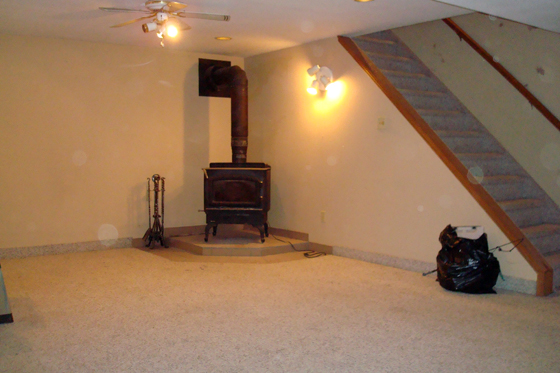
The original lighting in the basement.
We decided to keep just the pot lights, so Matt took apart the ceiling fan, and my Dad pulled out one of the wall-mounted ceiling fixtures while I dealt with the other one. We removed the boxes and wires running to each of the lights as well as the switches that controlled the ceiling fan and the pot lights. Then we reconnected the pot lights into the switch that originally controlled the ceiling fixtures.
Everything was working well, but we felt we needed a little more light, so we decided to add an extra pot light in the middle of the ceiling.
Apologies for the quality of the following photos. So many circuits are off in the basement due to the electrical work that we don’t have very many lights. We have construction lights set up, but they’re a little harsh. I played around with some new actions in Photoshop, but I can’t tell whether they made things better or worse.
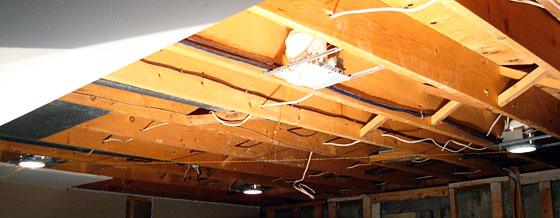
Our original four pot lights
Electrical work can be intimidating, but installing a pot light is a very straight forward job that can be completed in about a half an hour, even by those of us that are not licensed electricians. We did have a lot of other issues with the electrical in the basement, and for those we hired a professional electrician.
Here’s my pot light installation method, complete with lots of photos (of varying quality). Note that in the tutorial I’ve assumed that the wire that is going to be feeding your new pot light is already in place.
1) Turn off the electricity to your light. In this house, none of the circuits are labelled, so our usual method of finding the right one is to turn on the light (or plug something in) and have one of us watch it while the other person flips the breakers until we find the right one. Then we label it!
2) Determine where you want your new light. I used the oh so scientific method of tying a piece of twine to each of the existing pot lights. Where it crossed was the centre.

3) Now onto your light.
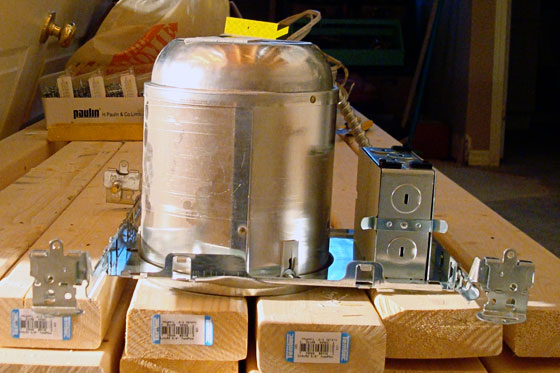
Some pot lights can be installed in a finished (drywalled) ceiling. However, this type of pot light has to be installed where the ceiling is open.
4) Pop the cover off the wiring box to reveal the wires.

Cover on (left). Cover off (right). I also cut off the push-in connectors because I’m used to twisting the wires together instead.
5) Now attach the pot light to the joist. For my light, this meant adjusting the brackets, or bar hangers, so that they were the right length to span between the joists and then nailing the bracket into the joist.

For reference, holding the light in place while taking a picture is not the easiest. A third hand, or better yet a second pair, would be helpful.
6) Take a break because your husband has arrived home, and he brought dinner.
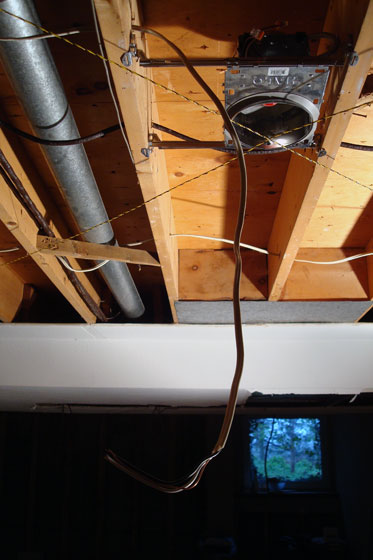
Pot light housing installed. Time for dinner.
7) If necessary, trim your feed wire to the required length and strip back the casing to reveal the individual wires. The easiest way to do this is to use your side cutters to snip a little split in the casing, just enough so that you can access the ground wire (the copper one). Grab the ground wire with your pliers and pull to rip the casing. You want to remove the casing for about 6 inches so that you can access the black, white and copper wire. Once your casing is ripped back far enough, clip it off with your side cutters. Strip about a 1/2 inch or so of the plastic coating off of the tips of the black and the white wires. I usually do this with a knife, as though I’m peeling a vegetable.

Remove the casing from the wires by pulling on the ground wire. For reference, the ground wire is pointing up to the right, the black and white wires are pointing down to the left and the empty casing is pointing down in the centre.
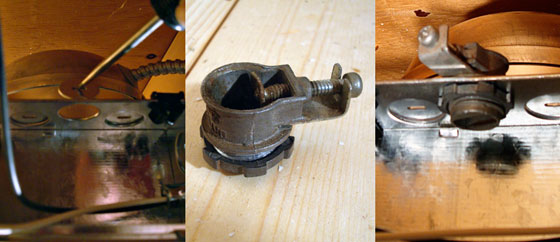
8) Knock out one of the round metal covers (coincidentally called knock-outs) on the pot light housing. I used my awl to bend it up and then wiggled it back and forth until it snapped out. The wire isn’t supposed to float loose in the hole, but the pot light didn’t come with any clamps or conduit, so I pulled one off of an old electrical box and put it in the hole.

From left to right, removing the knock-out, the clamp that will hold the wire in place and the clamp installed.
9) Insert your feed wire into the pot light and clamp it in place.
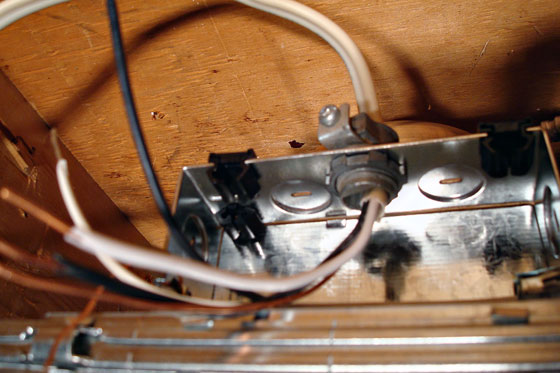
Sorry for the slightly blurry photo. The plastic casing should be just inside the pot light housing.
10) Connect your feed wire to the wire in the pot light: black to black, white to white, ground to ground. Twist them together with your pliers and cap them with marretts.

You don’t have to get fancy with different coloured marretts. These are simply the two I had on hand that fit the wires properly.
11) Once everything is securely connected, tuck your wires back into the housing, put in a light bulb and flip the circuit back on to test your light.

It works!
12) Put the cover back over the wiring area. Make sure the light is positioned where you want it on the hanger bars. There’s a screw that you tighten into the bar to lock the light in place. Stand back and admire your handiwork.

Let there be light!
The five pot lights look great, and throw a sufficient amount of light. I initially thought we might need some wall sconces or extra lamps, but I think the pot lights will work well for us.
Oh and you might want to take down your measuring twine, unless you really like it as a decorative element.
ETA: The final, final step in installing pot lights is installing the trim, which I did after our ceiling was drywalled. I’ve posted my instructions of how to install pot light trim.







 Home on 129 Acres