How I make our annual family photobooks

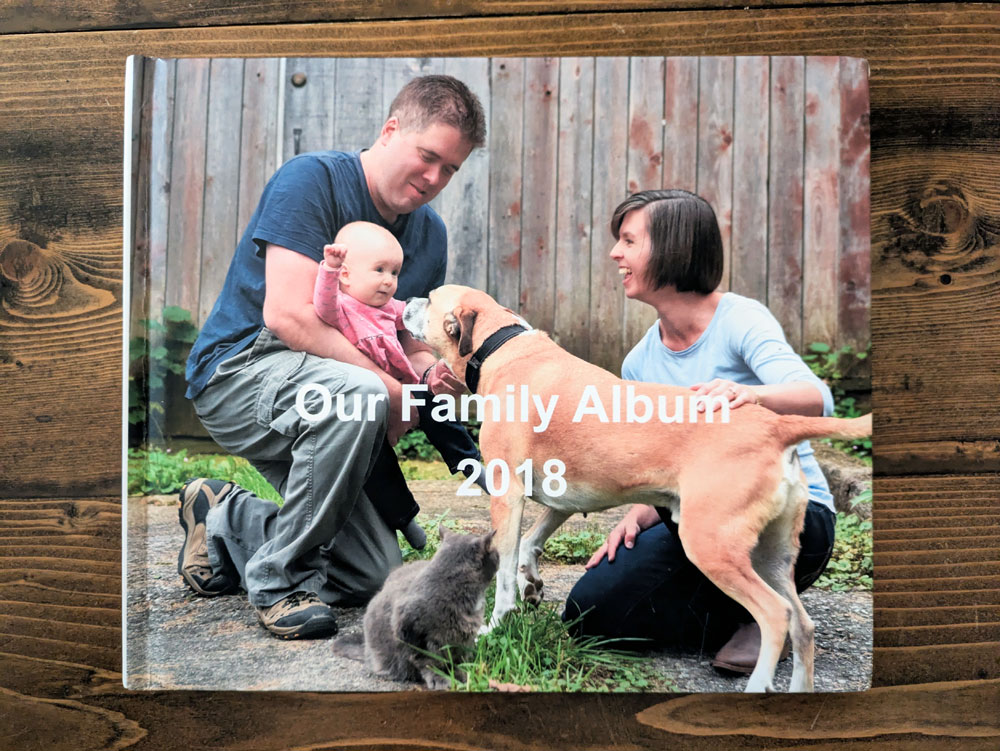
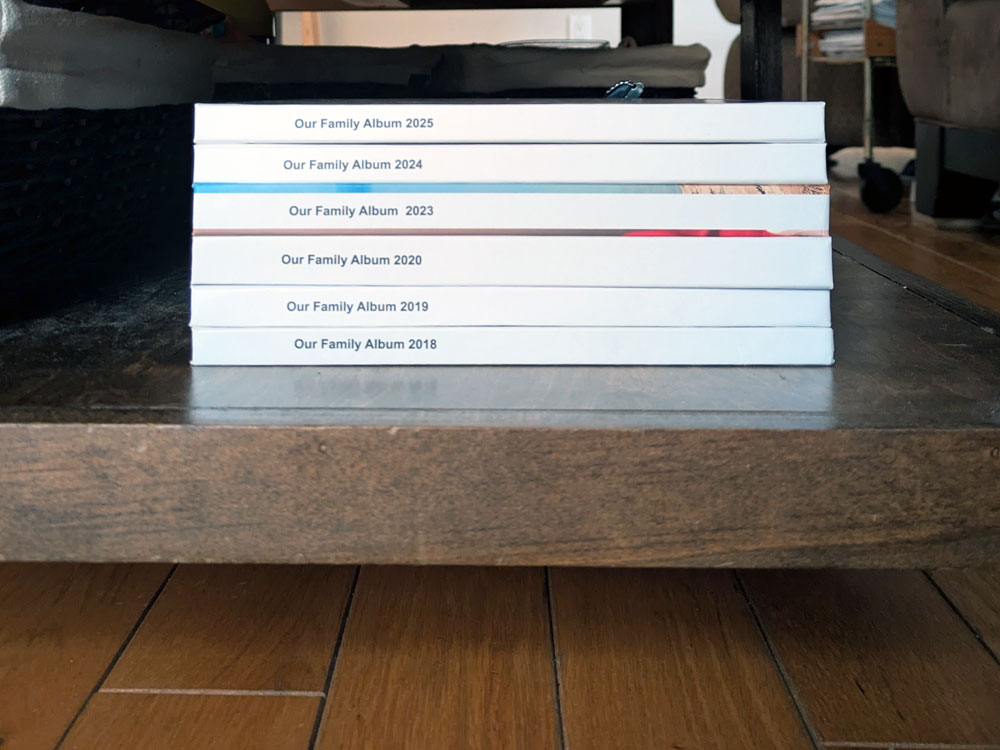
On the shelf under our coffee table, we have a stack of books. These are our annual photo books, and they are one of our most special heirlooms.

Photo books are such a good way to record special moments in your life. Ellie and I both frequently flip through them and reflect on the things we did.

I love our tradition of documenting each year in a book, and I have a lot of fun putting these together. I thought, with the holidays approaching, now might be a good time to share my tips of how I create our family photo books.

I also asked my friend Laurie the share her advice. There are so many different ways to make photo books. I wanted to show just some of the options that are available.
What program do you use?

There are lots of programs available to make photo books. Laurie uses Blacks, a Canadian company. I’ve used Blurb for all of my books.

Some things to think about might include cover options (hard or soft cover), book dimensions, page limits (minimum and maximum), paper quality, cost. It really depends on what is most important to you.

With Blurb, I get a hard cover book that can go up to 440 pages. My books have ranged from 90-156 pages.

Most programs have lots of built in layouts, and I’ve figured out which ones work best for me. I’ve also found it easy to build my own layouts when I need them. One feature I always use in Blurb is automatic image enhancing. It makes my pictures more vibrant, which I like.

I will say I’m definitely faster and better at using the software now than I was on my first book. There is a bit of a learning curve to figure out how to move photos around or manipulate layouts, but it’s really not complicated.

I found out about Blurb from Young House Love who have a very detailed post about using Blurb.

No matter what program you use, Laurie has some important advice. Save often. Photo books are a lot of work. You don’t want to lose all of your progress if your computer crashes or the software has a problem.
How do you choose photos?

I take lots of photos. Every day activities, special occasions, funny moments–they all live on my phone. I’ve learned over eight years of building books that I need to organize my photos as I go. Each day I go through the images I’ve taken and delete any that aren’t keepers. This daily cull means much less sorting when it’s photo book time. My phone is set to automatically back all my pictures up to Google photos. I also save any photos people send me to Google. When I want to begin my book, I know I need to look in just one place to find all the pictures I want.

Laurie is also a prolific photographer, usually taking around 700 pictures a year. She uploads all of her photos to her computer organizes them in folders by date. She then goes through one day at a time and picks her favourites, which go into a new folder titled ‘photo book’ and the year.

“Once I have the entire year’s worth of pictures I want to keep in one folder, I go through and delete the ones that are not as good and that are redundant. Going through the slideshow in order helps me cull more,” she says.

Sometimes I come across an HEIC photo. This is a format some iPhones use, but it’s not compatible with many programs, including Blurb. I tried some online converters, but there were limits on how many photos I could convert, and I wasn’t confident in their security. I found HEIC to JPG Real Converter, a free download that I could install on my computer. It’s easy to use, unlimited (at least I’ve never found a limit) and preserves good image quality.

The biggest thing with my photobooks is everything goes in–the good, the bad, the ugly. Matt when he was sick? In there. Visiting Matt’s Mom in the hospital? In there. Ellie’s x-ray when she broke her arm? In there. Life is made up of good and bad, and our photo books are a record of it all.
How do you start a photo book?

A photo book can feel daunting when you’re first faced with a blank pages and hundreds of photos. I take it a month at a time. I will pull up all the photos I took in January, pick the ones I want for the book (usually this ends up being around 50 photos), download them all and then start to put them into the book. Doing one month at a time makes the process much easier for me.

Laurie uploads the whole year of photos at once. She says, “Then I can open it and work on it whenever I feel like it.”

To start, Laurie looks at her first 6 photos. “I may have 3 tall photos and 3 wide, so I choose a layout to fit them. I like being able to adjust my layout to best fit my pictures.”
How do you lay out a photo book?

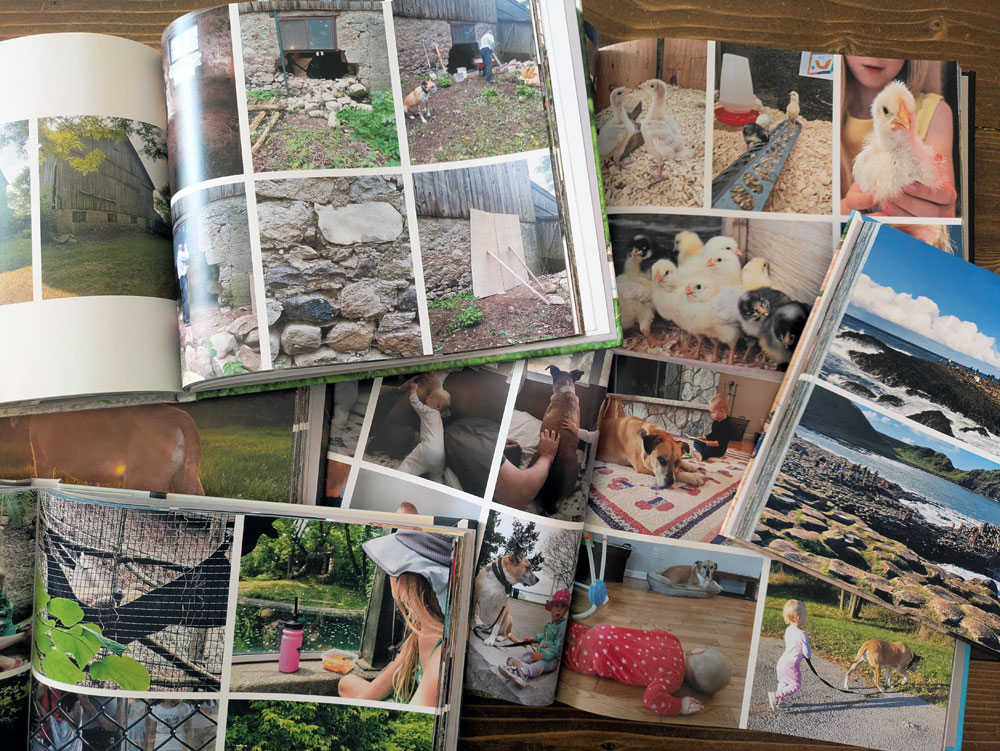
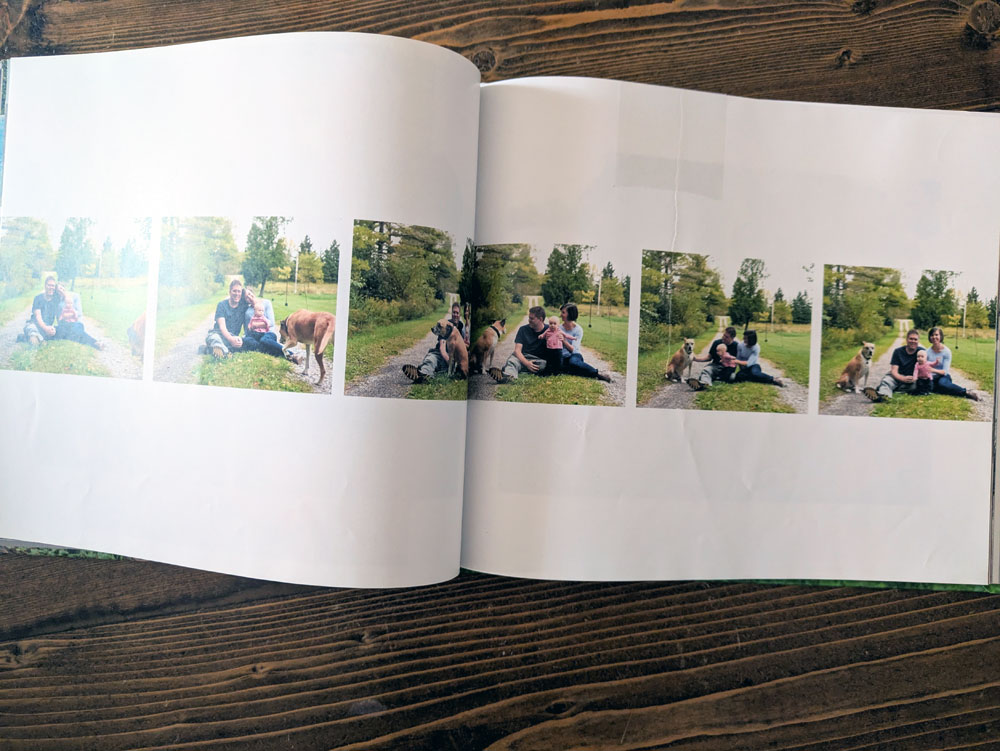
I always start with the pre-made layouts available in Blurb. Mostly I choose 4 or 6 picture grids with a white border between the photos. These layouts allow me to fit a lot of photos in not too much space. Occasionally I’ll use different layouts, like a full page for special photographs. A consistent layout makes the book easier to build and also easier to read. Our brains like patterns.

I don’t use backgrounds or graphics. I like a pretty clean look.

Laurie aims to fit 6 to 9 pictures on a page. She uses dark coloured backgrounds on all of her pages alternating between 5 or 6 solid colors. She does the background last to ensure the colour complements the photos on that particular page. Facing pages have matching colors and she avoids using the same color on more than 2 pages in a row. For special holidays she’ll occasionally use a themed backgrounds like candy canes or pumpkins.

I organize the photos in roughly chronological order. Sometimes to make a layout work, I may shuffle photos around a bit. For example, since I wanted everything Halloween–pumpkin, costume, trick or treating, candy sorting–on one spread, Thanksgiving and Ellie’s cross country race ended up together, even though they didn’t happen at the same time.

Laurie likes to keep pictures in a sequential order but may organize a day or two in reverse order to make photos fit. She keeps seasons together. For example, all the Christmas pictures have their own pages.

Laurie also pays close attention to the photos themselves. She arranges pictures so that faces and bodies are pointed in towards the centre of the book to keep the eyes from wandering off the edges of the page. She says, “I like balance on my pages. And symmetry. I’m not sure how to explain this!” Mostly, it comes down to what works best for your eye.

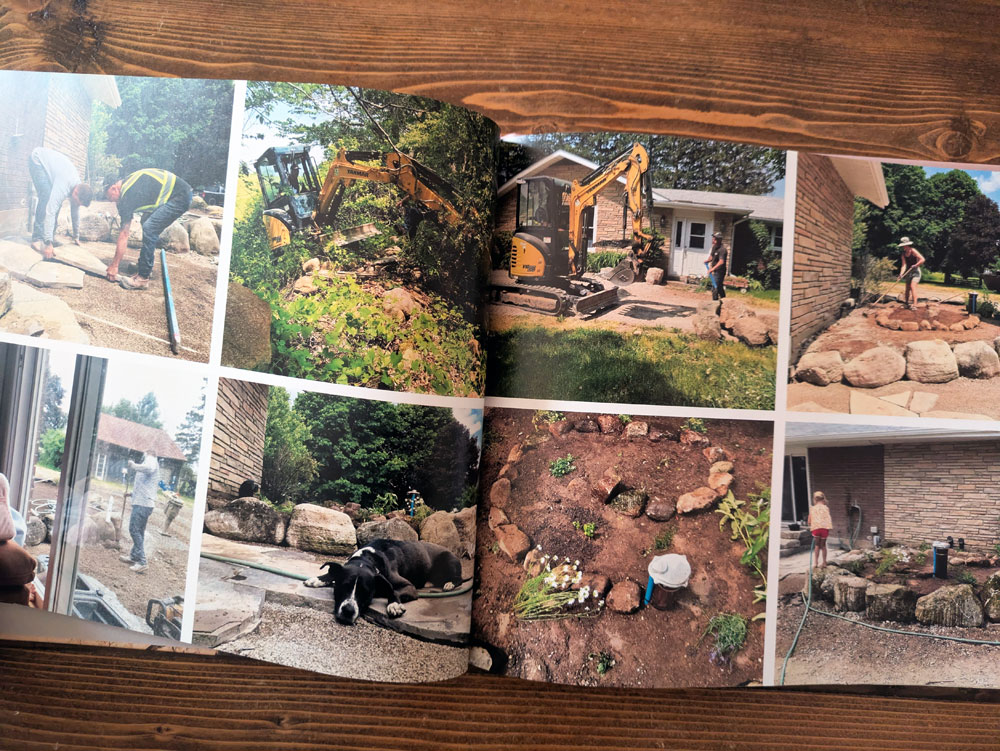
Another way I organize my layouts is to put “projects” in their own sections. For example, the vegetable garden is 12 pages all together in the middle of the book. Those pages include spring planting, summer harvesting and fall clean-up. I would rather have everything garden all together, as opposed to having it broken up across all the seasons. I also use this for renovation projects.

Over eight years of building photobooks, I’ve developed a consistent style that I use year to year, and Laurie has done the same. She puts a family picture on the front and a picture of her two boys on the back. The last page is for a repeat of one or two favorite pictures of the year.

For me, every book starts with a title page that is the same as the cover–usually our best family photo. Then I have a grid of 9 photos of favourite moments from the year (these photos are usually repeated in their appropriate section in the book). The next page is split between another family photo on one half and a list of highlights on the other. Then the book starts.

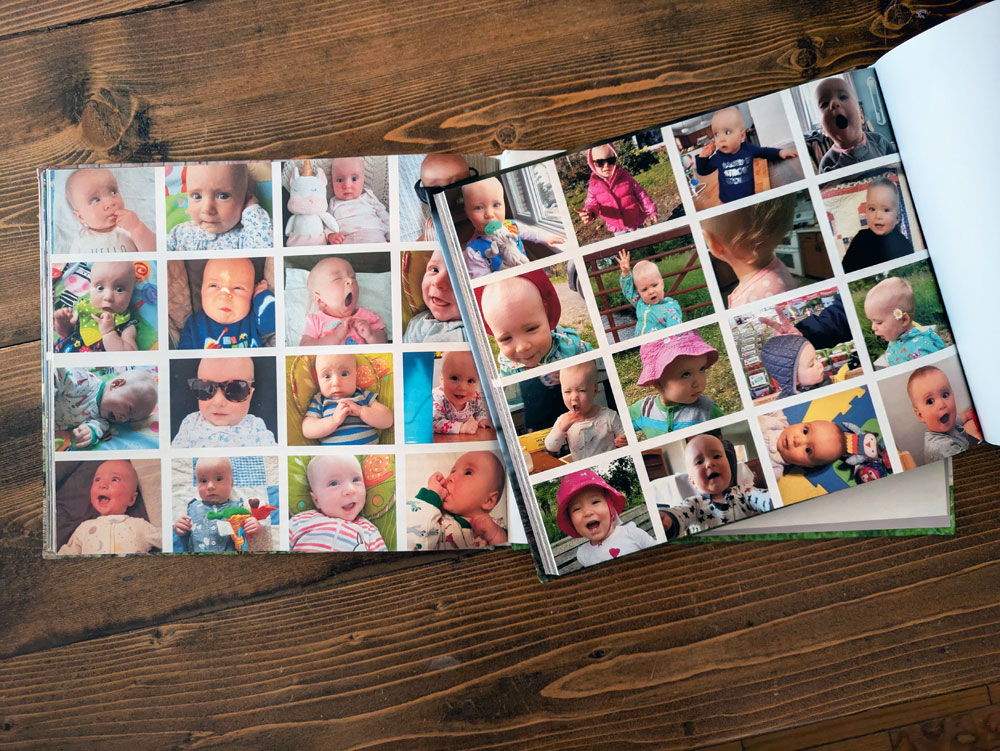
The very last page of the book is a grid of 16 funny Ellie faces. The back cover is usually another family photo, or something significant that has happened that year. For example when Matt’s Mom died, I put a beautiful photo of her and Ellie on the back cover.
What do you write in a photo book?

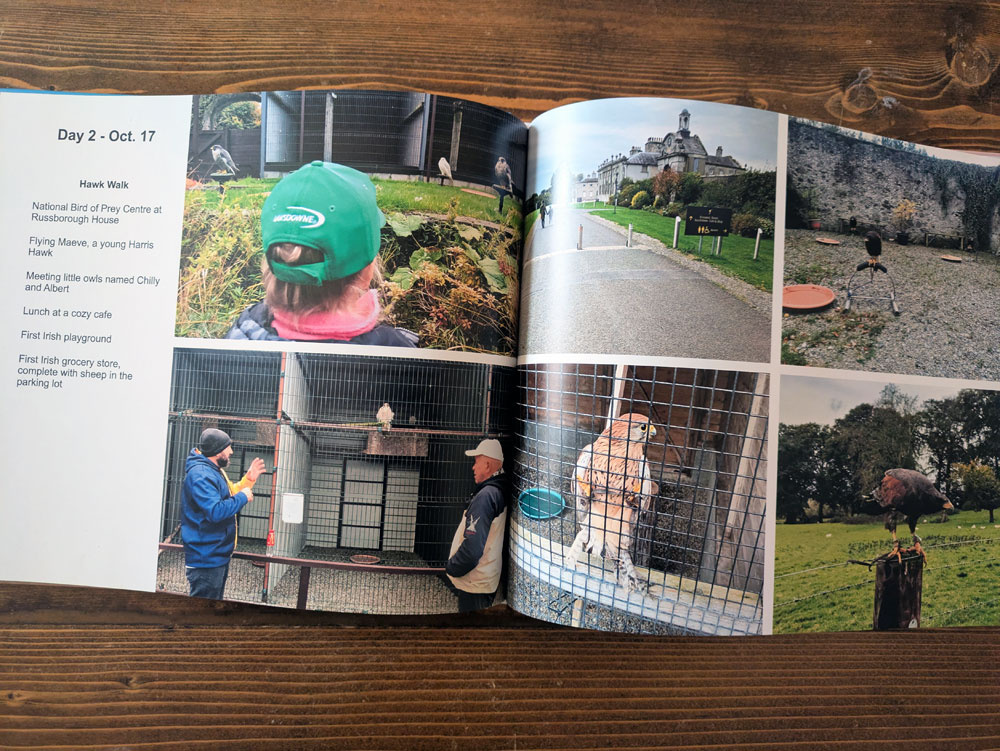
I don’t use a lot of text or captions in my books. I write a list of highlights at the start of the book to summarize key things that happened in the year. Occasionally, I’ll put in a write up for something important. For example, I have my Dad’s and Matt’s Mom’s obituaries, a log of what we did on our trip to Ireland, an explanation of Covid-19, and all the tributes we received for Matt in their respective books.

I realize that we may forget some of the people, places or activities over the years. I’m okay with that. I prefer the look of just photos and it’s a lot simpler to build the book without text.

On the other hand, Laurie notes the date on most of her photos. Occasionally she’ll include the setting or the names of people who are not usually in the book. She admits her captions have gotten simpler over the years. Figure out what is most important to you.
How long does it take to make a photo book?

A photo book usually takes me about a month. I like to lay out one month worth of photos a night. I use the rest of the time to add special sections or write-ups, track down missing photos or high resolution versions of photos I saved from texts, tweak the layout, check that there are no mistakes.

Laurie usually spends a few months on a book. “I just go at it while watching TV or just when I’m in the mood. I may sit down one day and only do one page, while the next day I may sit down and spend hours.”

For the past couple of years, I’ve been catching up on a few photo books that I missed. For these books, a dedicated month has worked well. I usually aim to finish the books in time to give them to Ellie for Christmas (it’s one of her favourite gifts).

This year, I’ve been building my 2026 book as we go. I started in the summer when I had half a year of photos. Since then, once we reach the end of each month, I put those photos into the book. I think I like building the book as I go, rather than doing it all at once. It feels like much less work to break it up.

My photo book schedule usually relates to gift giving and sales (more on this below). If I finish a book in November, I can print it during Black Friday sales and give it to Ellie for Christmas. If my book is almost done by New Year’s, I’ll finish it the first week of January, take advantage of another sale and give it to Ellie for her birthday.

How much does a photo book cost?

The price of your book depends on the company you use and the features you choose. Size, cover and page count all affect the price.

My last three photo books have had 120-150 pages and have cost about $95 each. This includes tax and shipping… and a discount code. Laurie’s books end up being about $200 before taxes, shipping or a discount. (She always uses the maximum number of pages.)

Most sites run promotions several times a year. If you’re able to finish your book and wait for a sale, it can make a big difference. Last week, Blurb was offering 30% off. Laurie usually waits for 40% from Blacks.

Blurb recommends printing a sample book as a proof. But they don’t offer proof copies and the sample is the same as a regular book, and the same price too.

I have had mistakes in my books–the cover photos on 2023 wrap onto the spine slightly, which none of the other books do, one photo in 2019 was wrong, the font in 2023 turned out bigger than I expected (2023 was a weird year). None of the mistakes are tragic and I can happily live with our imperfect books. But if perfection is important to you, you might want to budget for a proof copy if needed.

Final thoughts

For me, photo books have been a great way to chronicle our years. So much happens. I don’t want to forget. Pulling a book out of the stack and flipping through it with Ellie is special.

I’ve also used photo books as gifts. Many years ago I made books of our wedding for my two grandmothers. I also gave Matt’s Dad a book of our Ireland trip.

Whether you do a whole year, an occasion, or a person, photo books are a special heirloom.
Have you ever made a photo book? How do you store and share your pictures? Does anyone make traditional photo albums?

In case of my death

One of my goals for this year is to prepare for the worst. An item that’s been on my list for a long time is to make copies of all my important documents.

Reading about fires and floods, documentation is always something that people discuss. As well, having been through Matt’s death, I know exactly how much paperwork is involved and how helpful it is for my executor to have it all in one place.

I know why I should do this. But it’s overwhelming to think about getting it all together.

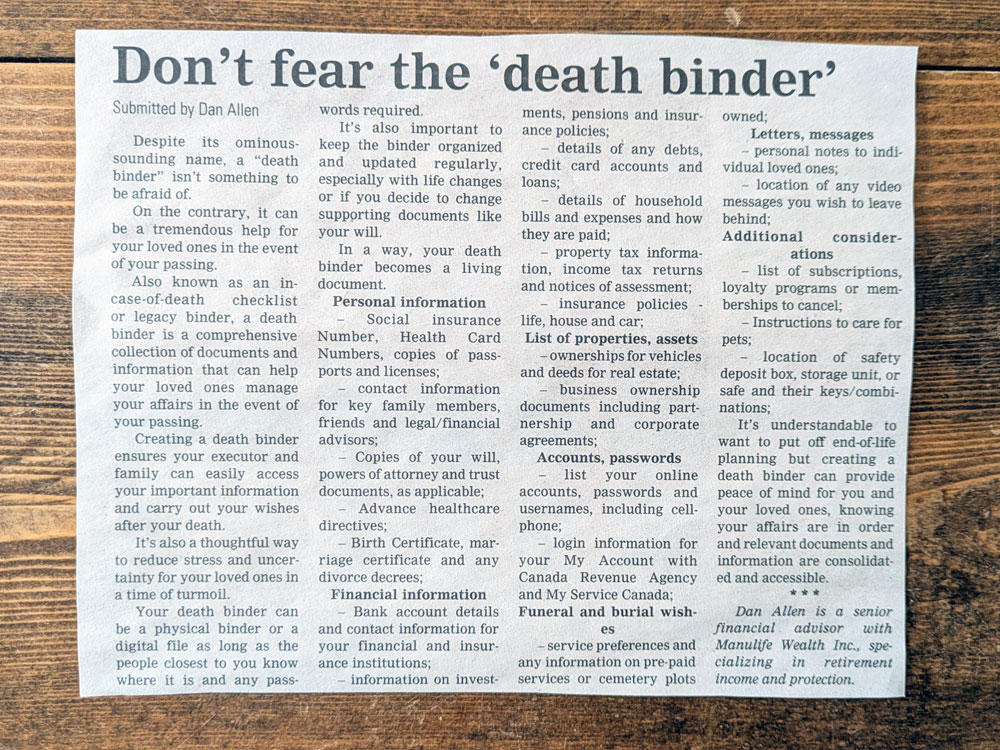
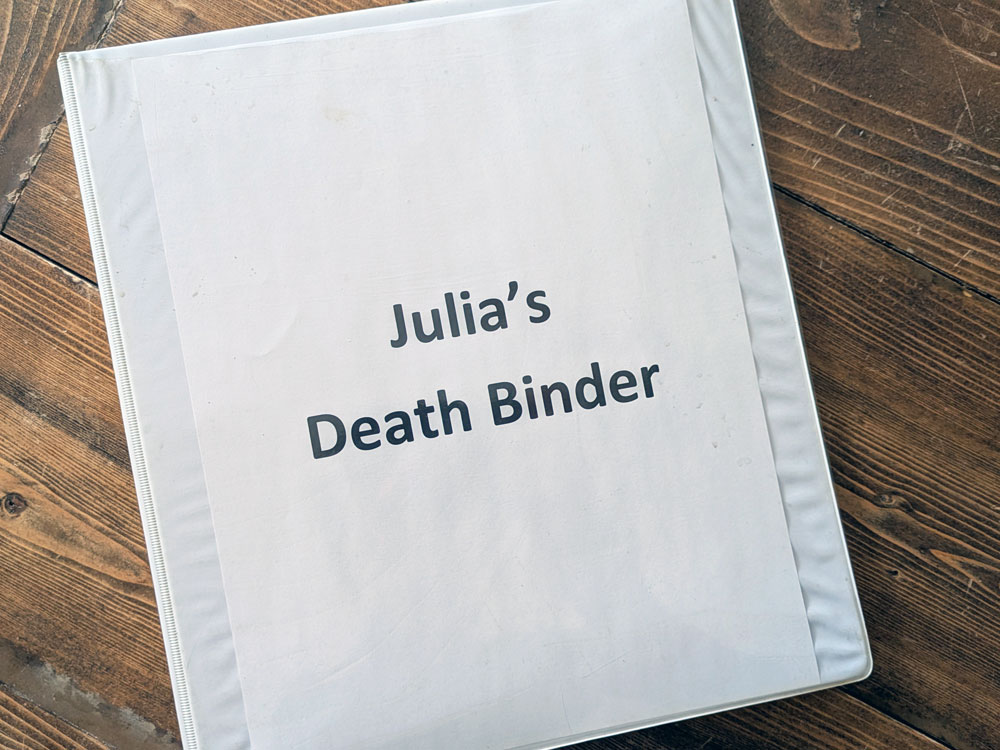
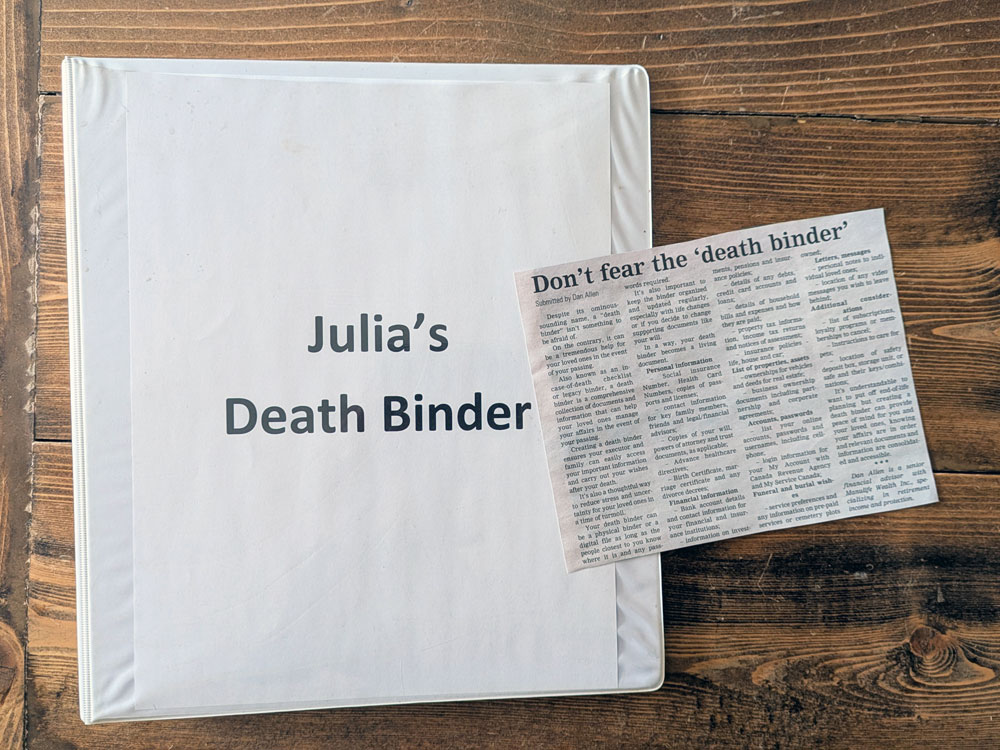
Then last year, I saw an article about a “death binder” in our community paper. The author wrote, “a death binder is a comprehensive collection of documents and information that can help your loved ones manage your affairs in the event of your passing.”

He listed all of the items a death binder should include: personal and financial information like your social insurance number and bank account details, as well as important contacts, passwords, pet care instructions, messages for loved ones and more.

It was a clear, simple list. It felt doable.

Even better, it was divided into seven different sections. So I came up with the plan of doing one section a month. I also invited my Mom to do it with me.

January was for personal information. February was financial. In March we did properties and assets. Now we’re working on accounts and passwords. May will be funeral and burial wishes, June letters and messages, July any other considerations.

I’m making hard copies as well as digital copies of everything. I’ll keep one set for myself and give another to my executor.

Working through it piece by piece feels manageable, and I’m glad to finally be making progress on this important task.

Does anyone else have a death binder? What information do you think is most important to pass on?

Lessons in remembrance

At 11 o’clock today, Remembrance Day, I will be standing in front of my students. Most of them are in their twenties. Few were born before 2000.

I will ask them about their relationship to Remembrance Day. I will tell them about my grandfather and the significance Remembrance Day has for me.

I will ask them to give a minute for reflection.

As we move farther from the world wars and the veterans who fought, I feel like the lessons of those wars are diluted. For many of us, war is something we see on our screens. It’s not something that happens to us. Yet we know there is trauma, violence and injustice happening right this moment in the world. Some of it very close to home.

Whether we are able to remember or not, Remembrance Day is a moment for reflection. Nov. 11 is not just for respect and recognition of those who have fought and died. It is for remembering the lessons they have taught us, so that we can do our part to create a world of peace, respect, care.

This is the lesson I am trying to share with my students today.

Lest we forget

Lest we forget. Rudyard Kipling wrote these words in 1897. Today, 126 years later, I feel like we’ve forgotten.

I do not remember the First World War, when “lest we forget” first began to be associated with what was then known as Armistice Day. I do not remember the Second World War, when my grandfather left his family in Canada and fought in Italy and Holland. I don’t remember Vietnam or Korea.

My memories of war are the Persian Gulf, Bosnia, Afghanistan, Iraq, Sudan, Congo, Ukraine, Israel, Palestine. Conflicts that I’ve seen on TV, the news, movies, and social media, while I am safe here in Canada.

My experience of war is distant. But the lessons of “lest we forget” are close.

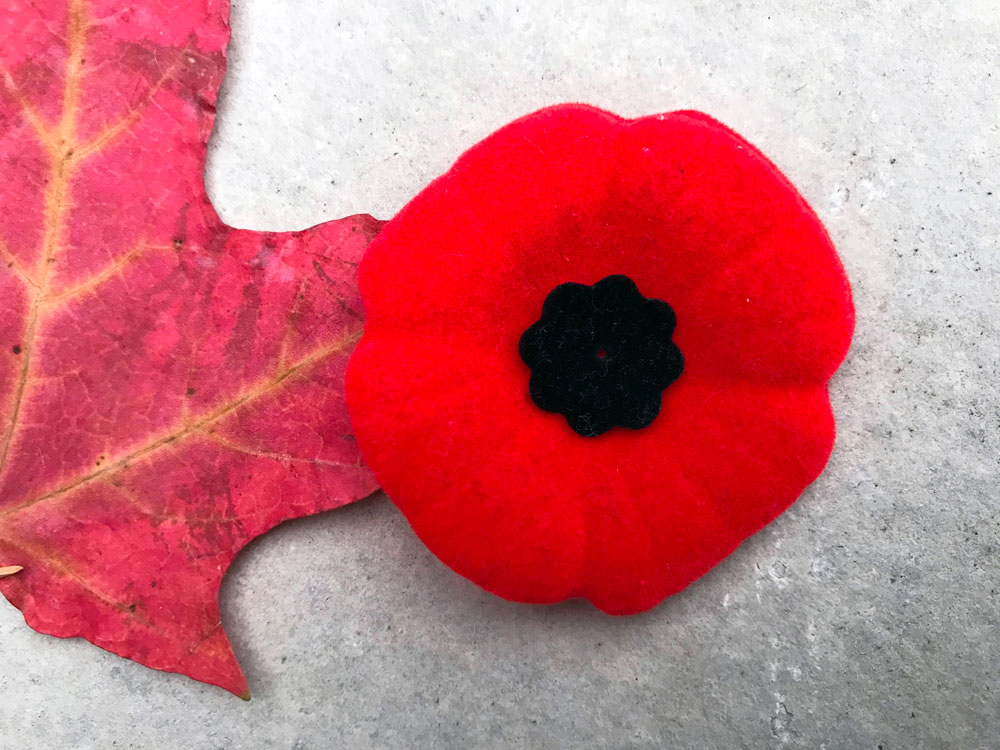
I saw my grandfather stand at Remembrance Day services every Nov. 11 with medals pinned to his chest. I wore a poppy, read In Flanders Fields, learned about the Holocaust and listened to The Last Post.

The lesson was always never again. These terrible things must never happen again. We must learn, so that we remember, so that we do not repeat.

I learned the lessons of lest we forget, and then I have watched conflict after conflict, genocide after genocide happen again and again. We have forgotten.

In some ways, it’s easy to forget. I feel safe. Israel, Palestine, the Ukraine, Sudan are all far away. My family doesn’t live there. What happens there doesn’t affect me. Why should I care?

I recently heard Malcolm Gladwell paraphrase author James Keenan to say, “Sin is the failure to bother to care.” If we stand by and do nothing when we could help, we are in the wrong.

The lesson of lest we forget is that I am part of the world, and it is my responsibility—everyone’s responsibility—to care for and protect each other.

Remembrance isn’t just about the past. It is about the present and the future. How we behave now, tomorrow and the day after that.

Lest we forget.

Odds & sods

Last week, Ellie and I came home after 10 days in Ireland. We were there for Matt’s niece’s wedding.

When the invitation first came through I dismissed it immediately. Then I started to think. Why couldn’t we go to Ireland?

Matt’s parents and I talked, and we decided to go together. When Matt’s Mom was dying, she wanted to make sure that Ellie and I would still go on the trip. After she died, Matt’s Dad wasn’t going to go but then he decided to. So the three of us went off to Ireland.

Two summers ago (shortly after the wedding invitation first arrived), I adopted a philosophy of say yes. If something was happening or we were invited to do something, I was going to say yes and figure it out. This pushed me out of my comfort zone a bit but it opened us up to so many amazing experiences. Ireland was part of that.

Ellie, Matt’s Dad and I had 10 days to travel around, see new things, share some incredible experiences and be together in a different way. It was a special trip that I will not forget. I’m grateful to Matt’s Dad for making this trip happen, and I’m grateful that I said yes when the opportunity came along.

Here are some Ireland links for this month.

Our trip started with a hawk walk at the National Bird of Prey Centre. An amazing experience to learn about birds of prey, see them up close and have a hawk fly to our hands.

We spent the night in a castle!

Watching a little dog herd sheep with the Atlantic Ocean in front of us and Benbulbin mountain behind us was a unique morning.

Derry was a surprise. When I was planning our route it was simply a place to sleep and break up a long drive. We had an amazing afternoon walking the ancient wall all around the old city. An incredible journey into history.

The Titanic museum in Belfast was another incredible journey. Belfast’s evolution, the construction of the ship, the sinking, the wreckage discovery were all presented in a way that truly took us on a journey and created so many emotions.

Helpful tips for traveling with kids. Plus, our favourite book to prepare for the plane.

We’re settling back into our regular routine this week, though with a little celebration for Hallowe’en. More opportunities for fun, love and joy.

What do you do that takes you out of your comfort zone? Have you ever been to Ireland? Any tips for travelling with kids? Are you celebrating Hallowe’en?

Memorial garden

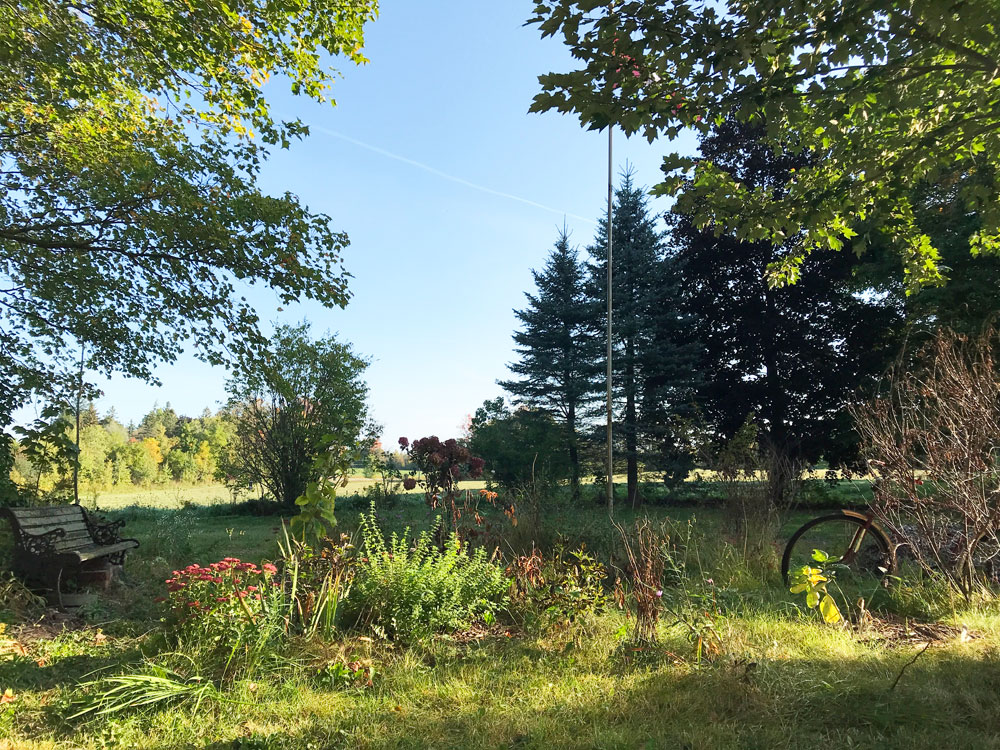
Expanding the turnaround garden was one of my goals for 2023. When I started working on the turnaround 10 years ago, my plan was to have a whole circle filled with lush plantings.

We put up the flagpole and a brick pathway (that I envisioned someday overhanging with greenery and flowers). Then I filled half of the circle and realized that the turnaround was so large that it basically swallowed up every plant I put there. So one half became a flower garden (which has filled in decently, though some of the gaps are filled with weeds). The other half we mowed.

Then this spring’s patio project came along. The garden around the well was going to be torn out and reconfigured. So almost exactly a year ago, Ellie and I quickly moved a bunch of plants from the well garden to the unplanted half of the turnaround.

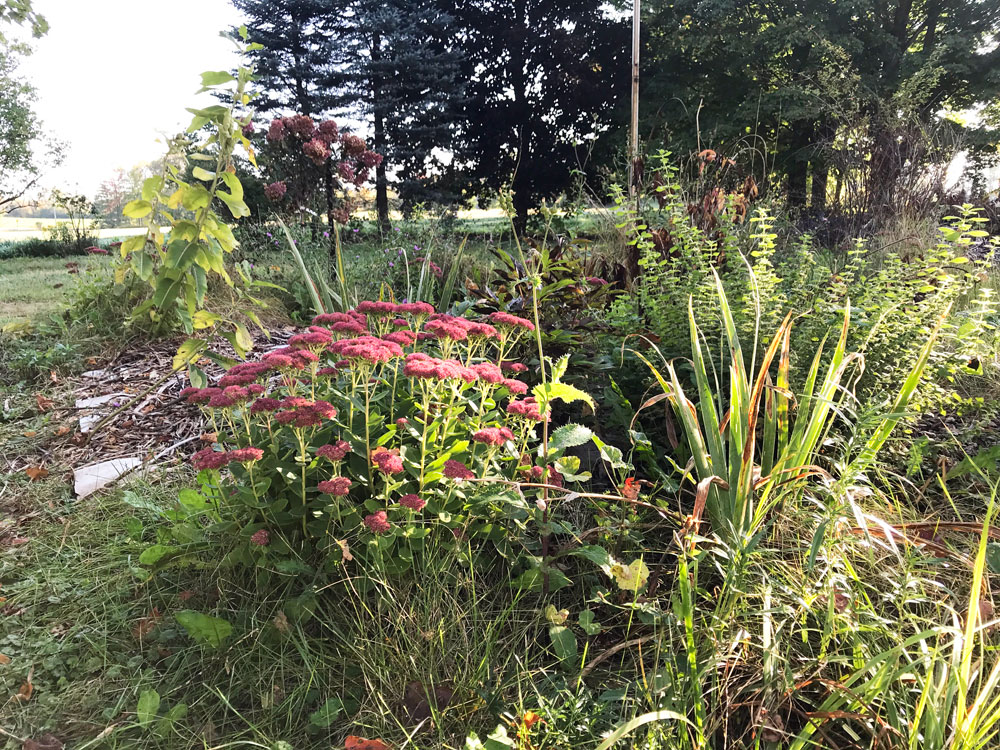
We still have a long way to go with this garden. The turnaround is still big and still eats plants. Our transplanting has been very hasty, so we dig holes wherever and don’t pull up the sod in any methodical or expansive way. But, most of the plants we moved survived, and we’ve since added a few more. It feels like a garden is starting to come together.

We’ve spread some mulch and made a little stepping stone path to the flagpole.

We also added two things this year which changed the significance of this garden.

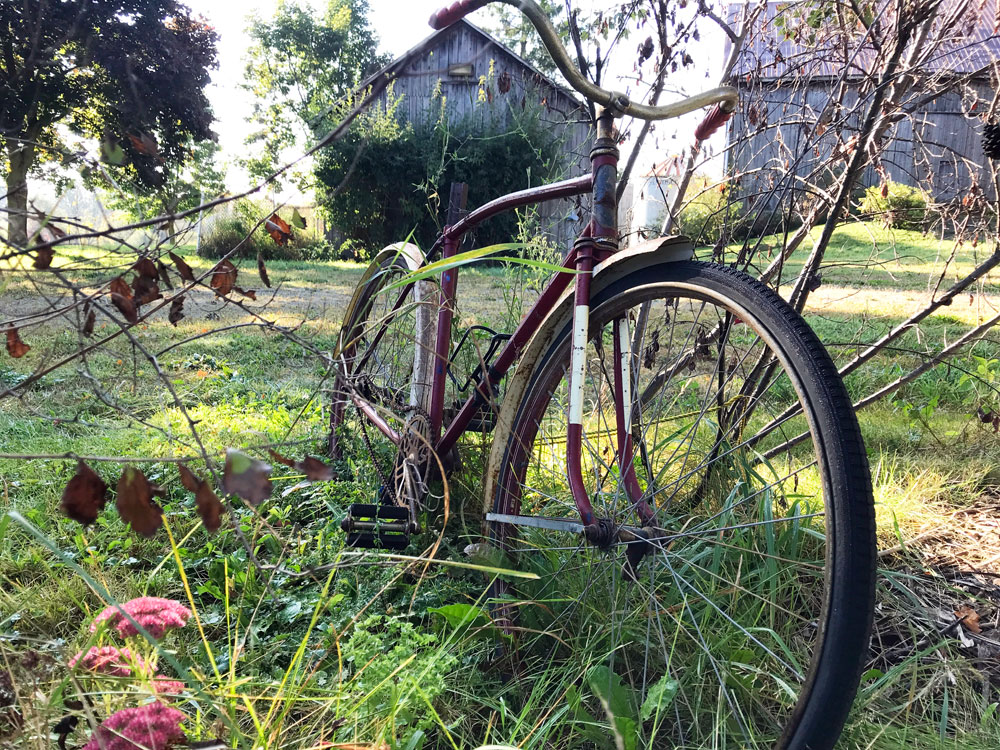
The first is my Dad’s bike. This is an old bike with no gears, no handbrakes. I remember my Dad riding it (often with one of my siblings in the baby chair behind his seat) when we’d go for family bike rides. It’s rustic, like the farm, and makes a nice sculpture in the garden–and is a happy reminder of my Dad.

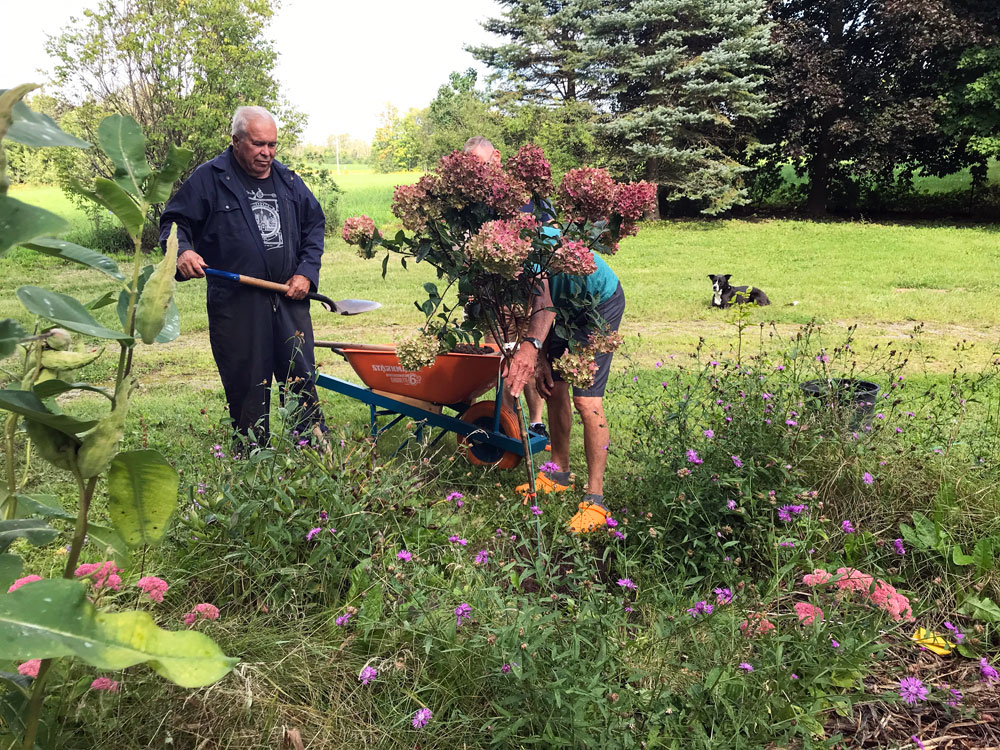
The second addition is a memorial tree for Matt’s Mom. Matt’s Dad’s friends wanted to plant a tree in her honour, and Matt’s Dad decided he wanted it to be at the farm. (His friends also planted a tree here for Matt.) So a few weeks ago they brought a strawberry hydrangea tree and added it to the turnaround.

It’s special to me to have these reminders of my Dad and Matt’s Mom, two people who are so precious to us.

The garden is a memorial in another way. Ralph is buried beside the flagpole. I like that they are all together here at the heart of the farm.

Do you have any memorials at your house? Do you have any in-progress gardens?

Another hole in our lives

Two years ago, Matt’s brother organized a family getaway to Manitoulin Island at the end of May. We had a great time together, so this year he did it again. This time we went to Killarney in Northern Ontario. It was another wonderful experience. During that weekend, Matt’s Mom told us that when she returned home, she had an appointment for a CT scan to try to find the source of some back pain she’d been having for a while.

That scan led to scary doctor appointments, treatments, a couple of stays in the hospital, and, then last month, Matt’s Mom died.

Another hole in our lives.

I often say that Matt’s parents and I work hard at our relationship, but that it’s not hard. We prioritize each other and make sure we connect, through big things like weekends away and little things like emails about how our day went. We do it for Ellie and for Matt, and also for each other. We love and appreciate each other.

Every Monday, Ellie and I go to Matt’s parents’ house for lunch. It was a rare week when Matt’s Mom wouldn’t have a new shirt or hat or outfit for Ellie. She would comb through the children’s section at the library so that she had a stack of books to read with Ellie. She made sure she had food Ellie would like, and we always came home with enough Bear Paws to fill Ellie’s lunch pail for the whole week. And she and I would chat about everything.

Matt’s parents both support us in so many ways. We are different people, but we respect and accept each other. When Matt and I bought our first house, Matt’s Mom showed up on the first day and cleaned our bathrooms. When we bought the farm, she did the same here. I will always remember how when I finished Ellie’s treehouse, Matt’s Mom was so proud to share my blog post on her Facebook page.

When she was in the hospital, we talked about some things that are happening in the fall. She wanted to make sure we would still do what we planned. Right up to her last moment, she was assuring me that I would continue to do a good job with my work, the farm and Ellie.

That unconditional love is for me the epitome of family.

When we were in Killarney in May, Matt’s Mom was in a lot of pain. Yet she walked all over that little town, she went to every breakfast and dinner, she watched her grandchildren play, and she even went out in a canoe with Matt’s Dad. She worked hard, and it was worth it. She soaked up every moment with her family. And we soaked up every moment with her.

Thankful

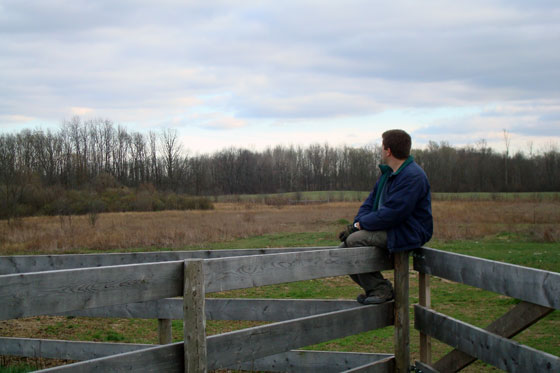
Matt sitting on a fence

“Gratitude turns what we have into enough”

Aesop

We celebrated Thanksgiving this weekend. When I think of what I’m thankful for, my answer is everything.

I can’t write a list like I did in the past because the list wouldn’t stop. I can’t single out one thing because they’re all magical.

We live each day with so much love and joy. And I try to make it enough.

I’ve been thinking of this Thanksgiving post all week. Trying to figure out what to write. When I found this quote it summed up what I felt. It was enough.

But tonight. Late at night. As I tap away on my phone (not my preferred way to write), my thoughts are different.

I am still filled with love and joy. Always.

But when I think about what comes after Thanksgiving three years ago this becomes a very hard time of year. I slide back easily and remember what each day was and what we were marching toward.

One giant, terrible hole. That is still with us. All the time. I am not grateful for the hole.

What I have of Matt is not enough.

So I live with the hole. I live with the love. I live with the joy. I am thankful. And I work to make it enough.

Harry’s tree

Two years ago, I met a woman whose grandparents had owned the farm in the early 1900s. Her name is Lorraine. Since then, Lorraine and I have stayed in touch, and she has visited the farm several times. Last fall, Lorraine arranged to have a tree planted in memory of man who worked on the farm with her father. I wrote an article about this for our community newsletter, and I’m sharing it here today.

In 1936, Harry Halworth came to Puslinch. He was 16 years old. At home in England, there were no jobs, so he signed up with a government program that brought young people to Canada to work on farms.

Harry’s experience in Puslinch forged a deep connection to Canada. This connection was commemorated in the fall with a special tree planting. Lorraine Stewart, the daughter of one of the farmers Harry worked for, arranged for a maple tree to be planted on her parents’ former farm.

“That tree is really like a memorial to Harry’s love for this country,” Lorraine explains.

A case of appendicitis brought Harry to the Stewart farm. The farmer Harry was working for could not pay Harry’s medical bills, and Harry was abandoned in the Galt hospital. Lorraine’s father, Allan Stewart, stepped in and Harry then came to work for the family.

Harry worked for the Stewarts and other farms in the community for three years. Then he decided to go home and bring his fiancée, Vina, to Canada.

Unfortunately, the year was 1939. When war broke out, Harry enlisted in the British Navy. He spent the next five years in submarines. When the war concluded, Harry stayed in England and went to work in the coal mines of Mexborough. He and Vina raised five children.

Harry at his home in England

Harry never forgot his time in Canada, though, and in 1962 Allan received a telephone call. The Stewarts had left the farm in 1942 when Allan took a job in Hamilton. But a cousin who lived in Puslinch had seen a notice in the Galt paper. Harry Halworth was inquiring about Allan Stewart and some other people.

“My Dad wrote to him, and Harry ended up coming here,” says Lorraine. Harry and Vina would return to Canada many times for holidays, continuing to visit with Lorraine and her friend Greta after Allan’s death. Harry’s last trip was in 2010 when he was 90. He rode the train to Vancouver, enjoying the view of the Rockies from the glass dome railcar.

Shortly after Harry returned to England, his daughter phoned Lorraine to tell her Harry’s health was failing.

“That’s when I told him I was going to plant a maple tree in the northwest corner of the property,” says Lorraine. “He loved this country. I think he felt so badly that he had missed out in not getting here.”

The tree honours Harry, his work in Puslinch, and his love of Canada. It will be a beautiful legacy for generations to come.

Lorraine (right) and her friend Greta with Harry’s tree

Lorraine came to see Harry’s tree a few weeks ago. The tree is struggling due to the lack of rain, but we’re working to save it. I’m proud to commemorate Harry and also Lorraine with this tree. Living on this farm which has such a history and getting to know some of that history is very special.

Remembering Thanksgiving

Thanksgiving is Matt’s favourite holiday.

Last year, Thanksgiving knocked me sidewise.

I couldn’t remember Matt’s last Thanksgiving. It bugged me so much that I had this big hole of lost time with Matt. That I couldn’t remember him enjoying his favourite holiday. From what I’ve been able to piece together from our families, he was feeling pretty rough and may not have enjoyed it very much.

But what happened after Thanksgiving was too clear.

The day after Thanksgiving, we were at the hospital for an appointment with our oncologist. I hung back after the appointment and he told me that Matt would live for a few more weeks. I said, “Christmas?” He said, “No.”

I remember how it felt to come home to Ellie and hold her as I laid on the floor and sobbed. I remember not telling Matt what the oncologist had said.

From Thanksgiving to November 9 last year, I was living a flashback. I remember how rough Matt felt and I remember how hard we were holding on.

I’m worried that the flashbacks will happen again this year. I’m worried that Thanksgiving will lead to another spiral.

But I’m also choosing to remember before.

Thanksgiving is Matt’s favourite holiday.

There are lots of Thanksgivings before last year and the last one.

He loves the turkey–the bigger the better. He’s particular about his potatoes–and must mash them personally. He and his brothers have their own language when they are together (obscure movie quotes that are meaningless to everyone else).

Ellie and I have been working on finding the joy and the love and the gratitude–as we always do.

We’ve been writing what we’re thankful for on paper leaves and sticking them on our thankful tree. Ellie made a picture at preschool of her and Daddy “when they were turkeys.” I found a fortune laying on the ground behind our car that says, “Someone is looking out for you.”

It is so, so hard that Matt is not here in the way I wish he was. But I am thankful for every way he is with us.

Happy Thanksgiving. Whatever your situation, I hope that you can find happiness today.