Looking for hope and working for change

Child's drawing of poppies

I want to write a message of hope this Remembrance Day. But for the last year, I have watched Israel’s war against Palestine and then last week the American election. It’s hard to find hope.

Self-interest. Power. Capitalism. Racism. They seem to be winning.

Over the past year, I have felt like public opinion has shifted. More people seem to recognize the wrong of Israel’s attacks. But our governments have not changed course. And watching the election last week, nothing has changed. I feel like people voted to maintain the status quo. To maintain their own status. I worry that Canada is on the same path.

No one wants to be inconvenienced.

More than 80 years ago, during World War 2, my grandfather left his family here in Canada. His wife. His three children. His home. He went to Europe and fought a war. His life was deeply affected for people he didn’t know, but for a cause he—and our government—believed in. I think about my grandfather.

I think about Indigenous peoples, Black people, Palestinian people whose lives are impacted everyday by injustice and inequality. I cannot speak for them, but I believe that for some it doesn’t matter who’s in charge. Liberal, PC, NDP, Democrat, Republican, they’re all the same. Perpetuating the same systems and the same injustices.

I think about myself. War, racism, discrimination, inequality, poverty–the evils of our world don’t impact me (so far). I get up in the morning. Get my daughter ready for school and go about my day. What reason do I have to disrupt my comfortable life?

In the aftermath of last week’s election, I have seen messages that we need community. We need to not rely on our governments and instead rely on each other. Not ourselves. Each other. We need to come together and work to change the world. I am feeling that strongly this Remembrance Day.

I think about my grandfather, World War 2 and Remembrance Day. I think about Ellie and her future in a world where people care most about themselves and are not willing to help others, to stop injustice, to change the world. What type of world do I want to be part of? How can I disrupt my comfortable life to help make that world happen?
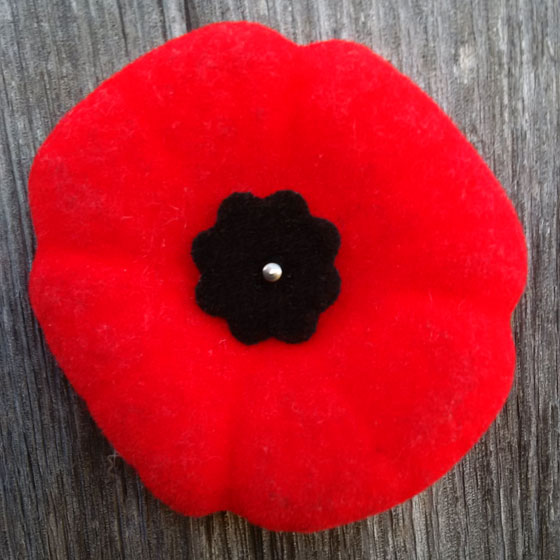
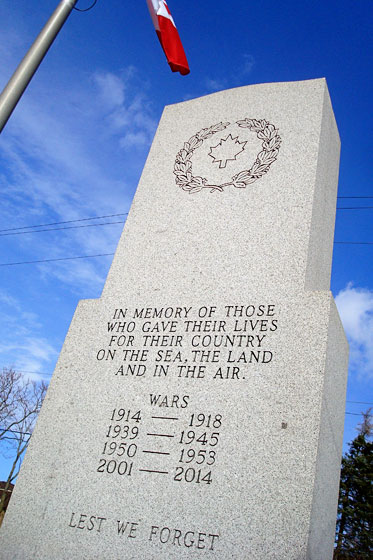
Lest we forget

Lest we forget. Rudyard Kipling wrote these words in 1897. Today, 126 years later, I feel like we’ve forgotten.

I do not remember the First World War, when “lest we forget” first began to be associated with what was then known as Armistice Day. I do not remember the Second World War, when my grandfather left his family in Canada and fought in Italy and Holland. I don’t remember Vietnam or Korea.

My memories of war are the Persian Gulf, Bosnia, Afghanistan, Iraq, Sudan, Congo, Ukraine, Israel, Palestine. Conflicts that I’ve seen on TV, the news, movies, and social media, while I am safe here in Canada.

My experience of war is distant. But the lessons of “lest we forget” are close.

I saw my grandfather stand at Remembrance Day services every Nov. 11 with medals pinned to his chest. I wore a poppy, read In Flanders Fields, learned about the Holocaust and listened to The Last Post.

The lesson was always never again. These terrible things must never happen again. We must learn, so that we remember, so that we do not repeat.

I learned the lessons of lest we forget, and then I have watched conflict after conflict, genocide after genocide happen again and again. We have forgotten.

In some ways, it’s easy to forget. I feel safe. Israel, Palestine, the Ukraine, Sudan are all far away. My family doesn’t live there. What happens there doesn’t affect me. Why should I care?

I recently heard Malcolm Gladwell paraphrase author James Keenan to say, “Sin is the failure to bother to care.” If we stand by and do nothing when we could help, we are in the wrong.

The lesson of lest we forget is that I am part of the world, and it is my responsibility—everyone’s responsibility—to care for and protect each other.

Remembrance isn’t just about the past. It is about the present and the future. How we behave now, tomorrow and the day after that.

Lest we forget.

Remembering

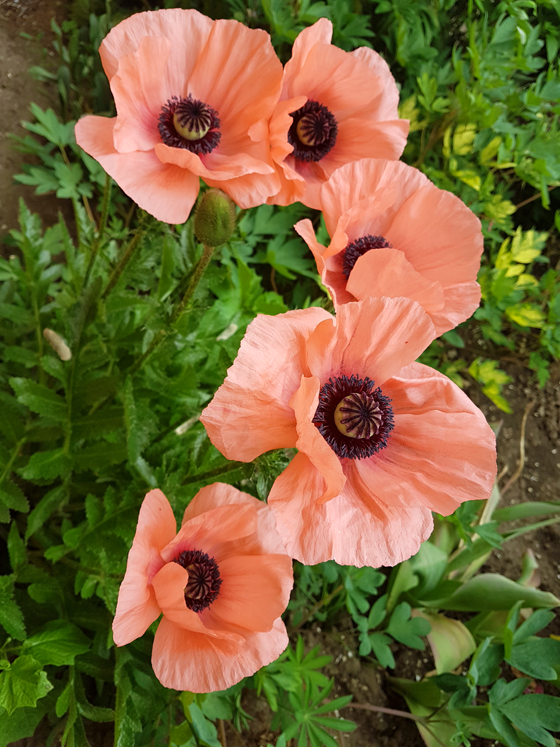
Light pink poppies

Tomorrow we will mark another Remembrance Day. I’ve written before about how meaningful this day is to me.

My grandfather served in World War II. Nov. 11 is also his birthday. Every year, the family would be together on Remembrance Day, and some of us still carry on that tradition, meeting at the cenotaph just before 11 o’clock on Nov. 11.

Growing up, my grandparents lived next door. One of the fixtures of my grandmother’s garden was her poppy plant. Now, whether through wind, seeds, transplanting or cuttings, my parents have the descendants of this poppy.

This fall, I collected a bunch of seeds from my Mom’s plants. I’m hoping that they will grow in our garden here at the farm, and give me more memories of my grandparents.

In Flanders Fields


poppy5

I’m thinking today of my grandpa and other veterans.

I’m not sure how familiar people are with this poem. Here in Canada, it’s a fixture of Remembrance Day.

It was written during the First World War by Canadian John McCrae, who was born very near our farm. In part because of this poem, “the poppy was adopted as the Flower of Remembrance for the war dead of Britain, France, the United States, Canada and other Commonwealth countries” (Source)

In Flanders fields the poppies blow
Between the crosses, row on row,
That mark our place; and in the sky
The larks, still bravely singing, fly
Scarce heard amid the guns below.
We are the Dead. Short days ago
We lived, felt dawn, saw sunset glow,
Loved, and were loved, and now we lie
In Flanders fields.
Take up our quarrel with the foe:
To you from failing hands we throw
The torch, be yours to hold it high.
If ye break faith with us who die
We shall not sleep, though poppies grow
In Flanders fields

Particularly this week, I am thankful to be Canadian. I’m also grateful to the people like my grandfather who took a stand to defend people who needed help and preserve freedom.

Remembrance

Remembrance Day is tomorrow. You might recall that this a very meaningful day for me.

In addition to marking the end of World War I and an occasion to remember the service and sacrifice of veterans as well as current soldiers, it is also my Grandpa’s birthday.

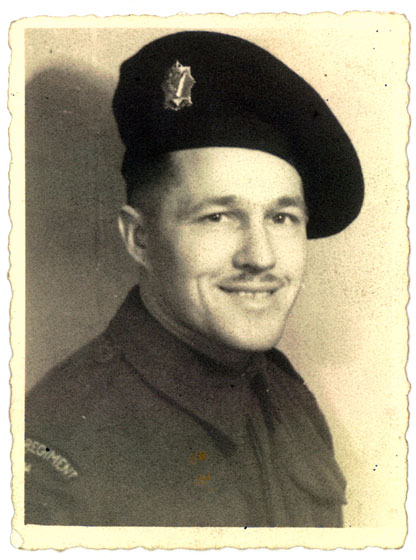
My grandfather in his World War 2 uniform

My grandfather at Avellino Dec. 29, 1944.

In Canada, many people observe Remembrance Day by wearing poppies for the weeks leading up to Nov. 11. The Royal Canadian Legion distributes the poppies. Poppies are never sold or purchased. People donate to the poppy campaign, and donations help ex-servicemen and women and their families.

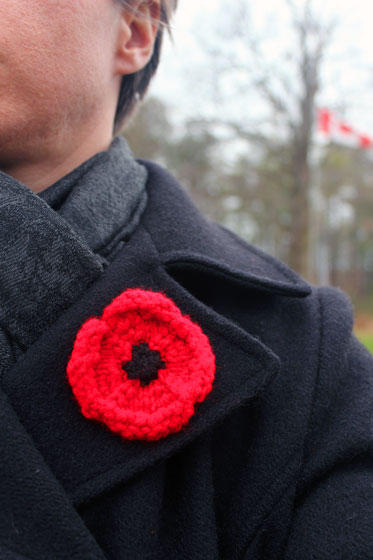
A few years ago, I came across a free knitting pattern to make my own poppy from Canadian knitting designer Laura Chau. Laura wrote a great blog post earlier this month that includes a link to her pattern.

Knitting poppy for Remembrance Day

The poppies are easy to knit. To stitch one up is a small effort in light of what the poppy symbolizes.

Remembrance Day previously:

Remembering

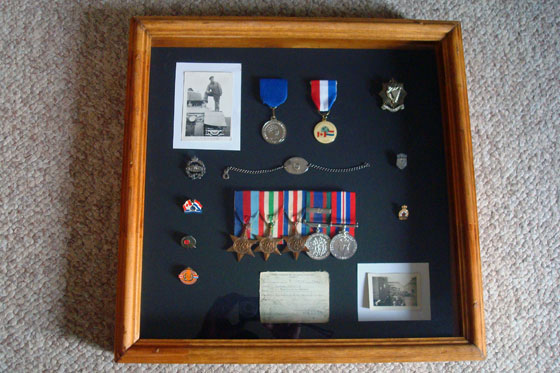
In a corner of my parent’s family room hangs a very special display. It is a shadow box made by my Dad, filled with photos and mementos from my grandfather’s service in World War II. There are his medals, pins, his ID bracelet (his “dog tag”), his tank drivers license, pictures from training here in Canada and with his division overseas.

World War II medals and mementos in a shadow box

The centre of the display is obviously my grandpa’s medals. It took my grandfather a long time to share these medals with the family. Growing up, my Dad never saw them. Slowly, as the years passed and grandchildren were born, my grandfather began to show us items from the war. Eventually, when we went to the annual Remembrance Day service, he wore his medals.

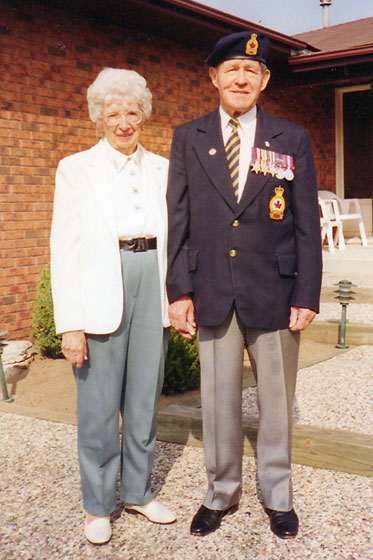
Grandma and Grandpa

My Grandma and Grandpa in 2000

My grandfather did not talk about the war. My Dad asked him once and has a single page of notes from the conversation. It was obviously very hard for my grandfather to remember that time.

Perhaps that is why Remembrance Day is so important to me. I don’t know what my grandpa went through when he was overseas, but I know it had a big impact on him. Therefore, today, I take the time to remember him and to be grateful.

For last year’s Remembrance Day post, click here.

The story of a wooden shoe

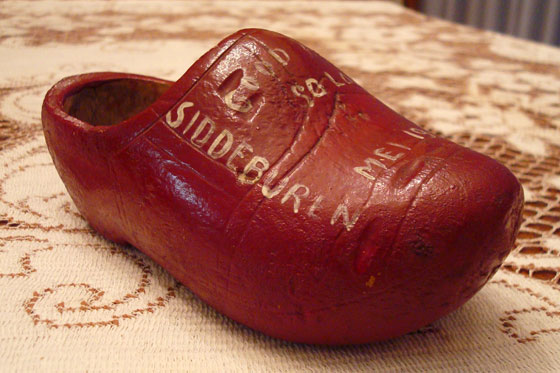
Painted wooden shoe

When I was a little girl, this shoe sat in the curio cabinet in my grandparents’ living room. It is a hand-carved, child’s wooden shoe from Holland.

During the Second World War, my Grandpa was part of the Canadian Army. After first serving in Italy, his division was transferred to Holland. While in Holland, he was billeted with a Dutch family in their home.

When it came time for my grandfather to return to his own family in Canada, the family who had housed him wanted to express their gratitude. The father took his daughter’s wooden shoe, painted it with messages for my Grandpa and presented it to him.

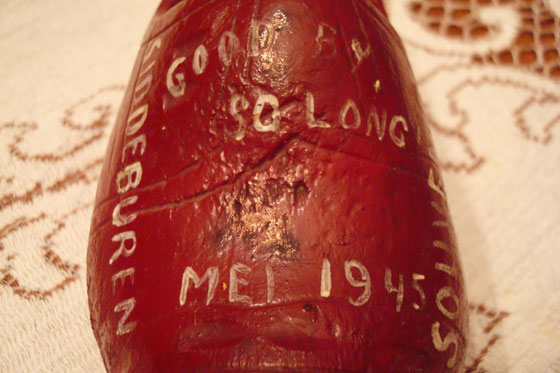
Painted on the shoe is “Siddeburen,” the name of the town in which they lived, “souvenier,” “good by [sic], so long,” and “MEI 1945” (May, the month Holland was liberated by the Canadians).

Painted wooden shoe

For many decades after the war, my grandparents stayed in touch with the family, sending letters and cards back and forth over the Atlantic. The gratitude the Dutch people have for the Canadians was made tangible by my family’s connection to this one family.

Remembrance Day is a very meaningful day for me. In addition to marking the end of World War I and an occasion to remember the service and sacrifice of veterans as well as current soldiers, it is also my Grandpa’s birthday.

My grandfather in his World War 2 uniform

A note on the back of this photo in my Grandma’s handwriting says this picture was taken at Avellino, Italy Dec. 29, 1944.

This Sunday on Remembrance Day, I will be thinking of my Grandpa as I stand at the Legion with my family.

The wooden shoe now resides with my Aunt. My grandfather’s medals are with my Dad. Every time I visit, I look at these items and remember.

It is my hope that as Matt and I work on our forever house, we can fill it with meaningful items that show the legacy and tell the story of our families.