I tackled the biggest projects we’ve done in a while here at the farm–maybe ever when I think of the birds who are now a fixture of the farm.
When I laid out my home goals a year ago, I was very excited by what was ahead. As I look back, I’m very excited and proud of what I accomplished.
Here’s my look back at Home Goals 2025.
Coop
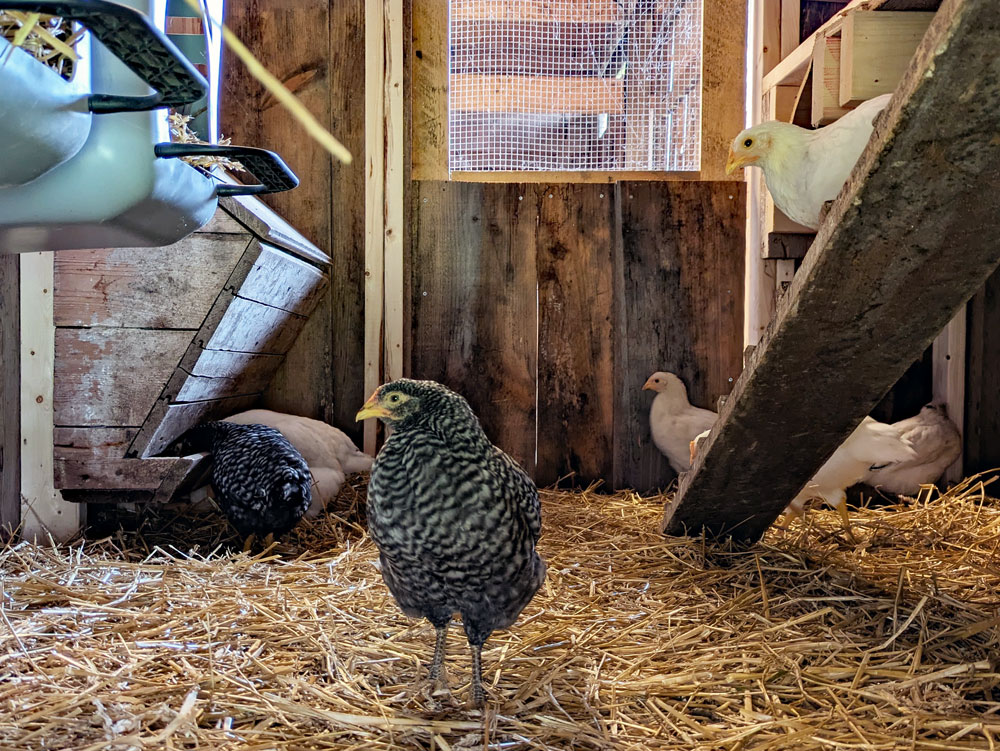
The coop was a big construction project and it turned out so well. The barn, pens, storage, and runs all work very well and have kept our birds comfortable and safe. Adding birds to our family has been a very special, fun experience–even the turkeys.
While it’s not directly for the coop, there was another big barn task I completed last year: eavestrough. I’ll be sharing more details about this project in an upcoming post.
My office
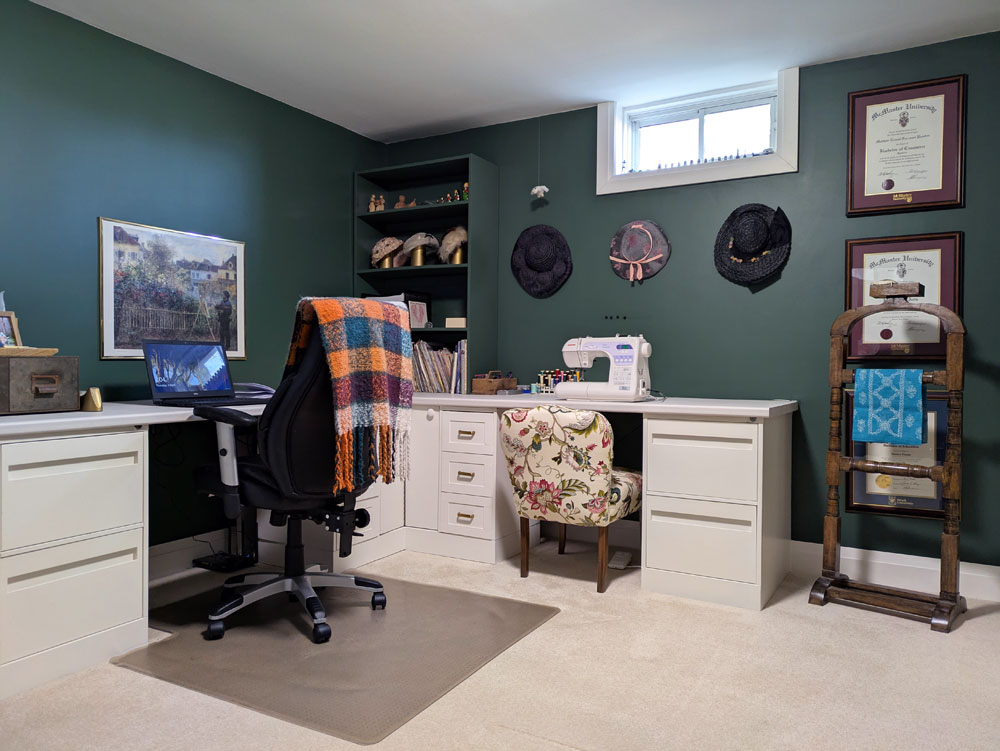
My office was the first project of the year. It is a comfortable, personal room. Having this space for working, writing, crafting, sewing, whatevering has been so nice.
It’s also helped me to be more focused with my worktime. I still bring my computer to the couch occasionally, but having the desk, a place for my laptop and a dedicated spot for work has helped me leave work on my desk a bit more.
Ellie’s playroom
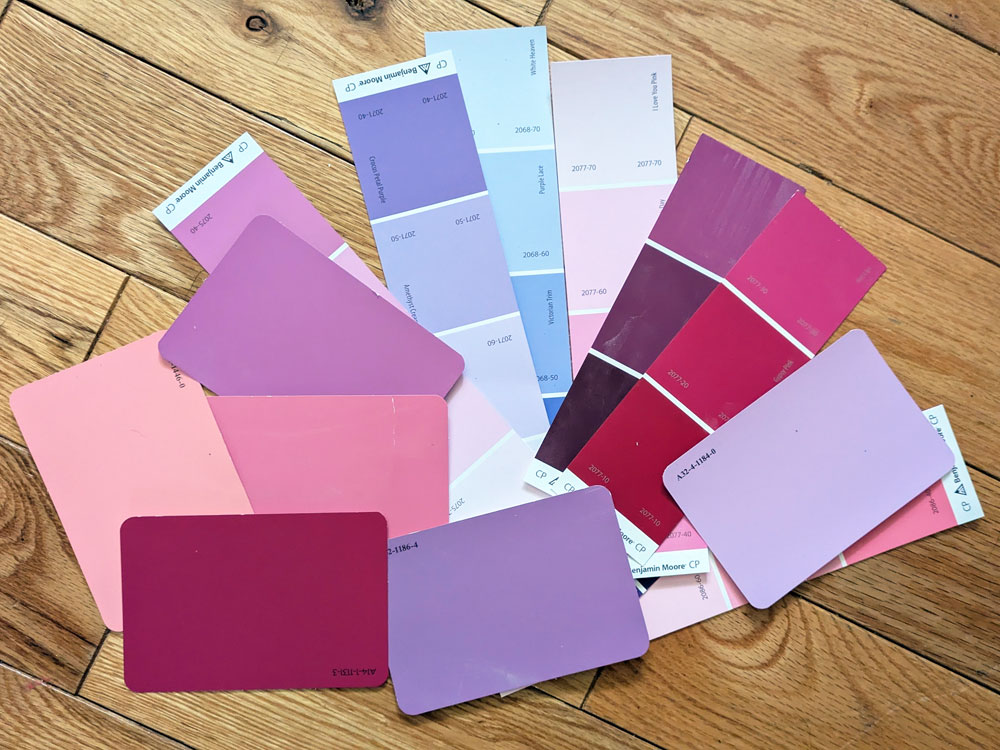
Ellie’s playroom makeover did not happen. As fall arrived, I really wanted to tackle it, but the reality of everything I was already doing and the number of hours in a day meant that another project would have been too much. I’m glad I decided to postpone the makeover, and I’m eager to start this room this year.
Main bathroom
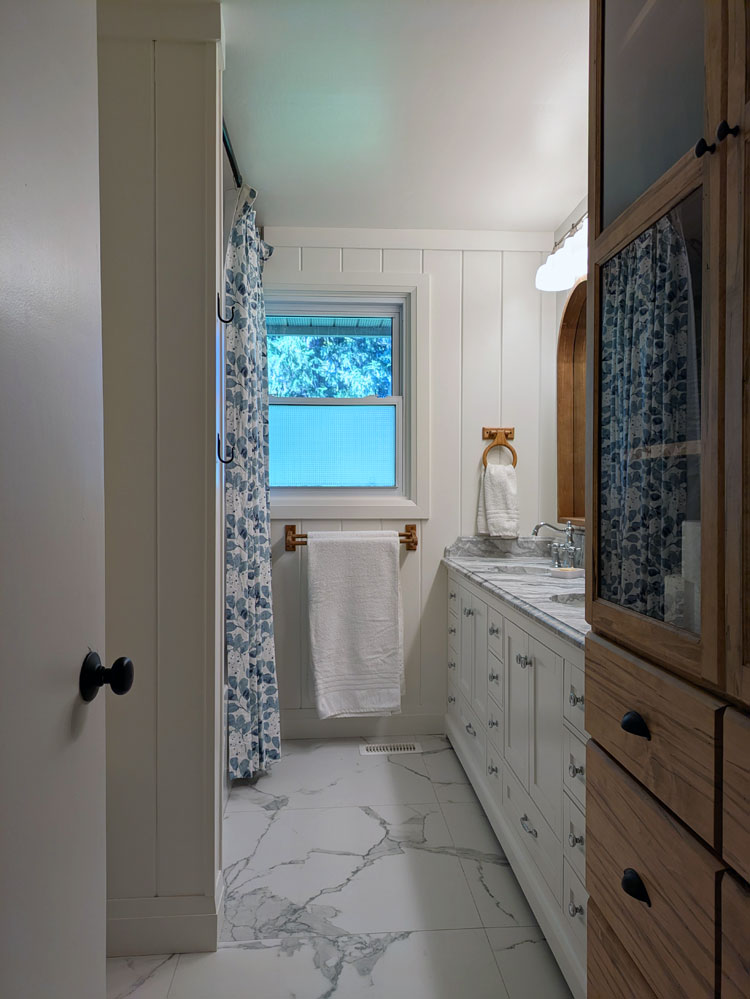
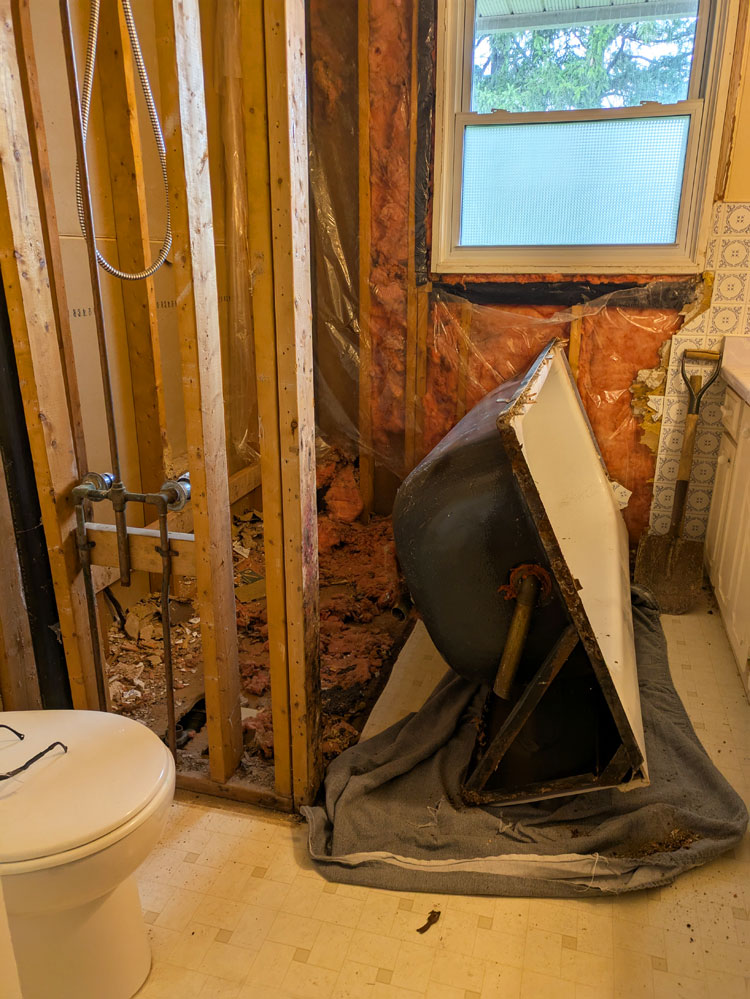
The novelty of our renovated bathroom has not worn off. Every day I am grateful for how beautiful it is, how well it works, that I did so much of the work myself and that after living here for 13 years it is finally done.
Checking off three out of four home goals feels pretty good, especially since these were big projects for us. And, I need to say it one more time, they all turned out so well. I love the changes we’ve made to the house and the farm, and I’m really proud of what we accomplished.
Did you have any big home accomplishments in 2025?
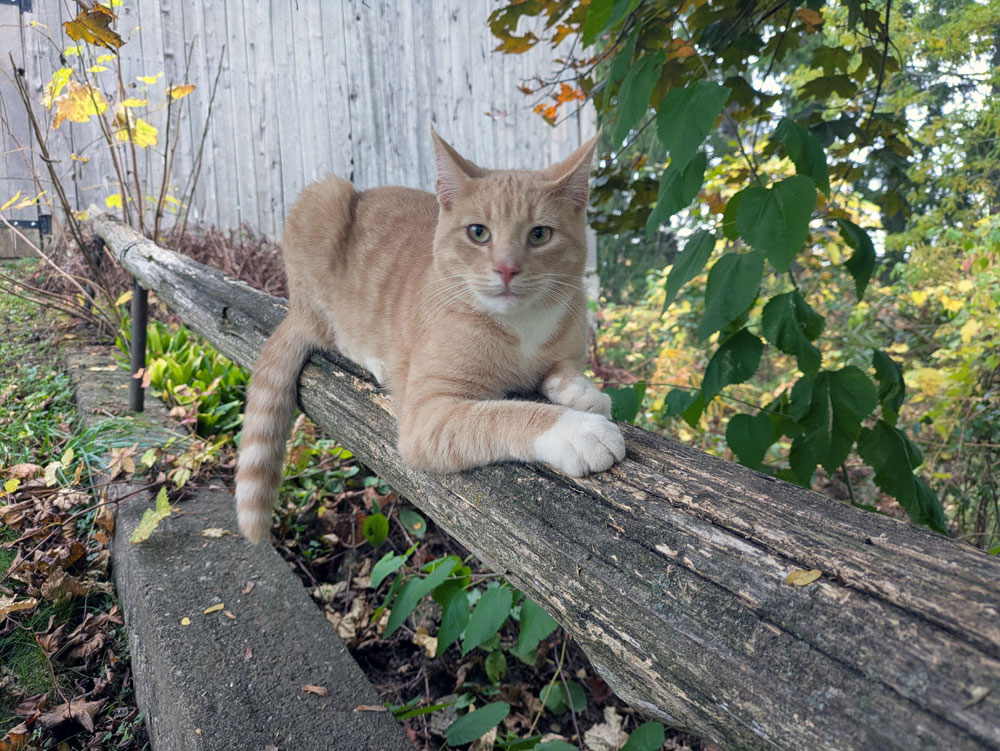
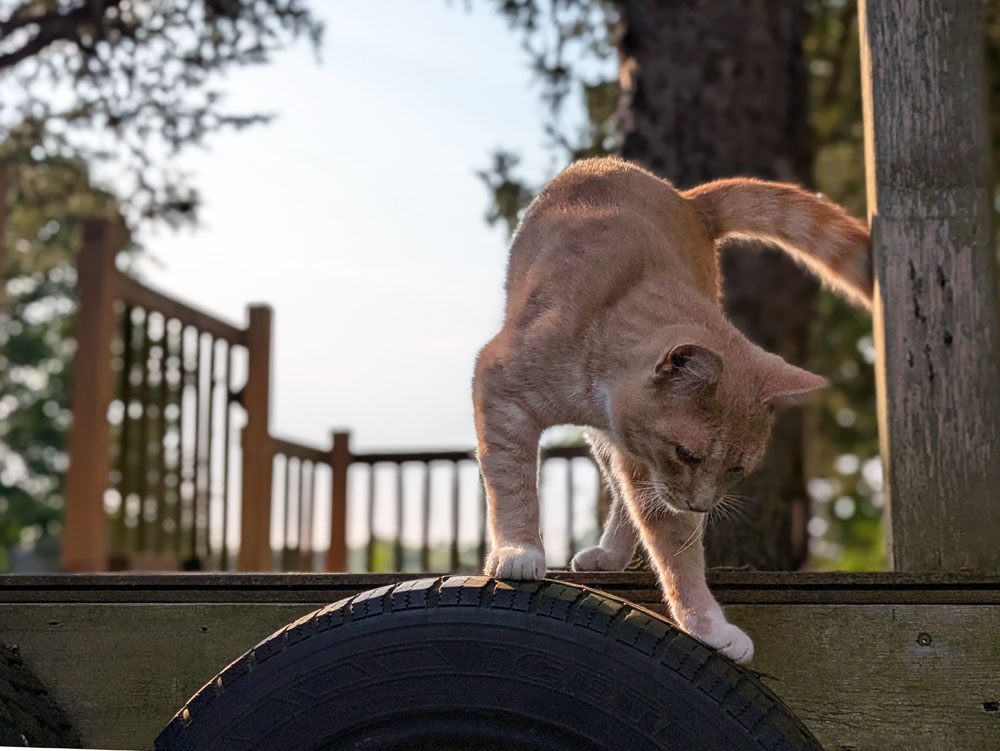
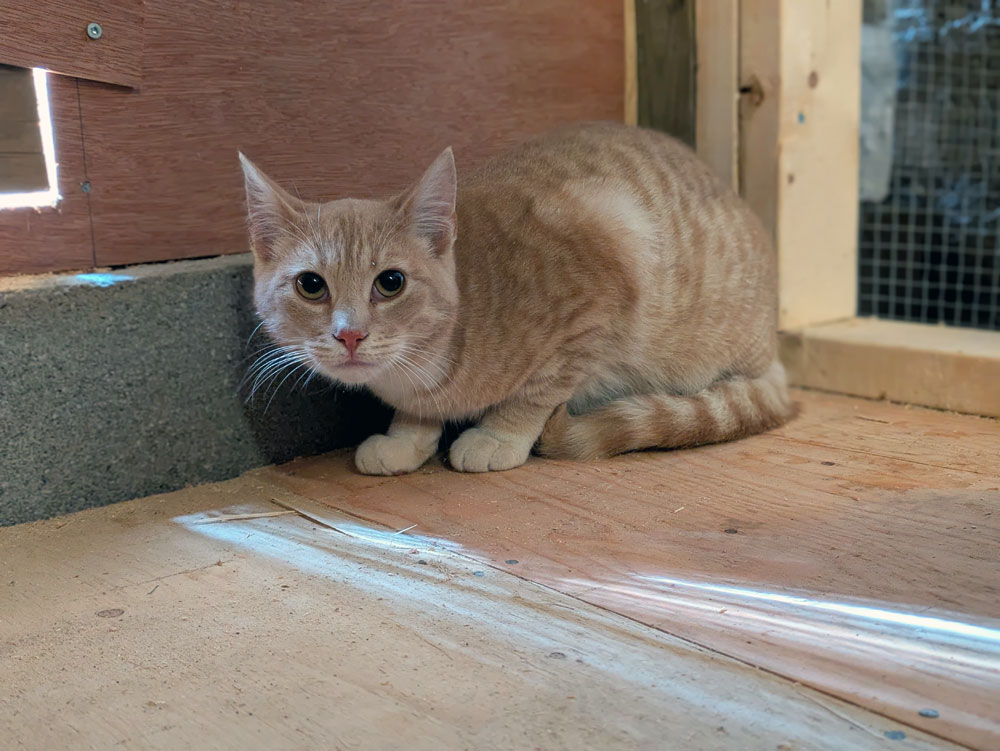
Our little orange kitten has become a champion barn cat, a much-loved family member and so much fun.
Cedar has been with us for six months. You may recall we adopted him and his brother Maple at the same time as the chickens and turkeys arrived in the spring.
We kept the kittens confined in the coop for several weeks so we could get to know each other and get through their neuter surgeries. (The birds were still in their brooders in the house.) After we let Cedar and Maple out to have free range, Maple disappeared just a couple of days later. We’ve never found any sign of Maple, but Cedar has stayed safe and stayed home.
He is a very social little cat and loves to be with us.
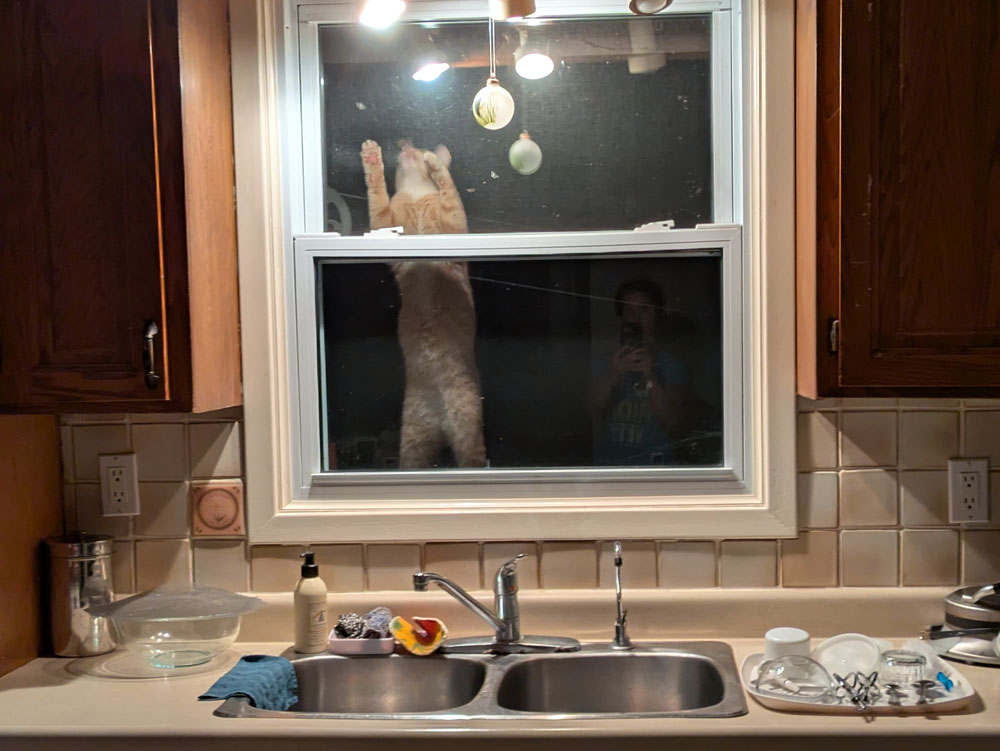
He’s usually waiting outside the mudroom door for Cigo and me in the morning and then runs to the barn for his breakfast. If we’re inside and he feels left out, he will sit on the steps outside the living room door or on the kitchen windowsill and meow. He hasn’t figured out how to break through the screen on the kitchen window, but he keeps trying.
Occasionally he comes into the mudroom if the door is open and one rainy night he made it as far as the living room until he decided he was ready to go back outside.
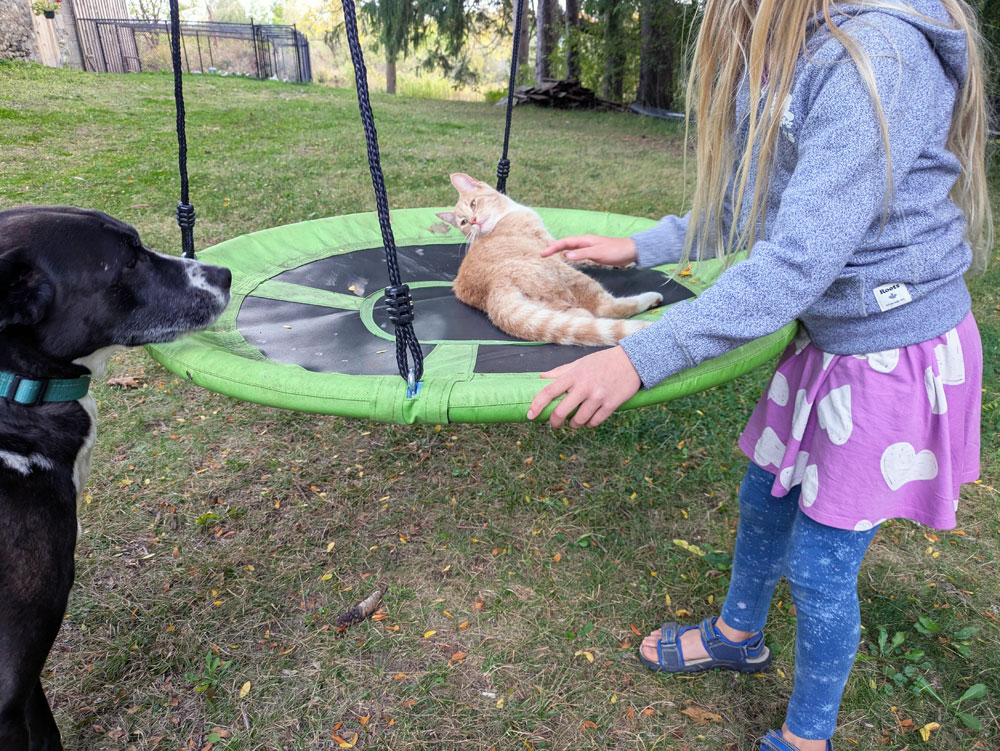
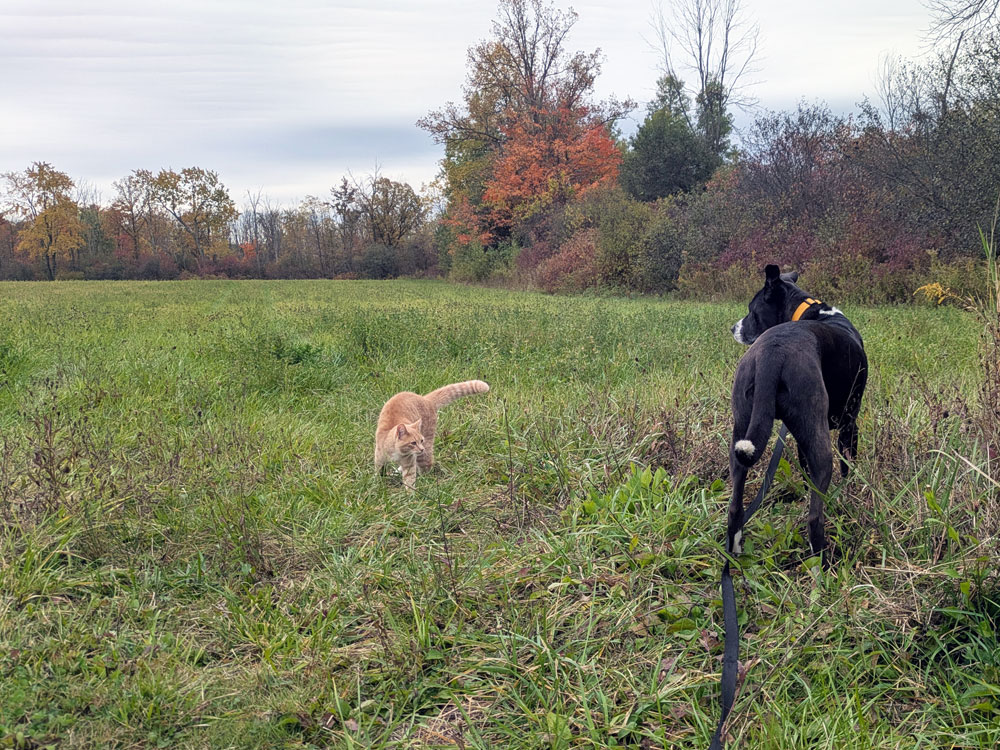
He’s gone on the trampoline, the saucer swing and the treehouse, loves belly rubs and tolerates being carried around by Ellie. He’s accompanied us down the driveway to the school bus and gone with Cigo for a walk to the back field.
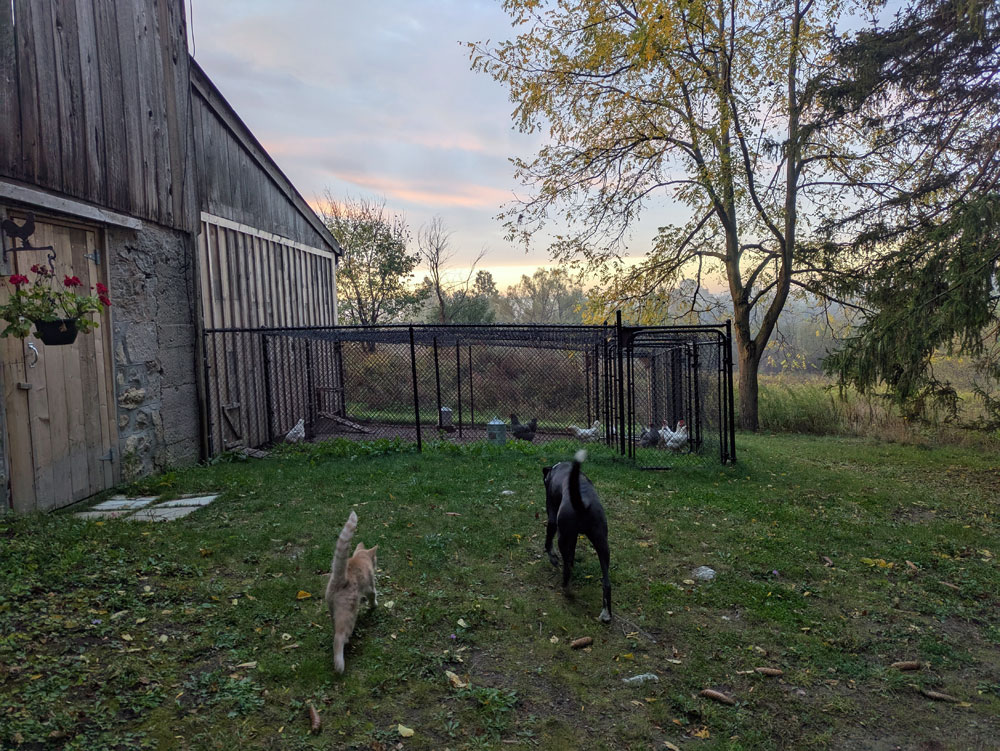
The biggest adjustment has been Cigo. Cigo has always been super excited by cats, so it took a while for him to get used to Cedar. He chased Cedar several times and got dragged back to the house for a timeout. Cedar learned climbing trees was a good escape–a good lesson for predators beyond Cigo.
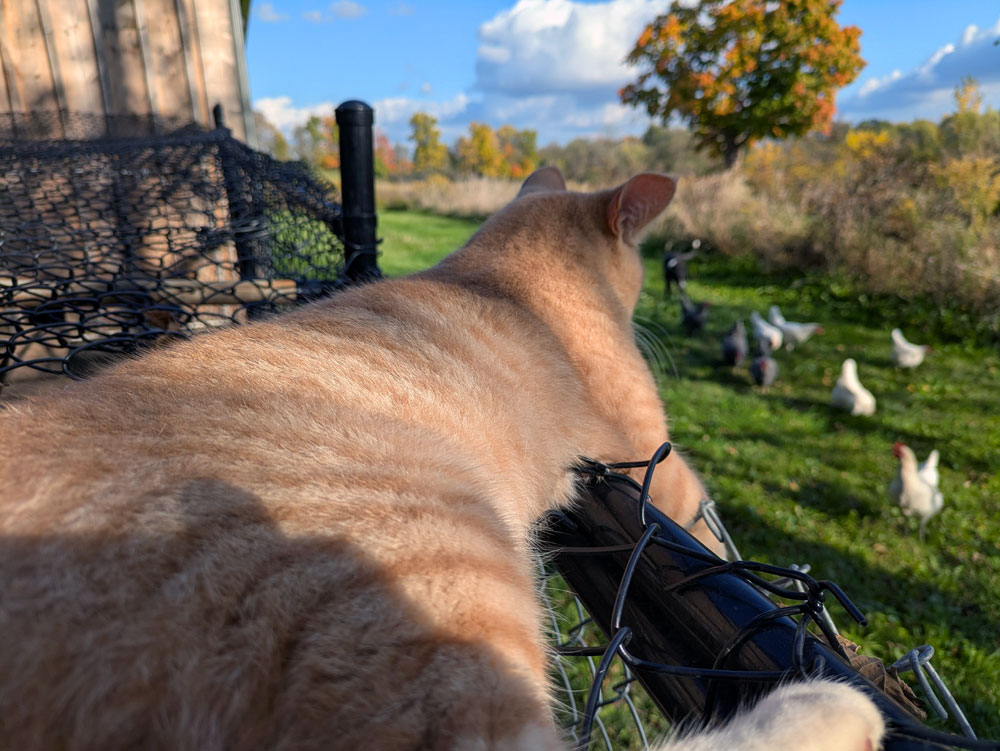
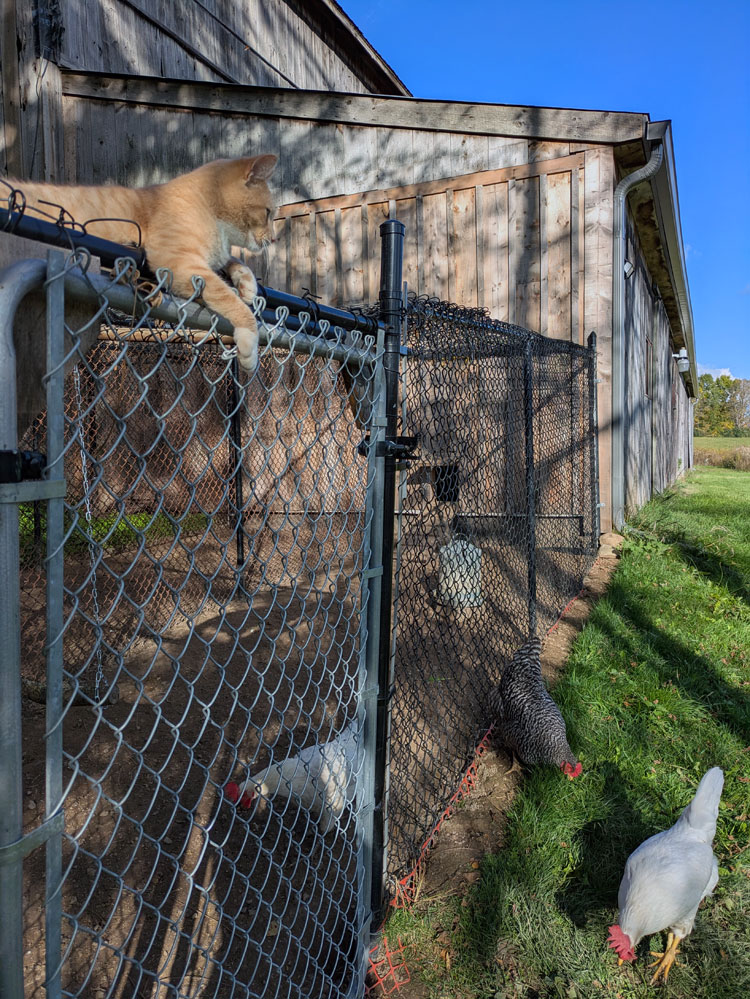
But Cedar is an easy going, tolerant, confident cat. So he kept venturing out of the barn even though he knew Cigo was around. We kept doing supervised visits with Cigo and Cedar and lots of treats for everyone. Eventually, they got used to each other and now we all–including the chickens–can be together with no issues.
Cedar can sprint past Cigo or walk through Cigo’s legs, and Cigo doesn’t blink. In fact, sometimes he seems to say, “Little dude, can you give me a break?” They occasionally try to play together, but haven’t figured out how to manage the size difference yet.
Beyond the fun, Cedar is also doing his job. He is a prolific hunter, and we find dead bodies in the barn and on the lawn regularly.
For winter, we’ve added a cat house full of straw outside the mudroom door. He also has the barn with lots of straw filled spots.
Cedar has added to the love and joy in our little family, and I’m very glad he’s with us.
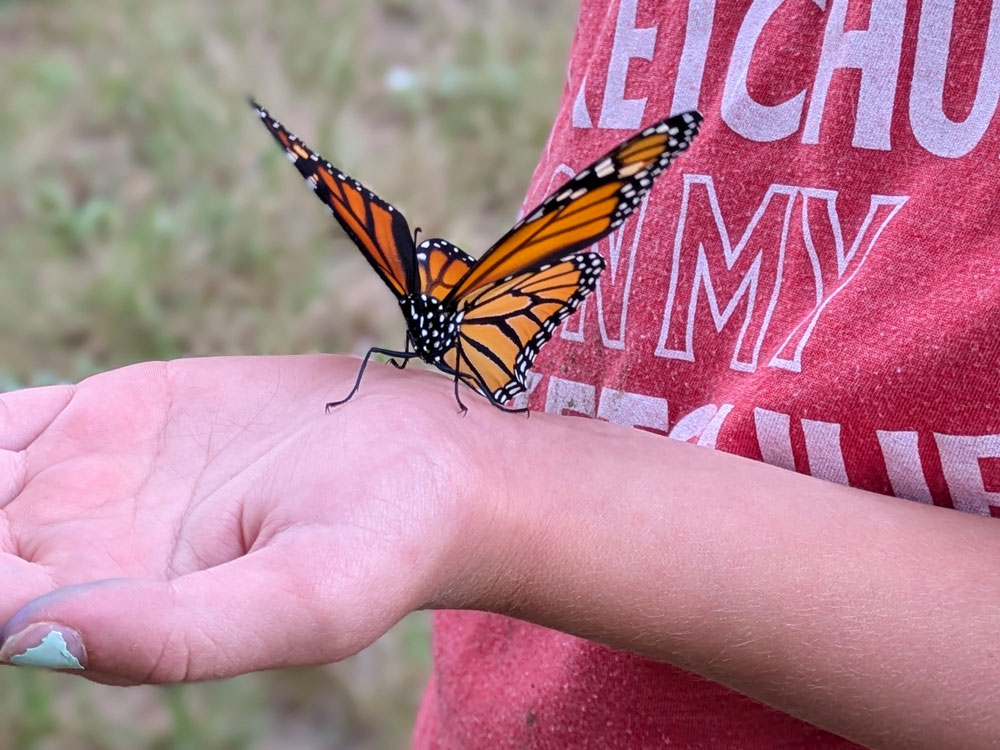
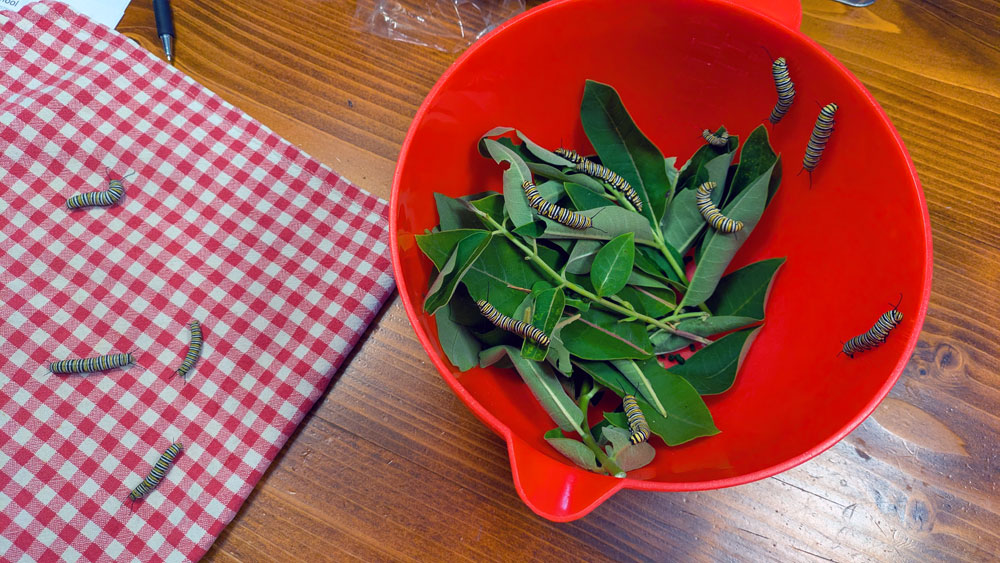
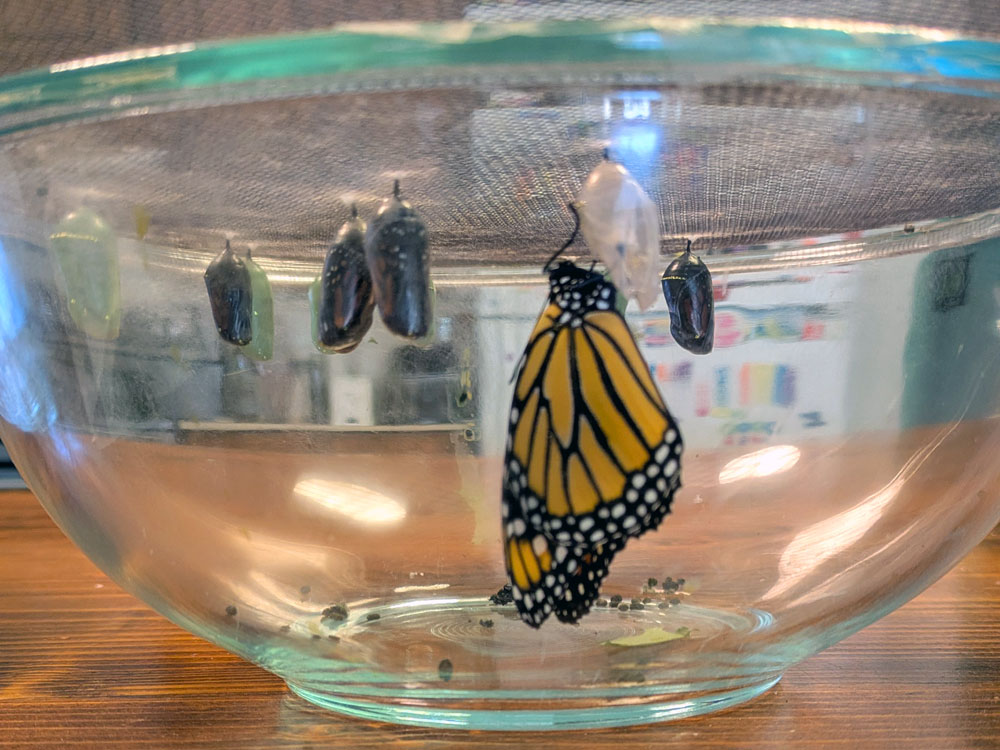
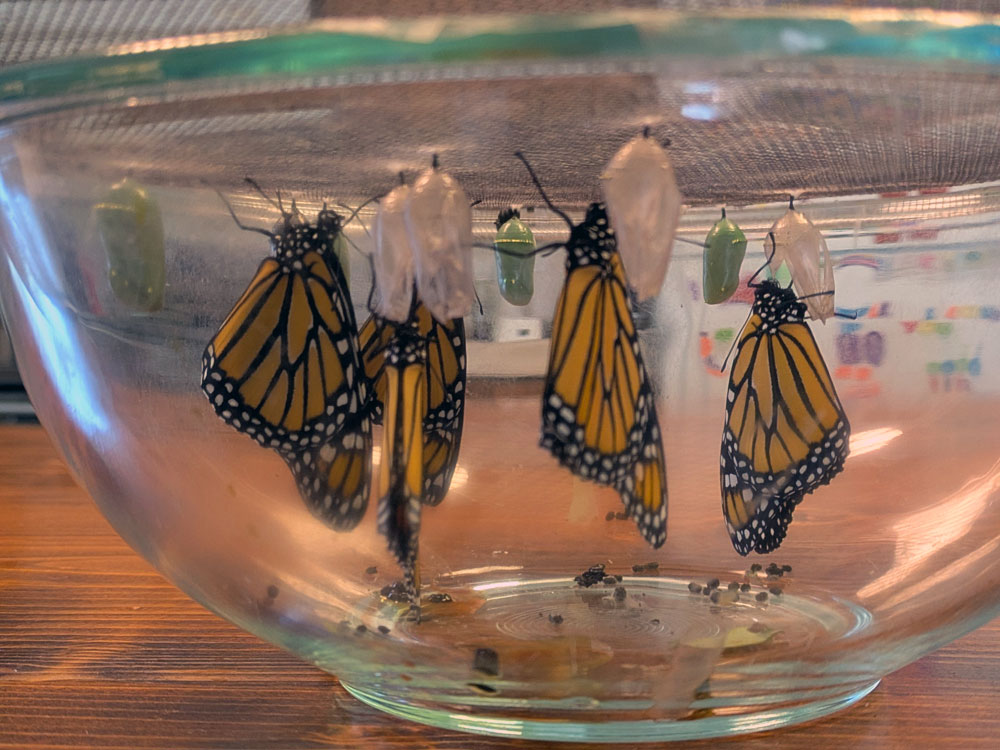
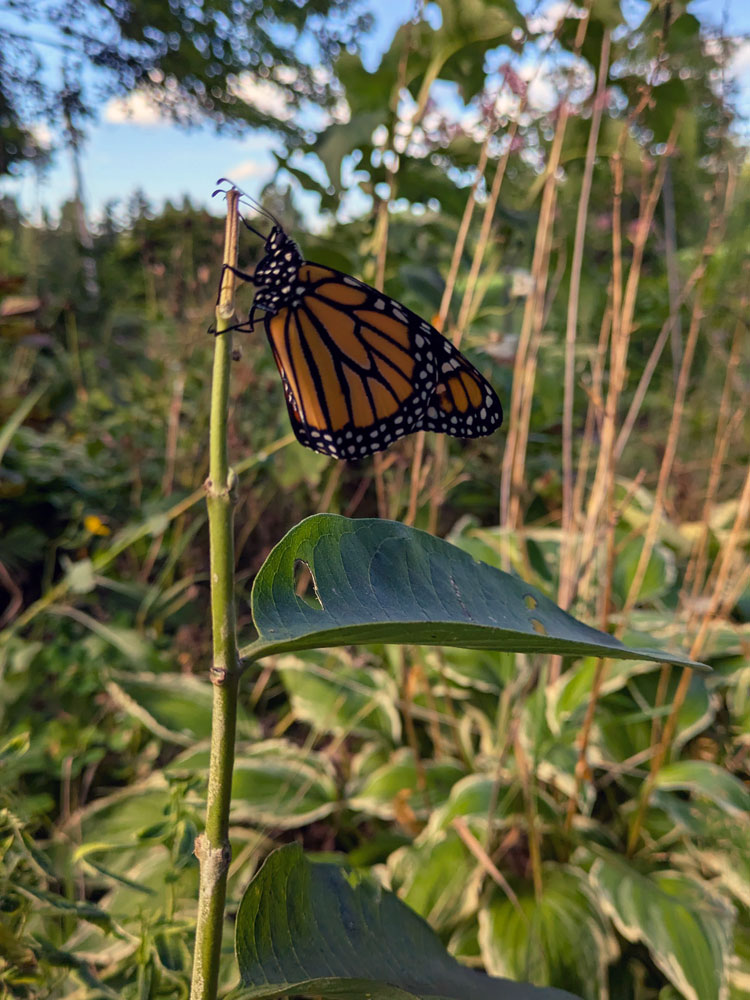
The teeny tiny caterpillars who depend completely on their leaves of milkweed. The big fat caterpillars who munch through their milkweed so loudly I can hear it. The chrysalis inside the caterpillar. The glimpse of black and orange wings through the clear walls of the chrysalis. The butterflies’ first flutter, first flight. Their migration.
That was 9 years ago, with Matt. Matt had raised monarchs before as a child. He was just as enthused to raise them as an adult here at the farm.
Since then, there have been more seasons, more butterflies. Ellie was born. Matt died. The cycle of life has continued.
This year, Ellie and I continued our monarch tradition.
We collected caterpillars and milkweed. We even collected two eggs and successfully hatched them. We found more caterpillars and added them to our nursery. We released butterflies. Found more caterpillars. We started in July and finally released our last butterflies at the end of September.
The number is phenomenal. We have never had so many monarchs. Part of me fears this flurry reflects a last gasp before the population truly collapses. A larger part of me hopes that this is a sign of resilience and strength. Or maybe it doesn’t have meaning, and it’s just life.
Life is a cycle. It is amazing and hard and magical and special. Seeing it up close through the monarchs is powerful. It reminds me to fully appreciate my life. Not take my time for granted. Do my part to support those around me. That I am part of something bigger.
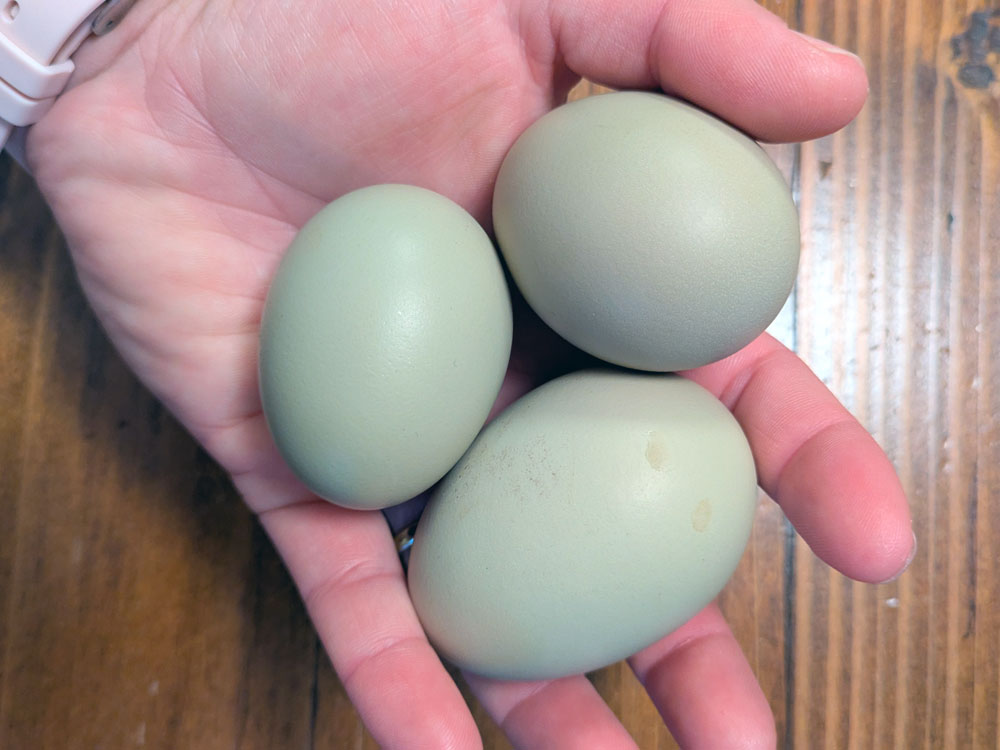
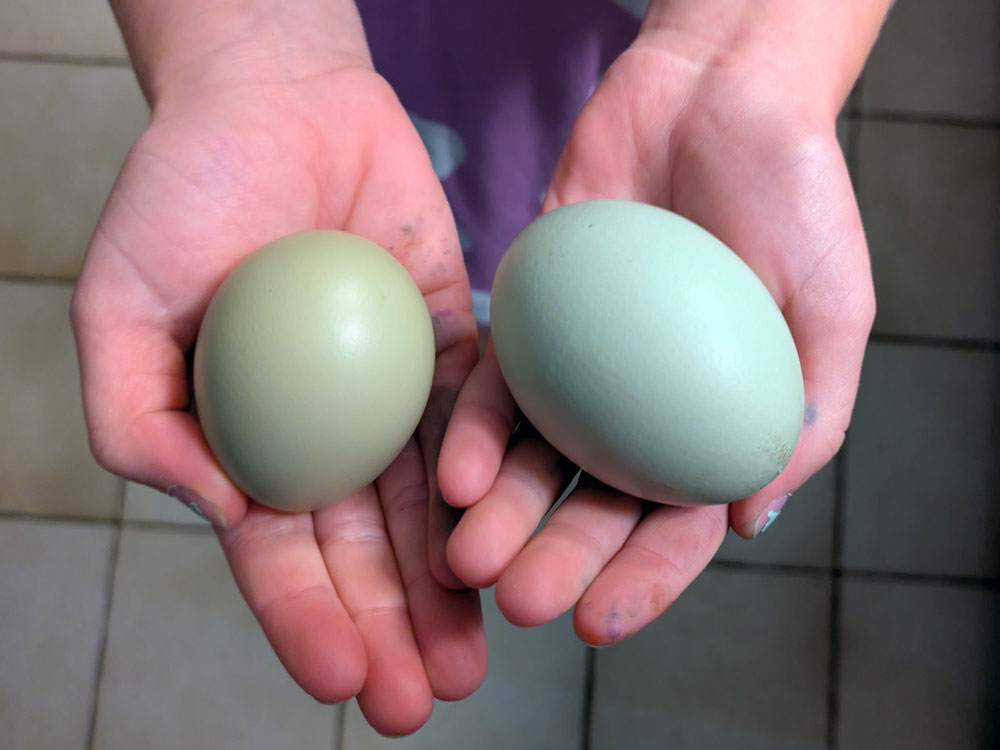
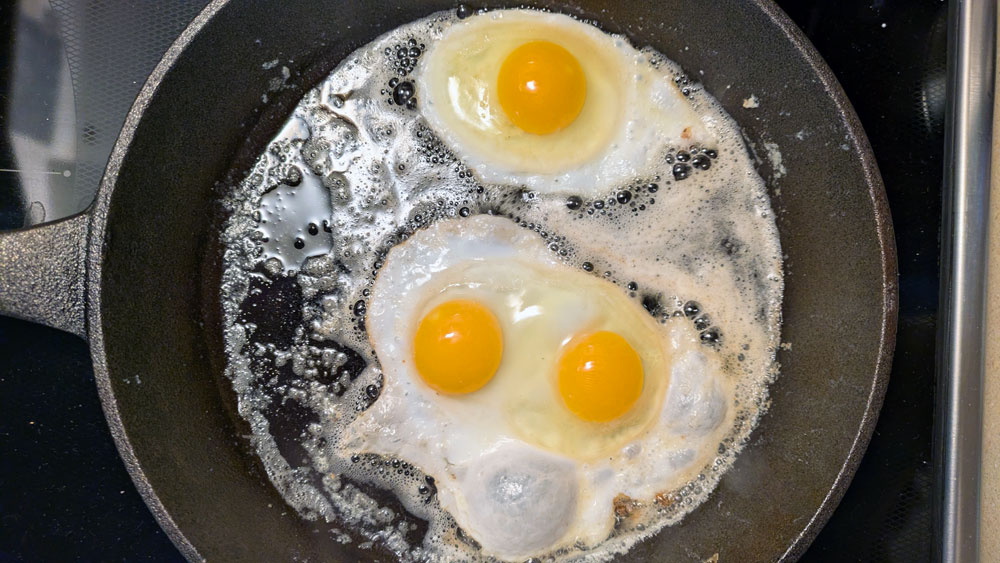
Mid-August our first egg arrived (the hens were about 16 1/2 weeks old at this point). It was laid on the roost and had a soft shell, so it was broken when I found it. We had one more soft shell roost egg, and then a few days later, I discovered three small greeny blue eggs in a corner of the coop. We ate them for breakfast–and one was a double yolker.
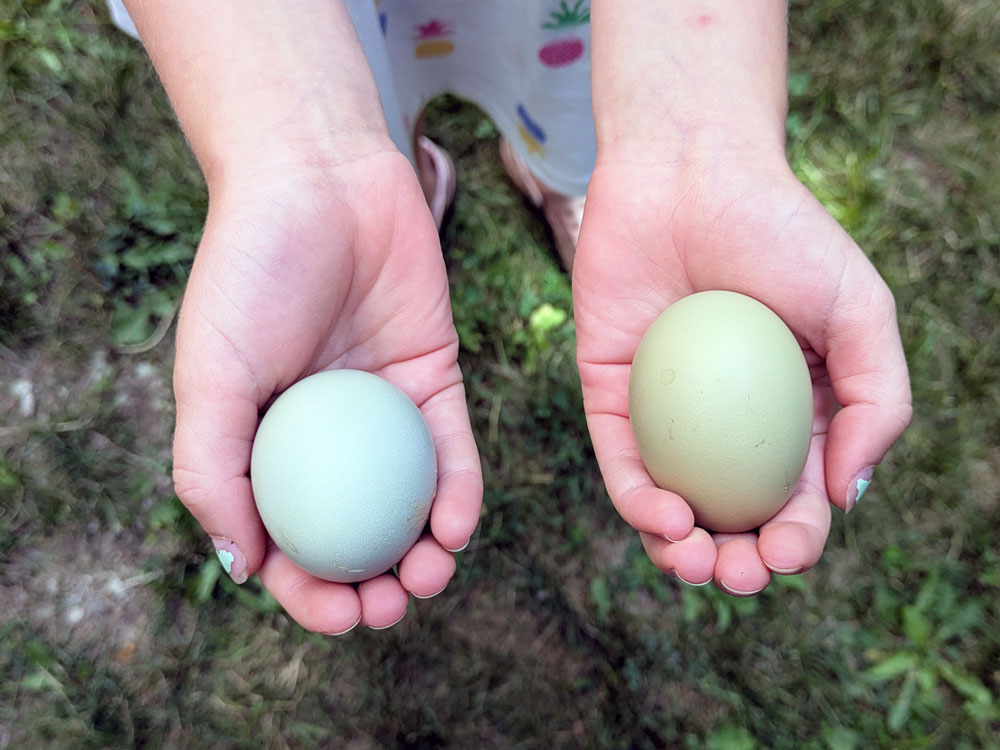
Since then, we’ve consistently had two eggs a day. They’ve been either olive or blue (it’s hard to tell) and small. We’ve had enough for ourselves and shared a few with Grandma and Papa.
On Friday, we had our first full sized egg, which turned out to be another double yolker.
Ellie found some chicken patterned fabric and sewed a cloth to line her egg basket. She collects the eggs every day, as she has anticipated doing since before the chicks arrived.
We’re waiting for everyone to start laying. My research says that most hens start to lay between 18-20 weeks. Today is the start of week 19, so we’re right in that window. We’re also waiting for them to try out the nesting boxes rather than the corner on the floor. We’ve switched the chickens to a layer food and added oyster shell to their diet, so I’m sure that will help move the other ladies along.
You want me to do what?
Every day is exciting to bring in new eggs, count how many there are, assess their colour and size, and eat our super fresh home grown breakfast. Also exciting? For the first time this weekend I didn’t put eggs on my grocery order.
Any other egg fans out there? Have you ever eaten a blue or green egg? Anyone else have experience collecting eggs?
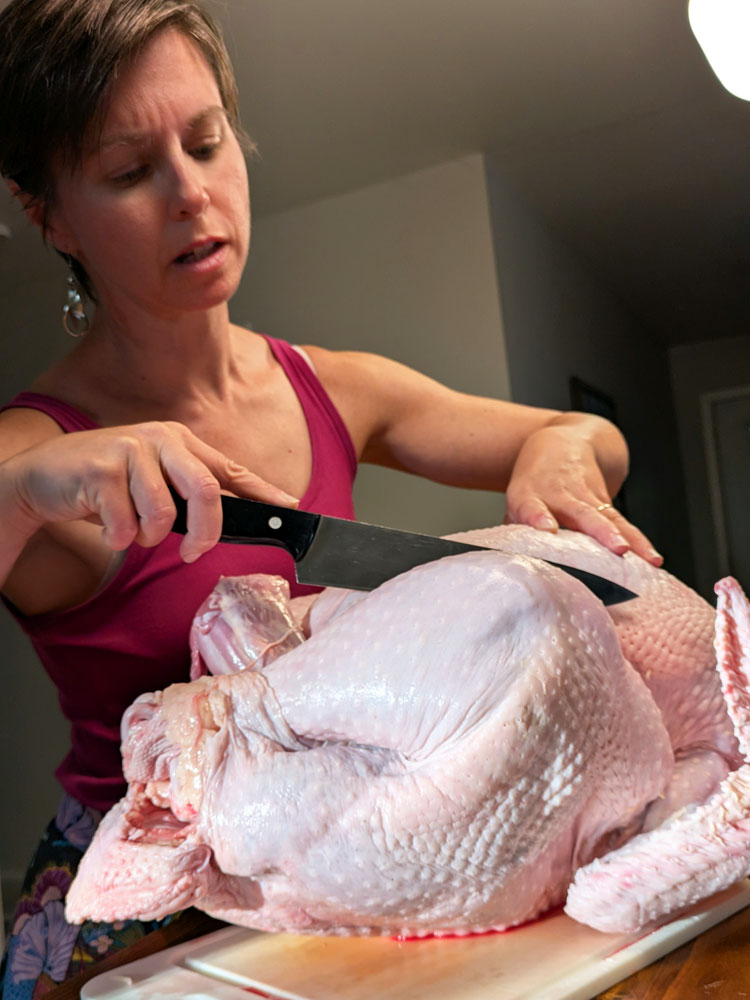
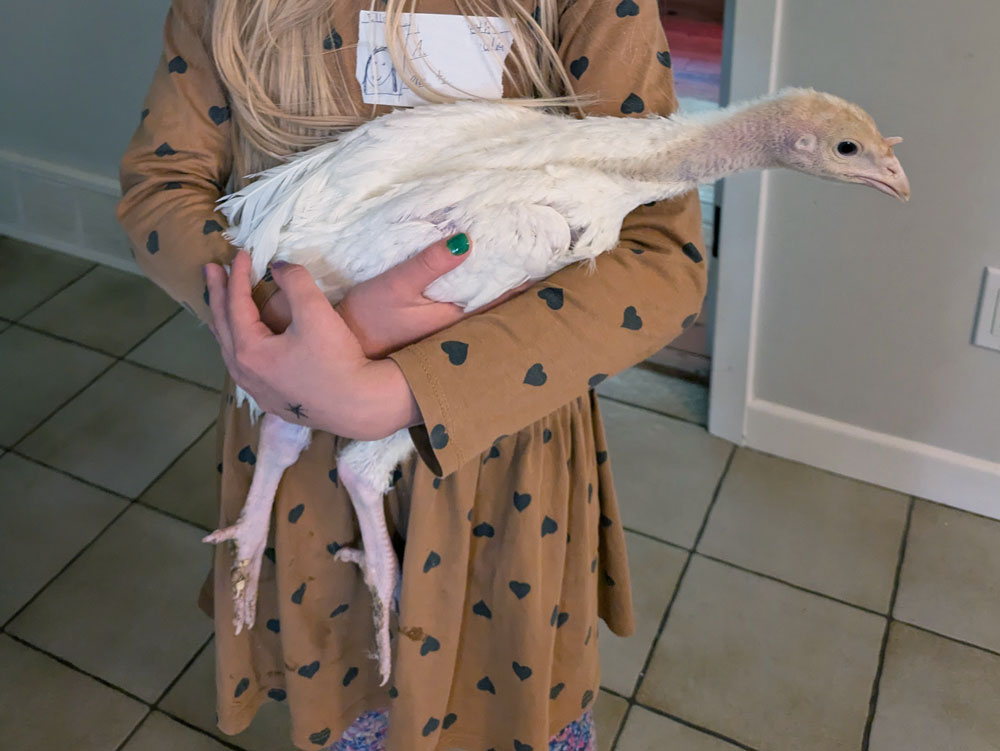
The turkeys went to the “processor” last week. Such a clean term for ending a life. It was hard for me, and definitely hard for Ellie.
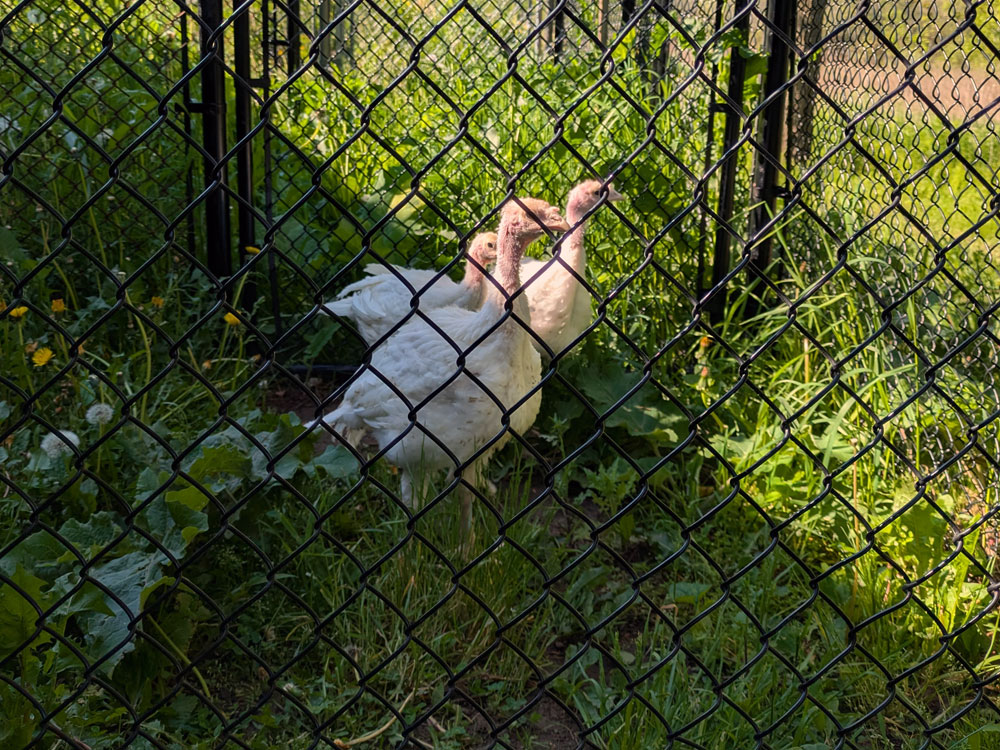
Our plan from the beginning was to eat the turkeys. We spent three months with them, from little fluffballs who climbed onto Ellie’s lap to large birds with their own personalities. Ending that was a big responsibility–as it should be.
One of the things I have been thinking about is food should be hard.
Over the years, food has become easy. As we have become distanced from the labour of producing food, we have lost sight of the investment that goes into what we eat. We ignore or are ignorant of what it takes to grow food, whether it’s a turkey or a tomato. The work of raising, sheltering, feeding, watering, harvesting, killing, butchering, storing, cooking is hard.
There is also a cost. That cost comes in the toll we take on our soil by growing monocrops, using synthetic fertilizers, pesticides, herbicides, draining the water table. It comes in the quality of life for our animals, the diseases that spread, the pathogens and contaminations that arise. It comes in the nutrients and flavour in our food, or lack thereof. It comes in the physical, financial and mental health of farmers.
Food should reflect those investments and costs. It should be something we consider and value more than most of us do. Food is our connection to the land and to each other. It should be nourishment, health, community. It should reflect the quality of the soil, the care of the animals and the labour of the farmers. It should be grown, harvested, bought and eaten with respect and gratitude.
I am grateful to the turkeys. To Strawberry, Medea, Stewart and Tutu. The experience of caring for an animal and growing our own food is powerful.
I introduced this year’s home goals by saying, “I am really, really excited by the projects I have planned.” Mid-way through the year, I am still excited about these projects. I’m also really, really excited by how much progress I’ve made.
What a year it’s been so far!
Coop
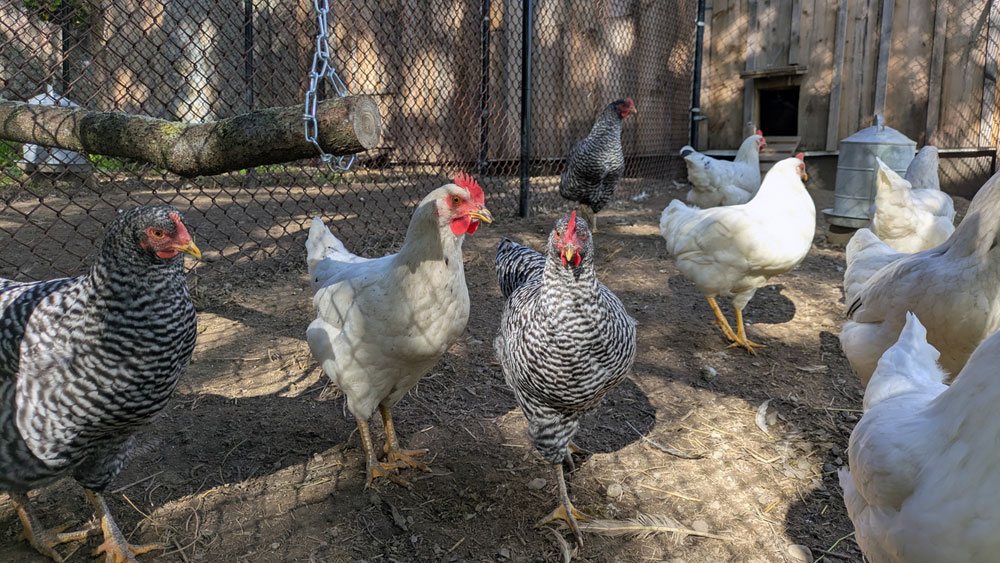
The coop is finished. The birds are in residence. It is awesome. I love having birds again. Seeing them walking around makes me happy. I am so proud of the coop and how well everything has worked out. I will likely continue to make tweaks depending on what the birds need (like repairing the turkeys’ door after they take it apart–again), but I am comfortable saying that for now, this project is done.
My office
Another project that’s done? My office. Transforming, decorating and organizing this space was fun, and I love having my own working, writing, crafting, sewing, creating, whatevering space.
Ellie’s playroom
A dedicated play, crafting, creating space for Ellie is still on the list for this year. She’s been collecting paint chips in anticipation. Can you guess what her current favourite colours are? This room will likely be our fall project.
Main bathroom
The bathroom renovation is well underway, and what a transformation. I’ve been able to do a lot of the work myself, which feels really good. My vision for the design and function of this space is turning out beautifully. I am really happy. More updates to come.
2025 is a big year. I don’t think I’ve had this many projects on the go since early days (perhaps years) or moving to the farm. It’s been tiring, fulfilling, challenging. But mostly it’s been fun. I love working on the house and the property, making it ours and making it beautiful.
I hope I can keep up the momentum for the rest of the year.
Have you tackled any project around your house so far this year? What’s on your list for the rest of 2025?Anyone else having a big house year? What’s exciting you about your house right now?
The chickens and turkeys turned two months old over the weekend. They are doing really well. Today, I’m going back to review our brooder set up and how we got from day-old birds to here.
We decided to brood in the house, and I would definitely do that again. Having the birds close made it easy to check on them frequently and manage their food, water and temperature.
The brooders
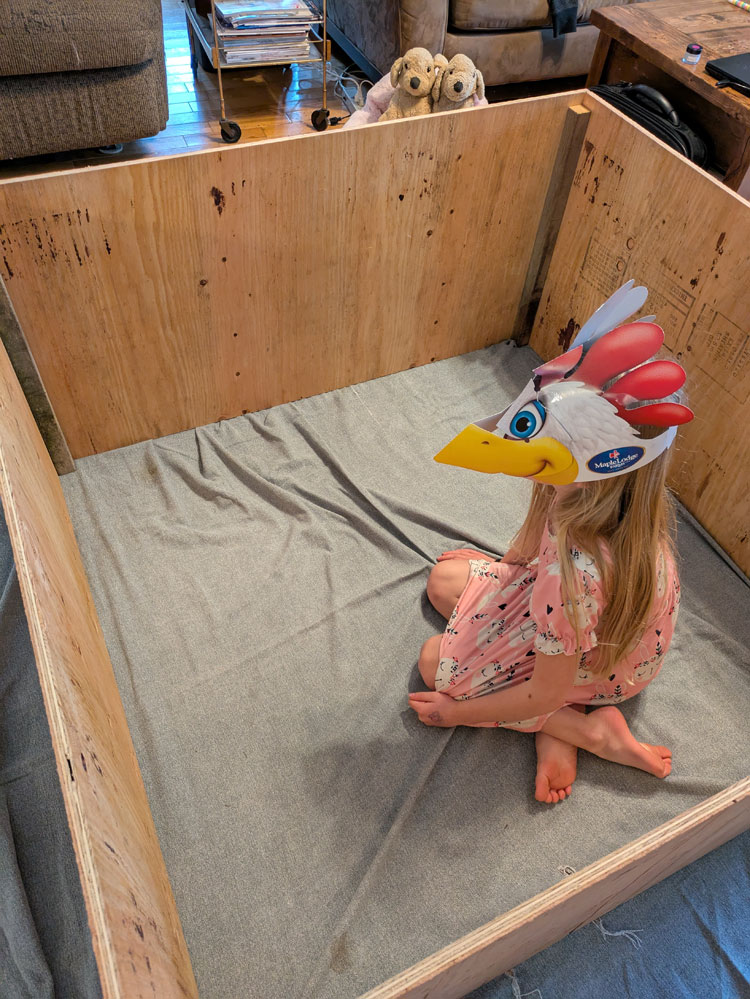
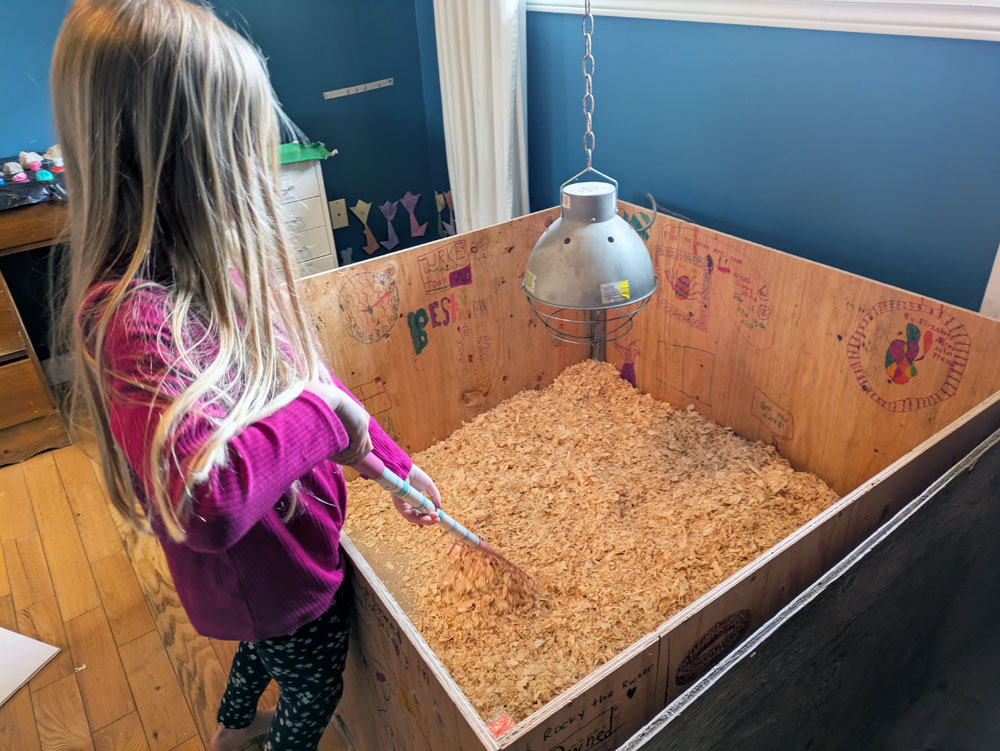
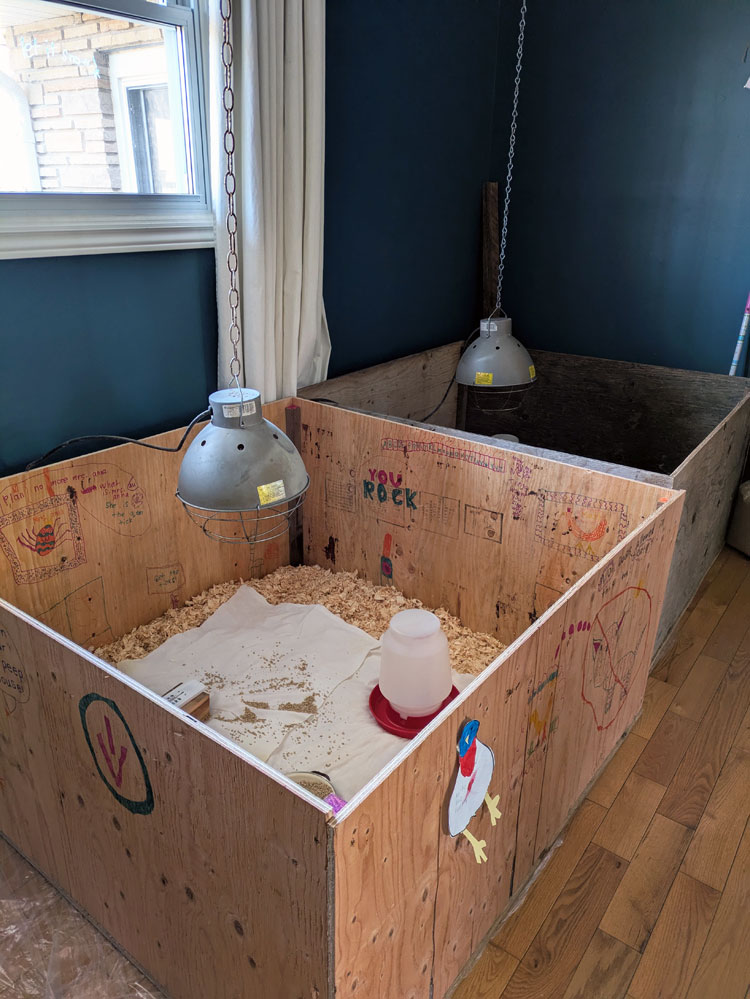
We built two large plywood boxes. Each box was 4 feet wide by 4 feet long by 2 feet high (a sheet and a half of plywood). We used 2x2s to reinforce each vertical corner and screwed the plywood to the 2x2s. The bottom of the box is nailed on.
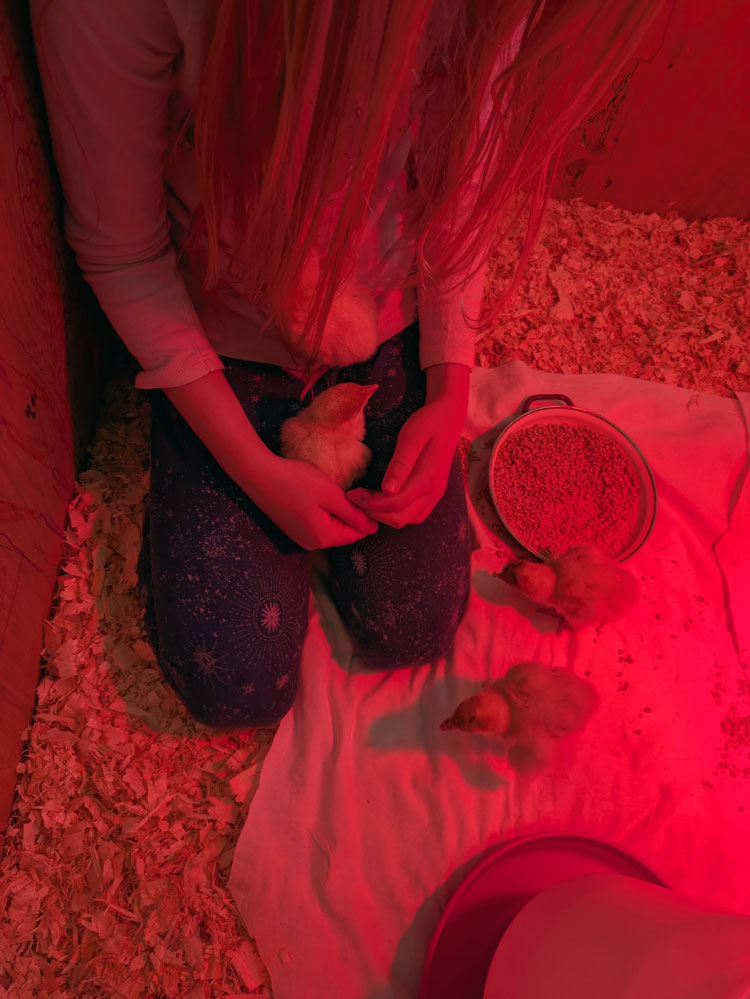
This is my little chick testing out the box before we attached the base. Thanks to Matt’s Dad for the mask.
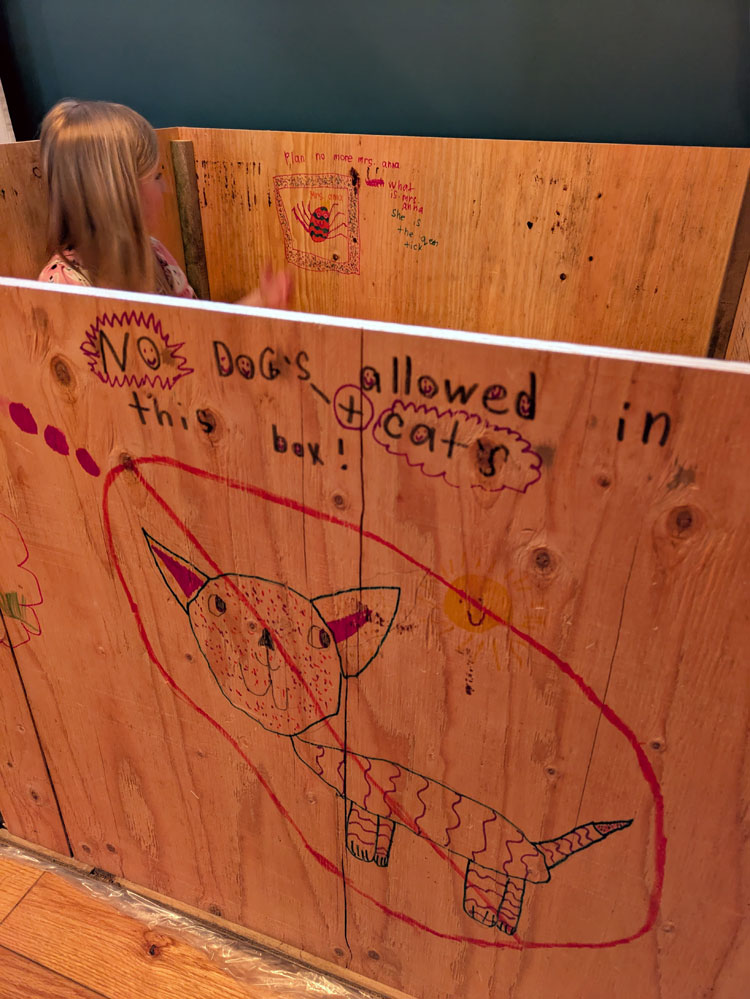
And here she is describing the decorations she added to the boxes. Many of the drawings are instructional. The birds received directions about eating ticks and learning the alphabet. Cigo got repeated lessons that birds are boring (and he absorbed those lessons so, so well).
We filled each box with wood shavings bought at the feed mill and added our waterers and food dishes (more details on food and water below).
At three weeks, we cleaned out the brooders and changed the shavings. The boxes were pretty stinky by that point, so to keep things pleasant in the house, a cleanout was needed.
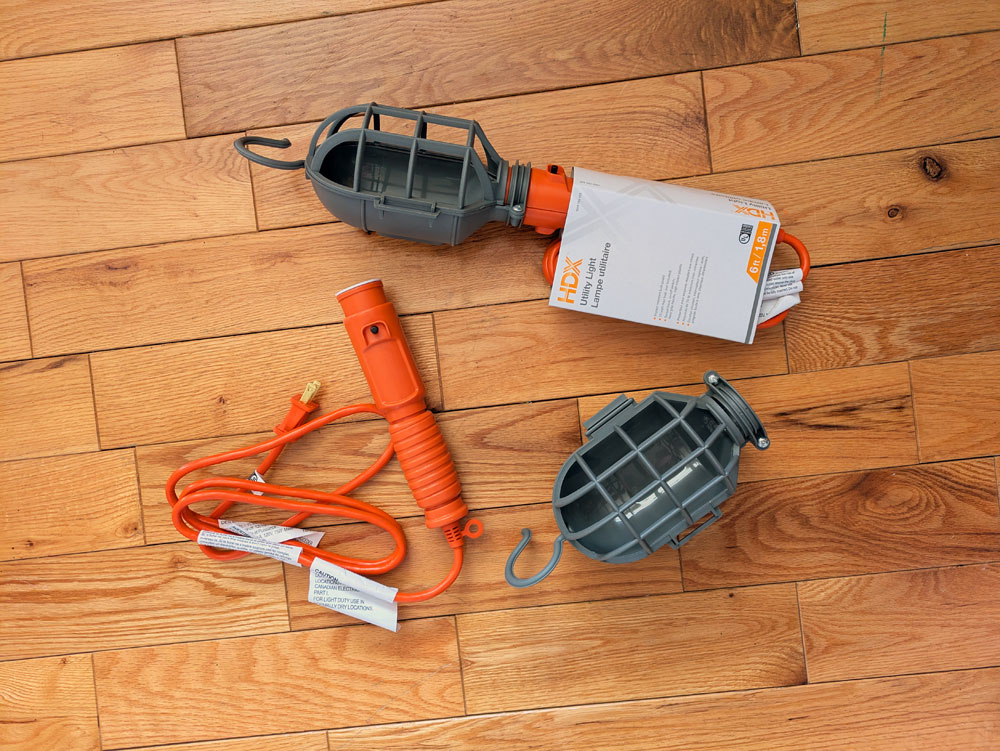
For warmth in the brooder we used some heat lamps we found in the barn. Growing up, I remember my Dad using basic lightbulbs. I bought a couple of utility lights and gave it a try, but I couldn’t get the temperature warm enough, so I went with the proper heat lamps.
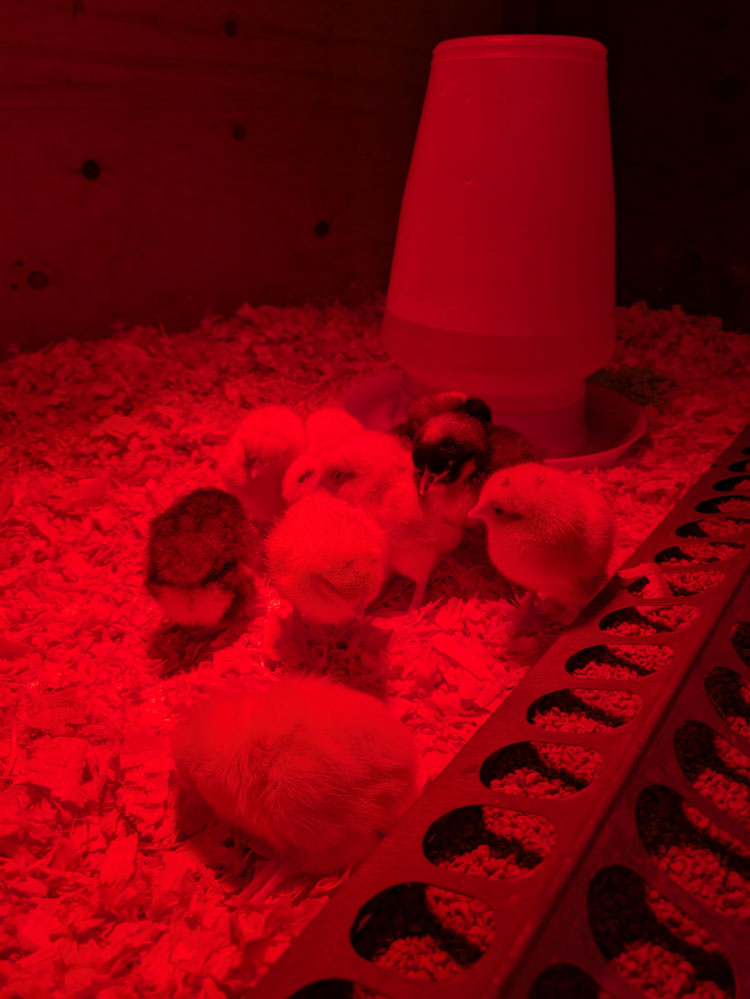
I set the lamps up on chains hanging from the ceiling. I started with the lights right at the top of the box. This allowed me to achieve the recommended temperatures for the chicks (33ºC) and poults (35ºC).
As the birds grew and I was able to decrease the temperature, I raised the lights higher above the brooders. At the beginning, I had thermometers in both boxes to keep an eye on the temperature. The birds ended up kicking the thermometers around, and I found they weren’t necessary. I watched the birds and adjusted the lights accordingly. If everyone was huddled along the edge of the brooder away from the light, I figured the temperature was too high. If they were hanging out comfortably in the middle, I left the light alone.
Regardless I raised the lights a few inches every week, as the birds needed less and less warmth (about 2ºC per week). At week 5, I began turning the lamps off during the day, and then I turned them off entirely to give the birds a few days to acclimatize before they went outside at week 6.
The temperature in the house was still significantly warmer than outside, so the move was still an adjustment, but the birds didn’t seem to have any issues (more on this below).
Food and water
For the turkeys I started with a basic bowl for their food. An information sheet I got from the feed mill recommended spreading a cloth over the shavings, I believe to help with traction. They also recommended sprinkling some feed on the cloth, so we did all of that.
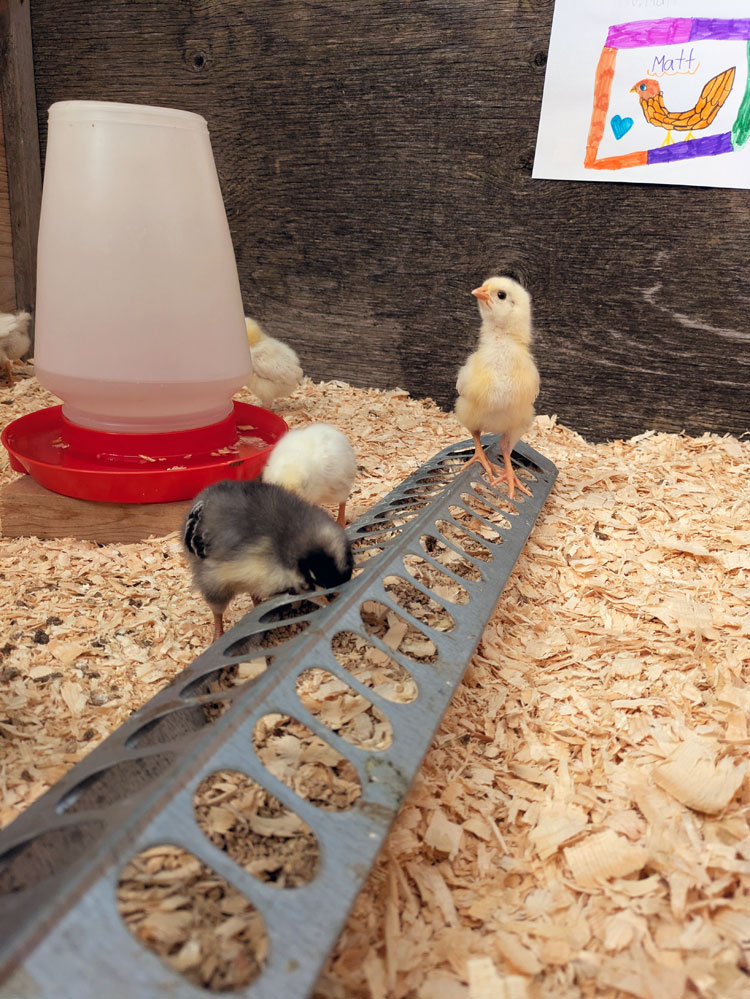
The chicks got an official chick feeder that was left in the barn by past owners. I’ve never used a chick feeder before, and it worked very well. They were able to access their food easily, they didn’t spill a lot, and the food stayed relatively clean. As the chicks grew, they kicked more and more shavings into the feeder. I think raising it up on a board once they’re bigger would be helpful.
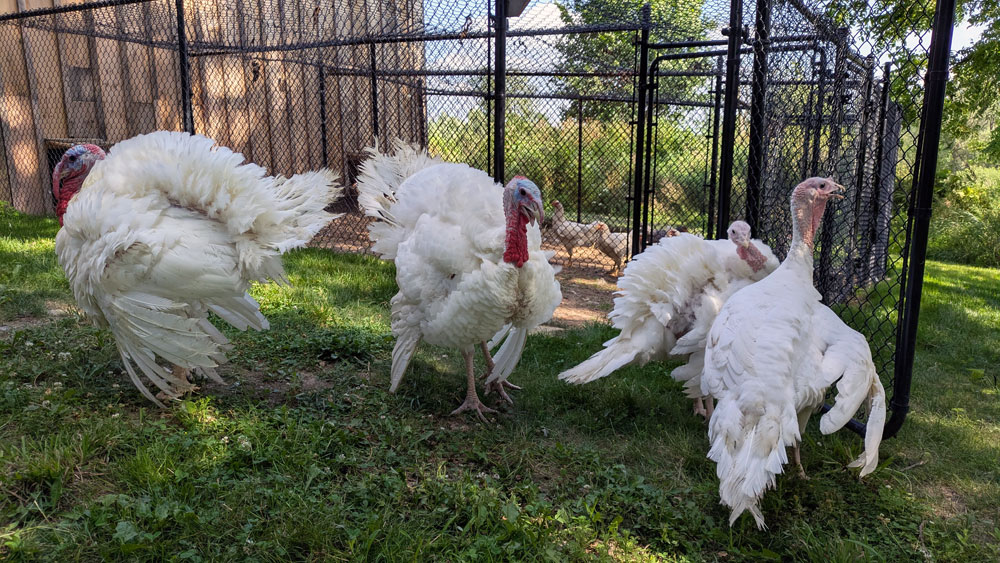
The turkeys graduated from their bowl (and the cloth covering) very quickly. Our turkeys are the Large White breed, and they are living up to their name. They eat constantly and grow so quickly. They stepped in their bowl, sat in it, pooped in it, tipped it over, emptied it.
I moved to another bowl that was in a little box to help stabilize it, and it only worked for a few days before they were too big again. I ended up with a small rectangular cement plant pot. It held more food and was a bit heavier so they couldn’t tip it as easily.
When I first put it in the brooder, I set it on a block of wood. The turkeys were so tall I thought it would help them to have their food a bit higher. A turkey climbed up to stand on the food dish, and he could see right over to the top of the box. It seemed like I’d given him an escape ladder. So the food dish went back down in the shavings. I’d like to find a better feeder solution if we do turkeys again.
At week 4, the chicks transitioned to a 50-50 mix of starter and grower food. I also started to mix the turkeys’ food. By week 6, everyone was fully eating grower. (The chicks will transition to a layer feed around week 18.)
In total, 10 chicks ate 20 pounds of starter. Four turkeys ate 40 pounds (!) of starter (they are monsters).
The waterers worked pretty well. When we first put the birds in the brooders, we dipped each of their beaks in the water. After this, they had no trouble finding the water themselves.
As the birds grew, I put the waterers up on wooden blocks so they could reach a bit easier and hopefully kick fewer shavings into the water.
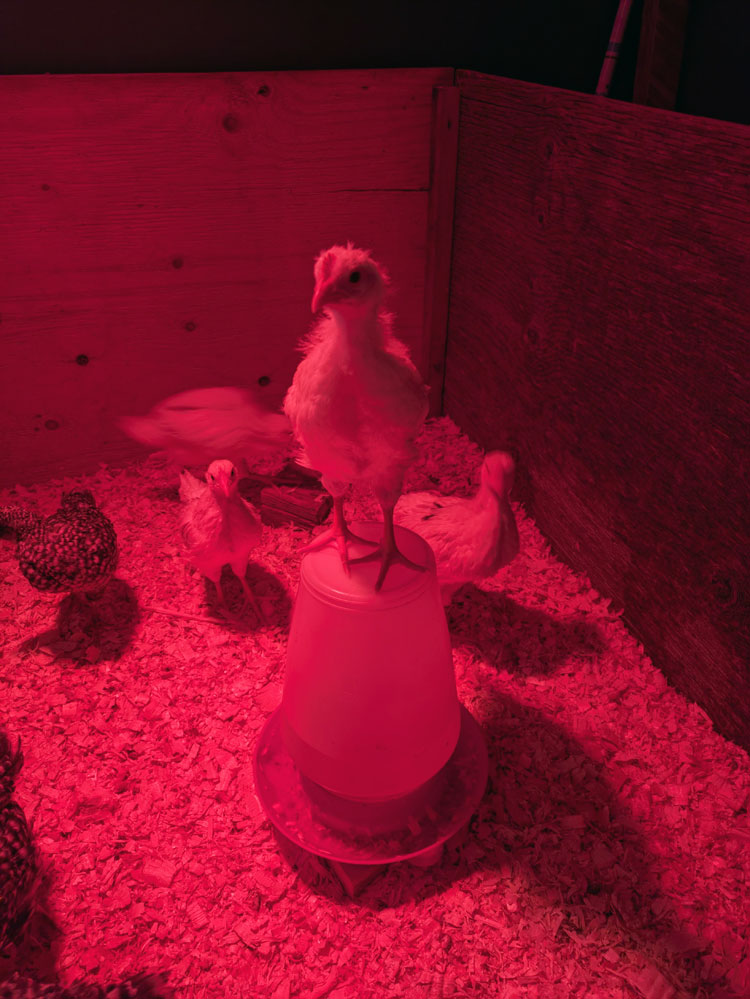
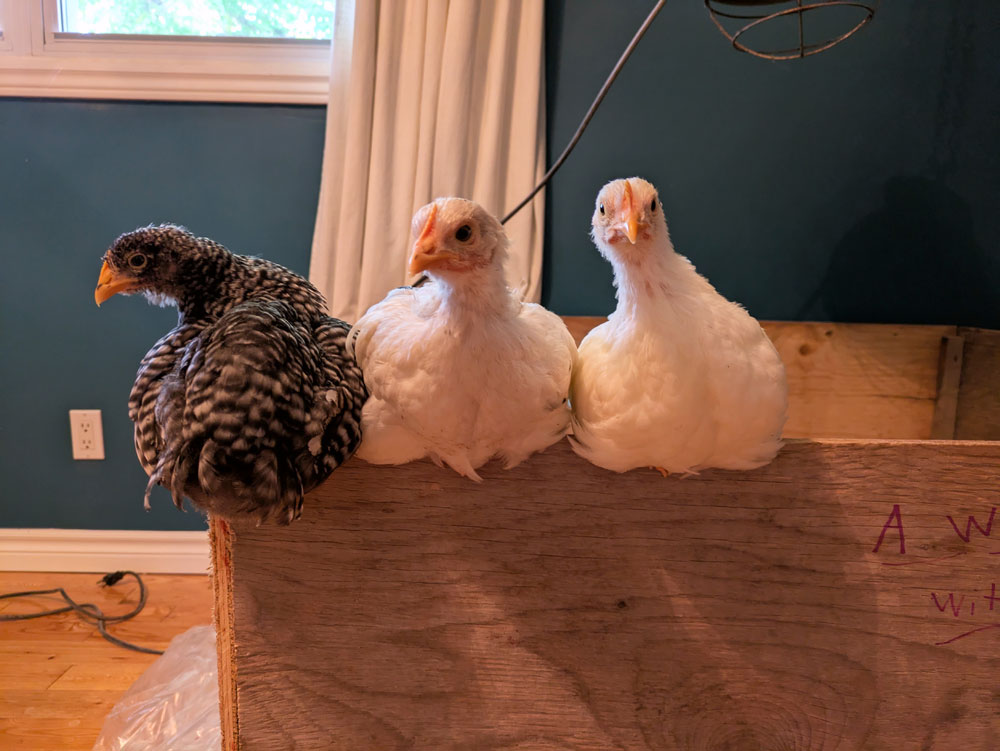
The chicks came to like to perch on top of their waterer. They didn’t use it as an escape ladder (though they easily could have), so the perching was not a problem.
The problem was the turkeys (again) who knocked their waterer over repeatedly. Wet shavings are not a good thing. Propping the waterer in the corner helped a bit, but they still managed to tip it from there.
Transition to the coop
When we first ordered the birds, I asked the staff at the feed mill when they could move outside. The answer was, “It depends.” Not helpful. Now that I’ve gone through one cycle, I understand that answer a little better. The forums at www.backyardchickens.com have also been helpful.
Birds can be outside without supplemental heat when they are fully feathered and the temperature is around 10-15ºC consistently day and night.
Our spring was a bit slow here this year, so getting to that consistent temperature took awhile. The birds ended up staying inside for nearly 6 weeks. By the end, that felt long.
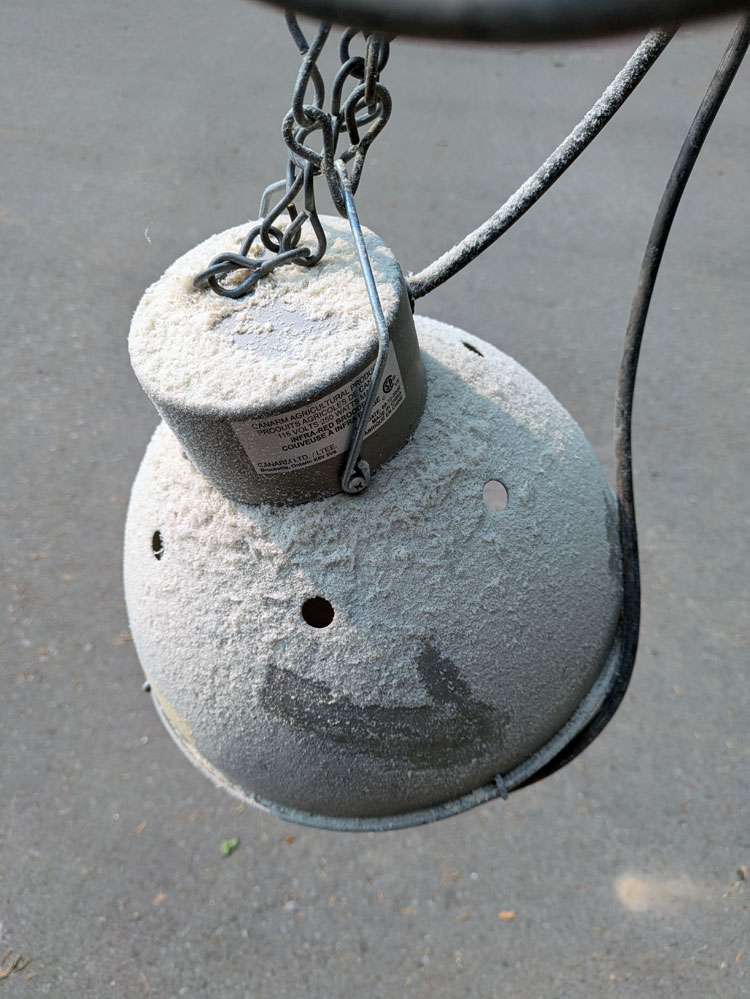
Things were pretty stinky and dusty. Between poop, feather fluff and sawdust, I felt like I was living in a barn. The photo below shows the amount of dust on the heat lamp when I finally took everything down. This dust went everywhere.
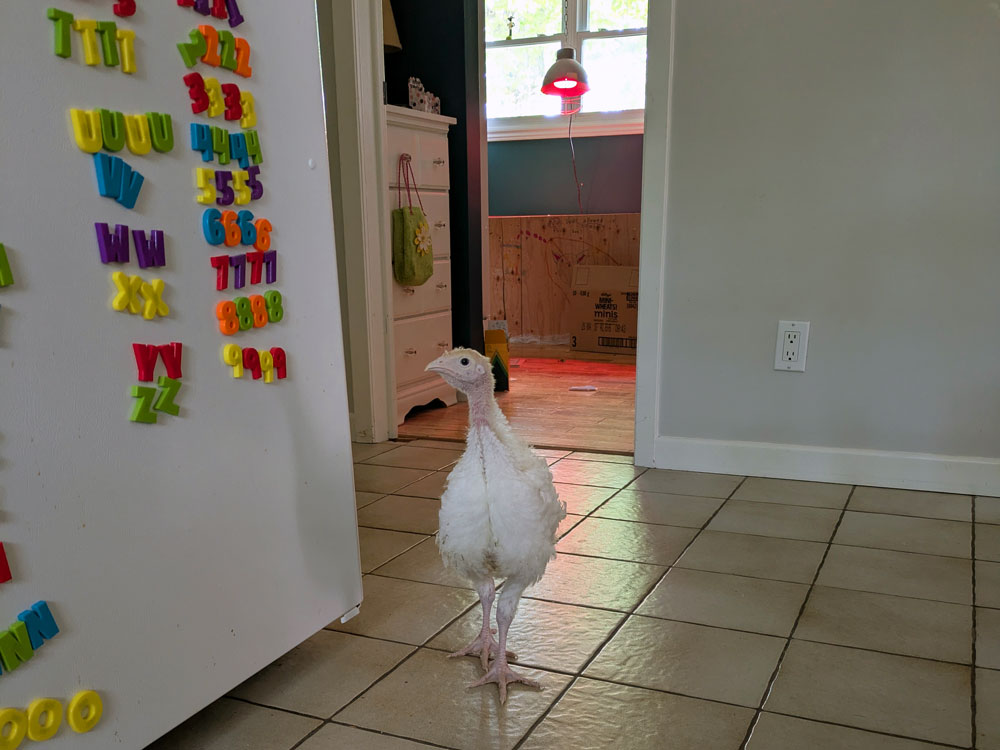
Everyone was big enough to hop out of the brooders. The turkeys have no coordination, so they were always surprised when it happened. The chicks had more control, so they mostly perched on the edge of the box or tight roped along the top. A couple did fall into the turkey box, which they turkeys did not appreciate. Fortunately, I was always nearby to rescue.
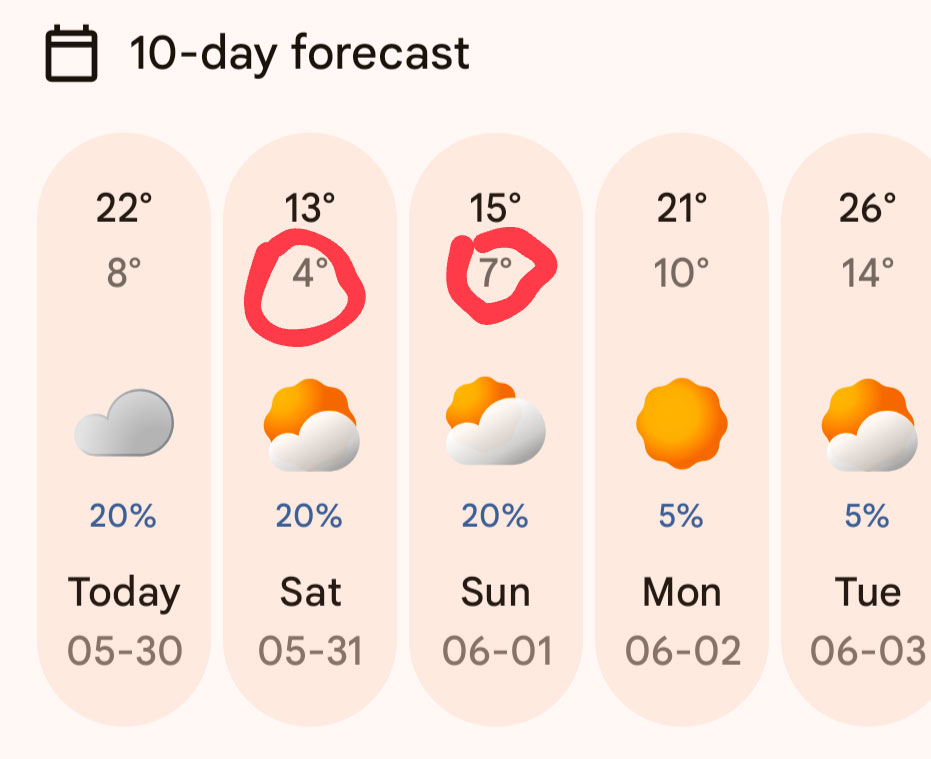
Then the turkeys started to fight. That was my sign they were over-crowded and had outgrown the brooder. On a warm Friday morning, I very quickly transferred some cantankerous turkeys to the run outside. Then I spent the day debating whether they could stay out. The weekend forecast was quite cold. What was worse? Fighting in the house? Or freezing in the barn?
We decided to keep them outside, and they did just fine. For the first weekend, we kept them locked in the barn where it was warmer, but when it finally warmed up the next week, they were thrilled to be out in the run.
The chickens joined them in the coop at officially 6 weeks and everyone transitioned without issue.
Final thoughts
Overall, our brooder set up worked very well. Everyone was safe and comfortable for a long time. I liked having day-olds. I feel like it’s a fun way to for everyone to get used to each other. Brooding the birds in the house was easy, albeit smelly and dusty by the end.
If we do birds again, I might try to move them outside around 3 or 4 weeks. Getting them a bit later in the spring would hopefully mean more favourable temperatures. I would also like to work on the wiring in the barn so we can have some heat out there safely if we need to.
So far, the birds have been a really fun experience. We’re definitely learning as we go, but the preparation we put into the coop and the brooders have worked out well. Two months in, I feel like we’re off to a good start.
The birds moved into the coop about a week ago, and I am proud to say this project is done.
Today I’m going to share all the finishing touches that went into completing this space.
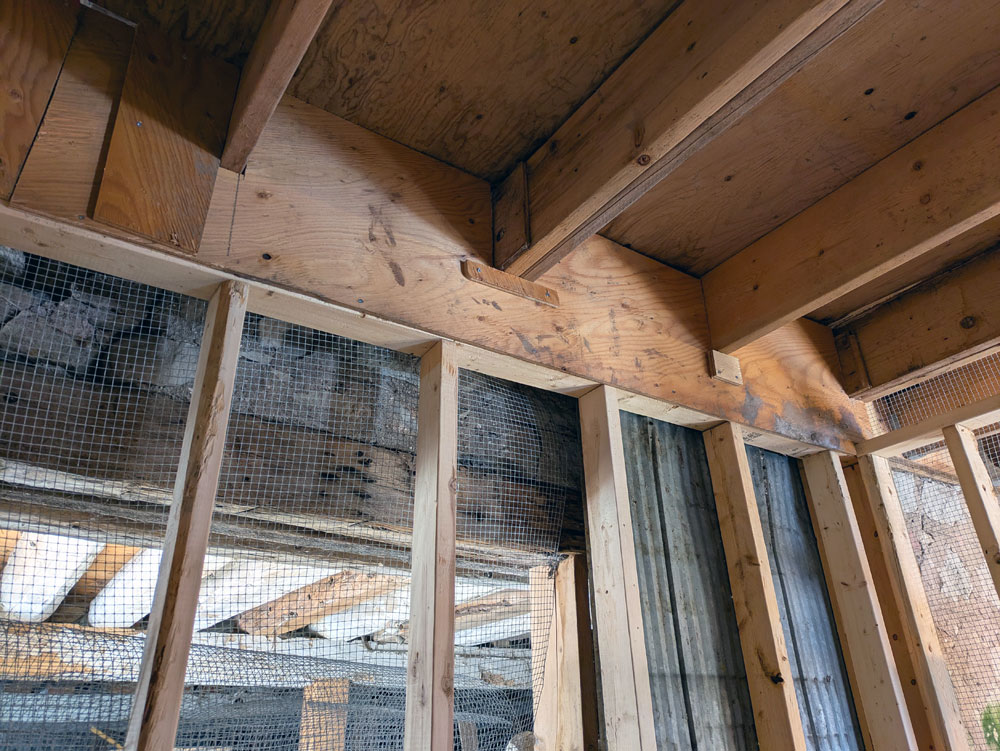
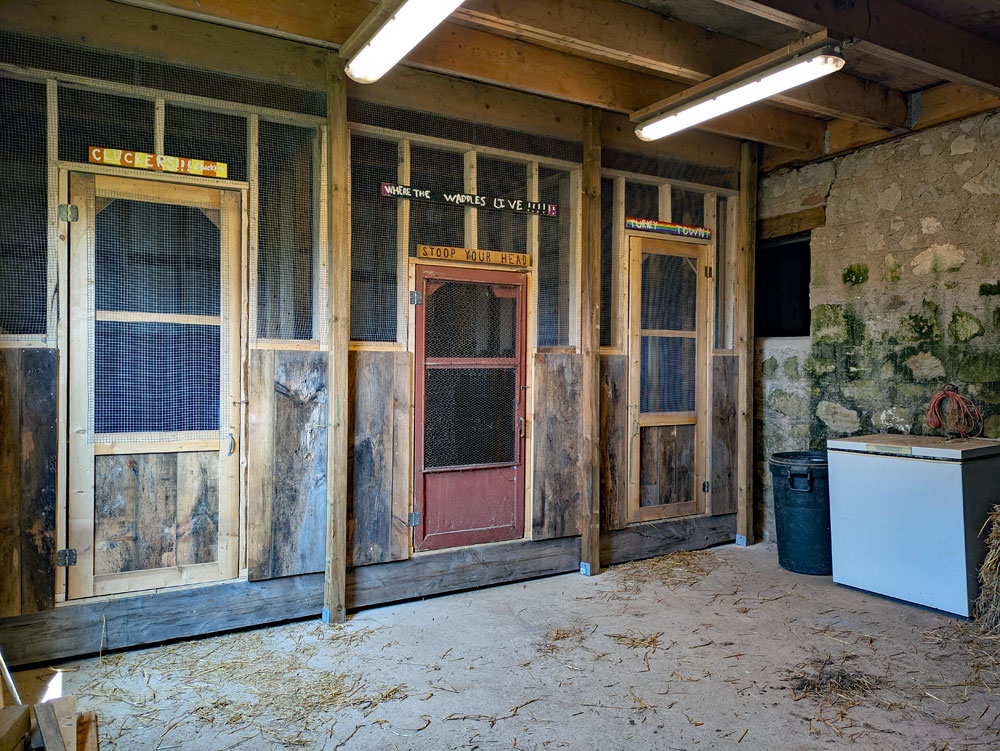
When we last visited the inside, the walls and doors were done, but the pens were not fully secure. I added mesh, boards, whatever worked around the perimeter of the coop along the ceiling. This will hopefully ensure that no climbing crawling predators can sneak over the top of a wall. It was fiddly work to make everything fit.
I also added a motion activated solar light on the back of the barn as an extra deterrent to anyone who comes creeping up through the field.
Then I needed to fit out the interior of the pens.
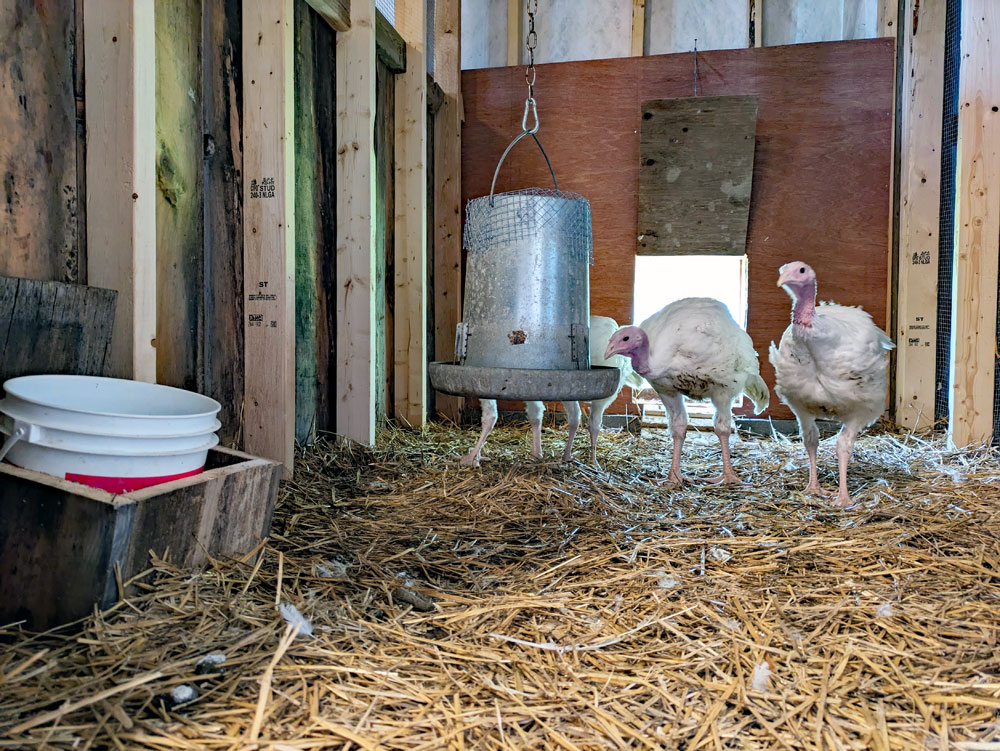
For the turkeys, this was simple: a feeder and a waterer. I found an old metal hopper feeder in the barn, so we washed it out, covered the top with mesh (to hopefully dissuade rodents) and hung it from the ceiling. It’s working very well for the turkeys. For their water, I went with a simple bucket. I built a little box to hold the bucket so the turkeys can’t tip it over (something they loved to do in the brooder). Right now the box is sitting on the floor, but I can attach it to the wall if I want to raise it up.
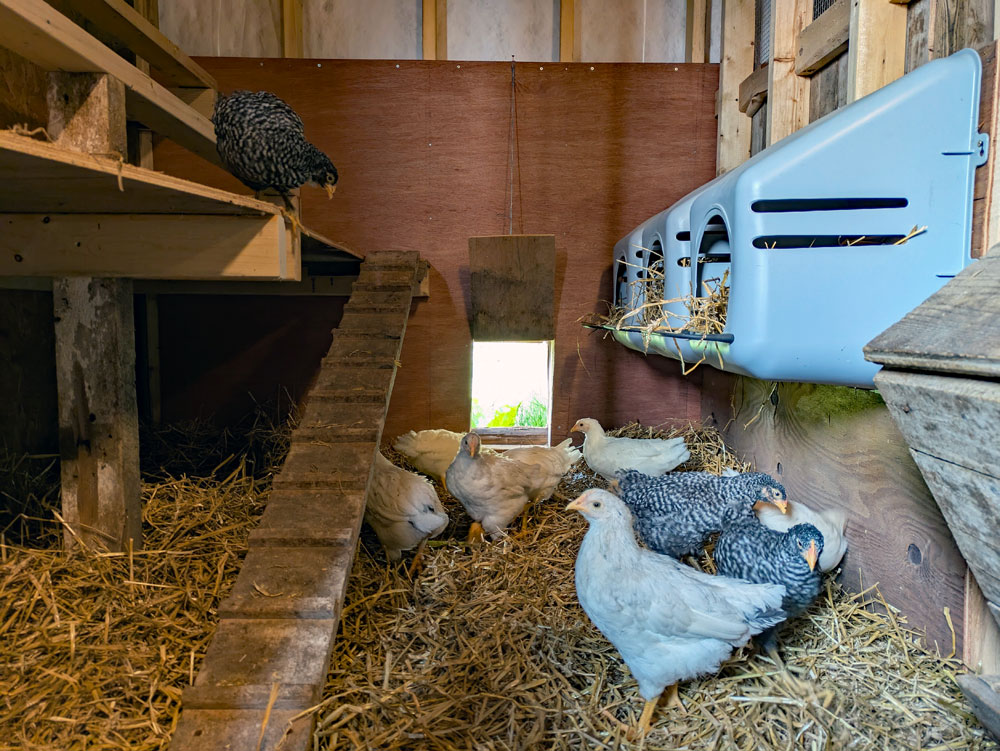
The chicken fit out took a little more work… and a relocation. The hens needed a few more things in their stall. Water and food, of course. But also nesting boxes and roosts. As I was planning the roosts, I realized everything wasn’t going to fit in the centre stall, which I had assigned to the chicks. But the end stall was a few inches bigger… just big enough for everything they needed. So they moved next door.
The nesting boxes are simple plastic bins that screw to the wall. They lift off the screws easily so I can dump out the straw or even rinse them out if I need to.
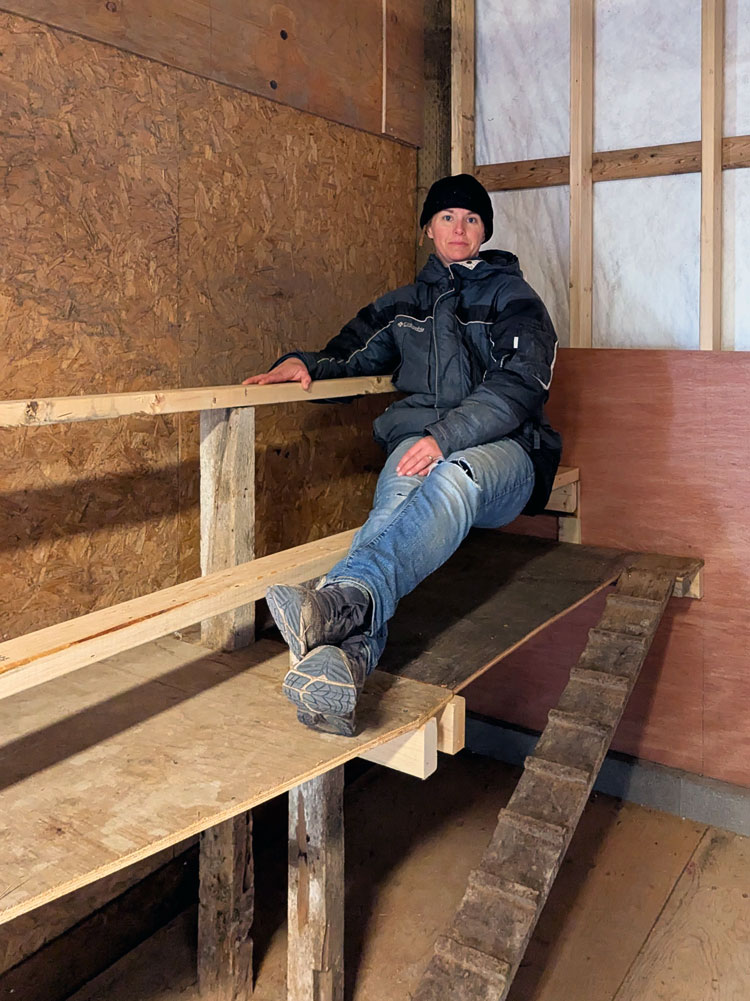
For the roost, I spent some time researching to figure out the best approach. Here’s what I found. Build your roost as the highest option in the pen. Chickens like to be high to sleep, so if your nesting boxes are the highest thing, that’s where they’ll sleep. Since I want them to sleep on the roost, I made sure the roosts were higher than the nesting boxes.
I also found that chickens like a sturdier perch. They are not songbirds who will wrap their toes around a branch (although watching them walk along the edge of the brooder box, I think they do pretty well). So I went with 2x4s laid flat for a nice wide perch.
The other topic was optimal spacing. The recommendation was 12 inches per bird. Since our order was for 15 birds, that meant 15 feet of roost. Our pens are 8 feet long, so this worked out easily to 2 roosts along one side of the pen.
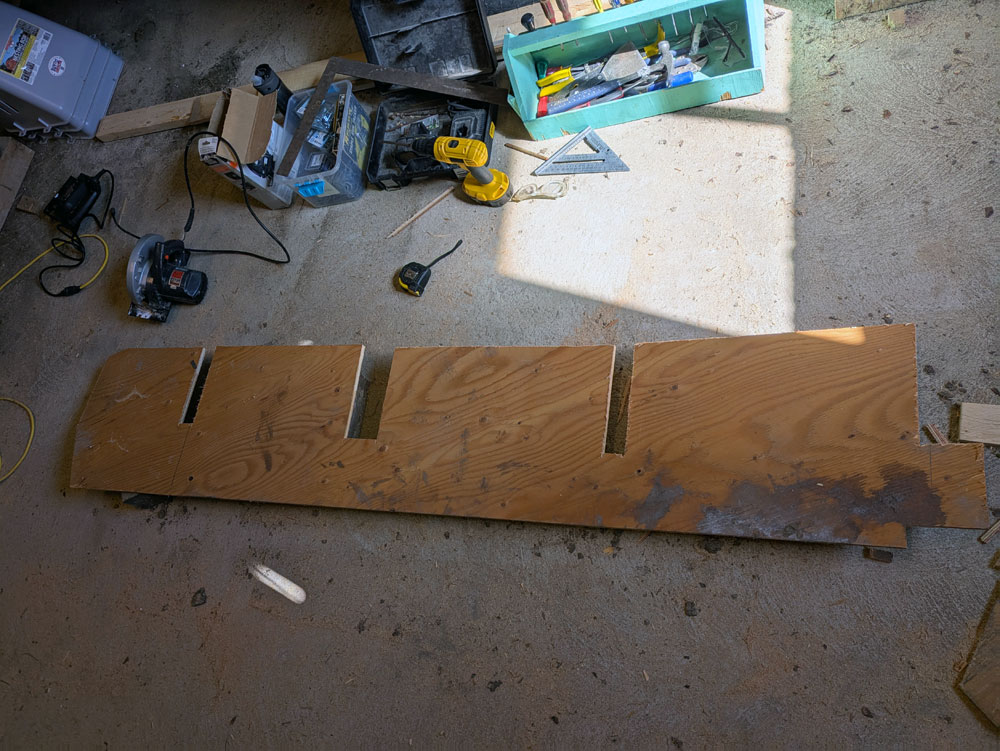
A feature I added courtesy of my Dad is a poop board under the roosts. Roosts tend to be a messy area. Chickens poop in their sleep and sometimes even lay an egg. The board under the roosts will hopefully catch the mess and then I can easily scrape it off, rather than changing all of their bedding.
All of my research and planning complete, I went to work and built the roost. Along the way I also decreased our chicken order. The pen was starting to look a bit tight, and I was worried the birds would be too crowded. So I dropped our order to 9 birds. We ended up with 10, as the hatchery seems to have a practice of giving 1 extra chick. We have lots of room for everyone to be comfortable… and we’ll still have lots of eggs.
The roost turned out well… nice and sturdy. (From my attire, you can tell when I was working on this.)
Then I added a little ramp that we had from the old coop in case any birds needed help getting up. It’s on a hinge so we can easily lift it out of the way when we need to clean out the stall.
The final touch was, once again, feed and water. The chicks have another bucket in a box, just like the turkeys for their water. For their feeder, I went with a wall mounted version to save space. This was another souvenir from the old coop that happened to fit perfectly in the remaining wall space.
After the first week, I made a couple of adjustments to decrease the size of the opening where the food comes out, because the chicks were spilling a lot of food, but otherwise it seems to be working well.
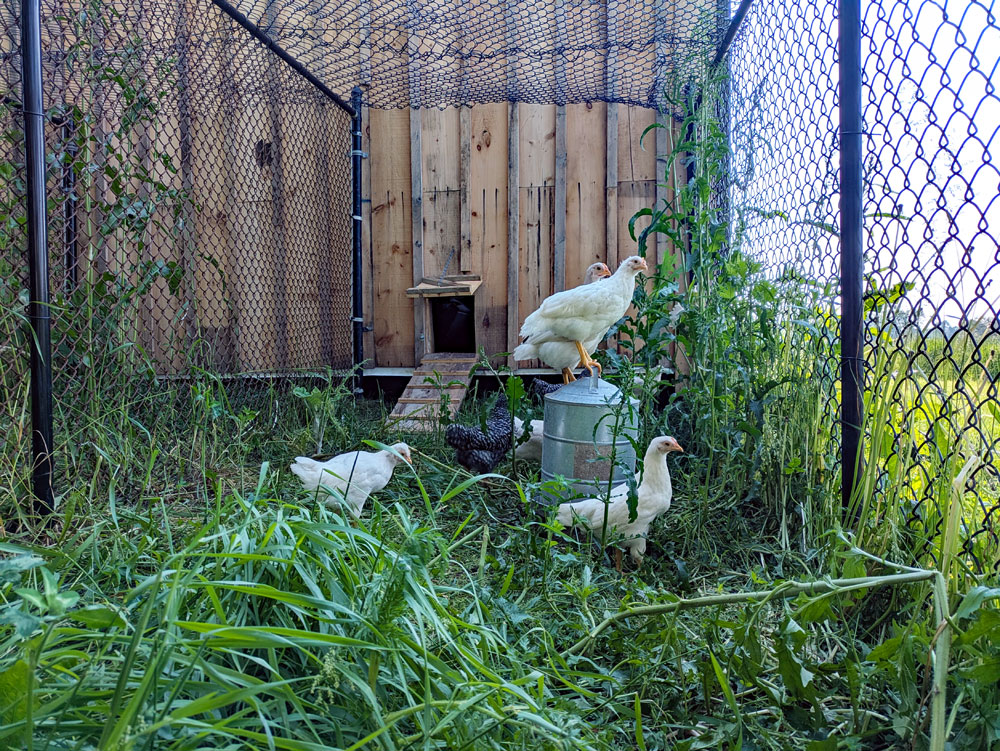
Each flock also has water in the run with two large metal waterers that we had stashed in the barn. (Yes, that is 2 chicks standing on top of the waterer.)
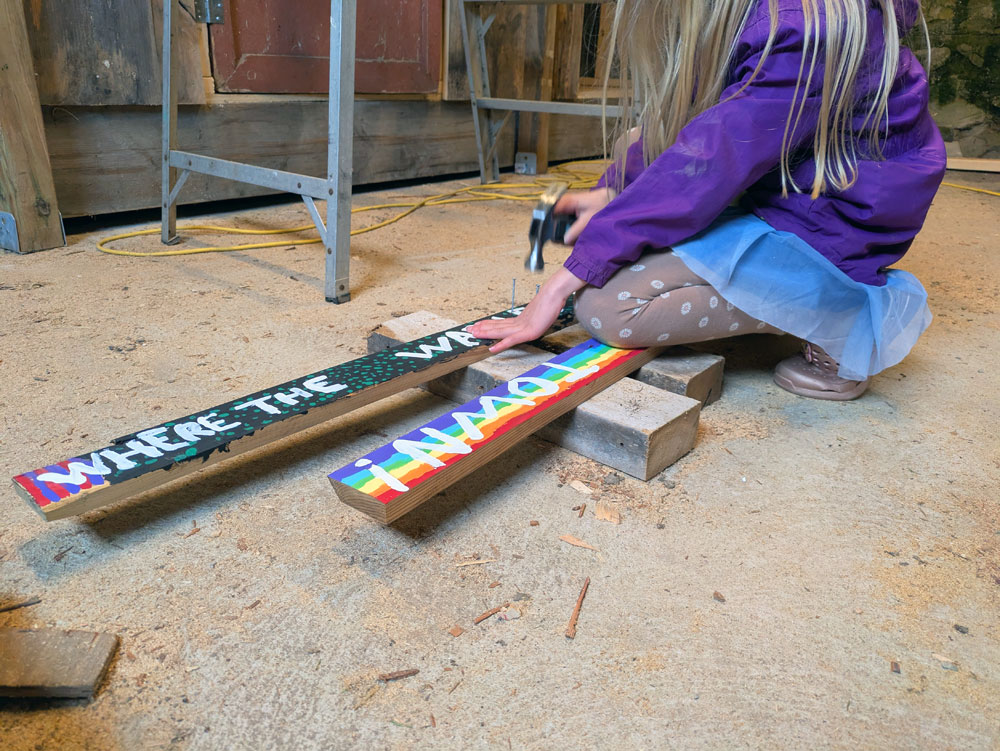
Ellie made some signs for each pen. The turkeys live in Turkey Town. The centre stall is Where the Waddles (will) Live. The hens are The Cluckers.
The final detail came from my Mom who bought me a coop warming present of a happy red geranium. This hangs by the door on a chicken plant hanger that used to be on the side of the house. I kept it during the garage demo and have been saving it for exactly this spot.
Since the turkeys and chicks moved in everything has been working really well. They seem comfortable in their pens and in the runs. We lock them in every evening, and it’s an easy task to move through the run, herd them inside, drop their little doors and latch them shut.
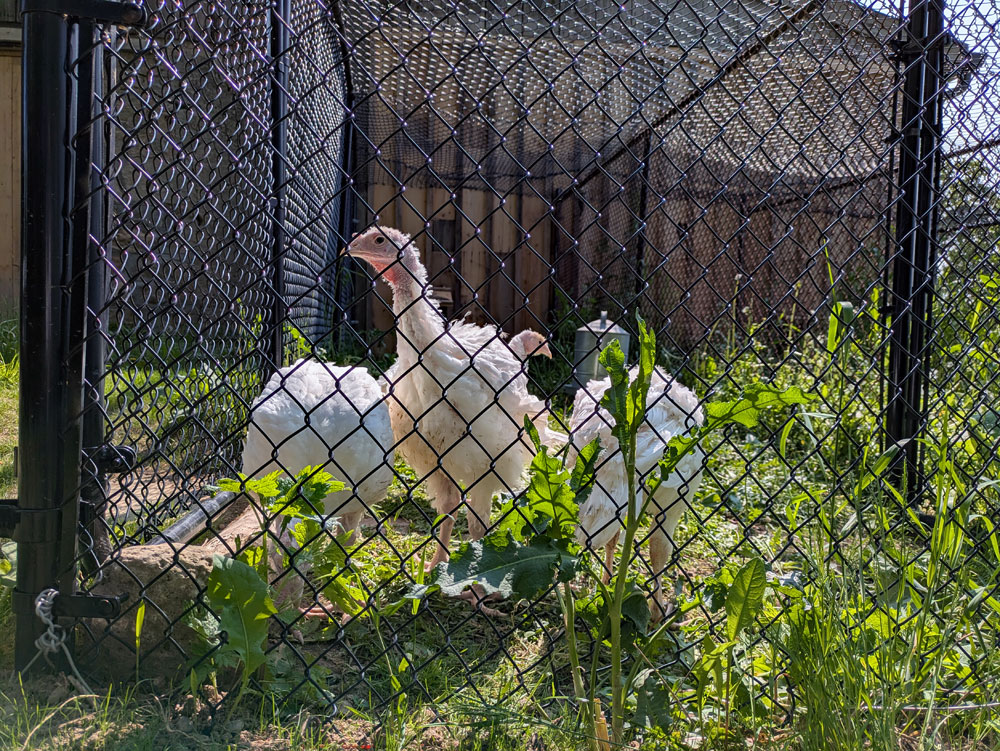
In the morning we open the little doors and they pop right out flapping and stretching. They’re eating down the grass and weeds that had grown pretty high in the runs.
I opened the gate between the Waddles and the Cluckers runs, so the chickens have double outdoor space. I had wanted this option during the run construction, which is why I had our contractor add extra gates. I’m pleased that it’s working as I envisioned. It’s nice to give the chickens some extra space and this way the grass doesn’t get overgrown. Win-win.
As a whole, the coop is working as I planned. I’m so proud of this project. It was a big build for me. I had help along the way on demo with my cousins, clean up with our landscapers, fencing with our contractors, walls and more fencing with Matt’s Dad, which I’m very grateful for. But the design and most of the work is mine.
It took figuring and muscle and time and energy and skill. I had what it took and I made it happen. It’s a really good feeling to see the birds in there, chirping (no clucks or gobbles yet), scratching, eating, drinking, snoozing, flapping… birding as they’re supposed to.
Thanks so much for following along with this project and cheering me on throughout it.
I shared the final video updates of the coop construction on Instagram. Follow me at juliaon129acres. If you want to relive the whole construction process, check out the coop highlights (part 1, part 2, part 3).
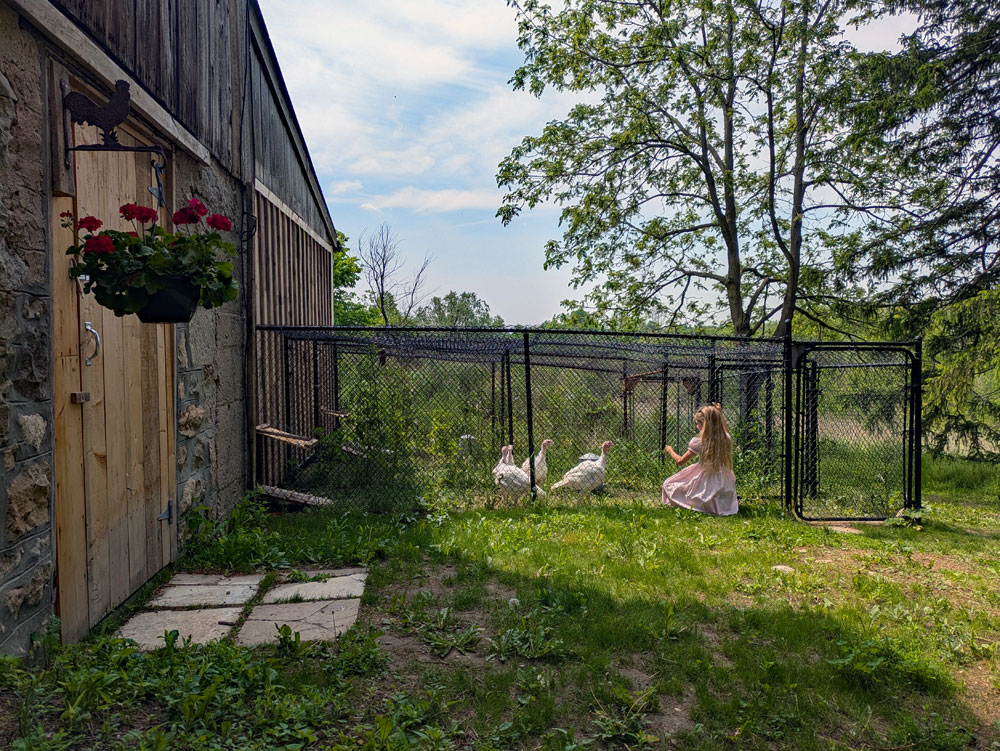
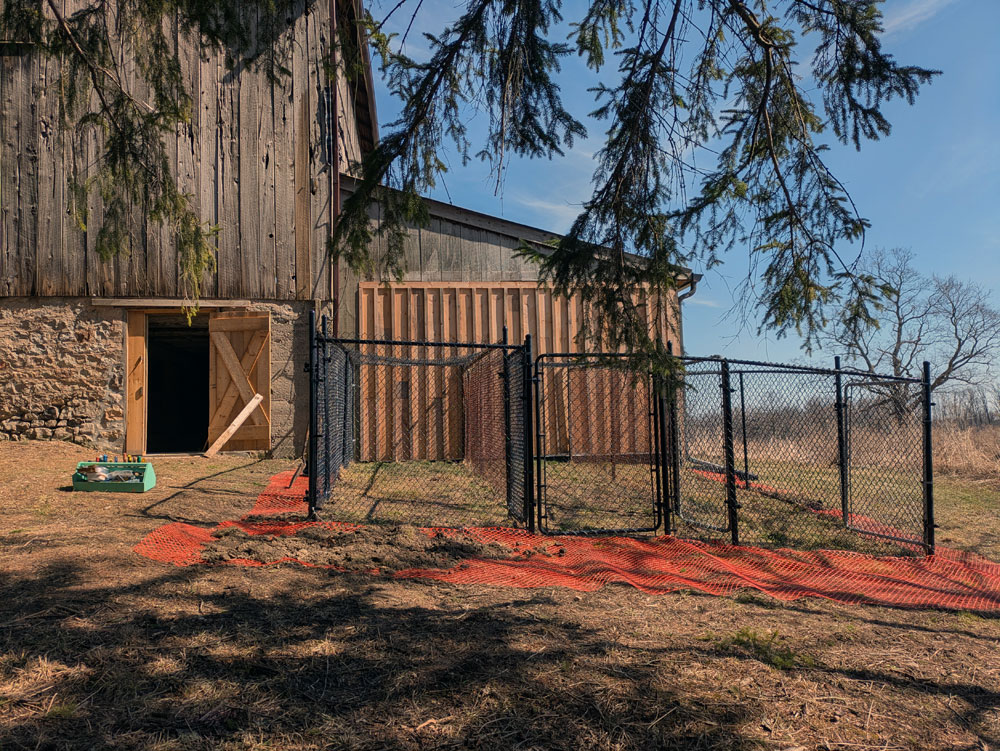
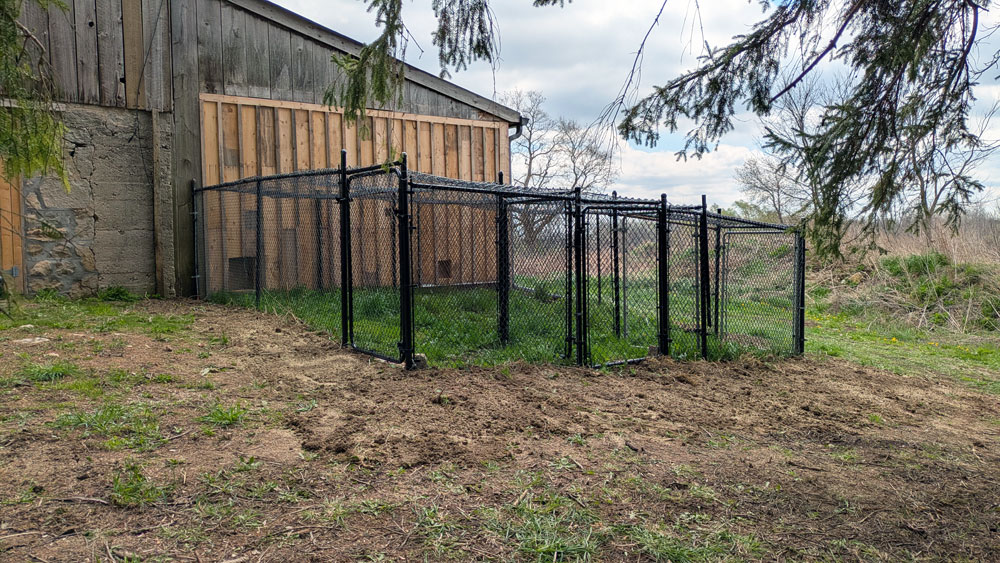
When we last visited the coop, the interior was in good shape. As the weather warmed this spring, I shifted my attention back outside to finish the run. You may recall I had a contractor install fencing for three outdoor pens back in the fall. I was very glad to hire that job out. But there were still things for me to do.
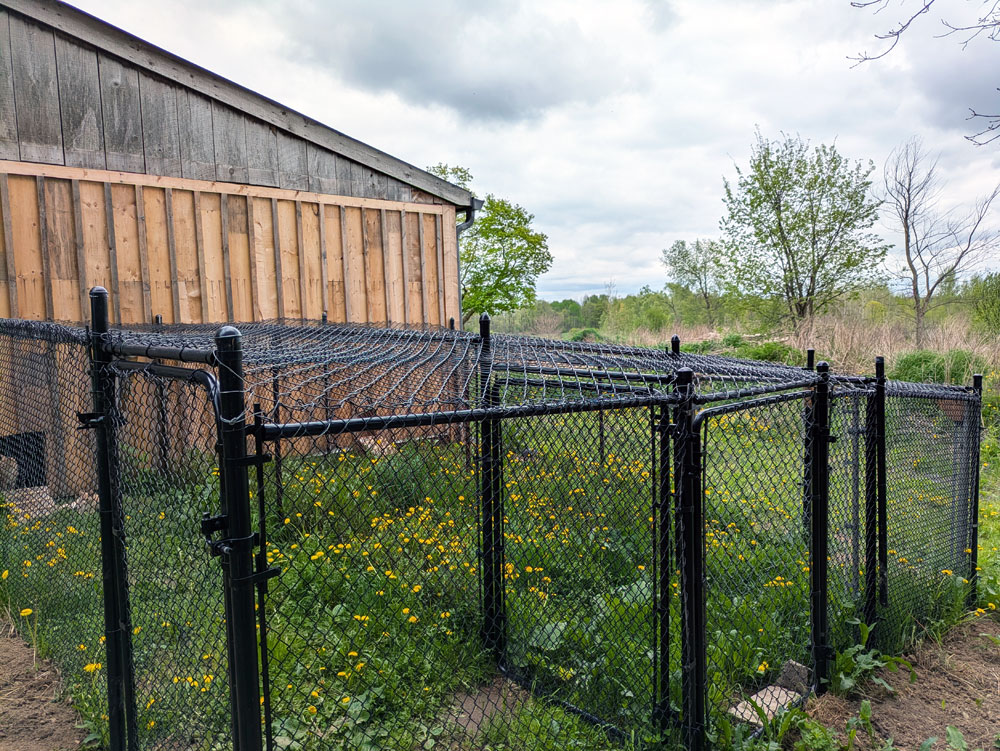
In my quest to make the coop as secure as possible, I wanted to cover the top of the run so no hawks, possums or other predators can get in.
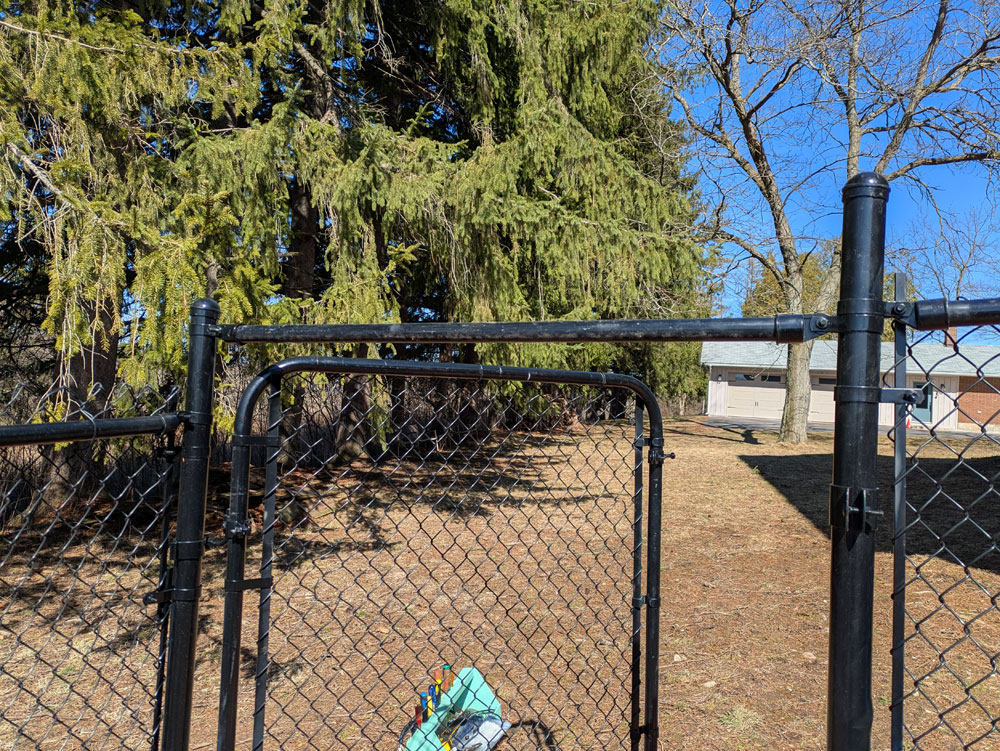
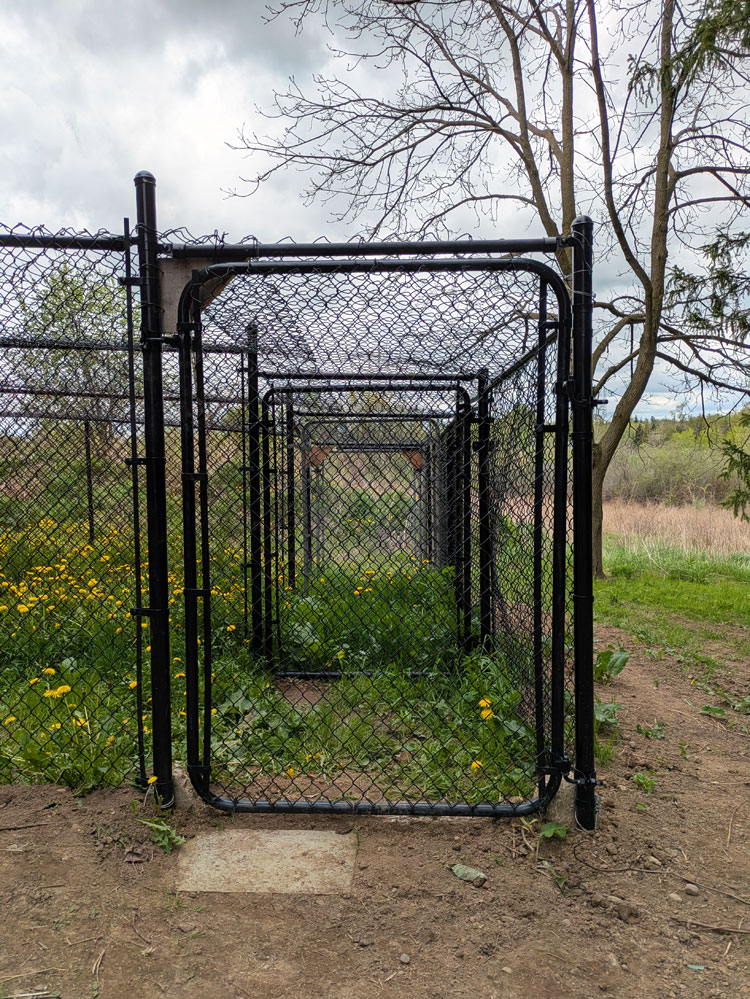
I still had chainlink left over from the pen construction, so I planned to stretch that over the top. I added top rails over each of the gates to attach the fencing to and then I started to lay out the roof.
I quickly discovered it was not a one-woman job. Attaching the roof to the barn or the existing fence while pulling it tight was not fun. So I called Matt’s Dad, and he came and helped.
We laid strips of fencing over the top of the runs, stapling it to the barn wall, attaching it to each vertical section and then wiring each strip to the one beside it. Unless a predator brings plyers I don’t think they’re getting in.
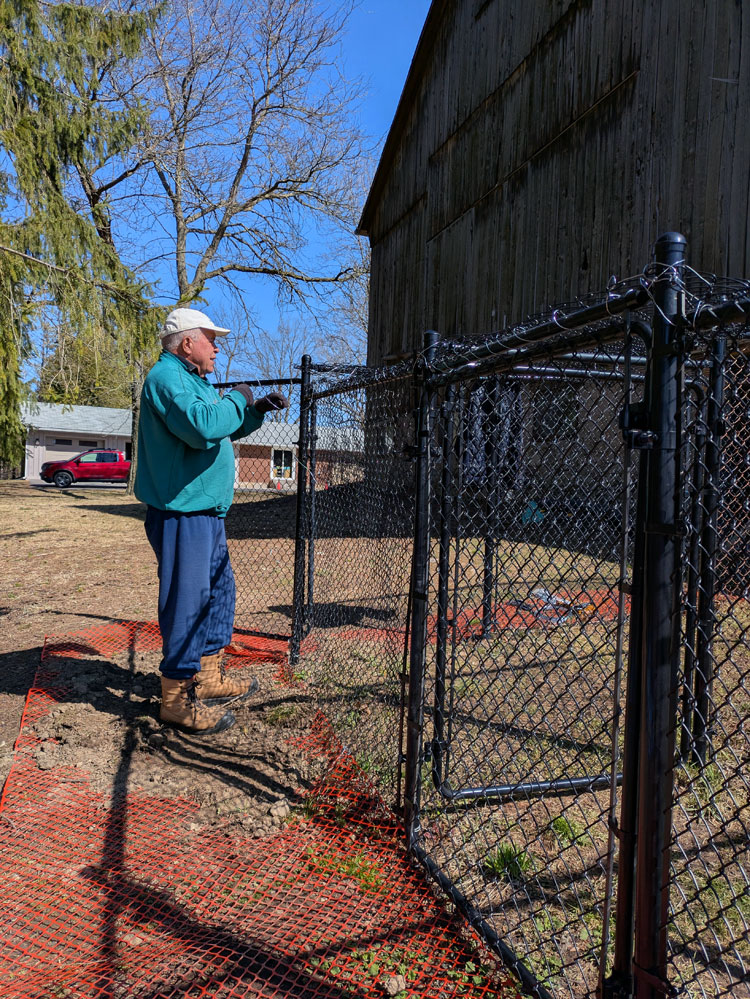
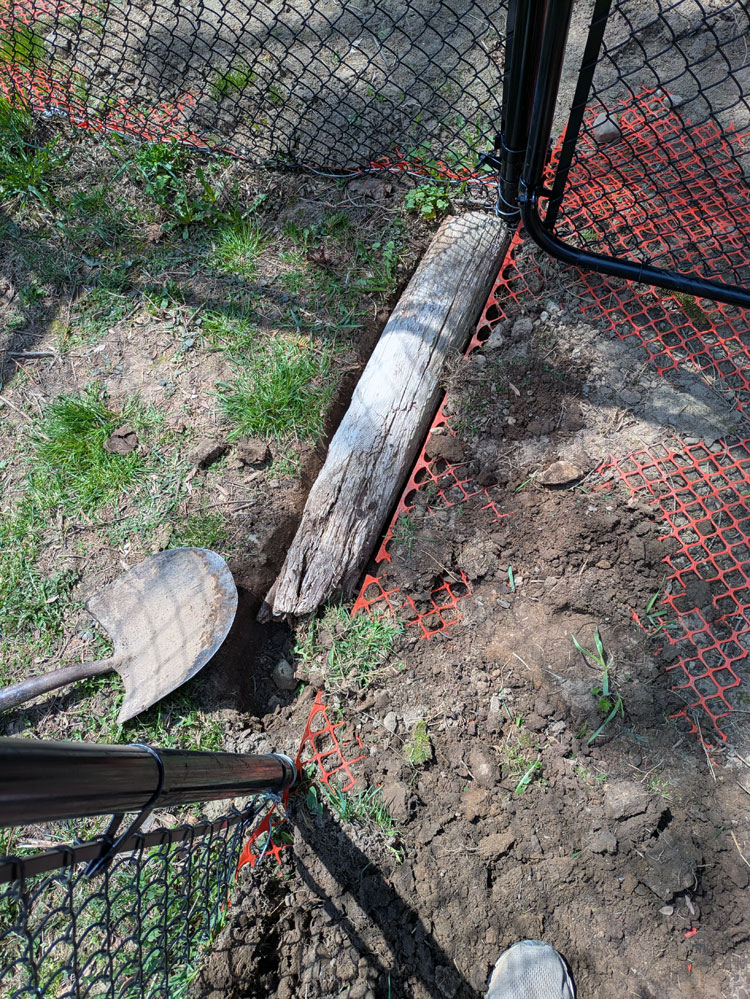
We also laid more mesh around the ground. This will hopefully stop anyone from digging in. All of the mesh is wired to the fence along the bottom and then buried in dirt.
I adjusted all of the gates to make sure they swung easily and latched securely. Between installing the roof and frost this winter, some of the posts had shifted slightly.
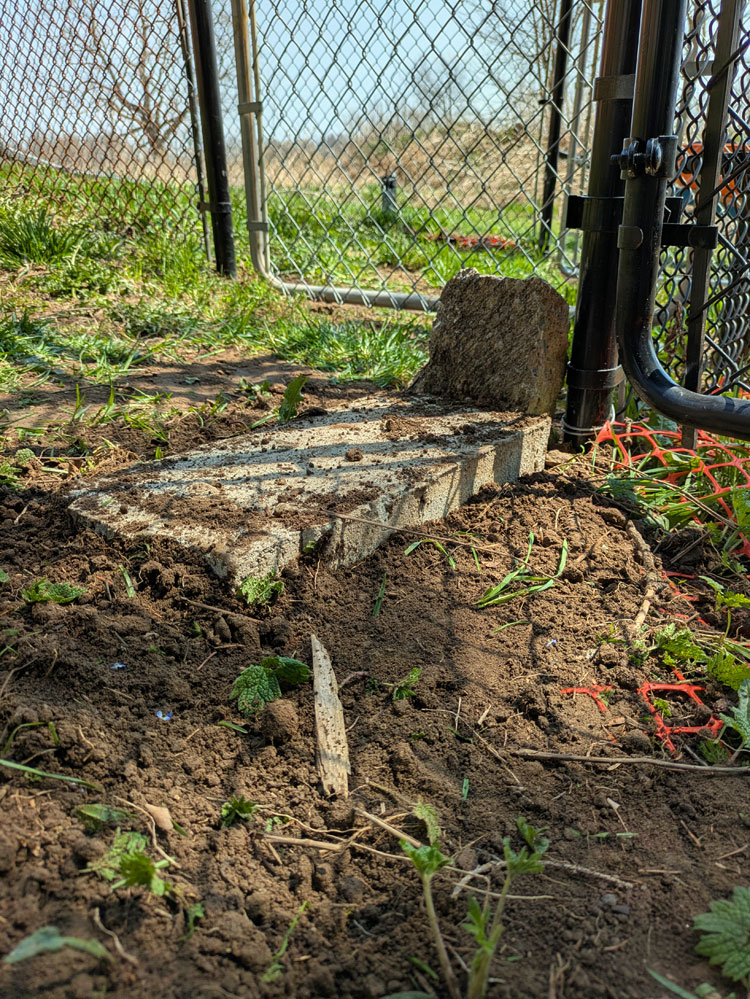
Then I blocked any little gaps around gates or corners that looked big enough for a creature to crawl through. This involved an old fence post and stepping stones as thresholds, metal posts, rocks, wood corner blocks… whatever worked.
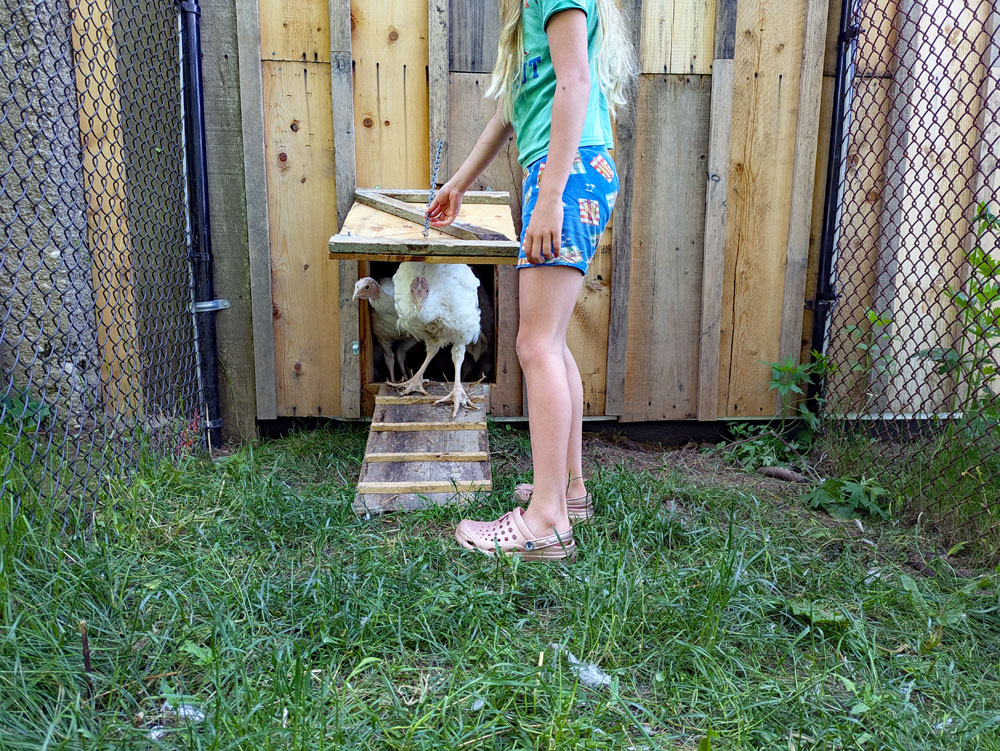
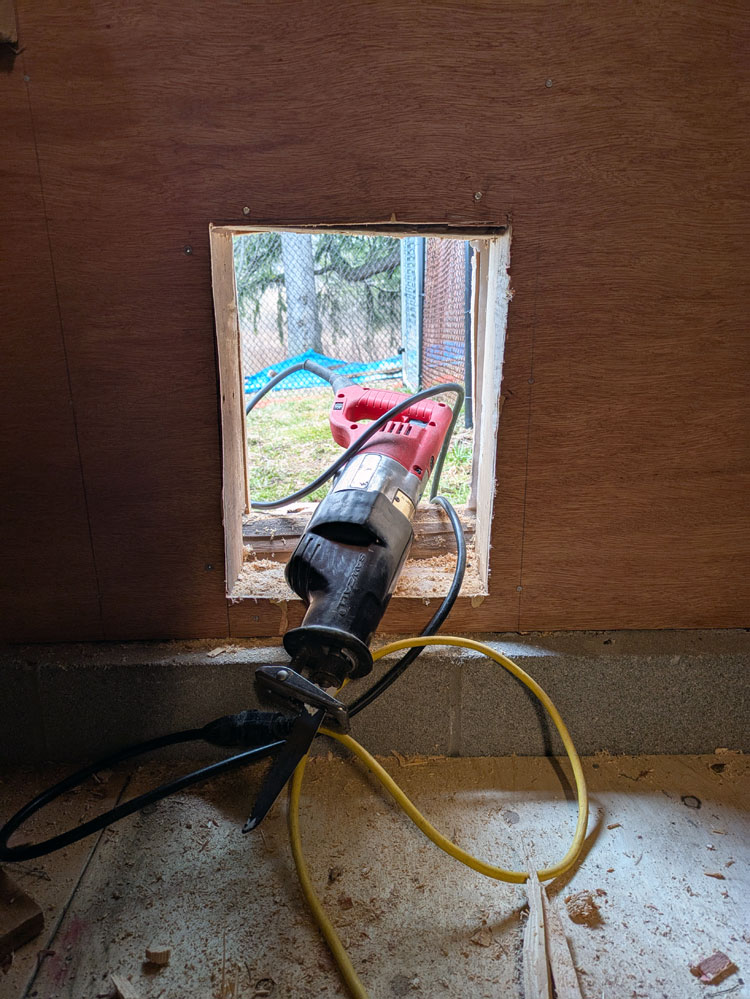
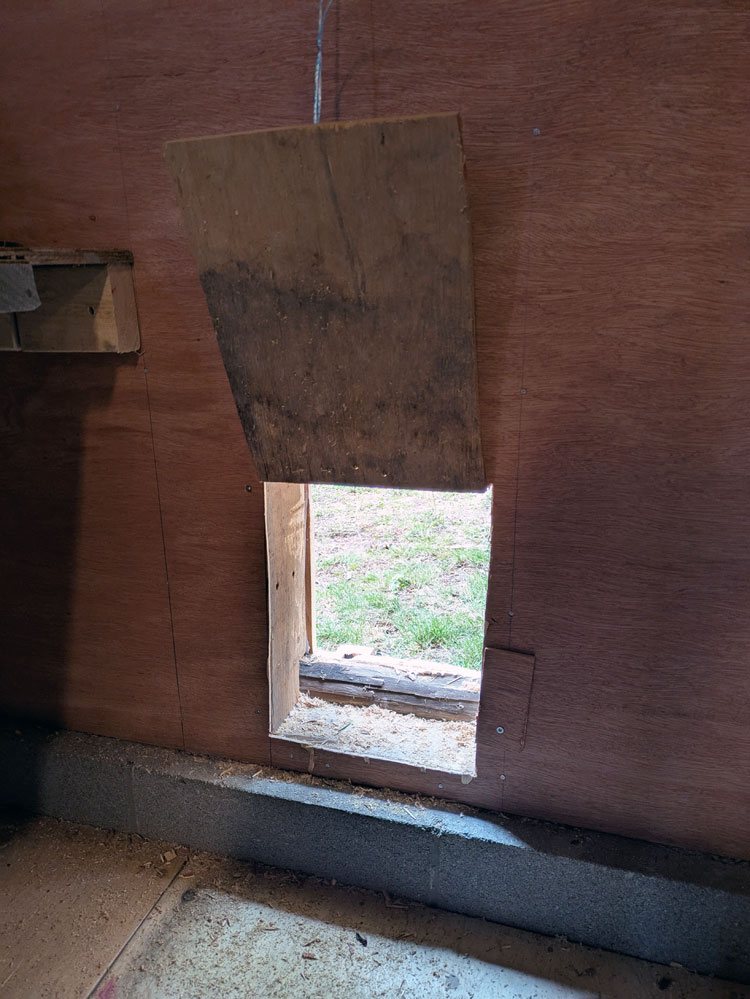
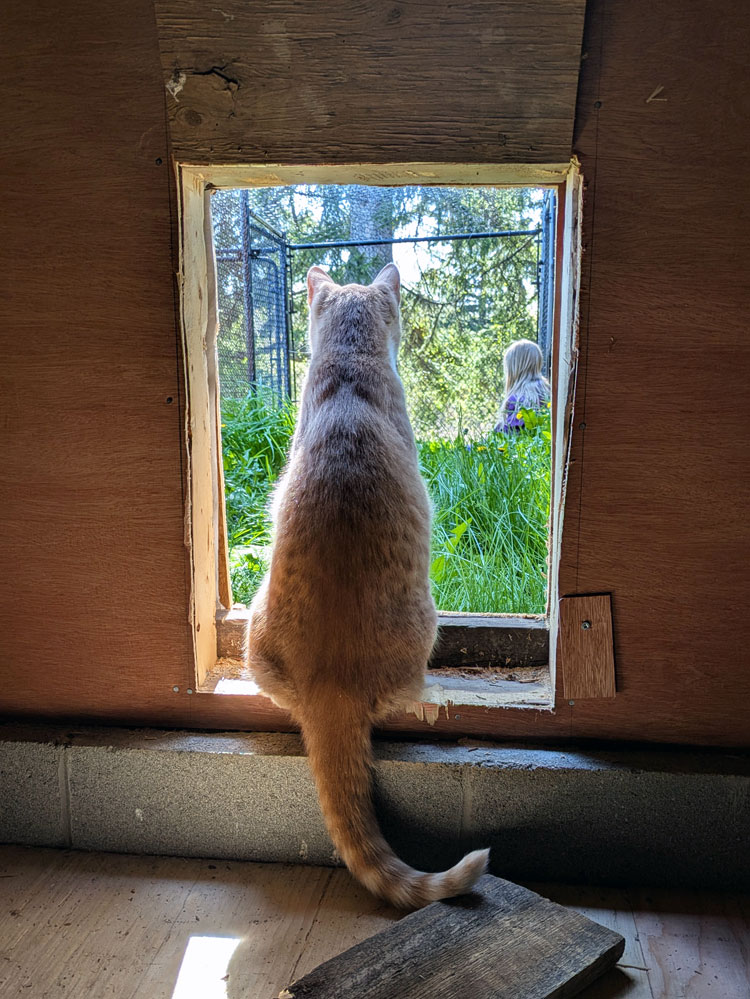
I also cut little doors in the wall of the barn. This will allow the birds (and currently the cats) access to the runs. Hatches can swing down to close the doors.
(Cedar figured out how to unlock the little button that kept the door closed, so for now the cats are enjoying going outside whenever they want. I’m hoping the birds aren’t quite as dexterous.)
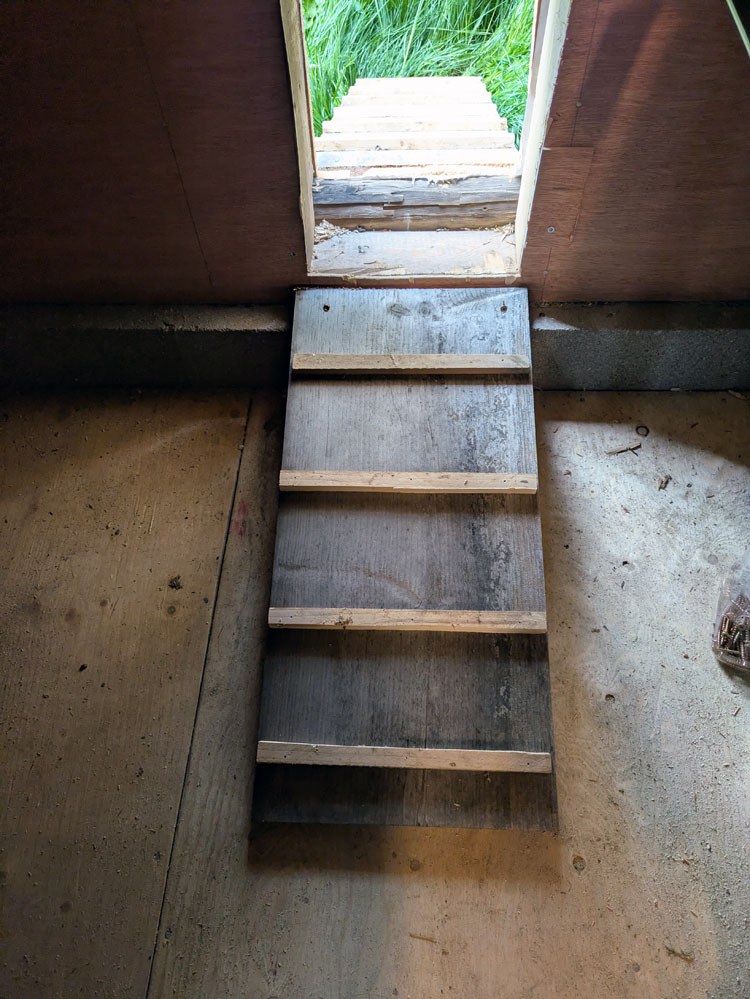
Then I built ramps to make it easy for everyone to get in and out. I expect the hens will be able to hop or flap, but a full grown turkey may not be so acrobatic.
And with that, the runs are done.
The birds are hopping and flapping in their brooders. While they’re not full grown, they are definitely growing.
It is time for them to move out. As soon as the temperatures are consistently warm (and they have all their feathers), they will be moving into the coop.
Yay!
It’s exciting to be so close to having birds in the barn, as I’ve dreamed of and been working towards for so long.
I’ve still been sharing video updates of the coop construction on Instagram. Follow me at juliaon129acres, and catch up on all the construction in the coop highlights (part 1, part 2, part 3).
Our little family of 3 has grown a lot recently. As you saw last week, we added 4 turkeys and 10 chicks. We also added 2 cats. Yep. We are now a family of 19.
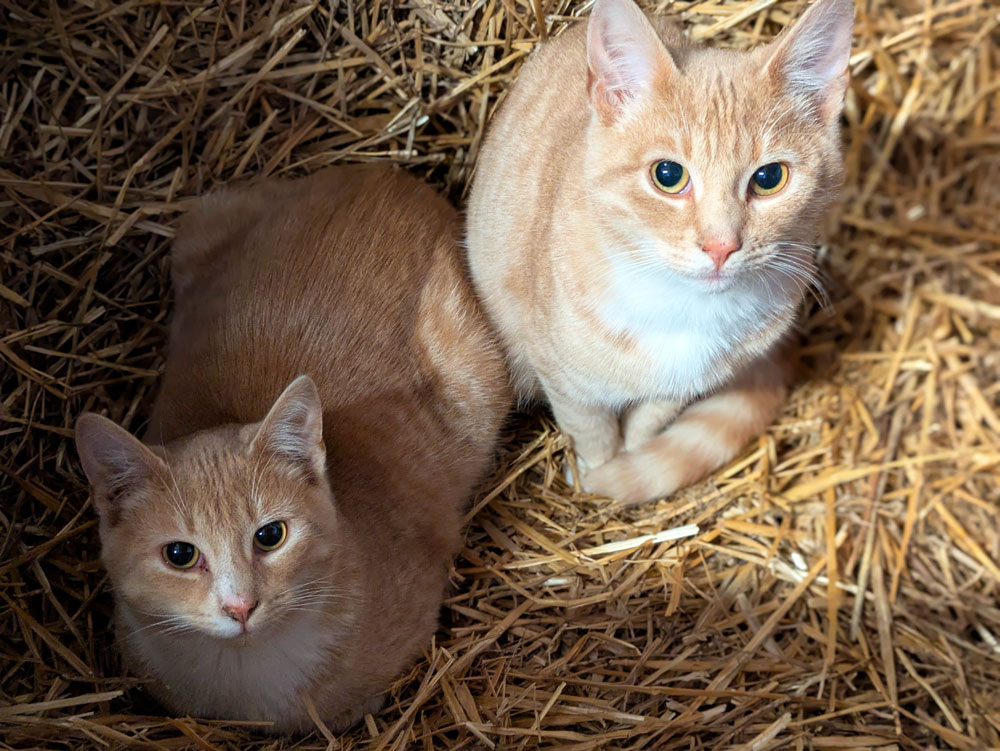
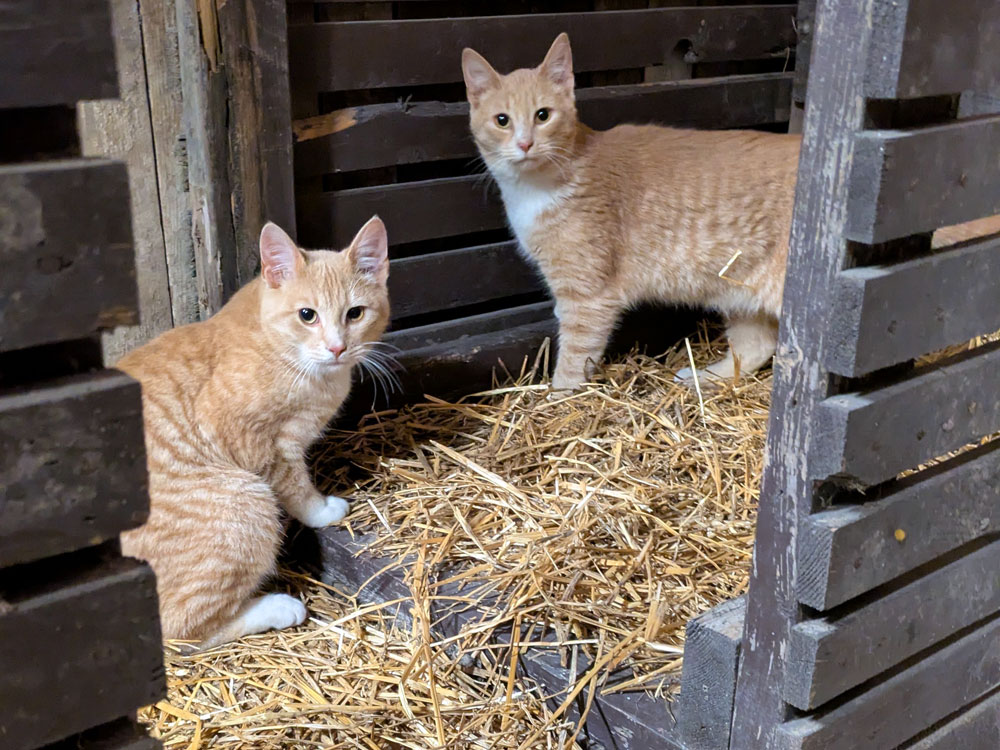
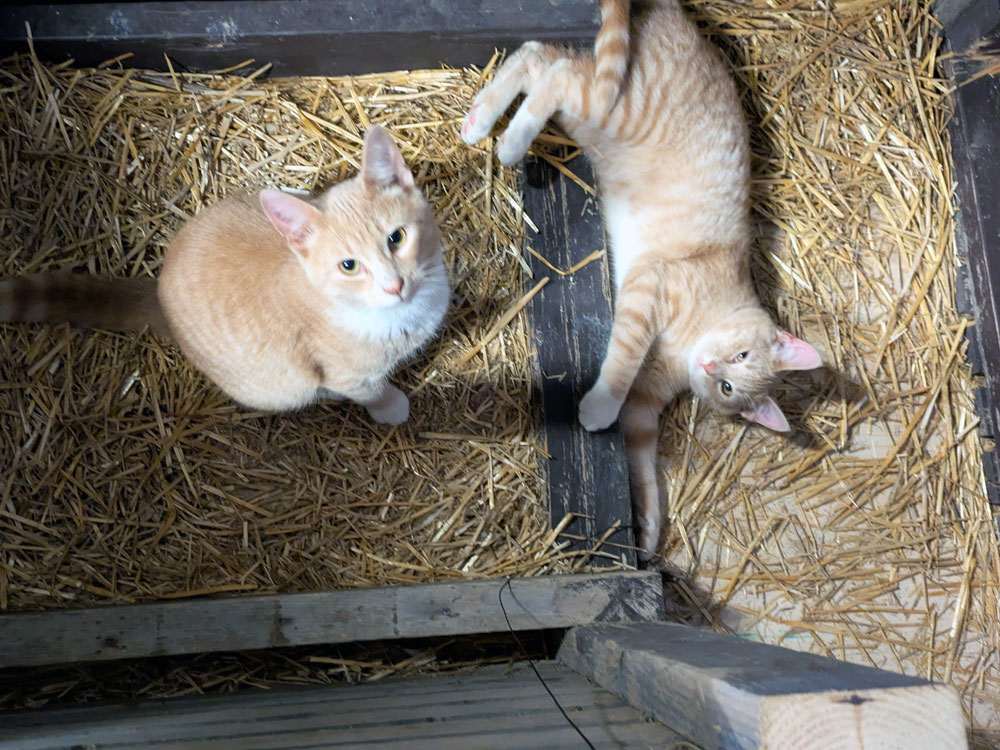
Meet Maple and Cedar, our new barn cats.
I knew we’d have another barn cat someday. While I’m not a cat person, I do like a barn cat. We had fun with Ralph and I’ve missed having a cat at the farm. Plus, with the birds, I knew we’d need some help with rodents and pests.
So I mentioned to a few people I was looking for a barn cat. One person knew of a litter at her brothers’ dairy farm that had been born in September. She had brought 3 of the kittens to her barn and there were 2 left. Did I want them?
I said yes and quickly began planning how we would handle them.
Another friend recently adopted a barn cat from the SPCA. They had recommended she keep the cat contained in a section of the barn for a few weeks until it got used to her and her farm. That sounded like a good strategy to me, but our barn is pretty open. Where could I keep the cats?
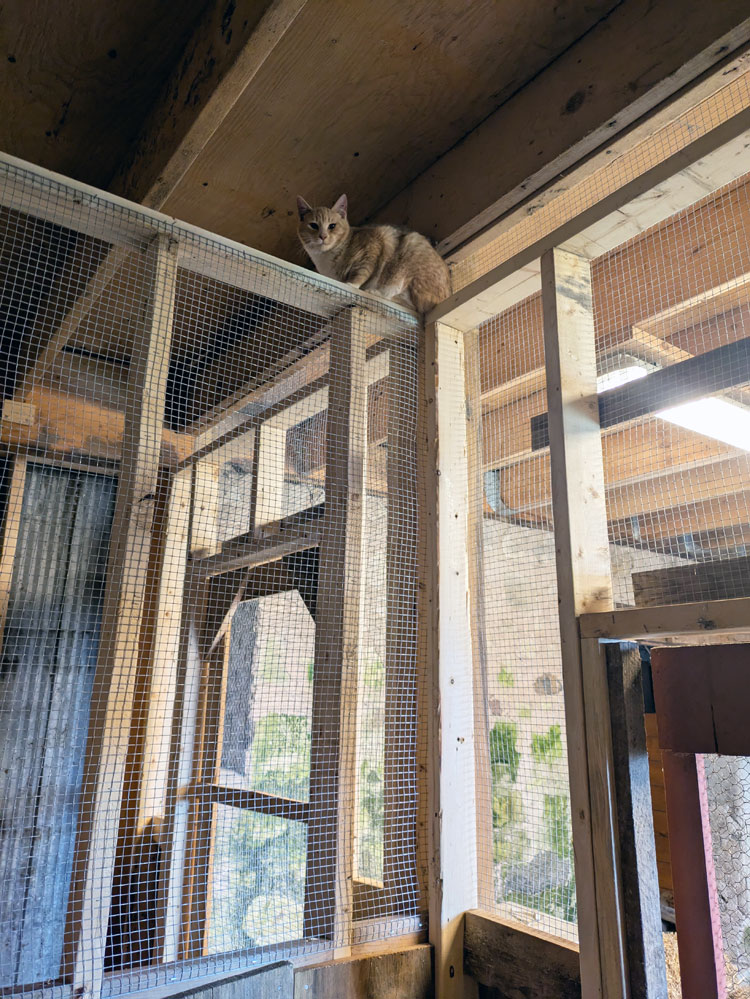
Then I had a brainwave. Cedar and Maple could stay in the coop. I’ve worked very hard to make it secure. They would be contained and safe. The birds would be in the house for a few weeks, so the cats could acclimatize in the meantime.
So Ellie and I got kibble and litter, we set up one of the pens in the coop with beds and food dishes, we dug out the cat carrier and made an appointment with the vet. And the kittens came home with us.
At first Cedar and Maple were pretty shy. We gave them time to settle in, visited with them every day, fed them lots (and lots) of treats.
Now they’re super affectionate. They come running when we come into the barn, looking for pets and treats. For now, they are still in the coop. They go to be neutered this week, so we’re keeping them contained for the next while. Once they’re recovered they’ll move into the rest of the barn and the birds will take over the coop.
This time has actually been a good test of the security of the coop. The cats have climbed all over, so if there was a way to escape, they would have found it. I’m hoping that means predators won’t be able to find a way in.
Cedar is the brave one (also a bit of the pushy one) who is always exploring and loves treats and toys. Maple is more cautious, though he’s better at catching the toy, so he may be the better hunter of the pair. They’ve both become super affectionate and love to be pet.
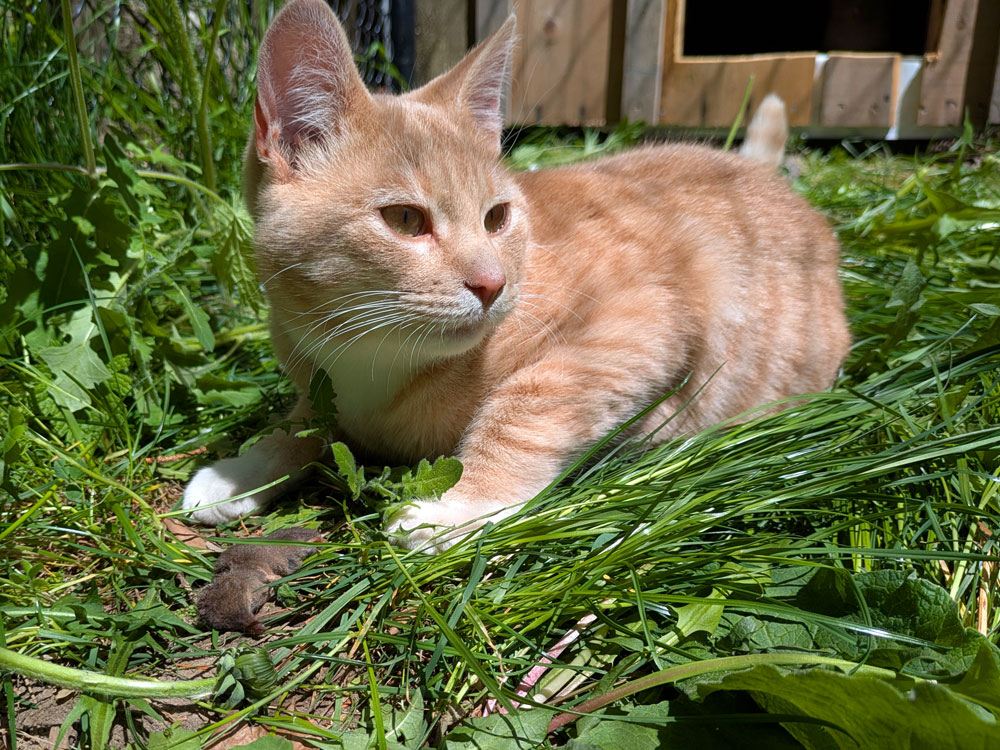
They already caught their first mouse. I’m not sure who gets the credit. (This is Cedar with it after I threw it outside.)
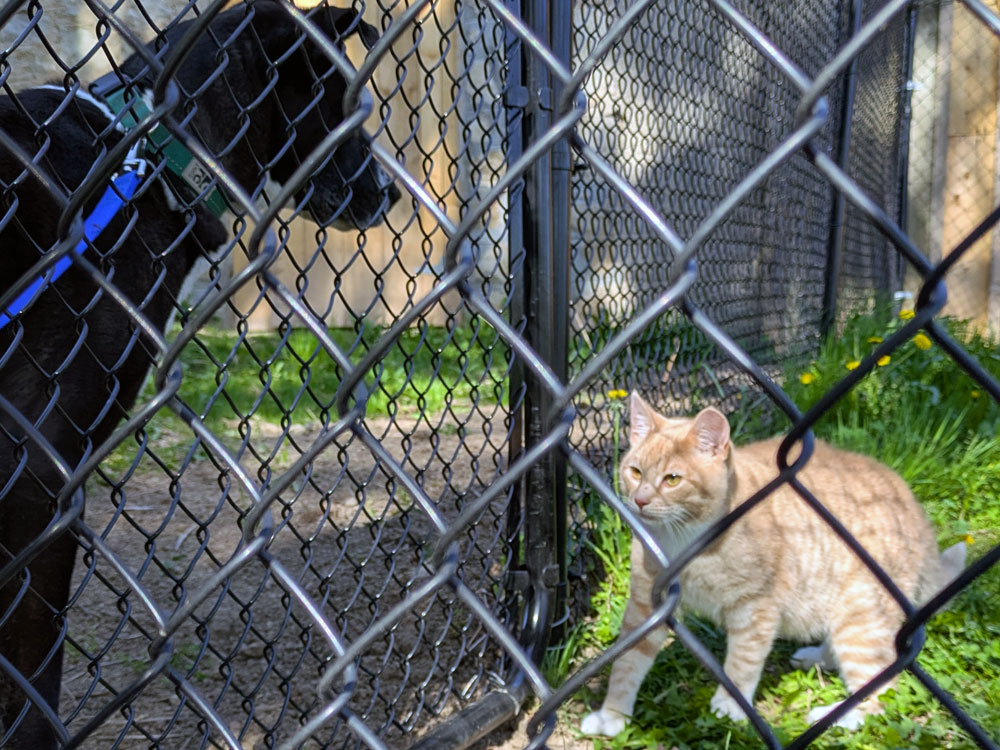
Cigo has been extremely excited that there are cats in the barn. He’s been sniffing around the coop everyday since Cedar and Maple arrived. We finally introduced everyone this weekend, using the run to separate dog and cats. Cedar is pretty unconcerned. Maple is, as expected, more hesitant. Cigo did very well, but he was very excited. We’re going to keep working on making cats boring, and we’ve made inside the barn a dog-free zone.
This getting to know you time has been really fun. It’s been neat to learn Cedar’s and Maple’s personalities and see their trust in us grow. It’s been special to add them to our family.


 Home on 129 Acres