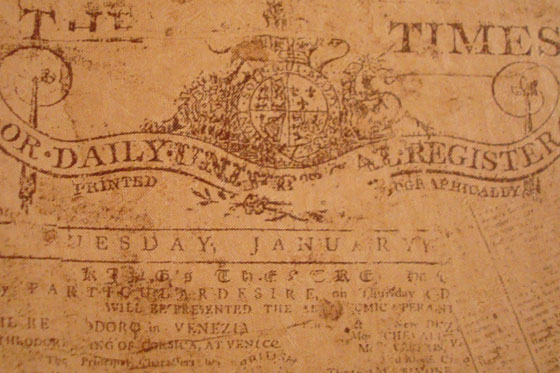
As neat as it would have been to find an old newspaper hidden in the wall–as we’ve heard other renovators have–that was not the case for us.
The answer to last week’s guessing game, if you haven’t already guessed from the title of this post, is that the “antique newspaper” is wallpaper that graced the walls in the basement.

I work in communications. I appreciate good journalism. However, graphics of old newspapers pasted onto my wall are not good journalism.
While the wallpaper trend in decor shows no signs of going away, this particular pattern is not in keeping with our decor vision for the basement. The newspaper wallpaper was going away.
In my experience, removing wallpaper goes one of two ways. You either spend hours and hours scraping with a trowel only to have it come off in teeny tiny chips approximately the size of your smallest fingernail, or you smoothly peel the paper away a few minutes after you spritzed it with hot water.
Over the years, I’ve tried a variety of scrapers and scorers, tools and techniques, chemicals and solutions. I’ve suffered burns from heavy steamers and patched pock-marked walls when the wallpaper peeled away the paper on the drywall.
You never know how your paper is going to come off until you start trying to remove it. Fortunately for me, our newspaper wallpaper came off very easily. Fortunately for you, I’m going to share my method.
Unfortunately for some of you likely, this is not a tutorial of how to remove stubborn wallpaper. This is how to remove wallpaper that’s a single layer, has been installed correctly and isn’t sticking like bubblegum to the wall.
If your wallpaper has an attachment disorder, you have my sympathies. My best advice is to keep going and remember you can fix the divots and tears afterwards. Drywall compound is your friend.
Here is my very simple chemical-free method for stripping wallpaper. First, assemble your tools.
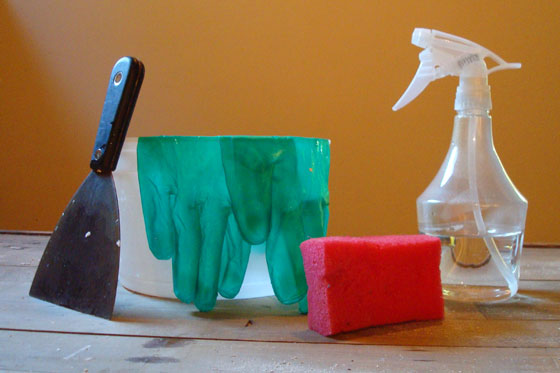
There is nothing fancy here. You need a scraper or trowel, a bucket and a sponge. Optional equipment is a spray bottle and gloves. If you’re working in a nicely finished area as opposed to a gutted basement, you’ll likely also want a tarp or a sheet to protect your floors.
Fill your bucket and spray bottle with hot water. You don’t need to boil the kettle. I find hot tap water works just fine. Just make sure to run the water for a few minutes until you have truly hot water.

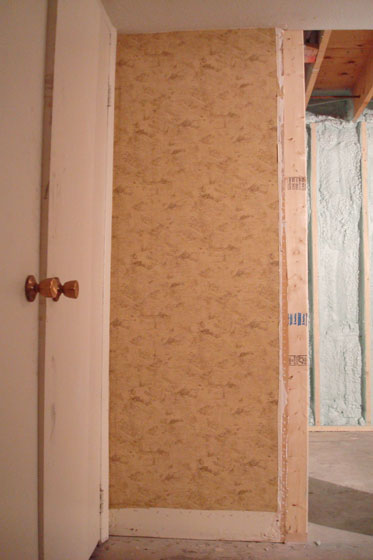
Here’s what I started with. Just a small wall covered with wallpaper.
The easiest method I’ve found for removing wallpaper is a two-step approach.
Start by soaking your paper using either your sponge or the spray bottle. Just like drywall compound is your friend after the wallpaper is removed, water is your friend during the removal. Start at the top of the wall and work your way down. The water will drip and run down the wall, but making sure the paper is fully saturated will make your life easier in a few minutes.
Once you’ve completely soaked the wallpaper from top to bottom, find a seam and use your trowel or your fingernails to grab an edge. Peel back the paper.

You can let the water soak in for a little while, but I usually find at this stage I can go right from soaking to peeling without delay.
You’ll likely notice that when you peel off the paper you are only removing the outer layer, the one with the pattern printed on it. There is still a second layer that is stuck to the wall. Do not despair. Remember this is a two-step process.
Once you’ve removed the outer layer, your next job is to–surprise!–tackle the inner layer. This is the part of the paper that’s actually adhered to the wall. The patterned side of wallpaper often has a glossy or smooth finish on it that prevents the water from fully soaking into the paper and reaching the glue that’s holding the paper on the wall. By removing the outer layer first, you can then fully soak the inner layer and (hopefully) easily loosen the glue.
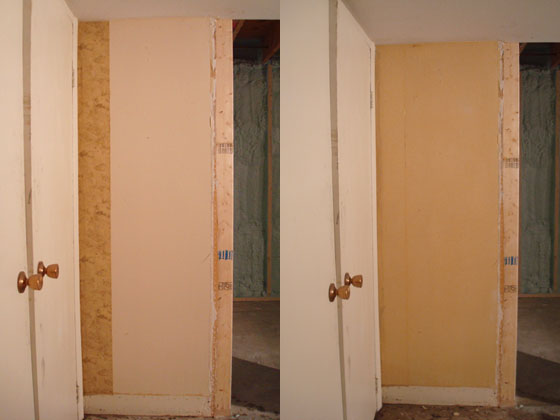
The left shows one panel of the outer layer removed. The right shows the inner layer after I’ve spritzed it with my spray bottle of hot water.
Again, you want to saturate the paper that’s on the wall. Don’t be shy with your spray bottle. Just like before, start at the top and work your way down. I usually find it helpful to let the paper sit for a few minutes to let the water fully absorb. Then, go to work with your scraper.
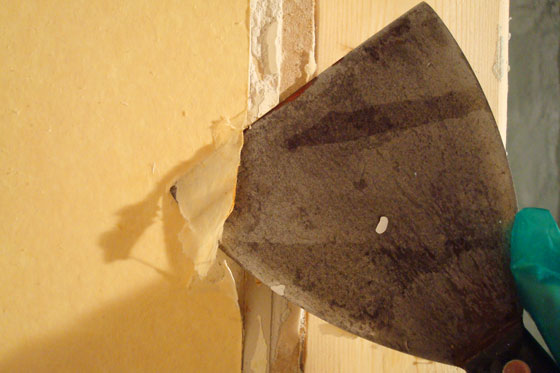
Catch an edge on the wallpaper. This time, instead of pulling the paper off by hand, let your trowel do the work.
Scrape with your trowel. I usually try to keep my trowel at a fairly shallow angle–less than 45 degrees off the wall. This allows me to easily get under the paper and scrape it smoothly off the wall.
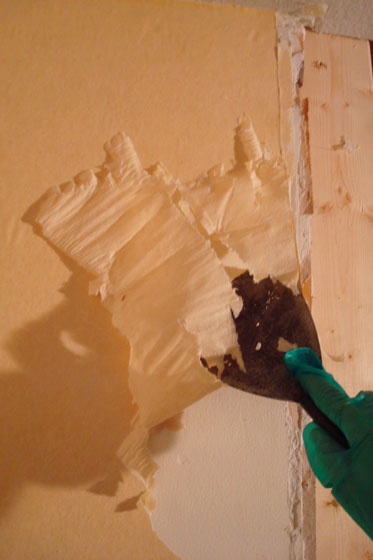
If the water has done its work, the paper should scrape off the wall fairly easily.
Apply more water as you need to to keep the paper peeling off easily. I like to spray a large area so that it can soak while I’m working on another section.

Halfway there
Once you have scraped all of the paper, wipe the wall with your wet sponge. You’ll find small shreds of paper and a film of glue left behind. The remaining pieces of paper will usually come off with a few swipes of your sponge. Go over the wall a couple of times to remove as much of the glue as possible. Before you paint, you may want to consider washing the wall with TSP, just to make sure there’s no residue.
At this point, you should have a nice clean wallpaper-less wall.

The after.
And a pile of paper on the floor.
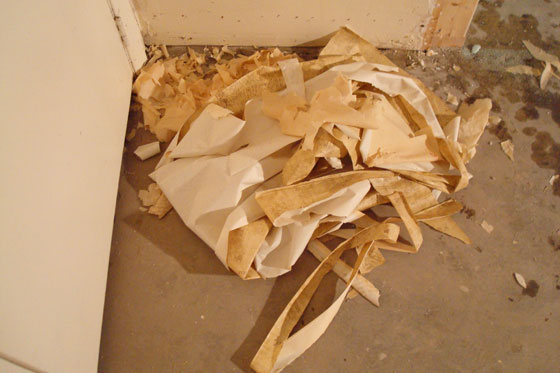
I get a lot of satisfaction from seeing the wallpaper on the floor instead of on the wall.
Even if your wallpaper came off with minimal effort, you may have a few spots on the wall that need smoothing out afterwards with drywall compound. In my experience, wallpaper can hide a lot of lumps and bumps. Remember, drywall compound is your friend.
Now, some of you may be wondering why I’m spending time stripping wallpaper when we don’t even have walls in the rest of the basement. Shouldn’t I be hanging drywall instead of flitting around with a spray bottle? The answer is probably yes, but I do have two good reasons for focusing on the wallpaper now:
- Instant gratification: I spent 30 minutes stripping this wall. It was quick, it’s done, and I can now check it off the to-do list. If I spent 30 minutes working with the drywall, I would not get nearly as much done and I would have much less sense of satisfaction.
- Efficiency: Once we finish installing the new drywall, the next step is taping and pasting all of the seams. I can easily patch any areas on the wallpaper wall at the same time. The end result will be a nice smooth finish on all the walls, old and new.
So, here concludes my method for stripping wallpaper. Anyone else have a method they’d like to share? Or any tips? A lot of people have horror stories of stripping stubborn wallpaper. Feel free to share your saga in the comments. We will commiserate with you.




 Home on 129 Acres