Who you gonna call? 1-800 DRYWALL

And we’re back.

Since I can no longer dive right in to a lake any time I want, let’s dive right back in to the basement renovation.

To recap for people whose minds may still be on a beach somewhere up north in cottage country (ahem), we ended up taking down all of the drywall on all of the exterior walls in the basement to upgrade the insulation. Then we ended up taking down most of the drywall on most of the ceilings to upgrade the electrical.

Matt declares victory over a pile of drywall and insulation.

Remember this scene from oh so long ago?

All of that taking down meant that eventually we’d reach a point where we’d have to put it all back up. But not the old stuff. That’s not how you do a reno.

With the old drywall unsalvageable, we had to buy new drywall. Now normally, I’d borrow my Dad’s truck and drive to the local lumber mill or home improvement store and buy the sheets that I need. However, renovating a whole entire basement means I’m working on a bit larger scale than usual. Too large for my Dad’s truck.

However, Dad still came in handy. With his help, we measured up the basement and came to the conclusion that we needed about 50 sheets of drywall. We also needed screws, tape, drywall compound (also known as mud or paste) and cornerbead.

As we were adding everything up, we decided that we also really needed someone to carry it down the basement stairs for us.

Matt, who like my father also happens to be a handy fellow, sourced out a selection of suppliers looking for the best price on both materials and delivery. As soon as he landed on 1-800 DRYWALL‘s website, the first words he said were, “These guys say basement delivery is their specialty.”

The marketing was working, but we needed a bit more information before we closed the deal.

We spent some time on their web site, reading all of their FAQs and getting a quote based on the material quantities we needed. Then I did it all again over the phone. Despite me asking a number of questions that were in the FAQ–including, “And delivery includes carrying all of the drywall down into the basement?”–the 1-800 DRYWALL staffer Roy was extremely friendly and helpful. He didn’t even mind when I decided to stop talking to  him and place my order through the web site because I could get $25 off for an online order.

On delivery day, my Dad was on-site to accept the order and supervise the unloading of all of the materials. True to their promise, the delivery team carried absolutely every piece of drywall down into the basement. They even stacked it in two different rooms based on my Dad’s directions.

Stack of drywall

A portion of our 50-sheet drywall order (and some new drywall already taped in the background)

The only hiccup on the day was on the screws. The screws I’d ordered online did not meet with my Dad’s approval. When it comes to drywall screws, my Dad likes a coarser thread because in his experience they hold better. However, the screws stocked by 1-800 DRYWALL had a thread that was too fine for my Dad’s standards, so back on the truck they went. Within a couple of days, 1-800 DRYWALL refunded my credit card, no questions asked.

Even with basement delivery (and not counting the screw refund), the price we paid for all of our materials was about $80 less than any other supplier we looked at–not a huge dollar figure, but enough to make a difference for us.

Where 1-800 DRYWALL truly beat the competition though was on the service side.

On the phone, over email and in person, everyone we dealt with was courteous, prompt and very helpful. Once I placed my order, I received a personal email confirmation, and two days after delivery I received a follow up email thanking me for my business and asking for any feedback.

The other element that I really appreciated was their web site. The site allowed me a high level of self-service, which I liked. I could fill my virtual shopping cart and get a quote all on my own. Plus, the FAQs, tips, testimonials, links to provincial building codes and professional site design inspired confidence that I was dealing with a reputable company.

In the end, my confidence was borne out. When you need drywall, I highly recommend you call 1-800 DRYWALL.

Wildflower week – Goldenrod

Matt and I have decided to take it easy this week, so the blog is going to be a little quieter than usual. To tide you over until we resume our regular program of renovations, I present a week of wildflower pictures from around the farm. Thank you for allowing me to loaf a little.

Goldenrod

Goldenrod (apologies to all allergy sufferers)

Goldenrod

A stand of goldenrod

Wildflower week – Thistles

Matt and I have decided to take it easy this week, so the blog is going to be a little quieter than usual. To tide you over until we resume our regular program of renovations, I present a week of wildflower pictures from around the farm. Thank you for allowing me to loaf a little.

Bumblebee on a thistle

Fuzzy bumblebee on a thistle

Thistles

Thistles in the field behind the barn

Wildflower week – Cornflower

Matt and I have decided to take it easy this week, so the blog is going to be a little quieter than usual. To tide you over until we resume our regular program of renovations, I present a week of wildflower pictures from around the farm. Thank you for allowing me to loaf a little.

Cornflower

Lovely light blue cornflower

Cornflowers

Every morning, the cornflowers stretch eastward capturing the rays of the rising sun

Wildflower week – Queen Anne’s Lace

Matt and I have decided to take it easy this week, so the blog is going to be a little quieter than usual. To tide you over until we resume our regular program of renovations, I present a week of wildflower pictures from around the farm. Thank you for allowing me to loaf a little.

Queen Anne's Lace

The quintessential farm flower for me, Queen Anne’s Lace

Queen Anne's Lace

Queen Anne’s Lace at sunset

Fall fashion preview

Accessorizing your house with Mother Nature is always in style. For this fall, it’s about accessorizing your hair with natural elements.

Burrs in long hair

Bring on the burrs

Burrs have long lasting hold and can be arranged in a variety of artistic patterns. Just touch them to your hair, and they will be held firmly in place, no need for additional pins or spray.

Removal is a challenge, but with a lot of patience, a gentle brush and high pain tolerance, scissors can be avoided.

Watch for these natural fashion accessories to appear at farms and forests this fall.

Byebye bin

If there was a bright side to doing the roof–beyond rain not seeping into our house, of course–it was the garbage bin that we ordered.

Empty garbage bin

Before

We took advantage of every cubic metre of our 40-yard bin to do a major clean up in the barn, the fields and even the house.

Full garbage bin

After

The indoor pool was the last room we cleaned out, hence the pool noodles and solar blanket. Can I just ask why you need a solar blanket on an indoor pool?

Underneath all of that are the shingles, the leather barn couch and numerous other treasures I was quite happy to say goodbye to.

Hauling a garbage bin

Buh-bye junk

The final tally was 10,780.5 pounds, which equates to 4.89 metric tonnes, 5.39 tons or “freakin’ heavy” in Matt’s words–and a huge weight off my mind.

Anyone else out there find cleaning cathartic? This blitz was particularly rewarding, I think, because most of the junk belonged to past owners.

Roof wrap-up

Matt’s a numbers guy, so as the roof was his project, it’s only fitting that I summarize his work in a statistical fashion.

Here, in a series of lists, is the story of how we reshingled our roof ourselves.

Newly shingled roof

Schedule breakdown

  • Day 1 – 1.5 hours
    Matt loads the shingles and other materials onto the roof. Thank goodness for rooftop delivery.
    Day 2 – 10 hours
    Matt, his Dad and I strip more than three-quarters of the old shingles off the roof. And then we cross our fingers for the night and don’t cover it with a tarp.
  • Day 3 – 15 hours
    Shingling begins. Matt, his Dad and his friend (a former professional roofer) complete about two-thirds of the roof and strip the remaining old shingles. Fingers are still crossed and the naked part of our roof is still untarped when we go to bed that night.
  • Day 4 – 14 hours
    I take a personal day to stay home from work, and Matt, his Dad, my Dad and I finish shingling the roof.
  • Day 5 – 6 hours
    Matt and his Dad do clean-up picking up nails and shingles from around the house and out of the eaves troughs.
  • Total: Five people 46.5 hours–note that nearly 40 of those hours came over just three days

I have to say a huge massive thank you to Matt’s dad and his friend. It was hot, dirty, heavy, uncomfortable work, and they put in a lot of hours, especially Matt’s dad, just to help us out. They supplied tools, equipment and expertise, and we could not have done this without them.

I have to say thanks as well to our roofing supplier AMA Roofing. They were a complete cold call, and we had a great experience. From the office staff I dealt with on the phone to the delivery man who brought the materials to the house, Matt and I were both very impressed. They spent a lot of time answering all of our questions and provided great guidance about how much to order and how to install everything. I highly recommend them.

Materials breakdown

  • 110 bundles of shingles – used 102 bundles
  • 22 pieces of drip edge (176 lineal feet) – used none, as there was a strange flashing/drip edge installed on the roof that we ended up reusing
  • 48 lineal feet of valley
  • 14,400 nails (120 coils) – used only 75 coils. We had so many nails left over because we had to buy two cases, as we would have been short with just one.
  • 3 rolls of ice & water shield (240 lineal feet)
  • 6 roof vents (we found an additional four in the driveshed that we were able to use)
  • 1 special roof cap/vent for the kitchen hood fan exhaust
  • 8 rolls of tar paper – used 7 rolls
  • 6 tubes of roofing tar
  • 10 sheets of plywood – used only part of one sheet for three small patches. Despite the awful state of our shingles, the plywood underneath was in good shape.

You’ll notice that we went with a very light grey shingle. Its official name is dual grey, and it’s a combination of black, grey and white stones. At times it reads almost green or blue from the ground. This is not what I was going for at all, but I can live with it.

My biggest goal in choosing the colour of the roof was to pick something light. White roofs are more eco-friendly, because they reflect more of the sunlight, rather than absorbing all of that heat into our house. We didn’t want to go with a true white roof, but we chose a light colour to give us as much reflectivity as possible.

By the numbers

  • Total roof square footage: 3,375
  • Average temperature: 29.82ºC (not including the humidex)
  • SPF: 60
  • Cost savings from doing it ourselves: $7,000 (this is a guess, as we didn’t actually get a proper quote from professional shinglers)
  • Hours between installing the last shingle and the first rain drop: 10. And then it rained for three days straight.

Rain falling into eaves trough

Casualties

  • One air compressor – it literally went up in smoke

Campbell Hausfeld air compressor

  • Three shirts – Matt wore white in the hopes that he would be slightly cooler, and I’m not even going to try and wash those poor shirts
  • Two pairs of gloves – Matt and I both wore through the fingertips
  • One shower loofa – used to be white, now is the colour of shingle scum
  • One pair of shoes – the soles melted and are now completely misaligned

Old shoes

I was a little bit uncertain about tackling the roof reshingling all on our own. This is a big job and does require a certain amount of know-how to do it right–know-how that Matt and I didn’t have at the start. As it came time to order the materials and figure out exactly how we were going to do this thing, I was very nervous and did consider calling in professional help. However, I’m a big believer that everything happens for a reason, and as we got closer to starting the work there were a few signs that showed me we were going to be okay:

  1. A tremendously positive, helpful and encouraging phone call with our roofing supplier. Getting the quote and talking through the project with Debbie at AMA boosted my confidence tremendously.
  2. Kit, another roofing novice who shared my trepidation–or as she wonderfully described it “grim determination wrapped around an unmistakable sense of dread,” single-handedly shingled her donkey barn.
  3. Matt’s friend, a former professional roofer, rearranged his schedule so that he was able to come and help for a day.
  4. This Old House had a segment on roofing–and yes, we took notes.

As well as everything worked out, I cannot recommend roofing as a DIY. This is a really tough job, and Matt basically knocked himself out getting this done. I’m incredibly grateful that he’s willing to take something like this on, but we’ve both agreed we won’t be doing this ever again.

Final lessons

  • There’s a fine line between stubborn and stupid, and we ended up deep in dingbat territory
  • Bungalow = big roof. Big, big, biiiiiiiiiiiiig roof
  • Don’t try this at home. Seriously, folks. Don’t.

This is not taking it easy

Remember on Friday when I said that I was hoping Matt and I would do nothing this weekend? Yeah, well, that plan didn’t work out at all.

Instead of sleeping in and sitting outside in lawn chairs for two days straight, we went and rented an auger.

We’ve had a number of people turn in the driveway and come all the way up to the house. Once they get to the top and realize our cars are parked there (i.e. we’re home), they make their way around the turnaround and go back down the driveway. Usually by this point I’ve come out of the front door to glare at them as they drive away.

We have a long driveway, so if people are lost and need to just turn around, we wouldn’t even know they were there. For people to end up at the house, they’re trespassing.

We decided we need a gate at the bottom of the driveway.

A gate needs posts, and posts need holes, so we needed an auger.

Drilling post holes with an auger

Matt and my Dad drill a post hole with the auger

Matt and my Dad ran the auger while I came behind and cleaned out the holes.

Reaching into a post hole

Why does the person with the shortest arms have to clean out the hole?

We do own shovels, but a hands-on approach worked better for me sometimes given what we found in the holes.

Field stones

Lots and lots of stones

The auger did not like the stones.

Rock at the bottom of a post hole

It particularly disliked this stone.

This boulder became the bane of my existence for about an hour. We all took our turns working around it with the shovel, the prybar, even a pick. It was massive, and it wasn’t moving.

The post that was to go in this hole was supposed to be our hinge, so we needed it to be really solid. But with the rock in the way, we couldn’t get the hole deep enough. So, we decided to swing the gate the other way and drilled a new nice and deep hole on the other side of the driveway.

Then, it was a matter of mixing up our concrete and setting our posts in place.

Mixing concrete in a wheelbarrow

I take a turn mixing while Matt adds the water

By the end of the day, we had four new posts in place: two at either end of the gate, one to hook the gate to when it’s open and a new post for the mailbox.

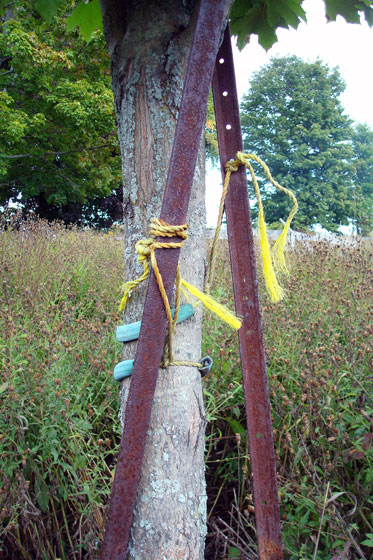
Posts braced

We braced the posts to hold them plumb while the concrete sets

Oh, and we also had more sore muscles and a few new calluses.

Have we reached the end of the to-do list yet? Has anyone spotted the end? Can you please tell me is it far away?

And please tell me someone out there got to sleep in and sit in a lawn chair this weekend.