Lighting love

If you’ve been following along for a little while with our renovation saga, you’re familiar with some of the lighting that we started with in the basement: ceiling fixtures mounted on the walls, a ceiling fan recessed up into the joists. As you can probably imagine, I have a bit of a need for new lighting.

With the Barn Light Electric giveaway making the rounds of the blogosphere, I saw an opportunity.

Once I was browsing the web site, however, I was seduced. I was sidetracked. I decided I can live with bare bulbs and pigtails in the basement.

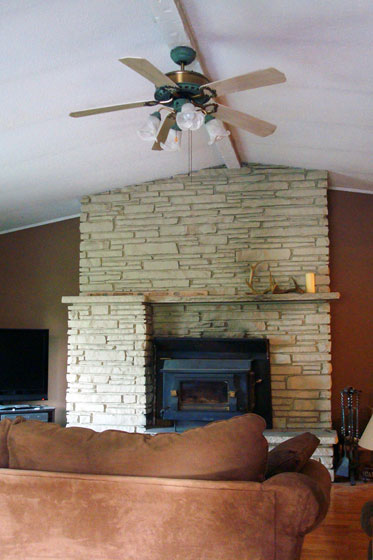
But I absolutely positively cannot any longer live with this.

Green and faux wood ceiling fan

The green and brass and faux wood ceiling fan in the living room.

Wouldn’t this be a fun replacement?

We have a beautiful big living room with lots of natural light, wonderful vaulted ceiling, great rustic beams and a stone fireplace (that admittedly could use a bit of work). In the middle of all that, we have a huge, horrific green ceiling fan.

Living room with fireplace

This is never appropriate.

Barn Lighting has tonnes of great options that will satisfy my need for a pretty, polished, traditional aesthetic that’s in keeping with our rustic country setting. We have an actual barn on this property. We should choose a company with “barn” in its name.

Once I was focused on the main floor, it was easy to line up other lighting options.

Barn Light Electric Mystic Seaport Chandelier

Mystic Seaport Chandelier (in dark brass) to replace a distinctly non-country chandelier in the dining room.

Barn Light Electric Mayfield Semi-Flush Ceiling Light

Two Mayfield Semi-Flush Ceiling Lights (in old bronze) to replace a pair of  unfortunate boob lights in the hallway

Barn Light Electric School House Pendant "The Brevard"

School House Pendant “The Brevard” (also in a bronze finish) to replace a flush mount fixture over the island in the kitchen–a pendant is much more appropriate and will balance the space nicely.

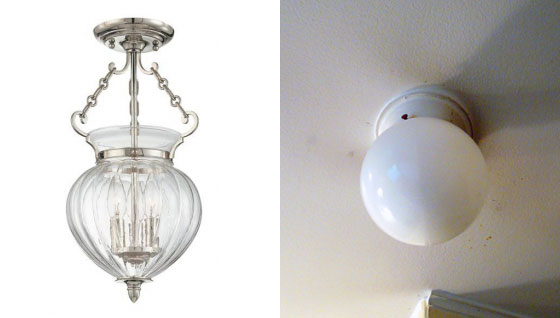
While I need the Outer Banks Chandelier for the living room, I just want the Halstead Semi-Flush Ceiling Light. I’d put it in my sewing room to replace yet another boob light.

Barn Light Electric Halstead Semi-Flush Ceiling Light

Or I’d put it in the bathroom to replace a weirdly located globe that’s straight out of 1989.

Halstead is not really country and it’s definitely not rustic, but oh it’s pretty.

Do you have some lighting needs of your own? There’s still time to enter the Barn Light Electric giveaway.

  1. Look around online at Barn Light Electric and pick lights you’d love to own.
  2. Feature your lighting picks on your personal blog, and link to the lights if you can!
  3. Copy/paste these rules at the bottom of your blog article so others can enter.
  4. Once your personal article is up, you must email your blog link to: marketing@barnlightelectric.com to be qualified to win.

The contest ends Monday, July 2, 2012. If you don’t have a blog, but do have need of beautiful lighting you can still enter. Find out how by reading the Official Rules.

The reveal… aka how to strip wallpaper

As neat as it would have been to find an old newspaper hidden in the wall–as we’ve heard other renovators have–that was not the case for us.

The answer to last week’s guessing game, if you haven’t already guessed from the title of this post, is that the “antique newspaper” is wallpaper that graced the walls in the basement.

Wallpaper pattern

I work in communications. I appreciate good journalism. However, graphics of old newspapers pasted onto my wall are not good journalism.

While the wallpaper trend in decor shows no signs of going away, this particular pattern is not in keeping with our decor vision for the basement. The newspaper wallpaper was going away.

In my experience, removing wallpaper goes one of two ways. You either spend hours and hours scraping with a trowel only to have it come off in teeny tiny chips approximately the size of your smallest fingernail, or you smoothly peel the paper away a few minutes after you spritzed it with hot water.

Over the years, I’ve tried a variety of scrapers and scorers, tools and techniques, chemicals and solutions. I’ve suffered burns from heavy steamers and patched pock-marked walls when the wallpaper peeled away the paper on the drywall.

You never know how your paper is going to come off until you start trying to remove it. Fortunately for me, our newspaper wallpaper came off very easily. Fortunately for you, I’m going to share my method.

Unfortunately for some of you likely, this is not a tutorial of how to remove stubborn wallpaper. This is how to remove wallpaper that’s a single layer, has been installed correctly and isn’t sticking like bubblegum to the wall.

If your wallpaper has an attachment disorder, you have my sympathies. My best advice is to keep going and remember you can fix the divots and tears afterwards. Drywall compound is your friend.

Here is my very simple chemical-free method for stripping wallpaper. First, assemble your tools.
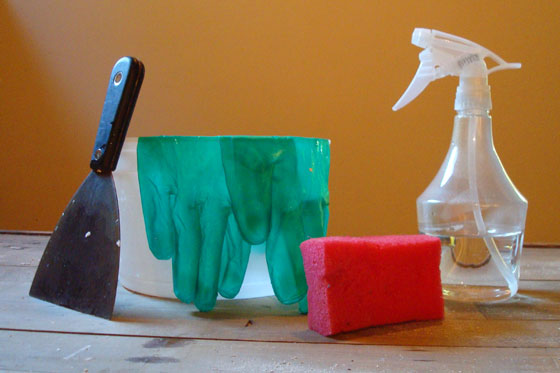
Tools for removing wallpaper

There is nothing fancy here. You need a scraper or trowel, a bucket and a sponge. Optional equipment is a spray bottle and gloves. If you’re working in a nicely finished area as opposed to a gutted basement, you’ll likely also want a tarp or a sheet to protect your floors.

Fill your bucket and spray bottle with hot water. You don’t need to boil the kettle. I find hot tap water works just fine. Just make sure to run the water for a few minutes until you have truly hot water.

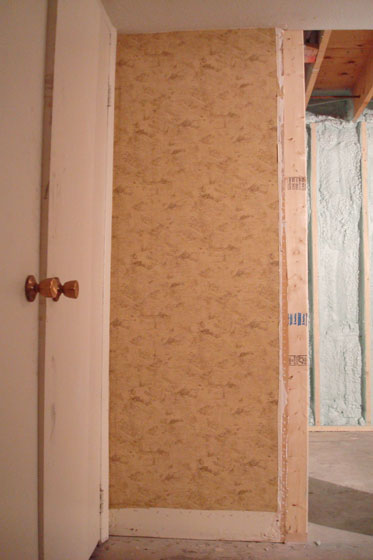
Wallpaper on a wall

Here’s what I started with. Just a small wall covered with wallpaper.

The easiest method I’ve found for removing wallpaper is a two-step approach.

Start by soaking your paper using either your sponge or the spray bottle. Just like drywall compound is your friend after the wallpaper is removed, water is your friend during the removal. Start at the top of the wall and work your way down. The water will drip and run down the wall, but making sure the paper is fully saturated will make your life easier in a few minutes.

Once you’ve completely soaked the wallpaper from top to bottom, find a seam and use your trowel or your fingernails to grab an edge. Peel back the paper.

How to strip wallpaper

You can let the water soak in for a little while, but I usually find at this stage I can go right from soaking to peeling without delay.

You’ll likely notice that when you peel off the paper you are only removing the outer layer, the one with the pattern printed on it. There is still a second layer that is stuck to the wall. Do not despair. Remember this is a two-step process.

Once you’ve removed the outer layer, your next job is to–surprise!–tackle the inner layer. This is the part of the paper that’s actually adhered to the wall. The patterned side of wallpaper often has a glossy or smooth finish on it that prevents the water from fully soaking into the paper and reaching the glue that’s holding the paper on the wall. By removing the outer layer first, you can then fully soak the inner layer and (hopefully) easily loosen the glue.
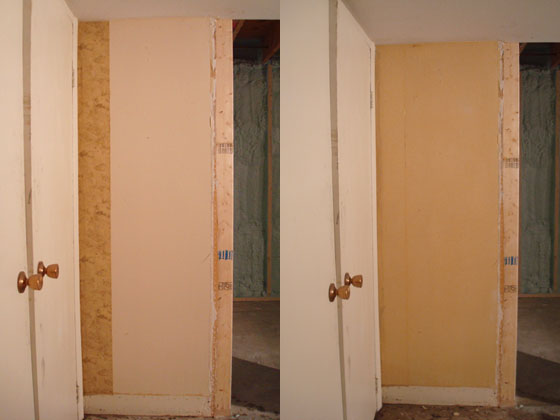
How to remove wallpaper

The left shows one panel of the outer layer removed. The right shows the inner layer after I’ve spritzed it with my spray bottle of hot water.

Again, you want to saturate the paper that’s on the wall. Don’t be shy with your spray bottle. Just like before, start at the top and work your way down. I usually find it helpful to let the paper sit for a few minutes to let the water fully absorb. Then, go to work with your scraper.
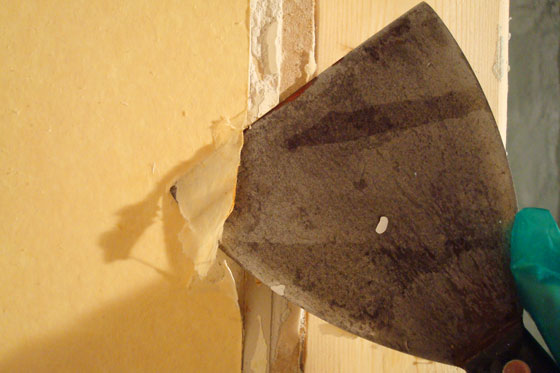
Scraping wallpaper

Catch an edge on the wallpaper. This time, instead of pulling the paper off by hand, let your trowel do the work.

Scrape with your trowel. I usually try to keep my trowel at a fairly shallow angle–less than 45 degrees off the wall. This allows me to easily get under the paper and scrape it smoothly off the wall.
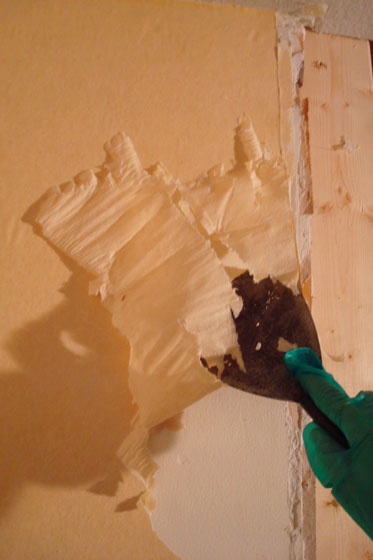
Removing wallpaper with a scraper.

If the water has done its work, the paper should scrape off the wall fairly easily.

Apply more water as you need to to keep the paper peeling off easily. I like to spray a large area so that it can soak while I’m working on another section.

How to remove wallpaper

Halfway there

Once you have scraped all of the paper, wipe the wall with your wet sponge. You’ll find small shreds of paper and a film of glue left behind. The remaining pieces of paper will usually come off with a few swipes of your sponge. Go over the wall a couple of times to remove as much of the glue as possible. Before you paint, you may want to consider washing the wall with TSP, just to make sure there’s no residue.

At this point, you should have a nice clean wallpaper-less wall.

Wall after wallpaper is removed

The after.

And a pile of paper on the floor.
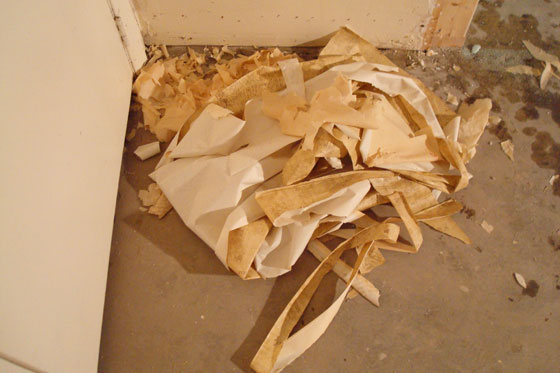
How to remove wallpaper

I get a lot of satisfaction from seeing the wallpaper on the floor instead of on the wall.

Even if your wallpaper came off with minimal effort, you may have a few spots on the wall that need smoothing out afterwards with drywall compound. In my experience, wallpaper can hide a lot of lumps and bumps. Remember, drywall compound is your friend.

Now, some of you may be wondering why I’m spending time stripping wallpaper when we don’t even have walls in the rest of the basement. Shouldn’t I be hanging drywall instead of flitting around with a spray bottle? The answer is probably yes, but I do have two good reasons for focusing on the wallpaper now:

  1. Instant gratification: I spent 30 minutes stripping this wall. It was quick, it’s done, and I can now check it off the to-do list. If I spent 30 minutes working with the drywall, I would not get nearly as much done and I would have much less sense of satisfaction.
  2. Efficiency: Once we finish installing the new drywall, the next step is taping and pasting all of the seams. I can easily patch any areas on the wallpaper wall at the same time. The end result will be a nice smooth finish on all the walls, old and new.

So, here concludes my method for stripping wallpaper. Anyone else have a method they’d like to share? Or any tips? A lot of people have horror stories of stripping stubborn wallpaper. Feel free to share your saga in the comments. We will commiserate with you.


How to recover a chair seat

As part of preparing for the family dinner that we hosted on Good Friday, I had to put new cushions on our dining room chairs.

We had our dining room set refinished just before we moved into the farm, and since moving in the chairs have been naked.

Naked dining room chair

Yikes, naked chair!

I know it’s not a hard core renovation, but it is DIY, so I’m posting a brief how-to. I should be clear though that this was my first true upholstery project, and I am sure I made a few mistakes along the way. There are lots of great tutorials online by people much more skilled than me. However, here’s the method that I used for our dining room chairs.

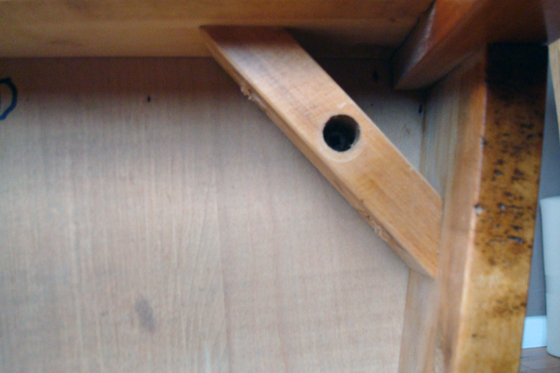
1) Remove the seat from the frame. In my case, this meant unscrewing the seat from four corner braces that were underneath.

Bracket

Brace under the seat that holds the seat to the chair frame.

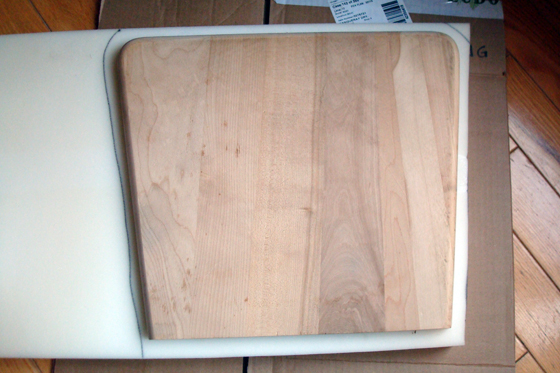
2) Cut your foam. My foam was 1 1/2 inches thick. I cut the foam about a 1/2 inch bigger all the way around than the seat (no measuring, I just eyeballed it). If you’re fancy or a professional, you’ll probably want to use a foam saw for this step, or even an electric knife. I didn’t have either of those things. I tried a utility knife but ended up having the best luck with my kitchen scissors. The edge wasn’t perfect, but it was smooth enough for me.

Cutting the foam

I allowed about a 1/2″ border all the way around.

3) Using the tips in this video, I tacked the foam to the top of the seat. I stapled about every 3 inches around the three outside edges. Again, if you’re fancy or a professional, you will likely use a pneumatic staple gun for this. I am neither of those things, so I used my manual staple gun that’s a hand-me-down from my father-in-law (pictured in the upper right below). It takes a bit more muscle, but you can do this project without fancy (or professional) tools.

Foam tacked in place

Foam tacked in place

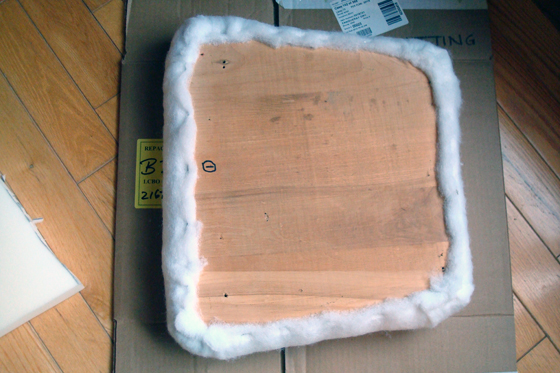
4) The next step is batting. Cut a square of batting that’s about 8 inches bigger all the way around than your seat. Lay the foam covered seat face down on the batting, fold the batting around your seat and staple it on the bottom. Make sure to pull the batting taunt. This is the moment to make a nice smooth surface for your fabric. Start on the straight edges in the middle and work your way out to the edges. Do the corners last. For the corners, I didn’t have a special technique. Usually, I just tried to smooth and squish the batting into position and then I stapled the heck out of it. Once you’ve stapled all the way around, trim off the excess batting.

Batting

Bottom of the chair with the batting stapled in place

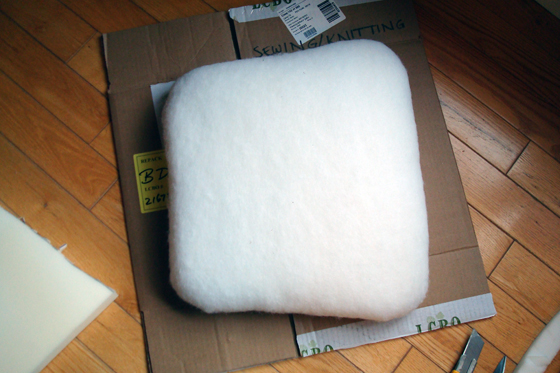
5) Flip over your seat and admire the lovely cloud that is now your cushion. At this point, you’re ready for fabric.

Chair seat ready for fabric

Chair seat ready for fabric

6) The process for installing your fabric is the same as the batting. Make sure to allow yourself lots of extra fabric all the way around your cushion, start in the centre of the front edge and staple in place. Pull your fabric taunt as you go and make sure it’s square on your cushion–especially important if you’re using a plaid or striped fabric. I probably stapled every inch or so. For the most part, I used 5/16″ staples, but I switched to longer staples for the corners where I had to staple through a lot of batting and pleats of fabric. The corners are the spots where you’ll have to spend a bit of time figuring out exactly how you want your cushion to look. For me, because I had rounded corners at the front, the best solution seemed to be a double pleat. It took some time to get my fabric to lay exactly the way I wanted it. And then it took some more time to make sure the other corners all looked roughly the same as my first pleat.

Pleats on the front corner

Pleats on the front corner

At the back I did a simple single pleat that’s pretty much hidden by the chair frame.

Back corner pleat

Pleat on the back corner (ignore the wrinkle)

7) Once your cushion is complete, the next step is to reattach the seat to the frame. In my case, this meant rescrewing the seat to the corner braces. I ended up having to get longer screws for this because, with the batting and fabric, the old screws were too short.

Finished chair

A finished chair

As I said at the beginning, this is my first upholstery project (beyond sewing toss cushions for the couch), and my verdict is that this is a very easy DIY. You don’t need any sewing expertise, and you need very minimal equipment. My chairs are not perfect by any means, but I still think they look great, and I’m really pleased with the fabric I chose.

I picked a linen blend that looks very natural. It has a slightly rough texture that I think is appropriate for a farm setting.

Close up of the new fabric

Close up of the new fabric

We’ve had this dining set for five years (I’ll save the story of how it came to be ours for another post), and during all that time the cushions have been torn, mis-matched and not at all cushy. It’s so nice to walk through the dining room and see the chairs finally finished.

Dining room set with finished chairs

Dining room set with finished chairs

For a more comprehensive (and professional) tutorial, I recommend you check out this video which I mentioned in step 3. I used this as a reference when I was beginning my project. Jenny on Little Green Notebook also tackles a lot of upholstery projects and posts great step-by-step tutorials, including this one for chairs that are much more complicated than mine.