Who you gonna call? 1-800 DRYWALL

And we’re back.

Since I can no longer dive right in to a lake any time I want, let’s dive right back in to the basement renovation.

To recap for people whose minds may still be on a beach somewhere up north in cottage country (ahem), we ended up taking down all of the drywall on all of the exterior walls in the basement to upgrade the insulation. Then we ended up taking down most of the drywall on most of the ceilings to upgrade the electrical.

Matt declares victory over a pile of drywall and insulation.

Remember this scene from oh so long ago?

All of that taking down meant that eventually we’d reach a point where we’d have to put it all back up. But not the old stuff. That’s not how you do a reno.

With the old drywall unsalvageable, we had to buy new drywall. Now normally, I’d borrow my Dad’s truck and drive to the local lumber mill or home improvement store and buy the sheets that I need. However, renovating a whole entire basement means I’m working on a bit larger scale than usual. Too large for my Dad’s truck.

However, Dad still came in handy. With his help, we measured up the basement and came to the conclusion that we needed about 50 sheets of drywall. We also needed screws, tape, drywall compound (also known as mud or paste) and cornerbead.

As we were adding everything up, we decided that we also really needed someone to carry it down the basement stairs for us.

Matt, who like my father also happens to be a handy fellow, sourced out a selection of suppliers looking for the best price on both materials and delivery. As soon as he landed on 1-800 DRYWALL‘s website, the first words he said were, “These guys say basement delivery is their specialty.”

The marketing was working, but we needed a bit more information before we closed the deal.

We spent some time on their web site, reading all of their FAQs and getting a quote based on the material quantities we needed. Then I did it all again over the phone. Despite me asking a number of questions that were in the FAQ–including, “And delivery includes carrying all of the drywall down into the basement?”–the 1-800 DRYWALL staffer Roy was extremely friendly and helpful. He didn’t even mind when I decided to stop talking to  him and place my order through the web site because I could get $25 off for an online order.

On delivery day, my Dad was on-site to accept the order and supervise the unloading of all of the materials. True to their promise, the delivery team carried absolutely every piece of drywall down into the basement. They even stacked it in two different rooms based on my Dad’s directions.

Stack of drywall

A portion of our 50-sheet drywall order (and some new drywall already taped in the background)

The only hiccup on the day was on the screws. The screws I’d ordered online did not meet with my Dad’s approval. When it comes to drywall screws, my Dad likes a coarser thread because in his experience they hold better. However, the screws stocked by 1-800 DRYWALL had a thread that was too fine for my Dad’s standards, so back on the truck they went. Within a couple of days, 1-800 DRYWALL refunded my credit card, no questions asked.

Even with basement delivery (and not counting the screw refund), the price we paid for all of our materials was about $80 less than any other supplier we looked at–not a huge dollar figure, but enough to make a difference for us.

Where 1-800 DRYWALL truly beat the competition though was on the service side.

On the phone, over email and in person, everyone we dealt with was courteous, prompt and very helpful. Once I placed my order, I received a personal email confirmation, and two days after delivery I received a follow up email thanking me for my business and asking for any feedback.

The other element that I really appreciated was their web site. The site allowed me a high level of self-service, which I liked. I could fill my virtual shopping cart and get a quote all on my own. Plus, the FAQs, tips, testimonials, links to provincial building codes and professional site design inspired confidence that I was dealing with a reputable company.

In the end, my confidence was borne out. When you need drywall, I highly recommend you call 1-800 DRYWALL.

Olympic dreams

I had hoped today to be showing you the Canadian flag flying from our newly installed flagpole in honour of the Canadian Olympic team. However, the flagpole is still lying in the barn and the flag is folded up in Matt’s office.

However, we did manage to get something installed that has come in handy with the Olympics.

Shaw satellite dish

Our new satellite dish

Like everything else at the farm, the job of installing the satellite turned out to be more work than initially expected.

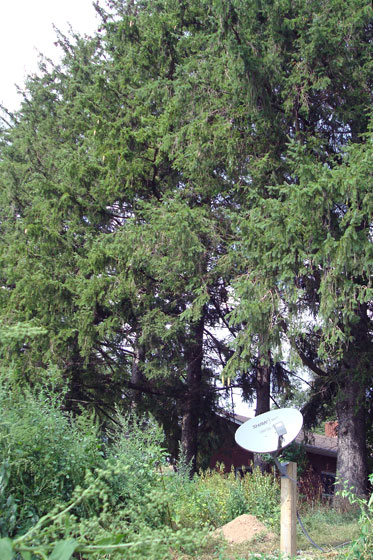
First, we couldn’t install the dish on the house. The satellite signal wouldn’t clear the row of huge pine trees right beside the house. The solution was a post in the meadow on the other side of the pines. Matt spent a couple of hours digging a deep hole while my Dad and I cut a big 6×6 for the post and with Wiley‘s help gathered concrete and gravel to set everything in place. It’s handy having spare construction supplies lying around courtesy of past owners.

Satellite dish on a post

Our dish is dwarfed by the big pines

Satellite dishes on posts in the middle of people’s yards is one of my pet peeves. I’m trying to come to terms with mine by remembering that it’s our only solution (aside from taking down the trees) and it’s in the meadow where we’ve let the grass grow long, so it’s fairly hidden.

The second issue was running the wires from the post in the meadow up to the house. Trenching the wire in the meadow and across the lawn was no sweat–well, it’s sweaty work, but not super difficult. However, between the house and the lawn is a large patio. Running wires over the surface, even if we protected them in conduit, was obviously not a great option. We were able to lift the patio slabs pretty easily, but the poured concrete border around the edge was a bit more challenging.

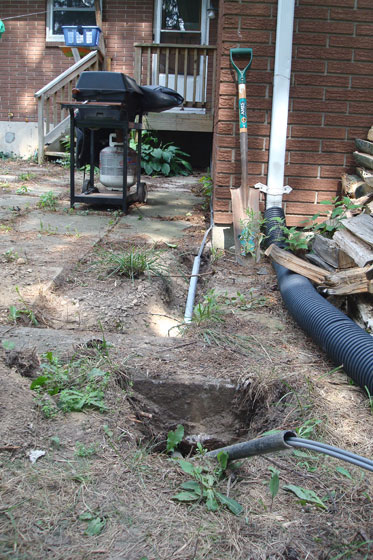
With two shovels and a bit a teamwork from both Matt and me, we each dug from opposite sides to tunnel under the concrete so that the installer could easily feed the wire under the patio.

Wire running under concrete slab

We also ran the wire through some plastic conduit for extra protection

As the saying goes, bad news comes in threes, so two challenges were not enough in the saga of the satellite.

We decided we wanted a satellite receiver in the basement as well as in the living room upstairs. Installing an additional feed in the basement would have been easy had we done it while the ceilings were all open. However, we weren’t certain initially that we were going for two receivers, so we went ahead and installed all of the new drywall and made no accommodations for the satellite wiring. Argh!

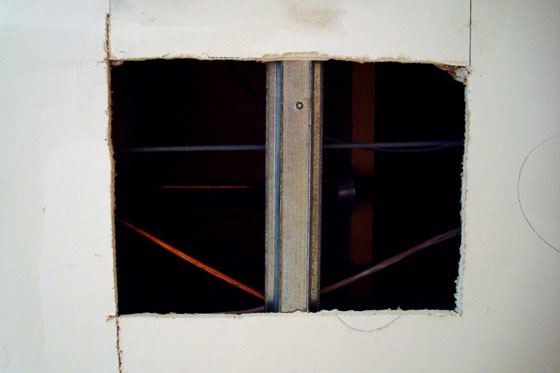
Matt and I had realized we were going to have to cut some holes in our brand new ceilings and had gone through all of the stages of grief about undoing our nearly completed work. For my Dad, though, who showed up with his long wire fish to help us prepare for the installation, he had to get from denial (“maybe we don’t really have to cut holes”) to acceptance (“we’re going to need another hole here too”) pretty quickly.

Metal stud

Ouch! Our poor ceilings. The satellite wire is the grey one at the top of the hole

Thanks to all of our prep work, the actual installation of the satellite went fairly smoothly. And just in time. Two hours before the opening ceremonies started, we had TV at the farm.

CTV Olympics on TV

Please ignore the drywall dust which is every where

Matt and I enjoy our TV, but we really haven’t missed it since moving in, mostly because we’ve been so busy with renovations.

However, I am a huge Olympic fan, so being able to stay on top of all of the coverage is a nice treat.

Any other Olympic fans out there? What event are you watching for? Anyone have tips for fishing wires or your own story of a challenging installation?

Oh and one more thing.

Go Canada go!

(Feel free to add your own national cheer below).

We have walls!

It’s been more than a month since I posted the first pictures of new drywall in the basement. Things definitely don’t move quickly when you’re DIYing–or at least Matt and I don’t move quickly!

I am pleased to announce that thanks to a big push this weekend as of Sunday afternoon all of the drywall is installed. Yay!

Untaped drywall

The new view in the long room

The total tally was 59 sheets. The entire bathroom, all of the exterior walls, and the ceilings in the main room and long room all got new drywall (click here for a refresher on the floorplan for the basement).

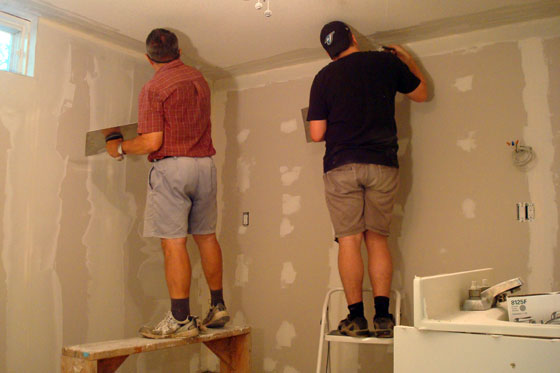
And taping is already underway. The bathroom has its third (and final) coat, the office has its second, the main room has its first. Matt has taken the lead on this part of the project, and my Dad has come up several times to help out. Between the two of them, they are motoring.

Pasting drywall joints

My Dad and Matt put the second coat of paste on the office

With three coats of paste plus sanding between each coat, this will be a big part of the basement renovation. Hopefully the next update is less than a month away.

The reveal… aka how to strip wallpaper

As neat as it would have been to find an old newspaper hidden in the wall–as we’ve heard other renovators have–that was not the case for us.

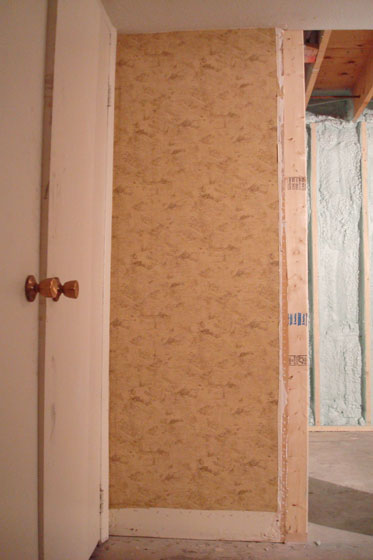
The answer to last week’s guessing game, if you haven’t already guessed from the title of this post, is that the “antique newspaper” is wallpaper that graced the walls in the basement.

Wallpaper pattern

I work in communications. I appreciate good journalism. However, graphics of old newspapers pasted onto my wall are not good journalism.

While the wallpaper trend in decor shows no signs of going away, this particular pattern is not in keeping with our decor vision for the basement. The newspaper wallpaper was going away.

In my experience, removing wallpaper goes one of two ways. You either spend hours and hours scraping with a trowel only to have it come off in teeny tiny chips approximately the size of your smallest fingernail, or you smoothly peel the paper away a few minutes after you spritzed it with hot water.

Over the years, I’ve tried a variety of scrapers and scorers, tools and techniques, chemicals and solutions. I’ve suffered burns from heavy steamers and patched pock-marked walls when the wallpaper peeled away the paper on the drywall.

You never know how your paper is going to come off until you start trying to remove it. Fortunately for me, our newspaper wallpaper came off very easily. Fortunately for you, I’m going to share my method.

Unfortunately for some of you likely, this is not a tutorial of how to remove stubborn wallpaper. This is how to remove wallpaper that’s a single layer, has been installed correctly and isn’t sticking like bubblegum to the wall.

If your wallpaper has an attachment disorder, you have my sympathies. My best advice is to keep going and remember you can fix the divots and tears afterwards. Drywall compound is your friend.

Here is my very simple chemical-free method for stripping wallpaper. First, assemble your tools.

Tools for removing wallpaper

There is nothing fancy here. You need a scraper or trowel, a bucket and a sponge. Optional equipment is a spray bottle and gloves. If you’re working in a nicely finished area as opposed to a gutted basement, you’ll likely also want a tarp or a sheet to protect your floors.

Fill your bucket and spray bottle with hot water. You don’t need to boil the kettle. I find hot tap water works just fine. Just make sure to run the water for a few minutes until you have truly hot water.

Wallpaper on a wall

Here’s what I started with. Just a small wall covered with wallpaper.

The easiest method I’ve found for removing wallpaper is a two-step approach.

Start by soaking your paper using either your sponge or the spray bottle. Just like drywall compound is your friend after the wallpaper is removed, water is your friend during the removal. Start at the top of the wall and work your way down. The water will drip and run down the wall, but making sure the paper is fully saturated will make your life easier in a few minutes.

Once you’ve completely soaked the wallpaper from top to bottom, find a seam and use your trowel or your fingernails to grab an edge. Peel back the paper.

How to strip wallpaper

You can let the water soak in for a little while, but I usually find at this stage I can go right from soaking to peeling without delay.

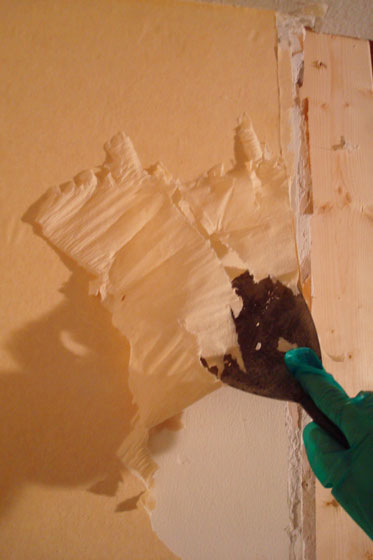
You’ll likely notice that when you peel off the paper you are only removing the outer layer, the one with the pattern printed on it. There is still a second layer that is stuck to the wall. Do not despair. Remember this is a two-step process.

Once you’ve removed the outer layer, your next job is to–surprise!–tackle the inner layer. This is the part of the paper that’s actually adhered to the wall. The patterned side of wallpaper often has a glossy or smooth finish on it that prevents the water from fully soaking into the paper and reaching the glue that’s holding the paper on the wall. By removing the outer layer first, you can then fully soak the inner layer and (hopefully) easily loosen the glue.

How to remove wallpaper

The left shows one panel of the outer layer removed. The right shows the inner layer after I’ve spritzed it with my spray bottle of hot water.

Again, you want to saturate the paper that’s on the wall. Don’t be shy with your spray bottle. Just like before, start at the top and work your way down. I usually find it helpful to let the paper sit for a few minutes to let the water fully absorb. Then, go to work with your scraper.

Scraping wallpaper

Catch an edge on the wallpaper. This time, instead of pulling the paper off by hand, let your trowel do the work.

Scrape with your trowel. I usually try to keep my trowel at a fairly shallow angle–less than 45 degrees off the wall. This allows me to easily get under the paper and scrape it smoothly off the wall.

Removing wallpaper with a scraper.

If the water has done its work, the paper should scrape off the wall fairly easily.

Apply more water as you need to to keep the paper peeling off easily. I like to spray a large area so that it can soak while I’m working on another section.

How to remove wallpaper

Halfway there

Once you have scraped all of the paper, wipe the wall with your wet sponge. You’ll find small shreds of paper and a film of glue left behind. The remaining pieces of paper will usually come off with a few swipes of your sponge. Go over the wall a couple of times to remove as much of the glue as possible. Before you paint, you may want to consider washing the wall with TSP, just to make sure there’s no residue.

At this point, you should have a nice clean wallpaper-less wall.

Wall after wallpaper is removed

The after.

And a pile of paper on the floor.

How to remove wallpaper

I get a lot of satisfaction from seeing the wallpaper on the floor instead of on the wall.

Even if your wallpaper came off with minimal effort, you may have a few spots on the wall that need smoothing out afterwards with drywall compound. In my experience, wallpaper can hide a lot of lumps and bumps. Remember, drywall compound is your friend.

Now, some of you may be wondering why I’m spending time stripping wallpaper when we don’t even have walls in the rest of the basement. Shouldn’t I be hanging drywall instead of flitting around with a spray bottle? The answer is probably yes, but I do have two good reasons for focusing on the wallpaper now:

  1. Instant gratification: I spent 30 minutes stripping this wall. It was quick, it’s done, and I can now check it off the to-do list. If I spent 30 minutes working with the drywall, I would not get nearly as much done and I would have much less sense of satisfaction.
  2. Efficiency: Once we finish installing the new drywall, the next step is taping and pasting all of the seams. I can easily patch any areas on the wallpaper wall at the same time. The end result will be a nice smooth finish on all the walls, old and new.

So, here concludes my method for stripping wallpaper. Anyone else have a method they’d like to share? Or any tips? A lot of people have horror stories of stripping stubborn wallpaper. Feel free to share your saga in the comments. We will commiserate with you.

Progress

Greenboard and cement board in the bathroom

Greenboard and cement board are up in the basement bathroom

I’m a little bit excited to finally be at the drywall stage in the basement reno. It’s going to be a huge job though, so we’ve decided to break it into smaller projects to make it more manageable. We started with the bathroom.

We used cement board in the shower and then moisture resistant greenboard on the ceiling and the rest of the walls. We’ve also patched the floor where Matt broke up the concrete for the drains and put the new concrete pan in the shower.

Cement board in the shower

Our new shower comes with a storage niche as well as a bench

Next step is taping all of the joints, and then we’ll move on to tile. It’s amazing what a difference the drywall makes. The room is already starting to feel more finished.

Things I love:

  • the niche
  • the bench
  • the precision cutting we were able to do around the electrical and plumbing–less pasting for us!

Hopefully the progress continues this weekend.

What are your plans?