Introducing Baxter

Anyone curious to see what was on the other end of the nose that you saw on Friday?

Everyone, meet Baxter.
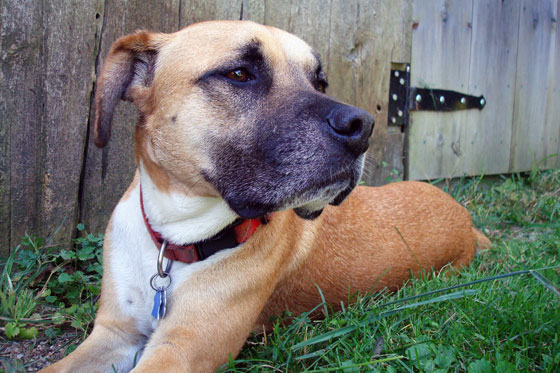
Our beautiful new dog, Baxter, laying down in front of the barn

“Hello. I love meeting new people (in case you can’t tell from my wagging butt). That’s the boxer in me. I wag my tail, but I also wag my butt. I can’t help it.

I’m also part lab. Somewhere in my family tree, there’s probably a hound dog too, because I like to sing sometimes.

I’ve lived with a few different people in a few different places, but Julia and Matt say I’m theirs for keeps now, so maybe this is where I’ll stay. (Julia says she’ll share my adoption story another time).

I guess you could say I’ve been through a lot even though I’m only three years old, but I prefer to live in the moment. I’m a glass half full kind of guy. Whatever you want to do, I’m up for it–unless you want to go for a really long walk, ’cause I haven’t done that a lot and I get a little tired sometimes. Matt thought it was really funny when I laid down in the weeds at the side of the road and didn’t want to go anymore. I knew he wasn’t going to let me stay there. I was really just thinking about him. I mean he’s only got two legs!

I like it best when we’re all in the house together, and I can lay on my pillow and keep an eye on them. Sometimes, they lay down with me and rub my back or scratch my cheeks. We practice sit and stay and down and come a lot. I know them all. I just have to remember them sometimes. And honestly, is it really fair to make me stay downstairs while they go upstairs? I can’t know what they’re doing just by listening!

I’m pretty sure Matt and Julia love me, but for some reason Easter and Ralph don’t. Easter and I have been introduced a few times, but she still won’t let me come very close. I had lots of friends at my last house, including a very little kitten. I know how to be gentle, but I just get so excited when I see them, and I really, really want them to like me. I didn’t mean to make Easter climb up the tree (she’s fine, by the way). I’d just been sitting there so long waiting for her to come over, and I got a bit impatient. Ralph, I’ve barely even seen her. When she finally came outside when I was there, I ran over to meet her, and she turned around and swiped her claws at me (she didn’t connect though, thank goodness). She must have met a not very nice dog some time (there are some of them out there, believe me, but I’m not one of them). I keep sniffing around the barn and sticking my nose in the cat door so they know I’m here. I make sure to wag my tail extra when I do, so they know I like them.
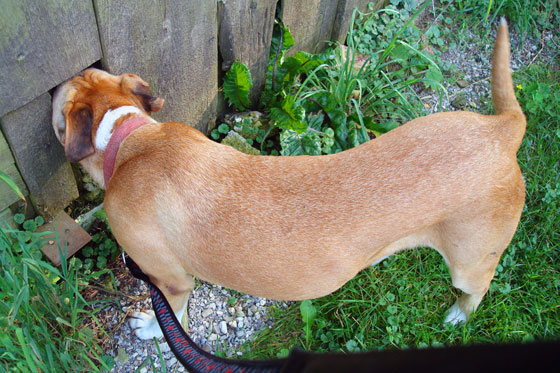
Dog peaking through an opening in a barn wall

I’ve already been to lots of new places and met lots of new people. The most interesting place so far was the park. There were lots of people and even a few dogs. I barked at one and sniffed another. There were some that were very excited, yapping and whining, so I just ignored them. Mostly everybody on the baseball team just petted me. I tried to go on the diamond once, because they didn’t have enough players, but Julia said they had enough boys and only needed girls.

Dog at a baseball diamond

Even though I’m not super energetic, I do like to play sometimes. We’ve played tag and wrestled a bit. I like to box–after all, I am part boxer. Sometimes, if I smell something really interesting, I’ll go looking for it (I think that’s my hound dog genes coming out). They keep me on the leash or the long cable pretty much all the time so far, but the one night Julia let me follow a trail out behind the barn. She kept up pretty well until I tried to go into the thicker bush. That was when she said we had to stop. She had to tie her shoes up again (wearing shoes must have something to do with only having two feet), but then we went for a run around the field and up and down the driveway. That was pretty fun. I let her win when we run up the driveway, usually. She says we’re going to go for morning runs instead of morning walks this week. I’m not sure how I feel about that.

So far, they’ve been doing an okay job of taking care of me. They did forget to take me outside to, you know, the one night before we went to bed. I did my best, but at 4am I couldn’t take it anymore. I only barked once, and Julia came and took me outside right away. They haven’t forgotten the bedtime bathroom break since.

They also gave me a bath the other day. I really don’t think it was necessary, but Matt kept saying I stunk. Julia said I wasn’t that bad, but they did it anyways. I think I was pretty stoic through the whole thing. Really it was like being petted a whole lot, although with water and suds. I rolled over in the grass a few times and laid down in the flowerbed afterwards, so I feel okay now.
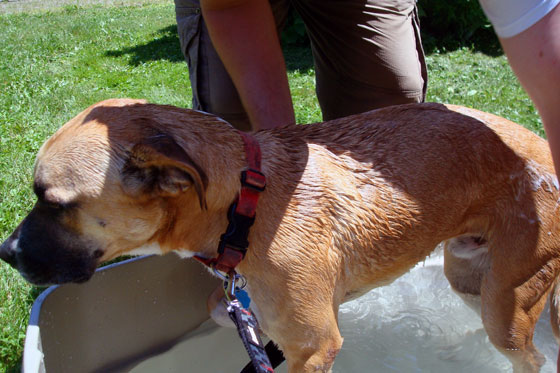
Giving a dog a bath

Overall, this seems like a pretty okay place to be. Matt and I are spending lots of time together, and we seem to have a lot in common. I mean, I don’t work on the computer like he does, but I’m good at keeping him company. And when he takes a break and watches a movie or plays a video game, I lay on my pillow and watch too. Julia and I go walking every morning and then all three of us hang out at night. That’s probably my favourite time.”

Mine too, Baxter. Welcome home. We’re so happy you’re part of our family.

Landscaping: Phase 2

I said at the beginning of the week that I’m declaring the start of July as the end of phase 1 of landscaping. We all know that the end of one thing is the start of something else, so it is also the beginning of… you guessed it… phase 2.

Yes, I still have things to finish up from phase 1, but let’s not get technical here.

For phase 2, I’m going to use the same technique that I did in phase 1. Walk out the front door and start with the first thing I see. Except this time instead of turning right, I’m going to turn left. Earth-shattering strategy, I know.

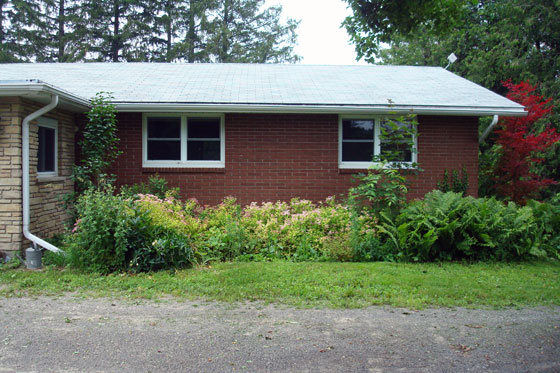
So what will I find when I turn left? Something that looks a little like this. (Our roof is not as green IRL as it appears in this photo).

Garden of spirea and ferns

From a distance it may not look that bad, but in reality it’s an overgrown jungle of spirea and ferns. I’m a variety is the spice of life kind of woman, so I need a little more diversity in my garden. I’ll be digging out a decent number of the plants. They will not go to waste though. (Remember the massive turnaround garden that needs plants?)

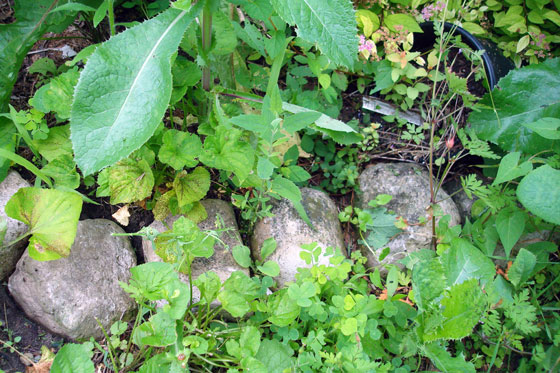
However, gardening here is never as simple as just weeding, pruning and transplanting. Take these rocks for example (and yet another plastic plant pot that escaped the earlier purge).

Rocks edging a weedy garden

Every single existing flower garden on the property is edged in rocks like this. I’m sure it looked lovely at one point. However, over the years, the rocks have sunk just far enough into the ground to become a complete hazard for the lawnmower. Plus, they’re not doing anything to keep the weeds or grass out of the garden. I would rather edge the garden every year with a spade and be able to get the lawnmower right up to the edge of the plants than deal with these rocks.

Rocks–specifically moving rocks–has been the major theme of landscaping this year. Wiley and I will spend some more quality time, moving loads and loads of rocks back to the pile behind the barn.

Let’s see. What else is there about this garden? Follow me down this garden path and let’s find out.

Broken patio slab path in a weedy garden

Note to self: Add weeding and remove broken patio slabs to the to-do list. Oh, and fill in the pit at the end of the path.

Square pit with wood retaining walls

Oh look. Another plastic plant pot.

This pit is the spot where the wood stove chimney came out of the basement. We’ve removed the wood stove, patched the hole in the wall and tarred the foundation. Now I need to deal with the pit. It’s about 3 feet deep and is usually home to frogs or, when I was taking the picture above, a camera shy garter snake. Perhaps this is a place to dispose of some of the rocks. Provided of course I rescue any creatures first.

If I follow this garden around the corner of the house to the north side, I’ll find more rocks (what else?) and more patio slabs from where the old oil tank used to be. If I follow it around to the back side, things get really wild.

The back gardens will likely be phase 3. No ETA for that yet, though.

Do you have any advice for plants that will add some diversity to my spirea and ferns? Or tips for transplanting? I tend to stick them in the ground and water the heck out of them. What’s edging your gardens? Anyone else have any “special” features in your gardens, like a pit?

Landscaping: Phase 1

Friday morning at work, a colleague who reads my blog regularly marveled at how much Matt and I have accomplished at the farm so far. I didn’t totally agree. Sometimes I see the difference that we’re making. Sometimes I just see the things left undone and the rest of the to-do list.

July does feel like a bit of a milestone to me, though. A turning point. Or a halfway mark. So I have decided to declare it the end of phase 1 of this year’s major project–landscaping–and I have decided to take a look at what we’ve done so far. If you’re interested in a refresher, here’s my previous progress report or the to-do list.

My focus has been the immediate area around the house. I used the very thoughtful technique of walk out the front door, turn right and start there. I slowly worked my way around to the side of the house. So the smaller of our two front gardens has been weeded and a new border of grass has been established.

Evolution of the front garden

Still to do: Put those poor plants that have been living in plastic pots for at least a year and a half in the ground. Transplant some other plants to fill in some of the gaps in this garden, and maybe give the yew and the Rose of Sharon a hair cut.

Around the corner from the front garden, we come to a creation I’m particularly proud of, the well garden. At the beginning of the spring, this area was a heap of hard-packed dirt strewn with rocks and overgrown with weeds. After digging everything out (including two window wells last year which were unnecessary after we bricked over the broken basement windows), leveling off the dirt, edging it with rocks (some really, really big rocks that required the help of Matt and his Dad to position), transplanting some plants, repositioning the downspout, installing a hose hanger and seeding the grass, it is starting to look like an actual garden.

Flower garden edged with rocks around a well head

Still to do: Convince the plants to grow. It’s a little hard to see, but I’ve actually planted quite a lot in this garden. I may do a bit more, but I’m trying to restrain myself, because I’m pretty sure once these plants take off, this garden is going to be pretty lush–just what I want.

Let’s go away from the house for a moment across the driveway to the fire pit. This really wasn’t a fire pit. It was more of an area where previous owners burned things. Matt and I have used it a lot as we’ve been cleaning up brush and lumber from the property. However, heaps of ash and brush wasn’t the nicest visual to see when I opened the front door or drove up the driveway. The brush I was able to relocate to a new burn area I’ve established behind the drive shed. The ash got spread around and leveled–and then I went back and forth over it with a big magnet to pick up all of the nails and screws (and hinges, door knobs and other metal) that were mixed in. The rock pile that I discovered buried in ash was picked up and dumped in the main rock pile behind the barn–talk about a dirty job.

Cleaning up an old firepit

Still to do: Make sure all of the metal has been picked out of the ash. Mix some manure and soil in with the ash so that grass might actually grow and seed it. Relocate the lawn chair and bench that were plopped beside the fire pit. Relocate the remaining large logs and lumber that were stacked waiting to be burned. Get rid of the dirt pile.

Between the fire pit and the house is the biggest undertaking of the year, the turnaround. This former mountain goat territory has been leveled, fertilized with loads and loads of manure and rototilled. I built a brick pathway across the middle of the garden and planted some bushes, hostas, trees, tomatoes and lettuce.

Evolution of the garden on the turnaround

Still to do: Finish the pathway–I need 60-80 more bricks and sand to fill the joints in between. Put a bench beside the path. Pull the weeds that have sprung up. Plant a whole lot of plants. Seriously. This thing is going to eat plants.

So it’s probably obvious from this post that I can’t just focus on what we’ve done so far. Although looking at the photos above, I am able to see the transformation happening. Slowly, ever so slowly, it’s starting to look a little more like the picture in my head (or on my Pinterest board).

How are you doing on your summer to-do list? Are you looking ahead at what’s yet to do? Anyone have any tips for living in the moment and appreciating what I’ve done so far?

How to sharpen a shovel

In case you haven’t noticed, I’ve been spending a lot of my time outside landscaping. What you definitely haven’t noticed… probably because I haven’t shared this with you before… is that much of my landscaping time is spent hopping up and down on my shovels trying to convince them to sink into the dirt. Or hacking away at defenseless plants trying to cut through tough roots.

Obviously, it was time to sharpen my shovels. Past time, rather.

Round mouth shovels with dried dirt stuck to them

The solution? Call my Dad.

Unfortunately for me, the solution is never that easy. Fortunately for you, I now have another how-to to share.

As soon as I pulled into the driveway at my parents’ house, shovels in tow, I realized that I was not going to be able to simply hand them over to my Dad. A whole sharpening station was set up in the driveway with a grinder, visor and safety glasses–multiple pairs.

There was going to be a lesson.

But first there was going to be a lecture.

“You know, back when I was on the construction site” (my Dad was a construction superintendent before he became a general contractor) “I had a labourer who would have taken those shovels away from you if he’d seen how you left them all covered in dirt. That’s not how you take care of your tools, Jules.”

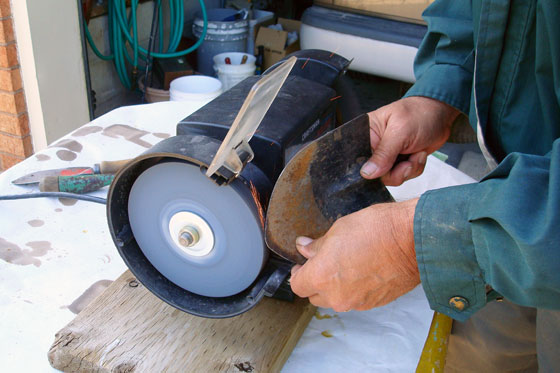
Fortunately–or unfortunately depending on how you look at it–my Dad did not take away my shovels. He did brush them off, but then he gave me a demonstration with one of his smaller shovels of how to sharpen them on the grinder. Most important lesson: keep your fingers out of the way of the grindstone.

Sharpening a small shovel on a grinder

Keeping my fingers away was easier on my big scoop shovels when I could hold them by the handle. However, they were a little more unwieldy because of their larger size. Also unwieldy: my Dad’s visor which was not sized to my head at all, but did provide complete eye protection.

Sharpening a shovel on a grinder

To sharpen the shovel, hold the back side of the blade at a very shallow angle against the grindstone. Start about halfway down the edge of the blade and curve around to the tip. Do a couple of passes on one side and then on the other.

Direction to sharpen a shovel

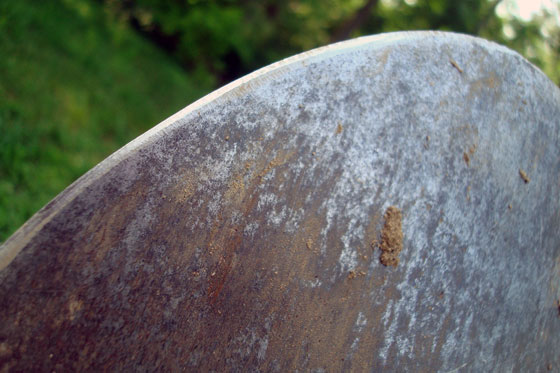
After running the shovels through the grinder a few times, I had a nice shiny, sharp edge.

Sharpened shovel

The shovels don’t magically become fillet knives, but they are much sharper and much easier to work with. Since sharpening, I have transplanted trees, bushes and flowers. Holes have been dug. Plants have been split, roots humanely cut with minimal trauma.

Oh, and the shovels have also had a shower.

Washing a muddy shovel

In addition to learning how to sharpen a shovel and remember to take care of my tools, I also learned why we used a standalone sharpening station set up in the driveway, rather than my Dad’s stable grinder that’s bolted to the bench in his work room. When the sharpening lesson was finished, he picked up the grinder and loaded it into my trunk.

I guess this means I have to do it myself from now on. My Dad’s wanted to give me this grinder for awhile now, and it will definitely come in handy for us. Although it is yet another tool to take care of. Thanks, Dad, for the lessons and the tools.

Guess who’s coming after dinner

Who’s Ralph keeping an eye on from across the driveway?

Cat sitting on a gravel driveway in front of a small wood barn

She’s probably met this gal before, given how unconcerned she was by the visitor. In fact, she stayed much too close for my comfort.

Anyone have a guess as to who came ambling through the farm? It was a new animal sighting for me.

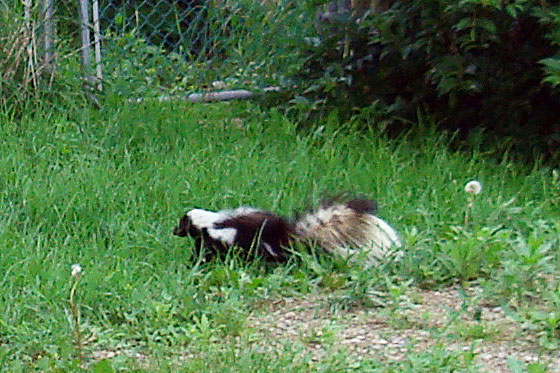
Skunk through green grass

Yup. Madam skunk took an evening stroll across the driveway up in front of the house and headed into the field. She didn’t seem too concerned by the cats–or by the curious photographer cautiously creeping closer and closer.

As long as she remains unconcerned by me and my family, I will be unconcerned by her, and she can take as many walks as she wants.

Going to camp

I don’t like to leave the farm, especially on the weekends when I have a big list of things I want to do and time to just enjoy the property. However, when I heard that WordCamp was coming to my hometown for the first time, I decided that was too much of an opportunity to pass up. After all, I said that one of my blog goals for year two was to maybe participate in a conference or professional development event.

Word Camp name badge

According to the official web site, “WordCamp is a conference that focuses on everything WordPress.” The first WordCamp was organized in 2006 in San Francisco by Matt Mullenweg. Since then, there have been more than 200 WordCamps held in more than 100 cities around the world.

My first WordCamp lived up to the official description of “informal, community-organized events” for everyone from casual users, bloggers, programmers to core developers.

I learned something in every single session–even the more technical ones. Here are just some of my takeaways.

On overall blog philosophy:

  • Don’t be afraid to be human.
  • Write first, code second. Blogging is not about the platform or coding. It’s about conversation and thought.
  • It doesn’t have to be pretty. It needs to function

On blog content:

  • Consistency–of tone, topics, visuals
  • Frequency–you don’t have to post everyday, but have a regular schedule that works for you
  • Categories–make it clear who you are, what you write about and help people to navigate your blog. One presenter phrased it as “Categories are great for external search.  Tags are great for your internal site search.”
  • Personality–be yourself

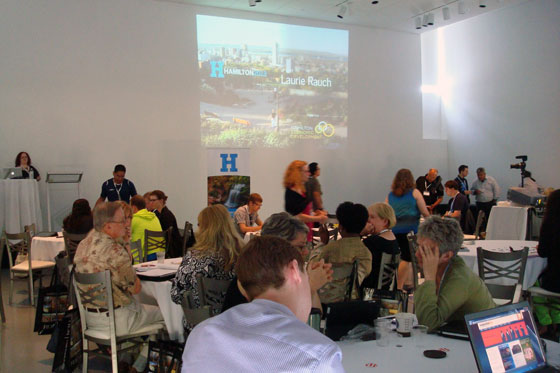
Attendees at WordCamp

On mobile (a session that was a little bit over my head):

  • “Developers and designers broke the web” (I love this quote). Simple text sites became pixel perfect print-esque designs, and these pages don’t work on the small screens of mobile devices.
  • On mobile, the screen is smaller, and the pointer (finger) is bigger
  • Responsive design adjusts how your web site displays based on what devices users are on (ReSS is the next generation to responsive design)

On customized–or semi-custom–designs (something that I’ve been considering ever since I started blogging):

  • You can build a child theme that’s based on an established WordPress theme (the parent theme). You’ll still get all of the updates and features of the parent theme, but the design and some of the functions will be tweaked to your preferences. I didn’t know this was even possible. I thought a custom design was built completely from scratch. I’m quite excited by the possibilities of child themes.
  • When selecting a parent theme, choose one that has the functionality that you like. Look for ones with lots of widgets and flexibility. You can change the design easily through CSS.

On hosting:

  • From any hosting service, expect 99% uptime, 24/7 support, system health dashboard, off peak hours maintenance windows
  • Do backups as frequently as you post new content. Back up source code, plugins and themes as well as content.

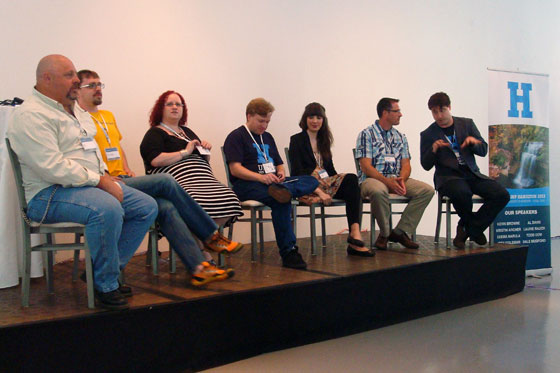
Here’s a picture of the final panel featuring most of the speakers: (from left to right) Al Davis, Richard Rudy, Laurie Rauch, Joey Coleman, Kristin Archer, Todd Dow and Kevin Browne (missing Seema Narula). They were all great. If you want more details about what anyone said, Todd Dow posted a good summary.

Panelists at WordCamp

I have to give kudos to all of the organizers and volunteers too. They put a lot of effort into making the day as useful as it was.

Since I started blogging more than a year ago, I’ve been very impressed by how supportive other bloggers are to each other. WordCamp was another illustration of that community. The first presenter of the day said, “If you know something teach it,” and that’s exactly how everyone–presenters, organizers, attendees–approached the day.

The enthusiasm and generous advice from other people at WordCamp may have inspired me to try and learn CSS. My programming knowledge is limited to rudimentary HTML that is more than a dozen years old. I’m hoping that knowledge might give me a bit of an advantage, but I’m also still a bit daunted by how much technology has changed since I did any programming.

I’m also going to try and inject a little more personality into my posts. Sometimes I feel like my posts are a bit shallow. Renovations and gardening and farming are still going to be the bulk of my posts, but I’m going to try to share a bit more about who I am.

For anyone considering attending a WordCamp or another networking or blogging event, I say go for it. I was a little uncertain about whether I’d fit in with the other attendees.

I mean, I’m not a professional blogger. I don’t have any advertisers or sponsors. I have less than 100 readers a day.

I was surprised to find out that I actually had more experience than a lot of the attendees. There were absolutely some professional programmers in the room, but there were lots of new or wannabe bloggers there too.

One of the messages that a few of the presenters had for the audience was if you’re thinking about blogging, just do it. Give it a try and see if you like it. Start. The lesson also applies to conferences. If you have an opportunity to attend WordCamp or another event, don’t be intimidated. Do it.

How about you? What advice do you have for bloggers? Have you ever been to WordCamp or another conference?

That time again II

Basket of strawberries

Our local strawberry farm opened last week, and you better believe I was there during the opening hour on opening day. I picked two baskets before heading in to work, and the next morning went back to pick some more.

So far, we’ve been eating strawberries for breakfast, lunch and dinner.

Strawberries with whipped cream and on cereal

Still on the menu for this week: waffles with strawberry maple syrup.

I love this time of year.

Have you had many strawberries yet this year? How do you like to eat them? Does anyone else have a bowl of whip cream in the fridge? Who else has gone picking? Are you growing your own berries?

That time again

The first day of summer meant the first harvest of the year on the farm.

The field behind the driveshed had been mowed earlier in the week, and by the time I came home on Friday, the hay was dry and had been mounded into long rows ready for baling.

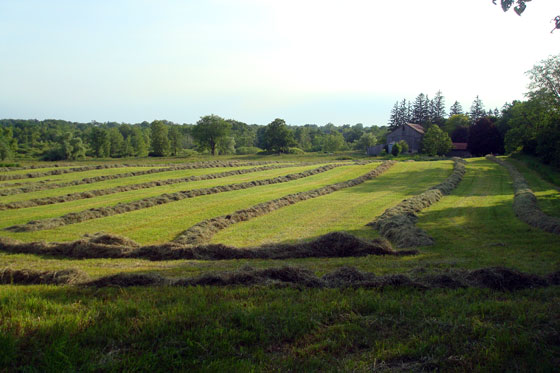
Mowed hayfield waiting for baling

As soon as I got out of the car, I could hear the clanking of machinery in the big field. Matt and I walked out to see what the commotion was.

Two big tractors were baling the hay. Unlike last year’s first cut when we had big round bales, this year we had massive rectangle bales. Allow Matt–all six feet of him–to illustrate the scale.

Large rectangle hay bale

As best I could tell, each of these huge hay blocks is made up of about 21 smaller size rectangle bales. For those not familiar with hay, it’s not any one plant. Each hay bale is made up of a variety of grasses, clover, flowers and other plants. Last weekend, when I walked out to the back field, I snapped some shots of the most frequently occurring grasses.

Grasses that make up hay

I’m not knowledgeable enough about haying to tell you what any of these grasses are. According to the farmer who manages our fields, we have a good crop of hay for this first cut thanks to a good amount of rain this spring and some doses of fertilizer earlier in the season.

Just like people have to mow the grass on their lawn weekly, the hay will grow back, and we should be able to have a second cut–or maybe even a third–in one year. Something I learned last year that surprised me was that the second cut is usually better–as in more nutritious–than the first.

So this scene may repeat yet this year.

Tractors baling hay
How did you mark the first day of summer?