One snake, two snake

My Dad had an interesting moment this past weekend while working on the downstairs bathroom.

We were putting in the venting for a new exhaust fan, and he had gone outside to pull off the cover so we could slide in the new pipe. He took off the cover and stuck his hand in to clear out the opening.

Unfortunately, there was more than old insulation and wood shavings in the hole.

Gartner snake in our foundation wall

There was a garter snake in our foundation wall.  In the background Dad watches from a safe distance.

Sorry for the dark photo. Here’s another view from the outside.

Garter snake

Matt examines the intruder

Dad’s not a fan of snakes, so he was not the best person for this to happen to. He left operation snake relocation to Matt.

Matt holding the garter snake

Fortunately, he’s just a little guy… the snake that is, not the husband.

Technically, I guess you could say the snake wasn’t actually in the house, but that isn’t a lot of comfort to me. Especially since when we walked around the back of the house a few hours later we discovered he had returned and slithering his way along the window sill.

Matt made a grab for him, and the snake headed right for his old hideout in the vent. He climbed the lattice and the vines on the foundation wall just as easily as though he was gliding along the flat ground.

Matt’s second attempt to nab the snake was successful, and the snake was re-relocated. Then we went to work pulling down the lattice and vines so as to avoid any repeat of this scenario in the future.

I’ll admit the back of the house looks less attractive now with the bare concrete, but it’s a small price to pay.

As you may be able to tell from the title of this post, this was not our only thamnophis encounter this weekend.

I was walking along the border of the far field on Friday evening when I heard a rustling in the grass. It took me a little while to spot him, but I was able to identify the source: a huge garter snake (much bigger than Matt’s new friend). He was also much more shy than Matt’s friend, and as soon as I moved closer to get a better look he slid away and hid in a pile of rocks.

At the time, I was wishing he’d stuck around so I could take a picture. Now I’m pretty happy he was so anti-social. Here’s hoping he prefers his rocks to our walls–and he’s looking for a small garter friend to keep him company.

Scenes from Saturday

Saturday is our main work day on the farm. There’s only so much we can do in the evenings when we come home from our day jobs, so we tend to put in a full day when we have the opportunity.

We’re focused right now on the basement and have finally started the process of putting it back together. The exterior walls in the main room and office have new studs. The electrician has fixed all of the wiring. The bathroom has been gutted.

This past Saturday, we got rid of all of the equipment that was part of the old water system for the house and the indoor pool. Of course, it was all full of water (even the pool filter, which we were told hadn’t been used in at least two years) and extremely heavy. We drained as much of the water as we could before hauling them up the stairs.

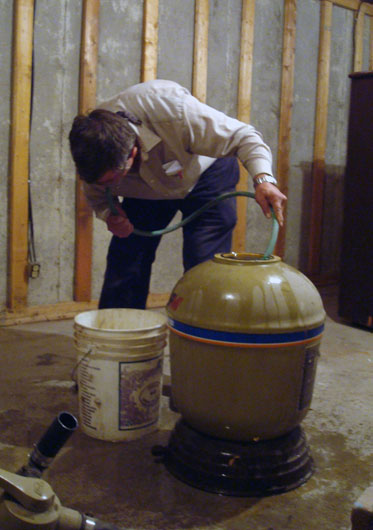
My Dad starts the siphon flowing

My Dad starting the siphon to drain the water from the old pool filter. And yes, I had the pleasure of restarting the siphon three more times myself, after it became clogged with the sand that was inside the filter. I’ll spare you the description of what the water tasted like.

The other clean-up we did was finally getting rid of our pile of scrap metal, thanks to a metal drive organized by a local Rotary club.

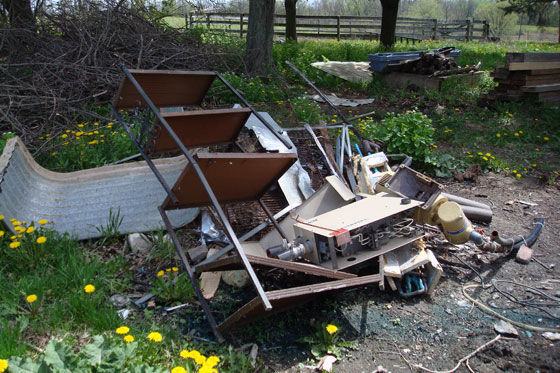
Scrap metal pile

Old window wells, hinges, nails, wires, an old reel lawn mower, pipes, racks, shelves that we’ve gathered from around the property have been piling up beside our fire pit.

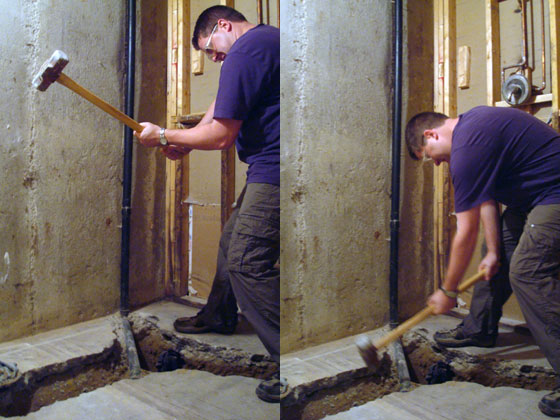
Back in the basement we made good progress on the bathroom. I pulled down the old studs on the exterior wall to get it ready for new framing, and Matt broke up the floor for the shower drain and the toilet (the new walls will be thicker than the old ones, so the toilet has to be repositioned by just a few inches).

Matt breaking the concrete floor in our basement bathroom

Smashing concrete with a sledgehammer is not a fun job. I’m so glad I didn’t have to do it.

It was another productive Saturday. I feel like we’ve finally turned the corner on the basement reno from demo into reconstruction.

What did you do with your weekend? Anyone else have a regular Saturday project?

Going geothermal – The costs

When you’re undertaking a large renovation project, such as installing a geothermal system, you of course want to know how much it’s going to cost.

Most people want this information as early in the process as possible and so they spend time typing “how much does geothermal cost” into search engines and talking with contractors, trying to figure out what the final bill will be.

Often, it’s really difficult to find this information. Many people are uncomfortable talking finances and don’t necessarily want to share how much they pay for things. Contractors don’t want to put a number on projects until they’re able to work up a quote that’s accurate for your particular situation.

Beginning with my very first phone calls with the five geothermal contractors, I very casually asked for ballpark numbers. I found I had better success if I phrased the question gently. My approach usually sounds something like, “So what am I looking at here in terms of costs? I’ve heard it’ll be between $20,000 and $30,000.”

And for reference $20,000-$30,000 is the range we worked with in all of our early figuring for our geothermal, and we tend to always go on the high end–start with the worst case scenario and hopefully you’ll be pleasantly surprised. All of the contractors I spoke with confirmed we were likely looking in that range.

In the end, Waterloo Energy Products’ estimate for our geothermal system came in at $25,558.34.

For this we got

  • a full heat loss calculation on our house
  • all of the paperwork required for the system and for our certification submission to the Canadian GeoExchange Coalition
  • 5 tonne ClimateMaster heat pump
  • 6 tonne horizontal loop (including excavation)
  • horizontal boring from the loop field into the house
  • desuperheater for our hot water, plus two 40 gallon hot water tanks
  • 10kw electric back-up heater
  • a new programmable thermostat
  • all of the required electric, plumbing and duct work to connect it all

A big factor for us when it came to the costs for our geothermal system was also the Government of Canada ecoEnergy program. This program (which has now ended) provides a rebate of $4,375 for installation of a ground source earth-energy system (aka geothermal).

Sometimes when you’re doing a renovation, there ends up being a difference between the price you’re quoted at the beginning of the project and the price you end up paying when all of the work is done. This did not happen for us with our geothermal system. The price that Waterloo Energy Products originally quoted us was the price we paid.

So, all in, taxes, certifications, rebates, our geothermal system cost $20,883.34.

Only one more post left in our “Going Geothermal” series. Coming up next week, the verdict on our system, our contractor and geothermal itself.

For previous posts in the Going Geothermal , click on one of the links below:

Going geothermal – The installation

As I mentioned in previous entries of “Going Geothermal” (see Part 1: The decision and Part 2: Picking a contractor), we were on a tight timeline for the geothermal system, and on the third day that we owned the farm installation began.

Geothermal excavation

Waterloo Energy Products crew laying the geothermal loop.

Coincidentally, the day before installation began the oil tank also ran dry. We topped it up with diesel, and then our geo contractors spent more than an hour getting the old furnace running. They never did get the hot water tank working again.

This timing just confirmed for us that we made the right decision in going for the geo right away.

Here’s the schedule of how our installation played out.

Day 1:

Remove old pool room furnace. Move new heat pump and hot water tanks into the basement. Prep work.

Day 2:

Directional drilling. The geo system is made up of two main components: the loop field where the pipes are laid and the heat pump in the house. Somehow, the two systems have to be connected.

Option 1 for doing this is digging a trench between the loop field and the house and popping the pipes horizontally through the foundation wall, hopefully right into the utility room. In this scenario, the pipes will be about mid-way between the floor and ceiling, so if you can’t get access directly into the utility room, the pipes will have to run along the wall until they can get into the utility space. Outside you need clean access to the foundation, which means no patios or other obstructions between the loop field and the spot that you want to go through the foundation.

Option 2 is directional drilling (also known as horizontal boring) where a special drill rig tunnels in from the field under the foundation (and in our case under a patio and under a sun room) and pops up through the floor of the utility room. It’s a very clean installation, but you pay extra for the convenience of not having a big trench running up to your foundation.

Geothermal pipes

The geothermal lines entering and exiting the utility room.

Also on day 2 our contractors removed the (non-functioning) hot water tank and the house furnace.

Day 3:

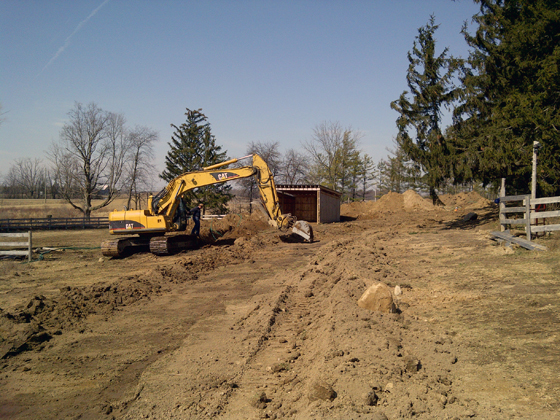
The Dig. This was the part I was most excited about. For our 6 tonne loop system, our contractor dug three trenches 300 feet long, 5 feet deep and 5 feet wide. It was a huge excavation. Fortunately, we have a lot of property and our contractor had a big excavator.

For some context picture me driving up to the farm at 7:45 in the morning (we weren’t living there yet) and seeing a giant machine toddling through the field behind the barn. It actually looked like it was picking its way delicately along. Of course, that illusion did not last as 15 minutes later the shovel was in the ground and digging had begun. One scoop of his shovel was a full 5 feet across.

Geothermal excavation

The progress after just 15 minutes of digging.

He started digging at 8 a.m. and by 3 p.m. the loop was fully installed, the trenches were back-filled and the machine was on its trailer heading away down the driveway.

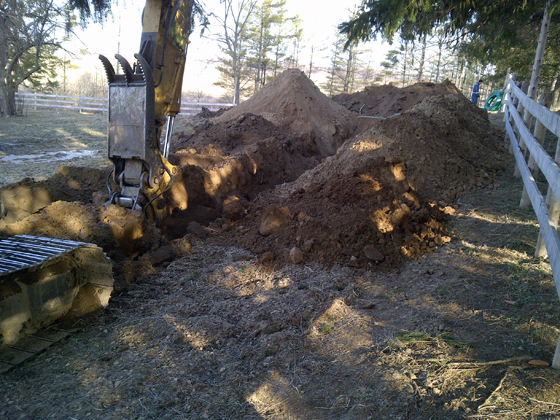
Geothermal excavation

Two-thirds of the loop down, one-third to go. The mounds of earth you see in the centre and at the left of the picture are the two completed trenches which run for 300′ long. The third trench is coming around behind the run-in shelter. If you look closely, you might be able to see the green pipes ready to be laid in the open trench.

While the Waterloo Energy Products crew was working out in the loop field, another contractor finished all of the duct work inside, including tying the new system in to the pool room. Our system also includes a 10kw electrical back-up unit (in case anything goes wrong with the heat pump) and by the end of day 3 it was chugging away and we had heat and hot water in the house again.

Day 4:

Inside installation, including connecting the heat pump into the loop. By the end of the day, I had my favourite email from my WEP crew: “You are running on geo as of now!” Throughout the installation the crew was great at keeping me updated on their progress, letting me know what time they were coming the next day and what was next on the schedule.
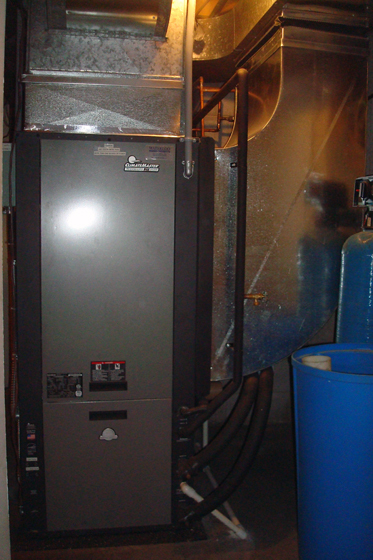
Climate master heat pump

Look how shiny! Our 5 tonne heat pump by ClimateMaster. (Ignore the old, decidedly not shiny water softener in the corner.)

Day 5:

Finishing touches and tweaks. Final hook-ups of hot water tanks (we have a desuperheater unit that captures excess heat from the heat pump and uses it to supplement hot water generated by our main electric hot water heater, hence the two tanks).
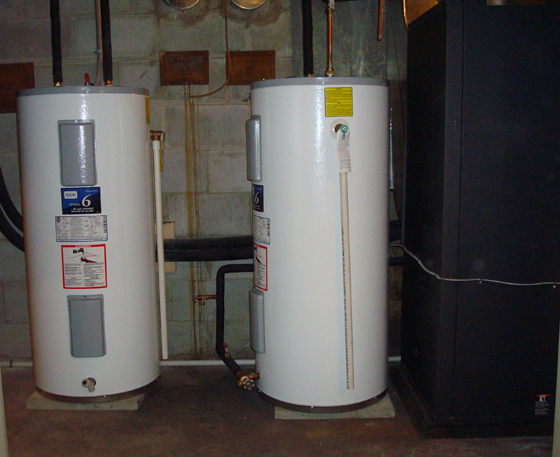
Hot water tanks

Day 5 also saw removal of our old air conditioner. One nice thing about the geothermal system is that there is no equipment outside. The loop is buried in the ground and the heat pump and hot water tanks are tucked away in the utility room.

And for a utility room, it looks pretty good. Everything is neat and tidy and very well placed. Every tour of the house now includes a stop to admire the geothermal system.

Coming up next in “Going Geothermal,” the question everyone most wants to know: the cost.

For previous posts in the Going Geothermal series, click on one of the links below:

Farewell first house

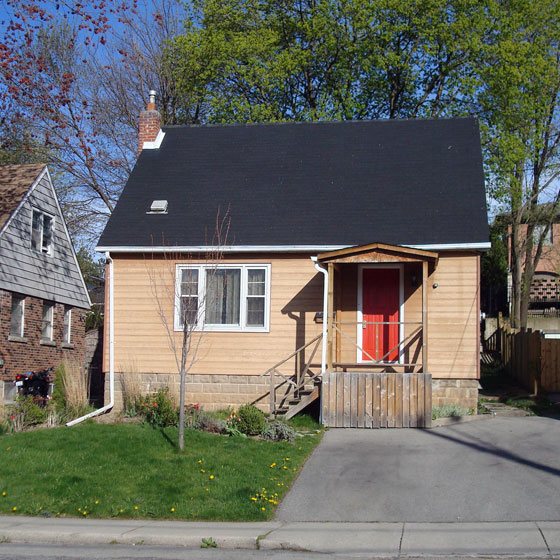
Our first homeThe sale on our first house officially closes today.

We listed the house for sale right after our offer was accepted on the farm, and it sold within three weeks. But due to a long closing date, we’ve technically owned two houses for the past two months.

This house was a great starter home for us. It was the perfect size for two people, and we had plenty of opportunities to practice renovating and fixing up a home.

On my last visit to the house, Matt’s tulips were just beginning to bloom in the front garden that we put in together.

Tulips

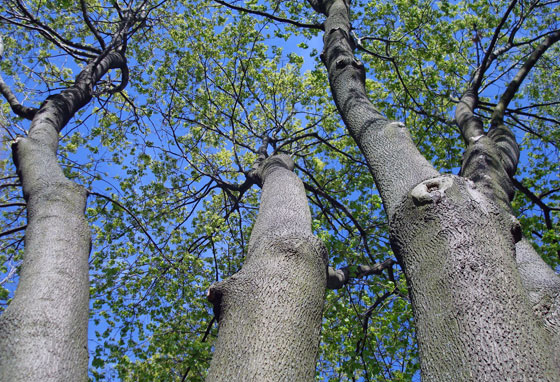
The trees were starting to come into leaf.

Maple tree

When we first saw the house, we were attracted by the mature trees in the backyard and were so excited by the fact that we owned them. Now we own hundreds of trees, and we value them just as much.

We knew all along that this house was just the start for us. Our time there made it possible for us to be at the farm now. It was a wonderful five and a half years.

Laundry day

The “Going Geothermal” series will continue later this week, but first I have to share an exciting update from this weekend, which involved installation of the latest in modern conveniences, a washing machine!

Laundry drying on a clothesline

The first laundry day at the farm

As I mentioned before, we’ve had some issues with our water, one of which is high iron content (remember Psycho Shower?). We didn’t want to hook up our new washing machine only to have it turn orange, so it’s been sitting in the basement for the past month.

As of Friday, our new treatment and filter systems are in place, so first thing Saturday morning we connected the washer and started laundry.

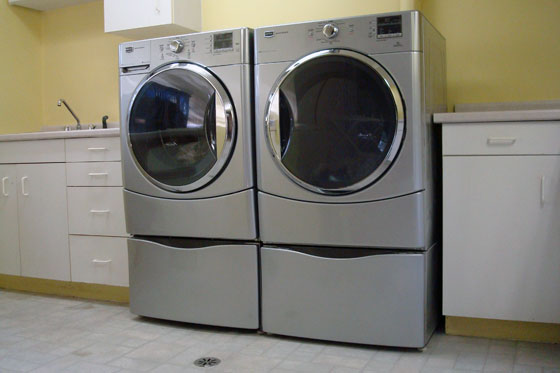
Our new Maytag 2000 Series washer and dryer

Sheets and towels, socks and underwear, pyjamas and work clothes, reno clothes and rags. Everything went through. By Sunday night, I’d done six loads in all.

We have a new dryer too, but I decided to take advantage of a nice day and hung the wet clothes on the line outside. Plus, I think a clothesline is just more farm-y. Don’t you?

Going geothermal – Questionnaire

Here is the list of questions I asked all of our geothermal contractors. Click here for the post on how we picked our geothermal contractor.

  1. How many geothermal systems have you installed?
  2. What types of systems do you install most (horizontal, vertical, closed, open)?
  3. What are the most common problems you encounter?
  4. Do you subcontract any of the work?
  5. How do you calculate heating/cooling load?
  6. What should we consider in planning for an addition to the house?
  7. Will you do locates for all of the utilities?
  8. What heat pump do you use?
  9. How much area do you need to dig?
  10. How far from the house can the system go?
  11. Are you able to install the loop on unlevel ground? (The answer to this one is yes)
  12. What are the electrical requirements for the system? Can you upgrade the electrical if it’s required?
  13. What changes to the duct work will be required?
  14. What hot water system do you use? How does the hot water system work?
  15. How long does installation take?
  16. When are you able to book the installation?
  17. How many people will be on site for the install?
  18. How does service and maintenance work?
  19. What warranties are on the system?
  20. Will you remove the existing furnace, air conditioner, hot water heater, oil tank?
  21. Do we need to have the ducts cleaned? Do you take care of this?
  22. Where will the thermostat be? How does the thermostat work?
  23. Does the weather affect the system?
  24. Does the type of soil affect the performance of the system? (The answer to this one is no, but the wetter the soil the more efficient the system)
  25. Do you take care of CGC certification? Is there a cost for this? (Certification from the Canadian GeoExchange Coalition is a requirement of the ecoEnergy program)
  26. What forms of payment do you accept?
  27. References?

I found these questions were a good way to learn about our system and understand geothermal technology. I tried to integrate the questions into our conversation during the site visits, rather than quizzing the contractors one question after another. Seeing how the contractors responded to all of my questions gave me an idea of their overall approach to customer service as well.

I guess you can call me a demanding client, but I believe when I’m making an investment, especially when it’s as big as a geothermal system, I want to know exactly what to expect and what I’m getting.

For previous posts in the Going Geothermal series, click on one of the links below:
Going geothermal – Picking a contractor

I’ve already talked about making the decision to install a geothermal system at our farm. Now I’ll talk about how we selected our contractor.

We started getting our quotes before we took possession of the farm. We knew the furnace upgrades were somewhat urgent, and the ecoEnergy rebate program expired at the end of the month that we took possession. Our goal was to have the contractor selected and the work scheduled so that we could have our new geothermal system installed the first week we owned the farm.

We didn’t really know anyone who had geothermal, so we couldn’t get a referral. There were a couple of houses along our concession that had geothermal, and the contractors had posted signs at the edge of the road, so I got one number that way. Through the Canadian GeoExchange Coalition, I was also able to get a list of CGC qualified companies in our area. We made our short list, and I started calling people.

I called five companies to start. I asked each of them the same basic questions about how geothermal works and what would work best for our situation. Based on the initial phone interviews, I then chose three contractors to come out to the farm and quote on the job. The decision of who made the short list depended on how they answered my questions and the overall feel I got from our conversation.

The site visits involved looking at locations for the loop field, inspecting the duct system within the house and checking out the utility room to figure out how to lay out the new system.

I was also up front with all of the contractors about two things that could dramatically affect our system. First, I knew I wanted to eliminate the two furnace set up and include the pool room on the same system as the rest of the house.

However, having one system was contingent on using the pool room as just a room and not having an indoor pool. A pool causes issues with temperature and humidity that can challenge a geo system.

The second issue was that we know that we hope to add on to the house eventually, so we wanted a system that was sized to handle the larger square footage.

During the site visits, I had detailed questionnaires that I asked each contractor. I’ve posted the questionnaire here in case anyone wants to check it out or copy it for themselves.

This post from 3 acres & 3000 square feet was helpful in giving me an idea of what to look for in a contractor and what questions to ask.

Based on just the questionnaires, the three contractors were pretty evenly matched. Two out of three used the same brand of highly rated heat pumps. They all did heat loss calculations to determine what size of system we needed (although it was a bit of a guess as to how big our house would be eventually). They were all very experienced and had worked on lots of residential and commercial projects. They could all do the work within the time frame that we needed. And I liked all of them.

In the end it came down to the quotes. I was surprised with the amount of variation in both the systems that were recommended and the prices that were quoted.

  • Contractor #1 quoted us a 5 tonne heat pump with a 6 tonne loop.
  • Contractor #2 quoted us a 4 tonne heat pump with a 4 tonne loop for $3,650 more than #1.
  • Contractor #3 quoted us a 6 tonne heat pump with a 6 tonne loop for $4,200 more than #1.

From what I can tell, most of the variation in the systems came from how each contractor accounted for future expansion. In the end, we felt like the 5 tonne heat pump with the 6 tonne loop would best meet our needs today and down the road. And I can’t deny that the lower price was a key part of the decision too. Reference calls yielded very positive reviews and confirmed the good vibes we had felt in meeting with the reps from the company.

So, we said, “You’re hired!” to Waterloo Energy Products and sent off our deposit cheque. Installation was quickly scheduled to begin the Monday after we took possession. And that’s next in the series. Stay tuned.

Click here for part one of the “going geothermal” series: The decision to go geothermal.

Going geothermal – The decision

A rural area presents certain limitations when it comes to city services. Most likely, you don’t have natural gas available at the road. That means, when it comes to heating and air conditioning, you have a choice of oil or propane. However, large rural properties open up a third option: geothermal.

When we first saw the farm, we recognized quickly that the furnace was pretty old and would have to be replaced. During the home inspection, our suspicions were confirmed.

Furnace

One of our old furnaces. Notice all of the soot.

There were two oil furnaces in the house: one for the house itself and the other for the indoor pool area. The pool furnace didn’t seem to be working. The house furnace, in addition to being ancient (probably original to the house), had been modified and jury-rigged over time so that it actually wasn’t in that great of shape.

Air conditioner

The old air conditioner

The air conditioner also appeared to be original to the house (remember we’re talking 30-40 years old here), the hot water heater was also running on oil and the oil tank itself was 20 years old.

When we were talking options with our home inspector, we were focused on a new high efficiency oil or propane furnace. My brother who had tagged along during the inspection said, “Or you could do geothermal.”

We scoffed because the only thing we knew about geothermal was that it was expensive.

However, after talking things through, doing a little bit of research and starting to run the numbers, we decided very quickly to go geothermal.

Why we chose to go geo:

  1. Since we had to upgrade the furnace, air conditioner and oil tank, we’d have to put out a significant amount of money just for up front capital costs.
  2. Given that oil was our most likely option for our location, we’d have to continue to put out a significant amount of money for ongoing operating costs.
  3. We plan to be in this house for a long time (notice the “forever house” tagline above), so the geothermal would eventually pay for itself, and we’d actually be able to save money over the long term.
  4. Through the Government of Canada ecoEnergy program, we could get a rebate for installing a geothermal system.
  5. We had the space to do a horizontal loop, the least expensive layout for geothermal.
  6. It’s a green option that’s a lot more environmentally friendly than burning fossil fuels.

Click here if you’re interested in more on how geothermal works.

Once we made the decision to go geo, we had to find a contractor, which I’ll talk about in the next installment of “Going geothermal.”

Putting down roots

We inherited many, many things from previous owners when we took possession of the farm (I haven’t shown you pictures of our personal Hoarders episode yet, but I may some day).

A number of those things were plants. Sometime last year, the people we bought the farm from went out and got many, many plants, but they never planted them! Bushes, flowers, trees, shrubs, all of them were still in their plastic pots sitting on the ground in and around the areas where the front flower gardens would be if they weren’t completely overgrown with weeds.

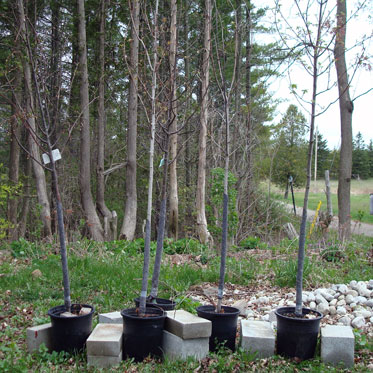
The stockpile included 5 trees.

Our inherited trees

Our inherited trees

I have no idea how long they’d been there, but when we saw the property for the first time at the beginning of January, they were all laying on their sides, frozen into a kiddie pool (I guess an attempt to keep them alive?), and they were still there, just like that, when we took possession in March.

When the ice in the pool melted enough, Matt and I stood them upright, but they were so curvy and bent from laying down that they easily tipped over again. We propped them up with concrete blocks and checked them frequently searching for any signs of life.

A few weeks ago, we noticed buds. Finally on Sunday (fittingly, Earth Day), we made some time to plant them.

I love a tree-lined driveway, and we’re already in pretty good shape, but there are a few blank spots, so that’s where we focused our plantings.

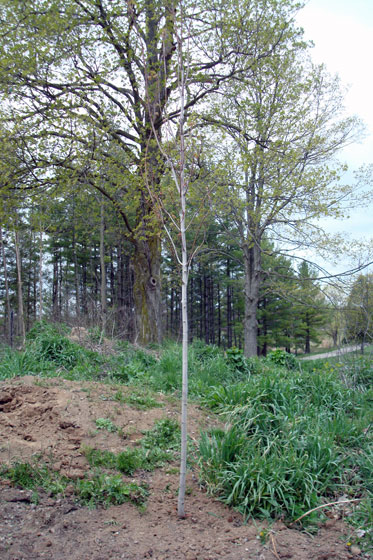
One of our new trees

One of our new trees. He's a little spindly right now, but the inspiration of what he can become is right behind him.

According to the tags that were tied to the trees, we have an Autumn Radiance Maple, two Unique Littleleaf Lindens, and an Autumn Blaze Maple. The fifth tree wasn’t labelled, but it looks like some kind of maple.

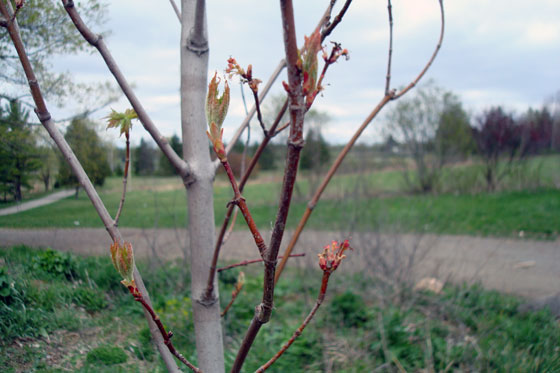
Close up of buds on our new maple tree

It's alive!

The trees make a nice addition to the farm, and planting was a very nice way to acknowledge Earth Day.

What about you? Did you do anything for Earth Day?