Farm flora

I’ve been having fun watching all of the flowers coming up around the farm this spring. It’s been a process of discovery as I figure out what that green shoot is and what’s planted over there.

Snowdrops

I believe this is Solomon’s Seal

Orange lilies

Orange lilies behind the house

Snow on the mountain

Snow on the mountain. This plant grows like crazy at my in-laws’ place, but I couldn’t get it to take at our old house. It turns out that the farm is home to a very robust crop.

Red Japanese maple and green ferns

Red Japanese maple and bright green ferns at the corner of the house

Lily of the valley

Beautiful lily of the valley. Another plant that I couldn’t get to grow at the old house.

Forget me nots

Forget me nots (and maybe a some strawberry blossoms at the top)

Purple iris

Purple iris at the south side of the house

Dandelions

Our most common flower at the farm: the dandelion

What’s your favourite spring flower? Anyone else have a successful dandelion plantation?

H2-O-kay

As I mentioned yesterday, the more we looked at the water system at the farm, the more problems we found.

Just a basic fix would have involved:

  • Repair or replace the pressure tank
  • Service the iron filter
  • Hook up the softener
  • Install a UV filter to deal with any potential bacteria contamination

We would use the existing well and the pump system would stay in the barn.
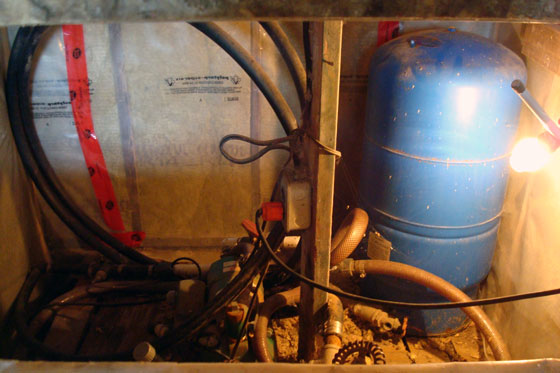
Old pressure tank and jet pump

A view inside the old “pump house” in the barn

The whole system would still not be up to standard, either for the Ministry of the Environment or for us.

We quickly came to the decision that fixing the problems was not good enough. We chose to start from scratch.

The first step was a new well.

Drilling a new well

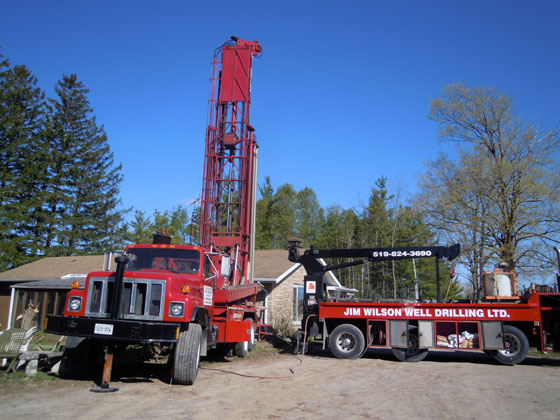
The drill rig in place beside the house

Our new drilled well is 75 feet deep with a production level of 25 gallons per minute–a really good depth and a really good rate (as opposed to our old 25 foot deep “non-standard homemade” well). It’s right next to the house meaning we have much better water pressure and most important of all it’s up to Ministry of the Environment standards.

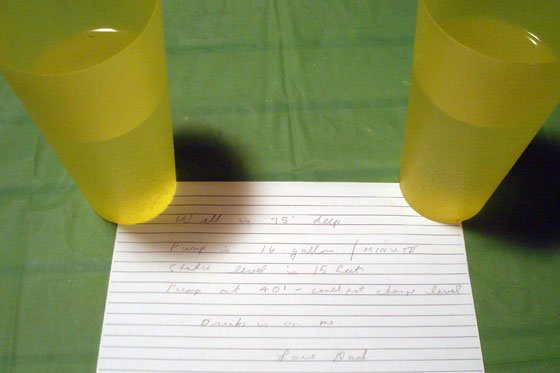
My Dad, who was supervising the well drilling, left a note to update us on what had happened while we were at work.  After listing all of the specifications, he concluded with “Drinks is on me. Love Dad.”

Note from Dad

He’d filled the glasses with water directly from the new well. I took a sip, but Matt refused the sample until we had the treatment systems installed inside the house.

Inside the well, we have a new high-efficiency submersible pump, which is much better than the old jet pump that was in the barn. The pump feeds into a constant pressure system in the house. This means that our water pressure is steady no matter how many taps or appliances are running, and the pressure is comparable to what we had when we were on city water.
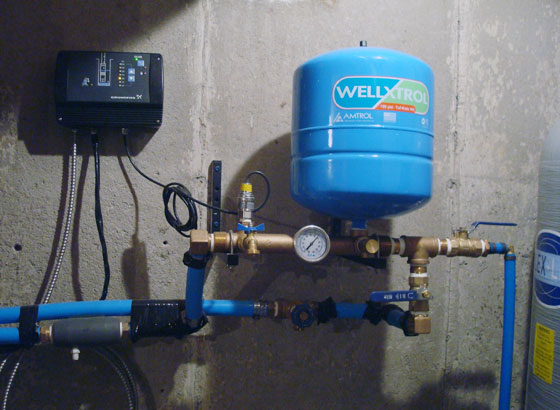
Constant pressure system and air injector tank

The constant pressure system includes an electronic controller (the black box above) and a cushion tank (blue) with a brass pressure log manifold assembly.

Next up in Operation H2O were the treatment systems.

As soon as the new well was drilled and the water was clean, our contractor took a raw water sample to determine exactly what treatment we needed. High iron content was a major issue with the old well, but no one knew whether that would continue with the new well.

It turns out that it did, so we installed a high efficiency, high capacity, chemical free air injected iron removal system. The air that’s injected oxidizes the iron (basically turning it to a solid particle–rust), and then the filter traps the rust and removes it from our water. In addition, we got a new softener–this one is actually connected!–and an ultraviolet sterilizer system.

The UV system is for bacteria, which is not likely to be an issue given our new well. However, it’s possible that the water table could become contaminated from another well in the area or some other source, and now we’re protected.

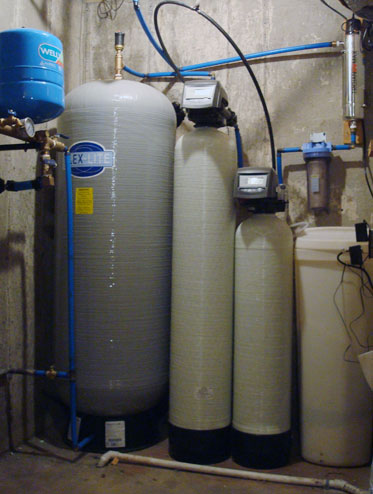
Water treatment system

From left to right, we have the blue cushion tank, a big retention tank for the iron, the iron filter, the water softener mineral tank and the brine tank which we fill with salt for the softener. The UV filter is mounted on the wall above the brine tank.

The final piece of the new water system was a reverse osmosis drinking water system. This is not a necessary piece of equipment, but Matt and I decided to go for it. Between the two of us, we drink a lot of water. Because of the salt used in our softener, the water in the house has higher levels of sodium. It’s safe to drink, but we definitely don’t need more sodium in our diets.

The reverse osmosis system is made up of a series of filters and a 14.4 litre tank that all sit in the cabinet under the kitchen sink. Our treated, softened water runs through these filters and then is pushed through a fine membrane that removes all of the salt and any other particles or impurities that might be in the water.

Reverse osmosis filter systems under the kitchen sink

The reverse osmosis filters are in the three canisters on the left and the holding tank is in the centre of the picture

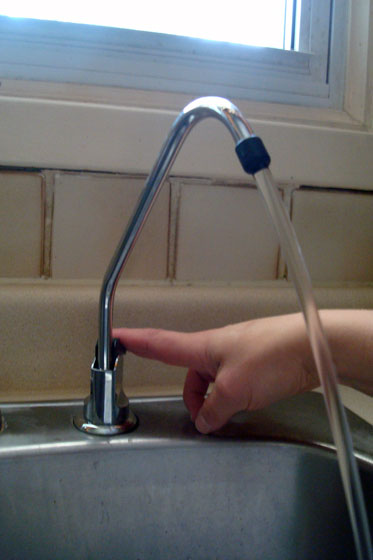
The storage tank is connected to a small faucet on the back of the sink where we have drinking water on demand.

Reverse osmosis tap

Nice clean water. Yum!

While all of this work on the water system inside the house was happening, we took advantage of having the contractors on site to make a few upgrades to the outside system as well. The old water line that brought water from the barn into the house was reversed so that we can run water from the new well to the barn. As well, we added an exterior hose at the drive shed by connecting a new line from the house and trenching it across the driveway.
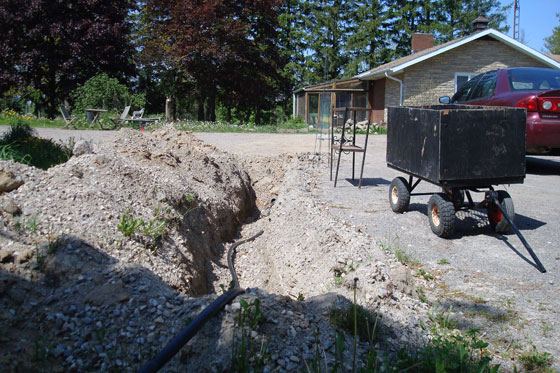
Water pipe in a trench

We’ll backfill the rest of the trench once we finish connecting the hose. How do you like our barriers so that no one drives into the trench?

Redoing the whole water system for the farm is a big project, and it was not in our original plans. However, the results make it worthwhile. With all of the equipment in the house, we don’t have to rely on a light bulb to keep the pump from freezing. We have good water pressure, no more iron or hardness and great peace of mind from knowing that everything is clean and safe.

H2-uh-O

Living in the country, we are not on city water. Like natural gas for heating, cable for television and internet, water and sewers are just not an option here. We have to rely on our own well.

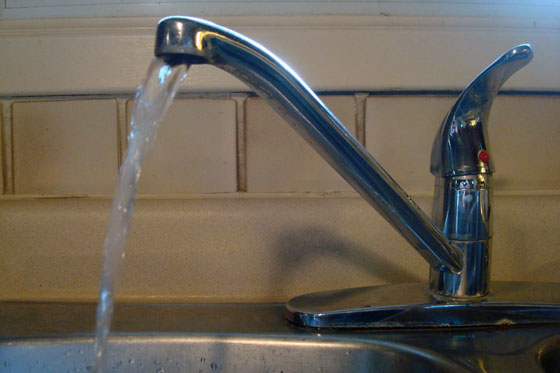
Water running from a kitchen faucet

In previous posts, I alluded to some of the issues we’ve had with our water at the farm (these issues are separate from our stinky hot water, which is now fixed). Today I’m going to go into a bit more detail.

Most people when they buy a house these days do a home inspection. We did that, and we also hired a special inspector just for the well. The inspection included looking at the well itself along with the pumping and treatment systems, performing a flow test to see the rate that water flows into the well and testing the water for bacteria contamination.

The reviews came back mixed.

The good:

  • The flow was continuous and steady, with an average of 5.08 gallons per minute–adequate for the size of our house and our needs.
  • Zero coliform and zero e. coli–no bacterial contamination
Water bacteria test form

The official form from the public health lab

The bad:

  • The pressure tank (which makes sure that you have water pressure even when the pump isn’t running) had a torn bladder. The exact wording from the inspection report was “it is in bad condition… The tank is the heart of the system and needs replacing as soon as possible.”
  • The filter in the house that was supposed to be removing iron from the water was “exhausted and needs replacement.”
  • There was a water softener in the house, but it was not hooked up to anything.

The ugly:

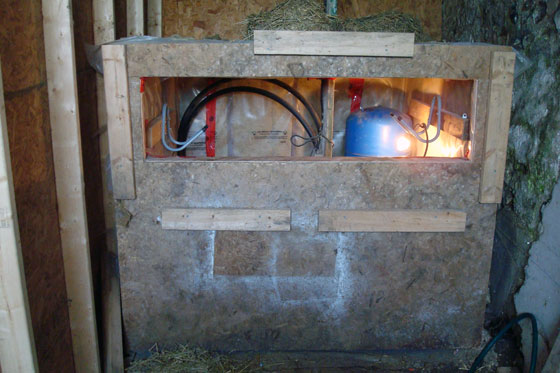
  • The pump and pressure tank were in the barn. This is a problem for several reasons. First, the barn is about 100 feet from the house. Therefore, by the time the water gets to the house, the water pressure was not very strong. The second issue is that the barn isn’t heated. The “pump house” was an insulated plywood box heated by a light bulb–okay until the bulb burns out or the power goes off. The city girl in me just couldn’t handle relying on that light bulb for a warm bath in the winter.
  • The well itself was “a homemade construction… modified as the water table dropped.” But it was still only 25 feet deep, which means that the source was surface water, not ground water, and therefore it was much more susceptible to contamination. The penultimate sentence in the inspection report was probably the most impactful: “There is no provision for sanitary protection and/or sealing of the well.” Lovely.
The plywood box that housed our pump and pressure tank

The plywood box in the barn that housed our pump and pressure tank. Note the light bulb.

We went ahead with our offer on the farm knowing we’d have to do a lot of fixes. As soon as we moved in all of the issues with the water quickly became apparent.

The first time I showered, the water pressure was very… shall we say… gentle. The first time Matt showered, he came out of the bathroom and said, “We’re fixing that.”

Over the course of a week, the tub and toilet slowly turned orange. At first, I thought it was just dirt. This is the first time Matt and I have shared a bathroom, so, of course, I blamed it on the boy. But I soon realized it was the iron.

Toilet

This is not actually a photo of a dirty toilet. The water in the toilet is clean, but all of the iron in the water and the staining on the porcelain makes it look yellow. (Sorry, but this is the best illustration I have of the iron in our water, aside from psycho shower.)

Boiling eggs for our weekend breakfast left the pot with a scale of hard water stains.

We did another water test to check for bacteria, and it again came back zero coliform and zero e. coli.

Despite this good news, the issues were piling up.

We started to look critically at the existing water infrastructure at the farm and investigating solutions. Coming up I’ll share what we did to fix our water woes.

Progress

Greenboard and cement board in the bathroom

Greenboard and cement board are up in the basement bathroom

I’m a little bit excited to finally be at the drywall stage in the basement reno. It’s going to be a huge job though, so we’ve decided to break it into smaller projects to make it more manageable. We started with the bathroom.

We used cement board in the shower and then moisture resistant greenboard on the ceiling and the rest of the walls. We’ve also patched the floor where Matt broke up the concrete for the drains and put the new concrete pan in the shower.

Cement board in the shower

Our new shower comes with a storage niche as well as a bench

Next step is taping all of the joints, and then we’ll move on to tile. It’s amazing what a difference the drywall makes. The room is already starting to feel more finished.

Things I love:

  • the niche
  • the bench
  • the precision cutting we were able to do around the electrical and plumbing–less pasting for us!

Hopefully the progress continues this weekend.

What are your plans?

Christie Antique Show

The semi-annual Christie Antique Show is the largest show in Canada, and it just so happens to be in our neck of the woods. Saturday afternoon, Matt, his brother, sister-in-law and I headed over to the show. Here are some of the things that caught my eye.

Old phonographs

Old phonographs

Vintage signs

Vintage signs

Lamps made out of old tripods

Lamps made out of old tripods

A gorgeous metal base on an old table

A gorgeous decorative metal base on an old table

Racks of vintage clothing

Racks of vintage clothing

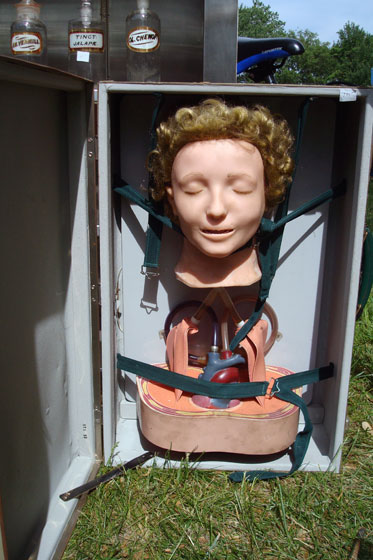
CPR dummy

A slightly creepy CPR dummy, complete with fake blood, inflating lungs and its own carrying case.

A suit of armor

A suit of armor, just in case we choose to buy a castle instead of a farm

His and her thrones

Also for our castle, his and her thrones

There were a couple of things that I would have considered more seriously if I wasn’t in the middle of a renovation.

Antique wood bench

A bench like this would be great for our front mudroom

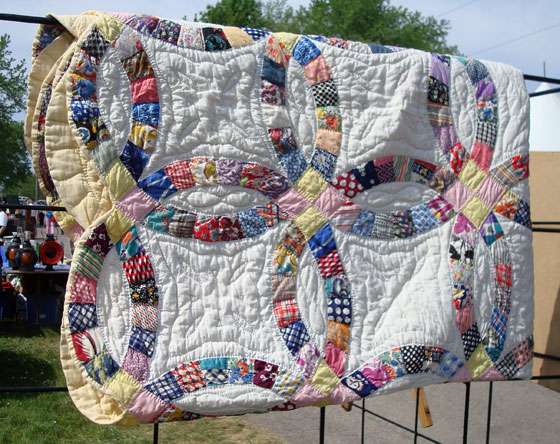
Antique double wedding ring quilt

This was labelled Dresden plate, but I’m pretty sure it’s double wedding ring, my favourite quilt pattern.

In the end, I didn’t come home empty handed. Matt bought me this little guy.

Wade England gingerbread boy

Gingerbread boy by Wade.

The gingerbread boy is part of a set of nursery rhyme figurines originally included in packages of Red Rose Tea. After receiving a few figurines from my grandmother, I started collecting them myself. The gingerbread boy is one that’s difficult to find, and I’m pleased to add him to my collection.

Pee-eww

We’ve had a bit of an odor recently over at 129 acres, and it’s not from the manure wafting from neighbouring farms. No, this smell was coming from inside the house.

At first it was just a slight malodorous scent of sulfur. It quickly became a rank rotten eggs with a side of green onion disgusting reeking stench.

This fetid fragrance materialized every single time we ran any hot water. The two days last week when I wore my hair in a ponytail? Yep, that was because I couldn’t bear to stand in the shower long enough to wash my hair.

Thanks to Katy at Turtle House for sharing her experience with this issue, I was able to take a guess as to the reason behind the stink:

Katy’s explanation: Turns out that hot water heaters contain an element called a sacrificial anode, which is typically made of magnesium or aluminum and keeps the hot water heater from rusting (and is also a terrific name for a rock band). However, it also somehow provides excellent breeding conditions for a harmless but stank-producing species of bacteria that releases hydrogen sulfide gas as a waste product.

Stank-producing indeed.

Hot water tanks

The perpetrators

I called our geothermal folks, as they installed the hot water tanks in the first place, and pleaded for help. They gave us a few options.

  1. Wait to see if the “unpleasant odour” dissipates on its own (not happening)
  2. Insert a filtration system ahead of the hot water tank to remove sulphur, iron etc. (already did this as part of the upgrades we did to the water system)
  3. Remove the anode from the tank (making the tank more susceptible to rust and therefore shortening the life of the tank)
  4. Replace existing anode with an aluminum anode usually eliminating the oxidization and smell ($150 for new anode)
  5. Install a new fibreglass tank that has no anode ($1,000 to supply & install tank)

We chose to go with option #3. We’ll take the risk of the tank rusting over replacing our three-month-old hot water tanks or installing a new anode that might be just as attractive to these stinky little bacteria.

Removing the anodes took about an hour.

Hot water tank anode

The weapons

Given that our tanks are pretty new, I was surprised by the amount of build-up on the anodes. I’m not sure whether it’s just minerals from the water, salt from the softener or actual corrosion. The one anode is coated in a grainy white sand. The other is actually pitted pretty substantially. I’m not sure what this means for the future of our anode-less hot water tanks.

Corrosion on a hot water tank anode

On the positive side of things, our water is now odor free. We turned on the tap in the bathroom to drain the tank and went for a walk outside to avoid the stench. After giving the tank some time to refill and reheat (and lighting a vanilla candle to cover the rest of the smell), I took a wonderful, warm, unscented shower. And yes, I even washed my hair.

Mini meows

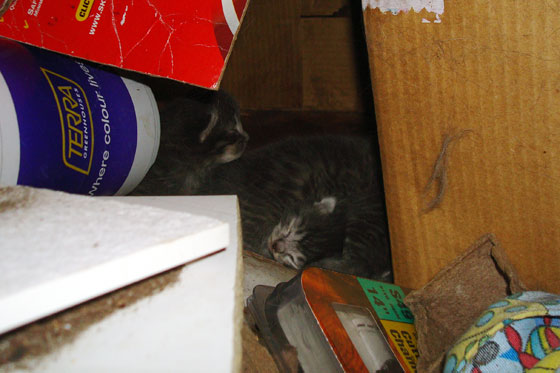
Here is the first photo of the kittens.

Garbage on the drive shed loft

Not quite the fluffballs you were expecting?

Let’s try that again. Here’s the second photo of the kittens.

Kittens in a cardboard box

See them now?

We haven’t cleaned out the loft in the drive shed yet (don’t judge), and, when it came time for Ralph to have her babies, this is the spot she chose. It’s actually a pretty good location. High off the ground so no animals can get them. Sheltered in a cardboard box. Well hidden behind all kinds of garbage. I’m amazed Matt was able to figure out where they were.

Sometime last weekend, Ralph decided her babies were ready for a new home. Again, Matt was the one who discovered where that was.

Week-old kittens

Matt pets the kittens for the first time

The kittens are now in a stall in the basement of the barn. For the first time, we’re able to see them clearly, so we can confirm we have four kittens. They’re two weeks old, so their eyes are starting to open, but they’re not very mobile yet.

Yawning kitten

I think someone’s getting hungry

Six weeks to go and they’ll be ready for adoption. Let me know in the comments if you want a fluffball of your very own.

Wiring woes

As you saw yesterday, work on the basement continues. In the meantime, I’m going back a few weeks to talk about some of the problems we encountered with the electrical.

Burnt junction box

Fried junction box in the basement ceiling. In case you were wondering, no, the inside should not be black like that.

We ended up discovering a total of 10 junction boxes in the basement ceiling, hidden behind the drywall. This is a big no-no. Junction boxes themselves are okay. But covering them over with drywall is not. You’re supposed to put a cover on them so that they are accessible.

The conversation during demo went something like this:

“I found another one.”
“Seriously? Crap!”
“Do you want to just pull the whole ceiling down?”
“We probably should. Who knows how many there are up there.”

One of my goals in hiring a professional electrician was to eliminate as many junction boxes as possible, because I didn’t want the covers polka-dotting our nice new ceiling. In the end, our electrician was able to get rid of all but two–much better than I’d hoped for.

The other unsettling moment during demo was when we’d open a wall or part of the ceiling and find a loose wire. The ends were usually cut. They weren’t capped or taped at all, and we had no idea where they went and whether or not they were live.

This was the moment when Matt would reach for his tester and point it at the offending wire. If the tester chirped, that meant the wire was live. It turned out that most of the wires were dead, completely disconnected at both ends. No one had ever bothered to remove them, so they just sat there behind the drywall waiting to scare future renovators.

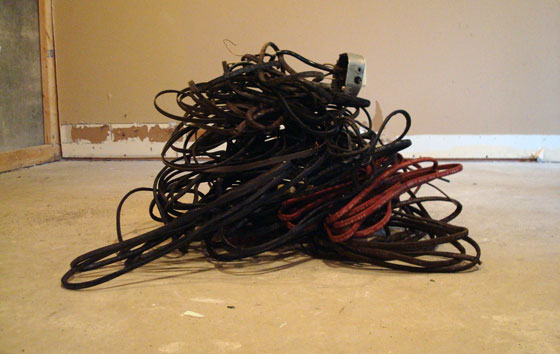
Matt made it his mission to eliminate all of this useless wiring, and he spent a lot of time tracing wires through the ceiling and along the walls so that he could pull them out.

Pile of old electrical wires

Pile of some of the old wires Matt pulled out in the basement.

We did as much of the wiring work ourselves as we could, but having the help of a skilled professional was absolutely necessary for fixing all of the problems. Electrical is not always straight-forward, and it can be dangerous if it’s not right.

I’m all about DIY, but only if I know what I’m doing. Thanks to our electrician, all of the problems have been fixed, the panel is organized and labelled, circuits have been tidied up and new outlets and lights have been added where we wanted them. Most important of all it’s done right and it’s safe.

Warm and toasty… and teal?

What do you think of our new colour scheme in the basement?

Spray foam insulation

It’s a little bit smurf, a little bit cotton candy.

Matt was hoping for blue. I’d say he got his wish.

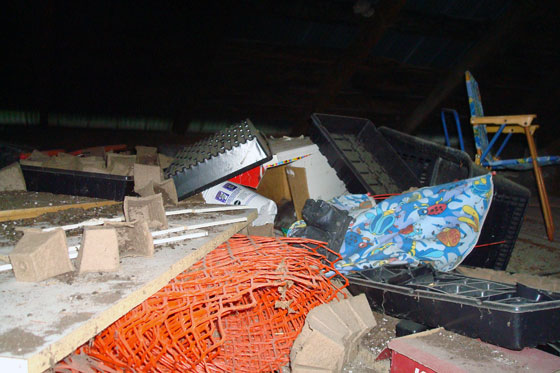
Last week, we had spray foam insulation applied to all of the exterior walls.

As you’ll recall, the original plans for the basement reno were mostly cosmetic (replace carpet, remove paneling, relocate cabinetry, leave all the drywall in place and just patch and paint). Simple, easy, quick!

However, we’ve had a few surprises in the form of inadequate insulation and improper wiring. Our solution was to remove the drywall and the existing R7 insulation from all of the exterior walls and start fresh.

R7 insulation

The old insulation was actually stamped R7. I don’t think I’d admit it if I was that inadequate.

However, we couldn’t just simply put the new insulation into the old walls because all of the studs were laid flat on the concrete. This meant we only had 1 1/2 inches for insulation. We had to fur out all of the existing studs with new 2x4s.

Furring out studs

We screwed new 2x4s onto the existing studs.

The count was close to 100 studs for the whole basement. Each one had to be plumbed (make sure it’s perfectly vertical) and then toenailed (screwed on an angle) with three inch screws to the old studs. It took two people to do each stud (one to hold and one to screw), so this stage has taken us a little while to complete. Matt and I found it took us about two hours to do a wall.

It would have been easier to put the new studs flat onto the old studs, but we wanted the higher R factor that additional depth allowed us. We ended up with 5 inches of space and we had the option of R20 or R27 for the insulation. R20 application meant we’d have 3 1/4 inches of foam and R27 would be 4 1/2 inches. We chose to go with R20 because there was nearly a $1,000 price difference for just 7 more R factors, which wasn’t worth it for us. R20 is still a really good rating.

I’ve never done spray foam before (and to be clear we couldn’t find a DIY option for spray foam, so we hired an insulation contractor to do the work for us), but we chose this option over the traditional batts for a couple of reasons:

  1. Traditional insulation requires tar paper (or some other membrane) between the concrete and the studs, and there was no way we could do this and still leave the existing studs in place. We then would have to run a plastic vapor barrier over the insulation before we put up the drywall.
  2. We found about 6 mice (all dead) and numerous rodent highways in the old insulation.

Spray foam is tar paper, insulation and vapor barrier all in one. Plus it’s more rodent resistant, which is comforting given our discoveries.

The spray foam covers the wall space between each stud as well as the joist headers at the top of the walls. In the main room and long room the ceilings are all open so the sprayers had easy access (click here if you need a refresher on the floor plan for the basement). In the office we left the ceiling in place, so Matt cut back about 12 inches of drywall off the ceiling on the two exterior walls so that the sprayers would be able to access the joist headers and we’d have a good seal all the way around.

Spray foam insulation in the joist headers

These joist headers (which were completely uninsulated before) can be the source of a lot of drafts

To prepare for the spray foam we made sure all of the electrical and plumbing work that we wanted to do was completed in advance. Spray foam fills all of the nooks and crannies and hardens very quickly. It’s great for efficiency, but you can’t really change your mind and say, “Oh I really wish that plug was over here” after it’s all done.

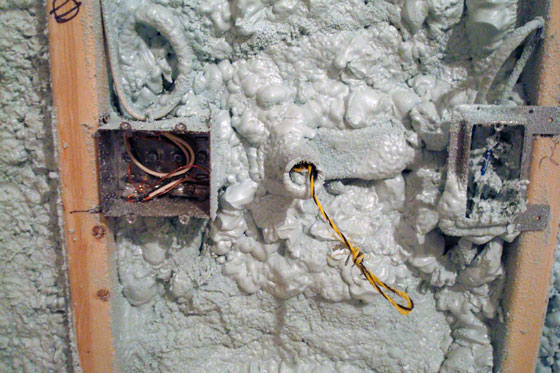
Electrical outlets encased in spray foam insulation

This is the corner in Matt’s office where the desk is going to go. From left to right we have a double box for electrical outlets, a plastic conduit that will eventually house the internet wire (we’ll use the string to pull the wire through the pipe) and a phone jack.

The spray foam crew took a full day to do the whole basement. While the spray is being applied, it is toxic, so the crew wore respirators and my Dad (who was on-site supervising) couldn’t stay in the house. When we got home from work that night there was a slight odor, but we opened the windows and it dissipated quickly.

Insulation is a major step in putting the basement back together. As much as we love the teal, we’re anxious to move on to drywall… Or maybe just anxious about drywall. This next stage is going to be a biggie. We’ll keep you posted on how we make out!