Help! I have hod claw

Matt and I put on a push this week in the basement in an attempt to pick up the pace on the pasting. (I love alliteration, but that’s a lot of ‘p’s even for me). We’ve made a lot of progress, but a side effect of all of this productivity (I just can’t stop!) is that we are both suffering from hod claw.

hod·claw

noun

an uncomfortable contraction of the hand, typically occurring after holding a hod for an extended time

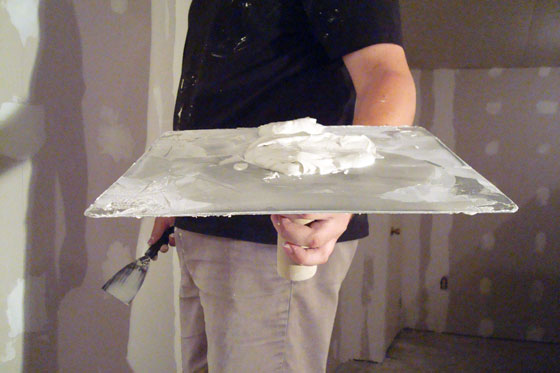
For those that haven’t had the pleasure, a hod is basically a big tray that holds the drywall paste (also known as mud or compound) while you’re working.

After a full evening of working in the basement, uncurling our fingers from our hods is harder than you’d think.

Hod with drywall paste

Matt holding the hod

It’s not that we love drywall and don’t want to stop. The issue is that our hands have seized around the handle of the hod and returning them to their regular dexterity requires much flexing and massaging.

When it comes to drywall, there are a variety of tools people choose to hold their paste. Some work directly from a bucket. Others use a mudpan. I grew up using a hod, so that’s what we use now.

Once I cross the three hour mark of pasting, I don’t think it matters what’s holding my paste. At that point, my hands have cramped. As long as I keep working, I don’t feel it too much. As soon as I set the hod down, though, that’s when I realize how tired my hands are.

Drywalling with a hod

Matt in action

Fortunately, by the next morning, I’ve usually regained most of my range of motion.

Even more fortunately, thanks to our concentrated efforts this week, we’re nearing the end on this pasting odyssey and will soon be setting down our hods. Hopefully, our  hands recover from their case of hod claw shortly thereafter.

Any other DIYers out there who use a hod for drywalling? Have you ever been afflicted with hod claw? Or do you have your own unique DIY injuries?

Degree of dustiness

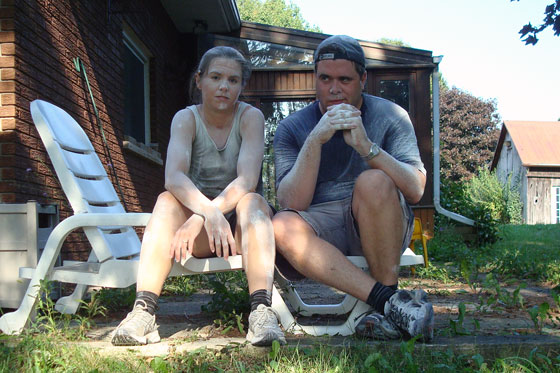
If you zoomed out on Friday’s photo, you would have seen something like this.

Matt and me after sanding drywall

Matt and me after sanding drywall

No, we did not have a baking accident and we’re not 18th century aficionados who powder our hair and faces.

We’re renovators and these days drywall is on the top of the to do list. Actually, it’s probably more the “please can we just get this done already” list, but I’m trying not to sound too desperate.

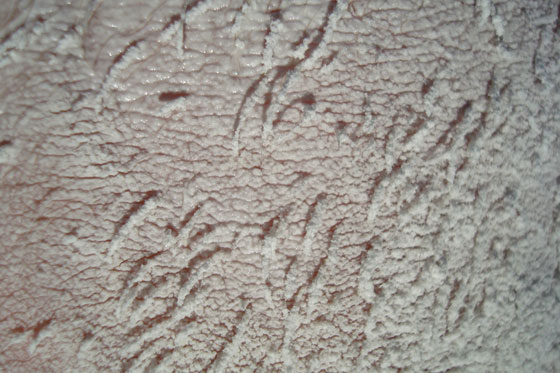
The photo that I posted on Friday was a thick layer of drywall dust coating Matt’s arm. Even though I teased her at the time, Catherine was actually pretty close with her first guess on last week’s post of “really dry skin.”

Drywall dust

Skin and arm hair with a heavy dusting of drywall. Yum.

The sanding stage of drywall installation is usually the time I start to reconsider my affection for DIY renovations.

This is a lot of work, and sanding drywall is really not fun work.

  1. Pretty much every single surface in the basement has new drywall or at least a patch of some kind. That means I’m sanding more than I’ve ever sanded in my life. My arm muscles are toned like they’ve never been before, but my nails and fingertips are rubbed off in some places. Ow. And I’m sure the amount of dust that has entered my body through my nose, eyes and mouth can’t be healthy.
  2. We’re not pros, so we’re slow. Therefore, the drywall and sanding stage take a long time.
  3. Even though we’re only working in the basement right now, dust is everywhere. Good news, you can slide around easily on the floors upstairs which makes getting around quick. Bad news, don’t set your black clothes down anywhere, or else you’ll have to choose a new outfit.
  4. We’re not pros, so there tend to be a few more bumps and ridges that we have to sand out… meaning more time, more sore muscles, more dust.

Matt uses the pole sander, but I have never been able to master it. I also feel like I get a better finish by hand. So that means I get up close and personal with every single square centimetre of drywall.

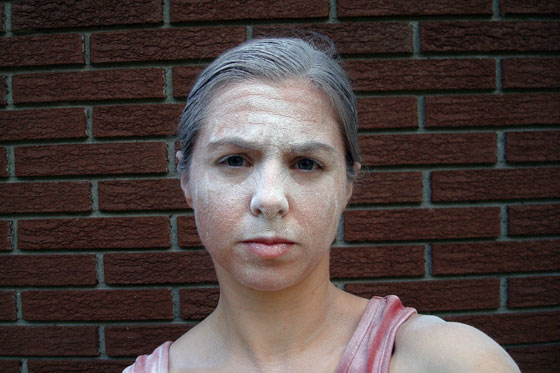
Covered in drywall dust

It’s a good look, wouldn’t you say?

The good news is that the basement is looking really good. We’re at the third (and final) coat of paste pretty much everywhere, and a few spots need only touch-ups.

If we can keep up the momentum, I’m anticipating being covered in paint spatters instead of drywall dust in just a few weeks.

That will be a nice change of style. I’m ready for a makeover.

Six month review

Some days, it seems like we’ve always been here at the farm. Others, it still seems unreal that all of this is ours. However, it is true that this is our new life. In fact, Sunday was our 6-month anniversary of farm ownership.

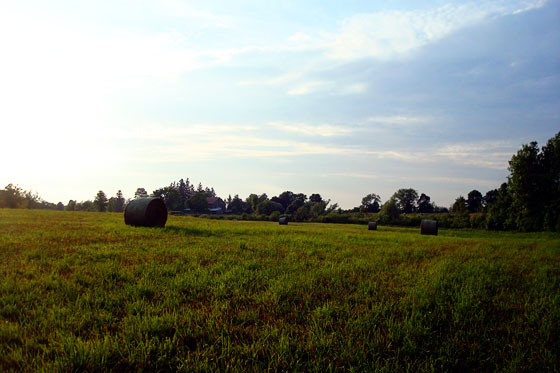
Looking over the hayfield towards the barn

My backyard

I thought it might be interesting to look back and see what we’ve accomplished so far:

  1. Energy Audit, both the initial inspection and the post-retrofit review
  2. Install new geothermal heating/cooling/hot water system
  3. Have all of the ducts cleaned
  4. Drill a new well and install completely new pumping and treatment systems
  5. Buy and install new washer, dryer, dishwasher, fridge. We were also given a new-to-us stove, so all of the appliances have now been replaced.
  6. Upgrade the insulation in the attic
  7. Remove woodstove from the basement
  8. Brick up two old windows and woodstove chimney hole in basement
  9. Reframe all of the exterior walls in the basement
  10. Rewire the basement and do minor electrical upgrades upstairs in the house like a new exhaust fan in the bathroom and a dimmer switch in the bedroom
  11. Reinsulate the basement with spray foam
  12. Install new drywall throughout the basement (pasting still in progress)
  13. Reframe and replumb basement bathroom and install new toilet in upstairs bathroom
  14. Choose tile for basement bathroom (we’ve taken delivery and just need to get moving on installation)
  15. Paint basement bathroom
  16. Reroof the house… I feel like this point should somehow be bigger to show the magnitude of this job
  17. Recover the chair seats of our newly refinished dining room set
  18. Cut down a huge tree that had a split in it and was dangerously close to the house (and cut and split all the wood)
  19. Find homes for three kittens, adopt one kitten ourselves… oh, and have Ralph spayed
  20. Get internet service
  21. Get telephone service
  22. Get satellite TV
  23. Remove the old TV aerial
  24. Make numerous repairs to the barn, including adding a door where there was just a door-sized hole, relocating another door, rehanging a third large sliding door, installing locks, fixing the broken staircase, installing lighting and plugs on the main floor, cleaning out many, many piles of garbage, scrap wood and bales and bales of loose straw
  25. Rehang the driveshed door so that it will now close
  26. Buy a tractor
  27. Install a gate on the driveway
  28. Sell the paddocks fencing, gates and run-in shelters (removal still in progress)
  29. Watch our first hay harvest
  30. Trench new waterline to the driveshed
  31. Clean out and clean up the house and property
  32. Move in (we’re waiting to finish the basement before we completely unpack)

We’ve had a lot of help over the past six months mainly from my Dad and Matt’s Dad. We also hired professional help for several of the jobs listed above, so it has not all been DIY.

It’s been a lot of work and at times I’ve been frustrated that we don’t seem to be accomplishing more. The to-do list is still very long, even if I just look at what we want to complete over the next six months. Looking back at what we’ve accomplished makes me realize that we have done a lot over the last half-year.

In the review that I posted when we were two weeks into farm ownership, I wrote:

This is definitely where I want to be. I feel very privileged that we were able to make this happen and that we’ve found the property for us. It’s very special. Tiring and a lot of work, but still special.

This statement still completely reflects my state of mind. We are so happy to be here, working together to build our forever house.

Going geothermal – Air conditioning

When the Going Geothermal series concluded, I promised to return to evaluate the air conditioning component of our system.

With several heatwaves this summer, we had ample opportunities to put it to the test.

Round thermometer

When the temperature is still 28ºC at sunset, you know it’s hot. And with the humidity it felt at least 10 degrees hotter.

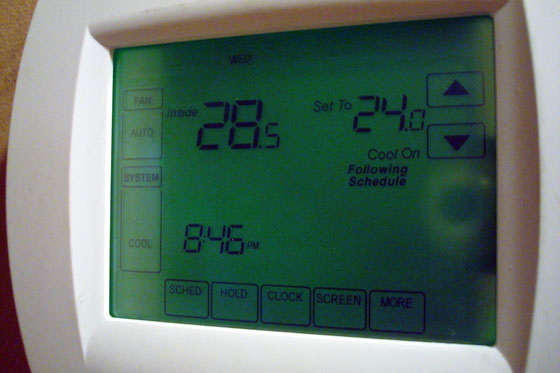
At the start of the summer, the geothermal heat pump had been off for several months as we hadn’t needed heat or cooling. To power it up, we simply chose our set point (24ºC) and turned the thermostat to cool.

Within a couple of minutes, the heat pump came to life and cool air was flowing out of the vents.

Thermostat

“Cool On” is what we’re looking for.

Everything was working well and we were enjoying the comfort air conditioning brings, especially after not having it for the past five years when we were living in our previous house. However, a few weeks in, things changed. A red light showed up on the thermostat a few minutes after we turned on the a/c one night.

Warning light on thermostat

I think this is a bad sign

I don’t know about you, but warning lights cause anxiety for me. Is this just a reminder that I have to clean the filter? Or is it a sign of real danger? Neither our manual nor Google were helpful in providing the answer.

With all of the dust in the house from the renovations, we knew we had to pay attention to the filter, so we gave it a good clean. No luck. The red light still glowed ominously. We shut down the whole system and turned it back on–technical, I know, but it works sometimes. Not this time.

With no solution in sight, we turned to the experts and called our geothermal installers for a service call.

It turned out that condensation was building up in the heat pump and wasn’t draining properly. Water + electricty = not a good idea, so the heat pump lit up the warning light.

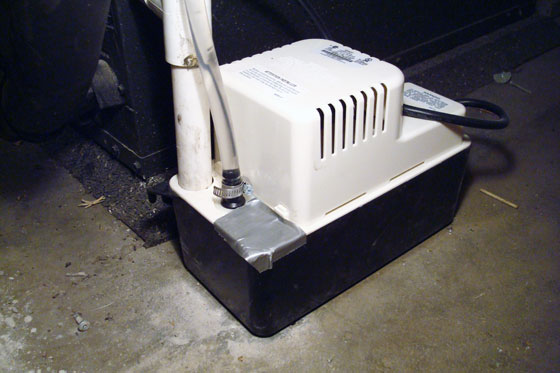
The solution to the condensation was a special pump to remove the water from the system.

Condensation pump

Our new little condensation pump. The duct tape on the corner is covering a little opening that didn’t have a cap.

The pump sits on the floor beside the heat pump. It feeds the water into the clear tube at the front of the unit and then the tube runs across the utility room to a drain.

Since the installation of the condensation pump, the geothermal system has been working perfectly. When we’re running the air conditioning, the temperature of the air is very comfortable–not frigid but it cools the house very quickly.

As with the heat setting, I definitely hear the air as it circulates through the ducts and vents. The air conditioning is not excessively noisy, but it is noticeable.

We are extremely pleased with all of the features of our geothermal system and are happy we made the choice to go geo.

For previous posts in the Going Geothermal series, click on one of the links below:

Who you gonna call? 1-800 DRYWALL

And we’re back.

Since I can no longer dive right in to a lake any time I want, let’s dive right back in to the basement renovation.

To recap for people whose minds may still be on a beach somewhere up north in cottage country (ahem), we ended up taking down all of the drywall on all of the exterior walls in the basement to upgrade the insulation. Then we ended up taking down most of the drywall on most of the ceilings to upgrade the electrical.

Matt declares victory over a pile of drywall and insulation.

Remember this scene from oh so long ago?

All of that taking down meant that eventually we’d reach a point where we’d have to put it all back up. But not the old stuff. That’s not how you do a reno.

With the old drywall unsalvageable, we had to buy new drywall. Now normally, I’d borrow my Dad’s truck and drive to the local lumber mill or home improvement store and buy the sheets that I need. However, renovating a whole entire basement means I’m working on a bit larger scale than usual. Too large for my Dad’s truck.

However, Dad still came in handy. With his help, we measured up the basement and came to the conclusion that we needed about 50 sheets of drywall. We also needed screws, tape, drywall compound (also known as mud or paste) and cornerbead.

As we were adding everything up, we decided that we also really needed someone to carry it down the basement stairs for us.

Matt, who like my father also happens to be a handy fellow, sourced out a selection of suppliers looking for the best price on both materials and delivery. As soon as he landed on 1-800 DRYWALL‘s website, the first words he said were, “These guys say basement delivery is their specialty.”

The marketing was working, but we needed a bit more information before we closed the deal.

We spent some time on their web site, reading all of their FAQs and getting a quote based on the material quantities we needed. Then I did it all again over the phone. Despite me asking a number of questions that were in the FAQ–including, “And delivery includes carrying all of the drywall down into the basement?”–the 1-800 DRYWALL staffer Roy was extremely friendly and helpful. He didn’t even mind when I decided to stop talking to  him and place my order through the web site because I could get $25 off for an online order.

On delivery day, my Dad was on-site to accept the order and supervise the unloading of all of the materials. True to their promise, the delivery team carried absolutely every piece of drywall down into the basement. They even stacked it in two different rooms based on my Dad’s directions.

Stack of drywall

A portion of our 50-sheet drywall order (and some new drywall already taped in the background)

The only hiccup on the day was on the screws. The screws I’d ordered online did not meet with my Dad’s approval. When it comes to drywall screws, my Dad likes a coarser thread because in his experience they hold better. However, the screws stocked by 1-800 DRYWALL had a thread that was too fine for my Dad’s standards, so back on the truck they went. Within a couple of days, 1-800 DRYWALL refunded my credit card, no questions asked.

Even with basement delivery (and not counting the screw refund), the price we paid for all of our materials was about $80 less than any other supplier we looked at–not a huge dollar figure, but enough to make a difference for us.

Where 1-800 DRYWALL truly beat the competition though was on the service side.

On the phone, over email and in person, everyone we dealt with was courteous, prompt and very helpful. Once I placed my order, I received a personal email confirmation, and two days after delivery I received a follow up email thanking me for my business and asking for any feedback.

The other element that I really appreciated was their web site. The site allowed me a high level of self-service, which I liked. I could fill my virtual shopping cart and get a quote all on my own. Plus, the FAQs, tips, testimonials, links to provincial building codes and professional site design inspired confidence that I was dealing with a reputable company.

In the end, my confidence was borne out. When you need drywall, I highly recommend you call 1-800 DRYWALL.
Byebye bin

If there was a bright side to doing the roof–beyond rain not seeping into our house, of course–it was the garbage bin that we ordered.

Empty garbage bin

Before

We took advantage of every cubic metre of our 40-yard bin to do a major clean up in the barn, the fields and even the house.

Full garbage bin

After

The indoor pool was the last room we cleaned out, hence the pool noodles and solar blanket. Can I just ask why you need a solar blanket on an indoor pool?

Underneath all of that are the shingles, the leather barn couch and numerous other treasures I was quite happy to say goodbye to.

Hauling a garbage bin

Buh-bye junk

The final tally was 10,780.5 pounds, which equates to 4.89 metric tonnes, 5.39 tons or “freakin’ heavy” in Matt’s words–and a huge weight off my mind.

Anyone else out there find cleaning cathartic? This blitz was particularly rewarding, I think, because most of the junk belonged to past owners.

Roof wrap-up

Matt’s a numbers guy, so as the roof was his project, it’s only fitting that I summarize his work in a statistical fashion.

Here, in a series of lists, is the story of how we reshingled our roof ourselves.

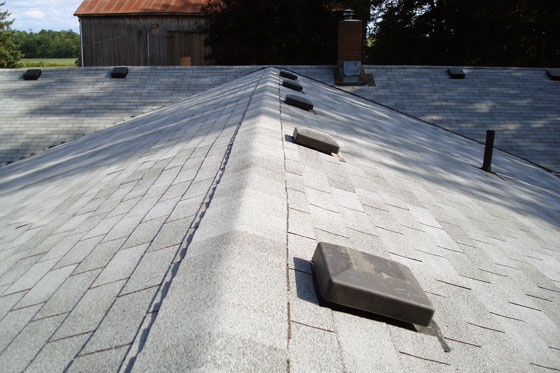
Newly shingled roof

Schedule breakdown

  • Day 1 – 1.5 hours
    Matt loads the shingles and other materials onto the roof. Thank goodness for rooftop delivery.
    Day 2 – 10 hours
    Matt, his Dad and I strip more than three-quarters of the old shingles off the roof. And then we cross our fingers for the night and don’t cover it with a tarp.
  • Day 3 – 15 hours
    Shingling begins. Matt, his Dad and his friend (a former professional roofer) complete about two-thirds of the roof and strip the remaining old shingles. Fingers are still crossed and the naked part of our roof is still untarped when we go to bed that night.
  • Day 4 – 14 hours
    I take a personal day to stay home from work, and Matt, his Dad, my Dad and I finish shingling the roof.
  • Day 5 – 6 hours
    Matt and his Dad do clean-up picking up nails and shingles from around the house and out of the eaves troughs.
  • Total: Five people 46.5 hours–note that nearly 40 of those hours came over just three days

I have to say a huge massive thank you to Matt’s dad and his friend. It was hot, dirty, heavy, uncomfortable work, and they put in a lot of hours, especially Matt’s dad, just to help us out. They supplied tools, equipment and expertise, and we could not have done this without them.

I have to say thanks as well to our roofing supplier AMA Roofing. They were a complete cold call, and we had a great experience. From the office staff I dealt with on the phone to the delivery man who brought the materials to the house, Matt and I were both very impressed. They spent a lot of time answering all of our questions and provided great guidance about how much to order and how to install everything. I highly recommend them.

Materials breakdown

  • 110 bundles of shingles – used 102 bundles
  • 22 pieces of drip edge (176 lineal feet) – used none, as there was a strange flashing/drip edge installed on the roof that we ended up reusing
  • 48 lineal feet of valley
  • 14,400 nails (120 coils) – used only 75 coils. We had so many nails left over because we had to buy two cases, as we would have been short with just one.
  • 3 rolls of ice & water shield (240 lineal feet)
  • 6 roof vents (we found an additional four in the driveshed that we were able to use)
  • 1 special roof cap/vent for the kitchen hood fan exhaust
  • 8 rolls of tar paper – used 7 rolls
  • 6 tubes of roofing tar
  • 10 sheets of plywood – used only part of one sheet for three small patches. Despite the awful state of our shingles, the plywood underneath was in good shape.

You’ll notice that we went with a very light grey shingle. Its official name is dual grey, and it’s a combination of black, grey and white stones. At times it reads almost green or blue from the ground. This is not what I was going for at all, but I can live with it.

My biggest goal in choosing the colour of the roof was to pick something light. White roofs are more eco-friendly, because they reflect more of the sunlight, rather than absorbing all of that heat into our house. We didn’t want to go with a true white roof, but we chose a light colour to give us as much reflectivity as possible.

By the numbers

  • Total roof square footage: 3,375
  • Average temperature: 29.82ºC (not including the humidex)
  • SPF: 60
  • Cost savings from doing it ourselves: $7,000 (this is a guess, as we didn’t actually get a proper quote from professional shinglers)
  • Hours between installing the last shingle and the first rain drop: 10. And then it rained for three days straight.

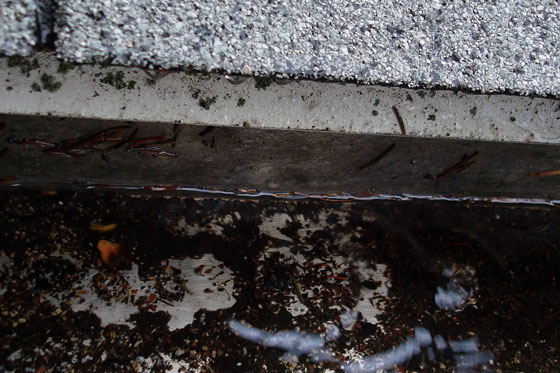
Rain falling into eaves trough

Casualties

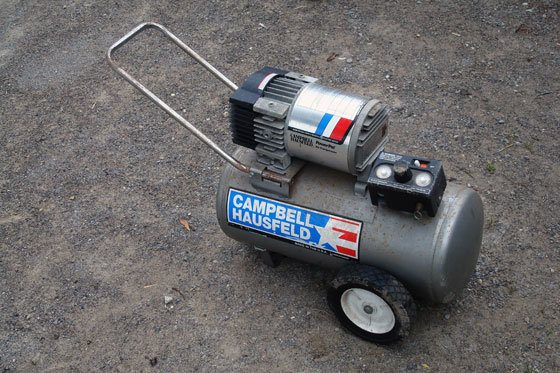
  • One air compressor – it literally went up in smoke

Campbell Hausfeld air compressor

  • Three shirts – Matt wore white in the hopes that he would be slightly cooler, and I’m not even going to try and wash those poor shirts
  • Two pairs of gloves – Matt and I both wore through the fingertips
  • One shower loofa – used to be white, now is the colour of shingle scum
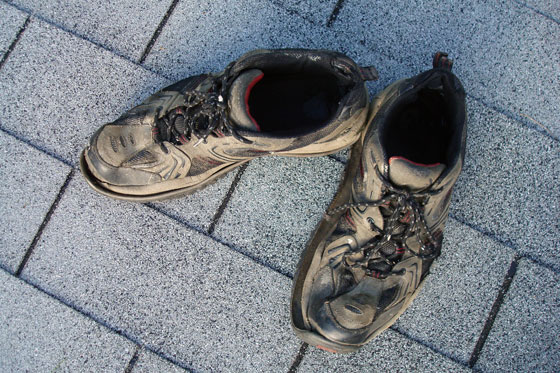
  • One pair of shoes – the soles melted and are now completely misaligned

Old shoes

I was a little bit uncertain about tackling the roof reshingling all on our own. This is a big job and does require a certain amount of know-how to do it right–know-how that Matt and I didn’t have at the start. As it came time to order the materials and figure out exactly how we were going to do this thing, I was very nervous and did consider calling in professional help. However, I’m a big believer that everything happens for a reason, and as we got closer to starting the work there were a few signs that showed me we were going to be okay:

  1. A tremendously positive, helpful and encouraging phone call with our roofing supplier. Getting the quote and talking through the project with Debbie at AMA boosted my confidence tremendously.
  2. Kit, another roofing novice who shared my trepidation–or as she wonderfully described it “grim determination wrapped around an unmistakable sense of dread,” single-handedly shingled her donkey barn.
  3. Matt’s friend, a former professional roofer, rearranged his schedule so that he was able to come and help for a day.
  4. This Old House had a segment on roofing–and yes, we took notes.

As well as everything worked out, I cannot recommend roofing as a DIY. This is a really tough job, and Matt basically knocked himself out getting this done. I’m incredibly grateful that he’s willing to take something like this on, but we’ve both agreed we won’t be doing this ever again.

Final lessons

  • There’s a fine line between stubborn and stupid, and we ended up deep in dingbat territory
  • Bungalow = big roof. Big, big, biiiiiiiiiiiiig roof
  • Don’t try this at home. Seriously, folks. Don’t.

Done

The roof is done.

I’ll post a full project wrap-up next week, but right now I’m too stupid tired to coherently tell the full story.

For the weekend, I leave you with some photos of what happened this week.

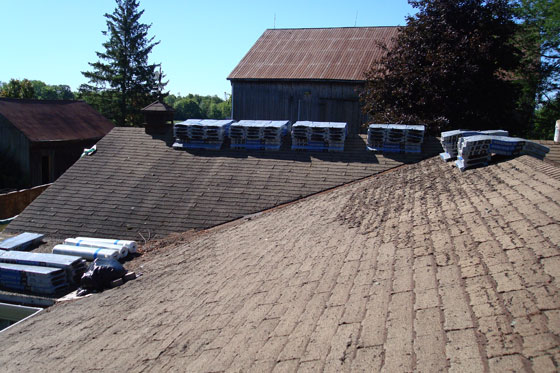
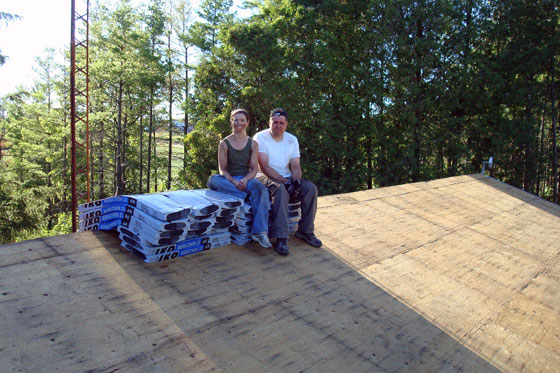
Bundles of shingles on the roof

The before shot: A portion of our 110 bundles of shingles sitting on the roof awaiting installation

Stripping old shingles from the roof

Work begins: Matt and his dad start stripping the old shingles off the roof

Bundles of shingles on a plywood roof

The end of day one: Note the naked roof and the new shingles waiting to be installed

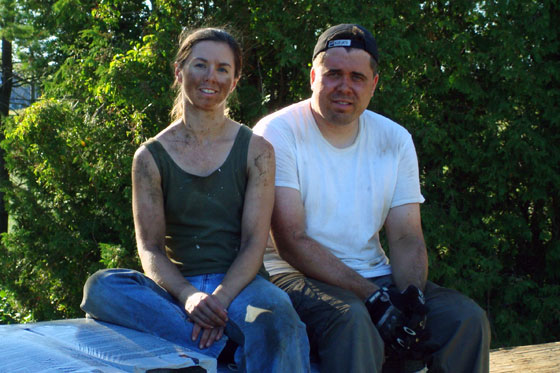
Let’s take a bit closer look at this photo, shall we? This image pretty much sets the scene for the rest of the week.

Matt and me

The dirty duo: Matt and me at the end of day one.

This is the “I’m trying to smile, but every single muscle hurts right now and I’m too tired to make the proper facial expression” look. Oh, and the reason the upper half of my face is the only part of me that is clean is that I was wearing a hat and sunglasses all day. I’m sure if I hadn’t the dirt would have been up to and into my hair.

Toad on the roof

The toad that showed up on the roof two mornings in a row. If he’d brought his tool belt, we might have let him stay up there. And can I just ask, what is it with us and amphibians?

Half shingled roof

The sun rises on the second day of shingling: On day one–also known as the 15-hour day–about two-thirds of the roof was shingled and the remaining old shingles were stripped.

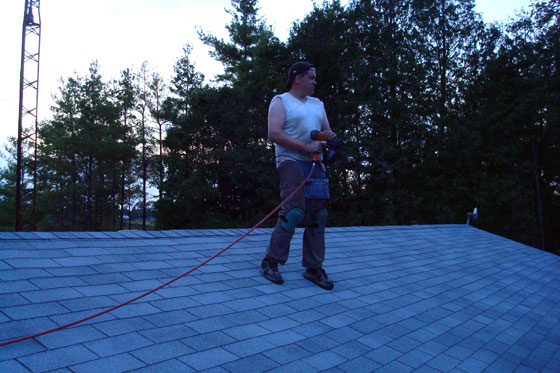
Matt on the freshly shingled roof

The end of shingling day two: As the sun sets, Matt gives his best Scott McGillivray pose on the finished roof

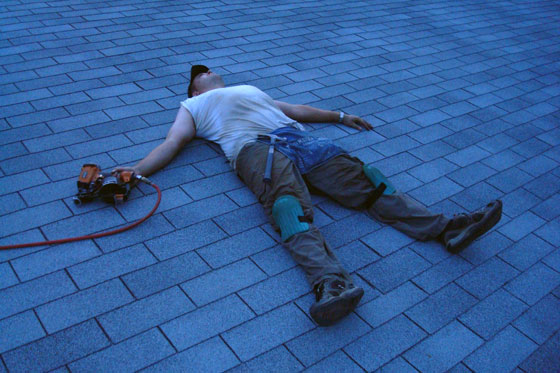
Matt laying on the roof

A few minutes later: Matt’s muscles give out and he collapses from exhaustion–nail gun in hand still wearing his hammer, tool belt and knee pads.

I’m wishing everyone a good weekend. I sincerely hope that Matt and I will be doing nothing.

Manpower

The theme of this week is manpower–as in Matt-power.

Matt is the type of person who when there’s a big job to be done or extreme physical effort required, he will just gut it out. It causes me concern frequently because he pushes himself so hard, but I also have confidence that when it comes to big jobs–such as reshingling the roof–he’ll get it done.

Last week, in preparation for the arrival of the garbage box that we ordered to handle the old roof shingles, Matt cleaned out the basement of the barn. By himself.

The inventory by the time I came home from work on Friday evening included everything and the kitchen sink.

Garbage pile by the barn

Can you spot the sink?

The centrepiece of the garbage pile is a leather couch whose disposal has been very high on my list since the very first time we saw the farm. Unfortunately, we didn’t realize it was a sleeper couch–complete with a very heavy metal frame inside–until Matt began to move it out of the barn. By himself.

Garbage pile by the barn

Can you spot the couch?

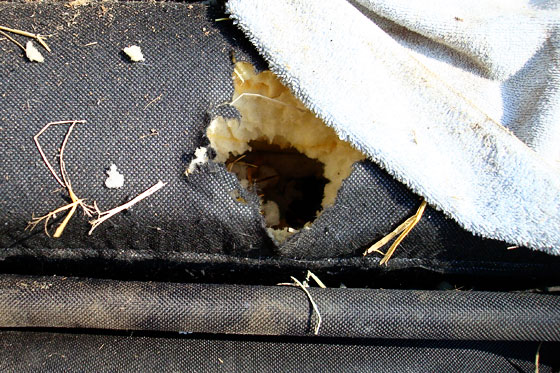
Our expectation that it was a popular mouse house was borne out. Who puts a couch in a barn? Fortunately, Matt did not have to handle the task of the extermination by himself. While Easter didn’t know what to do with the one she caught and did end up needing Matt’s help, Ralph dealt with the rest of them in one bite apiece.

Mouse hole in a couch cushion

The front door of casa de mouse

The edible portion of the clean out was limited to cat treats. The rest was sorted into garbage, recycling (including Habitat donations, beer store returns and scrap metal), burn and potentially useable items, which does in fact include the sink. Unfortunately, the useable items pile was by far the smallest.

Chains on the ground

The broom might be useful in the rest of the cleanout if we can find a handle

In the category of unuseable items, here are some of the highlights:

  • Several hundred plastic nursery pots–not even close to an exaggeration
  • Nearly a hundred cardboard egg cartons and vegetable baskets
  • A dozen plastic pails–mostly five gallons
  • A couple hundred feet of garden hoses
  • About ten tarps
  • Filters, hoses, pumps and other miscellaneous equipment for a half a dozen pools or hot tubs–I took apart one pool filter in the hopes of using the tank for a rain barrel, so this may not be completely unuseable

We ordered a 40 yard box–the biggest we could get–and it arrived on Saturday morning.

40 yard garbage bin

Our new lawn ornament–that’s almost as big as the house

Sunday afternoon, we combined Matt’s manpower with my woman power and started loading up the box. In addition to the basement of the barn, we cleaned out the loft in the driveshed, a long row of junk along the tree line in the field behind the driveshed and multiple junk piles we’d set aside in the upper level of the barn.

As happy as I am to finally clean up the property, by the end of the day I was just irritated. I know large properties and outbuildings can entice people to keep things just in case they might need them someday. However, this just seemed like littering.

Matt’s comment at one point summed up our attitudes: “I’m taking apart my jacuzzi, so I’ll just dump the pieces here in this field. No need to actually get rid of them properly.” In case you can’t hear it, the tone was very sarcastic.

So, in addition to strength, endurance and extreme stubbornness, my manpower comes with a biting sense of humour. It makes the tough jobs a little more palatable.

Anyone out there have their own manpower or womanpower partner? What do you do when they push themselves too hard?