Time to zigzag or stay on the straight and narrow?

Remember this picture from my 2013 home goals?
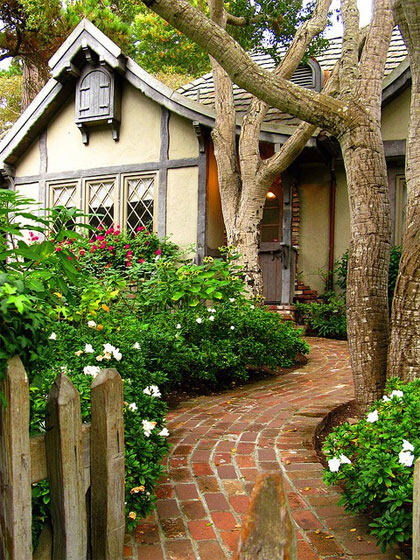
A lush garden with a brick path winding through it

This is my inspiration for the garden I’m building on the turnaround at the front of the house. Lush. A little bit wild. A beautiful brick walkway winding through.

Honestly, the path is an excuse to use up some of the piles of bricks that we have lying around the farm. But, it does have two additional benefits: the path will save us from having to walk all the way around the turnaround when we want to get to the other side (it’s farther than you might think) and it will be an attractive feature at the front of the house (I hope).

The path is next up on the landscaping list. I’ve dug out the route across the turnaround and gathered my bricks. Now I’m just trying to decide how to lay them: trendy herring bone or traditional brick pattern.
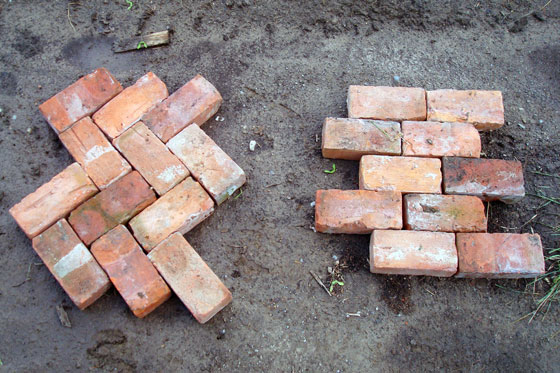
Herring bone brick walkway

If I go with the straight brick pattern, I’ll probably do six courses, not the five that are pictured here. If I go with the herring bone, this is pretty much what it’s going to look like. I’m not going to cut the bricks, so the edge will be a bit ragged. It will probably be hidden eventually by all of the lush plants, but that might take a little while.

I think I know what you’re all going to say, but I’m going to put it to a vote nonetheless. What do you think?

For those who might be concerned by the photo above, I am not going to lay the bricks directly on the dirt. I’m planning a base of sand, which we also just happen to have a huge pile of lying around. I’d use gravel, but the gravel in our pile (yes, we have one of those too) is a bit too large to provide a really stable base.

No matter what pattern I end up using, I’m planning on leaving about a half inch gap between the bricks. Does anyone have any experience with polymeric sand? I’ve heard that it’s good for filling the spaces between the bricks.

Feel free to expand on your opinions on polymeric sand, the beauty of herring bone, dos and don’ts of brick laying, fast growing plants and any other topic that strikes you in the comments. I appreciate any advice.

Manure manouvering

So how was your weekend? Mine was crappy–as in filled with manure.

We’d made some progress on the turnaround so far this spring, picking up the rocks and rubble and flattening out the piles of dirt. However, I wasn’t very confident in the quality of that dirt, so before I started to plant anything, I wanted to give it a boost of nutrition. Like any decent farm, ours came with that barnyard fixture, the manure pile, so we have lots of natural fertilizer.

Manure pile

The turnaround is the size of some people’s backyards, so a decent quantity of manure was required. Likewise, there’s a decent distance between the pile out behind the barn and the turnaround at the front of the house.

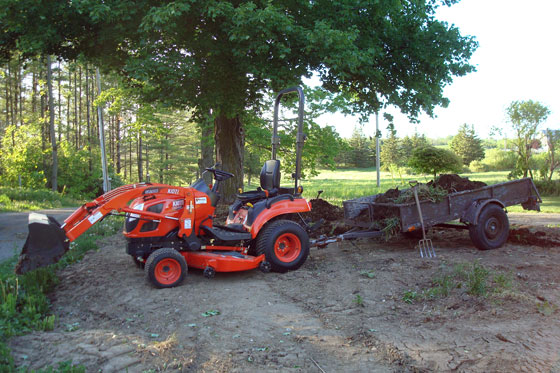
My Dad left his trailer here a few weeks ago, and with the help of Wiley and his front end loader–my skills are much improved over last year–I brought three full loads of manure up to the garden.

Kioti CS2410 towing a trailer full of manure

The manure isn’t smelly anymore, but the lesson of the weekend is that it can be a bit slippery. I had a couple of close calls standing in the trailer shoveling it off.

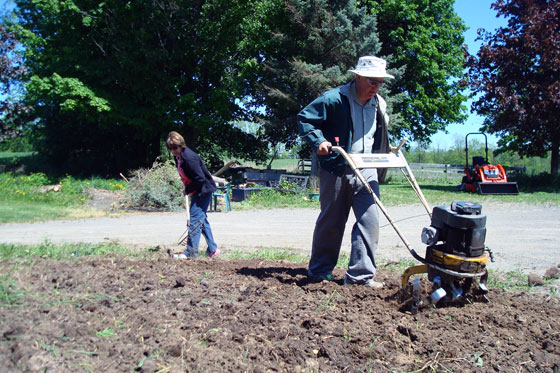
This probably wasn’t quite what my Dad had in mind for his trailer when he left it with us, but he’s a good sport. So good in fact that he brought his rototiller up to the farm and went back and forth over the turnaround mixing the manure into the soil. My Mom pitched in too spreading the soil around the edges and picking out the rocks–lots and lots of rocks.

Rototilling a garden

Thanks to my parents, our tractor, the trailer and our convenient manure pile, the turnaround is now ready for planting, so I guess my weekend wasn’t that crappy after all. Pretty productive, in fact.

How was your weekend?

Memories of Muriel

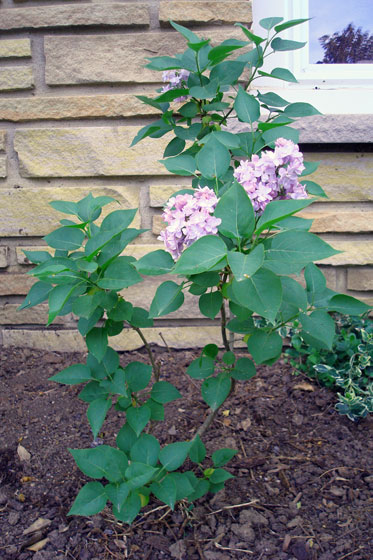
I’ve said that I didn’t do any gardening last year, and that’s not entirely true. I planted one thing: this lilac.

Double French light purple lilac

This lilac came from our first house. It had lived for six years in the flower garden Matt and I made in the front yard. It never bloomed. It didn’t really grow very much. But I nursed it along because this plant is another one of my special treasures.

This lilac was a shoot that I transplanted from a beautiful bush my grandmother had growing in her backyard. She was always very proud of her lilac and its prolific double blossoms. A few of the grandchildren took shoots to plant in their own gardens.

Last spring as we sold our first house and moved to the farm, I carefully dug up the lilac, cleared a space in the overgrown garden at the front of the house and transplanted it.

Double French light purple lilac

Over the past year, it has finally started to thrive. It’s grown taller and bushier. And for the first time ever, it’s blooming.

This is a banner year for lilacs at the farm and it turns out we have lots: a large bush outside our bedroom window, others scattered around the gardens, a hedge stretching nearly from the house to the pond. However, this, our smallest plant, is my favourite.

Landscaping… the long list

I cannot bring myself to write a list of everything I want to do for renovations in the house, but for some reason I have no problem doing a master list for the landscaping outside.

Landscaping plan

Alright, I’ll admit it. That’s a little overwhelming.

There’s obviously a lot to be done, so it’s a matter of prioritizing what part of our 129 acres we want to focus on. This year, it’s the residential area.

Layout of the residential section of the property

And just to make things a little clearer than the animation above, here’s the plan for this year.

Landscaping plan for this year

That’s manageable, right? As you saw at the beginning of the week, we’ve already made some progress on the turn around, the flowerbeds and the pond shore. Maybe by the end of the growing season, we’ll have the property in shape.

The long term plan will take who knows how long.

Long term landscaping plan

I’ve decided my goal when it comes to outside work is to transition from landscaping to gardening. Weeding flowerbeds is much more manageable than building them.

How do you handle renovations and landscaping at your house? Do you write everything down or just keep a mental list? What are you hoping to accomplish this summer?

Death by landscaping

I am dead.

I’ve been working on a lovely introduction to this post referencing the Secret Garden and the joy of tending a neglected garden. But it’s not coming together for me, and I lack the mental power to make it work. Because I am dead.

You never heard any of the characters from the Secret Garden say, “I am dead. This garden has killed me.” Let’s be honest here, Ben probably said it, but Frances Hodgson Burnett did not include it in her story of love, childhood and horticulture.

In my story of love, adulthood, responsibility, country living and horticulture, landscaping has started.

The turn around has gone from mountain goat terrain to a blank slate, thanks mostly to our farmer with his heavy equipment.

Making a garden on our turnaround

I’ve weeded one flowerbed and my mother-in-law tackled two more. (All of the plant pots were left by the last owners. The plants are still alive, so I’ll be planting them soon on the blank slate of the turn around).

Weeding a flower garden

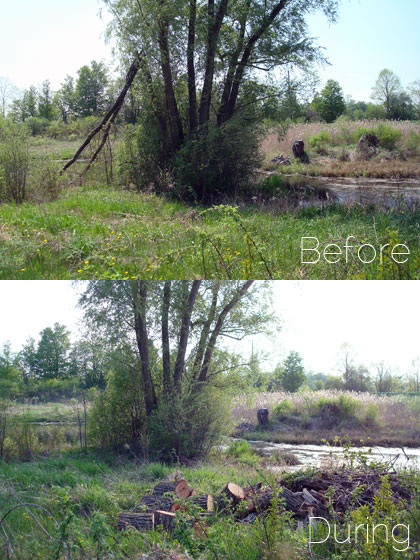
My father-in-law trimmed some of the trees and stumps around the pond. We still have a ways to go before we can actually mow the shore, but I’ve staked out the new fire pit, and we have lots of wood ready to burn.

Broken tree branch

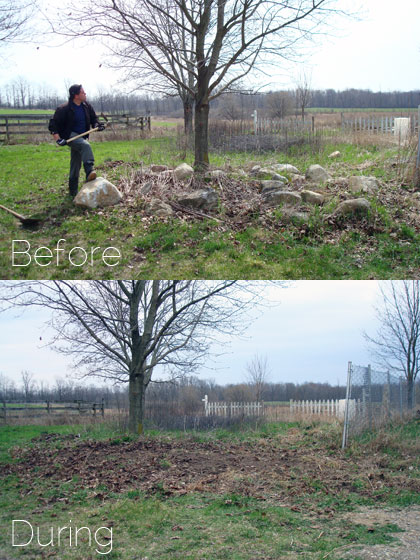
Matt, my Dad and I dismantled one of our biggest rock piles on the property–and it only took us four hours.

Cleaning up a rock pile

I started building a new flower garden around the well head. And this is when I died.

Rock edged flower garden around a well head

Last year’s landscaping efforts were limited to some very cursory grass cutting. The property was unkempt when we bought it, and our neglect over the past year while we focused on the basement reno made it worse.

The amount of work required to bring a garden back after years and years of neglect is never mentioned in the Secret Garden. Sure there’s a bit of pruning and weeding, but mostly it’s romance and roses.

In the category of things get worse before they get better, even our efforts at clean up have led to more mess. Drilling the new well and trenching new waterlines destroyed one established flowerbed and left lumpy piles of very hard dirt in its place. Burning brush and scrap lumber as we’ve tried to pick up around the property resulted a mountain of ash and a half scorched spruce tree.

Landscaping was at the top of the list on my home goals for this year, and I will get a handle on the situation outside, even if it kills me.

The doughnut tree

Outside the front door, what looks like a regular maple tree is not. It is a doughnut tree.

Pink doughnut hanging in a maple tree

Doughnut trees are sneaky. Under the canopy of leaves in the spring and summer, you forget that they bear a remarkable fruit. However, as the tree sheds its leaves in the fall, the doughnuts become visible again.

Pink doughnut hanging in a maple tree

The question is though, how does one pick a doughnut?

doughnuttree7
Any suggestions?

Home Goals 2013

I’ve never been big on new year’s resolutions, but there is a list that’s been building in my head for some time now. It is the Home Goals 2013 list.

After having most of last year sucked up by the basement-renovation-that-never-ends, my plan for this year is to avoid any other massive all-consuming projects. However, as you can probably imagine, there are a few to-dos I’d like to accomplish.

1. Landscaping. This is going to be the big one this year. As I’ve noted, we didn’t do any landscaping in 2012, so there is a huge need to get on top of the situation outside. However, with 129 acres of property, we will have to prioritize where we spend our energy.

  • Reestablish the flowerbeds around the house. Some will have to be rebuilt. Some will be extended. Everything will have to be weeded.
  • Level old fire pits at the top of the driveway and plant grass seed.
  • Build new fire pit close to the pond.
  • Tidy the east shore of the pond. The brush grew so thick over the past year that I can only access about ten feet of shoreline. Chainsaws and perhaps a bush hog will be required.
  • Put in a garden on the turnaround. This pile of dirt and rubble and weeds is approximately the size of a suburban backyard. A big lush flowerbed sounds like a better plan than mowing any additional grass.
A lush garden with a brick path winding through it

I’m going with inspirational photos for this post, rather than reality. A lush garden with a brick path winding through it would be perfect for the turnaround. Source.

2. Painting.

  • Living room
  • Dining room
  • Kitchen
  • Main floor hallway

3. Living room fireplace. A wood burning fireplace was high on my wish list when we bought the house. We have one, but it needs a little work to make it exactly what I want.

  • Replace the woodstove-esque insert with an open hearth one.
  • Reface with fieldstone.
  • Put up a new rustic wood mantle.
Stone fireplace with wood mantle

4. Laundry room. The final section of the basement needs to be brought up to our new and improved standard.

  • Fix the leaky foundation wall.
  • Paint.
  • DIY a fun light fixture.
  • Build a drying rack.

A few other things will sneak in there, I’m sure, but here’s hoping 2013 brings slightly more time for enjoying rather than always working the farm.

How do you feel about resolutions? Do you have any home goals for 2013? The nester, the champion of annual home goals, published her list last week. It’s a bit more philosophical than mine. I think I’m still at the stage of working on the underlying form for our house and property. Once I have that established, I’ll build in a bit more philosophy.

Growing free

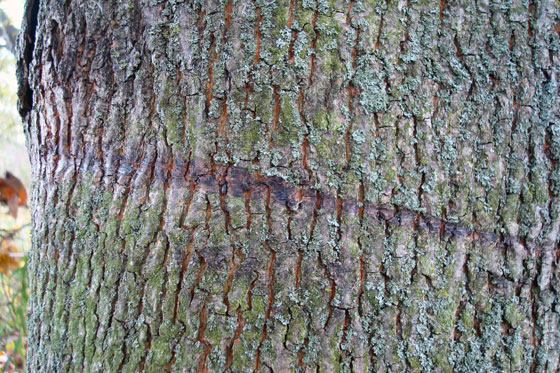
When we had the nephews at the farm two weeks ago, the tall one and I went to work on task #10 on the fall to-do list: remove stakes from established trees and stake the new trees that we planted this spring. The first step was to unshackle the trees from the cuffs that were wrapped around them. Some were tied with rope, some had sections of garden hose, some had wire. All were snug. Some were strangling. It was quite an arboreal torture chamber we were running here.

No tree emerged unscathed. Some are simply scarred.

Dark rope line on tree bark

Others are permanently deformed.

Deformed tree

We cut the wires and hoses and ropes out of the trees as best we could. Where we ran into trouble was the stakes. The nephew and I did fairly well on the first few trees rocking the stakes back and forth to loosen them up and then pulling them out in a coordinated effort. However, after he left and it was up to Matt and me, the rest of the stakes held strong.

We must have been missing the magic touch, because no matter how much we wiggled the stakes we couldn’t get them to budge.

In desperation, Matt went and got Wiley, and I found a rope. We tied the rope to the stake and attached the other end to Wiley’s loader. Then Matt raised the bucket, the rope snapped, and the stake stayed where it was.

I went and got a chain. We hooked everything together, and Matt raised the bucket again. And the front wheels of the tractor lifted off the ground.

We spent a while adjusting the chain, adjusting the tractor, tugging on the stake and only succeeded in bending it.

Tree with a bent metal stake

The conclusion I came to is that the stakes have been in the ground so long that the tree roots must have grown around the metal. I don’t think we’re going to get them out. Above ground, the trees are free. I can only hope they survive their ordeal and continue to grow. Matt, however, is a bit traumatized from his wheelie on the tractor, so we’re calling this job good enough for now. The rest of the stakes–removing them from the older trees and adding them to the new trees–can wait until spring.

Staking our claim

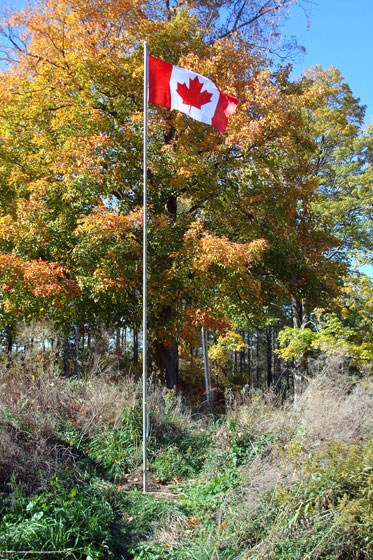
When European explorers first landed in the new world (including Canada), it was customary for them to plant their flag as a symbol of ownership.

I think this latest development means the farm is officially ours.

Canadian flag on a flag pole

Please ignore the overgrown mess that is the turnaround. Past owners dumped heaps of dirt and rubble here that made mowing impossible. Landscaping is next year’s project.

This project also means that Matt and I have officially started in on the fall to-do list. Planting the flag pole was #11.

I had bought the pole second hand on kijiji back at the end of June with the idea that we might be able to install it for Canada Day (July 1). That didn’t happen.

We drilled a hole for the pole back in August when we had the auger, and I tried to convince Matt that installing the flag pole would be a good birthday present for me at the end of September. That didn’t happen.

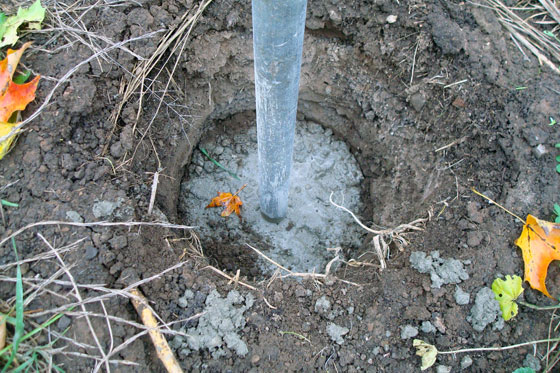
Finally on Sunday morning, we dragged out the wheelbarrow and a bag of concrete and made it happen. It took all of a half hour to mix the concrete, place the pole in the hole and pack the cement around it.

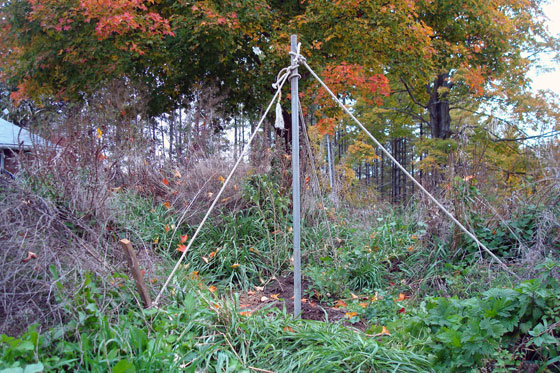
The hardest part was making sure the pole was plumb and holding it in place with ropes and stakes.

Flagpole braced with ropes

Our mini-circus tent… or the bottom third of the flag pole braced in place while the concrete sets.

Our flag pole came in three pieces, so it was very easy to wrangle one 7 foot piece into place, rather than a long 20 foot pole.

By Monday (I love long weekends by the way–we get so much accomplished) the concrete was set.

Flag pole in concrete

Set, secure and straight!

While Matt and his dad were working in the back bush clearing the trails, I went to work wrangling the rest of the pole into place. If you’re ever looking for a laugh, watch a 5’4″ woman staggering around with a 12 foot flag pole–to which she has already attached the halyard (or rope)–trying to keep it perfectly vertical so she can set it in place on top of another pole that’s as tall as she is. It took two tries, and the cats were absolutely no help.

Once the pole was fully assembled, it was a simple matter of attaching the clips to my rope and hoisting the flag.

Matt’s comment when he returned from the bush and saw the flag was, “I think we just improved this property more than any other owners. Except for maybe the guy who built the barn.”

So yes, we are both ridiculously happy to be flying the flag at the farm. Sometimes it’s the simple things.