Fireplace update – Week 1

It’s time for the first official update on the fireplace project. You got little tidbits last week, but today you get details and photos.

For a reminder, here’s what the fireplace looked like originally.

1970s fireplace

And here was the plan.

Fireplace fixes

To make this plan happen, we had to start over.

There was no liner or flue in the chimney, so if I wanted a true–and safe–wood burning open hearth, we had to build a proper chimney. That meant starting on the roof and taking everything down.

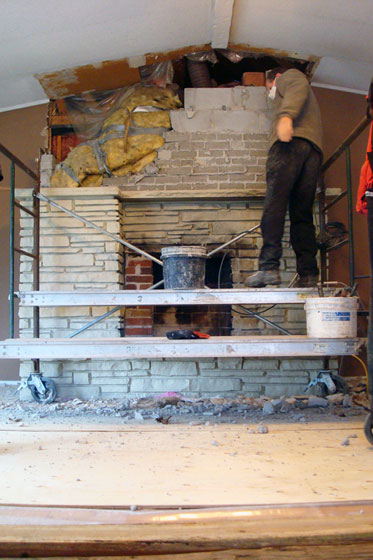
Demolishing the chimney

Wiley was very helpful during demo. I pulled him up to the edge of the roof and raised the front-end loader so that I could throw the bricks into the bucket and then drive them around to our rock pile.

Demolishing the chimney

Of course, even tractors get tired. All was going well until Wiley decided that one load was too heavy. No tractors or drivers were harmed, but it was definitely an anxious moment.

Wheelie in the tractor

Once we made it inside, it was more of the same: jackhammer, rubble and dust… lots and lots of dust. I’ve concluded that masonry dust is the worst kind of dust. Worse even than drywall dust. My hair has never been as stiff as it was on Monday night (no picture of that, sorry).

Demolishing the fireplace

It turns out there’s a reason for everything. The fireplace is where it is and is the size it is because it’s a chase for pretty much everything you could think of. There were two chimneys to vent the old furnaces that we used to have. There was the fireplace insert and its wonky chimney. And then on the far left, there was a heating duct and cold air return for the pool room.

The bump-out that I hated so much was actually there for a reason. It wasn’t just decorative. It was concealing the heat run to the pool room. Since we’re not using the pool room yet and don’t need to heat it, we just capped off the duct. When it comes time to redo the pool room, we’ll run heat some other way.

Capped heating duct inside the fireplace

After demo came rebuilding, which started a bit slowly. The wall behind the fireplace had to be insulated and then drywalled for fire protection, the duct had to be capped, the hearth had to be expanded, the base had to be laid. But by the end of the week some really good progress had been made. This fireplace is huge, so it takes a lot of time to put it all together.

Building the fireplace

Here’s how the fireplace progressed day by day.

Fireplace demo and rebuilding

We made some really good progress on the mantel yesterday, and we should be able to mount it by the middle of the week likely. I’m not sure that we’ll have everything finished this week, but we’re still on track to have fires by Christmas.

Milling the mantel

The fireplace is progressing. It’s still just cinder block, but it’s almost up to mantel height. You’re going to have wait a little while longer to see a picture. In the meantime, let’s take a little detour into the making of the mantel.

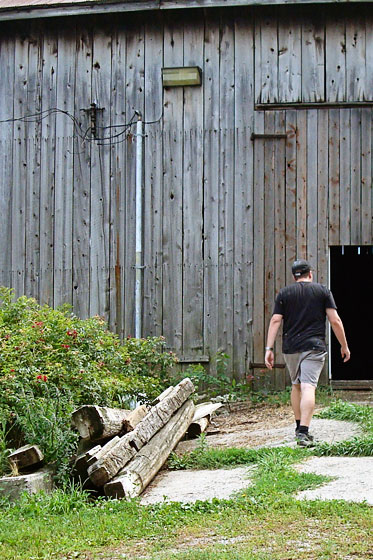
We started with some big barn beams. These have been lying outside the barn as long as we’ve owned the farm. You can see them beside Matt in this picture from our first summer.

Barn beams

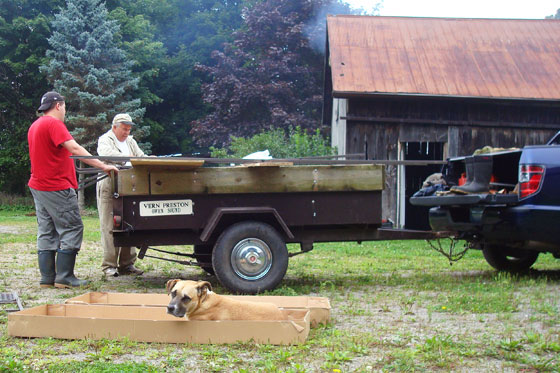
They are huge, heavy hunks of wood. They were more than 12 feet long, and it took my Dad, Matt, his Dad and me to move them, even after Matt cut them down with his chainsaw.

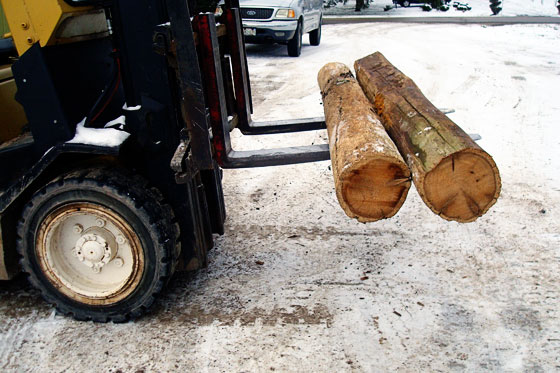
When I came up with my plan to use our barn beams for the mantel on the new fireplace, I hadn’t examined them very closely. I expected the beams to resemble beams. Instead, they were very round.

Barn beams on the forklift

To be a mantel, I was looking for something with some corners. One of the beams had one flat side, but that was it. My Dad found a local sawmill that would cut the beams square for me.

I love finding spots like the sawmill. They’re treasures of unique services and products. The variety of wood they had in their yard was amazing–trees, slabs, boards, logs, crosscuts, exotics, domestics. They mill custom flooring and trim. And of course they have cool equipment. I have to confess I’m looking for an excuse to go back.

After our logs went through the sawmill a few times, we ended up with two beautiful cedar beams 6 inches by 6 inches square. We’re going to sandwich them together to make one big 12 by 6 mantel. We were able to preserve the original flat side on the one beam. That’s going to end up facing into the room where its hand hewn face, complete with marks from the adze that originally shaped it, will be visible.

Attaching these two pieces and mounting them on the fireplace is a whole other issue–and tomorrow’s project. I think we’ve figured out our plan. Fingers crossed everything works out.

Anyone have any tips for installing the mantel? Have you ever custom-milled any of your own wood? Have you ever used reclaimed wood for a project?

Getting fired up

So remember back in November when I said, “No more projects until 2015”?

And remember before that when I talked about the living room fireplace? And before that when I posted my Home Goals 2014? (And 2013?)

Ummm, yeah. So we’re doing the fireplace.

Right now.

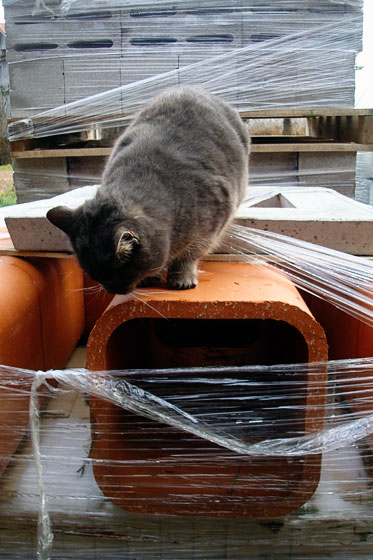
The stone–six skids of it–was delivered a week ago. Ralph signed off after a careful inspection.

Ralph inspecting the chimney pieces for our new fireplace

Yes, I believe Santa will fit down this chimney.

We gathered the various barn beams we have lying around (yeah, we’re lucky like that) and picked out a couple of contenders for the mantel. Since they were closer to tree trunks than lumber, on Saturday my Dad and I took them to a local sawmill and had them squared off.

Barn beams on the forklift

Matt and I removed the extremely heavy metal insert yesterday. We emptied the living room to get ready for demo and taped off all of the openings with plastic in a (probably vain) attempt to contain the dust and soot.

I should be clear that this is not a DIY project for us. We do not possess the expertise to build a fireplace. However, a close family friend does. He’s a professional mason, and he did all of the brickwork on my parents’ house, including their fireplace, and worked with my Dad for years. We’ve hired him. So when I say we’re doing the fireplace, I have a loose definition of we and doing.

I’m off work today to help with the take down, and I’m planning to work from home a couple of days this week, but my involvement will be very limited.

Regardless of my minimal contributions, we should have a new fireplace by Christmas.

Now that’s what I call a present.

Tips for making renovations manageable

Let’s be honest. Renovations can be a nightmare. DIY renovations can be especially challenging. In watching my Dad do construction for his whole career, working with him for several years and talking to friends and co-workers, I’ve seen some of the same issues:

  1. The vision in my head is too big. I don’t know where to start.
  2. The vision in my head is big and beautiful, and I’m going to do it all right now.
  3. I’ve started, but the vision in my head has gotten bigger, and now I’m never going to finish.

I’m going to share some of my perspective on each of these three scenarios. I’d love if you would weigh in too with your tips… or your renovation challenges. Between all of us, I think we can come up with some useful tips to help each other make renovations more manageable.

Problem #1: The vision in my head is too big. I don’t know where to start.

Yup. Renovations are daunting. But like anything you do, there is a first step and a second step. Sure in a renovation you might get to 1,000 steps… or even more. But sometimes you have to just take the first step.

My original vision for the laundry room was a standalone room on the main floor. Full of natural light, it would be a dedicated space for sewing, crafting and laundry. I’d have a big island, tonnes of storage, multiple sewing machines, an impressive fabric and yarn stash and so on and so on. It would be beautiful.

I’m pretty sure that this laundry room is never going to happen, but even if it does, there’s nothing to stop me from having a pretty laundry room now. I started with updating the cabinets, moved on to paint, did some decorating and now I have a pretty, functional space in the basement, thanks to a simple makeover.

Problem #2: The vision in my head is big and beautiful, and I’m going to do it all right now.

I’m a big believer in taking your time when renovating. You have to really figure out what exactly you need and what makes the most sense for your family. You also have to build up your energy and your finances.

Renovations take a lot of time and a lot of money. Gutting a whole house and renovating every room and landscaping your entire property all at once is a lot to take on.

Renovating in stages takes longer, but it might make it more manageable, both for your budget and your sanity. Paint the walls, but don’t replace the floor yet. Update the hardware, but don’t feel like you have to renovate the whole kitchen.

Using the laundry room as my example again, there are a few things I would have liked to have done. To borrow a phrase from one of my former bosses, here are my “even better ifs.”

I think some wood butcher block counters would look great in that room. A new floor would definitely spruce things up. I’d love to add some more racks for laying sweaters flat to dry. It would have been nice to put the plumbing for the washing machine and the venting for the dryer inside the wall rather than on the surface and patch the old observation portal for the oil line to the furnace.
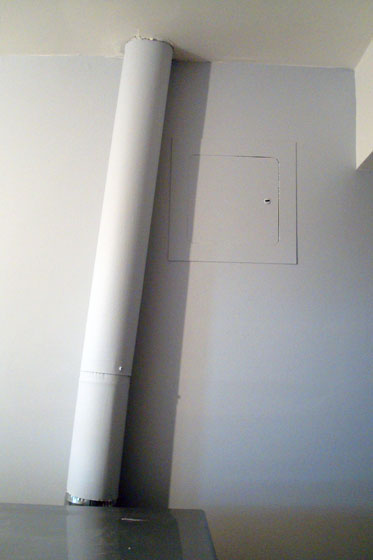
Laundry room venting running over the wall

But if I did all of that as part of my makeover, I’d still be renovating. Counters and floors and drying racks can be individual projects that I do someday in the future.

Problem #3: I’ve started, but the vision in my head has gotten bigger, and now I’m never going to finish.

Scope creep happens in most renovations. As I wrote way back when as we were just beginning the basement reno:

Scope creep happens when you say to each other, “Since we’re doing A and B, we might as well do C, D, E, F and G.”

Sometimes scope creep is necessary. If you uncover an electrical problem, you’re going to have to fix it. However, sometimes we just get carried away.

Towards the end of the laundry room makeover, I started thinking about replacing the faucet, sewing curtains and building a picture frame. These may sound like small add-ons, but they definitely would have extended the project. And just like the countertop that I mentioned above, none of these things were necessary. Pretty, but not necessary.

I was working towards a deadline for the One Room Challenge. I wanted time to take pretty photographs and write my blog post. Scrambling up to the last second with add-ons would have added extra stress that I just didn’t need.

Even if you don’t have a blogging deadline to meet, there are life deadlines, and sometimes you just have to stop. There’s always Laundry Room Version 2 (and 3 and 4 if necessary).

My tips:

So looking back over what I’ve written, I feel like these 7 tips sum up some of my approach to renovating:

  1. Start. Just start.
  2. Take your time and figure out exactly what you need.
  3. Don’t do everything at once.
  4. Have a plan.
  5. Break it down into steps and stages.
  6. Stick to the plan.
  7. Know when to stop.

I can’t promise if you follow these tips you’ll have a problem-free reno (does that even exist?), but they might help to make things go a bit more smoothly.

Now it’s your turn. What are your tips for keeping a renovation manageable? Have you ever encountered any of the problems I described? How did you work through them?

Dreaming in front of a crackling fire

A couple of Saturdays ago, while my father-in-law and Matt assembled some deer stands with Baxter’s help…

Baxter "helping"

I took advantage of the log splitter my FIL had brought with him and cleaned up some firewood that had been lying around.

Never mind that we still don’t have a working fireplace. Tree management is ongoing here.

Splitting wood

In the category of wishful thinking, let’s take a minute and talk about this fireplace, though, shall we?

1970s fireplace

I have always wanted a wood burning fireplace. When we moved to our little house in the city, the fireplace in my parents’ family room was one of the things I missed most. Redoing our fireplace has been on my list since we moved in. But it’s been delayed due to finances.

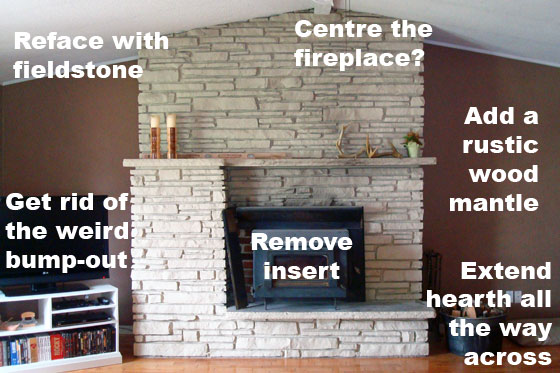
We discovered quickly that making the fireplace what I envisioned wasn’t going to be as easy as we thought. I wanted to pop out the insert so that we had a beautiful open hearth. And I wanted to reface the whole thing with fieldstone.

Unfortunately, the chimney won’t accommodate an open hearth. I don’t understand exactly what’s wrong with it, but it’s not entirely right, even for the insert that’s there.

Fixing the chimney means rebuilding the whole fireplace as though we were starting new. Great for getting exactly what I want. Not so great for the wallet.

Matt, my wonderful, accommodating, frugal husband, thinks that we will be able to scrape together enough money to do the fireplace this year. I’m a little more skeptical.

But let’s not let a little thing like the budget derail this post. Let’s talk about what needs to be done.

Fireplace fixes

The biggest question is the location of the fireplace. You’ll notice in the picture above that it’s off centre (look at the beam at the apex of the ceiling). This actually isn’t a bad thing, in my opinion. By centring the furniture arrangement on the fireplace, we have room to walk around the edge of the living room to the dining room. If we shift the fireplace so it’s centred, passage to the dining room will be a little tight.

What do you think? Should we centre the fireplace?

My plan for the new fireplace is roughly the same location, roughly the same dimensions. The biggest change will be to make the fireplace itself symmetrical. One continuous wide hearth across the bottom. No weird bump out on the left side. A rustic wood mantel (I have some great old beams in the barn) at one continuous depth. Fieldstone face. Open hearth.

I know the insert is more efficient and is a great way to heat the house. However, we are not going to heat this house with wood. Our geothermal system works really well and costs us very little. This fireplace is more about ambiance and appearance than function.

What would you do with the fireplace if it was yours? Are you a fan of the ’70s asymmetry? What would you face it with? Brick? Tile? Stone? Plaster? Would you keep the insert? Or would you get rid of the fireplace altogether? What’s your opinion on centring the fireplace versus leaving it where it is?

Surprise laundry room makeover

So you saw on Friday that I’ve started making over our laundry room. As I said, this project kind of snuck up on me. Yeah the laundry room was on my Home Goals 2014 list, but I wasn’t exactly sure when I was going to tackle it. Fall was always in my mind.

But then the stars aligned last weekend.

My thought process went something like this:

“Dad’s here today. He can help me get the table saw running and cut the strips to trim out the cabinets.”

“Dad brought his air compressor. Maybe he’ll leave it with me so I can attach the strips to the cabinets.”

“I have the Advance paint out for the bookshelves and a good stash of foam rollers. I might as well paint the cabinets at the same time.”

So my go-with-the-flow non-project plan for September has resulted in the biggest project of the year.

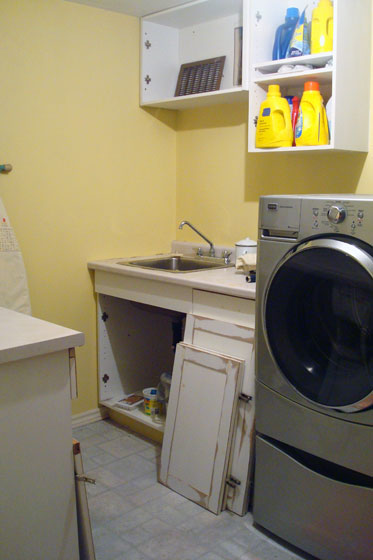
That’s absolutely okay with me. Here’s the before picture. I think you can probably see why I’m so excited to have this makeover started. Functional? Absolutely yes. Pretty. Not so much.

Laundry room before

I feel good about the possibility of having the makeover done before the end of the year, thereby meeting one of my home goals for the year. I feel even better about the possibility of the makeover matching the picture in my head. It’s not just going to be pretty. It’s gonna be puuuuuuurty.

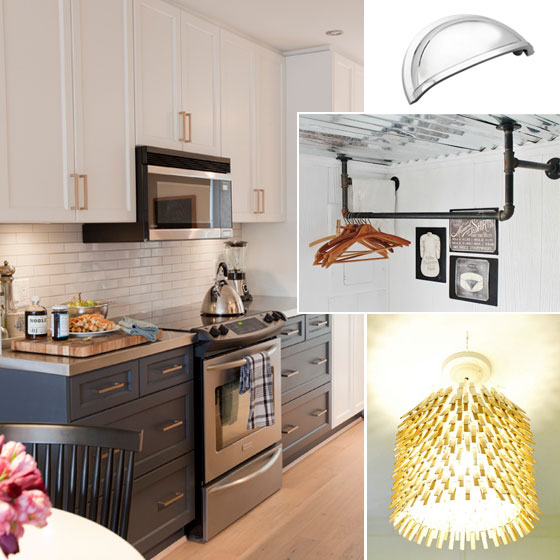
Here’s some of my inspiration for the laundry room.

I’m not doing one of my formal project plans. At least not yet. I’m sticking with my September plan of going with the flow. So, I’ll be back with an update when I’m back.

Do you have a pretty laundry room? What’s on your dream laundry room wish list? Do you have any suggestions for what I should do to my laundry room?

Damp, soggy and sloshy

You know that stale air musty house smell when you come back from vacation? After our week at the cottage last month, that’s exactly what Matt and I came home to. And then we walked down into the basement.

There we sniffed a distinct eau de damp.

Turns out that at the very start of our holiday, while we were lakeside, there was some water flowing at home.

A torrential downpour washed half the gravel down the driveway, overran the sump pump in the cold cellar and seeped through the foundation in the laundry room.

Believe it or not, we escaped with very little damage. The worst was some damp carpet in the long room and beside the laundry room. Some of the baseboards have swelled a little bit as a result, but overall it’s not too bad.

The cold cellar is about 6 inches below the rest of the basement, and the floor is concrete, so even though it appears that area was the sloshiest, the water didn’t seep into the main basement. Thank goodness.

Running the dehumidifier for a few days dried out the carpet.

The biggest bummer is that we had patched the laundry room foundation before we left on vacation… or we thought we had.

At one point, the laundry room window was a door into the basement. When we found occasional puddles on the laundry room floor, we figured that was the most likely source.

Matt dug out the foundation, I found a membrane at Home Depot, we stuck it onto the foundation and back-filled the hole. (Forgive the bad iPod photos. We temporarily misplaced the real camera).

Patching a leaky foundation

Well, either we missed the location of the leak, our patch didn’t work, or the freak volume of rain would have overwhelmed the foundation anyways. Hence the eau de damp.

Back at the farm after our vacation as we were drying out the basement, we watched on TV as more torrential rains flooded a town nearby. When the storms rolled into our area, the rain spewed over the edge of the gutters and puddled right next to our apparently porous foundation. Uh-oh.

A break in the storm found Matt and me outside in our raincoats and boots. Matt fetched the extension ladder, I held it secure, and he climbed up on the roof to empty the eaves troughs.

Cleaning out the eaves trough

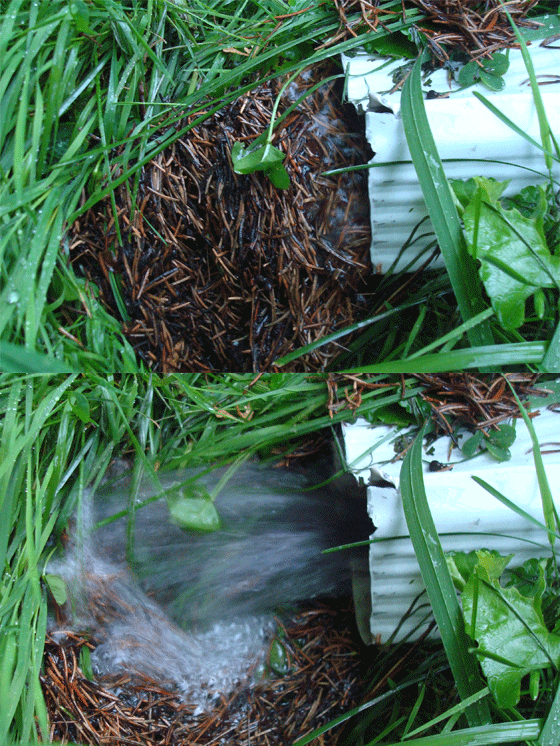
Our pine trees shed like crazy, and their needles clog the downspouts. When the second wave of the rain hit, the gutters flowed like they should.

Clogged downspout

We’ve had more rain since then, and Matt has been super vigilant about making sure the water runs away from the house and that the basement stays dry.

So far so good.

The problem of the clogged eaves troughs and downspouts has been solved. Now if only we could solve the where-the-heck-is-the-water-getting-in? problem.

Who else has come home to a not so pleasant surprise after vacation? Have you ever dealt with leaky foundation issues? How often do you clean your gutters? I swear I did them a few months ago. Anyone else ever done some mid-storm water diversion?

Six-month performance review

Not to alarm anyone, but we’re halfway through the year. (Sorry. Tempus fugit.)

It’s been nearly six months since I posted my home goals for 2014. Time for a mid-year performance review.

I had six projects on my list. Here’s how I’ve done so far.

1. Paint the main floor hallway and kitchen.

Big fat done on task number one. Matt and I knocked this one out in February.

Hallway painted Benjamin Moore Abalone

2. Laundry room.

I haven’t started this one yet. I figure it will be a good fall project when I don’t want to/can’t work outside anymore. Besides, I can’t start anything until Matt digs out the foundation wall and fixes the basement leak. Hello summer honey-do list.

3. Master bedroom.

For the most part, this is another fall project. However, prep starts this month with removing the popcorn ceiling.

4. Furniture.

I’ve done fairly well in this department.

  • Sofa table for the living room. Found this one in an empty office at work (I asked permission before I took it).
  • Narrow dresser for my office. DIYed this one out of two nightstands.

Tall and narrow DIY dresser

  • Cabinet for the laundry room. Bought this one from Canadian Tire. (There was some DIY, since we had to assemble it ourselves).
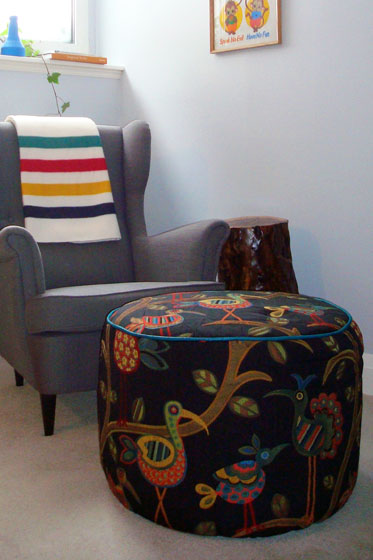
  • Ottoman for the basement reading nook. Made this one out of a plastic barrel.

How to make a round footstool

I have a few more pieces that I’m still on the lookout to buy or make. Top on the list is refreshing my bookshelves and the living room TV stand. My books have been packed away for more than two years. I want them back.

5. Living room fireplace.

Hope still springs eternal. The fireplace will be redone some day. Whether that day is this year depends solely on how much we’re able to rebuild our post-solar bank accounts.

6. Landscaping.

  • Reestablish the flowerbeds around the house. I’m slowly, ever so slowly, working my way around the house.
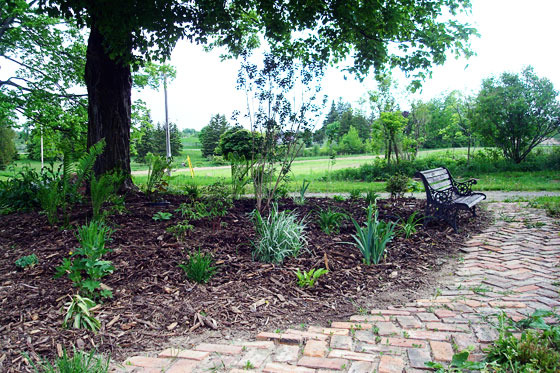
  • Continue to plant the turnaround. The turnaround is looking awesome, albeit a bit weedy.

Garden with a brick path and park bench under a big tree

The pond shore is even more overgrown than last year and is pretty much inaccessible. Since this is my favourite part of the property, that is a bit of a downer. I’m willing to cut my losses on the pond this year, but I’m still hoping I’ll be able to clear and fence the vegetable garden before the end of the year.

And that brings us to the bottom of this year’s original goals.

However, there are a few things we’ve done beyond this list.

Obviously, the solar panels are a pretty massive project.

Solar panel array

We’re also revisiting the basement, finishing off the reading nook, adding the ping pong table and making over the doors (in progress).

I’ve had a bit more success this year staying on task thanks to the monthly projects. Thanks as well to all of you for your encouragement along the way. It’s nice to look back and see that I’ve actually made some progress. We have half a year to go, and I have a bit more work to do yet, but I think I’m on the right track.

Have you ever given yourself a mid-year performance review? Who else feels like time is flying by? Is there anything you’d like to accomplish over the rest of the year?

Going solar – Show me the money

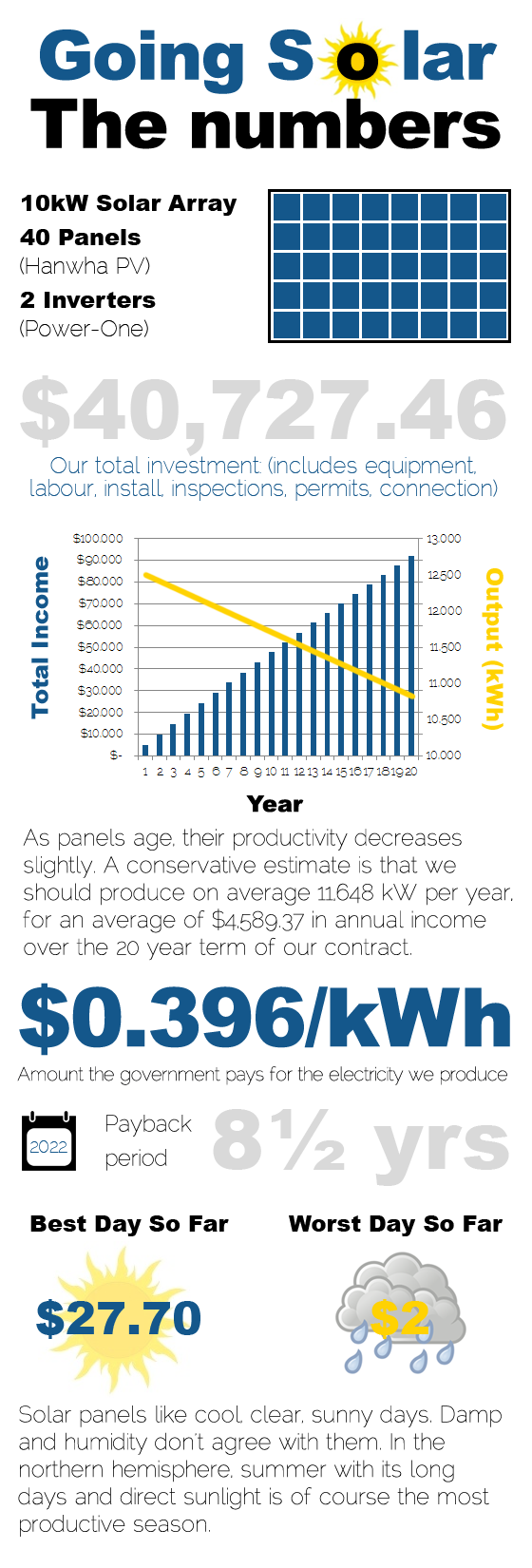
It’s time for the final post in our solar panel saga. As we all know, going green costs green. Today, I’m going into the numbers (in a slightly artistic fashion).

Read on to find out how much our solar panels cost, how many kilowatts they produce and all of the other details for our solar system.

Solar panels cost and output

Obviously, our solar array and its associated dollars and cents are specific to the Ontario microFIT program. I expect some of our numbers will translate, though, for others who are setting up their own systems.

The last outstanding part of our solar project is to receive our first payment from the hydro company. I have to say I’m looking forward to moving on to the payback stage of this project.