How to make a wood countertop

How to make a wood countertop

We’ve lived with our homemade wood countertop for more than a year now. To see my report on how it has worked for us, click here.

See the update after four years with our counters here.

Since we’d splurged on having our new kitchen island professionally made, I had to balance the scales and DIY the wood countertop.

There are some tutorials online and lots of inspiring photos, but in the end we pretty much winged it. Here’s what we did.

For our island’s 80 inch by 42 inch top, I decided that four 2x12s were the way to go. I chose spruce–the cheapest option at my local lumber mill. My first tip is to be very careful in selecting your lumber. I went through nearly the whole pile looking for the straightest, cleanest boards possible. Watch for chips, knots, bends and warps.

Once you’ve selected your boards, the first step is to trim them so that their edges are square rather than rounded. This will help you to get a smooth even surface when you join your boards together. I took a half inch off each side of my boards–or the staff at the lumber mill did for me.
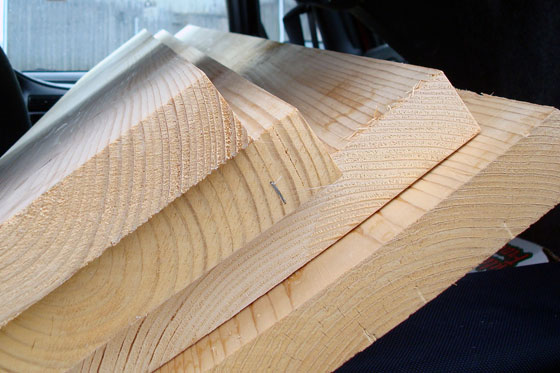
Squared edges on lumber

We let our boards acclimatize inside the house for a day or so–especially important as the lumber had spent the winter outside and was completely frozen. We could hear them snapping as they adjusted to the temperature.

Once we were ready to start constructing the countertop, we laid out our boards and decided the best configuration.

Making sure we kept everything in order, we marked the backside of the boards for screw holes.
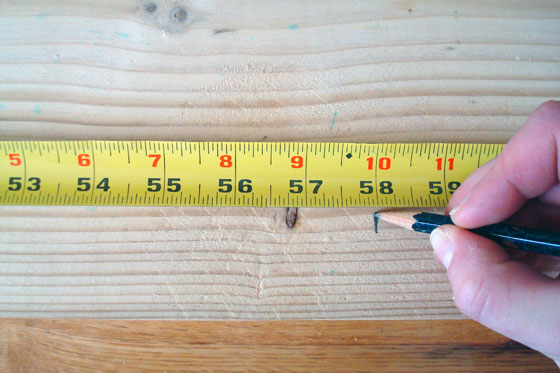
Measuring and marking lumber

We spaced the screws 8 inches apart.

Then, I set up my newest toy and drilled holes using my Kreg Jig–yup, I got one!

Using a Kreg Jig to drill holes in a wood countertop

I was pretty confident that the Kreg Jig would give us really tight joints, but we glued each board as well with carpenter’s glue just to make certain. Be careful not to use too much glue, as you don’t want drips or seepage on the good side of your top.

Gluing boards for a wood countertop

Holes drilled and glue spread, it was time to put it all together. Matt held the boards even and kept the joints tight while I went along with the drill and set each screw.
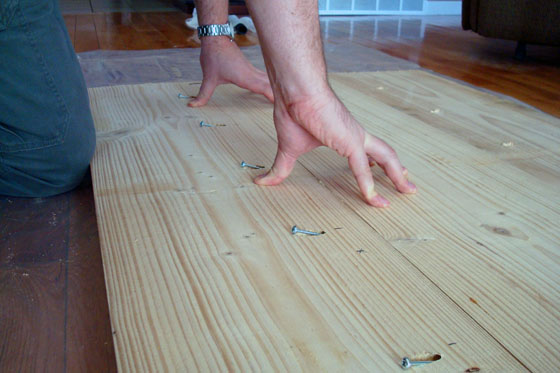
Connecting boards for a wood countertop

Soon enough, we had a large slab of wood. Don’t be confused by the stamps and the holes from the Kreg Jig. This is the underside.

Back side of a wood counterop showing holes from the Kreg Jig

We took our incredibly heavy countertop and flipped it over. I trimmed one end with my circular saw to get a nice flush edge. I left the other end ragged, because I wanted to wait until we had the island, just to make sure I got the length exactly right.

While the joints were really tight and pretty smooth, I still filled everything–every joint, every knot, every divot–with wood filler just to even out any imperfections.
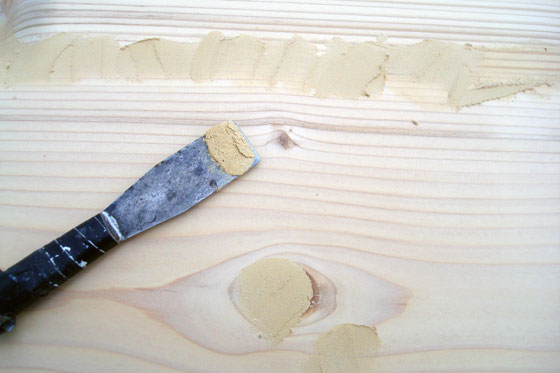
Using wood filler on a wood countertop

Then, it was on to sanding stage. Using my little orbital sander and lots and lots of sanding pads, I went over the countertop time and time again. I started with a 60 grit and slowly worked my way up to finer and finer grits (80, 120, 240 and 400).
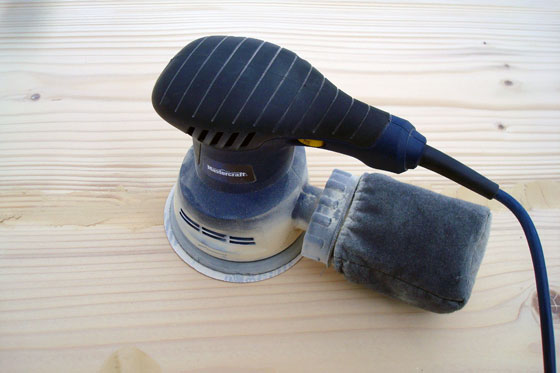
Sanding a wood countertop

Despite choosing a very cheap grade of lumber, it came up beautifully smooth and even with the sanding. Take your time with your sander and don’t skimp on this step.

We did have one issue arise with our DIY wood countertop. Once the boards were all together and the top spent more time acclimatizing inside the house, it started to warp a bit. I attribute this to the frozen state of our lumber before we started construction. By the time the island was installed and we set the counter on top, we had a pretty good wave going on.

Unfinished warped wood countertop

Aaaah! A wonky wavy countertop was not at all what I envisioned. Our cabinet maker diplomatically limited his comments to “I dunno about that countertop.” My Dad suggested shimming under the one edge, where the gap between the underside of the countertop and the top of the cabinet was about 1/4 inch.

To everyone’s surprise–including mine–trimming the length of the countertop helped immensely. I don’t know whether most of the warp was happening at one end of the boards, but it was laying nearly flat after we cut off the extra length. Screwing the countertop into place on the cabinets leveled it out a bit more–even though we were very gentle and didn’t overly tighten the screws for fear of opening the joints between the boards.

My enthusiasm for my DIY wood countertop was rekindled. However, it was basically a large hunk of raw wood sitting in the middle of our kitchen–an attractive hunk of wood, but not the most useable surface.

The next step was to finish and waterproof the wood–which I’ll talk about on Wednesday. Stay tuned.

See my review on how our wood countertop held up over its first year.
See my review after four years.

DIY fail… sorta

As a person who enjoys construction and DIY, I feel slightly guilty to admit that I did not DIY the big beautiful new island now sitting in my kitchen. I had planned to build it myself. I pinned lots of inspiration to my kitchen Pinterest board, took measurements and drew plans, but when it came time to put saw to wood, I wimped out.

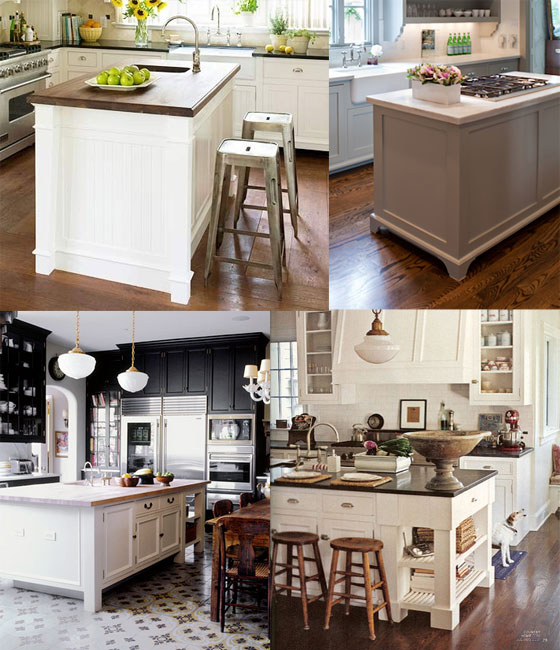
Kitchen islands

Island inspiration (clockwise from top left) 1, 2, 3, 4

My original plan was to find a second-hand kitchen that had cabinets that could be reconfigured into an island. However, weekly visits to the Habitat for Humanity Restore did not reveal a suitable candidate and made me realize that any reconfiguration would not be straight forward. Then, one day at the Restore I found eight cabinet doors with cathedral arch tops that mimicked the style of our kitchen cabinets. I bought the doors, came home and drew up a plan.

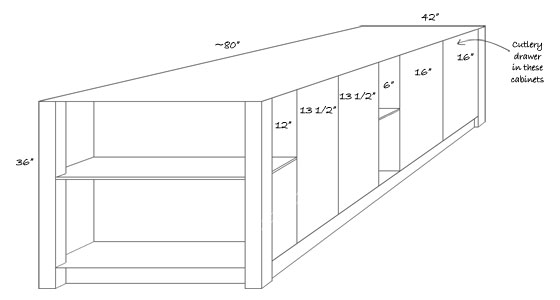
Plan for a kitchen island

Once I sketched the plan, I realized that I simply needed four cabinet boxes and two sections of open shelving. Simple! My Dad and I could build it ourselves over the Christmas holidays!

That plan was discarded after my Dad and I spent the holidays building the TV cabinet, and I decided furniture construction is neither my best skill nor my favourite way to spend my days.

It was time for some professional help. I called my Dad’s kitchen guy and emailed him my sketch and my inspiration photos. There was a bit of sticker shock when we received the quote, but I’d already made up my mind that DIYing a kitchen island wasn’t for me, so we decided to go ahead.

We saved some money by using the doors that I’d bought at Habitat (for $5 each) and eliminating the corner posts that I’d drawn on my original design in favour of basic cabinet boxes. However, we balanced that out by paying our cabinet maker to spray the doors white, rather than painting them ourselves.

I don’t have a good excuse why I wasn’t in the mood to DIY.

However, on the bright side I did eventually return to my normal self.

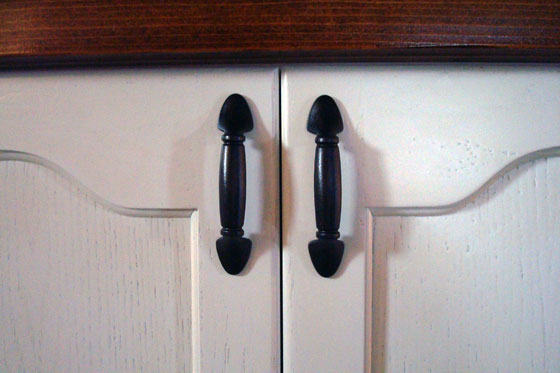
Habitat was also my source for cabinet pulls. I found handles that matched the existing ones in the kitchen for just 50 cents each. I hopped on the ORB (oil rubbed bronze) bandwagon, spray painting all of the handles, including our very chipped original ones.

Brass cabinet pulls spray painted with Oil Rubbed Bronze

I knew things were definitely back to normal on the DIY front when I decided to make the wooden countertop myself. That’s a story for next week, though.

Is there anyone else out there who’s gone through a DIY slump? How did you get through it? Who else is an ORB fan? How do you decide what to do yourself and what to hire out?

My own private island

Island hopping has taken on a different meaning here, as I’m jumping for joy over the newest addition to the kitchen.

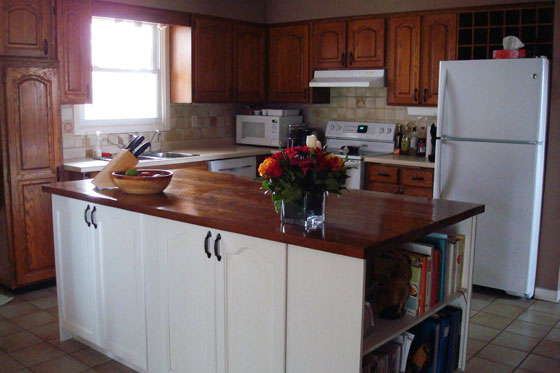
Kitchen island painted white with wood countertop

Our new island was the subject of Friday’s “guess what” post. Last week, Meghan guessed that we got a new kitchen, and we might as well have for all the difference this island has made.

It is fabulous and exactly what our kitchen needed. Oh, and so much better than the metal patio table “island” we’ve been living with for the past year.

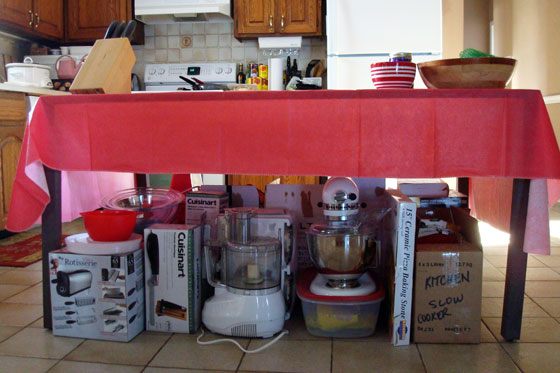
Metal patio table with appliances stacked underneath

Small appliances, cookbooks, dishes and mixing bowls spent last year all tucked under the table, most of them still in their moving boxes. It was neither convenient nor tidy. For someone who loves cookbooks and will happily spend an afternoon reading recipes, the new island offers a much more accessible and attractive solution.

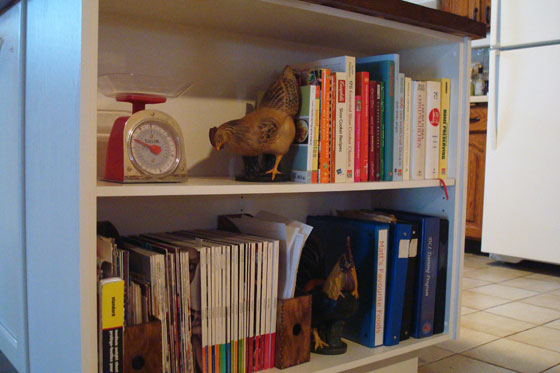
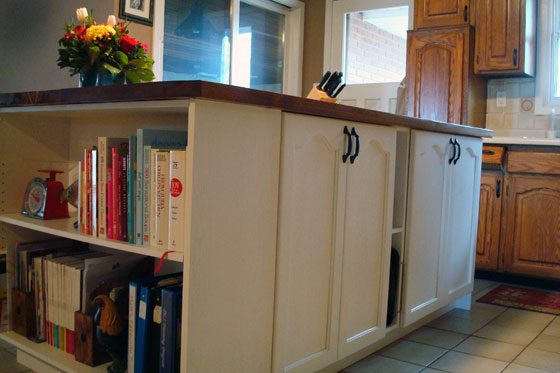
Cookbook shelf in island

In addition to the cookbook shelves, the island includes another section of open shelving for cutting boards, cookie sheets, cooling racks and trays. I don’t know about you, but I find these items incredibly awkward to store. But not anymore.

Narrow cookie sheet shelves in island

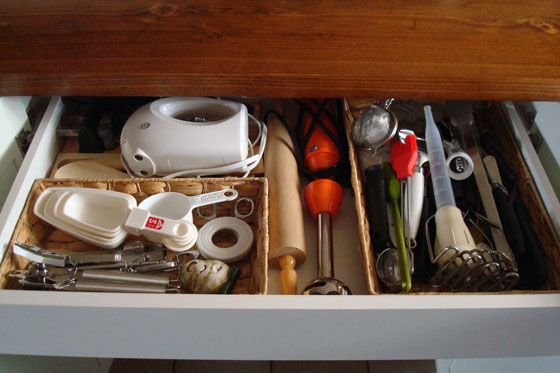
In our whole kitchen, we have only three drawers, and very narrow ones at that. I would have happily made the island all drawers, as I think they’re more useable than cabinets. However, in consideration of the budget, I only included one drawer. The good news is, it’s large and, while it may look cluttered, it is in fact very functional.

Utensil drawer in kitchen cabinets

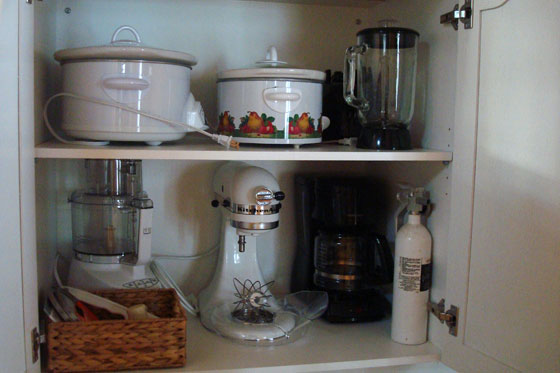
The biggest benefit of the island is its size. At 80 inches long by 42 inches wide and 34 inches high, it adds about 23 square feet of surface space and about 55 cubic feet of storage space. I think my mixer, food processor, slow cookers, blender and coffee maker are as happy as I am that they finally have a home.

Small appliances kitchen cupboard

The island is made of four cabinets, and so far I’ve only filled one, so there’s lots of room to grow.

Someday, we will redo the whole kitchen. At that point, we may expand it or tweak the layout. However, I knew that the kitchen would drive me crazy if I didn’t do something to fix the storage and counter space issues in the meantime. The island solves all of my problems and exponentially increases the functionality and the beauty of the kitchen.

White painted kitchen island with wood top

How do you handle storage and prep space in your kitchen? This is my first time having an island, and I’m actually a bit surprised how incredibly functional it is. Do you have an island? How would you improve your kitchen if you could? New appliances? More counter space? More drawers? Who else out there loves their cookbooks? Do you have any favourites to recommend?

Guess what

It’s been awhile since I’ve done one of these Friday guessing game posts. I think this one’s pretty easily identified.

What is this?

This is a big development for us.

The same drill applies. Leave your guess in the comments, and then tune in next week for the story.

DIY doldrums

I’m in an uncomfortable stage right now. I have unfinished projects staring at me from all over, and I’m not liking what I see.

Usually, I try to be a one project kind of woman.

However, I currently have a mudroom that’s half-way through a makeover, a new feature in the kitchen that’s spawned other updates (mysterious, I know. I’ll have lots of posts soon), some outstanding finishing touches around the basement and the beginnings of a spring to-do list.

In the mudroom, the sticking point is the trim. We’ve stripped the wallpaper, patched holes, painted the walls, installed new baseboard, made an umbrella stand, built a bench, hung some hooks and fit out the closet with new shelving.

The baseboard is fully painted, but the window trim has just one coat and the trim around both doors and the closet is still the lovely flesh tone.

Mudroom painted Wythe Blue by Benjamin Moore

Trim painting is slow and tedious, and not my favourite way to spend my time. Some of the more appealing jobs that are also on the mudroom to-do list are refinishing the closet doors and staining the bench.

The basement bathroom is some trim (seems to be a theme), a drawer and a single hinge away from being finished. I bought the trim and the drawer guides–both for the built-in storage unit–at least a month ago. I hung the cabinet door on the built-in also about a month ago, but couldn’t get the hinges aligned properly, so it hasn’t swung smoothly in all this time.

Built in bathroom shelving

Building a drawer, painting and installing the trim and trying a new hinge would probably take less than one day. For a little amount of time, the satisfaction of finally crossing one room completely off the to-do list would be large.

In the rest of the basement, I’d really like to branch out beyond the TV area and begin to furnish and decorate the other rooms. These bigger to-dos are accompanied by smaller ones like fixing a shelf in the front hall closet and repairing the window screens (remember this one from the fall to-do list?) so they’re ready to install as soon as warm weather arrives. Oh, and then there are the mysterious kitchen fixes.

Fortunately this weekend, I have not just one day, not just two, but four thanks to the Easter holiday. I have grand ambitions for the next four days.

What are your plans for your weekend? Is it all about chocolates and family dinners, or do you have a project list too? Happy Easter, everyone, whatever you get up to.

Year one theme: Go big

For me, our first year of farm ownership can be summed up in two words: big and more.

Everything we’ve done, every experience we’ve had has been bigger and more than I expected. It’s been amazing, frustrating, awful, exhausting, expensive, testing, uniting, surprising and wonderful–all to an extreme degree.

As this week is the one year anniversary of the farm becoming ours, I thought it would be a good time to look back at some of what we accomplished and a few of the lessons we learned over the first year. Click here for the two-week and six-month wrap-ups.

We started big, installing the new geothermal system the very first week. The excavation was bigger than if we’d been digging a foundation for a new house.

Geothermal excavation

Upgrading one central system for the house was quickly followed by another, when we decided to redo the entire water system, including a new well.

Our original plan for the basement to patch the walls, move a couple of things around and redo the bathroom quickly grew to a full gut job that involved reframing, rewiring, reinsulatingredrywalling and recarpeting.

Eventually, we did get to painting, furnishing and decorating. We still need art and furniture in most of the basement, but the TV area is done. And it’s awesome. We spend every night here–if we’re not working on one of our other projects, of course.

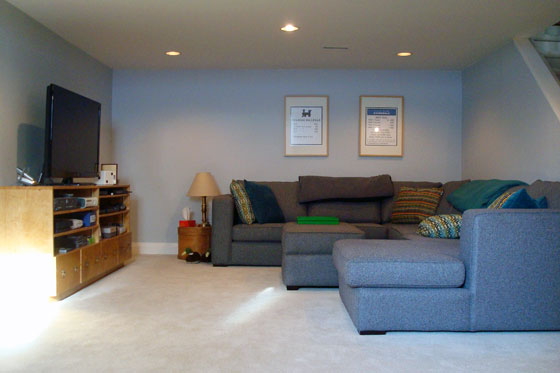
TV area with sectional couch in the basement

So far, the basement has turned out even better than I envisioned.

The bathroom, which was the most disgusting room in the whole house when we moved in, is now one of the best thanks to new plumbing, marble tile, dramatic dark paint, extra storage, a shower bench and a big mirror. After breaking the concrete floor, running all new waterlines, marathon tiling and grouting sessions and, oh yeah, the snake, we ended up with a bright, clean, shiny, functional and modern space.

Small basement bathroom with white tile and big mirror

While the basement has been our longest project and most dramatic transformation, it wasn’t our most difficult. The hardest project was definitely the roof. Over five days in the middle of the summer with average temperatures around 30ºC, Matt reshingled our house. For him, this project is his proudest accomplishment for year one. For me, this project taught me my most memorable lesson: roofing is not a DIY job.

Half shingled roof

Away from the work and the projects, there’s been a few other big developments in our lives over the past year.

First, the property came with other occupants already living here: most notably, Ralph the barn cat. Sticking with our theme of everything being more than we expect, Ralph kept things interesting by turning out to be both female and pregnant.

Kittens with mother cat

Her four kittens were a fun addition to the farm for the spring.

Kittens

Gratuitous kitten cuteness

Three went on to new homes in suburbia, but one, Easter, stayed on at the farm. Learning that I’m a cat person–as long as they stay outside–has been my most surprising lesson from year one.

Cats on the windowsill

Ralph and Easter pay a visit to the dining room window sill. This is Easter’s “meow–let me in!” face. Ralph knows better.

In addition to our feline family members, our family expanded with the addition of Wiley, our tractor. He’s been quite handy for the various jobs we’ve had to do, from mowing the grass to blowing the snow. Tractor maintenance and how to use the front end loader are lessons we’re still in the process of learning. Lesson from last weekend: a hairdryer can be used to get a tractor to start.

Kioti CS2410

Outside, we’re still learning how to manage a large property. We’ve had the paddocks and run-in shelters removed from all of the fields, added a gate to the driveway, cut down a few trees, put in a flag pole and cleaned up the property a bit. We’ve eaten apples and raspberries from our own land, and watched two hay harvests. We’ve spent hours walking the fields, admiring the pond, hiking the woods and even managed to go tobaganning on our own hill and skating on our own pond.

Walking in the hayfield

When I imagined living on a farm, I envisioned lots of friends and family around, fun parties and big gatherings. This vision has absolutely come true, whether it’s the fun days we’ve spent with nephews, the relaxing nights we’ve had with friends, or big family parties we’ve had for Christmas, Easter and just because. Most rewarding of all, though, has been all of the help our friends and family have given us to make the farm ours over the past year.

Drilling post holes with an auger

We’re still in the process of putting our own stamp on the farm. We know there are more projects and more lessons to come.

Between rural living, a farm, a large property and DIY home renovations, we’ve chosen a somewhat unique lifestyle. And it’s exactly the life for us.

The first year has been more than I ever expected. I’m excited to see what comes next.

Mirror, mirror finally on the wall

For the past few months, we’ve had a big blank unfinished wall in Matt’s bathroom.

Blank wall

Attractive, no?

It’s a small bathroom, so I decided that covering the whole wall above the vanity in one big mirror would help to make the space look bigger.

Me and my bright ideas.

We ordered the mirror just after New Year’s, and the supplier cut it right away. After a nerve-wracking evening of transporting the mirror in the back of Matt’s Dad’s truck, the mirror sat in the basement, propped against the wall just outside the bathroom.

The idea of actually hanging it was a little bit intimidating. I mean, it was more than four feet wide by four feet high. If we broke it, the bad luck would be exponential!

Plus the fact that it covered the whole wall and included a cut out for the light fixture presented some installation challenges. Everything had to match up perfectly and we had nearly no wiggle room.

Well, I’m pleased to say everything matched and, even better, nothing broke.

Mirrored wall above a bathroom vanity

The mirror definitely brightens up the room–and gives you a sneak peek of the shelving unit.

We have a few more things to do before the final reveal:

  • Light fixture
  • Toilet paper holder
  • Trim for the shelving unit
  • Cabinet door for the shelving unit (it’s cleverly just propped in place in the picture above)
  • Hooks for hanging towels
  • Heat register

Fortunately, none of these is as intimidating as the mirror–and I don’t know of any bad luck curses associated with toilet paper holders.

Caulking within the lines

Growing up, a pristine colouring book was a treasure. I carefully chose my colours and then filled in the drawings making sure to always stay within the lines. I started at the beginning of the book and worked through it page by page.

My younger sister on the other hand went through all of our colouring books putting blush, lipstick and eye shadow on all of the people–men, women and children. It was always a disappointing moment when I opened a book and found the characters covered with red, pink and sometimes even purple splotches.

Staying within the lines is still important to me, especially when it came to caulking the new shower. However, I am not a tidy caulker, so to ensure I had perfectly straight and even seams, I employed a technique I found courtesy of This Old House.

Caulking with painters tape

I laid two strips of painters tape on either side of the joint, squirted my caulking in between the strips, smoothed the bead with my finger and peeled off the tape.

The result was perfectly straight lines.

Caulking with painters tape

It’s definitely not a quick process to put on all of the tape, especially when the shower stall includes a niche and bench that all needed to be sealed, but the results satisfied my childhood hang up for staying within the lines.

Even my sister was impressed.

Home Goals 2013

I’ve never been big on new year’s resolutions, but there is a list that’s been building in my head for some time now. It is the Home Goals 2013 list.

After having most of last year sucked up by the basement-renovation-that-never-ends, my plan for this year is to avoid any other massive all-consuming projects. However, as you can probably imagine, there are a few to-dos I’d like to accomplish.

1. Landscaping. This is going to be the big one this year. As I’ve noted, we didn’t do any landscaping in 2012, so there is a huge need to get on top of the situation outside. However, with 129 acres of property, we will have to prioritize where we spend our energy.

  • Reestablish the flowerbeds around the house. Some will have to be rebuilt. Some will be extended. Everything will have to be weeded.
  • Level old fire pits at the top of the driveway and plant grass seed.
  • Build new fire pit close to the pond.
  • Tidy the east shore of the pond. The brush grew so thick over the past year that I can only access about ten feet of shoreline. Chainsaws and perhaps a bush hog will be required.
  • Put in a garden on the turnaround. This pile of dirt and rubble and weeds is approximately the size of a suburban backyard. A big lush flowerbed sounds like a better plan than mowing any additional grass.
A lush garden with a brick path winding through it

I’m going with inspirational photos for this post, rather than reality. A lush garden with a brick path winding through it would be perfect for the turnaround. Source.

2. Painting.

  • Living room
  • Dining room
  • Kitchen
  • Main floor hallway

3. Living room fireplace. A wood burning fireplace was high on my wish list when we bought the house. We have one, but it needs a little work to make it exactly what I want.

  • Replace the woodstove-esque insert with an open hearth one.
  • Reface with fieldstone.
  • Put up a new rustic wood mantle.
Stone fireplace with wood mantle

4. Laundry room. The final section of the basement needs to be brought up to our new and improved standard.

  • Fix the leaky foundation wall.
  • Paint.
  • DIY a fun light fixture.
  • Build a drying rack.

A few other things will sneak in there, I’m sure, but here’s hoping 2013 brings slightly more time for enjoying rather than always working the farm.

How do you feel about resolutions? Do you have any home goals for 2013? The nester, the champion of annual home goals, published her list last week. It’s a bit more philosophical than mine. I think I’m still at the stage of working on the underlying form for our house and property. Once I have that established, I’ll build in a bit more philosophy.

My Christmas cold may have knocked me out, but at least my tile are grouted

For the second year in a row I have been struck down by a doozy of a Christmas cold.

The fatigue, fever, headache and muscle aches are not conducive to writing… or thought, so for today’s post, all I have for you is a low quality picture of our grouted tile.

Tiled shower stall with bench and niche

You’re not tired of hearing about tile, are you?

The tile are grouted, the bench top is in place, the fixtures are all installed, and we even have running water.

Germs aside, it’s a merry Christmas in the basement.