Once upon a time, I went insane

Back in September, I lost my mind. It was just for a moment, but it was a definite psychotic break. And it’s taken me until now to talk about it.

In my normal state, I don’t

  • Shop online
  • Make impulse purchases, especially not over $20
  • Buy much decor

These aren’t formal rules. I’m just very frugal and tend to avoid purchases that I view as “frivolous.”

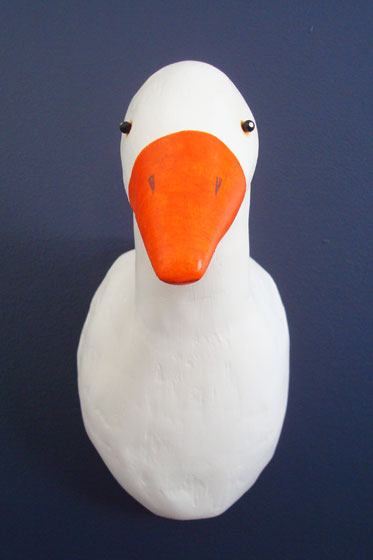
Well, in a moment of insanity, I whipped out my credit card and bought something that is the very definition of frivolous.

Behold my papier-maché goose head.

I first saw it on Lindsay’s blog, and it was pretty much love at first sight. Although, in all fairness, the goose wasn’t a complete impulse. I did think about this purchase for 24 hours before I finally pulled out my credit card and logged in to Etsy.

When the box came, I couldn’t even tell Matt what was in the package. And once I opened it, he still didn’t understand why I had to buy it (and Matt knows my history).

And I think it’s time you know this bit of my history too. Next week, I’ll share the story of Bill.

Robins update

Our baby robins didn’t make it.

They sadly didn’t grow much beyond the naked pink creatures I showed you in my first post.

Baby robins in a nest

I honestly didn’t know whether to write this post or not. I’d love to be able to show you pictures of cute fuzzy chicks, or awkward fledglings, or even the nest abandoned since the babies learned to fly. However, that’s not how the story goes this time around. This blog is about cataloging our life in the country–the good and the bad. In this case, there’s not a happy ending.

For the first few days after they hatched, Mama and Daddy stayed close, feeding them and sitting on them, keeping them warm. But then something changed. Mama didn’t come back to the nest one night. Maybe she got spooked or got attacked. Temperatures were still too cold for the babies, and they died.

When I first saw the babies, I thought they were the most helpless things I’ve ever seen.

Even though it was too late when I realized Mama wasn’t around, I started thinking about things like heat lamps and eye droppers. But the reality is that as much as I’m compassionate about animals, I’m also a “let nature take its course” kind of woman.

Growing up with chickens and ducks and geese–many of whom we raised from eggs and then ate, and many of whom had their own ailments and injuries over their lives–gave me a somewhat unique perspective on animals. Farm living has refined my attitude even more.

Nature is amazingly wondrous and exceedingly harsh. This is a fact of life… and death… that I’m reminded of every so often.

Blue eggs and baby birds

You want a sure sign that spring is here?

How about this?

Blue eggs in a robin nest

A robin built a nest right outside of the kitchen window on top of the clothesline post.

Robin's nest

She’s an artistic robin and decorated her nest with long streamers of hosta and hay.

Robin's nest

The only way I could get a picture of her was to shoot through the kitchen window, hence the grid of the screen.

Robin sitting on her nest

Over the weekend, I thought that something might have changed. So on Sunday, when I didn’t see her on the nest, I snuck out for a peak. The eggs were gone. In their place, we had these.

Baby robins in a nest

Amazing.

It was a little chilly over the weekend, so Mama stayed close, keeping everybody warm. Mr. Robin brought her snacks every so often. On Monday, Mama and Daddy were both on duty bringing a near constant buffet of bugs and worms to the babies.

Obviously, we’re keeping a very close eye on our new little family.

Do you have any spring babies at your house? Is there any more perfect colour than robin’s egg blue? How long does it take for baby robins to grow feathers?

Easter egg

As we wrap up Easter, I thought I would share a special family heirloom that has figured in our annual celebrations for as long as I can remember.

This antique silver egg coddler belonged to my grandmother. Every Easter, she would display it on her coffee table.

Antique silver egg coddler

I like to collect silver, so I was very honoured to add this piece to my collection when my grandmother passed away.

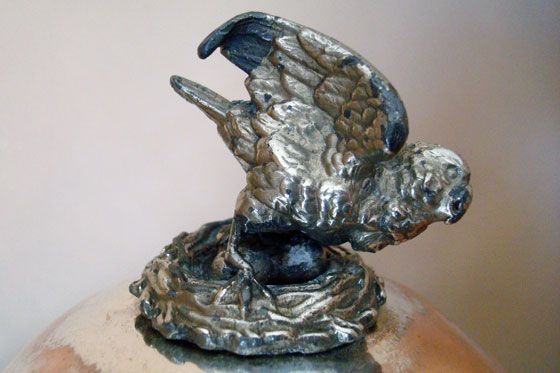
This dish is notable for the bird and her nest that form a kind of handle at the top the large egg. This bird was never attached when I was growing up. At some point, it had broken off, so each Easter my grandmother just perched it on top of the nest. A few years ago, I found an outstanding silversmith, and he was able to rebuild the bird’s legs and put her back on her nest. There are still some obvious quality issues with the dish, but I didn’t want to make too many repairs given the age of the piece.

Silver bird on top of an antique egg coddler

When you lift off the lid, inside there is a frame to hold six (very small) eggs.

Egg holder inside a silver antique egg coddler

I believe how this would have worked was you would fill the inside with boiling water and place your eggs in the holder. At the bottom of the dish, there is a spot for a burner of some kind, which would keep the water hot and cook the eggs.

Antique silver egg coddler

I have no plans to coddle any eggs, but I do plan to display it every Easter. It’s a piece that I treasure.

Do you have any Easter traditions in your family? Have you ever used an egg coddler? Does anyone else collect silver?

The vulture has landed

The turkey vultures have returned to our neighbourhood. They spent the weekend gliding over the farm intimidating animals and humans alike with their dark shadows, their red heads, their beady eyes and their giant wings. At one point, two touched down on the ridge of the barn, opened their wings and stood there sunning themselves.

They are absolutely massive birds. Unfortunately, Matt got outside first and yelled at them, so they flew away before I could get a picture. (Matt’s a bit concerned about any… let’s call it “interference”… landing on our new solar panels).

Here’s a picture from last year when a trio touched down on the barn roof. (Look how green! And no snow!)

Turkey vultures on the barn roof

I still don’t think this photo conveys the scale of these birds. Just keep in mind the barn’s really, really big, and you can clearly distinguish the vultures sitting on top of it.

Do you have turkey vultures in your neighbourhood?

Eating us out of house and home

Downside of the ice storm:

  • No power for 3 1/2 days
  • Broken branches and downed trees everywhere
  • A driveway that is now a skating rink
  • Grasses and branches all hidden under ice and snow

Upside of the ice storm:

  • Because all of the grasses and branches are hidden under ice and snow, the only food available is in the bird feeder (okay, this is probably a downside from the birds’ perspective)
  • Lots of fallen branches give me lots of material to make artificial bushes around the bird feeder so that the birds can scout out the situation or line up to wait their turn

Since putting up the bird feeder at the beginning of November, I have had no customers. Then, on a cold snowy January morning as I was sitting at the dining room table, I glanced out the window and I saw it. A little black dot in the bird feeder.

Was it?

Could it be?

It was!

Finally, a bird had discovered the feeder.

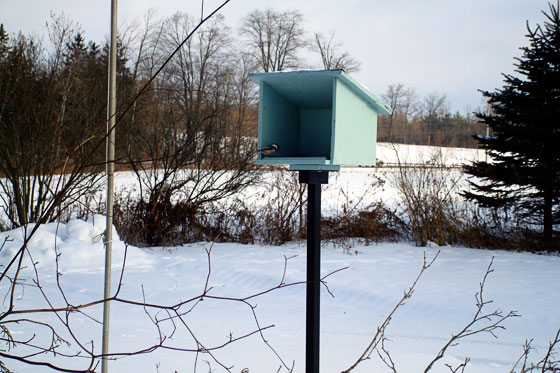
His friends soon followed, and now we have a steady line up of chickadees every morning.

Chickadee in a bird feeder

I love sitting in the dining room, eating my breakfast and watching the birds. This is exactly the scenario I envisioned when I built the feeder.

At first, only the chickadees were brave enough to come to the feeder. When I was outside photographing them, I heard a jay and eventually I was able to spot him high in the trees across the driveway. After a week of building up his confidence, he finally made his way to the feeder. It was neat to watch him cautiously select a seed and then take it up into the tree for his mate who is still too shy to join the buffet line herself.

Although it’s a large feeder and the chickadees are very little, everybody goes one at a time. Occasionally a greedy guy will try to sit in the feeder and steal more than one seed. A waiting bird always flies up and moves the glutton along.

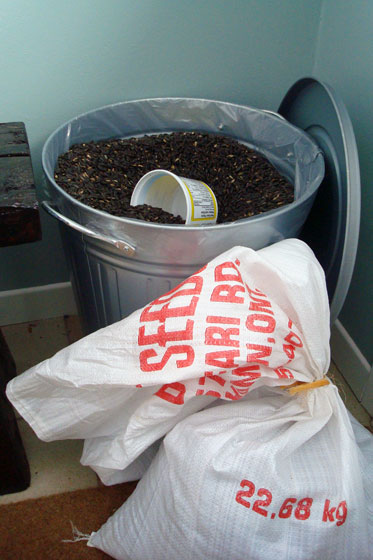
Even going one seed at a time, the birds are quickly emptying the feeder. This thrills me immensely. So much in fact that Matt is worried that I am going to blow all of our money on bird seed and we will lose the farm and end up destitute. However, having gone half the winter with no birds, the 50lb sack of seed that I bought back in the fall is holding out very well. In fact, I couldn’t fit it all in the Knodd I got from Ikea, so the sack still has some seed in it. The Knodd is really convenient though any time I have to scoop out more seed to refill the feeder.

Sack of bird seed

As I’ve been working on this post, I’ve had Feed The Birds from Marry Poppins in my head. It’s by no means my favourite song from the movie, but for some reason it’s all I can think about.

Our birds seed is a mite more expensive than tuppence a bag, but I still don’t think it’s likely that we’re going to end up destitute selling bird seed on the street corner any time soon. So come one, come all. Just try and eat us out of house and home. (Just don’t tell Matt).

Do you have a bird feeder? Who are your regular customers? What do you feed your birds? What’s your favourite song from Mary Poppins? Has anyone seen the new movie yet?

Building a family tradition

There’s a tradition in my family of working on projects together. Always. For as long as I can remember. Take this picture, for example, of my Dad and I building a bird feeder. I had probably just turned four that fall.
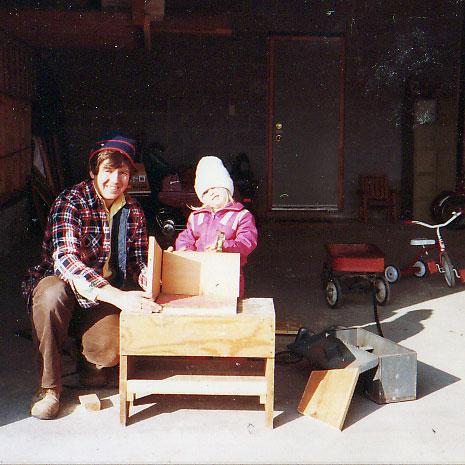
Child and father building a bird feeder

Here’s my Dad and I posing with the finished product (and my little sister) as we put seed in the feeder for the first time.
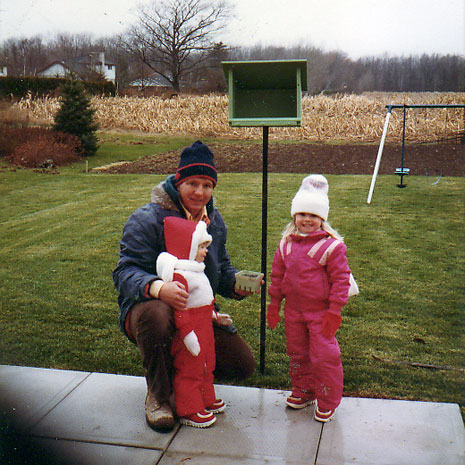
Putting seed in a simple wood birdfeeder

Fortunately I have a nephew who likes building things with me, so I’m able to carry on the tradition that my parents established. When he and his brother came to stay with us for a few days, building a bird feeder was top on my list of projects.

Using the measurements from my Dad’s feeder, we drew it out on a sheet of 5/8 plywood. He held the wood in place while I cut out the pieces with my skilsaw. Then, we switched jobs, and I held the pieces while he nailed them together. We used a bit of wood glue on each joint and some 1 1/4 inch finishing nails.

If I was to build another bird feeder, I might consider painting it before putting it together, but let’s face it, when working with an almost 14 year old, waiting for paint to dry is as exciting as… well… watching paint dry. So we put the feeder together and, after letting the glue set, I was on my own for painting (and yes, I used pretty much the rattiest piece of plywood I could possibly find for the roof).

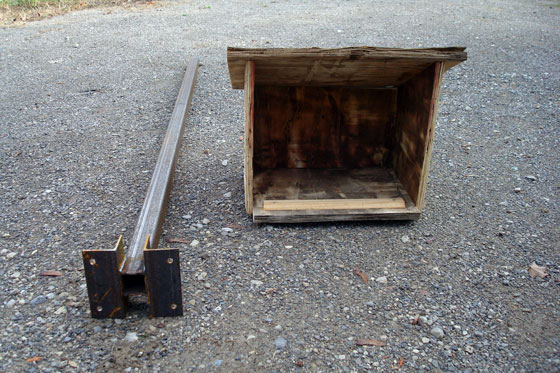
Bird feeder and pole

A few quick coats of paint on the feeder and one coat of Tremclad on the pole that my cousin welded for us–seriously, the most sturdy bird feeder post I’ve ever seen–the feeder was ready to go outside.

As my nephew hasn’t come back to visit yet, Matt stepped in as my helper. He hammered the post into the ground, and I screwed the feeder onto the post. Still nephew-less, I did the first ceremonial seed dump on my own.
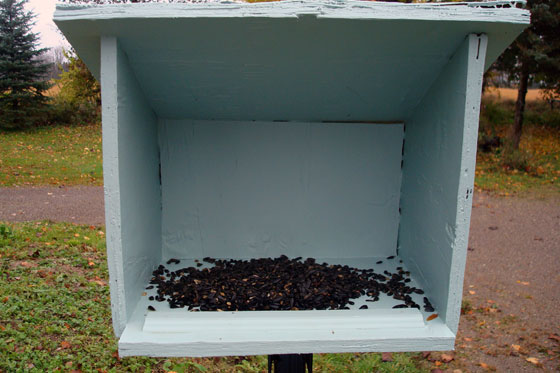
Sunflower seeds in a bird feeder

Perhaps the birdies are waiting for his return before they partake of the seeds, because no one has come to test out the feeder as far as I’m able to tell.

I’m thinking it could be because they feel the feeder is a little exposed. I put it on the turnaround where I can easily see it from the dining room table. However, that means there’s no bushes or trees close by for cover.
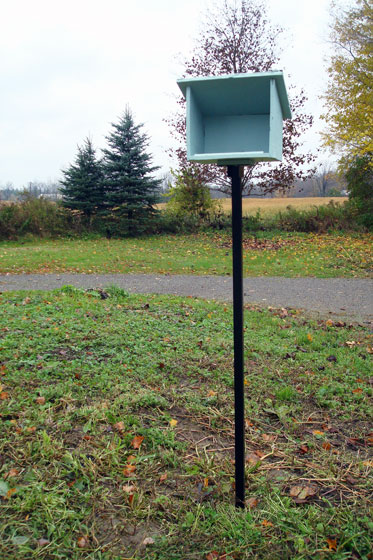
Simple wood birdfeeder

Birds do hang out on the turnaround, so I’m hoping it’s just a matter of time before they discover the feeder. I know the design appeals because nearly 30 years later my parents still have the same feeder in their backyard, and they have a steady stream of customers.

If you’re interested in building a bird feeder of your very own, I drew out the plans and you can download them here. This is a perfect project to do with kids because it’s quick and there’s lots of parts they can help with. And if the birds ever show up, I’m sure they’ll like watching them snack too.

Do you have a bird feeder? What bird seed do you use? Any tips for enticing birds to a feeder? Do you like to build things with your children or nieces or nephews? Or did you build things with your parents when you were growing up?
Making dreams come true

Since moving to the farm, the animal that Matt has wanted more than any other to see on our property is… a wild turkey.

Goat came out as the top guess in last week’s poll. Matt’s extremely enthused about goats–mostly for their lawn mowing potential, I think. In fact, he confessed that he very nearly voted for goat himself. However, the true animal of his dreams is the wild turkey.

We’ve seen them in local fields. We even saw their tracks in ours. We had one brief sighting of a hen (right on the driveway turnaround on the day after turkey season). But all in all, the turkeys have been elusive.

Until this happened.

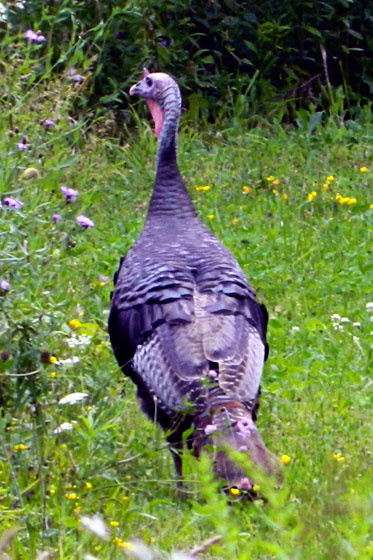
Wild turkey

Well hello fellow. Or should I say fellows.

Two wild male turkeys

These two tom turkeys appeared out of nowhere, strolling up the path from the pond to the house. Matt was so excited he called me at work to share the news.

To answer a couple of questions that were raised by the poll:

  • Jared said, “I would like to clarify: Even though I didn’t vote for Baxter, I assume he’s automatically allowed to stay. :P”
    Absolutely! He isn’t going anywhere. And really, I’m not sure that we really count our fuzzy family member as an animal anymore.
  • Diane asked, “Why wasn’t a duck listed as an option?”
    Because this is Matt’s list, not mine. 🙂

Our big question is will the turkeys stick around?

Pictures in this post courtesy of my brother-in-law Greg who also shot the best photos we have so far of deer at the farm. Apparently he is some kind of animal whisperer.

Now a few questions for you. What animal do you most enjoy seeing? Is there an animal you haven’t seen yet that you’re keeping an eye out for? Do you have wild turkeys in your neighbourhood? Anyone have any tips to entice the turkeys to move in permanently?

For rent: pond (feathery young couple with family aspirations preferred)

Our tenants on the pond seem to be changing daily. Everybody seems to be looking for the best spot to set up housekeeping.

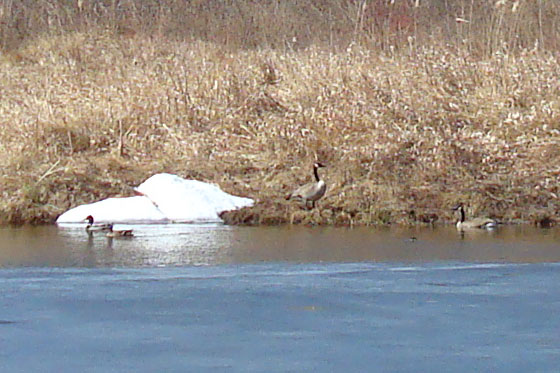
Our usual guests are Canada geese and mallard ducks–or both as seen in this picture from a few weeks ago.

Mallard ducks and Canada Geese swimming on a melting pond

I went down to the pond to get a more up to date picture on Saturday and only succeeded in spooking a very large solitary Canada goose. Actually, that’s not entirely true. I also succeeded in catching a nap, as I got tired of sitting quietly on the shore waiting for a bird to show up and laid back in the grass where I fell asleep. I also succeeded in getting my first sunburn of the year as a result of laying flat on my back with no shade.

Anyways, back to the uncooperative birds.

They mostly show up in pairs, although we have hosted singles as well as three mallard drakes for a bachelor party–perhaps the word on the wing is that our pond is the neighbourhood mixer?

Everybody is pretty spooky. I can’t get too close without them springing from the water and flying away–as my Canada goose did on Saturday. I am hoping that a nice young couple comes our way soon and decides that our pond is the perfect spot to start a family. I promise, I won’t take anymore naps on their lawn.

No chandeliers here

Last week on the Art of Doing Stuff, Karen professed her love of chicken coops and shared images readers had submitted of their coops.

Her post inspired me to get out and investigate our chicken coop. I confess, this is a spot that I usually prefer to avoid.

Karen wrote, “some of the most dilapidated coops are among my favourites.”

Well, dilapidated is a good descriptor of our coop. If you’re feeling charitable, you might call it rustic. Usually, I tend to just call it gross.

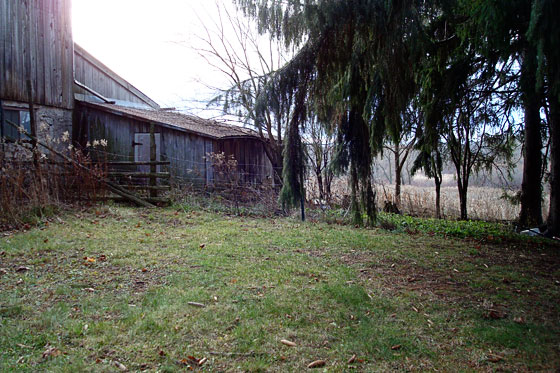
Chicken coop lean to on the side of the barn

Abandoned chicken run

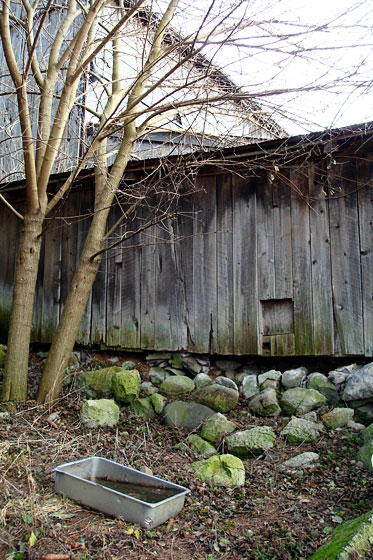
Rustic chicken coop

Broken concrete in a chicken coop

Perhaps a chicken laid a very heavy egg and broke the concrete floor?

I’ve seen some coops with chandeliers and artwork. The leaky roof in ours has started to form stalactites, which I guess could be considered sculpture.

Leaky chicken coop

And in case you’re starting to wonder, you are in fact correct. The coop has not been cleaned out. Likely not for several years. (Warning: The next photo may spoil your appetite).

Manure under chicken roosts

The coop is cozily tucked into the west side of the barn under the pines. The worn barn boards, old mullioned windows and generous size are appealing. The abandoned water and food dishes in the run, the layers and layers of manure inside and the overall dilapidated state both inside and out are decidedly not appealing.

I’m planning on adding geese, ducks and chickens to the farm someday, and they will need a home–a better home than this coop. My Dad (the general contractor) upon seeing the coop for the first time suggested that dynamite might be the best solution. We probably will end up starting over, but we’ll likely still end up more on the rustic side of coop design–I can’t see myself putting a chandelier in a chicken coop.

If you’re looking for some slightly more inspiring coops than ours (albeit no chandeliers), check out what Art of Doing Stuff readers submitted. And while you’re there, make sure to check out Karen’s own coop which completely puts ours to shame. Even though she says her hens don’t care how their coop looks, I don’t think Walnut and the ladies would be too happy if their home was anything like ours.