Building a garage in a barn

Have I mentioned how much I want a garage? So far this week we’ve started the days with heavy frost that took forever to scrape off the windshield and freezing rain that coated everything in ice. More rain is forecast this week, which means I will get wet coming and going from my car to the house.

Sarah in Illinois recently built a garage with a bit of help from family. She is here today to share the process and an extra special feature that makes it even more useful.

About a year ago, on a Friday night, Steve and I were laying underneath my SUV in our freezing cold garage. A few days earlier my transmission had went out, and since Steve has some experience as a mechanic and has no fear of tearing things apart and putting them back together, we decided to save some money by removing it and reinstalling a used transmission by ourselves.

Except things weren’t going well.

We were tired, sore, cold and frustrated. I drew the line when I laid my head down in a puddle of transmission fluid. Steve and I looked at each other, and he said, “I will own a car lift.” At the time I agreed but knew that lifts were really expensive, and we really didn’t have a good place to install one.

A couple months went by and a customer ordered a new car lift from the shop where I work. It is not often that we sell one, and I got to talking to him about his old lift. He said that it still worked. It just wasn’t working for him anymore. I grabbed my phone and called Steve and gave him the customer’s phone number. Two days later we owned a used car lift.

Now for the important part. Where the heck were we going to put it?

We have a large pole barn on our property, but it has a dirt and gravel floor. In one corner the previous owner had built a woodshop with a small concrete pad. We decided to extend this pad and basically make a garage inside a small part of the pole barn.

This picture is showing the woodshop inside the pole barn with two walls removed.
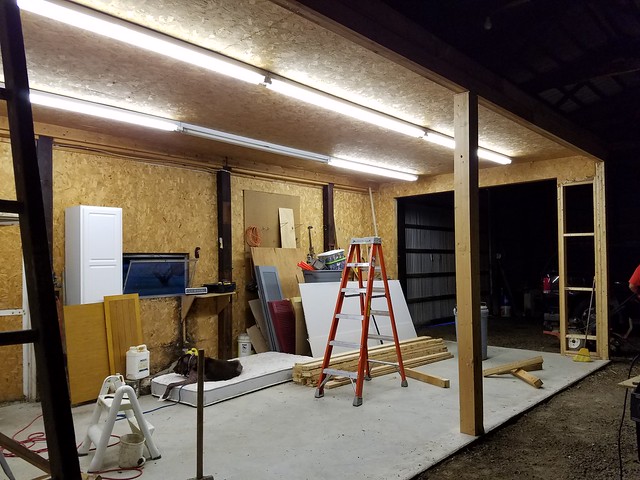
For several weeks we spent evenings and weekends tearing out two of the old walls of the woodshop and framing up for a concrete pad. When we had the framing ready Steve, my Dad and brother took a day off work and poured and finished the pad.
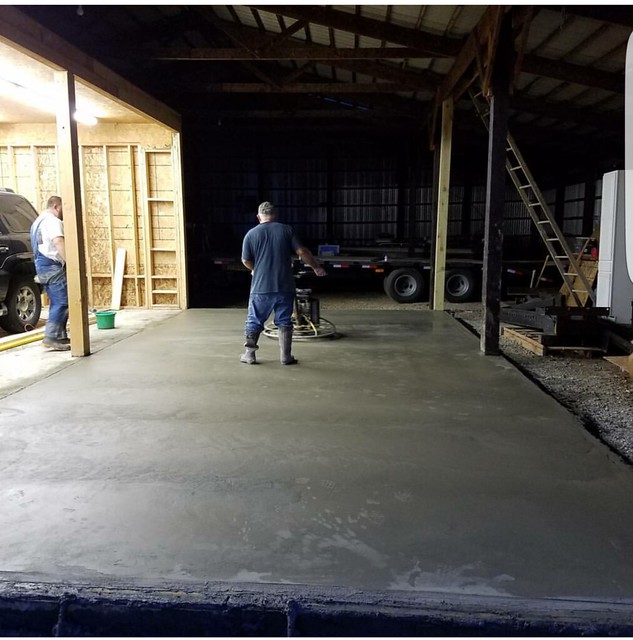
I am so thankful that my family is so helpful and knowledgeable with projects like that. They ended up saving us quite a bit of money.

Once the pad was cured, it was time to build the new walls.
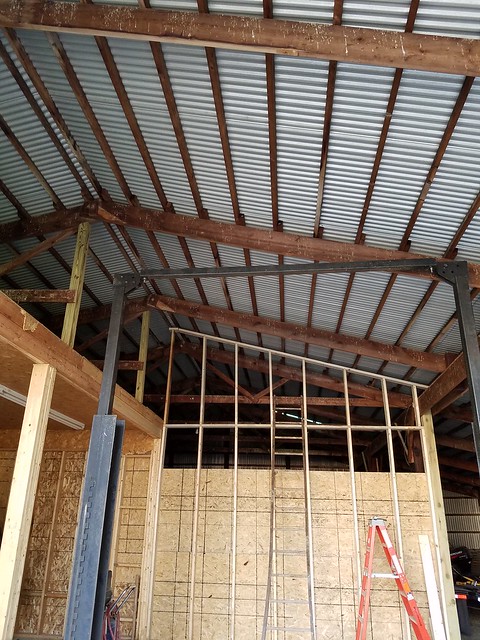
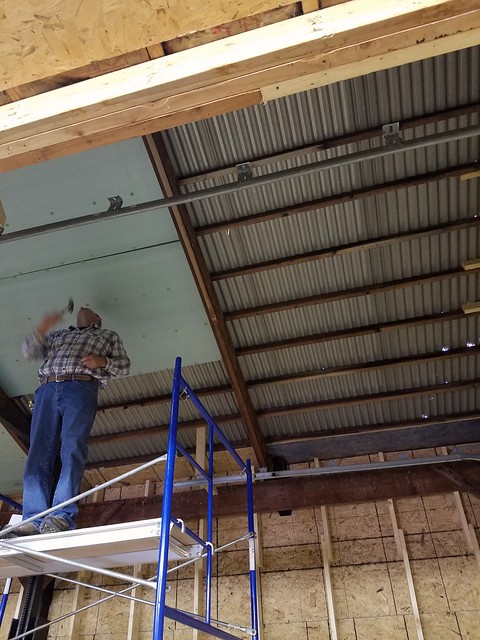
We borrowed some scaffolding to help with the new tall walls and to install some insulation board on the ceiling.

Steve and I believe that having good insulation is very important in any building project. What we have chosen to put on the ceiling is not ideal, but we have limited options with a tin roof. We seriously considered spray-on foam insulation, and honestly it’s probably what we should have done. But right now we are settling with what we have.
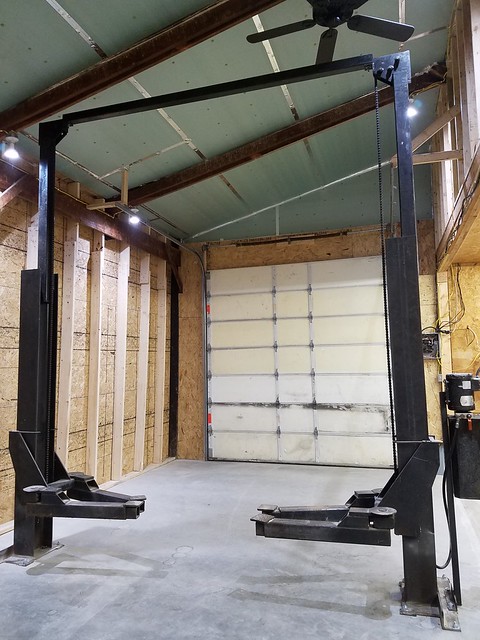
To install the vertical supports of the lift, Steve and my dad used concrete anchor bolts. They drilled holes using a hammer drill then inserted the sleeve and bolt into the hole. When the bolt was tightened it expanded to hold tight to the concrete.
One of the final steps was to install an overhead door. The pole barn has huge sliding doors on two sides, but this wasn’t handy for the new garage. So once again family came in very useful. My dad is known for not throwing things away in case he needs it someday. Well, it worked out for us. He had all of the parts and pieces for an overhead door.
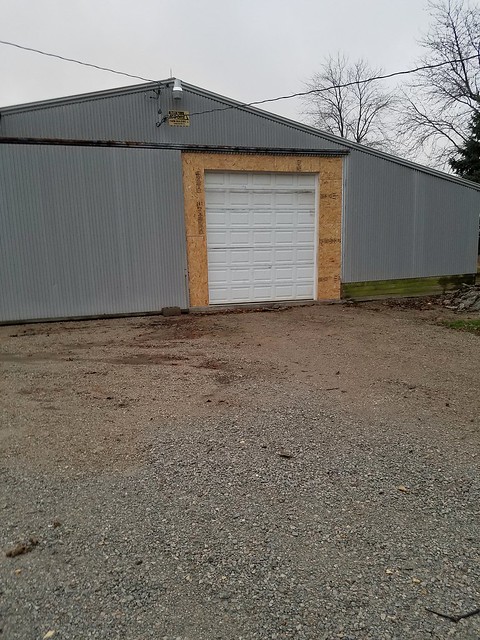
We had to frame in a smaller opening, and then Steve, my Dad and my stepson took some of the tin off of the sliding door and covered the new smaller opening.
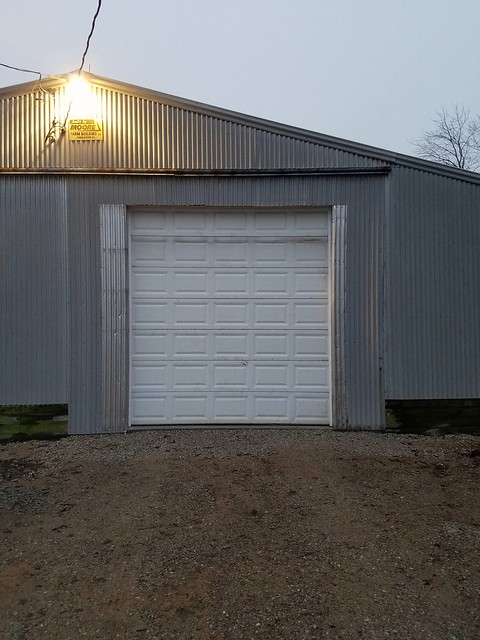
This week Steve has been insulating the walls. We still want to add another overhead door and of course he has to fill it with all of his tools and supplies. But basically we are going to call this project done.

And I have one happy hubby!

Great job, Sarah and family. I love that you did this all yourselves. Your family sounds very helpful and very handy. How great that your Dad had the door already! It looks like a great space for you and Steve. That lift is pretty cool.
New Year plans from Illinois

Sarah in Illinois is back for another year. She’s kicking off 2017 by sharing some of her plans and projects, and how she’s going to make it all happen.

It’s a new year! That means new goals, new projects and a big blank slate.

Last year I said that I was going to choose one word as my goal for the year, and that word was “focus.” That was helpful for a while. I used “focus” to stay on task and get things done.

However, like most resolutions, once the newness wore off I got back to my old habits.

That is what is so great about a new year. It’s a chance to start over.

So I went to oneword.com again to find a word for 2017. It only took a few seconds for a word to catch my eye. My word for this year is “less.”

It can apply to so many areas of my life. I plan to eat less, spend less, worry less and own less clutter.

Hopefully this year I use my one word to make some great changes and improvements.

As for projects around the house, I decided to set a goal of one project a month.

Some months the project may be large and some months may be much smaller, but the idea that at the end of the year I will have 12 completed projects sounds pretty darn great.

So here are my first 3 projects:

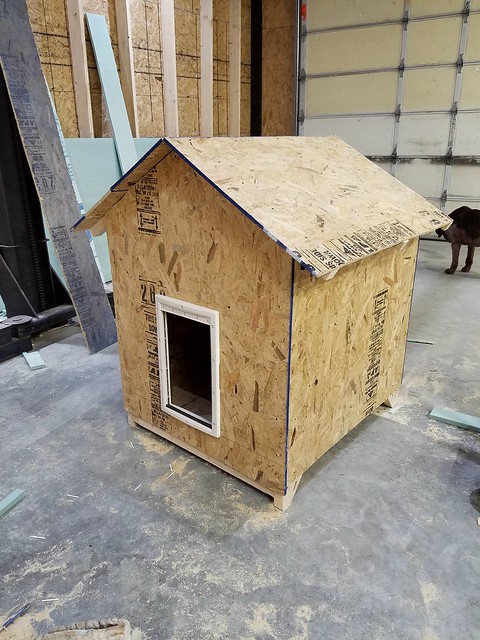
1. Steve and I built a dog house for Blitz to have when he is outside. However, it needs painted and needs some type of roofing material, most likely shingles.

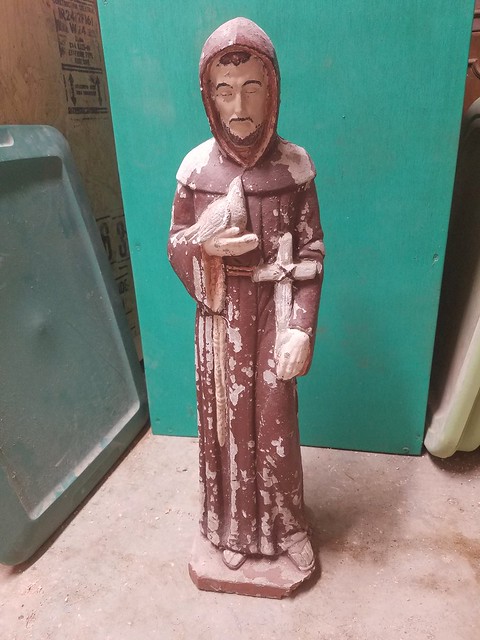
2. Months and months ago my mom brought me my grandma’s St. Francis of Assisi statue from her yard. My plan was to patch the cracks and repaint it. So far, I have not done a thing to it, and my grandma doesn’t even know that I have it. I would really like to get it fixed up for her before she looks out in the yard and thinks that someone stole her statue.

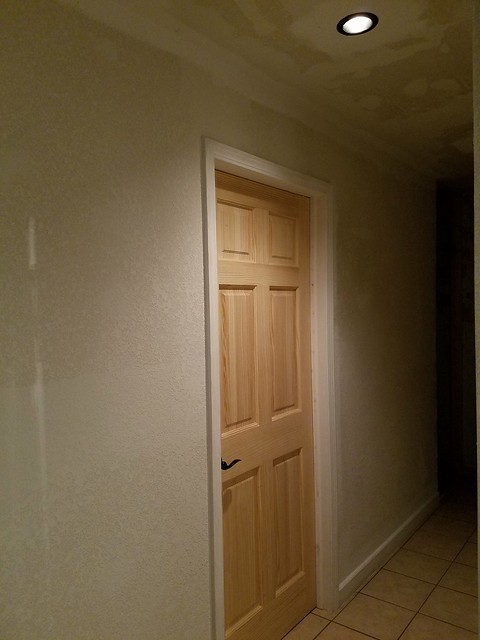
3. I really want to finish priming and painting our hallway. I am embarrassed to say how long it has been unfinished, but believe me it is a long long time.

I hope in the next three months I can get these projects done. It will take “focus” and “less” distraction that is for sure.

What are your plans for the new year? Do you make resolutions? What do you do to make sure you stay on task and get things done?

Thanks for sharing your plans, Sarah. I really like your strategy of having a word to guide you throughout the year and a project a month. Good luck with your first three projects. I’m looking forward to seeing the results.

Happy holidays from Illinois

Sarah in Illinois is here today with her final post for 2016. Thanks for being part of the blog for the past year, Sarah. I’ve enjoyed the peak you’ve shared into your life in Illinois.

The year is winding down and since this is my last post until the new year, I thought I would take a minute to thank Julia for letting me guest post and share a little of my rural living. I have really enjoyed being a part of her blog and I am excited to continue on in 2017.

This past year has felt like there were many detours and setbacks. In fact, most of the year I felt like I was changing plans, adjusting to a new normal or just trying to keep some sense of order to what was going on around here.

“You can’t plan life. Because no matter how perfect your plan is, life has a way to rearrange it.” — Mina Deanna

There were definitely some things that went according to (my) plan, like getting chickens and adding Blitz to our family. But it felt, more often than not, we were paddling against a raging river.

So instead of sitting around being grouchy about failed plans, I am going to focus on good things in my life.

I am thankful that our family is healthy and we have a warm house to live in and food for our bellies.

I am thankful for family gatherings like the one we had today where I got to spend time with my 91 year old grandmother.

I am thankful that my family has an annual tradition of collecting and donating baby clothes to families that need them.

I am thankful for my close group of girlfriends who are there for me, always.

I am thankful for the treats that a neighbor left on our doorstep today that remind me that I live in a wonderful neighborhood.

I am thankful that Steve and I have jobs that allow us to buy the things we need. And even some things that we don’t need.

No, this year did not go as planned, but I am thankful that each day is a new day to try again.

Thank you to everyone that read my posts this year and followed along with me. I’ll be back in January to start a new year with new plans!

Thanks for the reminder to focus on the good, Sarah. Merry Christmas to you, Steve, Blitz, the chickens and all the rest of your family.

Lessons learned after 4 months of chicken farming

Sarah in Illinois has had her chickens for about 4 months. Today she’s sharing what she’s learned so far with raising laying chickens.

I was very nervous when I decided to take this on. You may remember from my earlier posts that I had done a lot of research and read several books and asked lots of questions to fellow “chicken people.”

One piece of advice from my cousin was that I was overthinking it. From what I have experienced so far, she was exactly right.

I really can’t imagine raising chickens being any easier.

Now I need to make sure to point out that I have been lucky and have had no medical issues with any of my chickens, no injuries and no pests like flies or lice. All of those problems could still happen and I will rethink that raising chickens is “easy.”

Everyone who raises chickens has different circumstances so all I could do was try my best and make notes on what to change. So here is what I have learned in my first 4 months.

Coop

The coop seems to be working very well. It had plenty of ventilation this summer and I closed off all but a very little area for ventilation this winter. The temperatures are just starting to drop here, so I am hoping they will stay warm enough.
I have had no issues with any critters trying to get in the coop. We have had several raccoons, foxes and opossum on our property this year, but we have been lucky to find them before they got to the coop.

The only thing that I plan to change in the coop is maybe making them a new door, but that is purely for my own satisfaction, not a necessity.

Pen/Enclosure

I have gone back and forth on what type, if any, enclosure is best for the chickens.

I foolishly thought that they may stay in the fenced area that I already had set up for when Treu was here. That clearly did not work. They have been fully free-range so far. I really liked them being able to have a varied diet, hunt down bugs and just over all be healthier and happier.

But then Blitz came along. Blitz is not happy with them being free-range. I can’t tell you how many times I have run across the yard to grab a chicken out of his mouth.

Lately he has been grabbing them by the tail and dragging them as far away as he can. We are working on discipline, but I think we are fighting a losing battle.

Steve and I are pretty sure we are not far from him grabbing one just right and killing it. So we are going to continue to work with him coexisting with the chickens, but we have also bought a large roll of chicken wire to enclose the chickens and protect them from puppy bites.

Heat/Light

The chickens had been laying eggs very well up to about 2 weeks ago. We still had warm temperatures and enough daylight that I was getting 3-4 eggs a day consistently.

However, as expected, their production has decreased a lot now that we’re getting closer to winter. I am getting 2 eggs one day and nothing the next.

Some people add heat lamps to their coops for them to continue to lay all winter. I will not be adding a heat lamp. I am too nervous and have heard too many horror stories of coops and barns burning down from heat lamp accidents. But I have thought about adding a lightbulb on a timer to simulate longer hours of daylight. It would produce a minimal amount of heat but mostly just give them the feeling of longer days.

Food

Since the chickens have been free range, I have not been worried at all about their food. I always have pellets handy for them, but they eat very little chicken feed when they are free to roam the yard and fields.

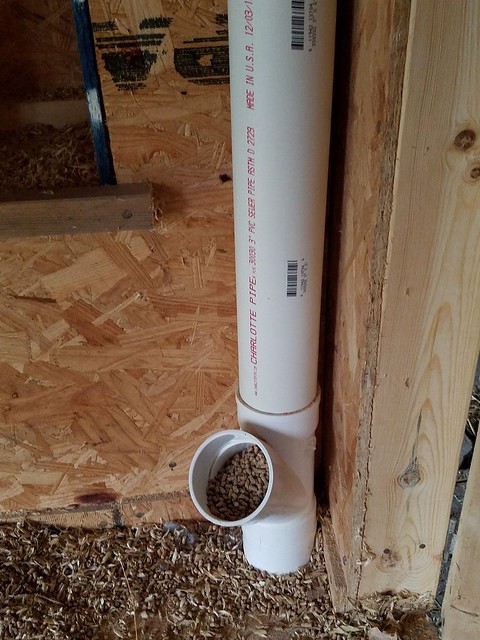
I did make them a feeder out of PVC pipe. I found several samples on Pinterest, but the idea is very basic.

I used a piece of 3-inch diameter PVC pipe, a “y” and two caps. I cut about 3 inches of the straight piece of pipe, this was used to connect the bottom cap to the “y.” In the picture below you can see how I stacked a cap, 3-inch section of PVC pipe, “y,” the remaining PVC pipe and a cap on top to keep out dust, dirt and chicken poop.

I fill the feeder approximately every 10 days. I expect to fill it more often as winter sets in and the chickens have less grass and bugs to eat.

Water

Right now their water may freeze over slightly overnight, but it has not been cold enough to freeze to where they can’t get water. I obviously will have to decide what kind of heated water container I am going to use and probably pretty soon.

More chickens

Yes, I plan to add chickens to my flock in the spring. I have known from the beginning that I may add to my flock.

Steve doesn’t like brown eggs. I know that is shocking. I can’t tell you how many conversations I have had where people can’t believe that and swear that brown eggs are richer, taste better and are healthier. But hey, we all have likes and dislikes and his is that he doesn’t like brown eggs. So I just see that as an opportunity to add more chickens!

When we built the coop we planned for it to be big enough to house 10-12 chickens. Now that I know what raising chickens is like, I can comfortably add more and not feel overwhelmed. My plan is to add 2-3 white egg layers (possibly Leghorns) that are 3 to 4 months old.

I am not ready to attempt to keep baby chicks alive, so that is why I want them to be a couple of months old.

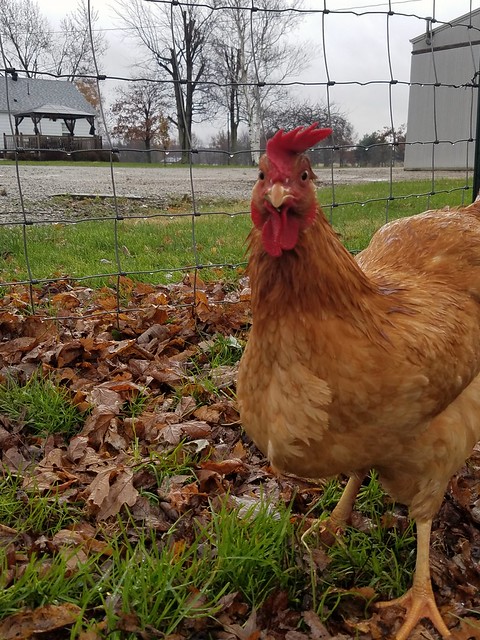
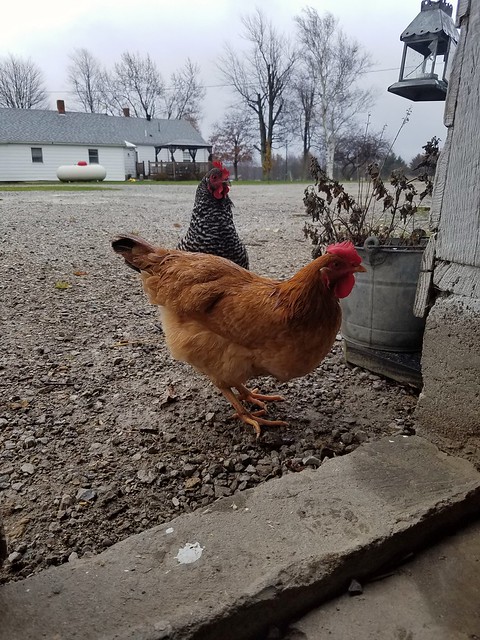
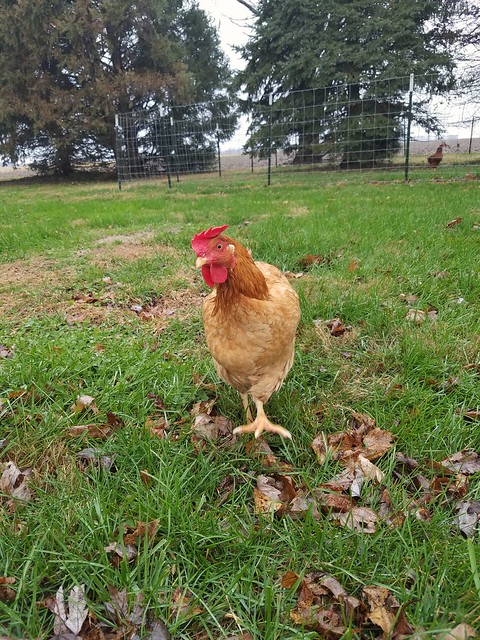
Clearly this was the more photogenic of the chickens. She was always in front of the camera!

Another reason to add chickens is that 4 chickens produce enough eggs that I can occasionally take some to my parents or Steve’s mom, but I don’t have enough where I think “what am I going to do with all of these eggs?” So I feel I can add a couple and easily have eggs to provide to our parents and my brother and his girlfriend.

So how do I feel after my first 4 months of being a chicken farmer?

I have nothing but positive things to say about my experience so far. If you are thinking about raising chickens for fresh eggs, do it.

Do your research, ask questions, then go for it! If you have questions for me, ask away. I will answer to the best of my knowledge with my short experience.

Yay, Sarah! I’m glad that your chickens are working out so well for you–despite the challenges with Blitz. I am so looking forward to the day when we have our own farm fresh eggs. I have to say that I’m on team brown… or blue (I love the idea of Ameraucanas) when it comes to eggs. However, I don’t really notice a difference in taste based on shell colour. I notice a difference in taste between farm fresh and store bought. I love the flavourful deep orange yolks!

When life gives you persimmons, make persimmonies

After using a pile of persimmons in her last post to try to predict what kind of winter we’re going to have, Sarah in Illinois is back today to answer the question of what she did with all of that fruit.

Persimmons are a big commodity in Illinois in the fall. A quick search on Facebook shows the going rate for persimmon pulp is $4/pint.

As I talked about in my previous post, I have used persimmons to try to predict the upcoming winter, but I had not used them to make any type of dessert. So this year I decided I should try one.

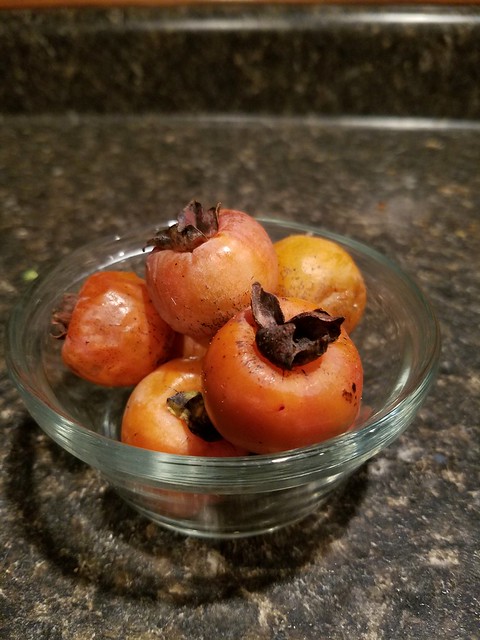
When you taste a ripe persimmon, it is really sweet and the texture is similar to an overripe peach. But there is a catch. If you taste a persimmon that is not ripe, you will know it.

An unripe persimmon will dry your mouth out in a second. I really have not tasted anything like an unripe persimmon.

So when I picked persimmons I tried to pick mostly from ones that had fallen to the ground. If they have fallen, they are most likely to be ripe.

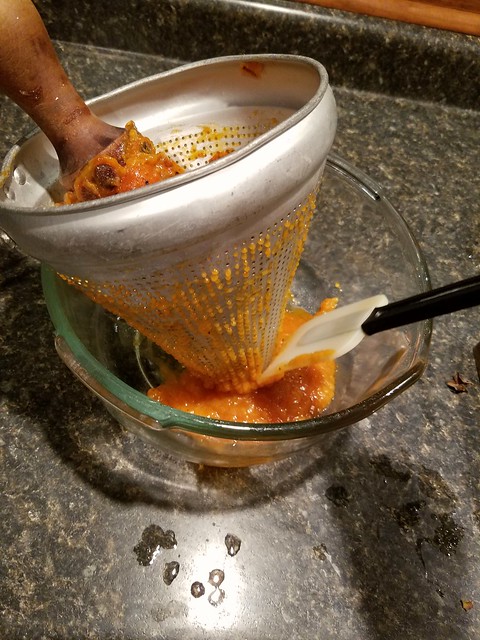
When I brought them home and removed the skin and the seeds, I put what was left in my Grandmother’s sieve/masher.

It has a wooden pestle that allowed me to push the pulp through the little holes. This step took a lot longer than I was expecting, but when I was done I had 2 cups of pulp.

Now I had to decide what to make.

When you say “persimmon” the first thing that comes to mind is “persimmon pudding.” A quick search on the internet will bring up more recipes than you can imagine. But that is not what I was looking for. Persimmon pudding is similar to a bread pudding, and I don’t care for bread pudding.

So my next search was persimmon cookies. Most cookie recipes call for walnuts and raisins. And I don’t care for either of those in my cookies. So what else could I make? Persimmon bread? Persimmon roll? Persimmon bars? Persimmon smoothie? Persimmon margarita?

I decided on Persimmonies which the author describes as a “cross between a bar cookie and a snacking cake.” It even has the suggestion of adding chocolate chips.

How can you go wrong with adding chocolate?

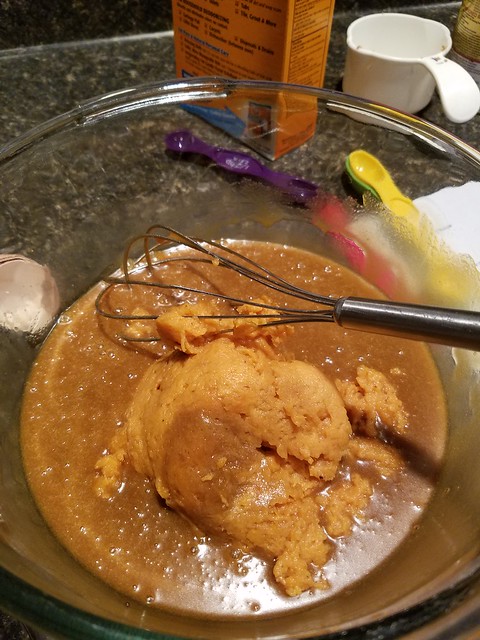
I followed the recipe exactly. I was surprised that the batter was pretty thick.

I won’t describe each step here, you can click on the website and get it straight from the author, but it was a pretty straight-forward cake like recipe.

I didn’t have chocolate chips on hand so I just used the author’s original recipe.

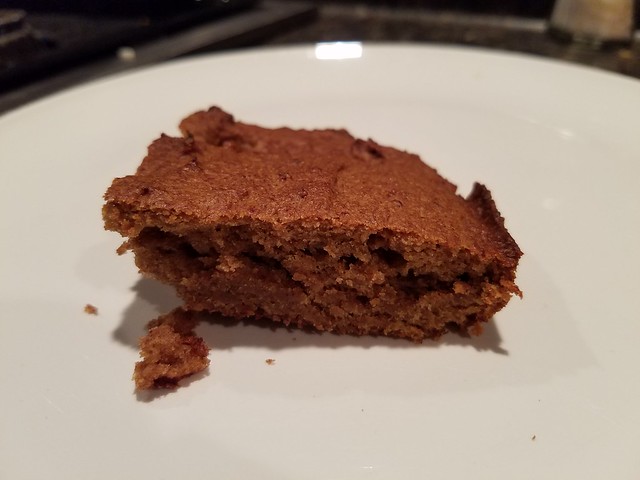
The results

In my opinion, it tasted like cinnamon bread, which was really, really good. I just didn’t taste much persimmon. Maybe I should have added some more pulp. And next time I will definitely add the chocolate chips, because again… chocolate.

I took the persimmonies to work and brought home an empty pan, so you could say they were a success.

Anyone made anything with persimmons? What recipe would you try? Are persimmons popular in your area?

I’ve not seen persimmons in our area, and I don’t think I’ve ever eaten one–let alone made anything with them. I’m curious now, Sarah, to give them a try. And I agree… chocolate is never a bad idea.

I have to add, a very happy Thanksgiving to Sarah and all of my other American readers.

Winter predictions

“A Canadian is someone who worries about winter before summer is even over,” a senior climatologist at Environment Canada said earlier this fall (source). Apparently, that definition extends to Illinois as well. When you live in a place like Canada or Illinois where winter can be a big deal, you try to anticipate what kind of season we’re going to have. Sarah in Illinois is sharing some of her predictions for the upcoming winter.

As the temperatures start falling, our thoughts are turning towards winter and more importantly what kind of weather we are going to have.

Snow? Wind? Or even worse, ice?

Of course there is no way to know for sure. Even the best meteorologists are just making scientific-based guesses. But it feels good to think maybe we can plan ahead, even just a little bit. We do look at our local weatherman’s winter forecast, but we also like to base our predictions off of old wives’ tales. Here are a few that we use at our house.

Persimmons

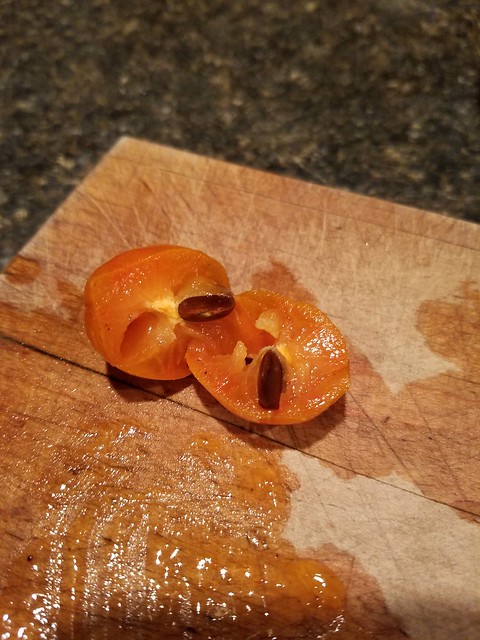
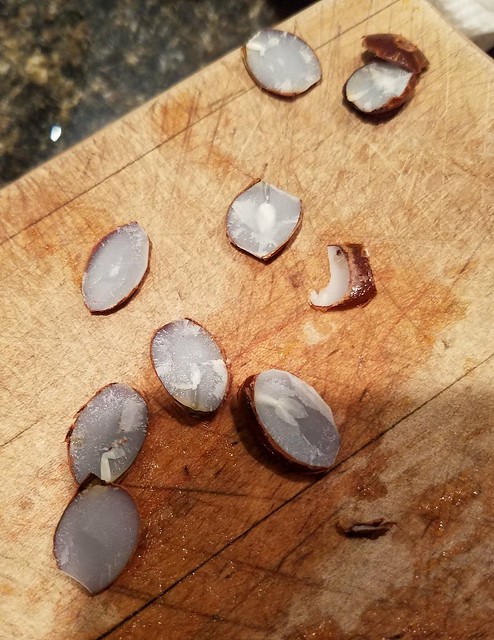
My brother has a persimmon tree. When the fruit starts falling to the ground we gather a few and take the seeds out. The seeds are very slimy and you have to wipe them off really well because the next step is a little dangerous. We take a very sharp knife or even a razor blade and slice the seed in half. Inside is the little white kernel. If you look closely it will resemble one of three shapes: a spoon, a fork or a knife.

If the shape is a spoon, then you should expect heavy wet snow. If it is the shape of a fork you should expect a milder winter, and if it is in the shape of a knife you can expect lots of sharp wind that cuts right through you. We cut some open at my brother’s house and they looked like spoons to us.

We cut some open when we got home, and it seemed like the knife scraped the kernel away and it was hard to read. But if we really looked hard we thought they looked like spoons. So by that we should prepare for lots of snow.

(In my next post I will share what I did with all of those persimmons.)

Woolly Worms

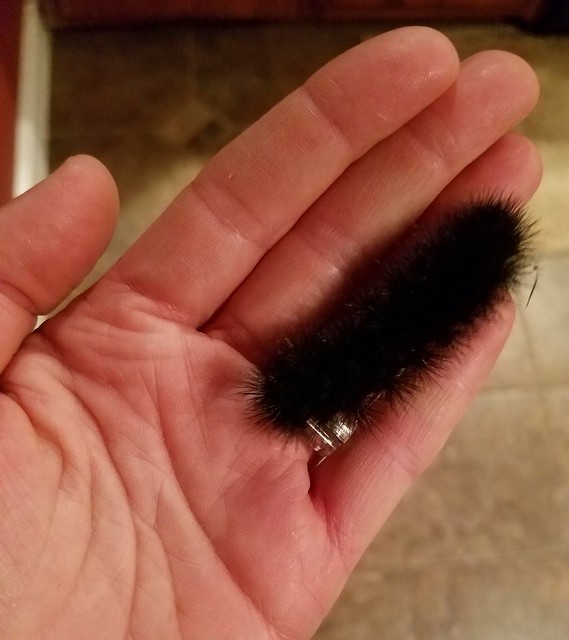
Another prediction that we have used since we were little is the color of the woolly worms. Woolly worms are usually striped black then brown then black. The more proportion of the worm that is black means the harsher the winter will be. We have seen several different woolly worms so far this fall. I have seen an all light brown woolly worm, and several with more black, then brown, then black but by far we have seen the most all black.

These seem to be crawling everywhere. If you do an internet search you will see some “professionals” that say these are not the worms you use to make your predictions. They say this is a different variety of woolly worm and it doesn’t count. So I guess you can make your own decision on what that prediction means. But to us it means be prepared for snow.

Squirrel Nests

Steve’s favorite predictor has to do with the squirrel nests in the trees. He says that the larger the nest, the colder the winter. I’ll be honest before I met Steve, I never paid attention to the squirrels even made nests in the trees, but now I am always on the lookout.

This prediction is yet to be determined since there are still way too many leaves on the trees and we can’t even see any nests. But I know we will start noticing them in the next few weeks and we will have to see what the squirrels predict.

I am curious, what other old wives’ tales are out there? Do you use anything in nature to predict your winter weather? Have you heard of the methods that we use? What does the winter forecast look like in your area?

So far it sounds like the prediction for Illinois is snow. Honestly, I like a snowy winter. I could do without some of the frigid temperatures we’ve had over the past few years. I’ve heard of the woolly bear (worm) method before, but never persimmons. You have me curious how you used all of those fruits.

Four new legs in Illinois

A new family member has joined Sarah and her family in Illinois. And he’s just about the cutest–I said just about, Baxter, don’t worry.

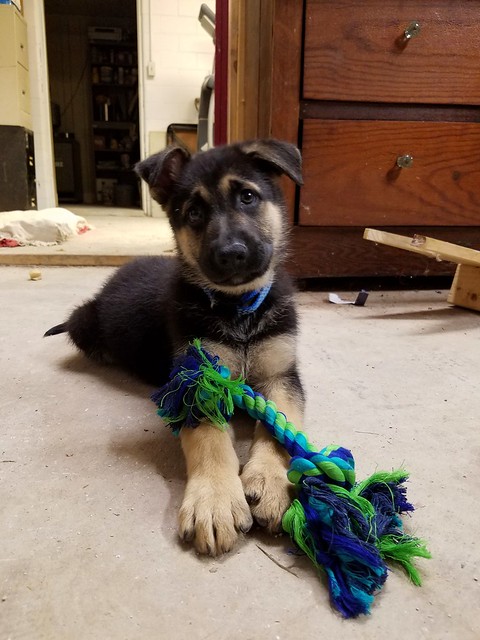
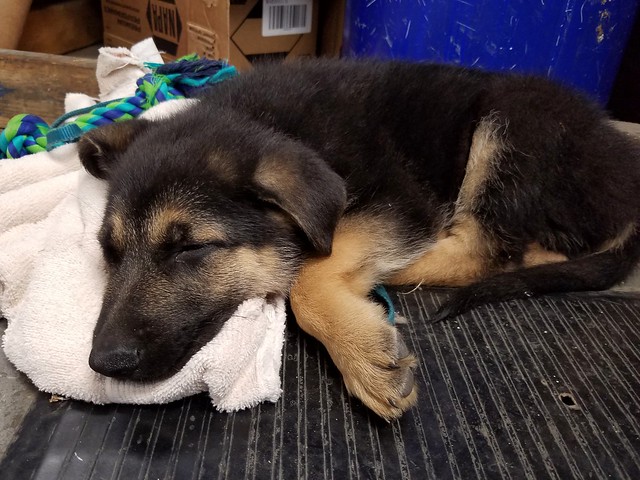
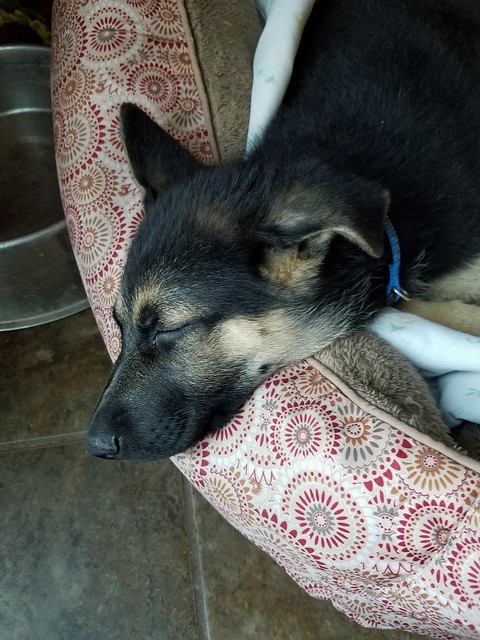
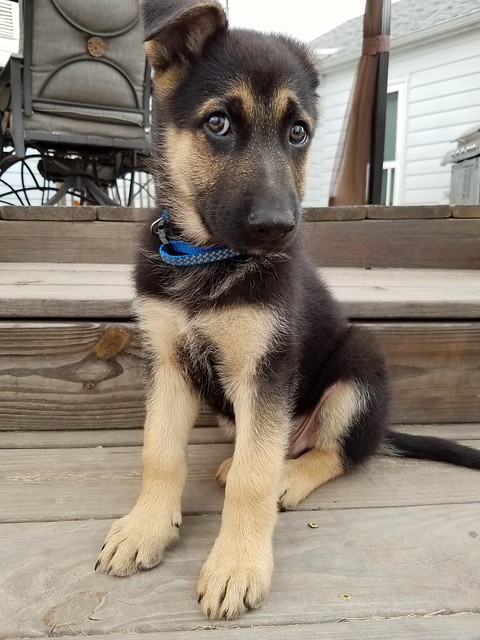
In my last post I left you hanging with the announcement that we had someone new joining our family. I am proud to introduce Blitz!

Last year I introduced my sweet Treu, but what I have not really wanted to write about was that in January of this year he got really sick.

He fought pneumonia for a while and then he quit eating and then quit drinking anything. It was at that point that the vet felt we were fighting something much more severe, most likely cancer.

Treu was 2 months short of his 13th birthday and I could not justify putting him through any invasive diagnostics or treatments. So I made the heartbreaking decision to put him to sleep. It was by far the hardest decision that I have ever had to make.

I went through all spring and summer working in the yard and garden without my sidekick.

I needed some time to grieve for him, but it was really hard not to have a dog at my side. (I should note that we still have Steve’s Lab, Brody. We have not been completely without a dog. But Brody is very clearly Steve’s dog and I have been missing having “my” dog.)

Late this summer a friend who knows my love of German Shepherd dogs told me that he knew of a litter to be born late in August. It took me a little time to decide if I was ready or not, and finally I decided that this little monster needed to join our family.

It has been 13 years since I have had a puppy. I had forgotten a few things, but they came rushing back:

1. Puppies sleep a lot. They have times of intense energy and play and then they crash…HARD.

2. Puppies don’t sleep of long periods of time. They want to play tug at 2am. And again at 4am.

3. No matter how many toys you buy for them, no matter what size, color, shape, no matter if they make noises or do not, puppies will chew on things that they are not supposed to.

4. You will have to clean up a lot of bathroom messes. It never fails, the moment you bring a puppy inside from going to the bathroom; he will pee right in the middle of the floor.

But, the puppy breath, the cuddles, the fun from teaching him a new trick, offsets all of the bad stuff. He won’t be a puppy forever so I am going to focus on all of the fun that we plan to have.

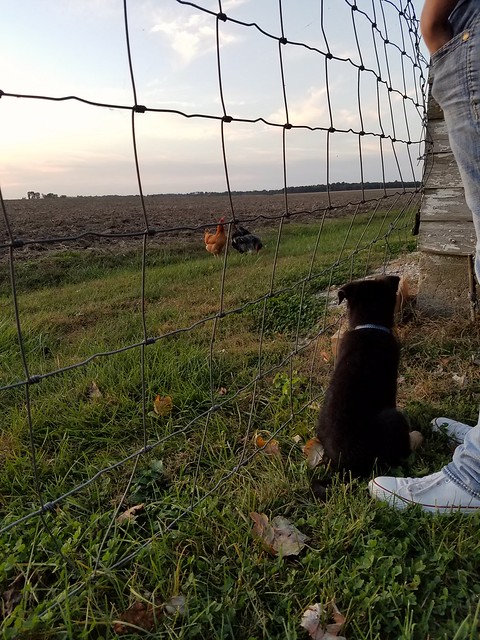
And all of the chickens that we have to chase.

Awww. I loooove that photo at #4. It’s totally an “I’m sorry” look. You both look so happy. It’s so nice to meet you, Blitz!

Happy fall from Illinois

Lots is happening in Illinois this fall. Sarah is here today with a whole bunch of updates–and some very exciting news.

Happy fall! I thought this week I would give you a review of what has been going on around here and a little sneak peek of what we are preparing for.

Harvest is in full swing here. Steve has been working long hours every day in the combine. It seems like every field on my drive to and from work is either already harvested or has farmers in it working hard.

The view from our house is opening up since we have fields on all four sides. But I have to admit; with or without crops our view isn’t too bad.

The chickens are doing great. They have become very comfortable here.

Maybe just a little too comfortable.

I can pretty much count on getting two eggs a day from them.

From everything I have read, four chickens should average about three eggs a day. So I think they still have some room from improvement. We have been catching grasshoppers from the fields for them and they have learned who brings them the treats. They follow us around the yard all of the time.

One project that we are currently working on is building a garage inside of our pole barn. I have decided to do one large recap of that when we finish, but here is a hint of what we have been working on including pouring a concrete slab for the floor.

And finally, if you follow me on Instagram you already know the most exciting news: we are adding four legs to our family. I will give him a formal introduction once he joins us, but here is my first picture with him on the day I picked him from the litter.

Our house is about to get a whole lot busier.

What does fall look like at your house? What crops grow in your area? Any suggestions on introducing the new puppy to the chickens?

Aaah! That is very exciting, Sarah. New chickens and new puppy all in one year. You’re more ambitious than me. As cute as that fluff ball is, I think I’m most jealous of your fresh eggs and your new garage.

Making more ‘mums

Almost exactly a year ago Sarah in Illinois wrote a post about sealing her deck, and she included a photo of the very impressive chrysanthemums that were growing on either side of the deck stairs. A year later, they’re even more impressive–and they’ve multiplied. Read on to learn about how Sarah successfully split her mums.

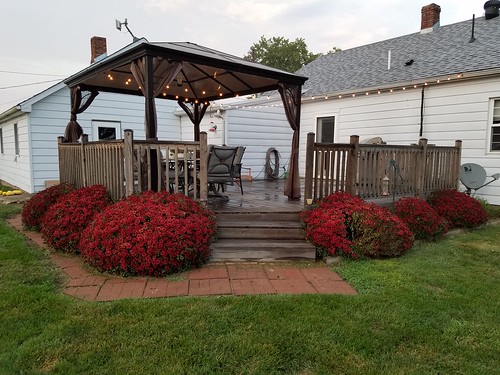
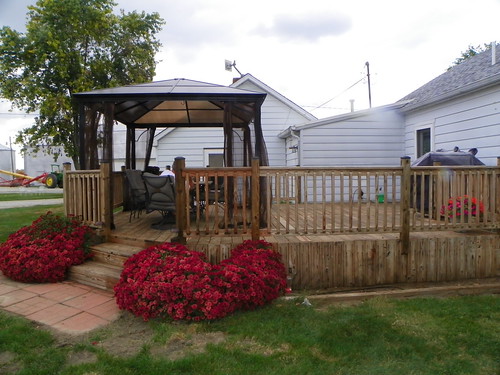
Last fall I shared a picture of my mums. I was really proud of them. They were so full and added so much color to our deck.

Then this spring Julia and I had a garden challenge. One of the projects I checked off my list was to divide my mums.

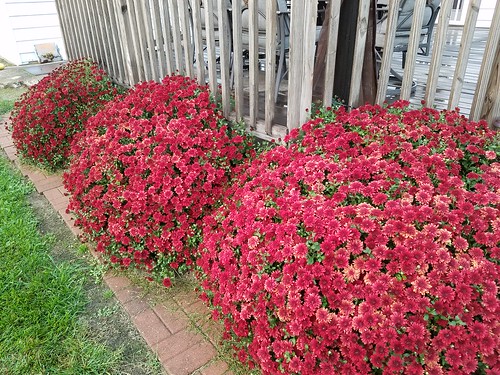
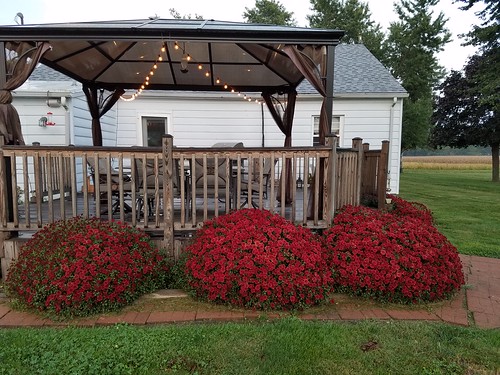
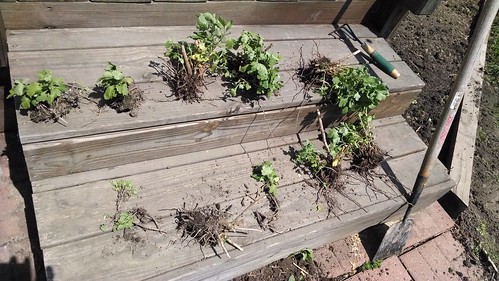
I simply dug them up out of the ground, divided them into a few same-sized clumps and planted them back into the ground around our deck.

That is it. That is all I did.

Then this is what happened.

I know. I am as impressed as you are.

I have had neighbors stop and ask me what my secret is. But all I can say is, I watered them for the first week or two after I transplanted them. That’s it. No fertilizer. No secret concoction. I didn’t trim them back or even sing to them! I just sat back and let them go.

That’s my kind of gardening.

Holy chrysanthemums, Sarah! Those are gorgeous. I’ve heard that some plants do better after splitting, and this seems to definitely be the case for your mums. My frugal heart also loves that you now have six huge plants and didn’t have to spend any extra money.

Garden Olympics in Illinois

Today’s post from Sarah in Illinois further solidified my belief that we’re completely kindred spirits. Obviously, Sarah and I both love our gardens. I realized today that we also both love the Olympics. Sarah has come up with a really clever, Olympic-esque way of summarizing her garden’s performance this year. Let the medal ceremonies begin.

Our garden is just about done for the year. We currently only have two things still growing: peppers and pumpkins. In a future post I will go over some of the ways that I am preparing for next year, but for now I will review this year.

I started out with such high aspirations for our garden. And it’s a good idea to set your goals high, but when I look back over the year I need to be realistic with my results. I need to focus on what went well and not what didn’t. So I am going to go over the results in the spirit of the Olympics and start with my gold medal winners.

Gold medals

Sugar Snap Peas – With a mild spring and plenty of rain, I had a much bigger harvest than normal and I even still have some in my freezer.

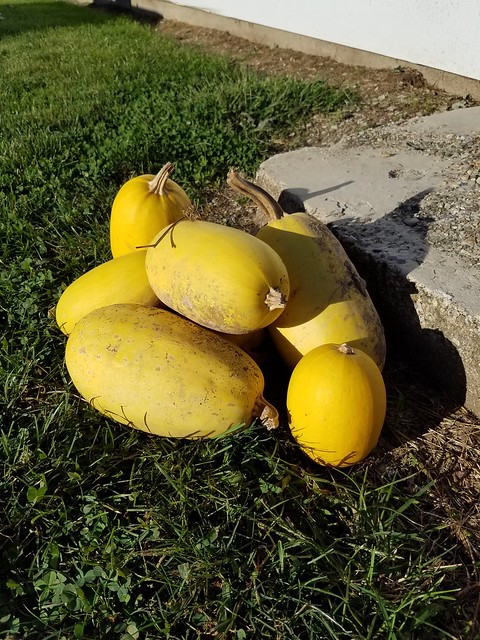
Spaghetti Squash – I gave away several, I baked a few, froze some and I still have more to use up.

Kale – I couldn’t keep up with my Kale this year. I didn’t know what to expect when starting it from seed indoors and transplanting it, but it could not have done better.

Green Beans – We had an excellent first harvest and even got a few meals from a second harvest.

Potatoes – The potatoes did very well and we still have a meal or two to dig up before we close down the garden.

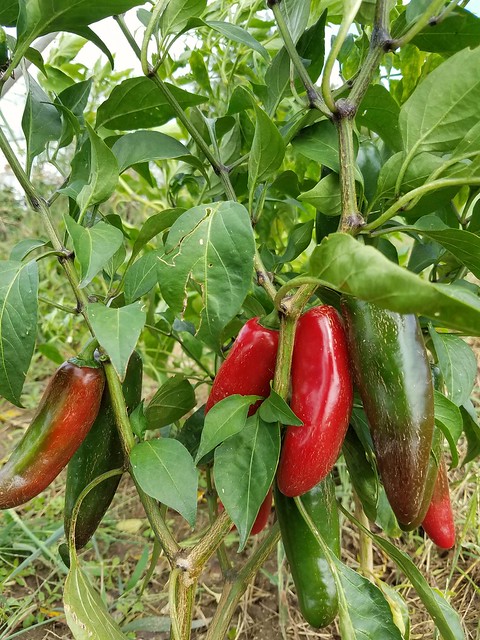
Peppers – Both our green peppers and our hot peppers really did well this year.

Silver medals

Radishes – The plants themselves did well. I just did a poor job of planning and planted too much at one time. So a lot was wasted.

Cauliflower – This was my first year for growing cauliflower. Again, the plant grew well, and I pinned the leaves closed like I was supposed to. Then I waited, and waited, and waited, and waited. Steve finally mentioned that he thought they should have been ready to pick by now. However, I had waited too long and they were all bitter. If I had been more vigilant they would have gotten a gold medal.

Tomatoes – The plants grew large and produced a lot of fruit. We made one harvest and took them to Steve’s mom to can. She made a few quarts of tomato juice from them. We had planned another harvest and then rain hit. In one weekend we got over 4 inches of rain and the garden was too soft for me to walk in. By the time the ground dried up a little and I remembered that we needed to pick tomatoes, most of them were rotten.

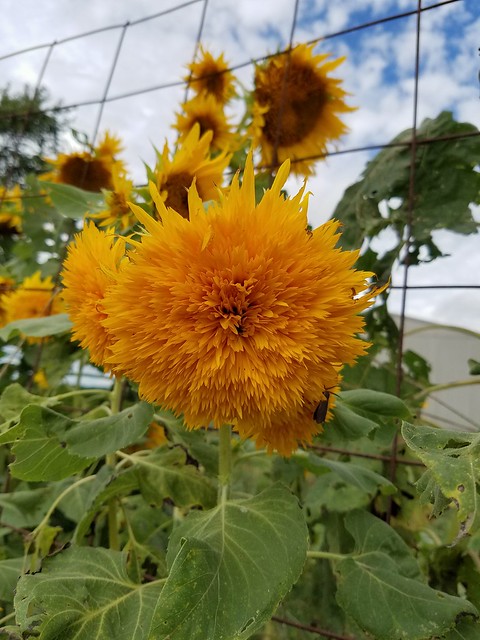
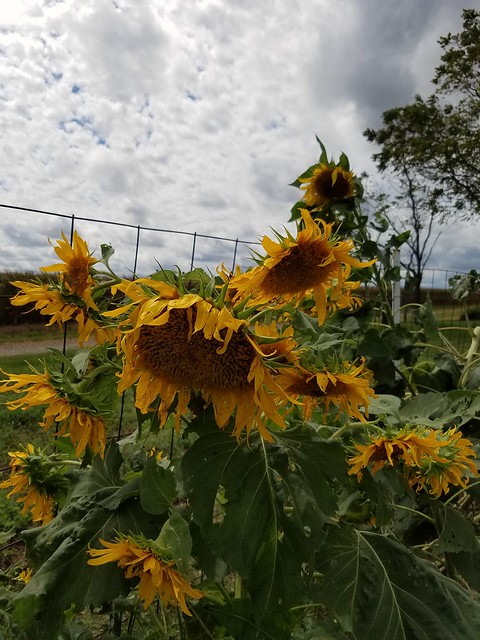
Sunflowers – The flowers are beautiful, but I did not pay attention to the amount I planted of each variety. I got several plants that are really pretty but only two are the type that you can harvest the seed from and the kids are disappointed that we will not have sunflower seeds to eat.

Bronze medals

Red Cabbage – I had planted 4 plants and they looked healthy, but I only was able to harvest one head.

Carrots – We planted the carrots too close together. The few that we harvested were good, but they did not have much room to grow very large.

Cabbage – I am thinking maybe cabbage moths or some type of pest took over the plants. All of the leaves were full of holes and we did not harvest any cabbage.

Asparagus – I didn’t know what to expect for my first year of asparagus. And I would normally think that maybe mine looked okay. Until I went to my brother’s and saw his first year of asparagus. His plants look so full and healthy and mine look so thin and spindly. I will have to add some new crowns next year.

There were a few vegetables that did not even show up to my “garden olympics” and so they did not get awarded anything:

Cucumbers – my plants this year were pitiful. Just pitiful. There is no other way to describe them. I think out of about 15 plants I harvested 2 cucumbers. TWO.

Brussels Sprouts – This was my first year of growing them and I knew that they didn’t seem to be doing anything. My thoughts were confirmed when I went out to the garden and saw Steve mowing the plants down. Apparently he had given up on them before I did.

Overall, I should be happy. We produced our own food. We grew food that was healthy and fueled our bodies with the best quality nutrients. There really is nothing I should be upset about. I should just look to improve next year.

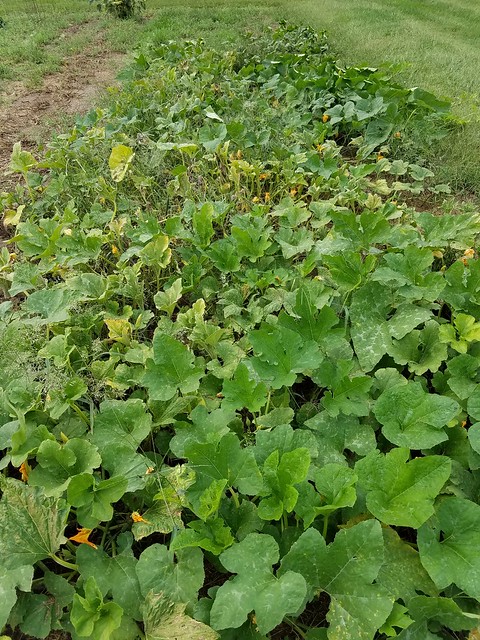
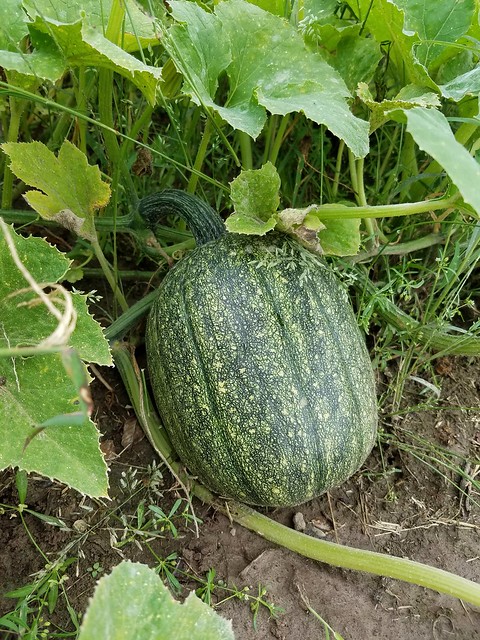
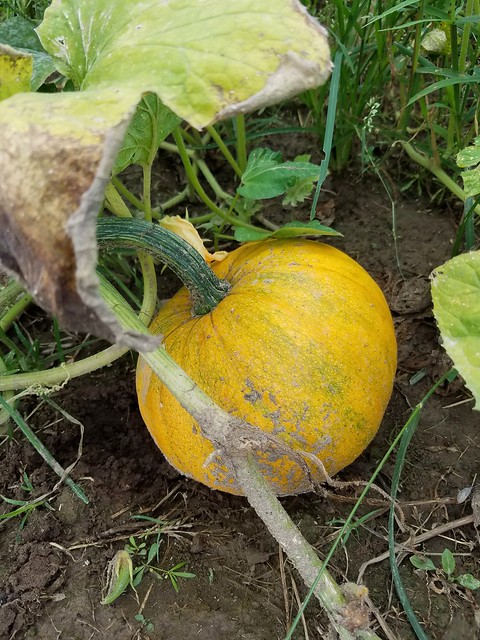
In the meantime, I will keep checking on these vines and hope that we have some pumpkins to carve this year!

Great summary, Sarah. I think as gardeners we learn very quickly that we can’t expect everything to be a success. It even varies year to year. It’s really good to keep a record like this of what worked and didn’t, and use that to set goals and plan for next year. (BTW, I love the fuzzy fluffy sunflowers! I’m adding those to my garden plan for next year.)

Save