Path preview

Please gaze upon my bliss.

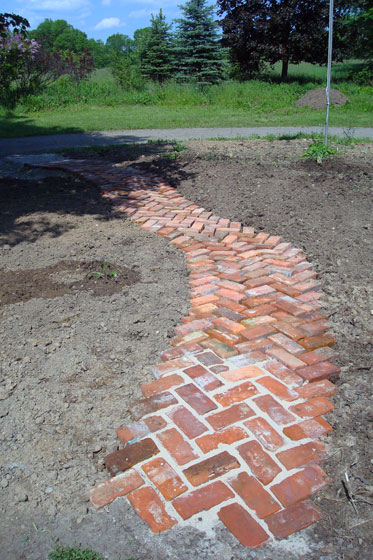
Herring bone brick pathway

Yes, that’s right. My definition of bliss is a brick pathway. So what?

But isn’t it so pretty? I realize some of you who voted for the traditional brick pattern–or “running bond” as I learned from a commenter–may not agree that this looks lovely. The vote came out very close, which really surprised me: 63% herring bone to 38% brick. I honestly thought herring bone would be the clear favourite.

I chose to go with the herring bone after spending a few days looking at the layouts that I’d mocked up last weekend. I just decided that I really, really liked the way it looked.

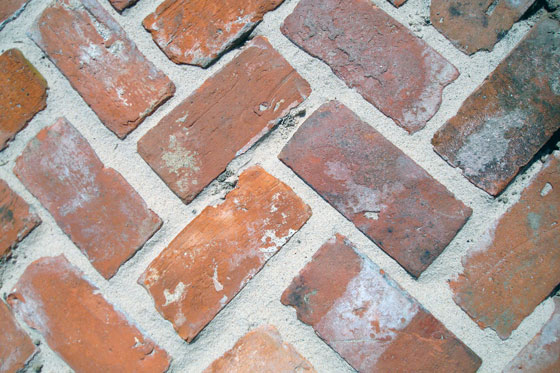
Bricks laid in a herring bone pattern

Laying the brick in the herring bone pattern and getting the bricks to bend smoothly around the curve was a bit more challenging than it would have been if I’d chosen another pattern, I’m sure, but I just fudged the spacing between the bricks as I needed to.

I still have to fill all of those spaces with sand. I found two bags of something called “magic sand” in one of our junk piles. The description said that it was a polymer infused sand made to fill the joints between paving stones. That sounded like just what I needed so I dumped the bags onto the bricks and managed to fill the joints for the first three feet of pathway. I’ll pick up the rest of the sand this week and hopefully finish off the path next weekend.

I say hopefully because along with needing more sand, I also need a few more bricks. What might be a little hard to see in the top photo is that as the path heads into the shade, about six feet from the end, I ran out of brick.

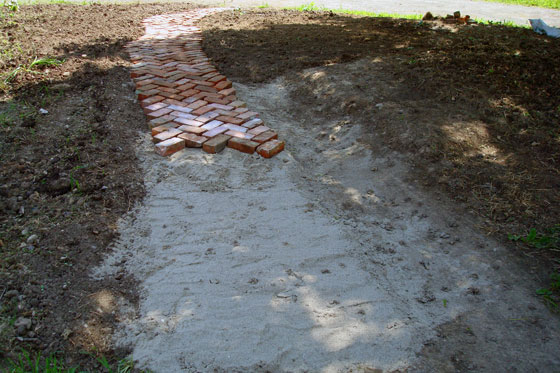
Brick pathway laid in a herring bone pattern on a bed of sand

I knew I was going to be short, and I actually made it much farther across the turnaround than I expected to. Apparently 362 bricks are just not enough. They are enough to make me blissfully happy though.

Time to zigzag or stay on the straight and narrow?

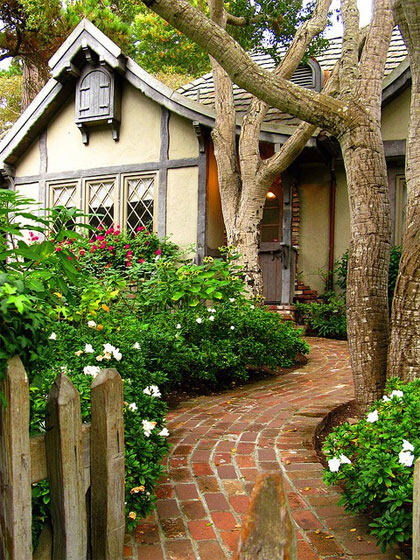
Remember this picture from my 2013 home goals?

A lush garden with a brick path winding through it

This is my inspiration for the garden I’m building on the turnaround at the front of the house. Lush. A little bit wild. A beautiful brick walkway winding through.

Honestly, the path is an excuse to use up some of the piles of bricks that we have lying around the farm. But, it does have two additional benefits: the path will save us from having to walk all the way around the turnaround when we want to get to the other side (it’s farther than you might think) and it will be an attractive feature at the front of the house (I hope).

The path is next up on the landscaping list. I’ve dug out the route across the turnaround and gathered my bricks. Now I’m just trying to decide how to lay them: trendy herring bone or traditional brick pattern.

Herring bone brick walkway

If I go with the straight brick pattern, I’ll probably do six courses, not the five that are pictured here. If I go with the herring bone, this is pretty much what it’s going to look like. I’m not going to cut the bricks, so the edge will be a bit ragged. It will probably be hidden eventually by all of the lush plants, but that might take a little while.

I think I know what you’re all going to say, but I’m going to put it to a vote nonetheless. What do you think?

For those who might be concerned by the photo above, I am not going to lay the bricks directly on the dirt. I’m planning a base of sand, which we also just happen to have a huge pile of lying around. I’d use gravel, but the gravel in our pile (yes, we have one of those too) is a bit too large to provide a really stable base.

No matter what pattern I end up using, I’m planning on leaving about a half inch gap between the bricks. Does anyone have any experience with polymeric sand? I’ve heard that it’s good for filling the spaces between the bricks.

Feel free to expand on your opinions on polymeric sand, the beauty of herring bone, dos and don’ts of brick laying, fast growing plants and any other topic that strikes you in the comments. I appreciate any advice.

Manure manouvering

So how was your weekend? Mine was crappy–as in filled with manure.

We’d made some progress on the turnaround so far this spring, picking up the rocks and rubble and flattening out the piles of dirt. However, I wasn’t very confident in the quality of that dirt, so before I started to plant anything, I wanted to give it a boost of nutrition. Like any decent farm, ours came with that barnyard fixture, the manure pile, so we have lots of natural fertilizer.

Manure pile

The turnaround is the size of some people’s backyards, so a decent quantity of manure was required. Likewise, there’s a decent distance between the pile out behind the barn and the turnaround at the front of the house.

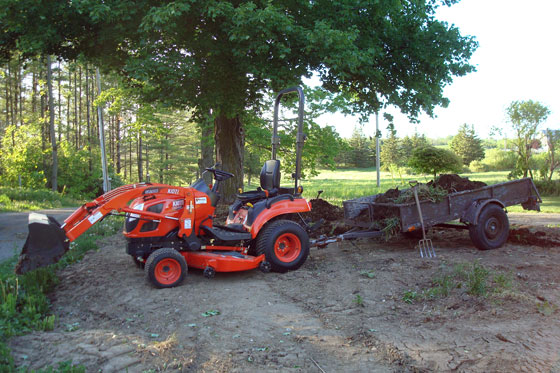
My Dad left his trailer here a few weeks ago, and with the help of Wiley and his front end loader–my skills are much improved over last year–I brought three full loads of manure up to the garden.

Kioti CS2410 towing a trailer full of manure

The manure isn’t smelly anymore, but the lesson of the weekend is that it can be a bit slippery. I had a couple of close calls standing in the trailer shoveling it off.

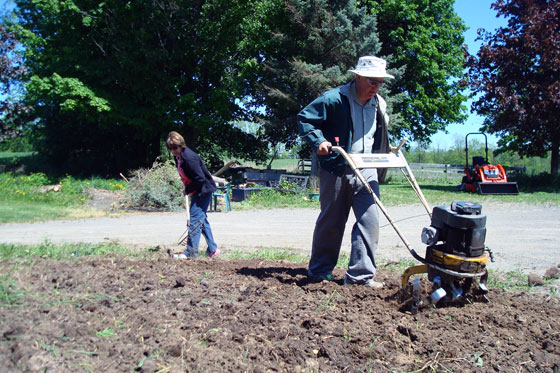
This probably wasn’t quite what my Dad had in mind for his trailer when he left it with us, but he’s a good sport. So good in fact that he brought his rototiller up to the farm and went back and forth over the turnaround mixing the manure into the soil. My Mom pitched in too spreading the soil around the edges and picking out the rocks–lots and lots of rocks.

Rototilling a garden

Thanks to my parents, our tractor, the trailer and our convenient manure pile, the turnaround is now ready for planting, so I guess my weekend wasn’t that crappy after all. Pretty productive, in fact.

How was your weekend?

Memories of Muriel

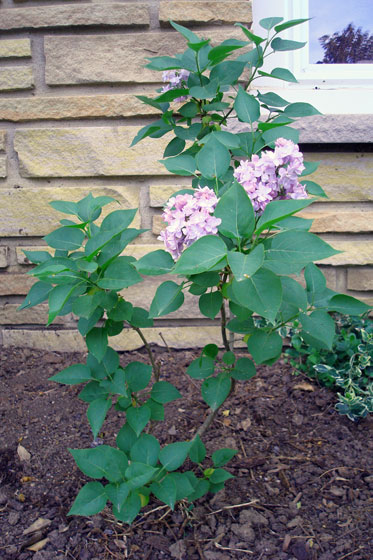
I’ve said that I didn’t do any gardening last year, and that’s not entirely true. I planted one thing: this lilac.

Double French light purple lilac

This lilac came from our first house. It had lived for six years in the flower garden Matt and I made in the front yard. It never bloomed. It didn’t really grow very much. But I nursed it along because this plant is another one of my special treasures.

This lilac was a shoot that I transplanted from a beautiful bush my grandmother had growing in her backyard. She was always very proud of her lilac and its prolific double blossoms. A few of the grandchildren took shoots to plant in their own gardens.

Last spring as we sold our first house and moved to the farm, I carefully dug up the lilac, cleared a space in the overgrown garden at the front of the house and transplanted it.

Double French light purple lilac

Over the past year, it has finally started to thrive. It’s grown taller and bushier. And for the first time ever, it’s blooming.

This is a banner year for lilacs at the farm and it turns out we have lots: a large bush outside our bedroom window, others scattered around the gardens, a hedge stretching nearly from the house to the pond. However, this, our smallest plant, is my favourite.

Landscaping… the long list

I cannot bring myself to write a list of everything I want to do for renovations in the house, but for some reason I have no problem doing a master list for the landscaping outside.

Landscaping plan

Alright, I’ll admit it. That’s a little overwhelming.

There’s obviously a lot to be done, so it’s a matter of prioritizing what part of our 129 acres we want to focus on. This year, it’s the residential area.

Layout of the residential section of the property

And just to make things a little clearer than the animation above, here’s the plan for this year.

Landscaping plan for this year

That’s manageable, right? As you saw at the beginning of the week, we’ve already made some progress on the turn around, the flowerbeds and the pond shore. Maybe by the end of the growing season, we’ll have the property in shape.

The long term plan will take who knows how long.

Long term landscaping plan

I’ve decided my goal when it comes to outside work is to transition from landscaping to gardening. Weeding flowerbeds is much more manageable than building them.

How do you handle renovations and landscaping at your house? Do you write everything down or just keep a mental list? What are you hoping to accomplish this summer?

Death by landscaping

I am dead.

I’ve been working on a lovely introduction to this post referencing the Secret Garden and the joy of tending a neglected garden. But it’s not coming together for me, and I lack the mental power to make it work. Because I am dead.

You never heard any of the characters from the Secret Garden say, “I am dead. This garden has killed me.” Let’s be honest here, Ben probably said it, but Frances Hodgson Burnett did not include it in her story of love, childhood and horticulture.

In my story of love, adulthood, responsibility, country living and horticulture, landscaping has started.

The turn around has gone from mountain goat terrain to a blank slate, thanks mostly to our farmer with his heavy equipment.

Making a garden on our turnaround

I’ve weeded one flowerbed and my mother-in-law tackled two more. (All of the plant pots were left by the last owners. The plants are still alive, so I’ll be planting them soon on the blank slate of the turn around).

Weeding a flower garden

My father-in-law trimmed some of the trees and stumps around the pond. We still have a ways to go before we can actually mow the shore, but I’ve staked out the new fire pit, and we have lots of wood ready to burn.
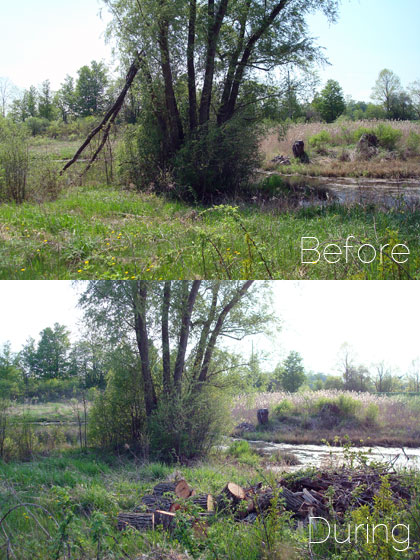
Broken tree branch

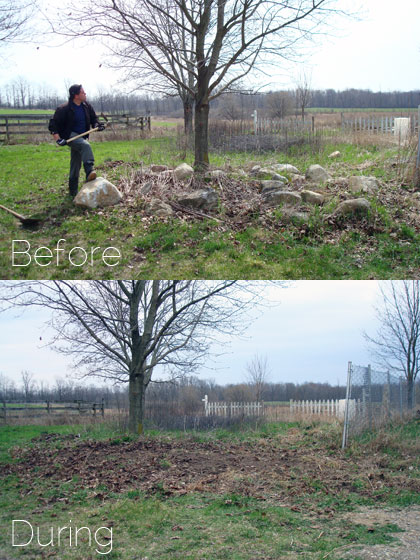
Matt, my Dad and I dismantled one of our biggest rock piles on the property–and it only took us four hours.

Cleaning up a rock pile

I started building a new flower garden around the well head. And this is when I died.
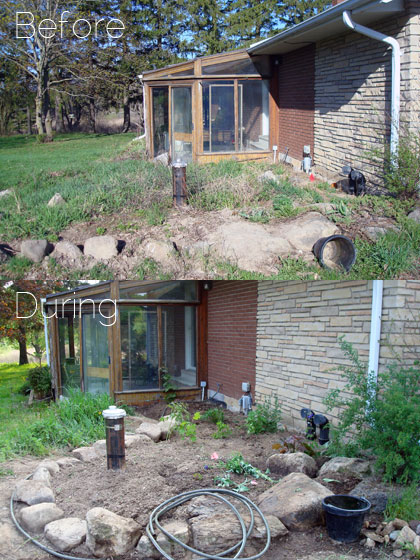
Rock edged flower garden around a well head

Last year’s landscaping efforts were limited to some very cursory grass cutting. The property was unkempt when we bought it, and our neglect over the past year while we focused on the basement reno made it worse.

The amount of work required to bring a garden back after years and years of neglect is never mentioned in the Secret Garden. Sure there’s a bit of pruning and weeding, but mostly it’s romance and roses.

In the category of things get worse before they get better, even our efforts at clean up have led to more mess. Drilling the new well and trenching new waterlines destroyed one established flowerbed and left lumpy piles of very hard dirt in its place. Burning brush and scrap lumber as we’ve tried to pick up around the property resulted a mountain of ash and a half scorched spruce tree.

Landscaping was at the top of the list on my home goals for this year, and I will get a handle on the situation outside, even if it kills me.
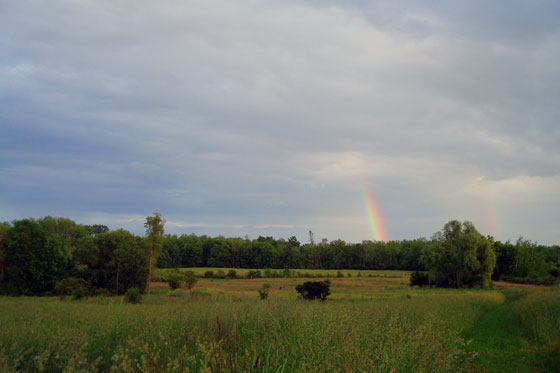
Doe a deer

It’s apparently wild kingdom week here on the blog, and I’ve saved the best for last.

White tailed deer in molt

For the past week or so, deer have been grazing in the back field. They show up every night around 8 o’clock and eat their bed time snack before heading back into the bush.

White tailed deer grazing

Some nights there’s been only one. Usually there’s a group of three or four. The high point was a herd of seven.

We can walk partway along the back lane towards the field without them bolting.  Usually we just watch them with binoculars and try not to spook them.

Fortunately, Matt’s brother, who came to visit last weekend, has a better camera than we do–and is also apparently a bit of a deer whisperer–because he was able to get quite close and get the best pictures so far for us. Thanks, Greg!

“I could be Thor!”

Pop quiz:

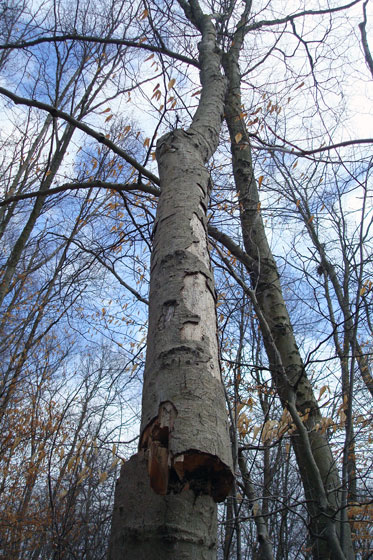
You’re walking in the forest and you see this tree.

Cracked tree leaning against another tree

What do you do?

  1. Marvel over the crack and continue on with the hike. Nature will take care of itself.
  2. Marvel over the crack and make a note to invite your father-in-law over with his chainsaw.
  3. Marvel over the crack and decide that it’s too dangerous to leave and go find a saw to deal with it yourself.
  4. Marvel over the crack. Poke sticks in the crack to try and lever the tree off the stump. Fail. Decide that this tree must come down right this minute. Decide that the best tool will be a sledge hammer. Saw, pshaw.

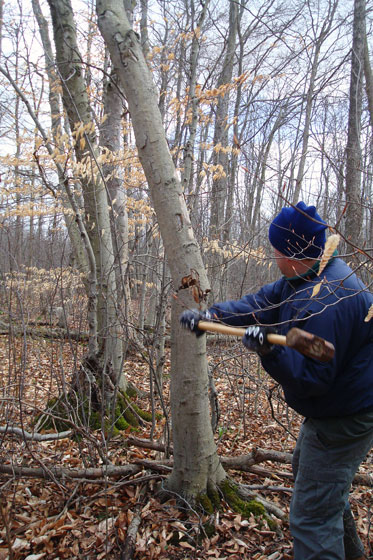
Matt prepares to do battle with a fallen tree with a sledgehammer and wrecking bar

So my answer would probably be ‘B,’ but of course my resident lumberjack saw an opportunity to advance from his most recent experience felling a tree with an ax to be even more manly. The words “I could be Thor!” did in fact come out of his mouth.

Knocking over a tree with a sledgehammer

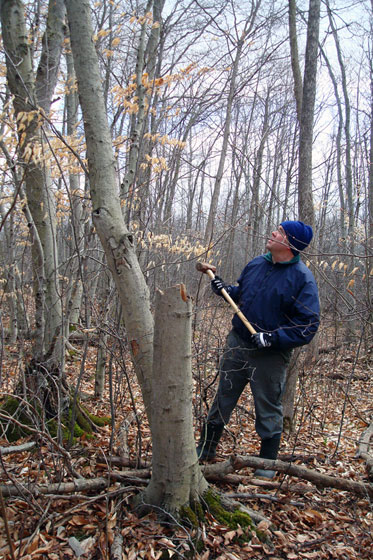
A couple of hard whacks popped the tree off its stump–all while I watched and photographed from a safe distance. However, the tree is still standing more vertical than horizontal, branches tangled in his closest neighbour.

Knocking over a tree with a slegehammer

We are now moving on to plan B.

What would you do? Any idea what made the tree crack like that? We had a big ice storm the other week, so it could have been the weight of the ice, but other trees that came down didn’t crack horizontally across the trunk. Anyone else living with someone who fancies himself a god?

Having a blast

I suspect that the universe is trying to tell me that it’s not yet barbecue season. When I fired up the grill for the first time this year, I had a bit more fire than I expected.

Barbecue dials on fire

Further investigation revealed additional flames around the pipe fittings on the underside.

Propane barbecue fittings on fire

Fortunately, the combustion was confined to fire and nothing actually exploded. Unfortunately, barbecue was not to be on the menu, and we had to rely on indoor appliances to salvage dinner.

Cooking steak and potatoes on the stove

Our barbecue is an old hand-me-down, so it may be time to replace it. However, I don’t like to give in that easily. Do you think it can be fixed? Tightening the fittings or maybe adding some teflon tape is a lot easier and cheaper than buying a new barbecue. Has anyone else had a problem like this? I’m open to advice for repairing barbecues or for grilling steaks. Any suggestions?

Frozen out

Winter isn’t going down easy this year. Spring had made some gains over the last week with four days straight of rain and above zero temperatures. However, today, winter struck back, driving the temperature back down below freezing and turning the rain to ice.

Windblown icicles

Fortunately, Matt and I made it home before the roads got too slippery. Unfortunately, that wasn’t soon enough for our gate, whose padlock was frozen solid. My poor little car was locked out.

Car behind a closed farm gate

Matt and I each keep a bottle of lock de-icer in our cars specifically for this situation. However, smashing the ice that had frozen the chain to the post, chipping at the ice around the lock with my car key and squirting most of my bottle into the keyhole had little effect on the lock.

Frozen padlock and chain

Abandoning my car, I headed off on the long, cold, windy, wet walk to the house. Did I mention it was cold? Fortunately, I’ve learned some things since moving to the country and was already wearing my rubber boots–with my nice suit trousers attractively tucked into the top.

I was able to get into the house much more easily than I was able to get into the property. I changed into warmer clothes, ate some Easter chocolates and contemplated my life while I waited for the kettle to boil.

This new country life I lead sees me outside with the wind blowing the freezing rain nearly horizontal, trotting down the driveway carrying a steaming kettle.

Pouring boiling water over a frozen padlock

It took just a few splashes of hot water to release the lock.

Open padlock

Soon enough I was inside, warm and dry. The lock also got to spend some time in the house warming up and drying out.

Hopefully the padlock recovers and there’s no issue getting into the property tomorrow night–I don’t want any delay in starting my weekend!