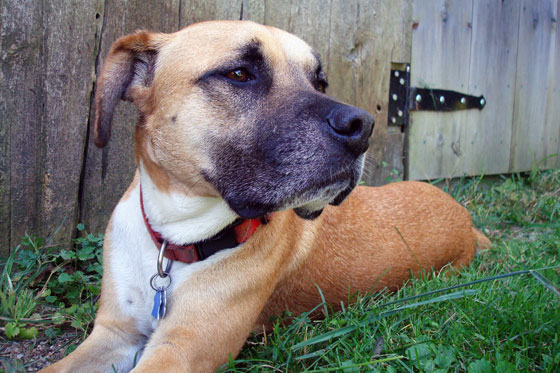
You all heard from Baxter himself earlier this week about what life has been like since he came to live at the farm. Now it’s my turn to talk about his life before and how he came to be ours. (Brace yourself for another long post).
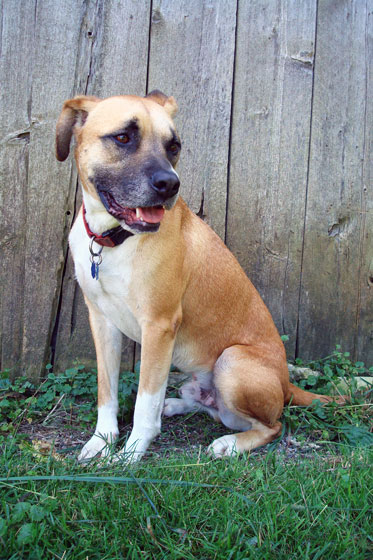
Here’s his story as we were told by the woman who fostered Baxter:
Baxter lived in Kentucky. His neighbour’s chickens started disappearing, and they blamed Baxter. They threatened to sue Baxter’s owners unless they got rid of him. Baxter’s owners also kept chickens, which he never bothered, but his owners got rid of him anyways. They surrendered him to a high kill shelter. I don’t know how long he was there, but when that shelter was over capacity, it put out a call to rescue organizations in the U.S. and Canada asking them to take some of the dogs before they were euthanized. Baxter was one of the dogs who was rescued. Apparently, when dogs are shipped, they usually ride in crates in the back of a truck. Baxter arrived sitting up front beside the driver, which tells you about his good nature.
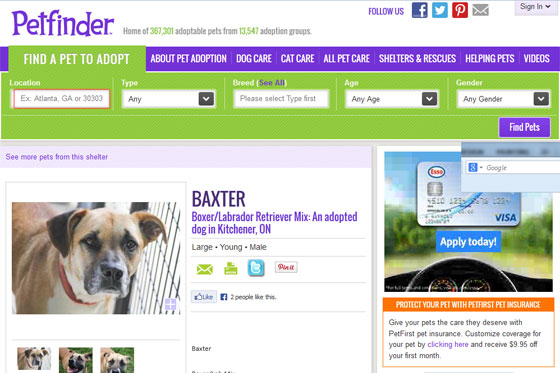
For three weeks, Baxter lived with his foster family, which included other dogs, cats, bunnies and kids. He got along great with everybody. His profile was posted on Petfinder, and that’s where we saw him first.

Matt and I started looking for our dog at the end of June. We went to the local SPCA and Humane Society and didn’t find anyone who was going to be a fit for us. We knew we wanted a rescue dog, but we didn’t want someone who had a whole lot of issues or was super hyper. This is not too much to ask when adopting a rescue dog. There are lots of great dogs out there, so make sure to take your time and find the right one for you. Our biggest debate was on size: I wanted a bigger dog and Matt wanted a smaller one.
Searching online through Petfinder worked really well for us because we could specify what we were looking for. For those that don’t know, rescues and shelters from all over North America post adoptable animals on Petfinder, so in one central place you can see hundreds of dogs (or cats or other animals) who need a home.
When I was looking for Baxter, I never searched by breed or gender. Age (young or adult), size (medium or large–hey it was me doing the searching) and the “my household has” section (cats, kids and dogs–not that we do, but I wanted a dog who was good with all three) were my usual criteria.
When Baxter showed up on my screen, he sounded perfect for us. I emailed the woman who was fostering him, and she wrote me back right away and confirmed that he was easy going and “a really awesome boy.” She encouraged me to submit an application through the rescue, so I did.
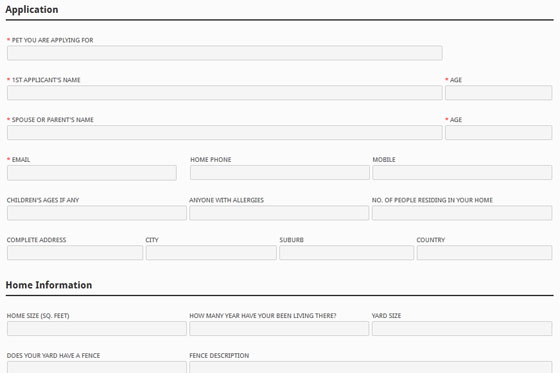
The application process was pretty involved. The form was very long and asked lots of really specific questions: What type of food were we going to feed him? Were we going to take him to a trainer? If so, what was the trainer’s name? Under what situation would I ever get rid of a dog? Why did we want a rescue dog?
I was completely honest on the application, talking about our barn cats, how long we were at work during the day and that we don’t have a fenced yard. Since our application, I’ve read a lot about how many rescue organizations are very strict and won’t adopt dogs to people with outdoor cats or without fenced yards, but I found our rescue organization to be very reasonable, and fortunately my honesty did not result in our disqualification (more on that later).
The rescue also asked for three personal references, contact information for our vet so that they could confirm how we take care of our other animals, a phone interview and a home visit. Not every rescue follows this process. This was simply what ours required. It may seem like a lot of hoops to jump through, but I respect their requirements because I do feel that they wanted what was best for Baxter.
From my initial email to the rescue to completing the preliminary screening took just three days, and then on Saturday, day four, we got word that we’d been declined.
I was extremely upset.
The only red flag that was raised through the whole screening process was the outdoor run that we planned to use for him when we weren’t home. The people at the rescue were adamant that they do not adopt dogs to be outdoor pets, and they were concerned that Baxter could not tolerate cold winter days outside.
I felt like Baxter was the one for us. So I asked to be reconsidered. I promised that Baxter could stay indoors, and we wouldn’t subject him to severe weather. All Saturday afternoon and into the night, I had to stop myself from obsessively refreshing my email–I limited myself to checks every half hour. Sunday morning, we woke up and we still hadn’t heard back. Finally, by late morning, I found a phone number and called the rescue. They had just approved us. There will be follow up visits to make sure Baxter isn’t outside when the weather is inappropriate, but he was going to be ours.
The afternoon was spent again obsessively checking my email, waiting for word from Baxter’s foster family that we could come get him. Finally, late in the afternoon, he was ready. Matt and I hopped in the car immediately.
Our first meeting with Baxter at his foster home was very brief, which in hindsight may not have been the best for determining that we were actually meant for each other. But in that brief meeting he was everything we had been told. We saw him with very little children. We saw him with a very little kitten. We saw him with the family’s other dogs. He met us and was very polite, if a little reserved. He definitely knew something was up. We signed the adoption agreement, handed over our cheque and took all of his paperwork and vet records. The woman who fostered him gave us a box full of food and treats and walked him out to the car. He hopped into the backseat, and he was ours.
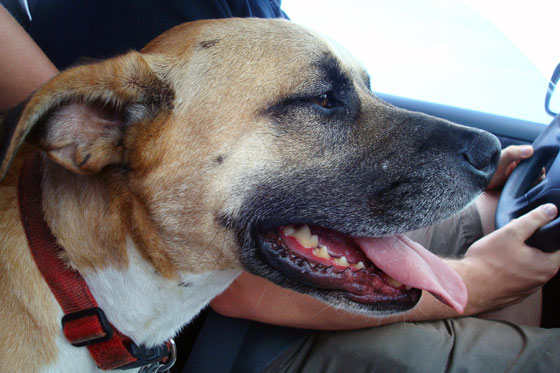
Since then, Baxter has lived up to his easy going reputation for the most part. At home, in the car, on walks, on outings, inside and out, he’s pretty well-behaved. He’s still adjusting and wants to do things his own way sometimes. He’s gotten pretty attached to me, so we’re working on helping him realize he’s okay being on his own. We’re still adjusting too, and I know we’re making some mistakes. I’m sure my desire (obsession) to make this relationship work is contributing to his attachment disorder. We are all working hard together to overcome our issues. I am pretty confident that the three of us are very happy that we found each other–I know the two two-legged ones are.
A couple of notes:
- About chickens: Yes, Matt and I want to get chickens someday. However, that day is probably a few years away still, and I’m not going to pass on Baxter on the chance that he might have issues with chickens. If it turns out that he does, we’ll deal with it then.
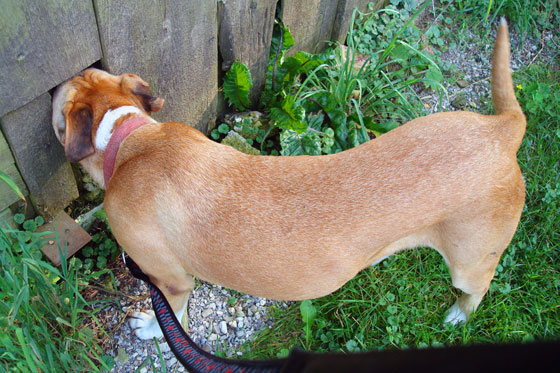
- About the outdoor run: Yes, we are still hoping to use the outdoor run when we’re not home. It’s my opinion that the run is a better place for him than a crate or shut in a room in the house. We’re working slowly with him, making him spend about an hour a day in there by himself so that he can get used to it. He’s turned out to be a very stubborn, dedicated escape artist, so I cannot say he’s used to it yet. The good news, I guess, is that he doesn’t run away once he gets out. He just comes looking for us–the attachment thing again. The run includes a fully insulated dog house, which as the weather gets colder will be filled with straw and have a sturdy flap on the door. If the weather is very severe or the run ends up not working out, we will have a place where he can safely spend the day indoors even if we’re not home, as I committed to the rescue.
During the screening process with the rescue, we were asked a few times why we wanted to adopt a rescue dog. I find that a really difficult question to answer. I can tell you we’re not picky about what breed we have. I can explain why we didn’t want a puppy. I can say that we’re prepared to invest the time that it takes to help Baxter adjust to his new life. I can give you the pat “we feel like we can give a dog a good home” answer. All of those things are true, of course, but I don’t know as they sum up the answer of why adopt a rescue dog? I guess I would say, “Why not?”
Who else has adopted a dog? What was your experience with your shelter or rescue organization? Any tips on helping a dog adjust to his new home? Anyone have advice on dealing with separation issues or training a dog to stay in his kennel (big or small)? Baxter (and Matt and I) appreciate any wisdom you can share.













 Home on 129 Acres