Eco incentive

These days, there are numerous programs where people can access government grants to help make their homes more energy efficient.

When we bought the farm, Matt and I were able to qualify for the ecoEnergy retrofit program through the Government of Canada. Knowing that we had a long list of repairs that we needed to do, including improving the insulation in the house and replacing the furnace and air conditioning system, we were looking for any help we could find.

The ecoEnergy program “provided grants up to $5,000 to help homeowners make their homes more energy-efficient.” Ummm, $5,000 is pretty helpful!

The challenge for us with the ecoEnergy program was that it had a very tight deadline: the end of March 2012. We only took possession of the farm on March 2, so as soon as our offer was accepted in January, we went to work to get things in place to qualify for our grant.

Step 1: Register for the program.

A registration number was required for all steps of the program. Registration was free and easy to do online. By requiring homeowners to register in advance, the government could manage the budget for the program; there was only space for 250,000 homeowners to participate. I registered the farm on Jan. 27. The program reached its cap and stopped accepting registrations the very next day. This was just one of many times where I felt fate was on our side with this property.

Once we had registered, we were in a bit of a holding pattern. While we were able to enroll in the ecoEnergy program before we officially owned the farm, inspections and any actual work had to wait until the deal closed on March 2. But, March 31 was the deadline to complete any upgrades. We would have just 29 days to do all of the work. That meant I spent February finding an inspector to do our pre-retrofit evaluation, getting quotes for our geothermal system and insulation upgrade, hiring contractors and scheduling everything so that we were ready to go as soon as the farm was ours.

Step 2: Pre-retrofit evaluation

Before we did any work, we had to have the house inspected by an inspector licensed by Natural Resources Canada. We chose to go with Energuy. The pre-retrofit inspection was scheduled for 12 noon on March 3, the day we officially took possession.
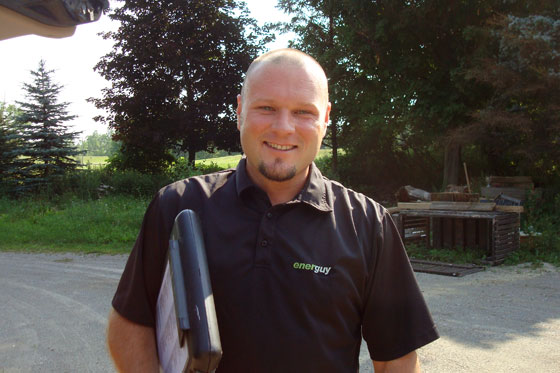
Energuy inspector

Serge, one of our inspectors from Energuy

The inspector looked through the house from the attic to the foundation, documenting the insulation, the furnace and air conditioner, the hot water tank, the windows and the toilets (the areas that were eligible under the terms of the program). With the help of a big fan he put in the front door, he also performed a blower test which showed any air leaks that we had in the house. He also helped us fill out all of the paperwork required by the program.

Blower test for an energy audit

The blower test fan set up in the front door

At the first inspection, our house received a rating of 58 points (out of 100) on the EnerGuide Rating System (ERS) scale. The ERS compares the our home’s efficiency with other similar houses by estimating our annual energy consumption based on our house’s “location, size, mechanical equipment and systems, insulation levels and air tightness.”

According to Energuy, the average rating for a house like ours is 64. So we weren’t too far below the average, but that wasn’t much comfort to this over-achiever.

Step 3: If we wanted to improve our rating, we one option: Do the work

Obviously, the biggest upgrade we were making was the geothermal system. Installation started on March 5 — 26 days left in the program. The attic insulation was upgraded on March 16 — 15 days to go. And then just under the deadline, on March 25, we bought two new low-flow toilets — 6 days to complete install!

Attic hatch

Post upgrade, our energy auditor checks out the new insulation in the attic.

We did one additional upgrade that we weren’t able to squeak in before the March 31 deadline–the spray foam insulation in the basement, which happened at the start of May.

Step 4: Post-retrofit evaluation

The final step in the ecoEnergy program was the final inspection. We had until June 30 to complete this step. Matt and I scheduled our inspection on June 29, as we wanted the basement renovation to be as far along as possible before the inspector came. While none of the work we did in the basement counted towards our grant, sealing the broken windows and insulating the exterior walls all contributed to the overall air-tightness of our house.

Testing for air tightness

During the blower test, the inspector took eight readings at five different pressure points to test how air tight our house is.

Again, the inspector checked the house top to bottom, took pictures of all of our upgrades and did another blower test. We gave him copies of all of our receipts to prove that we completed the work before March 31 and filled out some more paperwork, and then we waited.

And waited.

And waited.

Then, last week, this arrived.

Cheque from the government of Canada

Money coming in, rather than going out!

Yup. We maxed it out. We got the full $5,000 we were eligible for through the program!

The results from our second inspection spell out all of the details.

Remember that the rating from our first inspection was 58. Our first report, which included tips of how to improve our energy efficiency, said, “If you implement all of the recommendations in this report, you could reduce your energy consumption by up to 57 percent and increase your home’s energy efficiency rating to 80 points… and reduce your greenhouse gas emissions [such as CO2] by 9.0 tonnes per year.”

After all of our upgrades, our final ERS was 85. We beat the estimate of how much we could improve our efficiency by 5 points! Even better, we tied the “highest rating achieved by the most energy-efficient houses” in our category.

This over-achiever is satisfied.

The grant is a very nice acknowledgement of the improvements we’ve made to the farm and our commitment to be more energy conscious. The rebates offered by the government are not enough to make someone do repairs just to get the grant, but, for people like us who are planning to do the work anyways, the grant ends up being a nice bonus.

Anyone else out there ever participated in a government grant program? What are you doing to be energy conscious in your home?
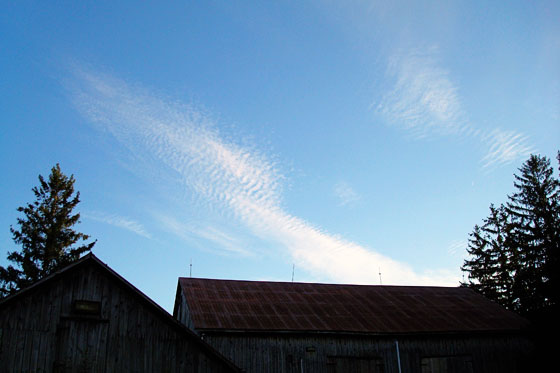
Is there something fishy going on?

What does it mean when my mackerel clouds are shaped like actual fish?

Mackrel clouds

Mackerel clouds over the barn

And seagulls take flight across the sky?

Gulls flying in front of mackrel clouds

Seagulls seem to like farm fields just as much as the seashore

I live on a farm. I feel like I should know these things.

The heat is on

Fall is officially here, and I finally broke down and turned on the heat pump.

Thermostat screen

The temperature has been down as low as 17.5 over the last couple of days. Brrr.

I enjoy sleeping in the cool fall nights. With an extra blanket, I’m nice and cozy under the covers. However, once I’m out from under those covers, the cool fall mornings are uncomfortably nippy.

And now that the temperature is staying fairly cool through the days and evenings too, I was feeling the chill, even with slippers and sweaters.

Duck slippers

Matt’s slippers of choice, the ducks.

I had hoped to make it to Thanksgiving or at least the first of October before we turned on the heat, but we wimped out.

Go, go geothermal!

What about you? Have you turned on the furnace yet? Anyone else out there like their animal slippers?

Taste is more than skin deep

Our beautiful spring blossoms have become slightly gnarly apples.

Apples

Nothing personal, but they’re just not that pretty

The tree appears to be pretty ancient and wild, so I didn’t have high hopes for its fruit. Especially when they turned out all lumpy and dimpled.

However, being the selfless individual that I am, I did pick one for a taste test to satisfy your curiosity.

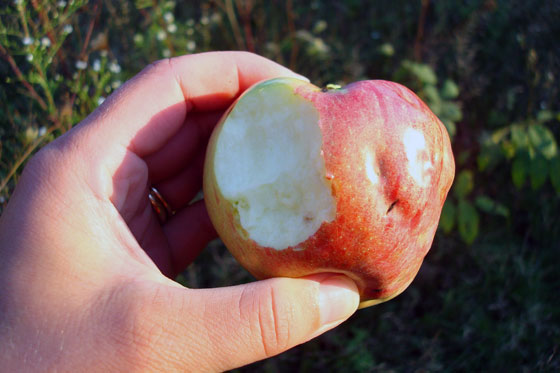
Apple with a bite out of it

First bite of my gnarly apple fresh off the tree

Surprisingly, it was really good. Nice and crisp and sweet. The dimples were just dimples and despite the apple’s appearance the taste did not suffer.

The expression on my face is not reflective of the taste of the apple

The expression on my face is not reflective of the taste of the apple. I think I was still giving photography instructions to Matt at this point. I’m starting to realize why there aren’t more photos of me on this blog. And yes, I did cut my hair, and yes, I am looking exhausted. I think this drywall blitz is starting to wear me out.

Has anyone else gone apple picking yet this fall? What’s your favourite kind?

Morning at the pond

Over just the last 24 hours, there’s been a change in the air. It feels like the cool fall weather has arrived.

Before I officially move on from summer, though, I want to share some photos from a warm sunny morning a few weeks ago.

Pink flowers by a pond

Down by the pond

I’ve said before that the pond is one of my favourite spots on the property.

Early morning as the sun is coming up is one of my favourite times on the property.

On this particular Saturday, I had both the pond and the early morning as I began my Saturday outside with the camera. I couldn’t resist these pretty pink flowers on the shore.

Pink flowers by the pond

Anyone know what these flowers might be?

As we head into fall, I’m already noticing that the foliage is fading and the leaves are becoming sparser around the farm. I now have a better view of the pond from the house, although I can’t see any pink flowers from here.

Is anyone else out there feeling the change in the air? What signs of fall are you seeing? Are you looking forward to fall?

Aliens have landed in the back field

As you can likely appreciate, it’s pretty dark at the farm once the sun goes down. There’s no glow of city lights. The closest street light is about a kilometre away. The stars and the moon are our only light.

So imagine Matt and me arriving home very late one night last week. It’s a moonless night, so it’s pitch black outside. We can see the glow of the cats’ eyes in the headlights… and some very bright lights circling the back field. We’re a wee bit startled.

It turned out that it wasn’t aliens who had flown over the fence and it wasn’t hooligans who had somehow broken in past our newly installed gate. It was our farmer finishing our second hay harvest of the year.

Loading hay bales in the dark

The finished bales are loaded onto the trailer.

For those wondering how he got past the gate, our fields are gated separately and can be accessed from the road.

Owning a farm but not actually farming the land ourselves creates an interesting dynamic. It’s our land, but we don’t manage it ourselves, so sometimes we’re surprised by what happens when we’re not there.

We weren’t sure whether we were going to have a second cut this year because the summer was so dry and the hay was looking very scraggly to my untrained eye. However, apparently there was enough for a harvest because when I came home from work one evening last week I found all of the fields had been mowed.

A couple of days later all of the hay was baled, and by nightfall it was loaded up and trucked away.

So no alien sightings on the farm. At least not yet. We are however keeping our eyes open for crop circles in our freshly mowed fields.

Help! I have hod claw

Matt and I put on a push this week in the basement in an attempt to pick up the pace on the pasting. (I love alliteration, but that’s a lot of ‘p’s even for me). We’ve made a lot of progress, but a side effect of all of this productivity (I just can’t stop!) is that we are both suffering from hod claw.

hod·claw

noun

an uncomfortable contraction of the hand, typically occurring after holding a hod for an extended time

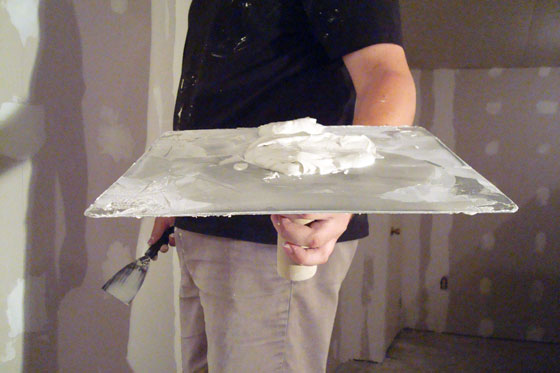
For those that haven’t had the pleasure, a hod is basically a big tray that holds the drywall paste (also known as mud or compound) while you’re working.

After a full evening of working in the basement, uncurling our fingers from our hods is harder than you’d think.

Hod with drywall paste

Matt holding the hod

It’s not that we love drywall and don’t want to stop. The issue is that our hands have seized around the handle of the hod and returning them to their regular dexterity requires much flexing and massaging.

When it comes to drywall, there are a variety of tools people choose to hold their paste. Some work directly from a bucket. Others use a mudpan. I grew up using a hod, so that’s what we use now.

Once I cross the three hour mark of pasting, I don’t think it matters what’s holding my paste. At that point, my hands have cramped. As long as I keep working, I don’t feel it too much. As soon as I set the hod down, though, that’s when I realize how tired my hands are.

Drywalling with a hod

Matt in action

Fortunately, by the next morning, I’ve usually regained most of my range of motion.

Even more fortunately, thanks to our concentrated efforts this week, we’re nearing the end on this pasting odyssey and will soon be setting down our hods. Hopefully, our  hands recover from their case of hod claw shortly thereafter.

Any other DIYers out there who use a hod for drywalling? Have you ever been afflicted with hod claw? Or do you have your own unique DIY injuries?

I’m missing my front-end loader gene

You know when you see those large machines working away, effortlessly moving large piles of dirt, easily scooping massive rocks, bopping along over the roughest terrain? I’ve discovered there’s a lot of skill that goes into this mechanical ballet.

Skills I apparently don’t have.

Wiley’s been getting a workout over the last little while, cutting, hauling, scooping and carrying. He’s a great partner when it comes to managing the property. Me, however? I’m not such a good teammate.

My specific issue is with the front-end loader.

I just do not find the front-end loader intuitive.

I raise when I want to scoop, I dump when I want to raise. It’s all kinds of awkward.

Backfilling a trench with Kioti CS2410

Please ignore the long grass and the basketball net. Landscaping is next year’s project.

The front end loader is controlled by a joystick. Move it up to raise the bucket, down to lower the bucket. Move it to the left and the bucket curls up. Move it right and the bucket tips to dump.

Maybe it’s because I never played video games growing up, but I just can’t master the joystick. I’m forever moving it the wrong way and end up digging the blade into the ground or prematurely dumping my bucket.

We finally got the new waterline trenched into the driveshed last week, and I decided to backfill the trench. While the job did go quicker with Wiley than it would have with a shovel, I was not efficient by any means. Poor Wiley must have been so confused. “Why is she dumping the dirt here when the hole is over there?”

Yeah. It wasn’t pretty.

Every so often I’d hop off the tractor and grab the shovel or the rake to deal with a random pile by hand.

Matt, Mr. I-love-video-games, has no such issues with the loader. Allow him to demonstrate.

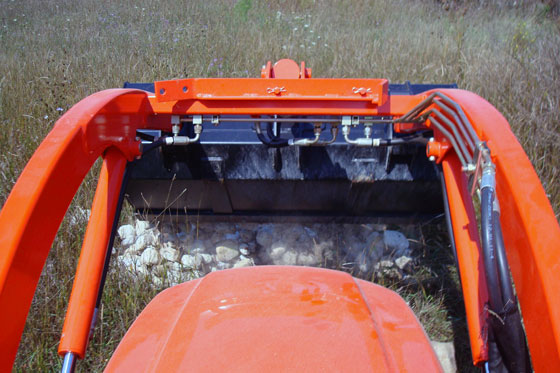
Moving rocks with a front-end loader

This is how you position the bucket to carry a load. This one happens to be one of the many piles of rocks that exist around the property.

Dumping a front-end loader

This is how you dump a load out of the bucket.

So is my lack of front-end loader ability an actual genetic deficiency? Or do you think front-end loader manipulation can be learned? Should I hook up Matt’s old Jump Man game for some joystick practice?

Degree of dustiness

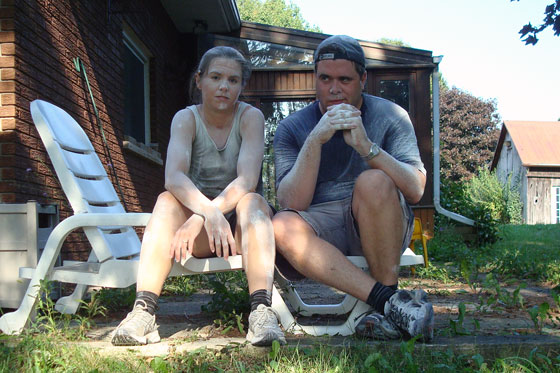
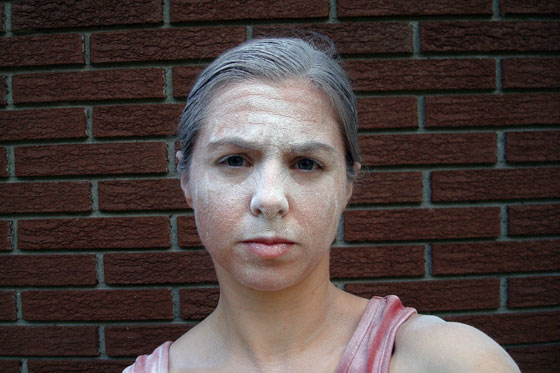
If you zoomed out on Friday’s photo, you would have seen something like this.

Matt and me after sanding drywall

Matt and me after sanding drywall

No, we did not have a baking accident and we’re not 18th century aficionados who powder our hair and faces.

We’re renovators and these days drywall is on the top of the to do list. Actually, it’s probably more the “please can we just get this done already” list, but I’m trying not to sound too desperate.

The photo that I posted on Friday was a thick layer of drywall dust coating Matt’s arm. Even though I teased her at the time, Catherine was actually pretty close with her first guess on last week’s post of “really dry skin.”

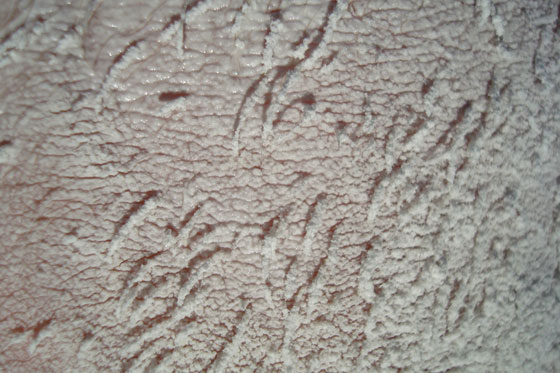
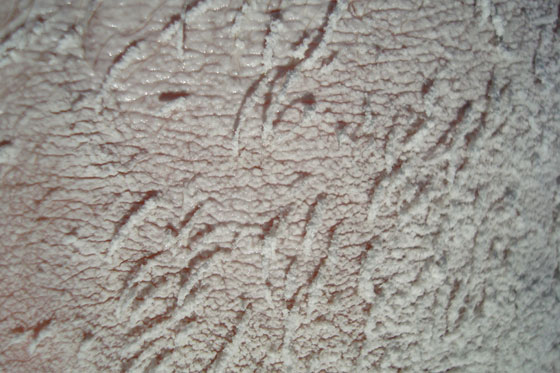
Drywall dust

Skin and arm hair with a heavy dusting of drywall. Yum.

The sanding stage of drywall installation is usually the time I start to reconsider my affection for DIY renovations.

This is a lot of work, and sanding drywall is really not fun work.

  1. Pretty much every single surface in the basement has new drywall or at least a patch of some kind. That means I’m sanding more than I’ve ever sanded in my life. My arm muscles are toned like they’ve never been before, but my nails and fingertips are rubbed off in some places. Ow. And I’m sure the amount of dust that has entered my body through my nose, eyes and mouth can’t be healthy.
  2. We’re not pros, so we’re slow. Therefore, the drywall and sanding stage take a long time.
  3. Even though we’re only working in the basement right now, dust is everywhere. Good news, you can slide around easily on the floors upstairs which makes getting around quick. Bad news, don’t set your black clothes down anywhere, or else you’ll have to choose a new outfit.
  4. We’re not pros, so there tend to be a few more bumps and ridges that we have to sand out… meaning more time, more sore muscles, more dust.

Matt uses the pole sander, but I have never been able to master it. I also feel like I get a better finish by hand. So that means I get up close and personal with every single square centimetre of drywall.

Covered in drywall dust

It’s a good look, wouldn’t you say?

The good news is that the basement is looking really good. We’re at the third (and final) coat of paste pretty much everywhere, and a few spots need only touch-ups.

If we can keep up the momentum, I’m anticipating being covered in paint spatters instead of drywall dust in just a few weeks.

That will be a nice change of style. I’m ready for a makeover.