My pot problem

Hello. My name is Julia. And I have a pot problem.

It’s not what you think. In fact, it’s more like a problem with a pot.

You see, there’s this great window in the basement. It’s large, lets in lots of sunlight and has a great wide windowsill. I wanted to do a little display there. A vignette if you will. One of the features I wanted to include was a potted plant.

All of this was a rather vague idea until at a meeting at work everyone was given a plant. I selected a bright green ivy thinking to myself, “This would be perfect in a bright yellow pot on the windowsill in the basement.”

Never mind that I’m not good with plants, particularly houseplants, and my ability to keep this ivy alive was very much in doubt. I had a vision in my mind. I had to see it come to reality.

Unfortunately, my perfect pot was hard to find. Well, not really. I found it last fall. It was in the garden clearance section at Rona. And it was $12.99. Now I don’t know about you, but that seemed like a high price to pay for a ceramic pot, especially in the clearance section at the end of the season.

I walked away.

I came back every so often to check on it and see if the price had been reduced. I looked at other stores. I examined numerous yellow pots. I considered spray paint. Nothing matched up to the picture in my head.

Finally, this spring, I snapped. I pulled into Rona on my way home from work one evening, strode into the store, picked up my pot and bought it. With tax, it was close to $15. For a ceramic pot. Granted, it was a ceramic pot in the perfect style, of the perfect size, of the perfect shade of yellow.

I stuck my ivy in it and plopped the whole thing onto the windowsill. And it’s perfect. It matches my mental image.

Yellow pot with ivy in it on a windowsill

I still begrudge paying $15 for a pot, but I do admit that seeing the ivy–which somehow is still surviving–makes me happy.

I’ve never consciously “decorated” a house before, so I’m finding it tough to spend money on decorative elements, which seem somewhat frivolous to me. I have no hesitation about pulling out my wallet when it comes to big ticket items like construction supplies or, ahem, pets.

Is it weird that I spent nearly 6 months thinking about a ceramic pot? Do I have a problem? What’s your usual spending threshold for decorative items? How do you justify buying pretty things for your house?

Distractions in thrifting

The other weekend while we were anxiously waiting to see if we’d be approved to adopt Baxter, Matt and I decided to distract ourselves with some retail therapy. He mapped out a route of second hand stores, and we headed out.

It turned out to be a great outing. Wandering the streets, admiring the architecture and the gardens of the historic houses, popping into stores here and there–it was pretty relaxing, even if I was checking my phone every stop for a new email.

And we each came home with a few treasures. Mine was found deep in the back room of a cluttered consignment store.

Old wash tub filled with firewood

It’s been nearly a year since I pinned the Paxton Copper Bucket from Pottery Barn. Since then, I’ve been on the lookout for a metal wash tub to hold firewood in the living room.

This one is huge, and, just like the Paxton, it’s both practical and decorative. The handles have obviously been reattached at some point, but overall it’s in pretty good shape. And for $40, it was a decent price too, in my opinion. Much better than the nearly $260 that PB wants.

I may be jumping ahead a bit, given that we don’t yet have a working fireplace, but that’s a minor detail.

And the addition of our firewood tub has provided me with some motivation. Our mason is coming over tonight to advise us on what it’s going to take to make the fireplace live up to its beautiful new (to us) sidekick.

Are there any fellow thrifters out there? What are you on the hunt for these days? What’s the greatest treasure you’ve found? Anyone else have a wood burning fireplace? Can I say I have one even if it’s not useable? How do you store firewood?

How to match seams across an invisible zipper

I have a different type of how-to for you today, completely unrelated to home improvement or farming (not that I am any particular expert in that area yet).

This how-to is related to the dress that I sewed for my sister’s wedding. The bodice on this dress is made up of lots of pieces with a zipper in the side seam. The challenge when putting in that zipper is to line up all of the seams from front to back.

I’ll admit that the first attempt was a big fat fail. Horizontal seams were stair stepping down the zipper. Not attractive. In fact, I couldn’t even bring myself to take a picture.

Second attempt was much more successful. So, here’s my tutorial on how to line up horizontal seams across an invisible zipper.

Sew the first side of your zipper to the dress, having the zipper open and leaving the other side free.

How to insert an invisible zipper and match horizontal seams

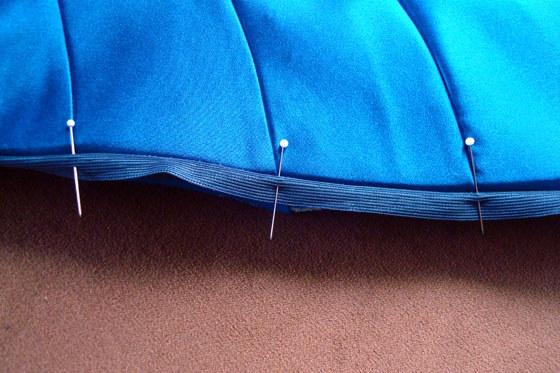
Close the zipper and, using pins, mark the seams that you need to match. Insert the pins horizontally in the tape on the unsewn side of the zipper.

Marching horizontal seams while inserting an invisble zipper

Unzip the zipper, and pin the unsewn side to the dress, starting at each of the seams.

How to insert an invisible zipper and make sure seams line up

Baste the zipper in place and stitch. When you close up the zipper, all of your seams should match.

Marching seams when inserting an invisible zipper

Or at least match close enough.

Next week, I promise a return to our regular program of home improvement and country living. We’re heading into the first long weekend of “summer” and I have big plans. Chainsaws–not sewing machines–are involved.

Hope you have a good weekend. Happy Victoria Day to my fellow Canadians.

Searching for my dream ‘man

Never fear, Matt, you are still the man for me. What the title of this post refers to is my search for the perfect ottoman.

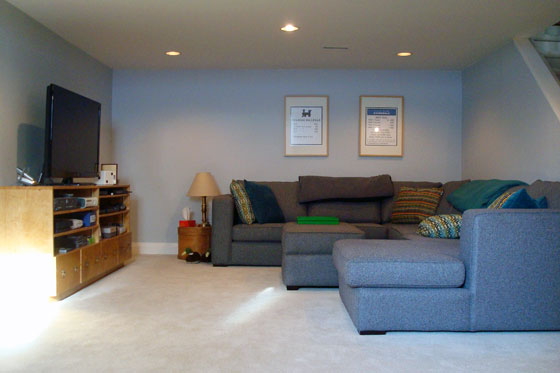
In case it hasn’t been clear, I’m loving our big, beautiful, brand new basement. However, things are a little barren down there. Between the two very large main rooms, we’ve only furnished one corner of one room–the TV area home to the most comfortable sectional ever and my homemade custom TV cabinet.

Our two lone pieces of furniture were both working out great. What wasn’t working so well was the big empty space in the middle of the sectional. We had nowhere to set a glass, a snack or a remote control.

I knew I wanted an ottoman–somewhere soft and cushy for people to put their feet up, something that could serve as extra seating if needed and something that had storage inside.

I was still in the looking around and seeing what’s available stage when we stopped into the store where we’d bought the couch. They offered a large storage ottoman with a hinged top made by the same company that made our sectional, Decor-Rest. I was planning to take it under consideration, but then Matt said the magic words, “Just buy it, woman.”

The guy really wanted a spot to set his drink.

We put in our order, and a few weeks later it arrived.

But now that it’s here, I’m not sure that I love it.

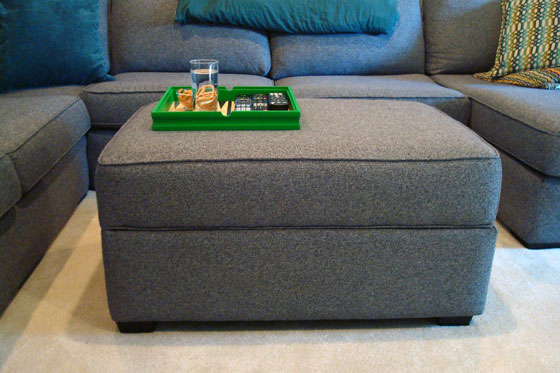
Decor Rest storage ottoman

Faced with placing the order more quickly than I expected, I chose the same fabric that we used on the couch. My original vision had been for a contrasting fabric with a bit more pattern, rather than matchy-matchy.

I didn’t want the same fabric, but I did want the same feet. The feet on the ottoman are in the same finish as the feet on the couch, but they’re narrower and taller than the feet on the couch. I realize this probably isn’t noticeable to most people, but the fact that the ottoman is an inch or so taller than the couch bugs me.

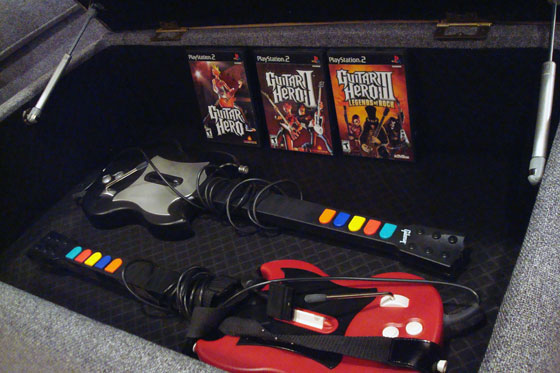
While the ottoman is too tall outside, inside it’s too short–or at least shorter than I expected. The top cushion is very thick, which limits the depth of the storage part. There’s still enough space to put the video game accessories, DVDs, throws or whatever else I decide to hide away, though, and the shallower storage will save me from losing things in the depths of the box, I guess.

Allow Guitar Hero to demonstrate the interior capacity of the storage ottoman.

Guitar Hero games and guitars inside the DecorRest storage ottoman

The biggest thing I’m not sure about is the shape. Back when I was imagining the basement, I had envisioned a square ottoman. This one is rectangle. It is a very large rectangle–36 inches by 28 inches by 20 inches tall–and fits comfortably in the centre of our sectional. And I guess the rectangle gives more breathing space between the ottoman and the TV, which isn’t a bad thing.

I’m not planning on returning the ottoman or reupholstering it any time soon, so it’s not as though our relationship is doomed. It does what I want in terms of storage, seating and providing a soft space to put up your feet. The overall style matches the style of our couch. I may trim the feet a little bit–we’ll see.

Even if the ottoman isn’t my dream ‘man, it accomplishes one other important objective: it gives my two-legged dream man a place to put his drink.

Tray on top of an ottoman

Isn’t there some saying about this situation? Happy husband, happy life? Somehow that doesn’t sound quite right to me. What about you? How do you approach furniture shopping? Have you ever had buyer’s remorse after a big purchase? Are you an ottoman or a coffee table person?

Coming to terms with my crafty side

I don’t consider myself to be a very crafty person. If I’m going to work on something, it’s likely going to involve large power tools, lots of dust, potential of injury and probably take over a whole room. However, as we’ve moved from the construction phase into the decorating phase in the basement, I’ve found myself working on crafts.

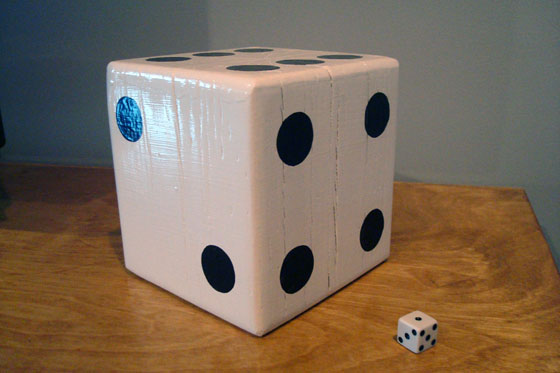
I made a large wooden die, as in singular dice.

Big dice beside a little dice

This was my first crafty project, and I felt really weird doing it. Like it wasn’t worth my time. I did use my skill saw and power sander and kicked up a bit of dust, which made me feel better. But then there was the miniature paint brush and the stencil. What the heck am I doing with a stencil?

The finished die is living on top of our TV cabinet in the basement, serving as a bookend to some classic tomes.

Large dice bookend

If you’re feeling crafty and want to make an oversize wooden dice yourself, here’s a link to my printable stencil. It’s sized for a 6×6 block (so each face is 5 1/2 inches). And if you’re a bit of a fiend about getting the details right, my stencil includes a pattern for the accurate configuration of the faces based on my Yahtzee game.

I also painted a tray.

Painting a backgammon tray

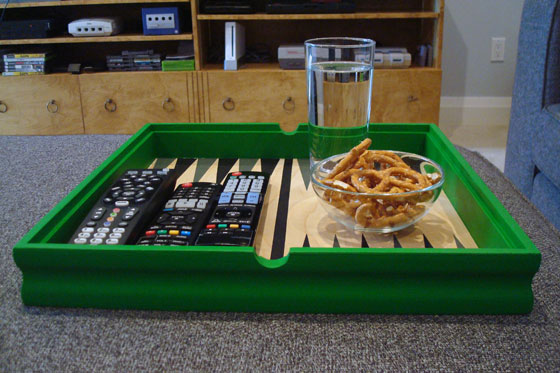
In keeping with the fun and games theme we have happening in the basement, I was planning to make a backgammon inspired tray for the top of the ottoman. When I found one at Value Village, I snapped it up–leaving the glass chess board that sat on top behind at the store.

The blond wood base and black and grey backgammon markings worked well for our decor. The red wood frame did not. A sample pot of Benjamin Moore yellow green perked it up in a hurry.

Tray with backgammon board base

You already saw the umbrella stand that I made for the Pinterest Challenge. I’ve also done some wood cuts–for gifts, so I can’t show them yet. I have plans for some more gifts and more fun and games inspired art for the basement.

It seems like now that I’ve started crafting I can’t stop. I’ll admit there’s something rewarding about working on a project that takes only one evening to complete, but I am starting to feel the need to demolish and rebuild something.

Year one theme: Go big

For me, our first year of farm ownership can be summed up in two words: big and more.

Everything we’ve done, every experience we’ve had has been bigger and more than I expected. It’s been amazing, frustrating, awful, exhausting, expensive, testing, uniting, surprising and wonderful–all to an extreme degree.

As this week is the one year anniversary of the farm becoming ours, I thought it would be a good time to look back at some of what we accomplished and a few of the lessons we learned over the first year. Click here for the two-week and six-month wrap-ups.

We started big, installing the new geothermal system the very first week. The excavation was bigger than if we’d been digging a foundation for a new house.

Geothermal excavation

Upgrading one central system for the house was quickly followed by another, when we decided to redo the entire water system, including a new well.

Our original plan for the basement to patch the walls, move a couple of things around and redo the bathroom quickly grew to a full gut job that involved reframing, rewiring, reinsulatingredrywalling and recarpeting.

Eventually, we did get to painting, furnishing and decorating. We still need art and furniture in most of the basement, but the TV area is done. And it’s awesome. We spend every night here–if we’re not working on one of our other projects, of course.

TV area with sectional couch in the basement

So far, the basement has turned out even better than I envisioned.

The bathroom, which was the most disgusting room in the whole house when we moved in, is now one of the best thanks to new plumbing, marble tile, dramatic dark paint, extra storage, a shower bench and a big mirror. After breaking the concrete floor, running all new waterlines, marathon tiling and grouting sessions and, oh yeah, the snake, we ended up with a bright, clean, shiny, functional and modern space.

Small basement bathroom with white tile and big mirror

While the basement has been our longest project and most dramatic transformation, it wasn’t our most difficult. The hardest project was definitely the roof. Over five days in the middle of the summer with average temperatures around 30ºC, Matt reshingled our house. For him, this project is his proudest accomplishment for year one. For me, this project taught me my most memorable lesson: roofing is not a DIY job.

Half shingled roof

Away from the work and the projects, there’s been a few other big developments in our lives over the past year.

First, the property came with other occupants already living here: most notably, Ralph the barn cat. Sticking with our theme of everything being more than we expect, Ralph kept things interesting by turning out to be both female and pregnant.

Kittens with mother cat

Her four kittens were a fun addition to the farm for the spring.

Kittens

Gratuitous kitten cuteness

Three went on to new homes in suburbia, but one, Easter, stayed on at the farm. Learning that I’m a cat person–as long as they stay outside–has been my most surprising lesson from year one.

Cats on the windowsill

Ralph and Easter pay a visit to the dining room window sill. This is Easter’s “meow–let me in!” face. Ralph knows better.

In addition to our feline family members, our family expanded with the addition of Wiley, our tractor. He’s been quite handy for the various jobs we’ve had to do, from mowing the grass to blowing the snow. Tractor maintenance and how to use the front end loader are lessons we’re still in the process of learning. Lesson from last weekend: a hairdryer can be used to get a tractor to start.

Kioti CS2410

Outside, we’re still learning how to manage a large property. We’ve had the paddocks and run-in shelters removed from all of the fields, added a gate to the driveway, cut down a few trees, put in a flag pole and cleaned up the property a bit. We’ve eaten apples and raspberries from our own land, and watched two hay harvests. We’ve spent hours walking the fields, admiring the pond, hiking the woods and even managed to go tobaganning on our own hill and skating on our own pond.

Walking in the hayfield

When I imagined living on a farm, I envisioned lots of friends and family around, fun parties and big gatherings. This vision has absolutely come true, whether it’s the fun days we’ve spent with nephews, the relaxing nights we’ve had with friends, or big family parties we’ve had for Christmas, Easter and just because. Most rewarding of all, though, has been all of the help our friends and family have given us to make the farm ours over the past year.

Drilling post holes with an auger

We’re still in the process of putting our own stamp on the farm. We know there are more projects and more lessons to come.

Between rural living, a farm, a large property and DIY home renovations, we’ve chosen a somewhat unique lifestyle. And it’s exactly the life for us.

The first year has been more than I ever expected. I’m excited to see what comes next.

Umbrella-ella-ella, the country version

I finally took up the challenge, all in the hopes of resolving a challenging situation that has plagued me for years.

I’m speaking of course of the Pinterest Challenge and umbrella storage–life changing, I know.

Pinterest Challenge

The idea behind the Pinterest Challenge is, in the words of Sherry from Young House Love, to “stop pinning and start doing.”

My (p)inspiration was Karen’s Country Living-inspired basket. Karen posted a great tutorial on her blog, The Art of Doing Stuff, back in the summer that I pinned right away with exactly this project in mind.

I used a few different materials (no peach basket) and changed up the assembly a little bit, but the end result is the same–a rustic, stylish and super functional basket. Perfect for wrangling all of our unruly umbrellas.
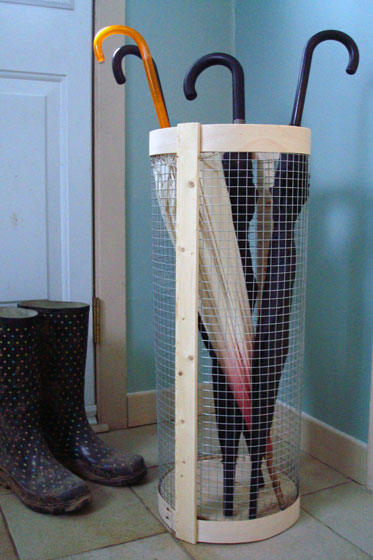
Rustic DIY umbrella stand

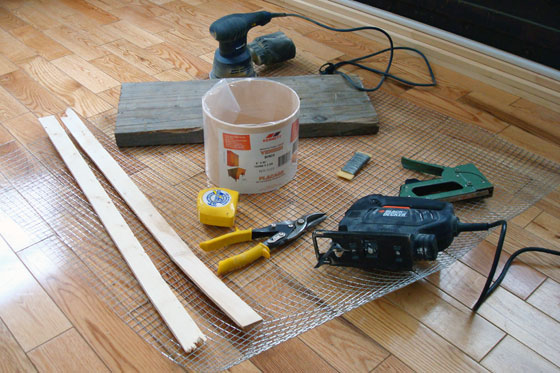
Here is the cast of characters:

Tools and materials for building a rustic umbrella stand

The materials: sturdy wooden board, wire mesh, veneer, wire and wood strips. The tools: sander, jigsaw, staple gun, snips, tape measure. Absent from this shot is a sharp utility knife, a metal ruler or straight-edge of some kind and a glue gun.

I chose a sturdy piece of wood for the base, as I wanted the stand to have some weight so that it would not tip over once it was full of umbrellas. Instead of a peach basket, I used a roll of veneer. The strips are the spacers that are used in big skids of lumber.

That woman in a business suit and heels you saw last week at Home Depot crawling around, stretching to reach under the stacks of lumber? Yeah, that was me. It’s hard to find strips that are long enough as most of them get snapped as people go through the piles, but they were the perfect rough texture for my basket, and best of all they were free.

First step was to make the base. I used a plate as my pattern and cut the circle with my jigsaw.
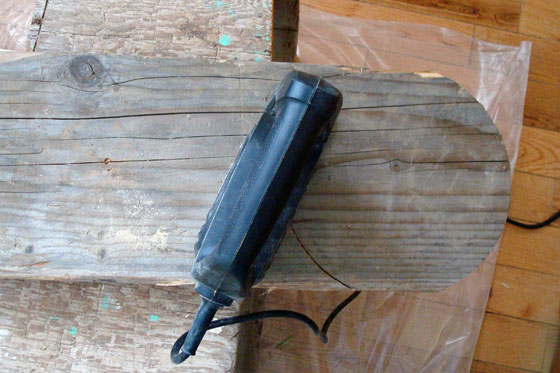
Cutting the circular base with the jigsaw

A few passes with my sander smoothed out the edges and took off the weathered grey outer layer–I wanted a natural wood finish for my basket.
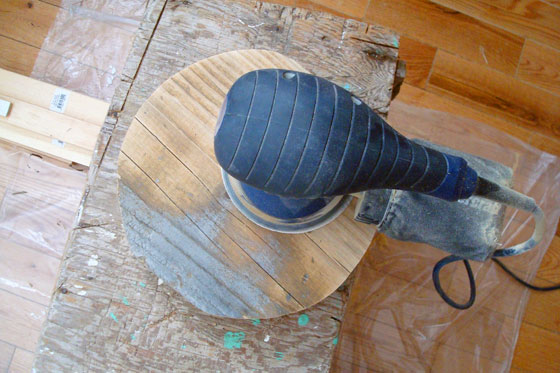
Removing a weathered finish from wood with a sander

I rolled the base in the wire to figure out how long to cut the mesh–very scientific measuring method, I know–and nipped it across with my snips.

Cutting wire mesh with snips

To form the mesh into a cylinder, Karen showed two options in her post: green wire and twine. I chose a fine silver wire that I already had on hand and wound it through each square. It blends in with the mesh perfectly. To deal with the springiness of the mesh, it’s helpful to “tack” it in a few spots with small lengths of wire.
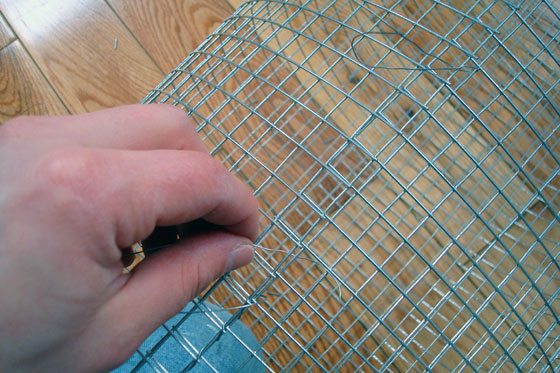
Wiring mesh together into a cylinder

My wire tube was pretty good looking, but to make it a functional umbrella stand, it needed a base. I slid the wood disc into the mesh, lined it up along one of the rows of wire and stapled it in place.
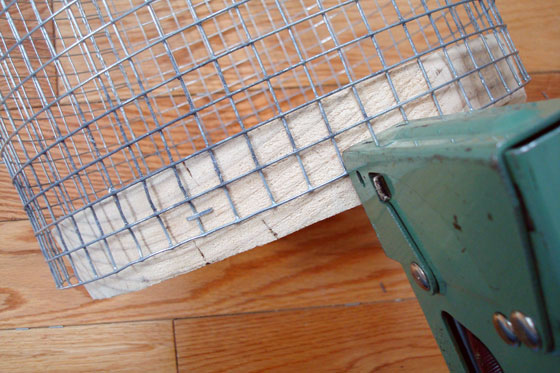
Stapling wire mesh to a wooden base

Now for the finishing touches. To cover up the staples, the raw edge of the base and the end of the mesh, I went to my roll of veneer. The veneer was about 6 inches wide, but I only needed strips that were 1 1/2 inches. This is where a good straight-edge and a sharp knife came in handy. I measured off my strips and then scored the veneer along the edge of my ruler.

Cutting veneer with a ruler and utility knife

The veneer was very thin, so the knife cut through it easily. The only challenge was that the knife wanted to follow the grain of the wood rather than the straight edge, so I had to make sure to keep the knife snug to the side of the ruler as I was cutting.

I had planned to tack the veneer to the basket with a couple of staples or small nails–I figured those would be in keeping with the rustic aesthetic I was going for. It turned out though that the veneer was pretty fragile. It cracked as soon as it was pierced. I returned to Karen’s tutorial and decided a glue gun was the way to go.

However, out of all of the tools that I own, a glue gun was not one of them, so the project was delayed until I could borrow a glue gun from my Mom. Turns out she had an extra from my grandmother that now belongs to me. Who knew Grandma was so crafty?

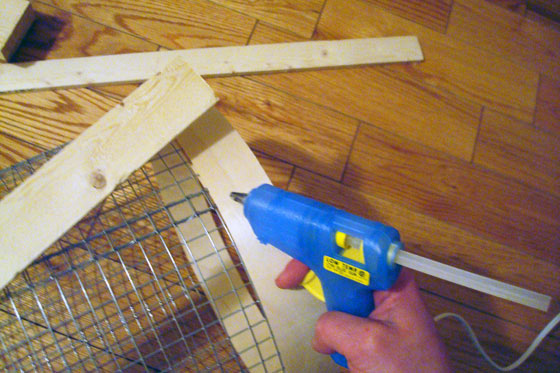
A bunch of daubs of glue around the base attached the veneer to the bottom of the stand. At the top, I sandwiched the mesh between two more strips of veneer and stuck them together with more glue. My edge turned out fairly tidy, so I didn’t apply twine like Karen did.

A couple quick nips with my jigsaw cut two of the lumber yard strips to the right length, and four more daubs of glue had them attached to my basket.

Using a glue gun to stick wood to wire mesh

Sorry for the poor image quality. The sun had set by the time I got to the glue gun stage.

I had forgotten how easy it is to work with a glue gun. It held all of the wood in place really securely and the glue set up really quickly. In no time, I was able to transfer my finished basket to the mudroom and fill it with umbrellas.
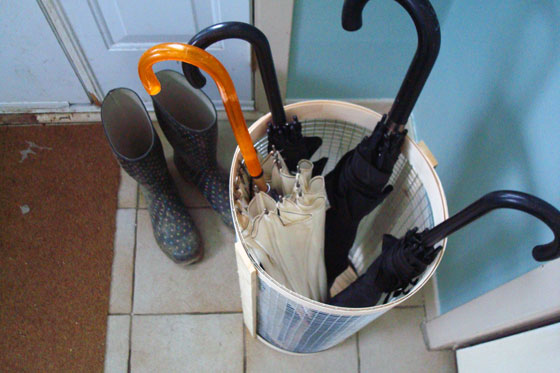
Rustic wood and wire mesh umbrella stand

We do not do cute shiny rubber boots here. They started out cute and colourful, but they are now very muddy.

The basket is perfect. Exactly the right rustic style, and exactly the right size (9 inches in diameter and 25 1/2 inches high, in case anyone is wondering). It easily fits our four umbrellas and could probably handle a couple more. I am quite excited to finally have a place to put them and to no longer have to deal with them flopping out of the closet at me. In fact, every time I walk past the mudroom now, I switch on the light just to look my new umbrella stand sitting tidily in the corner. Yep, I’m a little weird.

Now we just have to finish off the rest of the mudroom. We painted the walls on the weekend, but I still need to tackle the trim (currently painted a flesh-tone, ugh), fit out the closet, refinish the closet doors and build a bench. Right now, the umbrella stand is the best thing in there!

Are there any other Pinterest addicts out there? You can see all of my boards, including the mudroom one, here. Have you been inspired to make anything from Pinterest or participated in the Pinterest Challenge? You can check out all of the projects on Sherry’s, Katie’sMegan’s and Michelle’s blogs. Anyone else have a crafty grandma–or are you a crafty grandma yourself? Does anyone else find umbrellas hard to store?
How to use preglued veneer edging

I’ve posted an addition to this tutorial: How to apply pre-glued veneer on curved edges

Our new TV cabinet that you saw at the beginning of this week is a thing of beauty in my (admittedly biased) opinion. However, this wasn’t always the case.

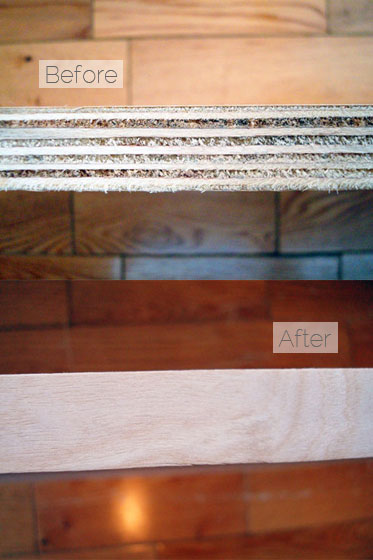
The cabinet is made of 3/4″ pine plywood. It’s paint grade, so the surfaces have a nice smooth finish. However, the raw edges are just that… raw. They’re rough and the layers of plywood are clearly visible. To finish off the edges, I used preglued veneer edging. This edging is very easy to use. Here’s what you do.

1. Gather your tools and materials.

Materials to apply veneer edging

This is a simple job that doesn’t require a lot of technical tools. Clockwise from bottom left, I have my roll of preglued veneer edging, my iron, a scrap 2×4 block, a file and scissors.

2. Set your iron to the cotton setting.

3. Prepare the edging. Use your scissors to cut a section of veneer that’s roughly half an inch longer than the edge you’re going to cover. You don’t have to be precise in your measurements. I just hold the veneer against the cabinet edge to figure out how long the section should be. You can work directly from the coil, but it’s easy for the veneer to get twisted, so I recommend cutting it into lengths first.

4. Starting at one end, carefully position the veneer against the edge that you want to cover.

Iron on veneer edging

The veneer will be slightly wider than the edge that you’re covering. Keep it flush on one end and one side and let it overhang the other.

5. With your edging in position, apply the iron to melt the glue.

Ironing veneer edging

I’ve found a “pressing” technique rather than an “ironing” technique works best. Just hold your iron in one spot for about 20 seconds. When you remove the iron, make sure the veneer is still aligned along the edge of the plywood. The glue will stay soft for only a couple of seconds so adjustments have to be made quickly.

6. Using your block of scrap wood, firmly press the edging onto the plywood.

Pressing veneer edging onto plywood

Press hard and slide the block back and forth over the section that you ironed making sure that the veneer fully adheres to the plywood.

Repeat steps 5 and 6 until the raw edge is completely covered with veneer.

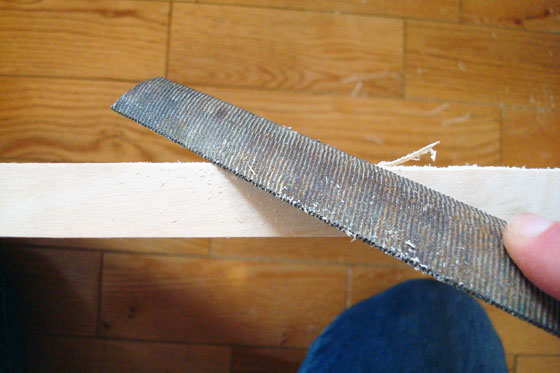
7. Once the veneer has cooled, trim the excess that’s overhanging the one side with a file.

Trimming veneer with a file

File towards the face of your plywood keeping the file at roughly a 45 degree angle. There are tools that will trim the veneer as well, but the file has always worked well for me.

Your edge should now be nice and smooth and ready for stain or paint.

Finishing a plywood edge with oreglued veneer edging

Some tips for using preglued veneer edging:

1. When cutting the veneer with your scissors, try to get a nice 90 degree cut. This will give you a good starting point for your next piece.

2. Check for joints in the veneer before you glue it to your plywood.

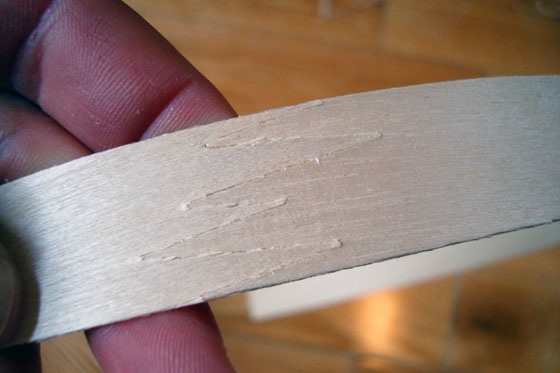
Finger joint in veneer edging

The veneer is connected by finger joints that aren’t the most attractive and wreck the illusion of a solid piece of wood.

3. Don’t skimp on pressing the veneer with your block. You don’t want your veneer to peel off once your cabinet is done. Pay special attention to the edges of the tape to make sure it’s firmly stuck.

4. If you use the file to trim the veneer, clean the file every so often. The sawdust will fill the grooves and make it more difficult to get a clean edge. I just tap the file to knock out the dust.

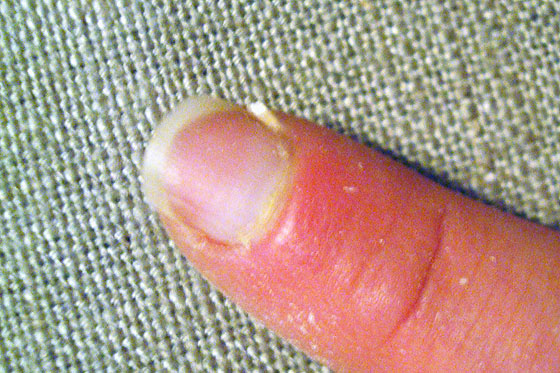
5. Watch out for splinters.

Splinter beside my fingernail

Ouch!

Although iron-on preglued veneer edging can be slightly dangerous for klutzes like me, it is very easy to use. Ironing is one of my least favourite tasks, but for some reason ironing wood is less tedious than ironing clothes for me. Just a little bit of effort results in a very nice polished finished for furniture, shelves or other creations.

Have you used veneer edging before? Who else is not a fan of ironing? Is anyone else susceptible to splinters? I seem to get a few a week. I’m sure a few are in my future this weekend. How about you? Any special projects on tap for the weekend?

I’ve posted an addition to this tutorial: How to apply pre-glued veneer on curved edges

Our $9 TV

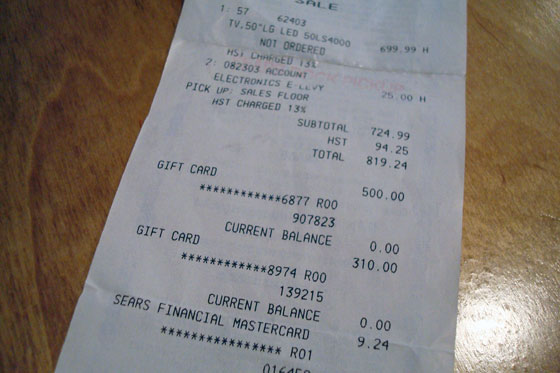
It sounds like an episode of extreme couponing. Customer goes into a store. Cash register rings up a charge of $819.24. Customer opens wallet and pays $9.24.

Well, we’re not extreme couponers, but this is exactly what happened when Matt went to buy the new TV for our basement.

50 inch LG LED TV with DIY network on the screen

You know I had to put DIY Network on the screen for this photo

So how did he do it? It’s all about the points.

For years, Matt has had a Sears Mastercard. He liked it because he could redeem his points for gas or restaurant gift cards. But then everything changed. A couple of years ago, Sears decided that points could only be spent at Sears. We don’t shop at Sears a lot (at all), so Matt’s been building up his point balance for a long time.

Knowing that we wanted a second TV for the basement, Matt decided that this purchase was the chance to finally use his points. He did his research to figure out what TV he wanted. He cashed in his points for a couple of gift cards. He watched for sales. And then it happened.

A 50-inch LED LG TV came on sale. The total price after tax (including Ontario’s special e-tax) came to $819.24. He plunked down $810 in gift cards and charged the rest to his Sears Mastercard.

Bill for a new TV

Depending on how you look at it, the TV cost either $9 or $81,000–the amount of money Matt had to spend to earn all of his points. Buying on points is definitely not a quick process.

I should also say that while Matt and I use our credit cards often, we pay off the balance in full every month, so there are no interest charges and we didn’t go into debt to buy our $9 TV.

Have you ever bought anything on points? Are there any extreme couponers out there? What’s your favourite rewards program for collecting points? What’s the best deal you’ve ever found?

Video game heaven

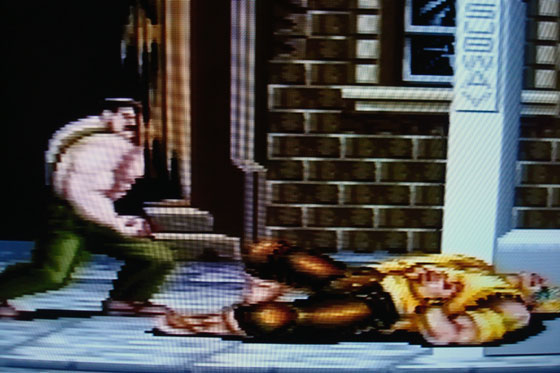
Anybody know what this is a picture of?

Final fight nintendo game

I wouldn’t know what this is except that I live with someone who exposes me to such things. This picture is from Final Fight, a video game for the Super Nintendo.

Rather than asking what the picture is of, however, I should be asking you what it signifies. What this picture means is that Matt finally, for the first time in his life, has all of his video game systems set up at once.

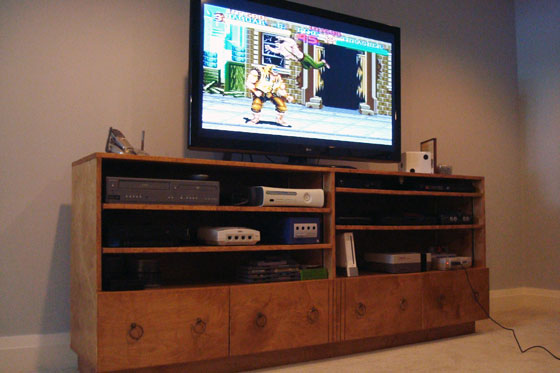
The reason for this momentous occasion is our new TV cabinet.

TV cabinet for vintage video game systems

I’ve never been into video games, but Matt has played his whole life and has built quite a collection. However, it’s always been a case of he would get a new system and the old one would be packed away. On those days when he really wanted to relive his childhood and play his old Sega Master System (the first he ever bought), he was out of luck.

When we were renovating the basement, one of the criteria was to have a good TV area for watching movies and playing games–any game he wanted. So, we needed a TV cabinet.

And the cabinet needed to do a few things:

  • Accommodate all of the equipment: the TV, the satellite receiver, the Blu-Ray player and at least 10 video game systems.
  • Store DVDs and video games.
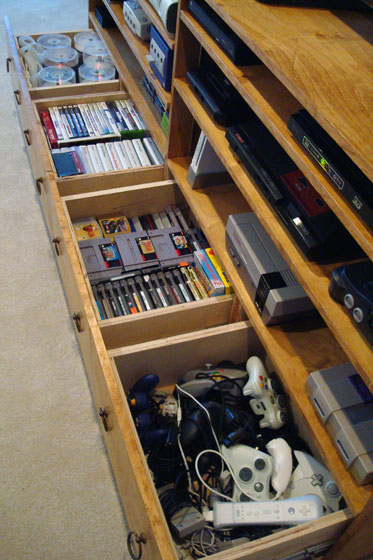
  • Keep all of the controllers, connectors and wires that come with video games handy but out of sight.
  • Keep everything tidy and organized.

I decided my best option was a custom cabinet, so I sketched up a plan, and my Dad and I went to work.

We went with adjustable shelves on the top section and drawers on the bottom. The overall dimensions of the cabinet are 80 inches wide by 16 inches deep by 33 inches high. The top gives us a spot for our phone (we need a land line in the country where cell service is a bit unreliable), our new 50-inch flat screen (more on that later this week) and a little bit of display.

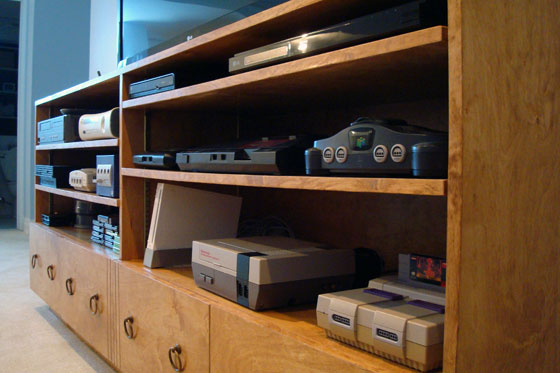
The shelves are dedicated to all of the systems.

Video game systems in a TV cabinet

Matt has set up his XBox 360, PlayStation 2, Sega Dreamcast, Gamecube, Sega Genesis, Sega Master System, Nintendo 64, Wii, original Nintendo, Super Nintendo. Holes drilled in the back of the cabinet allow him to poke the wires through to hook up the systems.

The best part of the cabinet is the drawers.

Drawers in a TV cabinet for video games

There are four nine-inch-deep drawers along the bottom, and they hold DVDs, games and controllers. As we were building the cabinet, I kept increasing the size of the drawers, and I’m so glad that I did. They hold so much and make it so easy to keep everything tidy. It was a big pain to get four drawers perfectly lined up and sliding smoothly, but I can say now that it was worth it to have everything so well organized.

It’s also worth it to see how much Matt enjoys having all of his games at hand.

How many of you recognized the picture at the top of the post? Are there any other video gamers out there like Matt? In addition to Haggar and Cody from Final Fight, our basement has also hosted Link, Zelda and Mario over the past few weeks. What’s your favourite game? Have you ever built a piece of custom furniture? Any tips for constructing drawers? How do you keep video games or electronics organized at your house?