Comatose

No post today. I’m in a tile coma.

Tiled shower

The result of three days of labour

Obviously, I still have to put the seat on the bench and the top on the threshold, take out all of the spacers and grout everything, but the hard part is done.

Finally.

Thank goodness.

Sorry for the brevity today. Full breakdown… project breakdown, not personal sanity (already had my “I’m going crazy” moment at the end of my 12-hour second day)… will come later.

How did you spend your weekend?

William Wallace by way of a wet saw

Saturday morning, Matt’s bathroom looked like this.

Shower with cement board

It’s not just Saturday. The bathroom has looked like this for the past several months while our attention has been on finishing the drywall in the rest of the basement.

By Saturday evening it looked like this.

Tiled bathroom and shower floor

Beautiful tile. Finally progress!

I’ve tiled before, and I actually enjoy doing it. It’s not hard work, but it does require planning.

My Dad and I spent several hours in the morning laying out the shower floor, carefully fitting and figuring. When we finally spread out the mortar, we had a really good idea of how everything should go.

The marble mosaic hexagon tiles that we used on the shower floor are all on a mesh backing that basically makes them into 12×12 tiles. It’s important to  pay close attention when you join the sheets to make sure the gaps between the tiles are consistent. Despite our best efforts, I did still have a bit of difficulty keeping everything perfectly straight all the way across the floor, but I was able to adjust the spacing on the individual hexagons, and I think it will all look okay once it’s grouted.

Here are two lessons I learned about how to work with mosaic tile:

  1. Don’t start with your first sheet tight to the wall. Keep it off an eighth or even a quarter of an inch. This will give you more room to make adjustments on your other sheets as you progress across the floor.
  2. For areas like the drain, remove all of the tiles that come into contact with the drain. Lay your (mostly) full sheet as you usually would, and then insert individual tiles (or pieces of tiles) into the gaps as necessary.

On the main area of the floor we used actual 12×12 tiles, which were a piece of cake to install. The biggest piece of figuring we had to do was determine where the middle of the floor was and then centre our tile along that line.

The only sour bite in our cake was cutting out for the toilet. I know other people have used dremels or other tools to get nice round circles. We used the wet saw, which only cuts in a straight line. With lots of patience, lots of back and forth and even trading off cutting duties between my dad and me, we got the tile cut on the first try.

Tile cut around toilet flange

The cut of the day

It’s not as smooth as it would have been with another tool, but it will all be hidden under the toilet. That works for me.

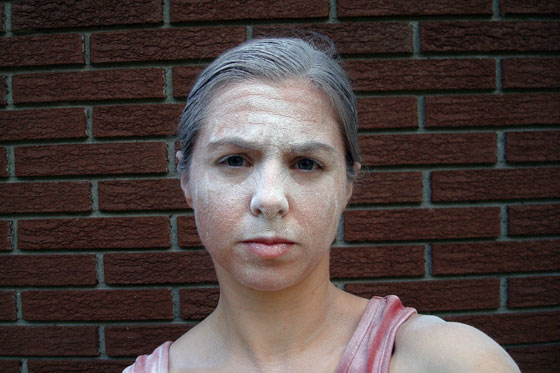
What didn’t work for me was the William Wallace/Gene Simmons makeup I had going on after using the wet saw all day. All of the tile dust mixes with the water from the saw and from my waist to my hairline I had a dusty grey stripe in line with where the saw blade had sprayed me all day long–attractively along only the right side of my face.

Cutting tile on a wet saw

Thank goodness for safety glasses

Next step is grout and then I can move onto the walls. Who knows, someday we might even move on to installing the actual fixtures and using this bathroom.

What’s your tiling experience? Any tips for keeping things straight and even? Or cutting a curved line with a straight saw?

The greatest dilemma of all time

The title of this post may be a little over dramatic. I am not the first to face this conundrum or to wrestle with this question. However, the angst, the uncertainty, the pressure of this choice is well known by many.

What paint colour do I choose?

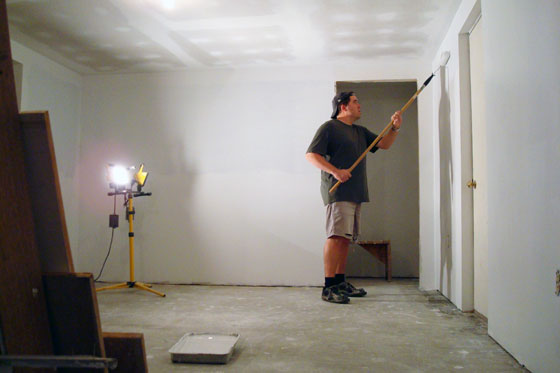
With the conclusion of the drywall phase of the basement, we progress to the painting stage. We (optimistically, as it turned out) bought primer months ago, so last week Matt and I started priming the basement.

Matt priming the long room with the roller

Matt rolls on the primer in the long room

You would think with 5 1/2 months of drywalling (still can’t get over how long it took us), 7 1/2 months of farm ownership, and 9 1/2 months of knowing we were going to be painting the basement, I’d have figured this out by now. But I haven’t.

Most of the time in this project, I was planning on going grey. However, we’re planning on buying a charcoal grey sectional and the carpet will likely have grey tones in it. Painting the walls grey too was starting to seem like a lot. So over the last little while, I started thinking about other options.

The criteria for the colour are

  1. Light – I want the basement to be fairly bright, but, with only one window, pale paint is my best bet.
  2. Neutral – I really don’t want to repaint any time soon, but I may want to redecorate every so often. A neutral colour gives me the option to switch up the other colours in the basement when the mood hits.
  3. Works for the whole area – We have a fairly large basement, and the main room, long room, laundry room, stairwell and hallway are all going to painted the same colour (click here if you need a floor plan refresher).

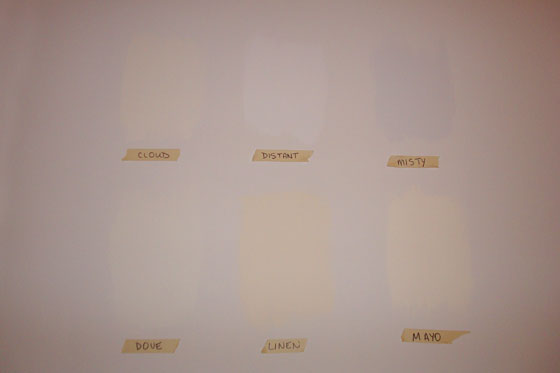
I ended up buying samples of six different colours. Originally, I bought four, but then I didn’t like any of them, so I went back and bought two more.

Off white paint samples

Clockwise from top left: Cloud White, Distant Gray, Misty Gray, Mayonnaise, Linen White, White Dove. (All colours from Benjamin Moore).

This is my first time sampling colours on the actual wall. Usually I just trust my gut and go with a paint chip that I think will work. However, this is also my first time painting my forever house (bathroom aside), so I feel like it matters more that I get this right.

So, in addition to sampling the colours, I am appealing to you for help. What do you think?

Have a favourite colour that’s not covered in my samples? Let me know in the comments what you recommend.

Stick a trowel in me…

… I’m done.

We are calling it on the drywall phase of the basement reno. Five and a half months–in case the text version wasn’t clear, let me translate that into numerals 5 1/2 (or 5.5 for you digitally minded folks) months–after we started drywalling the basement, we are finally finished.

Oh the glamourous life of DIYers.

Lest there’s any additional lack of clarity, the basement reno itself is not finished. Only the drywall stage is done.

Some other things that are done:

  1. Bandaging my fingers for my evening sanding sessions.
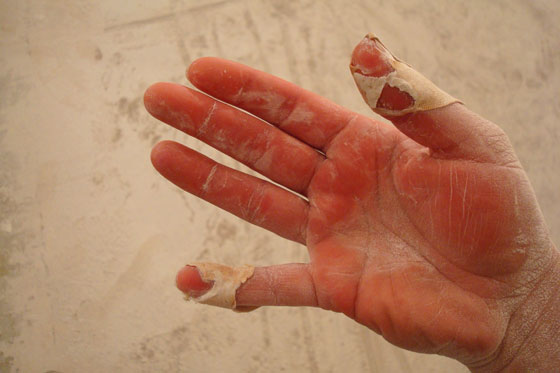
Bandaged fingers

This is what my hands looked like at the end of a night of sanding. The bandages are pretty much worn away.

I built up calluses on my fingers, of course, but calluses can only do so much. It took me two nights of bleeding fingers to learn my lesson. (Point in my favour: the nights were not consecutive. I’m not that dumb). Before the second incident, I thought my fingers were sufficiently toughened from the first incident to not require protection. I learned that no matter how leathery and rough I think my hands are, I can apparently always do more damage.

Good news is I would make a good spy these days, as my fingerprints are sanded off.

  1. Also done is Matt’s nightly decoding dilemmas as he tries to interpret the pasting instructions I draw on the drywall.
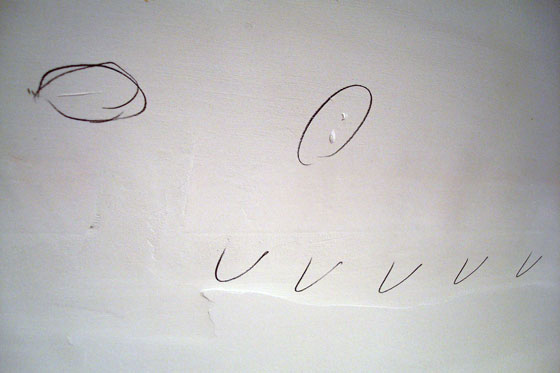
Pencil markings

The two circles highlight a scratch and some divots that need to be filled. The U and V markings are supposed to be arrows that point out a ridge that needs to be feathered out with paste.

The division of labour when it came to drywall was I sand, Matt pastes. As I work, I keep a pencil behind my ear, so that I can mark spots that need particular attention.

Additional symbols in my drywall lexicon include lines and once in awhile actual words–that usually still require translation.

  1. The biggest change that will result from concluding drywall work will be no more drywall dust throughout the house.
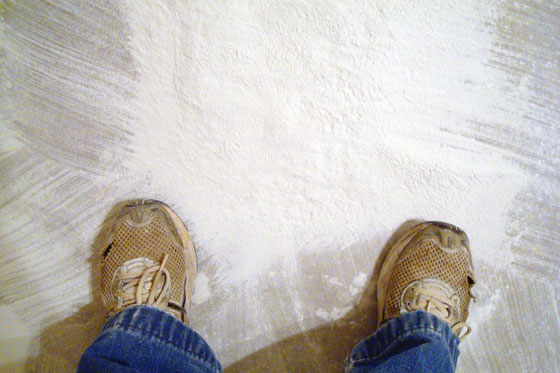
Pile of drywall dust

The partially swept office floor (and yes, I know my work shoes are looking a little worn).

In the basement, the dust was so deep that dunes were starting to form. It took Matt and me a full afternoon to wipe down the walls and ceilings, sweep up the worst of the dust and then vacuum the remaining powder.

Upstairs is also covered in a fine skim of dust, although we haven’t done a deep clean there yet. We have to keep up our glamourous DIY lifestyle, after all.

Starting out on this project, I never dreamed that drywall would take us nearly half a year (ouch, that sounds like a really, really long time). My only excuse is that we ended up having to redo a huge area–pretty much the whole basement, we didn’t work on it religiously every single day and we’re not professional, so we’re slow.

The finish is definitely not perfect, but I’m satisfied with how it turned out, and I’m really happy that Matt and I were able to tackle such a big project together by ourselves (with help from my Dad, of course. Thanks, Dad!).

And now, in the way of DIY, concluding one stage of the project means it’s now on to the next. Painting here we come!

What’s on your agenda for this weekend?

Staking our claim

When European explorers first landed in the new world (including Canada), it was customary for them to plant their flag as a symbol of ownership.

I think this latest development means the farm is officially ours.

Canadian flag on a flag pole

Please ignore the overgrown mess that is the turnaround. Past owners dumped heaps of dirt and rubble here that made mowing impossible. Landscaping is next year’s project.

This project also means that Matt and I have officially started in on the fall to-do list. Planting the flag pole was #11.

I had bought the pole second hand on kijiji back at the end of June with the idea that we might be able to install it for Canada Day (July 1). That didn’t happen.

We drilled a hole for the pole back in August when we had the auger, and I tried to convince Matt that installing the flag pole would be a good birthday present for me at the end of September. That didn’t happen.

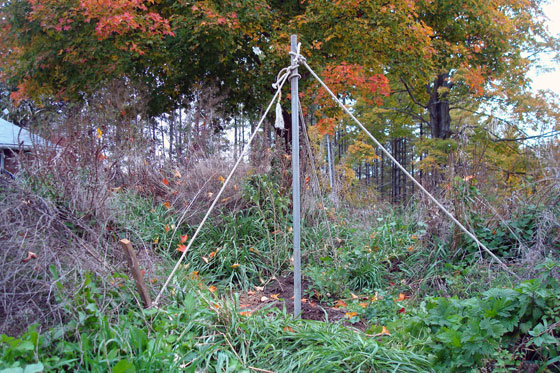
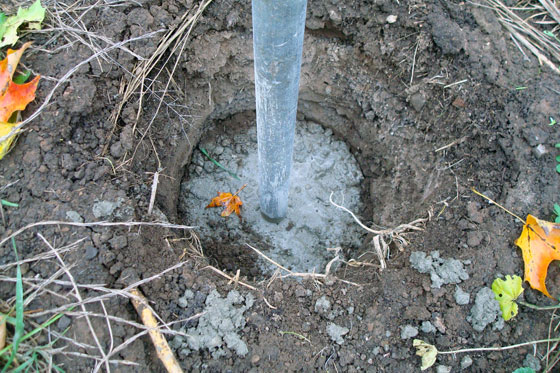
Finally on Sunday morning, we dragged out the wheelbarrow and a bag of concrete and made it happen. It took all of a half hour to mix the concrete, place the pole in the hole and pack the cement around it.

The hardest part was making sure the pole was plumb and holding it in place with ropes and stakes.

Flagpole braced with ropes

Our mini-circus tent… or the bottom third of the flag pole braced in place while the concrete sets.

Our flag pole came in three pieces, so it was very easy to wrangle one 7 foot piece into place, rather than a long 20 foot pole.

By Monday (I love long weekends by the way–we get so much accomplished) the concrete was set.

Flag pole in concrete

Set, secure and straight!

While Matt and his dad were working in the back bush clearing the trails, I went to work wrangling the rest of the pole into place. If you’re ever looking for a laugh, watch a 5’4″ woman staggering around with a 12 foot flag pole–to which she has already attached the halyard (or rope)–trying to keep it perfectly vertical so she can set it in place on top of another pole that’s as tall as she is. It took two tries, and the cats were absolutely no help.

Once the pole was fully assembled, it was a simple matter of attaching the clips to my rope and hoisting the flag.

Matt’s comment when he returned from the bush and saw the flag was, “I think we just improved this property more than any other owners. Except for maybe the guy who built the barn.”

So yes, we are both ridiculously happy to be flying the flag at the farm. Sometimes it’s the simple things.

Help! I have hod claw

Matt and I put on a push this week in the basement in an attempt to pick up the pace on the pasting. (I love alliteration, but that’s a lot of ‘p’s even for me). We’ve made a lot of progress, but a side effect of all of this productivity (I just can’t stop!) is that we are both suffering from hod claw.

hod·claw

noun

an uncomfortable contraction of the hand, typically occurring after holding a hod for an extended time

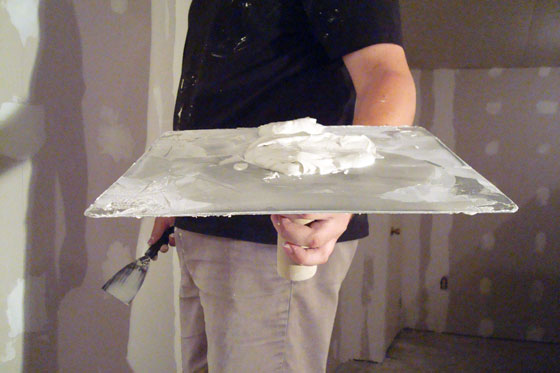
For those that haven’t had the pleasure, a hod is basically a big tray that holds the drywall paste (also known as mud or compound) while you’re working.

After a full evening of working in the basement, uncurling our fingers from our hods is harder than you’d think.

Hod with drywall paste

Matt holding the hod

It’s not that we love drywall and don’t want to stop. The issue is that our hands have seized around the handle of the hod and returning them to their regular dexterity requires much flexing and massaging.

When it comes to drywall, there are a variety of tools people choose to hold their paste. Some work directly from a bucket. Others use a mudpan. I grew up using a hod, so that’s what we use now.

Once I cross the three hour mark of pasting, I don’t think it matters what’s holding my paste. At that point, my hands have cramped. As long as I keep working, I don’t feel it too much. As soon as I set the hod down, though, that’s when I realize how tired my hands are.

Drywalling with a hod

Matt in action

Fortunately, by the next morning, I’ve usually regained most of my range of motion.

Even more fortunately, thanks to our concentrated efforts this week, we’re nearing the end on this pasting odyssey and will soon be setting down our hods. Hopefully, our  hands recover from their case of hod claw shortly thereafter.

Any other DIYers out there who use a hod for drywalling? Have you ever been afflicted with hod claw? Or do you have your own unique DIY injuries?

Degree of dustiness

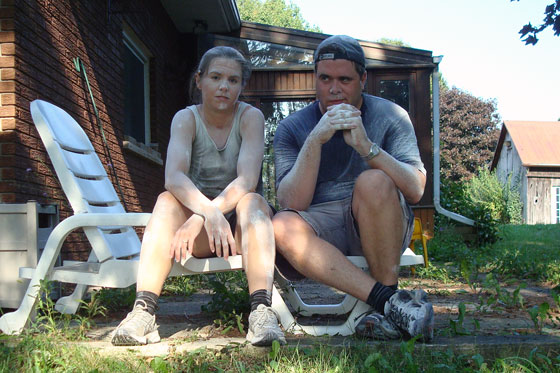
If you zoomed out on Friday’s photo, you would have seen something like this.

Matt and me after sanding drywall

Matt and me after sanding drywall

No, we did not have a baking accident and we’re not 18th century aficionados who powder our hair and faces.

We’re renovators and these days drywall is on the top of the to do list. Actually, it’s probably more the “please can we just get this done already” list, but I’m trying not to sound too desperate.

The photo that I posted on Friday was a thick layer of drywall dust coating Matt’s arm. Even though I teased her at the time, Catherine was actually pretty close with her first guess on last week’s post of “really dry skin.”

Drywall dust

Skin and arm hair with a heavy dusting of drywall. Yum.

The sanding stage of drywall installation is usually the time I start to reconsider my affection for DIY renovations.

This is a lot of work, and sanding drywall is really not fun work.

  1. Pretty much every single surface in the basement has new drywall or at least a patch of some kind. That means I’m sanding more than I’ve ever sanded in my life. My arm muscles are toned like they’ve never been before, but my nails and fingertips are rubbed off in some places. Ow. And I’m sure the amount of dust that has entered my body through my nose, eyes and mouth can’t be healthy.
  2. We’re not pros, so we’re slow. Therefore, the drywall and sanding stage take a long time.
  3. Even though we’re only working in the basement right now, dust is everywhere. Good news, you can slide around easily on the floors upstairs which makes getting around quick. Bad news, don’t set your black clothes down anywhere, or else you’ll have to choose a new outfit.
  4. We’re not pros, so there tend to be a few more bumps and ridges that we have to sand out… meaning more time, more sore muscles, more dust.

Matt uses the pole sander, but I have never been able to master it. I also feel like I get a better finish by hand. So that means I get up close and personal with every single square centimetre of drywall.

Covered in drywall dust

It’s a good look, wouldn’t you say?

The good news is that the basement is looking really good. We’re at the third (and final) coat of paste pretty much everywhere, and a few spots need only touch-ups.

If we can keep up the momentum, I’m anticipating being covered in paint spatters instead of drywall dust in just a few weeks.

That will be a nice change of style. I’m ready for a makeover.

I live in a gated community

It’s a very exclusive enclave we have here in the country.

Population: 2 (plus 1 cat and 1 kitten)

With our new gate in place at the bottom of the driveway, farm living has become quite chi-chi.

Gate at the bottom of the driveway

Open sesame

Actually, setting aside my new pretensions, we installed the gate for security. We’re far enough from civilization that neighbours or police really wouldn’t be much help to us in the event of a break in. If we’re home we can keep an eye on things, but when we’re not the gate may just be enough of a deterrent to people who are thinking about trespassing.

I’ll admit that I was initially pretty resistant to having a gate. I don’t like the way they look, and I didn’t want the inconvenience of opening and closing it when I was coming and going.

However, I actually like the way our gate ended up looking. It’s still a bit of a pain to stop, open the gate, drive through, park and close the gate when you’re leaving or arriving, but it’s a small price to pay for feeling secure about our house.

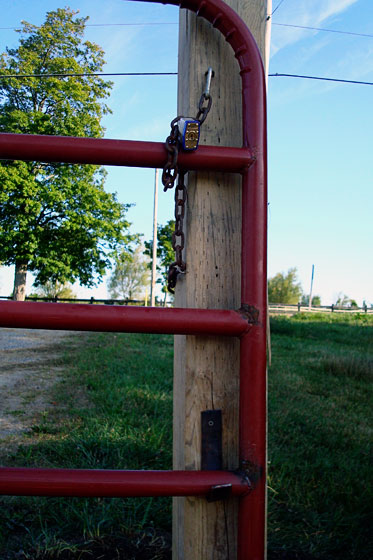
It’s a simple set up: just a chain and a padlock

Padlocked gate

If you want in, you have to have the key

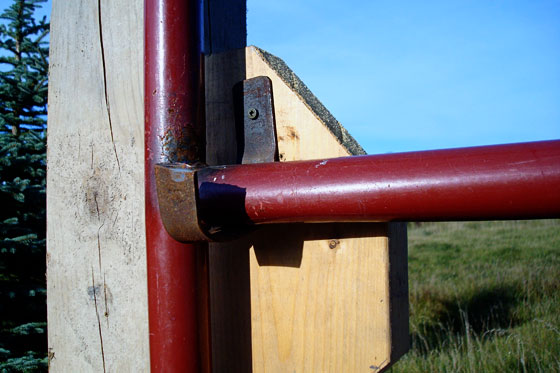
My Dad and Matt made some metal hooks to support the gate when it’s closed and when it’s propped open.

Large metal hook

The hook supports the gate to ease the weight on the hinges and also secures the gate in place.

We do like having visitors at the farm–at least from people we know. So if you’re planning on dropping by, let us know, and we’ll open the gate for you!

Open gate

Welcome to the farm

Anyone out there live in an actual gated community? How do you deal with security at your house?

See my earlier post for the story of setting the posts for the gate.

Six month review

Some days, it seems like we’ve always been here at the farm. Others, it still seems unreal that all of this is ours. However, it is true that this is our new life. In fact, Sunday was our 6-month anniversary of farm ownership.

Looking over the hayfield towards the barn

My backyard

I thought it might be interesting to look back and see what we’ve accomplished so far:

  1. Energy Audit, both the initial inspection and the post-retrofit review
  2. Install new geothermal heating/cooling/hot water system
  3. Have all of the ducts cleaned
  4. Drill a new well and install completely new pumping and treatment systems
  5. Buy and install new washer, dryer, dishwasher, fridge. We were also given a new-to-us stove, so all of the appliances have now been replaced.
  6. Upgrade the insulation in the attic
  7. Remove woodstove from the basement
  8. Brick up two old windows and woodstove chimney hole in basement
  9. Reframe all of the exterior walls in the basement
  10. Rewire the basement and do minor electrical upgrades upstairs in the house like a new exhaust fan in the bathroom and a dimmer switch in the bedroom
  11. Reinsulate the basement with spray foam
  12. Install new drywall throughout the basement (pasting still in progress)
  13. Reframe and replumb basement bathroom and install new toilet in upstairs bathroom
  14. Choose tile for basement bathroom (we’ve taken delivery and just need to get moving on installation)
  15. Paint basement bathroom
  16. Reroof the house… I feel like this point should somehow be bigger to show the magnitude of this job
  17. Recover the chair seats of our newly refinished dining room set
  18. Cut down a huge tree that had a split in it and was dangerously close to the house (and cut and split all the wood)
  19. Find homes for three kittens, adopt one kitten ourselves… oh, and have Ralph spayed
  20. Get internet service
  21. Get telephone service
  22. Get satellite TV
  23. Remove the old TV aerial
  24. Make numerous repairs to the barn, including adding a door where there was just a door-sized hole, relocating another door, rehanging a third large sliding door, installing locks, fixing the broken staircase, installing lighting and plugs on the main floor, cleaning out many, many piles of garbage, scrap wood and bales and bales of loose straw
  25. Rehang the driveshed door so that it will now close
  26. Buy a tractor
  27. Install a gate on the driveway
  28. Sell the paddocks fencing, gates and run-in shelters (removal still in progress)
  29. Watch our first hay harvest
  30. Trench new waterline to the driveshed
  31. Clean out and clean up the house and property
  32. Move in (we’re waiting to finish the basement before we completely unpack)

We’ve had a lot of help over the past six months mainly from my Dad and Matt’s Dad. We also hired professional help for several of the jobs listed above, so it has not all been DIY.

It’s been a lot of work and at times I’ve been frustrated that we don’t seem to be accomplishing more. The to-do list is still very long, even if I just look at what we want to complete over the next six months. Looking back at what we’ve accomplished makes me realize that we have done a lot over the last half-year.

In the review that I posted when we were two weeks into farm ownership, I wrote:

This is definitely where I want to be. I feel very privileged that we were able to make this happen and that we’ve found the property for us. It’s very special. Tiring and a lot of work, but still special.

This statement still completely reflects my state of mind. We are so happy to be here, working together to build our forever house.

The dark side

I may be getting ahead of myself, but the other night I did this.

Paint brush and can of paint

Work continues on the drywall in the basement, but we’re all done in the bathroom. So before I put the tile on the walls, I decided to put on some paint.

Yes, I should be sanding and pasting, but it’s so much easier to open a can of paint and brush it around a small room. Never underestimate the power of instant gratification when it comes to renovations.

In fact, I was so pleased, I may not have stopped with just the prime.

Benjamin Moore Wrought Iron

I decided to go really dark with Matt’s bathroom. It’s a pretty small room, and there are no windows, so my first instinct was to choose a really light paint. However, between the built-in shelving, tile and a big mirror, only one wall is going to be painted. Therefore, there’s room for some drama. Plus, everything else is going to be white or mirrored, so there will likely be enough lightness that the room doesn’t feel like it’s closing in on you.

The colour I chose is Wrought Iron from Benjamin Moore. It’s a really dark grey that reads as black at times.

I’m hoping that it will play well with the grey tones in the tile.

And that’s another benefit of painting at this point in the project: no spatters or drips on our beautiful new tile.

This is my first time choosing a paint colour this dark, and so far I’m loving how it looks. If it turns out that I don’t love it later on, it’s simple enough to repaint one little wall.

Anyone else a fan of the dark side? What are your tricks for dealing with a small window-less room?