Umbrella-ella-ella, the country version

I finally took up the challenge, all in the hopes of resolving a challenging situation that has plagued me for years.

I’m speaking of course of the Pinterest Challenge and umbrella storage–life changing, I know.

Pinterest Challenge

The idea behind the Pinterest Challenge is, in the words of Sherry from Young House Love, to “stop pinning and start doing.”

My (p)inspiration was Karen’s Country Living-inspired basket. Karen posted a great tutorial on her blog, The Art of Doing Stuff, back in the summer that I pinned right away with exactly this project in mind.

I used a few different materials (no peach basket) and changed up the assembly a little bit, but the end result is the same–a rustic, stylish and super functional basket. Perfect for wrangling all of our unruly umbrellas.

Rustic DIY umbrella stand

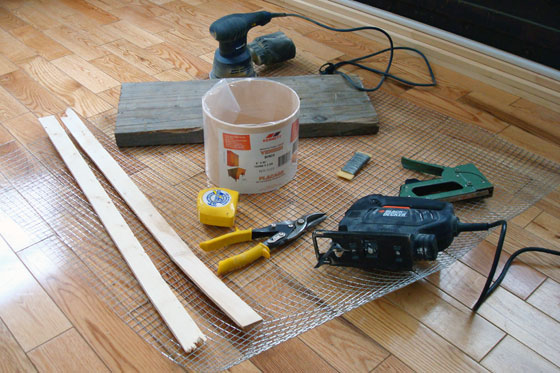
Here is the cast of characters:

Tools and materials for building a rustic umbrella stand

The materials: sturdy wooden board, wire mesh, veneer, wire and wood strips. The tools: sander, jigsaw, staple gun, snips, tape measure. Absent from this shot is a sharp utility knife, a metal ruler or straight-edge of some kind and a glue gun.

I chose a sturdy piece of wood for the base, as I wanted the stand to have some weight so that it would not tip over once it was full of umbrellas. Instead of a peach basket, I used a roll of veneer. The strips are the spacers that are used in big skids of lumber.
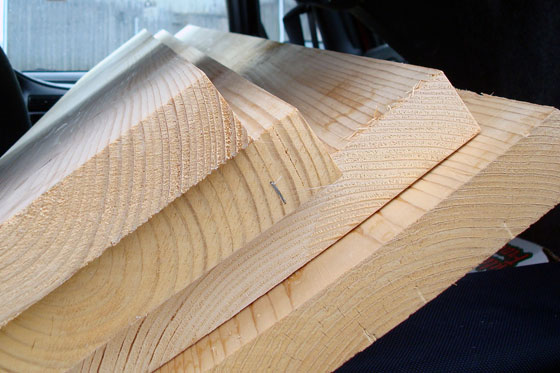
That woman in a business suit and heels you saw last week at Home Depot crawling around, stretching to reach under the stacks of lumber? Yeah, that was me. It’s hard to find strips that are long enough as most of them get snapped as people go through the piles, but they were the perfect rough texture for my basket, and best of all they were free.

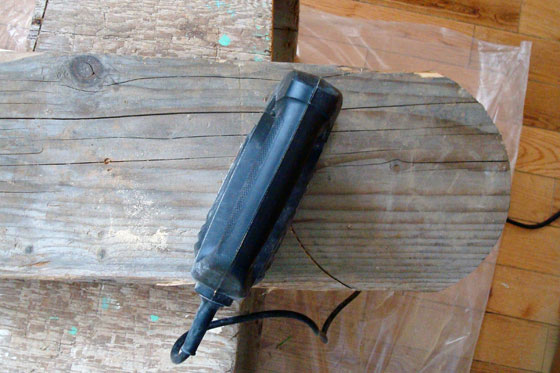
First step was to make the base. I used a plate as my pattern and cut the circle with my jigsaw.

Cutting the circular base with the jigsaw

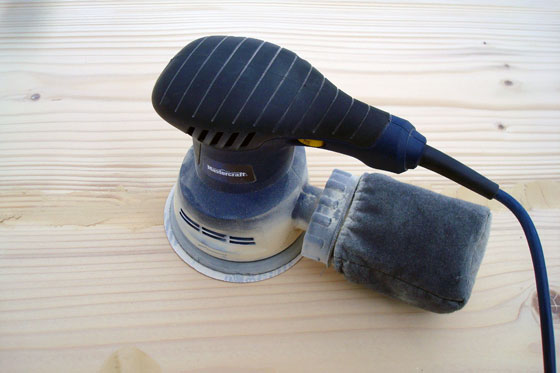
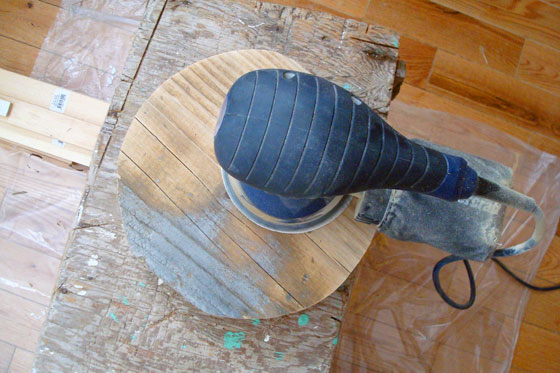
A few passes with my sander smoothed out the edges and took off the weathered grey outer layer–I wanted a natural wood finish for my basket.

Removing a weathered finish from wood with a sander

I rolled the base in the wire to figure out how long to cut the mesh–very scientific measuring method, I know–and nipped it across with my snips.

Cutting wire mesh with snips

To form the mesh into a cylinder, Karen showed two options in her post: green wire and twine. I chose a fine silver wire that I already had on hand and wound it through each square. It blends in with the mesh perfectly. To deal with the springiness of the mesh, it’s helpful to “tack” it in a few spots with small lengths of wire.

Wiring mesh together into a cylinder

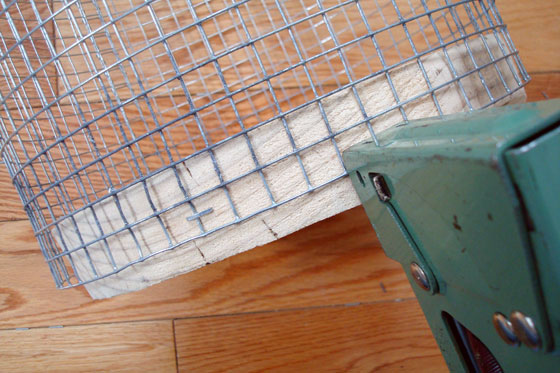
My wire tube was pretty good looking, but to make it a functional umbrella stand, it needed a base. I slid the wood disc into the mesh, lined it up along one of the rows of wire and stapled it in place.

Stapling wire mesh to a wooden base

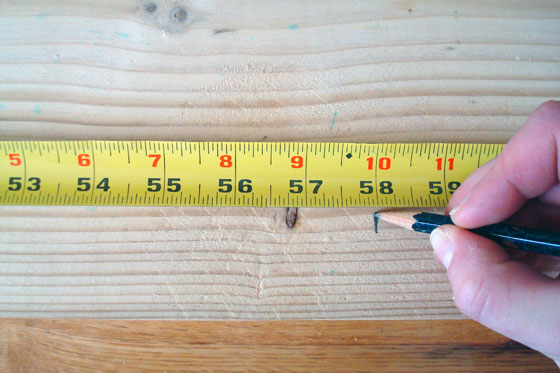
Now for the finishing touches. To cover up the staples, the raw edge of the base and the end of the mesh, I went to my roll of veneer. The veneer was about 6 inches wide, but I only needed strips that were 1 1/2 inches. This is where a good straight-edge and a sharp knife came in handy. I measured off my strips and then scored the veneer along the edge of my ruler.

Cutting veneer with a ruler and utility knife

The veneer was very thin, so the knife cut through it easily. The only challenge was that the knife wanted to follow the grain of the wood rather than the straight edge, so I had to make sure to keep the knife snug to the side of the ruler as I was cutting.

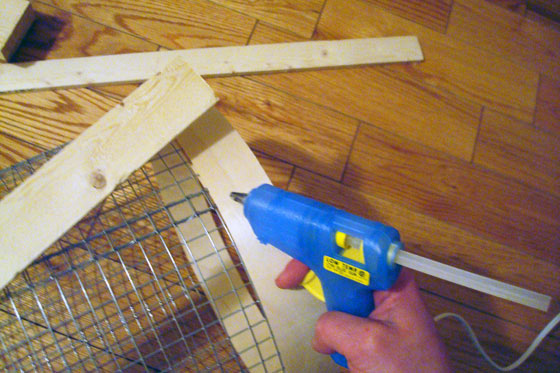
I had planned to tack the veneer to the basket with a couple of staples or small nails–I figured those would be in keeping with the rustic aesthetic I was going for. It turned out though that the veneer was pretty fragile. It cracked as soon as it was pierced. I returned to Karen’s tutorial and decided a glue gun was the way to go.

However, out of all of the tools that I own, a glue gun was not one of them, so the project was delayed until I could borrow a glue gun from my Mom. Turns out she had an extra from my grandmother that now belongs to me. Who knew Grandma was so crafty?

A bunch of daubs of glue around the base attached the veneer to the bottom of the stand. At the top, I sandwiched the mesh between two more strips of veneer and stuck them together with more glue. My edge turned out fairly tidy, so I didn’t apply twine like Karen did.

A couple quick nips with my jigsaw cut two of the lumber yard strips to the right length, and four more daubs of glue had them attached to my basket.

Using a glue gun to stick wood to wire mesh

Sorry for the poor image quality. The sun had set by the time I got to the glue gun stage.

I had forgotten how easy it is to work with a glue gun. It held all of the wood in place really securely and the glue set up really quickly. In no time, I was able to transfer my finished basket to the mudroom and fill it with umbrellas.

Rustic wood and wire mesh umbrella stand

We do not do cute shiny rubber boots here. They started out cute and colourful, but they are now very muddy.

The basket is perfect. Exactly the right rustic style, and exactly the right size (9 inches in diameter and 25 1/2 inches high, in case anyone is wondering). It easily fits our four umbrellas and could probably handle a couple more. I am quite excited to finally have a place to put them and to no longer have to deal with them flopping out of the closet at me. In fact, every time I walk past the mudroom now, I switch on the light just to look my new umbrella stand sitting tidily in the corner. Yep, I’m a little weird.

Now we just have to finish off the rest of the mudroom. We painted the walls on the weekend, but I still need to tackle the trim (currently painted a flesh-tone, ugh), fit out the closet, refinish the closet doors and build a bench. Right now, the umbrella stand is the best thing in there!

Are there any other Pinterest addicts out there? You can see all of my boards, including the mudroom one, here. Have you been inspired to make anything from Pinterest or participated in the Pinterest Challenge? You can check out all of the projects on Sherry’s, Katie’sMegan’s and Michelle’s blogs. Anyone else have a crafty grandma–or are you a crafty grandma yourself? Does anyone else find umbrellas hard to store?

How to use preglued veneer edging

I’ve posted an addition to this tutorial: How to apply pre-glued veneer on curved edges

Our new TV cabinet that you saw at the beginning of this week is a thing of beauty in my (admittedly biased) opinion. However, this wasn’t always the case.

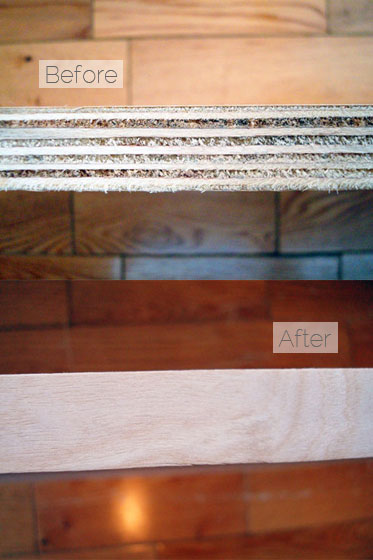
The cabinet is made of 3/4″ pine plywood. It’s paint grade, so the surfaces have a nice smooth finish. However, the raw edges are just that… raw. They’re rough and the layers of plywood are clearly visible. To finish off the edges, I used preglued veneer edging. This edging is very easy to use. Here’s what you do.

1. Gather your tools and materials.

Materials to apply veneer edging

This is a simple job that doesn’t require a lot of technical tools. Clockwise from bottom left, I have my roll of preglued veneer edging, my iron, a scrap 2×4 block, a file and scissors.

2. Set your iron to the cotton setting.

3. Prepare the edging. Use your scissors to cut a section of veneer that’s roughly half an inch longer than the edge you’re going to cover. You don’t have to be precise in your measurements. I just hold the veneer against the cabinet edge to figure out how long the section should be. You can work directly from the coil, but it’s easy for the veneer to get twisted, so I recommend cutting it into lengths first.

4. Starting at one end, carefully position the veneer against the edge that you want to cover.

Iron on veneer edging

The veneer will be slightly wider than the edge that you’re covering. Keep it flush on one end and one side and let it overhang the other.

5. With your edging in position, apply the iron to melt the glue.

Ironing veneer edging

I’ve found a “pressing” technique rather than an “ironing” technique works best. Just hold your iron in one spot for about 20 seconds. When you remove the iron, make sure the veneer is still aligned along the edge of the plywood. The glue will stay soft for only a couple of seconds so adjustments have to be made quickly.

6. Using your block of scrap wood, firmly press the edging onto the plywood.

Pressing veneer edging onto plywood

Press hard and slide the block back and forth over the section that you ironed making sure that the veneer fully adheres to the plywood.

Repeat steps 5 and 6 until the raw edge is completely covered with veneer.

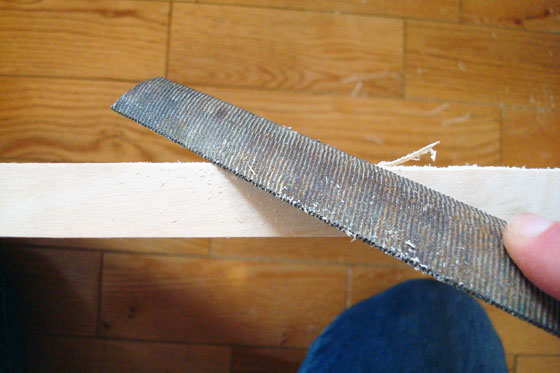
7. Once the veneer has cooled, trim the excess that’s overhanging the one side with a file.

Trimming veneer with a file

File towards the face of your plywood keeping the file at roughly a 45 degree angle. There are tools that will trim the veneer as well, but the file has always worked well for me.

Your edge should now be nice and smooth and ready for stain or paint.

Finishing a plywood edge with oreglued veneer edging

Some tips for using preglued veneer edging:

1. When cutting the veneer with your scissors, try to get a nice 90 degree cut. This will give you a good starting point for your next piece.

2. Check for joints in the veneer before you glue it to your plywood.

Finger joint in veneer edging

The veneer is connected by finger joints that aren’t the most attractive and wreck the illusion of a solid piece of wood.

3. Don’t skimp on pressing the veneer with your block. You don’t want your veneer to peel off once your cabinet is done. Pay special attention to the edges of the tape to make sure it’s firmly stuck.

4. If you use the file to trim the veneer, clean the file every so often. The sawdust will fill the grooves and make it more difficult to get a clean edge. I just tap the file to knock out the dust.

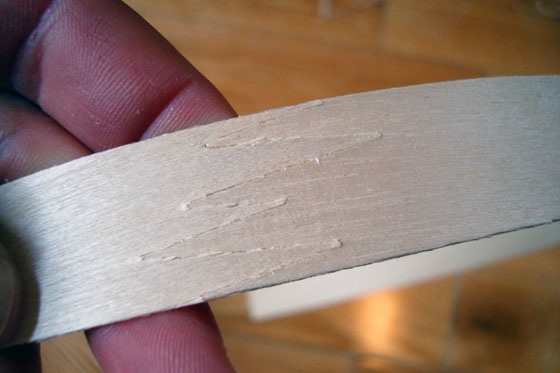
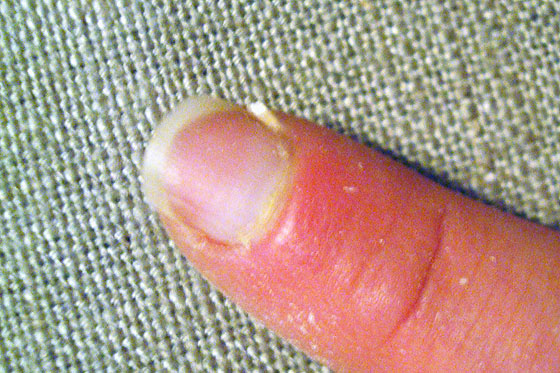
5. Watch out for splinters.

Splinter beside my fingernail

Ouch!

Although iron-on preglued veneer edging can be slightly dangerous for klutzes like me, it is very easy to use. Ironing is one of my least favourite tasks, but for some reason ironing wood is less tedious than ironing clothes for me. Just a little bit of effort results in a very nice polished finished for furniture, shelves or other creations.

Have you used veneer edging before? Who else is not a fan of ironing? Is anyone else susceptible to splinters? I seem to get a few a week. I’m sure a few are in my future this weekend. How about you? Any special projects on tap for the weekend?

I’ve posted an addition to this tutorial: How to apply pre-glued veneer on curved edges

Video game heaven

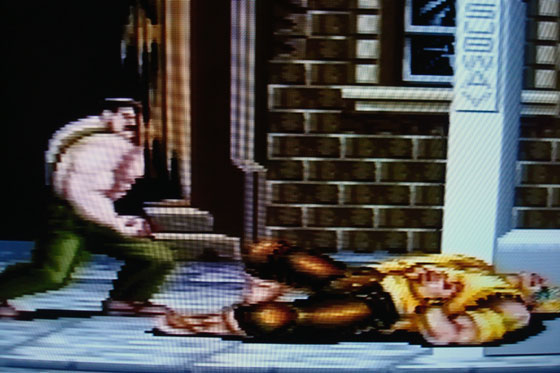
Anybody know what this is a picture of?

Final fight nintendo game

I wouldn’t know what this is except that I live with someone who exposes me to such things. This picture is from Final Fight, a video game for the Super Nintendo.

Rather than asking what the picture is of, however, I should be asking you what it signifies. What this picture means is that Matt finally, for the first time in his life, has all of his video game systems set up at once.

The reason for this momentous occasion is our new TV cabinet.

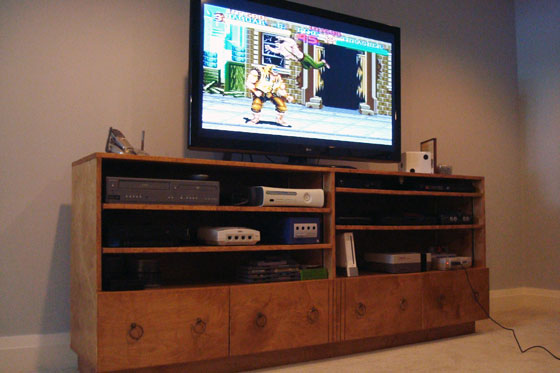
TV cabinet for vintage video game systems

I’ve never been into video games, but Matt has played his whole life and has built quite a collection. However, it’s always been a case of he would get a new system and the old one would be packed away. On those days when he really wanted to relive his childhood and play his old Sega Master System (the first he ever bought), he was out of luck.

When we were renovating the basement, one of the criteria was to have a good TV area for watching movies and playing games–any game he wanted. So, we needed a TV cabinet.

And the cabinet needed to do a few things:

  • Accommodate all of the equipment: the TV, the satellite receiver, the Blu-Ray player and at least 10 video game systems.
  • Store DVDs and video games.
  • Keep all of the controllers, connectors and wires that come with video games handy but out of sight.
  • Keep everything tidy and organized.

I decided my best option was a custom cabinet, so I sketched up a plan, and my Dad and I went to work.

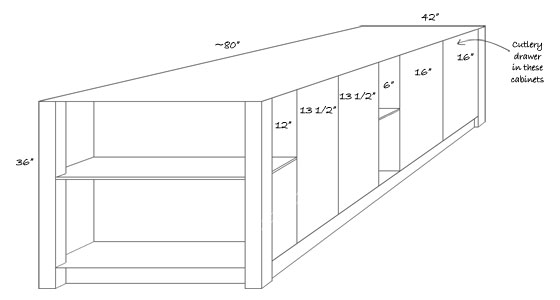
We went with adjustable shelves on the top section and drawers on the bottom. The overall dimensions of the cabinet are 80 inches wide by 16 inches deep by 33 inches high. The top gives us a spot for our phone (we need a land line in the country where cell service is a bit unreliable), our new 50-inch flat screen (more on that later this week) and a little bit of display.

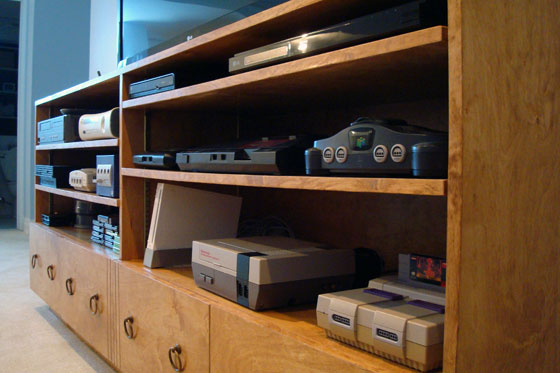
The shelves are dedicated to all of the systems.

Video game systems in a TV cabinet

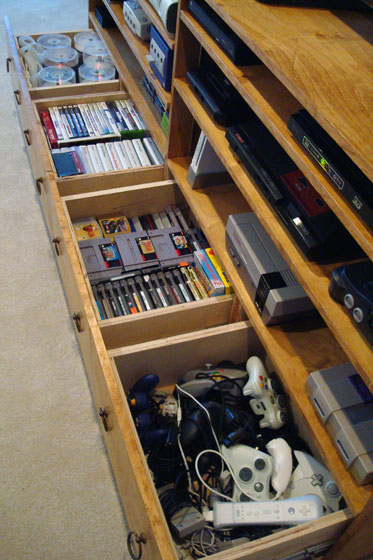
Matt has set up his XBox 360, PlayStation 2, Sega Dreamcast, Gamecube, Sega Genesis, Sega Master System, Nintendo 64, Wii, original Nintendo, Super Nintendo. Holes drilled in the back of the cabinet allow him to poke the wires through to hook up the systems.

The best part of the cabinet is the drawers.

Drawers in a TV cabinet for video games

There are four nine-inch-deep drawers along the bottom, and they hold DVDs, games and controllers. As we were building the cabinet, I kept increasing the size of the drawers, and I’m so glad that I did. They hold so much and make it so easy to keep everything tidy. It was a big pain to get four drawers perfectly lined up and sliding smoothly, but I can say now that it was worth it to have everything so well organized.

It’s also worth it to see how much Matt enjoys having all of his games at hand.

How many of you recognized the picture at the top of the post? Are there any other video gamers out there like Matt? In addition to Haggar and Cody from Final Fight, our basement has also hosted Link, Zelda and Mario over the past few weeks. What’s your favourite game? Have you ever built a piece of custom furniture? Any tips for constructing drawers? How do you keep video games or electronics organized at your house?

How tiling is like reality TV

I should have known. It was like a scene out of reality TV where someone says, “I completely trust my alliance. That million dollars is mine.” You just know that they’re going to be the next person voted off.

A month after  I naively wrote “I actually enjoy [tiling]. It’s not hard work.” the reno gods were still chuckling at me as I glowered at the untiled walls of the basement shower.

I decided I really do mind tiling, and I did everything I could think of to avoid it. I delayed, I procrastinated, I spent my time on other things (important things like baseboards and tractors and carpet, and less important things like parties and first snowfalls). However, none of these were tiling and none were enough to distract me from the ugly cement board, the cartons of tile and the need to bring the two together.

So I appealed to my alliance.

I negotiated with the reno gods: “I don’t need the whole Lotto Max jackpot. Just a little bit will be enough to finish the tile!” I bargained with Matt: “I don’t think I’ll do a good enough job. What if it ends up crooked and we hate it?” I pleaded with my Dad: “Please call your tile guy!”

The reno gods were silent. Matt was supportive: “You’ll do a great job. I have confidence in you.” My Dad was befuddled: “You, the woman who drywalled her own basement, are now intimidated by a shower stall?” But because he’s my Dad, he called his tile guy.

The tile guy said it would be $900.

$900? Just for tiling? With materials I already own?

$900 for professionals versus $0 for me. Ummm… “I guess I’m tiling a shower.”

So I booked a day off work. I booked my Dad. Just like the challenge part of the episode, I threw myself into the mud pit (mortar bucket?), and we got to work.

The first step was to figure out our starting point. Between the bench, the niche, the accent band and the vanity, there were lots of spots that I wanted to line up. However, the most critical was the top of the vanity, so we drew our level line from there.

Level line for tiling

Despite any appearances, the line is actually in line with the top of the vanity, and it is level.

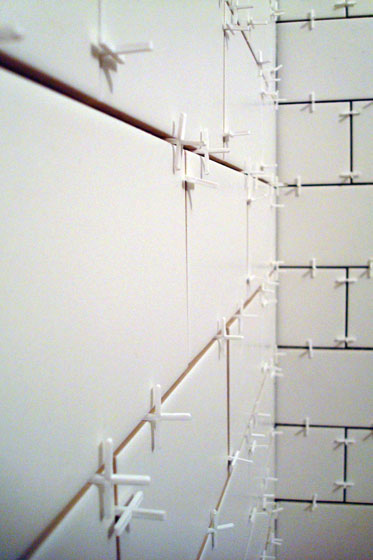
Once we got going with our tile, the most important objective was keeping everything level and even. For me the solution was using spacers. I wanted fairly narrow joints, and every single one had to be the same. I may have gone a bit overboard.

Tile spacers

Too many spacers?

I had two bags of spacers, but those were quickly emptied. As I progressed around the shower, I kept going back to areas that had already set up and removing the spacers so that I could reuse them.

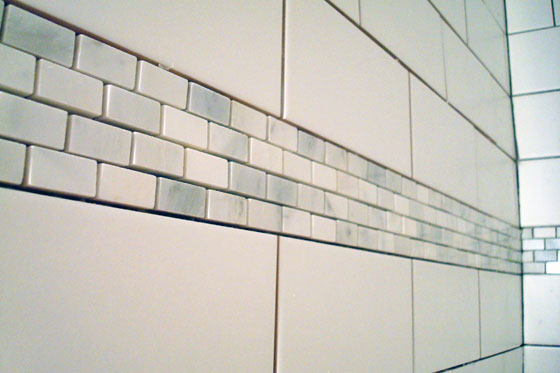
The other spacing issue I ran into was with the accent band. I’d chosen a marble mosaic tile that was slightly thicker than the white subway tile I was using the rest of the shower. I could have camouflaged the difference with a chair rail or another type of tile, but I really wanted a flat, clean, simple look. My tile supplier suggested putting a little extra mortar on the subway tiles to build them out to the same depth as the mosaic.

Back buttering the subway tile

Back buttering the subway tile

I back buttered for two rows on either side of the accent band. Because I only did it in this one spot, the walls have a very slight curve. I’m hoping it’s imperceptible unless you know it’s there (obviously, all of you will be diplomatic enough to not point it out when you come to visit, please).

Carrera marble tile accent band

Everything looks pretty even between the carrera marble accent tile and the subway tile. Doesn’t it?

The back buttering was tedious, but not particularly difficult. The trickiest area–and the point that I started to go slightly insane–was the niche.

When we were building the shower, I thought the niche was a great idea. No bars of soap and bottles of shampoo set on the bench or the floor. No caddy hanging from the shower head. Just a convenient built-in shelf.

It turns out niche functionality, good. Niche tiling, bad.

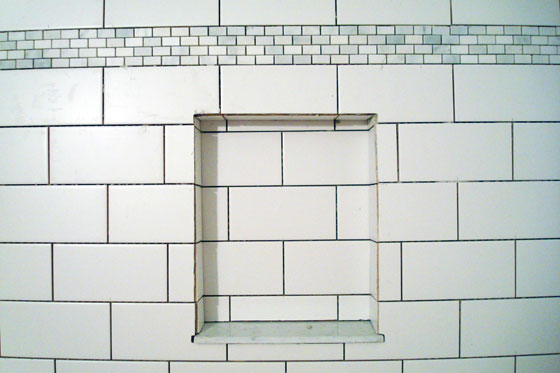
Because I’m a glutton for punishment, I wanted the pattern to continue from the walls right through the niche. That meant dozens and dozens of cuts. In the whole niche, there is only one full tile. Ugh. But, I have to say, the result was worth all of the extra figuring and cutting. And yes, the next photo is completely bragging.

Tiled shower niche

Look at that brick pattern marching right along!

We used a small piece of marble we picked up at Home Depot for the base of the niche, as I wanted a single solid piece on any horizontal surface. It’s slightly sloped so that the water, but hopefully not the soap, will run off.

In the end, tiling the shower is not as fun as sitting on the couch all weekend watching a reality TV marathon, but my early fears proved unfounded. I did do a good enough job, I think. Everything is nice and straight–and it will look even better when it’s grouted.

I may not have won the million dollars, but I didn’t get voted off the island.

Comatose

No post today. I’m in a tile coma.

Tiled shower

The result of three days of labour

Obviously, I still have to put the seat on the bench and the top on the threshold, take out all of the spacers and grout everything, but the hard part is done.

Finally.

Thank goodness.

Sorry for the brevity today. Full breakdown… project breakdown, not personal sanity (already had my “I’m going crazy” moment at the end of my 12-hour second day)… will come later.

How did you spend your weekend?

William Wallace by way of a wet saw

Saturday morning, Matt’s bathroom looked like this.

Shower with cement board

It’s not just Saturday. The bathroom has looked like this for the past several months while our attention has been on finishing the drywall in the rest of the basement.

By Saturday evening it looked like this.

Tiled bathroom and shower floor

Beautiful tile. Finally progress!

I’ve tiled before, and I actually enjoy doing it. It’s not hard work, but it does require planning.

My Dad and I spent several hours in the morning laying out the shower floor, carefully fitting and figuring. When we finally spread out the mortar, we had a really good idea of how everything should go.

The marble mosaic hexagon tiles that we used on the shower floor are all on a mesh backing that basically makes them into 12×12 tiles. It’s important to  pay close attention when you join the sheets to make sure the gaps between the tiles are consistent. Despite our best efforts, I did still have a bit of difficulty keeping everything perfectly straight all the way across the floor, but I was able to adjust the spacing on the individual hexagons, and I think it will all look okay once it’s grouted.

Here are two lessons I learned about how to work with mosaic tile:

  1. Don’t start with your first sheet tight to the wall. Keep it off an eighth or even a quarter of an inch. This will give you more room to make adjustments on your other sheets as you progress across the floor.
  2. For areas like the drain, remove all of the tiles that come into contact with the drain. Lay your (mostly) full sheet as you usually would, and then insert individual tiles (or pieces of tiles) into the gaps as necessary.

On the main area of the floor we used actual 12×12 tiles, which were a piece of cake to install. The biggest piece of figuring we had to do was determine where the middle of the floor was and then centre our tile along that line.

The only sour bite in our cake was cutting out for the toilet. I know other people have used dremels or other tools to get nice round circles. We used the wet saw, which only cuts in a straight line. With lots of patience, lots of back and forth and even trading off cutting duties between my dad and me, we got the tile cut on the first try.

Tile cut around toilet flange

The cut of the day

It’s not as smooth as it would have been with another tool, but it will all be hidden under the toilet. That works for me.

What didn’t work for me was the William Wallace/Gene Simmons makeup I had going on after using the wet saw all day. All of the tile dust mixes with the water from the saw and from my waist to my hairline I had a dusty grey stripe in line with where the saw blade had sprayed me all day long–attractively along only the right side of my face.

Cutting tile on a wet saw

Thank goodness for safety glasses

Next step is grout and then I can move onto the walls. Who knows, someday we might even move on to installing the actual fixtures and using this bathroom.

What’s your tiling experience? Any tips for keeping things straight and even? Or cutting a curved line with a straight saw?

The greatest dilemma of all time

The title of this post may be a little over dramatic. I am not the first to face this conundrum or to wrestle with this question. However, the angst, the uncertainty, the pressure of this choice is well known by many.

What paint colour do I choose?

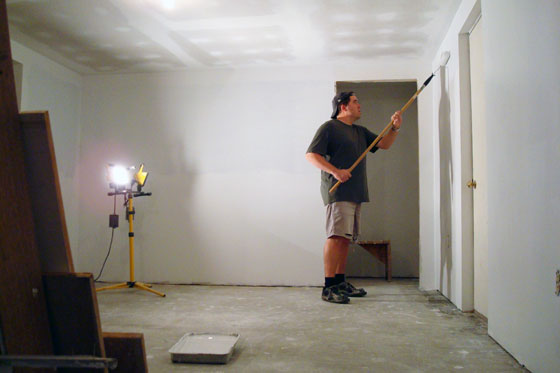
With the conclusion of the drywall phase of the basement, we progress to the painting stage. We (optimistically, as it turned out) bought primer months ago, so last week Matt and I started priming the basement.

Matt priming the long room with the roller

Matt rolls on the primer in the long room

You would think with 5 1/2 months of drywalling (still can’t get over how long it took us), 7 1/2 months of farm ownership, and 9 1/2 months of knowing we were going to be painting the basement, I’d have figured this out by now. But I haven’t.

Most of the time in this project, I was planning on going grey. However, we’re planning on buying a charcoal grey sectional and the carpet will likely have grey tones in it. Painting the walls grey too was starting to seem like a lot. So over the last little while, I started thinking about other options.

The criteria for the colour are

  1. Light – I want the basement to be fairly bright, but, with only one window, pale paint is my best bet.
  2. Neutral – I really don’t want to repaint any time soon, but I may want to redecorate every so often. A neutral colour gives me the option to switch up the other colours in the basement when the mood hits.
  3. Works for the whole area – We have a fairly large basement, and the main room, long room, laundry room, stairwell and hallway are all going to painted the same colour (click here if you need a floor plan refresher).

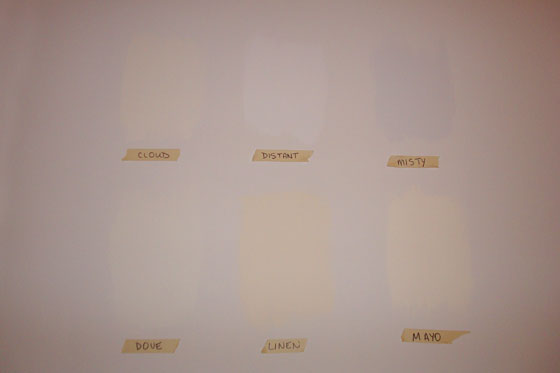
I ended up buying samples of six different colours. Originally, I bought four, but then I didn’t like any of them, so I went back and bought two more.

Off white paint samples

Clockwise from top left: Cloud White, Distant Gray, Misty Gray, Mayonnaise, Linen White, White Dove. (All colours from Benjamin Moore).

This is my first time sampling colours on the actual wall. Usually I just trust my gut and go with a paint chip that I think will work. However, this is also my first time painting my forever house (bathroom aside), so I feel like it matters more that I get this right.

So, in addition to sampling the colours, I am appealing to you for help. What do you think?

Have a favourite colour that’s not covered in my samples? Let me know in the comments what you recommend.

Stick a trowel in me…

… I’m done.

We are calling it on the drywall phase of the basement reno. Five and a half months–in case the text version wasn’t clear, let me translate that into numerals 5 1/2 (or 5.5 for you digitally minded folks) months–after we started drywalling the basement, we are finally finished.

Oh the glamourous life of DIYers.

Lest there’s any additional lack of clarity, the basement reno itself is not finished. Only the drywall stage is done.

Some other things that are done:

  1. Bandaging my fingers for my evening sanding sessions.
Bandaged fingers

This is what my hands looked like at the end of a night of sanding. The bandages are pretty much worn away.

I built up calluses on my fingers, of course, but calluses can only do so much. It took me two nights of bleeding fingers to learn my lesson. (Point in my favour: the nights were not consecutive. I’m not that dumb). Before the second incident, I thought my fingers were sufficiently toughened from the first incident to not require protection. I learned that no matter how leathery and rough I think my hands are, I can apparently always do more damage.

Good news is I would make a good spy these days, as my fingerprints are sanded off.

  1. Also done is Matt’s nightly decoding dilemmas as he tries to interpret the pasting instructions I draw on the drywall.
Pencil markings

The two circles highlight a scratch and some divots that need to be filled. The U and V markings are supposed to be arrows that point out a ridge that needs to be feathered out with paste.

The division of labour when it came to drywall was I sand, Matt pastes. As I work, I keep a pencil behind my ear, so that I can mark spots that need particular attention.

Additional symbols in my drywall lexicon include lines and once in awhile actual words–that usually still require translation.

  1. The biggest change that will result from concluding drywall work will be no more drywall dust throughout the house.
Pile of drywall dust

The partially swept office floor (and yes, I know my work shoes are looking a little worn).

In the basement, the dust was so deep that dunes were starting to form. It took Matt and me a full afternoon to wipe down the walls and ceilings, sweep up the worst of the dust and then vacuum the remaining powder.

Upstairs is also covered in a fine skim of dust, although we haven’t done a deep clean there yet. We have to keep up our glamourous DIY lifestyle, after all.

Starting out on this project, I never dreamed that drywall would take us nearly half a year (ouch, that sounds like a really, really long time). My only excuse is that we ended up having to redo a huge area–pretty much the whole basement, we didn’t work on it religiously every single day and we’re not professional, so we’re slow.

The finish is definitely not perfect, but I’m satisfied with how it turned out, and I’m really happy that Matt and I were able to tackle such a big project together by ourselves (with help from my Dad, of course. Thanks, Dad!).

And now, in the way of DIY, concluding one stage of the project means it’s now on to the next. Painting here we come!

What’s on your agenda for this weekend?

Staking our claim

When European explorers first landed in the new world (including Canada), it was customary for them to plant their flag as a symbol of ownership.

I think this latest development means the farm is officially ours.

Canadian flag on a flag pole

Please ignore the overgrown mess that is the turnaround. Past owners dumped heaps of dirt and rubble here that made mowing impossible. Landscaping is next year’s project.

This project also means that Matt and I have officially started in on the fall to-do list. Planting the flag pole was #11.

I had bought the pole second hand on kijiji back at the end of June with the idea that we might be able to install it for Canada Day (July 1). That didn’t happen.

We drilled a hole for the pole back in August when we had the auger, and I tried to convince Matt that installing the flag pole would be a good birthday present for me at the end of September. That didn’t happen.

Finally on Sunday morning, we dragged out the wheelbarrow and a bag of concrete and made it happen. It took all of a half hour to mix the concrete, place the pole in the hole and pack the cement around it.

The hardest part was making sure the pole was plumb and holding it in place with ropes and stakes.

Flagpole braced with ropes

Our mini-circus tent… or the bottom third of the flag pole braced in place while the concrete sets.

Our flag pole came in three pieces, so it was very easy to wrangle one 7 foot piece into place, rather than a long 20 foot pole.

By Monday (I love long weekends by the way–we get so much accomplished) the concrete was set.

Flag pole in concrete

Set, secure and straight!

While Matt and his dad were working in the back bush clearing the trails, I went to work wrangling the rest of the pole into place. If you’re ever looking for a laugh, watch a 5’4″ woman staggering around with a 12 foot flag pole–to which she has already attached the halyard (or rope)–trying to keep it perfectly vertical so she can set it in place on top of another pole that’s as tall as she is. It took two tries, and the cats were absolutely no help.

Once the pole was fully assembled, it was a simple matter of attaching the clips to my rope and hoisting the flag.

Matt’s comment when he returned from the bush and saw the flag was, “I think we just improved this property more than any other owners. Except for maybe the guy who built the barn.”

So yes, we are both ridiculously happy to be flying the flag at the farm. Sometimes it’s the simple things.

Help! I have hod claw

Matt and I put on a push this week in the basement in an attempt to pick up the pace on the pasting. (I love alliteration, but that’s a lot of ‘p’s even for me). We’ve made a lot of progress, but a side effect of all of this productivity (I just can’t stop!) is that we are both suffering from hod claw.

hod·claw

noun

an uncomfortable contraction of the hand, typically occurring after holding a hod for an extended time

For those that haven’t had the pleasure, a hod is basically a big tray that holds the drywall paste (also known as mud or compound) while you’re working.

After a full evening of working in the basement, uncurling our fingers from our hods is harder than you’d think.

Hod with drywall paste

Matt holding the hod

It’s not that we love drywall and don’t want to stop. The issue is that our hands have seized around the handle of the hod and returning them to their regular dexterity requires much flexing and massaging.

When it comes to drywall, there are a variety of tools people choose to hold their paste. Some work directly from a bucket. Others use a mudpan. I grew up using a hod, so that’s what we use now.

Once I cross the three hour mark of pasting, I don’t think it matters what’s holding my paste. At that point, my hands have cramped. As long as I keep working, I don’t feel it too much. As soon as I set the hod down, though, that’s when I realize how tired my hands are.

Drywalling with a hod

Matt in action

Fortunately, by the next morning, I’ve usually regained most of my range of motion.

Even more fortunately, thanks to our concentrated efforts this week, we’re nearing the end on this pasting odyssey and will soon be setting down our hods. Hopefully, our  hands recover from their case of hod claw shortly thereafter.

Any other DIYers out there who use a hod for drywalling? Have you ever been afflicted with hod claw? Or do you have your own unique DIY injuries?