Dueling DIY – The Final Update

Six weeks ago when I launched this Dueling DIY adventure, I thought, “I got this. No problem. I’ve got six weeks! Sarah’s going down.”

I had a somewhat ambitious list, but I thought it was entirely doable. Now that we’ve come to the end of the challenge and my final report, I’m stiff, I’m sore, I’m proud of what we accomplished… but I’m also a little bummed that I couldn’t cross everything off.

In that respect, Sarah, whose update you saw earlier this week, is the winner.

Here’s my final list:

  • Hang the gate
  • Edge the garden
  • Build raised beds around the perimeter
  • Build trellises for the raspberries, tomatoes and squashes (I have wood and wire, but nothing’s put together yet)
  • Start a few seeds indoors
  • Till in the ash, straw and manure (still only half the garden is done)

And a couple of maybes:

  • Weather permitting, plant grapes and potatoes
  • Run a waterline out to the garden (this one is Matt’s task, so I’m not really feeling too bad that we didn’t get this done)

So I made it just over halfway through my to-do list (56% if you’re wondering).

The perimeter beds were definitely a much bigger project than I anticipated–both in terms of the amount of work and their literal size. But I’m really happy with how they turned out. In fact, I’ve already started filling them up with onion (seeds), sunflower (seeds) and grapes.
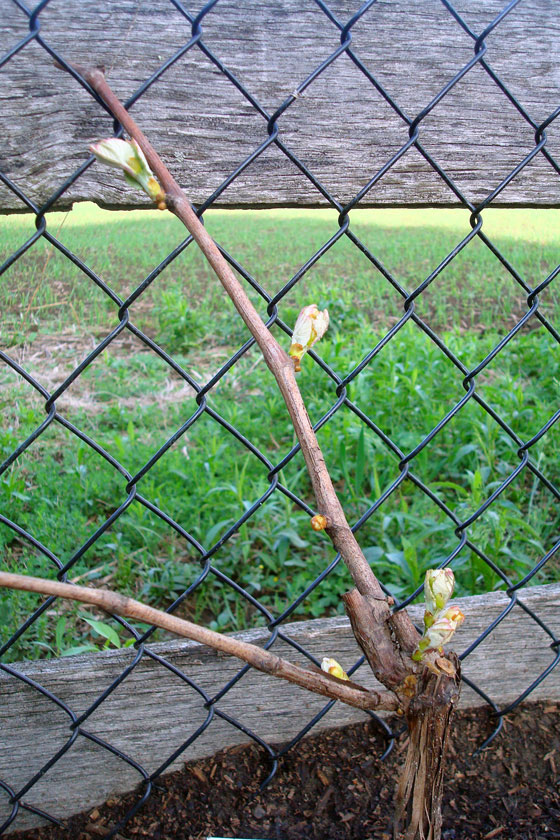
Grape buds

Although filling might be a bit of an exaggeration. According to my original calculations when we started this challenge, the perimeter of the garden is approximately 175 feet. The beds are just over 2 feet deep, which means we have 350 square feet in the perimeter alone. I’m not sure Matt and I eat enough food to keep up with this garden!

Rustic raised beds in a round vegetable garden

The outer beds are obviously where I spent most of my time throughout this challenge, but the interior of the garden–or at least half of it–got some attention too. We’re now up to 5 rows of potatoes (who exactly is going to eat all these?). We have three rows of reds, which we grew for the first time last year, and then we have two new varieties that we’re trying out: Kennebecs (highly recommended by Karen at The Art of Doing Stuff) and Russian Blues (another Karen suggestion that I couldn’t resist adding just for fun).

Potatoes growing in the garden

Our sprouts have overcome their damping off and are growing well. In fact, I’ve moved on to the hardening off stage and they’ve spent a few days outside this week. Matt brought home some tomato plants to supplement our own seedlings. Those can probably go in the garden this weekend, but I’m going to let our sprouts grow a bit more before they move outside permanently.
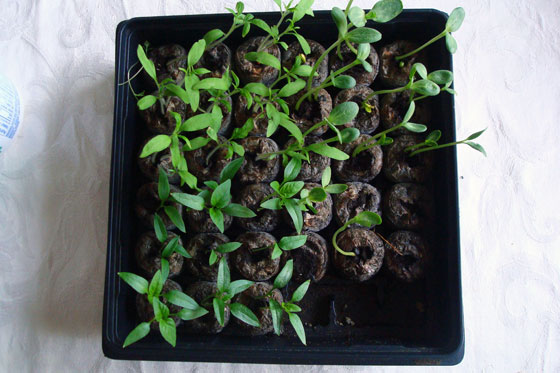
Sprouts and seedlings

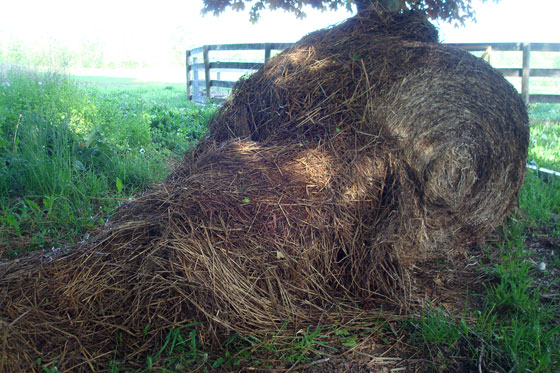
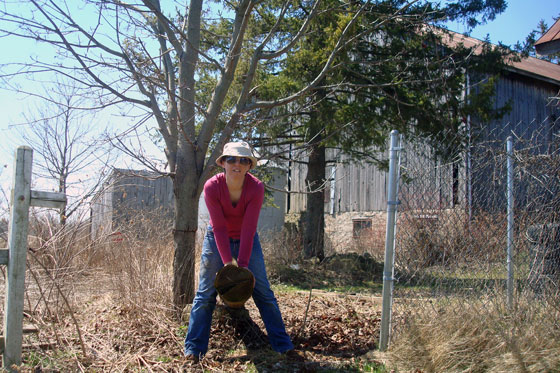
Aside from finishing the raised beds, our biggest accomplishment last weekend was wrestling an abandoned hay bale out of the tree line beside our big field (where it and a friend have lived for years)…

Bales of hay stuck in the trees

onto the trailer (seriously, it took us about 45 minutes to get to this point)…

Straw bale in the trailer

and up to the garden.

Straw bale for mulching the garden

I’m going to try the deep mulch method to deal with weeds, maintain moisture and add nutrients to the garden. This bale is going to be my mulch. Hopefully it’s enough because I do not want to go back to get his friend. What a ridiculous way to spend a holiday Monday morning.

So obviously work does not end on the garden just because Dueling DIY has concluded. Trellising and tilling and gating and waterlining are still going to happen. As is planting and growing and (hopefully) harvesting. And I’ll be sharing more garden updates as we go along–I can’t help myself.

The beauty of taking on a project like this Dueling DIY is that in the end we each win. We’ve each made progress on our gardens, and we’re closer to enjoying the fruits of our labour (literally) than we were six weeks ago.

Thanks for the motivation, Sarah. And congratulations on your victory. I may have to send you a potato as a prize. And thanks to all of you for following along, doing your own challenges at your homes and encouraging us.

How’s your big spring project going? What gardening progress have you made recently?

Dueling DIY – The Challenger’s Final Update

Six weeks ago, Sarah in Illinois and I started a Dueling DIY challenge. Our mission was to get our gardens in shape for the year through some friendly competition. Today, Sarah’s here with her final update on how she did. To see how we got here, check out all of our previous posts.

I have to admit, when I first made my list of things to finish for the challenge, I thought that I made it too easy on myself.

I saw Julia’s list and thought that I was sure to win.

However, what I learned was: most projects take longer than what I plan for, weather does not care what you have planned, and I procrastinate just as much as I did in high school when doing homework.

So as you can guess from what I have written so far, I did not completely finish everything on my list. But I sure made a valiant effort!

1. Make some kind of designated area (possibly raised bed) for annual vegetables such as asparagus and strawberries.

I call this 90% done. Everything is planted. Asparagus and strawberries are planted, rhubarb is in the ground and seeds and bulbs are planted for my cutting garden.

Raised beds made of barn board

For the borders I used old rough cut barn wood. We have a large pile of old wood out in the barn but I did not find enough long boards. So I am going to have to keep digging to find a couple more boards.

However, I am happy to have the two outside beds defined so that there is no fear of cutting too close with the mower.

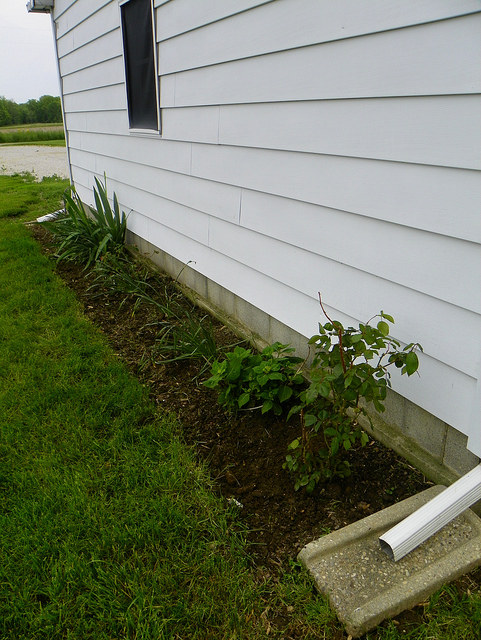
2. Neaten and define north flower bed and add mulch.

Clean siding

Nothing new has been done here. Steve and I are debating on whether to buy a couple bags of mulch or dive right in and get a truck load.

Now that he is in the field all hours of the day, we still haven’t made the decision so the mulch didn’t get put on the flower bed. But I am still happy with how this flower bed is filling out.

Hydrangea mid-way through spring

3. Divide mums and spread around deck.

Mums around the edge of the deck

This is the first thing that I finished, and the mums are really taking off.

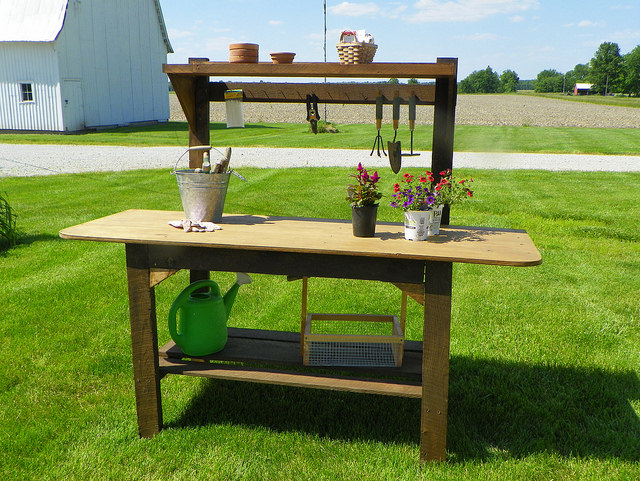
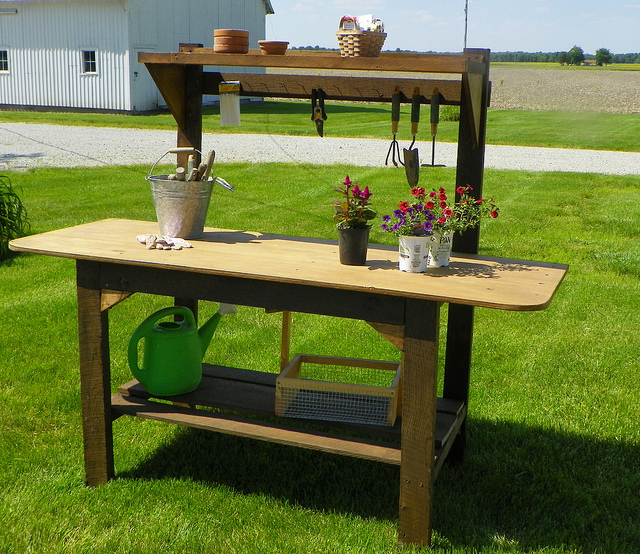
4. Make a designated gardening area complete with workbench.

This was my favorite project!

Potting bench

We were tearing out a room in our pole barn and so I had the countertop and the top shelf ready. All I had to do was make the framework.

Potting bench

I say that was “all I had to do” but designing the work bench from scratch was time-consuming. I knew I wanted a top shelf and a shelf underneath. I also knew I wanted a place to hang my tools.

Tools hanging on a potting bench

I used mostly older barn wood but a few pieces are newer pine so I used the darkest stain that I had on hand to try to blend the different woods together. I really could not be happier with the finished project!

Potting bench

So here is my final list:

  1. Make some kind of designated area (possibly raised bed) for annual vegetables such as asparagus and strawberries.
  2. Neaten, and define north flower bed and add mulch.
  3. Divide mums and spread around deck.
  4. Make a designated gardening area complete with workbench.

I won’t find out until Julia’s post to see how I fared in this competition, but I’m feeling kind of good about my odds!

I am so happy that we did this challenge. I guarantee if I didn’t have the constant competition in the back of my mind, I would not have gotten as much done as I did.

I would have made excuses about how I was tired, or how I had so many other things to do, and I would have avoided all of the hard work. But I am proud at how much I got done, and I am happy with my progress whether I “win” or not!

(It would be nice to win though!)

Okay. I’m impressed that Sarah can cross everything off her list. And that potting bench is awesome. I’ll be back on Friday with my final post in this Dueling DIY challenge.

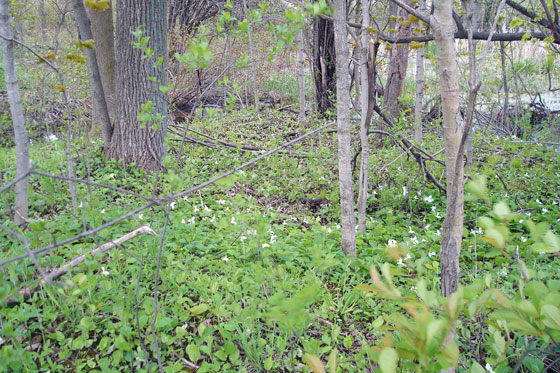
Trilliums, trilliums everywhere

The trilliums are out.We see them along the roadsides, at the edge of the fields and–this year–in our front garden.

Last year, I carefully transplanted a couple of plants into the front garden. One of them survived and is blooming this spring.

Transplanted trillium

It’s a bit remarkable to me how many are around the farm. Growing up, I very rarely saw trilliums–Ontario’s official flower–and it was a special occasion when I did.

Trilliums in the woods

Now, even though I see them more regularly, it’s still special. Especially when it’s right outside my front door.

Have you ever successfully transplanted a wildflower into your garden? Do you have any elusive flowers in your area? What’s your state (or provincial) flower?
Garden Dueling DIY Week 3

Sarah in Illinois and I have entered into a friendly competition this spring to help us get our gardens in shape. We’re now at the conclusion of week 3 of this Dueling DIY, and I’m sharing my second update. You can check out all of the previous posts here.

It was just noon on Sunday. I had a long list of things that I wanted to do in the garden, but I was running out of steam. I managed a few more hours before I hobbled retreated indoors. (Sarah, take note that I said the garden claimed a temporary victory. I am not conceding anything yet in this DIY duel).

I still don’t have any dramatic before and after pictures to share yet. But I can report some progress.

The big accomplishment so far is edging the garden.

Our garden is 2,462 square feet, which means, if I’m remembering my geometry formulas correctly, its outer perimeter is roughly 175 feet. Whatever the distance, it felt like it took a very long time to go around the whole outer edge.

Here’s what the edge looked like at the start. Ugh.

Edging a weedy garden

Here’s the progress shot.

Edging the vegetable garden

And here’s the final.

Wood "curbs" to edge a vegetable garden

We used the fence posts (or in the case of the image above, the telephone pole) as “curbs.” I’m hoping they accomplish two things: 1) Keeping weeds out of the garden. 2) Keeping small critters from crawling under the chainlink and into the garden.

Matt cut the fence posts to length with his chainsaw and then we dropped them into the shallow trenches that I’d dug around the perimeter.

Remember this picture from my last update of all of the materials for the garden?

Materials for the garden update

We’re now down to a single pile of posts (and some firewood).

Fence posts

I also made a dent in the lumber part of the pile when I went on a marathon stake making session.

An electric mitre saw is perhaps not a conventional garden tool, but I wanted a lot of stakes.

Cutting garden stakes with a mitre saw

How many stakes? I couldn’t find the energy to count. More than 10 gallons worth.

Pails of garden stakes

The stakes came into play with my plan for the other half of the fence posts: the raised beds.

My plan is to build shallow raised beds just around the outside edge of the garden. These will host asparagus, grapes, rhubarb, sunflowers, and probably beets, lettuce and who knows what else.

Again, I’m using the fence posts as curbs, and I’m holding them in place with the stakes.

Shallow rustic raised vegetable garden beds

After digging my way around the outside of the garden, I have no desire to do more weeding, so I’m giving the lasagna method a try within the raised beds.

I used cardboard for my base layer. (Die weeds, die).

Using cardboard to kill weeds in the vegetable garden

Then I covered that with a layer of straw mulch that has been composting in the garden since last fall. I was surprised how much the straw has broken down already. I think it should be good food for the new beds.

Straw mulch

Four yards of topsoil arrived yesterday morning, so I will top up the beds this weekend.

The raised beds were where I lost my mojo. I had a small sledge for hammering in the stakes, but swinging the hammer over and over (and over and over) was surprisingly tiring. So I’ve made it halfway around the garden.

I know it’s halfway because I’ve marked the centre aisle with our super long rope. The picture below doesn’t look like a lot of progress, but you might be able to see the curbs at the far right waiting to be set in place.

Unfortunately, you’re also able to see all the weeds. Matt got the rototiller running with no trouble, which got us very excited, but as soon as he started to till it stalled. And stalled. And stalled. So frustrating. So the straw and weeds and ash are all still sitting on the soil.

Gardening progress

One place the weeds are gone is in the red raspberry row. Woo-hoo for small victories. (The twine is to mark the row until I get a proper trellis in place).

Raspberry row marked with stakes and twine

A bigger victory is how much the raspberries have expanded. Look at all those little plants. This is going to be good. And the black raspberries next door–while still weedy–also appear quite healthy.

Raspberry sprouts

My usual gardening sidekick is Bax. It was nice to be a trio this weekend thanks to Matt’s help with the fence posts. However, as soon as Matt was done cutting, Bax was more than ready for bro time–indoors. Apparently he’s only interested in gardening if he can work on his tan at the same time. The weather was cloudy and drizzly, and as much as dude likes to pretend he’s an outdoor dog, he’s a fairweather outdoor dog.

Thankfully, Ralph is much tougher than her brother, so she braved the weather to keep me company. And unlike the sunbather, she actually participated, inspecting the raised beds and even assisting with some weeding.

Ralph in the garden

Ralph in the garden

Eventually, though, even I gave in and retreated to the indoors. (Ralph as always stayed outside).

However, there’s still some more progress inside. Tomatoes (Sicilian Saucers) and peppers (a random mix) have sprouted, and I transplanted our tallest watermelon sprouts already.

Watermelon sprouts

We cut our seed potatoes down to isolate individual sprouts, and they’re firmly at the grody stage. We really need to get them in the ground this weekend.

Chitted potato sprouts

The weather forecast is supposed to be bright and warm this weekend, so I have high hopes again for progress and productivity. However, I’m away from the farm a bit (have to remember Mother’s Day) and… guess what… picking up my grapes. I’m excited to have my first vines. Finger crossed I can keep them alive and help them grow the way they’re supposed to.

Before I get to that, though, let’s go back to my original to-do list. I can cross at least a couple more things off.

  • Hang the gate
  • Edge the garden
  • Build raised beds around the perimeter (half done)
  • Build trellises for the raspberries, tomatoes and squashes
  • Start a few seeds indoors
  • Till in the ash, straw and manure

Three weeks to go, Sarah. We’re halfway through this Dueling DIY. Are you going to make it? The garden may have kicked my butt last weekend, but I’m going to be back and better than ever in just a few days. Watch out.

What progress have you made on your spring projects at your house? Any tips for lasagna gardening? Or building raised beds? How about growing grapes? Or keeping a rototiller running? Do you have any furry gardeners at your house?

Nesting instinct

We have a new tenant at the driveshed.

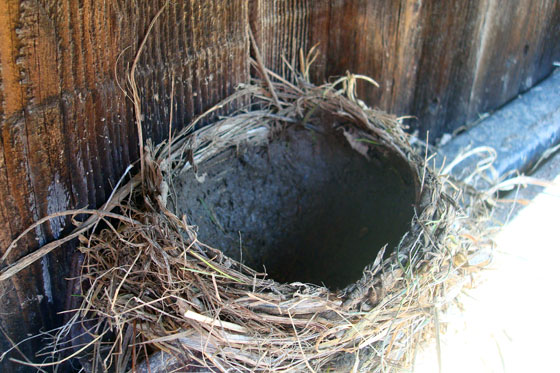
It took about a dozen false starts, but a robin has finally managed to construct a nest.

The start of birds nests at the front of the driveshed

Robin's nest

The streamers of grass waving over the door track caught the building inspector’s attention. Matt gave her a boost so that she could check the construction up close.

Ralph inspecting the birds nest

The mud wasn’t dry, but the robin got a pass nonetheless.

Robin's nest

Now she just needs to move in and start her family.

Is anyone constructing a new house where you are? Or do you have any birds sitting on nests? Who’s your building inspector?

Garden Dueling DIY Week 1

Fire in the field

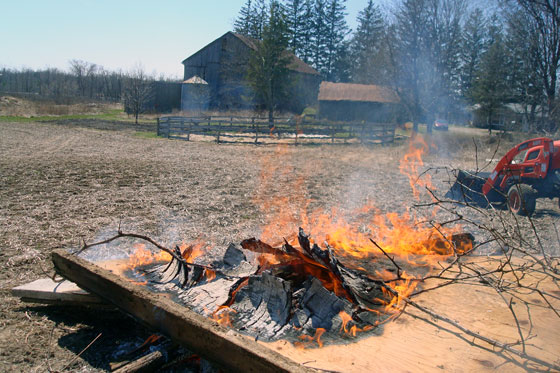
In this Dueling DIY garden challenge, I am on fire. Literally.

These were my jeans at the end of Saturday.

Burned cuffs on my jeans

And this was the back of my neck at the end of the weekend. Ow-ee.

Sunburned neck

If you’re new to this Dueling DIY series, Sarah in Illinois and I are undertaking some friendly competition to help us get our gardens in shape this spring. You can check out all of the previous posts here.

Now, if you look again at that top picture and squint through the smoke, you might notice that the fire is some ways away from the garden itself–that big round thing with the fence around it.

Fire in the field

Blame it on my pyromaniac tendencies. Blame it on the other outdoor task on my 2016 Home Goals list–general property cleanup. Blame it on the first nice weather of the year. I got a little bit distracted over the weekend.

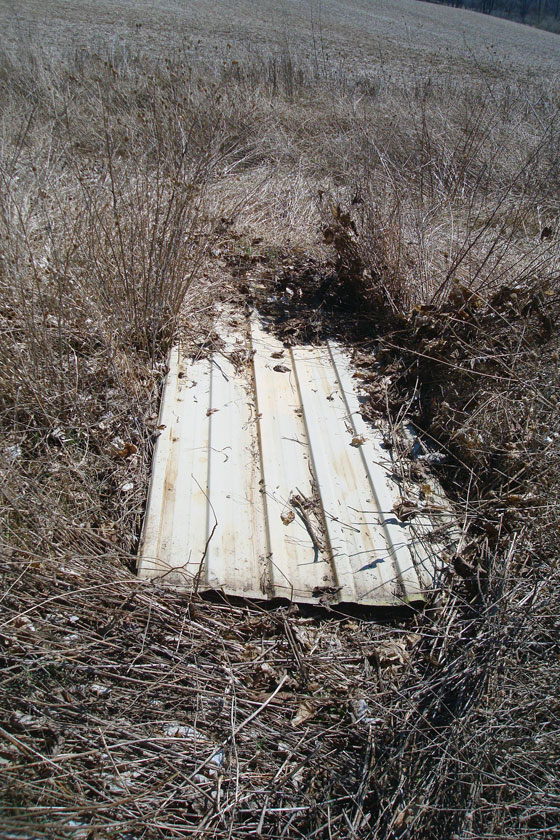
I cleared a stack of about a dozen incredibly heavy metal siding panels that had been hiding in the weeds on the south side of the garden.

Sheets of metal siding

Wiley and me moving the siding

Then I cleared the weeds themselves–using my preferred method of fire.

Burning weeds in the south field

Burning weeds in the south field

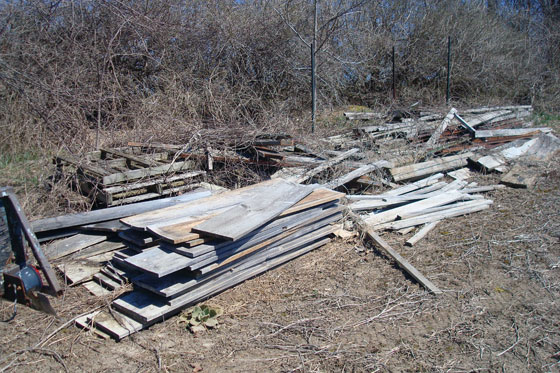
I cleared a very large pile of lumber at the edge of our centre field–and lit some of the really punky stuff on fire. (I might have a problem).

Lumber pile at the edge of the field

Field after clearing the lumber pile

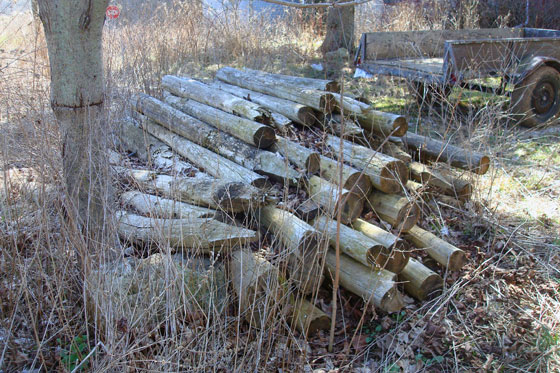
I cleared a stack of old fence posts beside the driveshed.

Pile of old wood fenceposts

I’ve moved these fence posts once before, picking them up from where they were scattered around the property and tucking them behind the driveshed. I had to remind myself a couple of times that I had moved them before, and I could move them again.

Moving the fenceposts

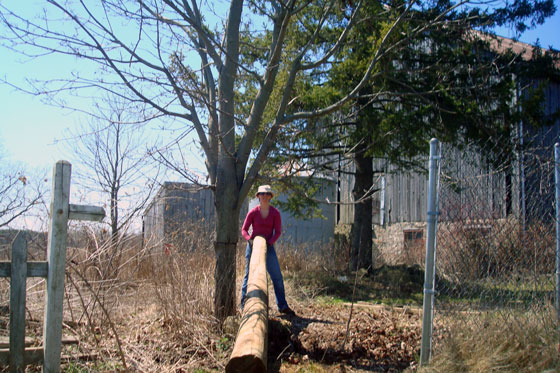
These things were heavy. The very last one was the girth and almost the length of a telephone pole–not even close to a fence post. Example 8,694 of why I don’t need a gym membership.

Moving the fenceposts

But I digress. All of these clearing tasks do actually have something to do with the vegetable garden.

The fence posts are going to become the “curbs” around the outside of the garden and the raised beds.

Some of the lumber from the field is going to be trellises for the tomatoes and stakes to hold the curbs in place.

The metal T-posts that were mixed in with the lumber pile are going to be the trellises for the raspberries.

So my big accomplishment in this Dueling DIY is that I have amassed all of my materials. A whole lot of materials.

Materials for the garden update

My other accomplishments are on the non-heavy lifting side: I ordered seed potatoes and grape vines, and we’ve started some watermelon, tomato and pepper seeds inside.

Here’s my original to-do list that I shared last week. I can cross just one thing off.

  • Hang the gate
  • Edge the garden
  • Build raised beds around the perimeter
  • Build trellises for the raspberries, tomatoes and squashes
  • Start a few seeds indoors
  • Till in the ash, straw and manure currently spread over the garden

But here’s how I’d calculate my scorecard so far:

  • I cleared the weeds from a space roughly equal to the size of the garden. Maybe this means fewer weeds to go to seed and infiltrate the garden itself.
  • I am prepped–and stocked–in the garden materials department.
  • I moved a telephone pole all by myself–in fact the equivalent of several telephone poles if you put all of those fence posts together.
  • And I lit myself on fire.

Beat that Sarah.

Thanks to everyone who shared their garden/spring to-do lists last week. Please share your progress. How is your spring project coming? Are there any pyromaniacs out there? Who else gets distracted from the primary project? What are you working on in your garden?

Surprise pussy willow

Growing up, an elderly lady lived next door. She couldn’t take care of her gardens very well, so things ran a bit wild. At the very back of her yard at the end of one of the overgrown flowerbeds was a huge pussy willow bush.

I loved that bush and its unique fuzzy flowers. And I’ve always wanted a pussy willow of my own.

This year I think I might have one.

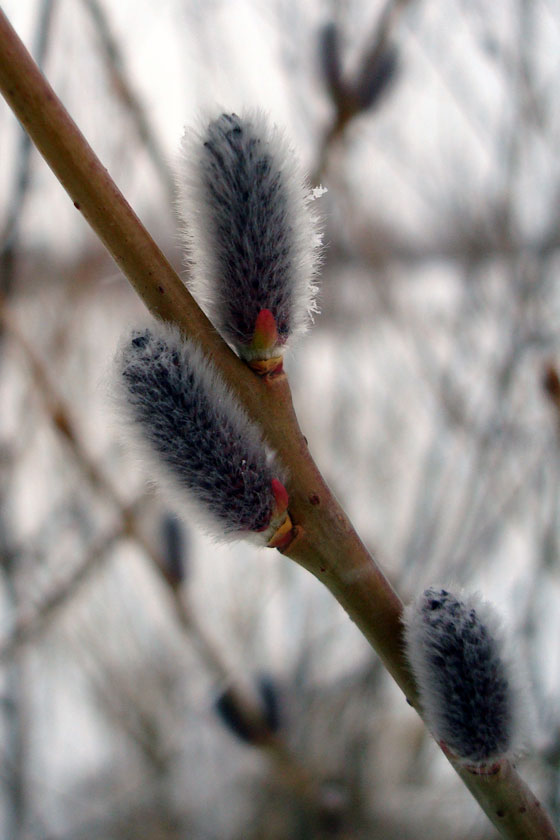
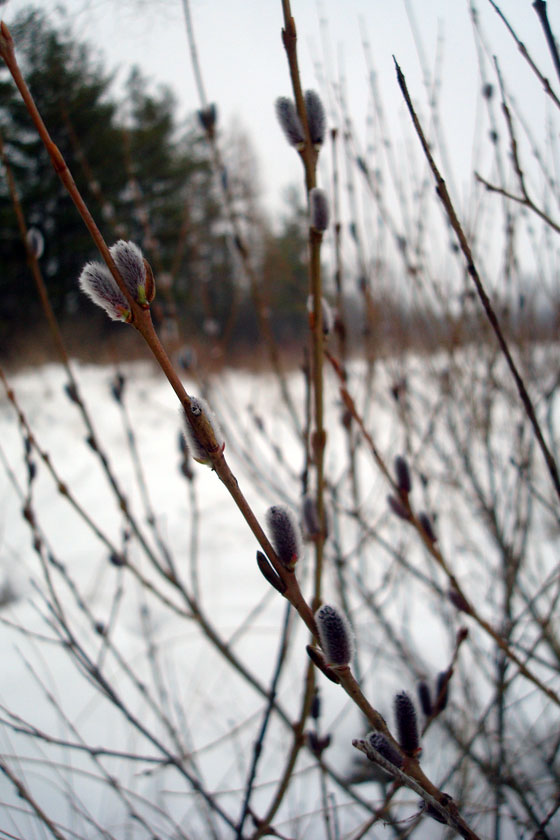
What looks like a pussy willow is growing in the creek alongside the driveway.

Pussy willow

Pussy willow

Pussy willow

The flowers–can I call these fuzzy things flowers?–are perhaps a bit sparser than the pussy willow of my memories, but other than that they look the same.

Anyone know if I can transplant this from the creek? I’d like to put it in one of the flowerbeds that are closer to the house.

April 2

April 2 has become my barometer of how spring is going to go.

The first year we moved to the farm, the forsythia was blooming on April 2. It hasn’t been that early since.

Each year I take a photo of the forsythia on April 2 and try to evaluate how long until we see blooms.

Given the mild winter we had this year, I’m thinking the forsythia might be close, but so far there’s no sign of the yellow blossoms.

You might recall that the past two years haven’t been great for our forsythia. The yellow blossoms have been few and far between. I gave the bushes a pretty vicious pruning last spring in the hopes that it might encourage some new growth.

We have what I think might be a few buds. And you can see where I hacked off the woody stalks.

Forsythia buds

Things were looking a little green around the farm, but then we got a dusting of snow Saturday morning.

Forsythia early spring 2016

It had mostly melted by afternoon, but then we got several inches of snow Saturday evening and more snow rolled in yesterday afternoon, so we’re back to winter now.

Forsythia bushes covered in snow

Looking at the pictures from April 2 going back to 2012, the snow rather than the forsythia tells the story of what kind of winters we’ve had.

Collage of forsythia through the years

Just a week ago, the forsythia was coated in ice, thanks to the ice storm.

Ice covered forsythia blossoms

So far, this spring has been very up and down. I’m not making any predictions of when the forsythia will actually bloom.

What’s spring been like where you are? What signs of spring are you watching for?

Icy Easter

Hello. How was your weekend? Did you have a good Easter?

Our Easter weekend ended up being extra long thanks to an ice storm that rolled through our area on Thursday. The storm closed both Matt’s and my work and turned off our electricity for 9 hours.

By Good Friday, the freezing rain had stopped, but temperatures had not risen, and a thick coating of ice covered everything.

Spring ice storm

Spring ice storm

Spring ice storm

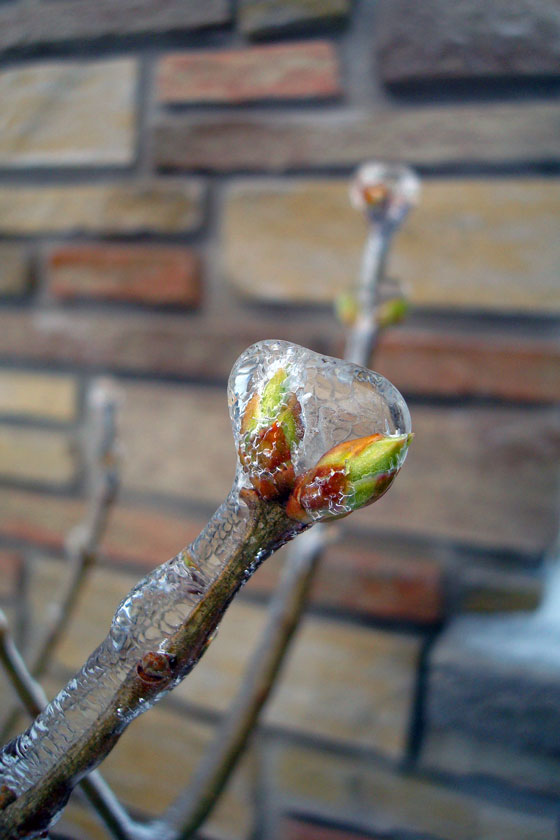
Just days into spring, and our lilacs had their new green growth encased in ice.

Spring ice storm

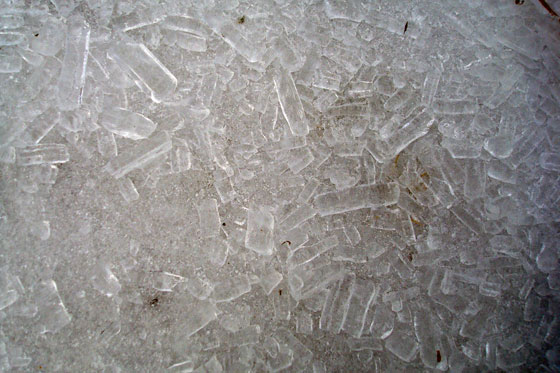
The ground was covered in ice chunks from the trees and bushes.

Spring ice storm

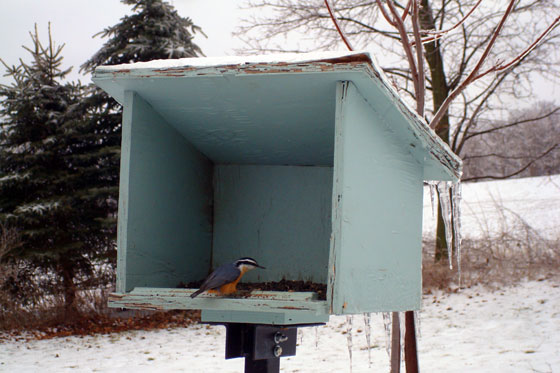
Icicles dripped off the back of the bird feeder and at the front there was a steady queue for the only food available.

Icicles on the birdfeeder

In the garden, icicles hung from the top fence rail and the chainlink was augmented with its own icy shield.

Spring ice storm

Fortunately, we didn’t have much damage. The worst was losing just a few branches off the pine trees.

Spring ice storm

The weight of the ice is incredible. Normally, we can walk easily under these branches that are touching the ground.

Spring ice storm

Down the driveway, more branches overhung far enough that Baxter could reach them.

Spring ice storm

Temperatures finally started to rise on Saturday afternoon. Ice slid off the roofs and the cars in sheets. Slowly the branches returned to their usual heights as the trees shed their icy casings, shards shattering into the ground.

By yesterday, Easter Sunday, the farm was back to normal.

What was the weather like where you are? Did you do anything special this weekend? How did you celebrate Easter?