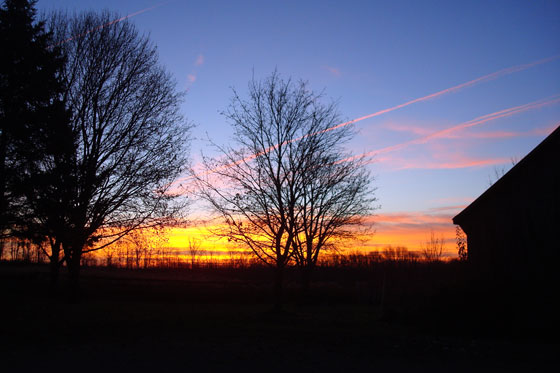
Walking on (frozen) water

A week or so ago, I talked about how I was trudging around the farm due to all of the snow. Thanks to a thaw and freeze last week, it’s gotten even worse. The temperature didn’t go up enough to melt the snow very much, so it’s still deeper than my knees. Then the temperature dropped, but just enough to freeze the surface into a very inconvenient crust.

Now I take a step and with a jerk drop down through the snow. The icy crust bruises my shin and grabs hold of my boot trapping me. My boots are full of snow, my shirt is soaked with sweat and my thigh muscles are burning. Walks are brutal.

Before he jetted off to Hawaii (I’m not at all jealous), my father-in-law left me his snowshoes. They may look more suited to being decorative objects hung on a wall, but desperate times call for desperate measures.

Vintage snowshoes

I strapped them on and took my first tentative steps.
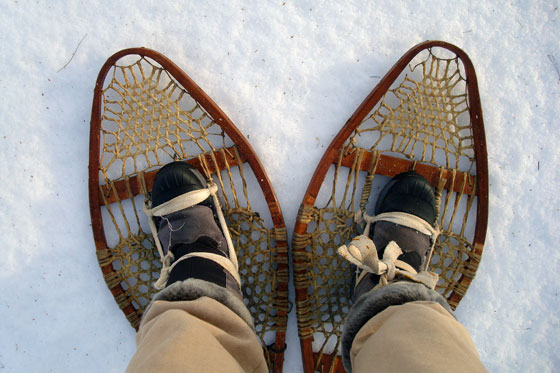
Hiking in vintage snowshoes

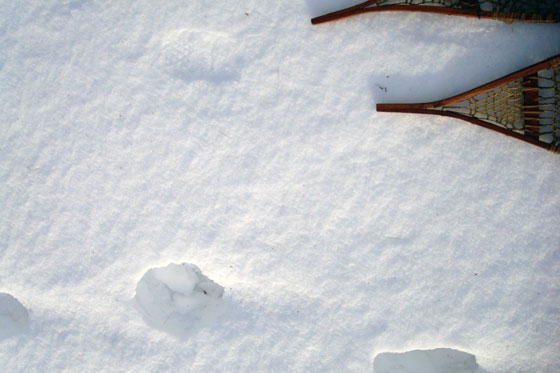
Antiques or not, these things still work. I can walk (waddle) without dropping down into the snow. In the picture below, you can see my crash-through path from the day before at the bottom and the gentle web prints from my new footwear at the top.

Hiking in vintage snowshoes

I am not coordinated at the best of times, so I can’t claim to be graceful or quick when I add snowshoes into the equation. However, after just one weekend I am already a snowshoe enthusiast. In fact, I’m already planning to upgrade my equipment. I’m thinking something made in this century might be a good choice.

Did you try anything new this weekend? Does anyone else use vintage tools or sport equipment? Have you ever gone snowshoeing?

Life lessons from my dog

When the going gets tough, I get trudging. With all of the snow and wind we’ve had recently, I spend a lot of time trudging.

In the photo below, I am up to my thighs in the snow, while Baxter the lucky dog lightweight stands on top.

Standing in a snow drift up to my thighs_

When the going gets tough, Baxter gets hopping. He makes like a bunny and bounds through the snow.

Sure, sometimes he lands in a drift that’s over his head. There’s a moment while he ponders the injustice of the situation and how he came to be buried up to his ears. However, then he gathers himself together and makes a larger leap, charging on through the snow.

Other times, he embraces the drift and dives in deeper, searching for real live bunnies.

This week, when work has been particularly hectic, when things seem to be much more difficult that they need to be and when I’m feeling particularly frenetic, a dog’s enthusiasm and joy for life are good lessons.

How’s your week going? Anyone else enjoying/dealing with particularly deep snow? What lessons have you learned from your pets?

A painter’s premonition

Matt’s grandpa was a painter. It was his hobby, and he was very skilled and prolific. Everyone in the family has a few of his works. This summer, Matt’s Dad came across a piece, and he immediately gave it to us. For our Christmas present, Matt’s parents had the painting framed.

It looks like it could have been painted at our farm.

Barn painting

What makes this a truly uncanny back to the future moment is that there’s a stump right at the edge of the driveway where the big centre tree stands in the painting. The small evergreens behind the barn ramp in the painting have now grown into our towering stand of pines.

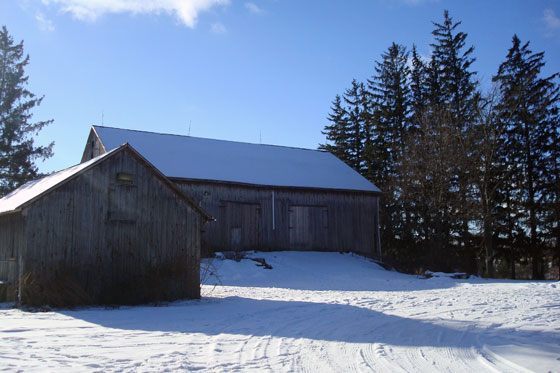
Barns on a sunny, snowy winter morning

Matt’s grandpa died in 1991. I never met him. With this painting, it feels like he is a part of our life at the farm in a very meaningful way.

Do you have any artists in your family? Do you have a painting of your house or property?

New Year’s Day skate

Ice storms are so 2013. For 2014, ice is going to be fun. We started on Jan. 1 with a New Year’s Day skate on the pond.

Ice skates on a frozen pond

Well, I was the only one who actually skated. Matt and Baxter just trotted around the ice rather than gliding.

Baxter and Matt walking on the frozen pond

Walking was safer than skating in some areas. Although the ice is mostly smooth, frozen coyote tracks here and there are tripping hazards.

Coyote tracks frozen in the ice

A few stumbles aside, a skate on my own pond was a fun way to kick off the year. This is how I’ll take my ice from now on, please… at least for the next month or so. In July I’ll probably want it cubed and in a glass. Although with the temperatures we’re having right now, the pond may stay frozen solid well into summer #polarvortex.

How did you spend New Year’s Day?

Freeze up

We’re at the time of the year when temperatures are rising and falling day-to-day. A week ago, the thermometre crept into double digits (up to 50º for those tuned to the Fahrenheit scale). This week, we’re having wind chills in negative double digits (down to 0º Fahreneheit). As a result, the view of the pond is constantly changing.

One day it looks like this.
Ice forming on a pond

The next day, the darkness of the water has expanded and the thin coating of ice around the edges has completely receded.

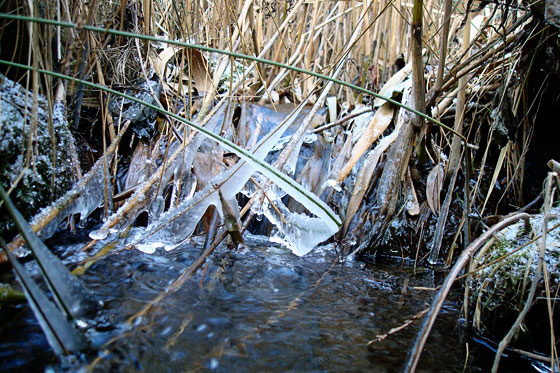
Our pond doesn’t like to freeze. It is helped in its quest to stay liquid by the creek that is constantly running fresh flowing water. Even here though, the cold takes hold and ice forms.

Ice covered grasses over a flowing creek

After a couple of days of cold temperatures and snow flurries, the darkness of the water is gone, replaced by ice.

Fuzzy cattails on the shore of a frozen pond

We’re not quite ready for skating yet, but we’re getting there.

What’s the weather like where you are? Does your thermometre count in Celsius or Fahrenheit? Anyone follow the Kelvin scale?

Top o’ the manure morning to ya

Our fields are in the process of being transitioned from hay to soybeans. Earlier this fall, our farmer killed off all of the hay, and at the end of last week, the manure men showed up.

I had an inkling that something might be in the works when on Baxter’s and my morning run on Friday–which takes place entirely before sunrise–a very, very large manure-smelling piece of equipment loomed out of the dark as we entered the big field. Baxter and I  were both a bit disconcerted, as it’s usually just the two of us alone. Once I ascertained that it wasn’t a) coyotes b) a UFO c) poachers, we were able to get on with our run, although Baxter continued to give it the stink eye (pun not intended, but I feel clever now, so I’m leaving it in) as we did our morning perimeter patrol.

Saturday morning, the rumble of machinery signaled that work was underway. Being the weirdo country newbie that I am, I rushed outside with the camera to document the process. I’m not sure that the manure contractors have ever been models before, but they were pretty tolerant of my presence and even took time to answer my questions.

Despite their explanations, I still know very little about manure spreading, so I’ll do my best to explain what I saw.

To start, this is a massive operation. The manure men were independent contractors hired by the farmer who rents our fields. They had traveled 3 hours by tractor that morning to come to our farm. Here’s just some of the equipment that was involved in manurefying our fields.

Equipment for manure spraying

Outside of the frame of this picture is a second tractor, a pick-up truck and another tanker. Each tanker holds 8,000-10,000 gallons of manure. Our front field, which is roughly 6 1/2 acres, took 7-8 truckloads of manure. Holy crap (okay, that pun was intentional).

The trucks were in a regular rotation, going to the veal farm down the road from our place to get filled with manure and then coming back to the farm to deposit their load.

The manure flows from the trucks, I’m assuming through some kind of pump, and then travels in long hoses across the fields to the tractor.

Hose for manure spraying

The big hose connects into smaller hoses on the tractor, which are each attached to a disc. It’s a bit hard to see here, but the rear window on the tractor cab has its own windshield wiper… a necessity for when one of the hoses has a “blow-out.” Ewwwww.

Tractor for manure spraying

Here is the spraying attachment folded up (for scale, the tractor’s tire is as tall as me).

Manure spraying attachment

The discs cut into the ground so that the manure goes right into the dirt, although some of it does pool on top.

Field that's been sprayed with manure

When the field is done, the hose rolls up onto a spool on the front of the tractor.

Manure spraying

Here’s an action shot of the spraying.

Tractor spraying manure

And here’s what our fields look like now. (For contrast here’s a picture from the same angle taken at the start of summer after this year’s first hay harvest.)

Field after spraying with manure

As for what our fields smell like now, well, I have to admit things are a bit stinky around here. It’s not as bad as I thought it would be (perhaps I’m building a bit of an immunity to “country air”). At the same time, I feel like I’m constantly smelling manure. Even when I’m in the house with the windows closed, the smell is still in my nose.

I’ll leave that part of the experience to your imagination.

Does anyone have any wisdom to share about manure spraying? How weird was it that I felt the need to document the whole process? Is anyone else dealing with a malodorous environment? Any idea how long it will take for the smell to fade?

Building a family tradition

There’s a tradition in my family of working on projects together. Always. For as long as I can remember. Take this picture, for example, of my Dad and I building a bird feeder. I had probably just turned four that fall.

Child and father building a bird feeder

Here’s my Dad and I posing with the finished product (and my little sister) as we put seed in the feeder for the first time.

Putting seed in a simple wood birdfeeder

Fortunately I have a nephew who likes building things with me, so I’m able to carry on the tradition that my parents established. When he and his brother came to stay with us for a few days, building a bird feeder was top on my list of projects.

Using the measurements from my Dad’s feeder, we drew it out on a sheet of 5/8 plywood. He held the wood in place while I cut out the pieces with my skilsaw. Then, we switched jobs, and I held the pieces while he nailed them together. We used a bit of wood glue on each joint and some 1 1/4 inch finishing nails.

If I was to build another bird feeder, I might consider painting it before putting it together, but let’s face it, when working with an almost 14 year old, waiting for paint to dry is as exciting as… well… watching paint dry. So we put the feeder together and, after letting the glue set, I was on my own for painting (and yes, I used pretty much the rattiest piece of plywood I could possibly find for the roof).

Bird feeder and pole

A few quick coats of paint on the feeder and one coat of Tremclad on the pole that my cousin welded for us–seriously, the most sturdy bird feeder post I’ve ever seen–the feeder was ready to go outside.

As my nephew hasn’t come back to visit yet, Matt stepped in as my helper. He hammered the post into the ground, and I screwed the feeder onto the post. Still nephew-less, I did the first ceremonial seed dump on my own.

Sunflower seeds in a bird feeder

Perhaps the birdies are waiting for his return before they partake of the seeds, because no one has come to test out the feeder as far as I’m able to tell.

I’m thinking it could be because they feel the feeder is a little exposed. I put it on the turnaround where I can easily see it from the dining room table. However, that means there’s no bushes or trees close by for cover.

Simple wood birdfeeder

Birds do hang out on the turnaround, so I’m hoping it’s just a matter of time before they discover the feeder. I know the design appeals because nearly 30 years later my parents still have the same feeder in their backyard, and they have a steady stream of customers.

If you’re interested in building a bird feeder of your very own, I drew out the plans and you can download them here. This is a perfect project to do with kids because it’s quick and there’s lots of parts they can help with. And if the birds ever show up, I’m sure they’ll like watching them snack too.

Do you have a bird feeder? What bird seed do you use? Any tips for enticing birds to a feeder? Do you like to build things with your children or nieces or nephews? Or did you build things with your parents when you were growing up?