The calendar now says it’s spring, and the temperature–and as a result the farm–is starting to agree.


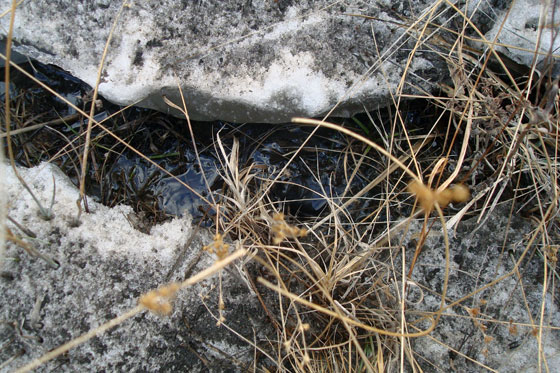
What’s spring looking like for you?
The calendar now says it’s spring, and the temperature–and as a result the farm–is starting to agree.
What’s spring looking like for you?

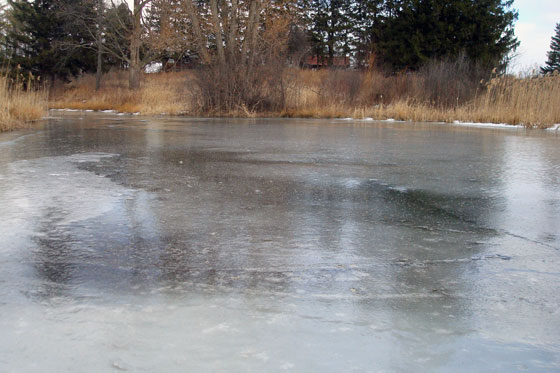
The pond on a wintery November afternoon.
You know that stale air musty house smell when you come back from vacation? After our week at the cottage last month, that’s exactly what Matt and I came home to. And then we walked down into the basement.
There we sniffed a distinct eau de damp.
Turns out that at the very start of our holiday, while we were lakeside, there was some water flowing at home.
A torrential downpour washed half the gravel down the driveway, overran the sump pump in the cold cellar and seeped through the foundation in the laundry room.
Believe it or not, we escaped with very little damage. The worst was some damp carpet in the long room and beside the laundry room. Some of the baseboards have swelled a little bit as a result, but overall it’s not too bad.
The cold cellar is about 6 inches below the rest of the basement, and the floor is concrete, so even though it appears that area was the sloshiest, the water didn’t seep into the main basement. Thank goodness.
Running the dehumidifier for a few days dried out the carpet.
The biggest bummer is that we had patched the laundry room foundation before we left on vacation… or we thought we had.
At one point, the laundry room window was a door into the basement. When we found occasional puddles on the laundry room floor, we figured that was the most likely source.
Matt dug out the foundation, I found a membrane at Home Depot, we stuck it onto the foundation and back-filled the hole. (Forgive the bad iPod photos. We temporarily misplaced the real camera).

Well, either we missed the location of the leak, our patch didn’t work, or the freak volume of rain would have overwhelmed the foundation anyways. Hence the eau de damp.
Back at the farm after our vacation as we were drying out the basement, we watched on TV as more torrential rains flooded a town nearby. When the storms rolled into our area, the rain spewed over the edge of the gutters and puddled right next to our apparently porous foundation. Uh-oh.
A break in the storm found Matt and me outside in our raincoats and boots. Matt fetched the extension ladder, I held it secure, and he climbed up on the roof to empty the eaves troughs.

Our pine trees shed like crazy, and their needles clog the downspouts. When the second wave of the rain hit, the gutters flowed like they should.
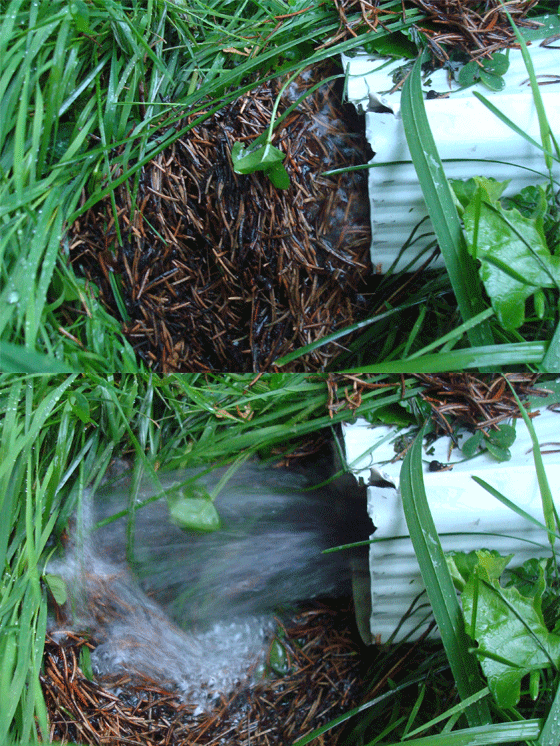
We’ve had more rain since then, and Matt has been super vigilant about making sure the water runs away from the house and that the basement stays dry.
So far so good.
The problem of the clogged eaves troughs and downspouts has been solved. Now if only we could solve the where-the-heck-is-the-water-getting-in? problem.
Who else has come home to a not so pleasant surprise after vacation? Have you ever dealt with leaky foundation issues? How often do you clean your gutters? I swear I did them a few months ago. Anyone else ever done some mid-storm water diversion?
I’ve written before how important it was to me to have a pond on our property.
Well, this spring we have a new pond, although it’s not quite what I imagined.
Behold the pond in the driveshed.

Can’t you just picture it? A peaceful afternoon at the shore, watching the trees reflect in the water’s surface, surrounded by recycling bins, tools and the smell of oil. Ahhh.
There’s always been a low spot inside the door of the driveshed. Occasionally after a big rain, we have a puddle. However, this year’s thaw resulted in more than a puddle. The really hazardous part of our new pond was that for a long time it was still partially frozen. The bottom layer of ice was extremely smooth and extremely slippery. Taking out the recycling took on a new layer of adventure.
Even now that the ice has melted, the adventure remains. Ralph was helping Matt with the garbage this week, and she had to make quite the leap to get in and out of the driveshed.
Addition for the spring to-do list: as soon as the gravel pile thaws, pick up a big scoop (or two) of stones for the driveshed.
How are things thawing at your house? Any water where it’s not supposed to be?
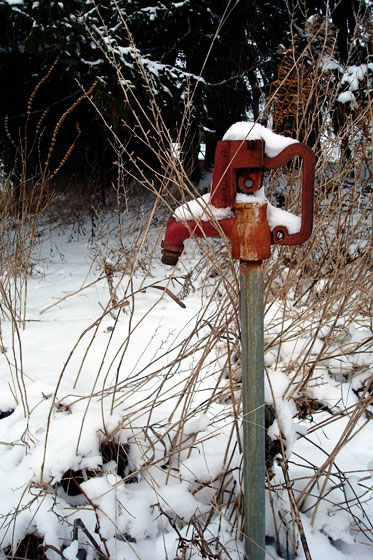
For the next couple months likely, our water will be in the frozen, fluffy white form.
Happy new year! I hope that you all had a great break. Thanks for waiting while I took a bit of an extended holiday. Our break ended up being a bit unusual, so for today I want to spend some time (okay, it’s kind of a long post, so perhaps I should say a lot of time) looking back before I dive into all that is new in 2014.
For some reason, I had my last post–my Christmas post–all set up more than a day in advance. I always have posts written a couple of days ahead, but I usually schedule them just a few hours before I want them to go live. I don’t know why I changed it up for this post, but I’m glad I did because by the time the post went live on Dec. 23, we’d been without power for about 24 hours. There was no internet on the farm.
However, it wasn’t just about not having any internet. We also had no heat. And we also had no water.
As many people are probably aware, a big ice storm rolled into southern Ontario on Dec. 22. Freezing rain coated trees and hydro wires, knocking out electricity to hundreds of thousands of people.
Power outages are not that unusual for us, so we weren’t too concerned when we heard the telltale beeps and clicks in the middle of the night as phones and other devices warned us they were no longer receiving power. By the time we woke up Sunday morning, the house was a little cooler than normal, so we snuggled down under the covers for awhile longer.
The fine print on the dogs are not allowed on the furniture and definitely not in the bed rule notes that exceptions are made during power outages on chilly winter mornings.

Morning Sunday: We were all disturbed from our cozy nest by a tree crashing to the ground right outside our bedroom window. Fortunately it missed the house, though I’m still not quite sure how. While Matt was content to investigate the situation from inside the house, Baxter and I headed out.
Ice more than a quarter inch thick covered the trees. The soundtrack to our morning walk was crack, crash, thump as branches broke, plummeted through the ice coated canopy and landed on the ground. We stayed well away from the treed perimeters of the fields, but I still consciously reminded myself which direction to run in case I heard a crack too close.
As we walked down the driveway to drag some fallen branches out of the way, we were surrounded by the scent of pine from the raw wounds on the trees in the forest beside the house.

Mid-day Sunday: We dug out the batteries to fire up a radio so that we could get an update from the outside world. I found the emergency number for the hydro company only to discover the line was too busy to reach even the automated system. We donned our hats and extra clothes. I sampled paint colours on the hall, kitchen and foyer. Matt graded papers… something he normally wouldn’t do until the very last minute. Baxter and I went for another walk. The crashing and cracking of trees continued. I flushed the toilet–muscle memory, I couldn’t help myself–and we were officially out of water.
For those not familiar with country living, we are reliant on our well for our water. Our well is reliant on its pump to provide us with that water. The pump is reliant on electricity to run. When the electricity runs out, we have the water in the pipes and that’s it. No more is flowing.
Evening Sunday: Darkness was falling, and the house was getting colder. We decided we needed a hot dinner, so we pulled the barbecue out of hibernation, hooked up the propane tank and retrieved a battered pot from our camping gear. I pulled out every candlestick we own and filled them with candles. Two cans of soup, some crackers, some cheese and pickles from our rapidly warming fridge, and we had a not-at-all romantic candlelit meal.
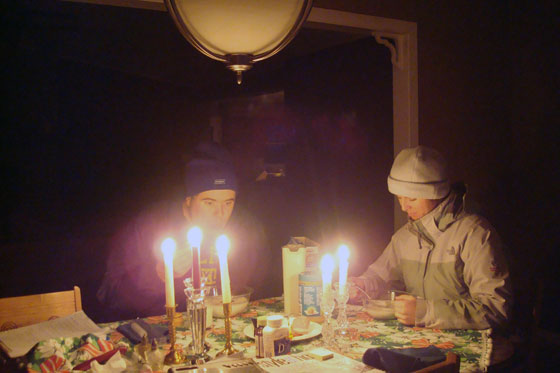
The only problem was, it was only 6 o’clock. We were done eating. Now what were we going to do? Scrabble followed by a marathon rummy session took us through to 9:30. I piled an extra comforter and two sleeping bags on our bed, and with hats on our heads, the dog curled between us and the radio playing, we went to bed in our 16 degree house.
Morning Monday: I have never been so happy to head to work on a Monday morning. Within 15 minutes of getting out of bed, I was out the door. That shower in the office bathroom was the best shower I’ve ever had. I had been wearing a hat for nearly 24 hours. I had not washed my hands aside from a cursory rinse in about 12 hours. I had gone for two vigorous walks with the dog. Let’s just say I was not at my best.
Evening Monday: Driving home my mantra was “Please let there be power. Please let there be power.” I turned into the driveway… and the house was dark. Matt had managed to get a shower at his parents house–they were also without power and on a well, but they have a generator that was connected to their water pump–but he had spent most of the day in the cold house marking papers and calling the power company only to be told they had no idea when our hydro might be restored, but we were one of 1,150 houses in our area without power. He transferred perishables out of the fridge and into the mudroom. With the window open, it was colder there than it was in the fridge.
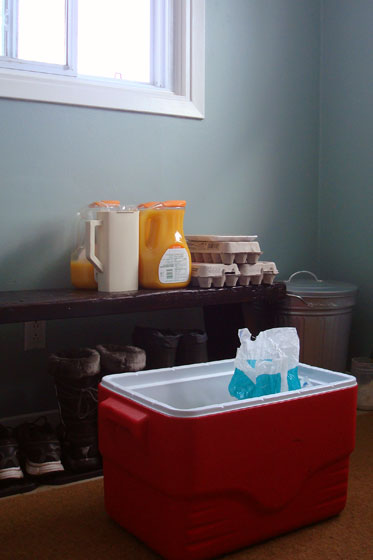
Our limited menu of cold food or barbecued soup did not sound appealing that night, so we tucked Baxter into his bed and headed out to find a restaurant where we could get a hot meal under electric light. It was easy to pick out the powerless people in the restaurant. They were the ones wearing the massive sweaters, yet still hugging themselves–both for warmth and for comfort. They were the ones with the hat hair–or the ones who wouldn’t take off their hats. They were the ones with the haggard faces. They were the ones that headed into the public bathroom after dinner to wash their haggard faces before they headed back to frigid pioneer-land.
Night Monday: Despite how hard it was to arrive back at that frigid pioneer land, Monday night was easier than Sunday night. We thumbed our noses at carbon monoxide poisoning and fired up the camping lantern for an hour, so I had enough light to read. Matt continued to mark by candlelight. I carefully made the bed, smoothing the sheets and layering the sleeping bags. Even though the temperature was 12 degrees, we slept well burrowed in our cocoon.
Morning Tuesday (Chrismas Eve): We were wearing our winter coats and could see our breath whether we were outside walking the dog or inside eating my cereal (with nearly frozen milk). We were down to 8 degrees inside. Matt continued marking, sure that the gods were just waiting for him to finish before they turned the power back on. However, as he wrote the last grade, the gods did not relent. We were still powerless 57 hours and counting.

Afternoon Tuesday: We were slated to go to Matt’s parents for Christmas Eve, so we decided to arrive early. We packed pyjamas and sleeping bags in case we decided once we got there that we couldn’t bear to abandon the luxury of heat and running water.
As we left the farm, we saw two hydro trucks at either end of our road. They were the first trucks we’d seen in our area, and we were so happy to see evidence that they were finally working on our lines. We followed one truck, which eventually pulled over. We rolled up beside him, and I leaned out the window and requested an update. The driver in the truck said that they were working on our block that afternoon and we should have power back in a few hours. We were ecstatic. We were going to have Christmas at home in our warm, lit, watered house.
Matt wanted to return to the farm to be there for the big moment, but I wanted to be warm that instant so we continued on to Matt’s parents’. Thanks to their generator there was warm running water so we could shower, and thanks to a woodstove we didn’t have to wear our coats and hats–Baxter included. We even watched a Christmas Carol—our annual Christmas Eve tradition—before we headed back to the farm.

Night Tuesday: Driving along the dark country roads with the headlights glinting off the ice coating the trees, we would catch occasional glimpses of lights through the trees. Some people seemed to have power. I tried not to jinx it, but may be we would too.
We turned into our driveway… and everything was dark. The light that we left “on” for our signal was not lit. We opened the door and flicked switches just to check. There was still no power. The temperature on the thermostat read 6.5 degrees. It was not a happy Christmas Eve.
Matt called the power company. There were now just 36 households in our area without power. And we were one of them. The ETA for return of the power? Boxing Day at 10pm. Nearly 48 hours away.
This moment was my lowest point. I was over it. This was not an adventure. I just wanted to be comfortable and home. But my home was completely uncomfortable. I was not going to stay in my frigid water-less house. We packed up some clothes, got back in the car and returned to Matt’s parents’ house.
The whole drive, Matt kept trying to say, “Well, at least we… ” I was not in the mood to look at the bright side of the situation. This was not how I had envisioned spending Christmas.

Clockwise from top left: Shattered ice caking our Japanese maple. The poor broken willow at the bottom of the driveway. Our Rose of Sharon, which is usually as tall as the dining room window. One of our new little trees bowed under the weight of the ice.
Morning Wednesday (Christmas): My father-in-law cooked breakfast on an electric frying pan plugged in to the one outlet powered by the generator. My mother-in-law and I walked up and down the road, looking at the ice coated trees, downed power lines and fallen branches. I sat next to the woodstove and read magazines. When I refused to leave the warm house, Matt headed back to the farm to check on the situation.
There was still no power, so he drained the pipes as best he could and poured antifreeze into the toilets. The temperature was now 4 degrees inside.
Afternoon Wednesday: Christmas dinner was to be at my parents’ house, so we headed out early to take advantage of their powered house. My parents had lost electricity as well, but only for about 24 hours. My Mom was able to cook dinner for 19 people, and we were able to enjoy a hearty meal.
Night Wednesday: Hope springs eternal, so after dawdling over the dishes for awhile at my parents’ we headed back to the farm. We turned into the driveway, and the outside light was on. As devastated as I was on Christmas Eve, I was equally elated on Christmas night. I nearly cried at the prospect of moving back into my house.
We walked in, and the thermostat already read 16 degrees. After the temperatures that we’d been living with, 16 degrees felt positively balmy. According to our blinking clocks, the hydro had come on at roughly 2:15pm–close to exactly 3 1/2 days after it had gone out. While Matt headed back to his parents’ to grab our things, I stripped the bed and threw all of the comforters and blankets into the washing machine.
Yes, the thing I wanted to do most after moving back into my house and being without power for half a week was laundry. The washing machine didn’t stop running for nearly two days, as I laundered bedding, towels, clothes, jackets, hats, mitts, sleeping bags and everything else we used during the outage.
As miserable as I was for my powerless Christmas, there were people much worse off. During the outage, I thought a lot about the farmers around us who had to take care of their animals without power or water. In Toronto (where I guess they probably had running water), some people were without power for the whole week.
I think for many it didn’t feel like Christmas. I know it didn’t for us. But now it’s a new year, and we’re all safe and sound and warm and watered. We’ll have a mini-Christmas celebration in a few months when we get a generator… ’cause you know there’s no way I’m going through this again.
Were you one of the powerless this Christmas? Were your holidays particularly memorable this year? Have you ever gone through a long power outage?
So I had a new experience in country living last weekend. A big vacuum on wheels showed up on Saturday morning. Except rather than vacuuming up fluff and fur like our new Sebo, this particular vacuum sucked up the contents of our septic tank.
(Yes. I have actually written a post about our septic tank. Feel free to skip this post if your stomach just did a little turn. Rest assured that the photos don’t get more graphic than this).

We never had the septic inspected or pumped when we bought the house, so when Matt’s Dad had his septic pumped by a new local company, we decided to hop on the septic pumping bandwagon. (What? You didn’t know that’s a thing?)
Pumping was as simple as taking the lid off the tank, sticking a big hose inside it and waiting until pretty much all of the contents were removed. (Seriously, people. You have no idea how carefully I’m wording this post).

Lessons learned during my first septic pump:
As a girl who grew up on city water, moving to the country has made me a lot more aware of where my water is coming from and where it’s going.
Rather than being grossed out, I actually found septic pumping pretty interesting.
While Matt made plenty of inappropriate comments, and I made numerous statements about the need for boundaries in a marriage, I also did say, “A sock? Let me see!”
Who knows what this Saturday has in store for me? What’s on your agenda? Have a good weekend everyone.
A thick fog on Friday night made for a hazardous drive home, and heralded the arrival of warm weather. Saturday afternoon found us outside without jackets. Saturday evening as we walked down the driveway in the dark we could hear water flowing in the creek.
Where the creek enters the pond, the ice has nearly disappeared.
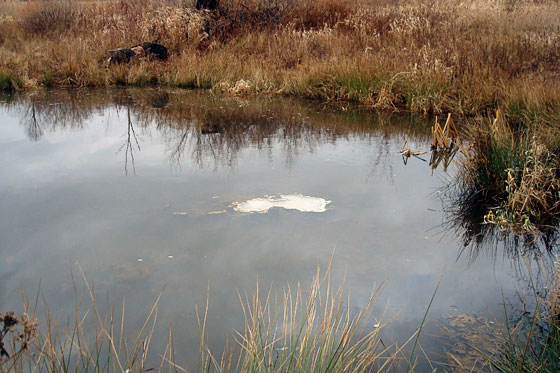
In the rest of the pond, the thin layer of ice that had formed on the surface has receded.

We’ll have to put off skating for another while yet.
Nothing is ever simple with us, and winterizing the water lines was no exception.
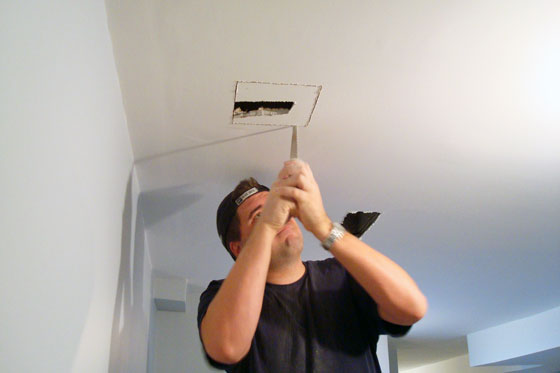
Tools used included a drywall saw, an air compressor and a mop.
The drywall saw was required to access the one shut off, which was in the ceiling in the ping pong area of the basement. We knew it was there and had marked its location when we were installing the drywall. (The other cut-out in the ceiling is a heat register).
We hung buckets by their handles from the taps to catch the water as we drained the lines. However, we quickly ran out of buckets, so Matt used what was available: one of our empty paint cans.
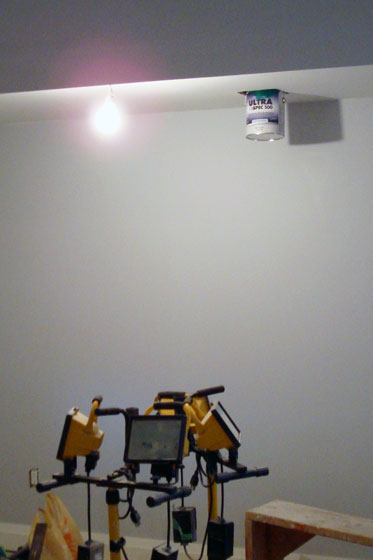
Paint cans dangling from the ceiling is not the decor we’re going for in the basement. Fortunately, this line drained quickly, and Matt was able to install the access panel that we bought to cover the hole.
The water line to the driveshed needed a little help to drain, hence the air compressor. The low point of the line is in the utility room in the basement, so my Dad connected the air compressor to the tap at the driveshed and let ‘er blow.
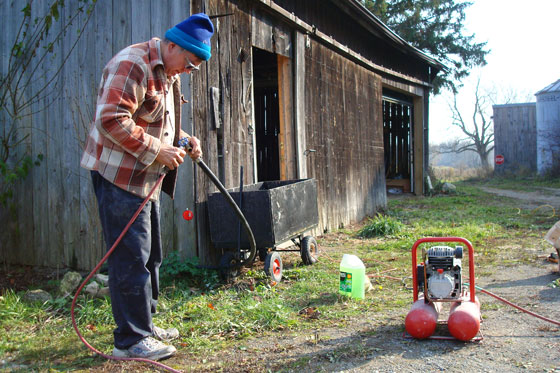
While the utility room is the low point, there’s obviously another area somewhere in the line where the water pools, because there was much more water in the line than I expected. The force of the air was a little too much for the bucket we’d hung on that tap, and we ended up with water sprayed all over the utility room.
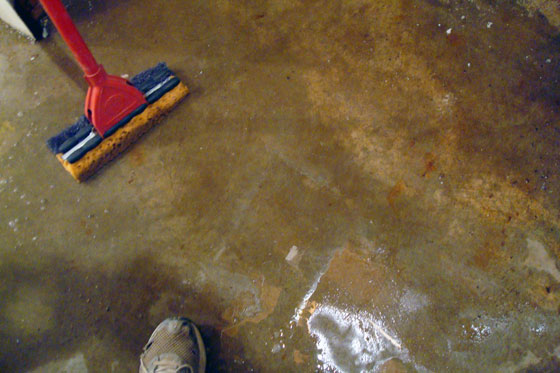
It was nothing a mop couldn’t fix, but since the water flowed out into the rest of the basement we were very relieved that our new carpet isn’t installed yet.
Once the line was clear, we poured some antifreeze down the pipe just for extra protection.
Our third exterior tap and the old line to the barn were winterized without issue. The old pump and pressure tank in the barn are probably not fully drained, but, given their deteriorated state, I’m not concerned about any further damage. The line itself is clear and is also below the frost line, so when we’re ready to have running water in the barn we should be able to put it into service.
Winterizing the waterlines was at the top of the list of our fall chores, and it feels good to cross off another to-do.
Have you winterized your waterlines? Or is your climate gentle enough to not freeze your exterior hoses? Anyone else dealt with basement floods recently? Do you have any jobs that ended up being more complicated than you expected?
As I mentioned yesterday, the more we looked at the water system at the farm, the more problems we found.
Just a basic fix would have involved:
We would use the existing well and the pump system would stay in the barn.
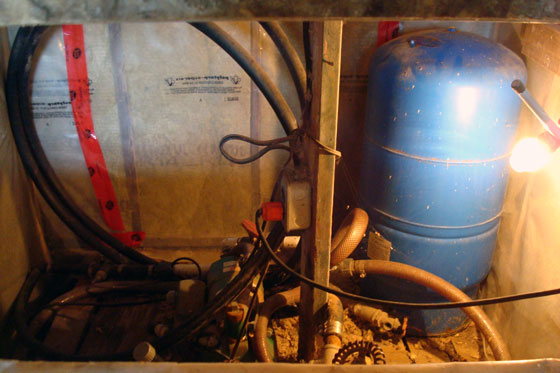
A view inside the old “pump house” in the barn
The whole system would still not be up to standard, either for the Ministry of the Environment or for us.
We quickly came to the decision that fixing the problems was not good enough. We chose to start from scratch.
The first step was a new well.
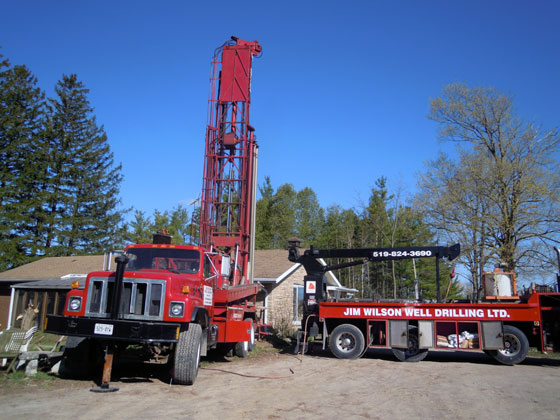
The drill rig in place beside the house
Our new drilled well is 75 feet deep with a production level of 25 gallons per minute–a really good depth and a really good rate (as opposed to our old 25 foot deep “non-standard homemade” well). It’s right next to the house meaning we have much better water pressure and most important of all it’s up to Ministry of the Environment standards.
My Dad, who was supervising the well drilling, left a note to update us on what had happened while we were at work. After listing all of the specifications, he concluded with “Drinks is on me. Love Dad.”
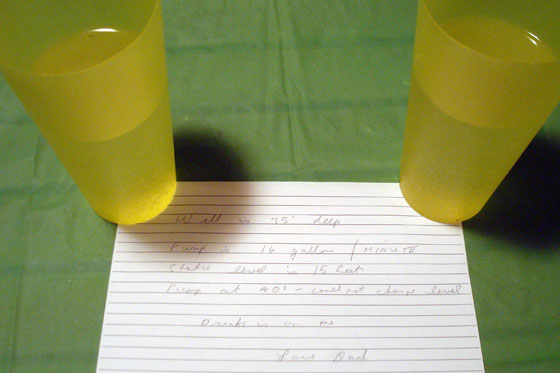
He’d filled the glasses with water directly from the new well. I took a sip, but Matt refused the sample until we had the treatment systems installed inside the house.
Inside the well, we have a new high-efficiency submersible pump, which is much better than the old jet pump that was in the barn. The pump feeds into a constant pressure system in the house. This means that our water pressure is steady no matter how many taps or appliances are running, and the pressure is comparable to what we had when we were on city water.

The constant pressure system includes an electronic controller (the black box above) and a cushion tank (blue) with a brass pressure log manifold assembly.
Next up in Operation H2O were the treatment systems.
As soon as the new well was drilled and the water was clean, our contractor took a raw water sample to determine exactly what treatment we needed. High iron content was a major issue with the old well, but no one knew whether that would continue with the new well.
It turns out that it did, so we installed a high efficiency, high capacity, chemical free air injected iron removal system. The air that’s injected oxidizes the iron (basically turning it to a solid particle–rust), and then the filter traps the rust and removes it from our water. In addition, we got a new softener–this one is actually connected!–and an ultraviolet sterilizer system.
The UV system is for bacteria, which is not likely to be an issue given our new well. However, it’s possible that the water table could become contaminated from another well in the area or some other source, and now we’re protected.
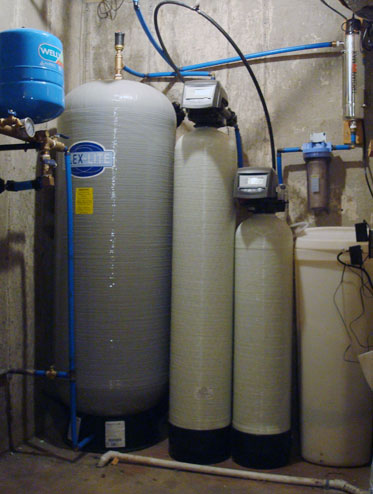
From left to right, we have the blue cushion tank, a big retention tank for the iron, the iron filter, the water softener mineral tank and the brine tank which we fill with salt for the softener. The UV filter is mounted on the wall above the brine tank.
The final piece of the new water system was a reverse osmosis drinking water system. This is not a necessary piece of equipment, but Matt and I decided to go for it. Between the two of us, we drink a lot of water. Because of the salt used in our softener, the water in the house has higher levels of sodium. It’s safe to drink, but we definitely don’t need more sodium in our diets.
The reverse osmosis system is made up of a series of filters and a 14.4 litre tank that all sit in the cabinet under the kitchen sink. Our treated, softened water runs through these filters and then is pushed through a fine membrane that removes all of the salt and any other particles or impurities that might be in the water.

The reverse osmosis filters are in the three canisters on the left and the holding tank is in the centre of the picture
The storage tank is connected to a small faucet on the back of the sink where we have drinking water on demand.
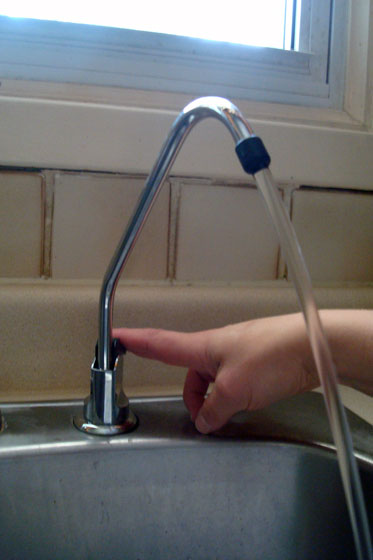
Nice clean water. Yum!
While all of this work on the water system inside the house was happening, we took advantage of having the contractors on site to make a few upgrades to the outside system as well. The old water line that brought water from the barn into the house was reversed so that we can run water from the new well to the barn. As well, we added an exterior hose at the drive shed by connecting a new line from the house and trenching it across the driveway.
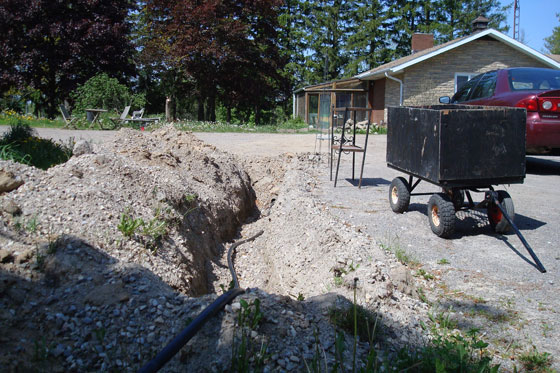
We’ll backfill the rest of the trench once we finish connecting the hose. How do you like our barriers so that no one drives into the trench?
Redoing the whole water system for the farm is a big project, and it was not in our original plans. However, the results make it worthwhile. With all of the equipment in the house, we don’t have to rely on a light bulb to keep the pump from freezing. We have good water pressure, no more iron or hardness and great peace of mind from knowing that everything is clean and safe.
 Home on 129 Acres