Going to camp

I don’t like to leave the farm, especially on the weekends when I have a big list of things I want to do and time to just enjoy the property. However, when I heard that WordCamp was coming to my hometown for the first time, I decided that was too much of an opportunity to pass up. After all, I said that one of my blog goals for year two was to maybe participate in a conference or professional development event.
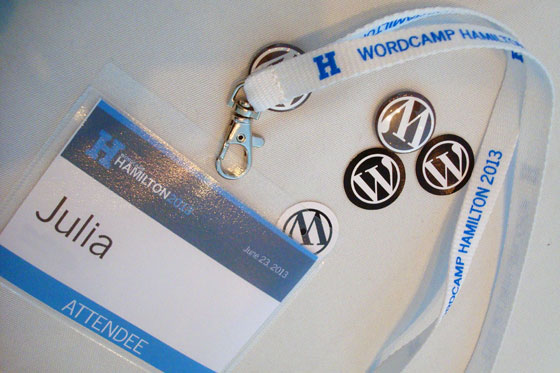
Word Camp name badge

According to the official web site, “WordCamp is a conference that focuses on everything WordPress.” The first WordCamp was organized in 2006 in San Francisco by Matt Mullenweg. Since then, there have been more than 200 WordCamps held in more than 100 cities around the world.

My first WordCamp lived up to the official description of “informal, community-organized events” for everyone from casual users, bloggers, programmers to core developers.

I learned something in every single session–even the more technical ones. Here are just some of my takeaways.

On overall blog philosophy:

  • Don’t be afraid to be human.
  • Write first, code second. Blogging is not about the platform or coding. It’s about conversation and thought.
  • It doesn’t have to be pretty. It needs to function

On blog content:

  • Consistency–of tone, topics, visuals
  • Frequency–you don’t have to post everyday, but have a regular schedule that works for you
  • Categories–make it clear who you are, what you write about and help people to navigate your blog. One presenter phrased it as “Categories are great for external search.  Tags are great for your internal site search.”
  • Personality–be yourself

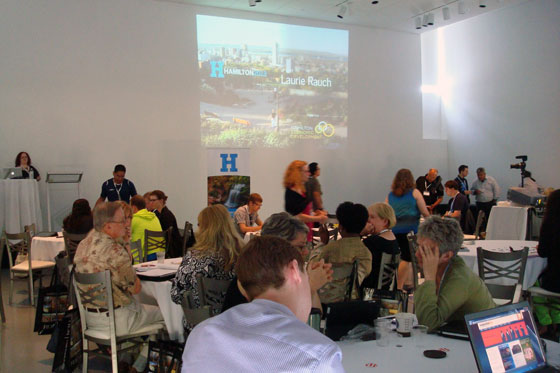
Attendees at WordCamp

On mobile (a session that was a little bit over my head):

  • “Developers and designers broke the web” (I love this quote). Simple text sites became pixel perfect print-esque designs, and these pages don’t work on the small screens of mobile devices.
  • On mobile, the screen is smaller, and the pointer (finger) is bigger
  • Responsive design adjusts how your web site displays based on what devices users are on (ReSS is the next generation to responsive design)

On customized–or semi-custom–designs (something that I’ve been considering ever since I started blogging):

  • You can build a child theme that’s based on an established WordPress theme (the parent theme). You’ll still get all of the updates and features of the parent theme, but the design and some of the functions will be tweaked to your preferences. I didn’t know this was even possible. I thought a custom design was built completely from scratch. I’m quite excited by the possibilities of child themes.
  • When selecting a parent theme, choose one that has the functionality that you like. Look for ones with lots of widgets and flexibility. You can change the design easily through CSS.

On hosting:

  • From any hosting service, expect 99% uptime, 24/7 support, system health dashboard, off peak hours maintenance windows
  • Do backups as frequently as you post new content. Back up source code, plugins and themes as well as content.

Here’s a picture of the final panel featuring most of the speakers: (from left to right) Al Davis, Richard Rudy, Laurie Rauch, Joey Coleman, Kristin Archer, Todd Dow and Kevin Browne (missing Seema Narula). They were all great. If you want more details about what anyone said, Todd Dow posted a good summary.
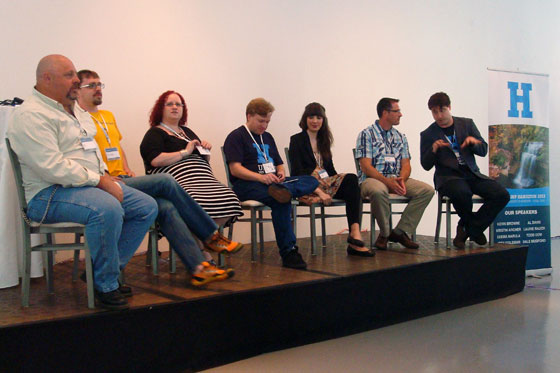
Panelists at WordCamp

I have to give kudos to all of the organizers and volunteers too. They put a lot of effort into making the day as useful as it was.

Since I started blogging more than a year ago, I’ve been very impressed by how supportive other bloggers are to each other. WordCamp was another illustration of that community. The first presenter of the day said, “If you know something teach it,” and that’s exactly how everyone–presenters, organizers, attendees–approached the day.

The enthusiasm and generous advice from other people at WordCamp may have inspired me to try and learn CSS. My programming knowledge is limited to rudimentary HTML that is more than a dozen years old. I’m hoping that knowledge might give me a bit of an advantage, but I’m also still a bit daunted by how much technology has changed since I did any programming.

I’m also going to try and inject a little more personality into my posts. Sometimes I feel like my posts are a bit shallow. Renovations and gardening and farming are still going to be the bulk of my posts, but I’m going to try to share a bit more about who I am.

For anyone considering attending a WordCamp or another networking or blogging event, I say go for it. I was a little uncertain about whether I’d fit in with the other attendees.

I mean, I’m not a professional blogger. I don’t have any advertisers or sponsors. I have less than 100 readers a day.

I was surprised to find out that I actually had more experience than a lot of the attendees. There were absolutely some professional programmers in the room, but there were lots of new or wannabe bloggers there too.

One of the messages that a few of the presenters had for the audience was if you’re thinking about blogging, just do it. Give it a try and see if you like it. Start. The lesson also applies to conferences. If you have an opportunity to attend WordCamp or another event, don’t be intimidated. Do it.

How about you? What advice do you have for bloggers? Have you ever been to WordCamp or another conference?

That time again II

Basket of strawberries

Our local strawberry farm opened last week, and you better believe I was there during the opening hour on opening day. I picked two baskets before heading in to work, and the next morning went back to pick some more.

So far, we’ve been eating strawberries for breakfast, lunch and dinner.

Strawberries with whipped cream and on cereal

Still on the menu for this week: waffles with strawberry maple syrup.

I love this time of year.

Have you had many strawberries yet this year? How do you like to eat them? Does anyone else have a bowl of whip cream in the fridge? Who else has gone picking? Are you growing your own berries?

That time again

The first day of summer meant the first harvest of the year on the farm.

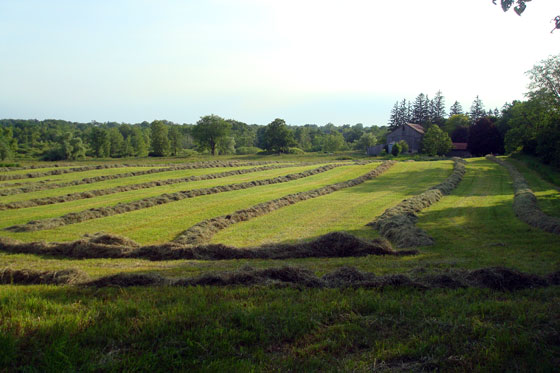
The field behind the driveshed had been mowed earlier in the week, and by the time I came home on Friday, the hay was dry and had been mounded into long rows ready for baling.

Mowed hayfield waiting for baling

As soon as I got out of the car, I could hear the clanking of machinery in the big field. Matt and I walked out to see what the commotion was.

Two big tractors were baling the hay. Unlike last year’s first cut when we had big round bales, this year we had massive rectangle bales. Allow Matt–all six feet of him–to illustrate the scale.

Large rectangle hay bale

As best I could tell, each of these huge hay blocks is made up of about 21 smaller size rectangle bales. For those not familiar with hay, it’s not any one plant. Each hay bale is made up of a variety of grasses, clover, flowers and other plants. Last weekend, when I walked out to the back field, I snapped some shots of the most frequently occurring grasses.

Grasses that make up hay

I’m not knowledgeable enough about haying to tell you what any of these grasses are. According to the farmer who manages our fields, we have a good crop of hay for this first cut thanks to a good amount of rain this spring and some doses of fertilizer earlier in the season.

Just like people have to mow the grass on their lawn weekly, the hay will grow back, and we should be able to have a second cut–or maybe even a third–in one year. Something I learned last year that surprised me was that the second cut is usually better–as in more nutritious–than the first.

So this scene may repeat yet this year.

Tractors baling hay
How did you mark the first day of summer?

Bird’s eye view

A few weeks ago as we headed into this year’s major undertaking that is landscaping, I posted an overview of what I call the residential portion of the property. That post got me thinking that you might be interested in seeing the whole farm. So let’s zoom out a bit, shall we?

Birds eye view of the farm

Voilà. The farm. All 129 acres of it. Clear? Good. Post done for today.

What? Oh. Not clear? Perhaps you’d like some explanation of where and what things are.

Layout of our farm

Obviously, the residential portion is a very small part of the property.

The farm is a fat L-shape. The small severance on the west side belongs to the people who owned the farm three owners ago.

During our real estate search, it was very hard to find farms that hadn’t been chopped up over the years. Lots of them had rows of small one acre lots cut off on all sides, and it became a running conversation between Matt and me about how I didn’t want a property that was missing any pieces of pie. This single severance is relatively small and tucked around the side, so I don’t notice it too much. Ironically, it’s an unusually shaped lot: triangle, just like a piece of pie.

Anyways, before you all leave me and go looking for dessert, back to the explanation of the farm.

At the top of the image (on the west half), the dark squiggly line cutting across the top left corner is the creek that runs across the front of the property and under the driveway. It flows into the pond and then continues out to the back half of the property, which is mostly marsh.

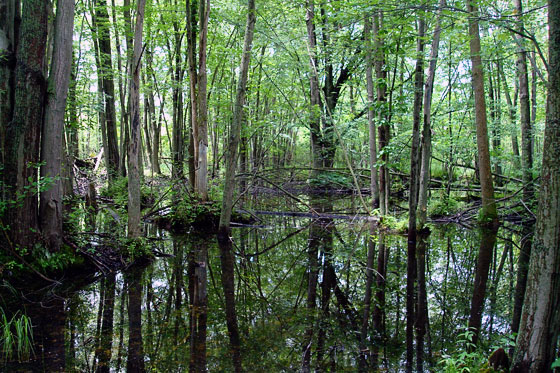
When I describe the property, I say that about half of it is cleared for hay fields and that the other half is natural. The natural half is very wet, but it’s also thickly forested.

Marsh

According to the third season of Sarah’s House (where Sarah Richardson bought her farm), an acre is about as big as a football field and fits 16 small city lots. So using that math, we could have more than 2,000 houses on our property–or a whole lotta guys in tight pants. Yikes.

One of our most frequently asked questions is, “What are you going to do with all of that land?” My answer is always, “Enjoy it.” The opportunity to live in these surroundings is a luxury that I do not take for granted.

I’ll admit that my environmentalist side was one motivator in buying such a large property. I am not a fan of suburbia, and I’m happy that I can preserve this small (or large, depending on how you look at it) corner.

Self revelations

I can be a bit snobby sometimes. I’m somewhat prim.

So when a caricature artist showed up at the very fancy restaurant where my sister was having her wedding rehearsal dinner, ready to draw all of our portraits, I may have sniffed a bit disapprovingly.

Matt and I were up first. There was no way out. After all, it’s not proper to insult my sister or her soon-to-be mother-in-law.

The artist—a large man who looked a bit like Steven Seagal, with a long ponytail wearing a Samuel L. Jackson beret—asked us in a loud raspy voice to tell him about ourselves. Matt said, “Well, we live on a farm.”

And that’s all it took.
Carticature of man and woman driving a tractor

Perhaps it because the farm has become so central to my identity, and I love it so much. Perhaps it’s that Wiley was included in our family portrait. Perhaps it’s because Matt and I are obviously having really, really good hair days.

I love our caricature. The artist was amazing. He captured us well (although I absolutely do not have those cheekbones IRL, and I don’t recognize that chin that Matt’s sporting). He was very friendly and obviously very skilled at his craft.

This picture is being carefully protected until I find a frame and hang it in the basement. I think it fits in perfectly with the fun atmosphere I’m trying to create down there.

So lesson of the caricature: loosen up, have a little fun, be open to new experiences, don’t worry so much about what’s proper. In this simple caricature, I found a bit of extra happiness, both in the moment of the portrait and now whenever I look at it.

Thanks to my sister, her mother-in-law and our amazing artist, Cartoon Bob.

Lakeside Living Home Tour

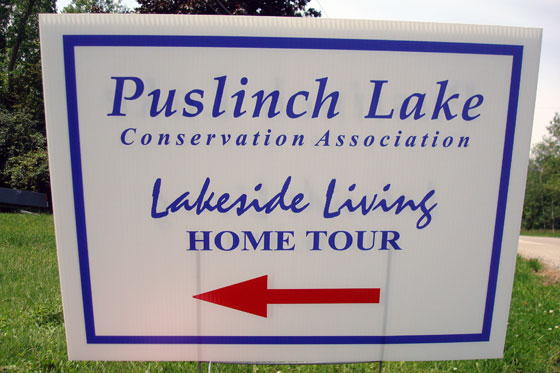
Sign for Lakeside Living Home Tour
Not far from the farm is a decently sized lake. One day each year, various residents on the lake open their homes for tours. I missed last year’s, but I knew I wanted to go this year, so Saturday morning I slathered on my sunscreen, grabbed my camera and headed out.

The tour is run by volunteers and funds raised support the lake’s restoration. People from all over the lake take part, shuttling visitors from house to house on pontoon boats.

Pontoon boats

At each stop, more volunteers greeted and directed us, including these two pint-sized safety-conscious tour guides.

Kids in life jacketsI was very impressed by how the whole community came together for this event. A few of the houses even had artists set up outside painting.

Artist painting a picture of a house

The houses we toured ranged from rustic cottages…

Woodsy cottage

To slightly grander new builds.

Large stone house

Many of the homes were quite personal and had some unique features. Like a sink made out of petrified wood.

Petrified wood sink

A screened porch with a built-in barbecue, vent hood, tap, flat screen TV, stainless steel counters, stamped concrete floor and large wood-topped bar.

Outdoor kitchen with built in barbecue

Unusual light fixtures.

Swirly pinwheel chandelier

Built-ins constructed by the homeowner from reclaimed wood.

Library built-ins

A hammered sink from Mexico set in an antique dresser.

Hammered metal sink

I wish I had a better picture of this vanity, because the dresser was amazing. In fact the whole bathroom was pretty unique with murals painted on the wall and the tub clad in wood that matched the dresser. Unfortunately, I couldn’t zoom out enough to get the whole room, and I thought climbing into the shower to get a wider angle might be too a bit to invasive.

While I don’t think a petrified wood sink is totally my style, the tour did give me a couple of inspiring ideas for our place. I think pretty much everyone on the tour was inspired by this closet.

Walk in closet with built-ins

On a slightly simpler scale, I love this twig and branch archway. I think something like this would be great at one end of the vegetable garden.

Arch constructed out of tree branches

Seeing some unique homes, supporting my local community and floating around a calm lake on a bright sunny morning. Not a bad way to spend a Saturday.

Small island in a lake

What did you do with your weekend? Anyone else get away to the lake? Have you ever gone on a home tour? Or have you had your home featured in a home tour? Who wants a wooden sink?

Oz

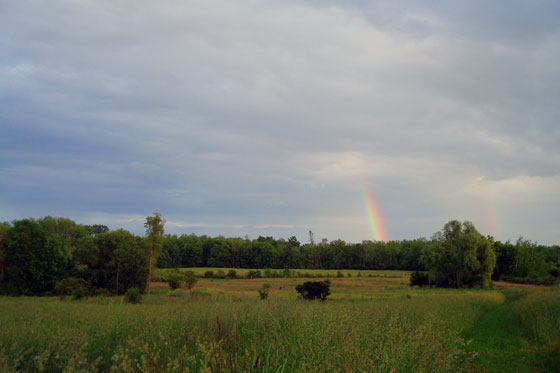
We’re definitely not in the emerald city, but last night somewhere over the emerald fields and out beyond the verdant green forest, we had a beautiful rainbow.

Rainbow over a green hayfield

It has been a very rainy week—a rainy spring, in fact—so I’m hoping this rainbow is a sign that the weather is taking a turn for the better.

Fortunately, the farm is not plagued by any flying monkeys. However, we do have enough mosquitoes to carry off a small dog or a full grown woman, so heading out into the hay fields to take pictures of rainbows is hazardous.

Mosquitoes biting my hand

Raindrops, mosquitoes, even flying monkeys, bring it on.

There is absolutely no place like home.

Path preview

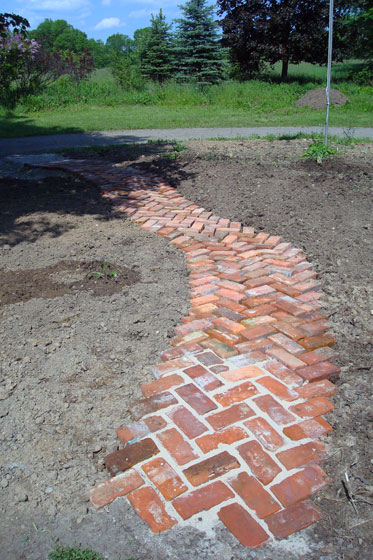
Please gaze upon my bliss.

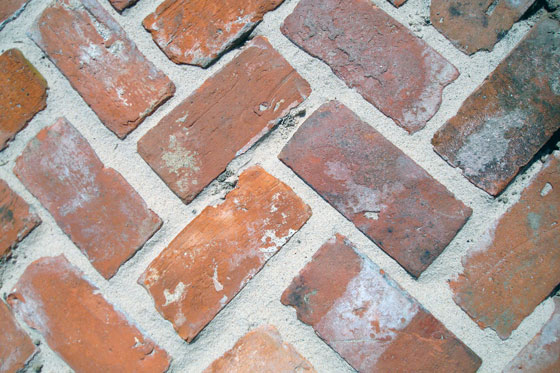
Herring bone brick pathway

Yes, that’s right. My definition of bliss is a brick pathway. So what?

But isn’t it so pretty? I realize some of you who voted for the traditional brick pattern–or “running bond” as I learned from a commenter–may not agree that this looks lovely. The vote came out very close, which really surprised me: 63% herring bone to 38% brick. I honestly thought herring bone would be the clear favourite.

I chose to go with the herring bone after spending a few days looking at the layouts that I’d mocked up last weekend. I just decided that I really, really liked the way it looked.

Bricks laid in a herring bone pattern

Laying the brick in the herring bone pattern and getting the bricks to bend smoothly around the curve was a bit more challenging than it would have been if I’d chosen another pattern, I’m sure, but I just fudged the spacing between the bricks as I needed to.

I still have to fill all of those spaces with sand. I found two bags of something called “magic sand” in one of our junk piles. The description said that it was a polymer infused sand made to fill the joints between paving stones. That sounded like just what I needed so I dumped the bags onto the bricks and managed to fill the joints for the first three feet of pathway. I’ll pick up the rest of the sand this week and hopefully finish off the path next weekend.

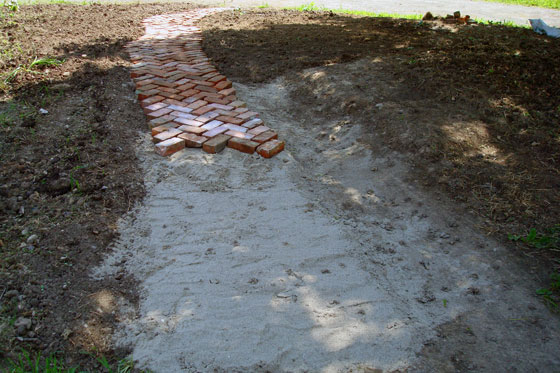
I say hopefully because along with needing more sand, I also need a few more bricks. What might be a little hard to see in the top photo is that as the path heads into the shade, about six feet from the end, I ran out of brick.

Brick pathway laid in a herring bone pattern on a bed of sand

I knew I was going to be short, and I actually made it much farther across the turnaround than I expected to. Apparently 362 bricks are just not enough. They are enough to make me blissfully happy though.

Time to zigzag or stay on the straight and narrow?

Remember this picture from my 2013 home goals?

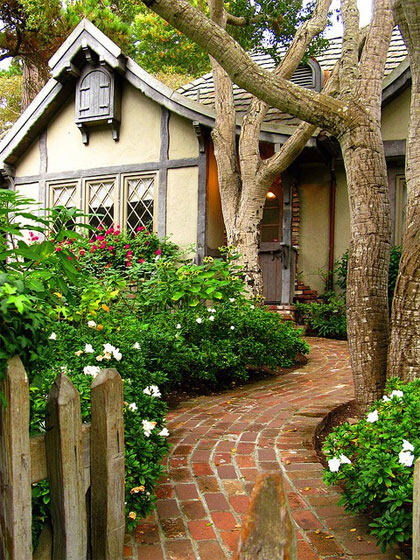
A lush garden with a brick path winding through it

This is my inspiration for the garden I’m building on the turnaround at the front of the house. Lush. A little bit wild. A beautiful brick walkway winding through.

Honestly, the path is an excuse to use up some of the piles of bricks that we have lying around the farm. But, it does have two additional benefits: the path will save us from having to walk all the way around the turnaround when we want to get to the other side (it’s farther than you might think) and it will be an attractive feature at the front of the house (I hope).

The path is next up on the landscaping list. I’ve dug out the route across the turnaround and gathered my bricks. Now I’m just trying to decide how to lay them: trendy herring bone or traditional brick pattern.

Herring bone brick walkway

If I go with the straight brick pattern, I’ll probably do six courses, not the five that are pictured here. If I go with the herring bone, this is pretty much what it’s going to look like. I’m not going to cut the bricks, so the edge will be a bit ragged. It will probably be hidden eventually by all of the lush plants, but that might take a little while.

I think I know what you’re all going to say, but I’m going to put it to a vote nonetheless. What do you think?

For those who might be concerned by the photo above, I am not going to lay the bricks directly on the dirt. I’m planning a base of sand, which we also just happen to have a huge pile of lying around. I’d use gravel, but the gravel in our pile (yes, we have one of those too) is a bit too large to provide a really stable base.

No matter what pattern I end up using, I’m planning on leaving about a half inch gap between the bricks. Does anyone have any experience with polymeric sand? I’ve heard that it’s good for filling the spaces between the bricks.

Feel free to expand on your opinions on polymeric sand, the beauty of herring bone, dos and don’ts of brick laying, fast growing plants and any other topic that strikes you in the comments. I appreciate any advice.