Landscaping: Phase 2

I said at the beginning of the week that I’m declaring the start of July as the end of phase 1 of landscaping. We all know that the end of one thing is the start of something else, so it is also the beginning of… you guessed it… phase 2.

Yes, I still have things to finish up from phase 1, but let’s not get technical here.

For phase 2, I’m going to use the same technique that I did in phase 1. Walk out the front door and start with the first thing I see. Except this time instead of turning right, I’m going to turn left. Earth-shattering strategy, I know.

So what will I find when I turn left? Something that looks a little like this. (Our roof is not as green IRL as it appears in this photo).
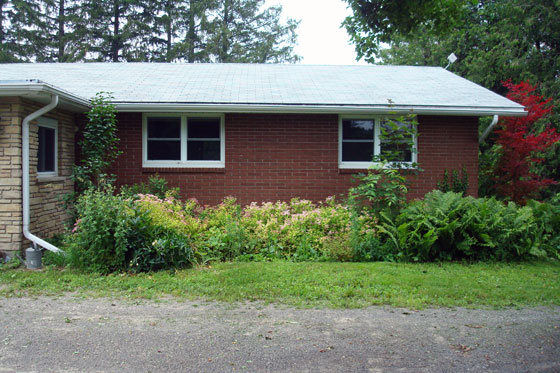
Garden of spirea and ferns

From a distance it may not look that bad, but in reality it’s an overgrown jungle of spirea and ferns. I’m a variety is the spice of life kind of woman, so I need a little more diversity in my garden. I’ll be digging out a decent number of the plants. They will not go to waste though. (Remember the massive turnaround garden that needs plants?)

However, gardening here is never as simple as just weeding, pruning and transplanting. Take these rocks for example (and yet another plastic plant pot that escaped the earlier purge).
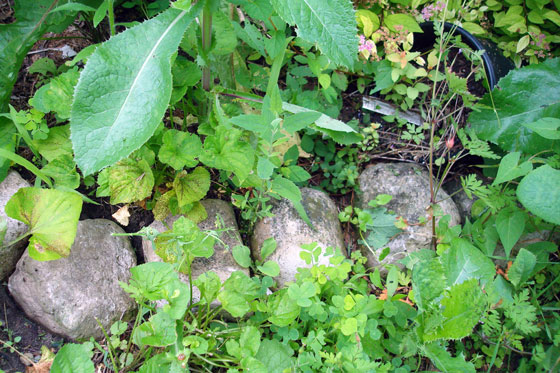
Rocks edging a weedy garden

Every single existing flower garden on the property is edged in rocks like this. I’m sure it looked lovely at one point. However, over the years, the rocks have sunk just far enough into the ground to become a complete hazard for the lawnmower. Plus, they’re not doing anything to keep the weeds or grass out of the garden. I would rather edge the garden every year with a spade and be able to get the lawnmower right up to the edge of the plants than deal with these rocks.

Rocks–specifically moving rocks–has been the major theme of landscaping this year. Wiley and I will spend some more quality time, moving loads and loads of rocks back to the pile behind the barn.

Let’s see. What else is there about this garden? Follow me down this garden path and let’s find out.

Broken patio slab path in a weedy garden

Note to self: Add weeding and remove broken patio slabs to the to-do list. Oh, and fill in the pit at the end of the path.

Square pit with wood retaining walls

Oh look. Another plastic plant pot.

This pit is the spot where the wood stove chimney came out of the basement. We’ve removed the wood stove, patched the hole in the wall and tarred the foundation. Now I need to deal with the pit. It’s about 3 feet deep and is usually home to frogs or, when I was taking the picture above, a camera shy garter snake. Perhaps this is a place to dispose of some of the rocks. Provided of course I rescue any creatures first.

If I follow this garden around the corner of the house to the north side, I’ll find more rocks (what else?) and more patio slabs from where the old oil tank used to be. If I follow it around to the back side, things get really wild.

The back gardens will likely be phase 3. No ETA for that yet, though.

Do you have any advice for plants that will add some diversity to my spirea and ferns? Or tips for transplanting? I tend to stick them in the ground and water the heck out of them. What’s edging your gardens? Anyone else have any “special” features in your gardens, like a pit?

Landscaping: Phase 1

Friday morning at work, a colleague who reads my blog regularly marveled at how much Matt and I have accomplished at the farm so far. I didn’t totally agree. Sometimes I see the difference that we’re making. Sometimes I just see the things left undone and the rest of the to-do list.

July does feel like a bit of a milestone to me, though. A turning point. Or a halfway mark. So I have decided to declare it the end of phase 1 of this year’s major project–landscaping–and I have decided to take a look at what we’ve done so far. If you’re interested in a refresher, here’s my previous progress report or the to-do list.

My focus has been the immediate area around the house. I used the very thoughtful technique of walk out the front door, turn right and start there. I slowly worked my way around to the side of the house. So the smaller of our two front gardens has been weeded and a new border of grass has been established.

Evolution of the front garden

Still to do: Put those poor plants that have been living in plastic pots for at least a year and a half in the ground. Transplant some other plants to fill in some of the gaps in this garden, and maybe give the yew and the Rose of Sharon a hair cut.

Around the corner from the front garden, we come to a creation I’m particularly proud of, the well garden. At the beginning of the spring, this area was a heap of hard-packed dirt strewn with rocks and overgrown with weeds. After digging everything out (including two window wells last year which were unnecessary after we bricked over the broken basement windows), leveling off the dirt, edging it with rocks (some really, really big rocks that required the help of Matt and his Dad to position), transplanting some plants, repositioning the downspout, installing a hose hanger and seeding the grass, it is starting to look like an actual garden.

Flower garden edged with rocks around a well head

Still to do: Convince the plants to grow. It’s a little hard to see, but I’ve actually planted quite a lot in this garden. I may do a bit more, but I’m trying to restrain myself, because I’m pretty sure once these plants take off, this garden is going to be pretty lush–just what I want.

Let’s go away from the house for a moment across the driveway to the fire pit. This really wasn’t a fire pit. It was more of an area where previous owners burned things. Matt and I have used it a lot as we’ve been cleaning up brush and lumber from the property. However, heaps of ash and brush wasn’t the nicest visual to see when I opened the front door or drove up the driveway. The brush I was able to relocate to a new burn area I’ve established behind the drive shed. The ash got spread around and leveled–and then I went back and forth over it with a big magnet to pick up all of the nails and screws (and hinges, door knobs and other metal) that were mixed in. The rock pile that I discovered buried in ash was picked up and dumped in the main rock pile behind the barn–talk about a dirty job.

Cleaning up an old firepit

Still to do: Make sure all of the metal has been picked out of the ash. Mix some manure and soil in with the ash so that grass might actually grow and seed it. Relocate the lawn chair and bench that were plopped beside the fire pit. Relocate the remaining large logs and lumber that were stacked waiting to be burned. Get rid of the dirt pile.

Between the fire pit and the house is the biggest undertaking of the year, the turnaround. This former mountain goat territory has been leveled, fertilized with loads and loads of manure and rototilled. I built a brick pathway across the middle of the garden and planted some bushes, hostas, trees, tomatoes and lettuce.

Evolution of the garden on the turnaround

Still to do: Finish the pathway–I need 60-80 more bricks and sand to fill the joints in between. Put a bench beside the path. Pull the weeds that have sprung up. Plant a whole lot of plants. Seriously. This thing is going to eat plants.

So it’s probably obvious from this post that I can’t just focus on what we’ve done so far. Although looking at the photos above, I am able to see the transformation happening. Slowly, ever so slowly, it’s starting to look a little more like the picture in my head (or on my Pinterest board).

How are you doing on your summer to-do list? Are you looking ahead at what’s yet to do? Anyone have any tips for living in the moment and appreciating what I’ve done so far?

How to sharpen a shovel

In case you haven’t noticed, I’ve been spending a lot of my time outside landscaping. What you definitely haven’t noticed… probably because I haven’t shared this with you before… is that much of my landscaping time is spent hopping up and down on my shovels trying to convince them to sink into the dirt. Or hacking away at defenseless plants trying to cut through tough roots.

Obviously, it was time to sharpen my shovels. Past time, rather.

Round mouth shovels with dried dirt stuck to them

The solution? Call my Dad.

Unfortunately for me, the solution is never that easy. Fortunately for you, I now have another how-to to share.

As soon as I pulled into the driveway at my parents’ house, shovels in tow, I realized that I was not going to be able to simply hand them over to my Dad. A whole sharpening station was set up in the driveway with a grinder, visor and safety glasses–multiple pairs.

There was going to be a lesson.

But first there was going to be a lecture.

“You know, back when I was on the construction site” (my Dad was a construction superintendent before he became a general contractor) “I had a labourer who would have taken those shovels away from you if he’d seen how you left them all covered in dirt. That’s not how you take care of your tools, Jules.”

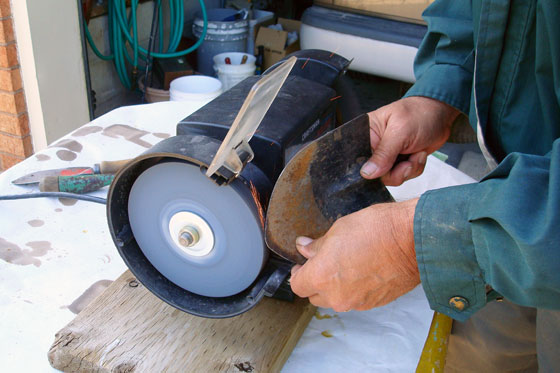
Fortunately–or unfortunately depending on how you look at it–my Dad did not take away my shovels. He did brush them off, but then he gave me a demonstration with one of his smaller shovels of how to sharpen them on the grinder. Most important lesson: keep your fingers out of the way of the grindstone.

Sharpening a small shovel on a grinder

Keeping my fingers away was easier on my big scoop shovels when I could hold them by the handle. However, they were a little more unwieldy because of their larger size. Also unwieldy: my Dad’s visor which was not sized to my head at all, but did provide complete eye protection.

Sharpening a shovel on a grinder

To sharpen the shovel, hold the back side of the blade at a very shallow angle against the grindstone. Start about halfway down the edge of the blade and curve around to the tip. Do a couple of passes on one side and then on the other.

Direction to sharpen a shovel

After running the shovels through the grinder a few times, I had a nice shiny, sharp edge.

Sharpened shovel

The shovels don’t magically become fillet knives, but they are much sharper and much easier to work with. Since sharpening, I have transplanted trees, bushes and flowers. Holes have been dug. Plants have been split, roots humanely cut with minimal trauma.

Oh, and the shovels have also had a shower.

Washing a muddy shovel

In addition to learning how to sharpen a shovel and remember to take care of my tools, I also learned why we used a standalone sharpening station set up in the driveway, rather than my Dad’s stable grinder that’s bolted to the bench in his work room. When the sharpening lesson was finished, he picked up the grinder and loaded it into my trunk.

I guess this means I have to do it myself from now on. My Dad’s wanted to give me this grinder for awhile now, and it will definitely come in handy for us. Although it is yet another tool to take care of. Thanks, Dad, for the lessons and the tools.

Path preview

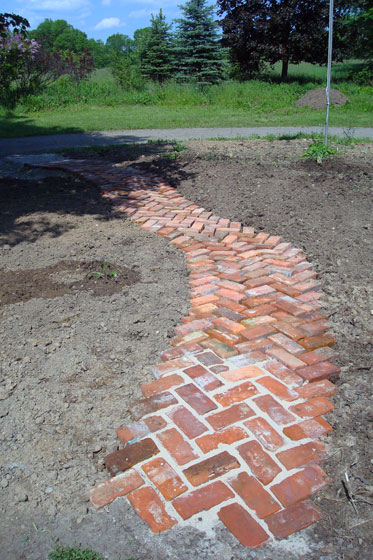
Please gaze upon my bliss.

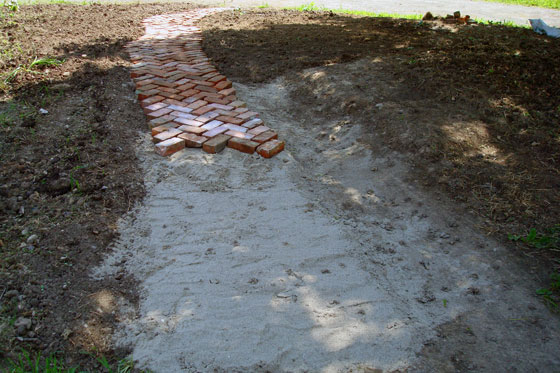
Herring bone brick pathway

Yes, that’s right. My definition of bliss is a brick pathway. So what?

But isn’t it so pretty? I realize some of you who voted for the traditional brick pattern–or “running bond” as I learned from a commenter–may not agree that this looks lovely. The vote came out very close, which really surprised me: 63% herring bone to 38% brick. I honestly thought herring bone would be the clear favourite.

I chose to go with the herring bone after spending a few days looking at the layouts that I’d mocked up last weekend. I just decided that I really, really liked the way it looked.

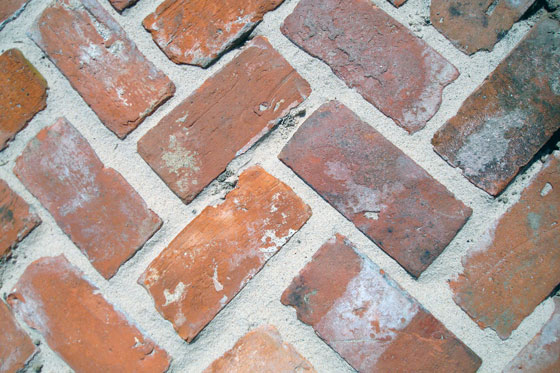
Bricks laid in a herring bone pattern

Laying the brick in the herring bone pattern and getting the bricks to bend smoothly around the curve was a bit more challenging than it would have been if I’d chosen another pattern, I’m sure, but I just fudged the spacing between the bricks as I needed to.

I still have to fill all of those spaces with sand. I found two bags of something called “magic sand” in one of our junk piles. The description said that it was a polymer infused sand made to fill the joints between paving stones. That sounded like just what I needed so I dumped the bags onto the bricks and managed to fill the joints for the first three feet of pathway. I’ll pick up the rest of the sand this week and hopefully finish off the path next weekend.

I say hopefully because along with needing more sand, I also need a few more bricks. What might be a little hard to see in the top photo is that as the path heads into the shade, about six feet from the end, I ran out of brick.

Brick pathway laid in a herring bone pattern on a bed of sand

I knew I was going to be short, and I actually made it much farther across the turnaround than I expected to. Apparently 362 bricks are just not enough. They are enough to make me blissfully happy though.

Time to zigzag or stay on the straight and narrow?

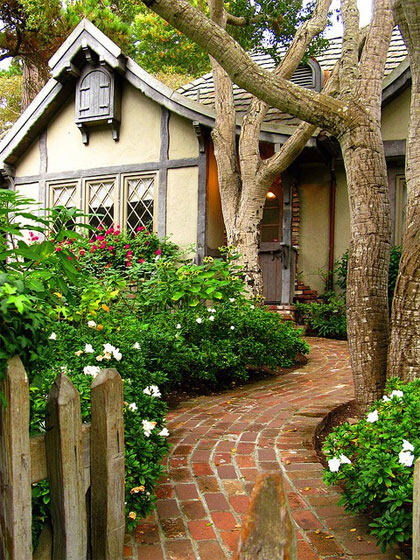
Remember this picture from my 2013 home goals?

A lush garden with a brick path winding through it

This is my inspiration for the garden I’m building on the turnaround at the front of the house. Lush. A little bit wild. A beautiful brick walkway winding through.

Honestly, the path is an excuse to use up some of the piles of bricks that we have lying around the farm. But, it does have two additional benefits: the path will save us from having to walk all the way around the turnaround when we want to get to the other side (it’s farther than you might think) and it will be an attractive feature at the front of the house (I hope).

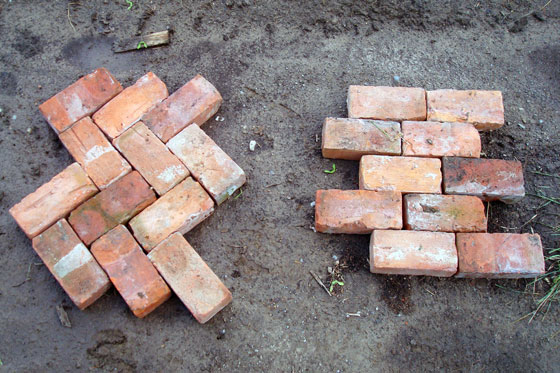
The path is next up on the landscaping list. I’ve dug out the route across the turnaround and gathered my bricks. Now I’m just trying to decide how to lay them: trendy herring bone or traditional brick pattern.

Herring bone brick walkway

If I go with the straight brick pattern, I’ll probably do six courses, not the five that are pictured here. If I go with the herring bone, this is pretty much what it’s going to look like. I’m not going to cut the bricks, so the edge will be a bit ragged. It will probably be hidden eventually by all of the lush plants, but that might take a little while.

I think I know what you’re all going to say, but I’m going to put it to a vote nonetheless. What do you think?

For those who might be concerned by the photo above, I am not going to lay the bricks directly on the dirt. I’m planning a base of sand, which we also just happen to have a huge pile of lying around. I’d use gravel, but the gravel in our pile (yes, we have one of those too) is a bit too large to provide a really stable base.

No matter what pattern I end up using, I’m planning on leaving about a half inch gap between the bricks. Does anyone have any experience with polymeric sand? I’ve heard that it’s good for filling the spaces between the bricks.

Feel free to expand on your opinions on polymeric sand, the beauty of herring bone, dos and don’ts of brick laying, fast growing plants and any other topic that strikes you in the comments. I appreciate any advice.

Manure manouvering

So how was your weekend? Mine was crappy–as in filled with manure.

We’d made some progress on the turnaround so far this spring, picking up the rocks and rubble and flattening out the piles of dirt. However, I wasn’t very confident in the quality of that dirt, so before I started to plant anything, I wanted to give it a boost of nutrition. Like any decent farm, ours came with that barnyard fixture, the manure pile, so we have lots of natural fertilizer.

Manure pile

The turnaround is the size of some people’s backyards, so a decent quantity of manure was required. Likewise, there’s a decent distance between the pile out behind the barn and the turnaround at the front of the house.

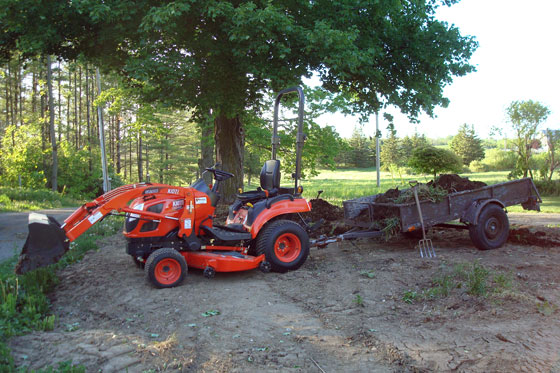
My Dad left his trailer here a few weeks ago, and with the help of Wiley and his front end loader–my skills are much improved over last year–I brought three full loads of manure up to the garden.

Kioti CS2410 towing a trailer full of manure

The manure isn’t smelly anymore, but the lesson of the weekend is that it can be a bit slippery. I had a couple of close calls standing in the trailer shoveling it off.

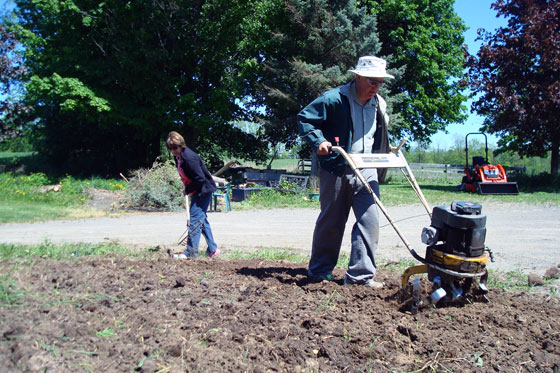
This probably wasn’t quite what my Dad had in mind for his trailer when he left it with us, but he’s a good sport. So good in fact that he brought his rototiller up to the farm and went back and forth over the turnaround mixing the manure into the soil. My Mom pitched in too spreading the soil around the edges and picking out the rocks–lots and lots of rocks.

Rototilling a garden

Thanks to my parents, our tractor, the trailer and our convenient manure pile, the turnaround is now ready for planting, so I guess my weekend wasn’t that crappy after all. Pretty productive, in fact.

How was your weekend?

Memories of Muriel

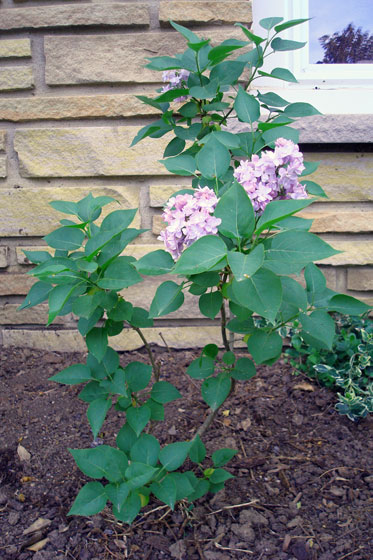
I’ve said that I didn’t do any gardening last year, and that’s not entirely true. I planted one thing: this lilac.

Double French light purple lilac

This lilac came from our first house. It had lived for six years in the flower garden Matt and I made in the front yard. It never bloomed. It didn’t really grow very much. But I nursed it along because this plant is another one of my special treasures.

This lilac was a shoot that I transplanted from a beautiful bush my grandmother had growing in her backyard. She was always very proud of her lilac and its prolific double blossoms. A few of the grandchildren took shoots to plant in their own gardens.

Last spring as we sold our first house and moved to the farm, I carefully dug up the lilac, cleared a space in the overgrown garden at the front of the house and transplanted it.

Double French light purple lilac

Over the past year, it has finally started to thrive. It’s grown taller and bushier. And for the first time ever, it’s blooming.

This is a banner year for lilacs at the farm and it turns out we have lots: a large bush outside our bedroom window, others scattered around the gardens, a hedge stretching nearly from the house to the pond. However, this, our smallest plant, is my favourite.

Landscaping… the long list

I cannot bring myself to write a list of everything I want to do for renovations in the house, but for some reason I have no problem doing a master list for the landscaping outside.

Landscaping plan

Alright, I’ll admit it. That’s a little overwhelming.

There’s obviously a lot to be done, so it’s a matter of prioritizing what part of our 129 acres we want to focus on. This year, it’s the residential area.

Layout of the residential section of the property

And just to make things a little clearer than the animation above, here’s the plan for this year.

Landscaping plan for this year

That’s manageable, right? As you saw at the beginning of the week, we’ve already made some progress on the turn around, the flowerbeds and the pond shore. Maybe by the end of the growing season, we’ll have the property in shape.

The long term plan will take who knows how long.

Long term landscaping plan

I’ve decided my goal when it comes to outside work is to transition from landscaping to gardening. Weeding flowerbeds is much more manageable than building them.

How do you handle renovations and landscaping at your house? Do you write everything down or just keep a mental list? What are you hoping to accomplish this summer?

Death by landscaping

I am dead.

I’ve been working on a lovely introduction to this post referencing the Secret Garden and the joy of tending a neglected garden. But it’s not coming together for me, and I lack the mental power to make it work. Because I am dead.

You never heard any of the characters from the Secret Garden say, “I am dead. This garden has killed me.” Let’s be honest here, Ben probably said it, but Frances Hodgson Burnett did not include it in her story of love, childhood and horticulture.

In my story of love, adulthood, responsibility, country living and horticulture, landscaping has started.

The turn around has gone from mountain goat terrain to a blank slate, thanks mostly to our farmer with his heavy equipment.

Making a garden on our turnaround

I’ve weeded one flowerbed and my mother-in-law tackled two more. (All of the plant pots were left by the last owners. The plants are still alive, so I’ll be planting them soon on the blank slate of the turn around).

Weeding a flower garden

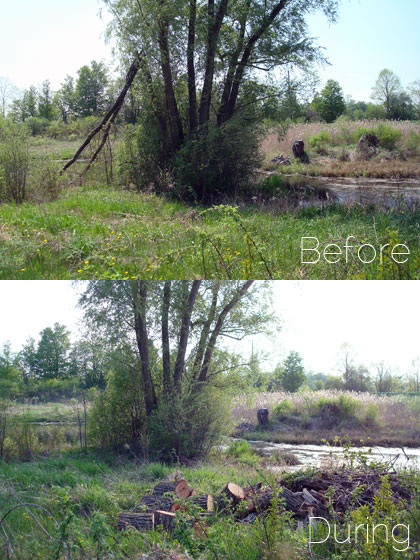
My father-in-law trimmed some of the trees and stumps around the pond. We still have a ways to go before we can actually mow the shore, but I’ve staked out the new fire pit, and we have lots of wood ready to burn.

Broken tree branch

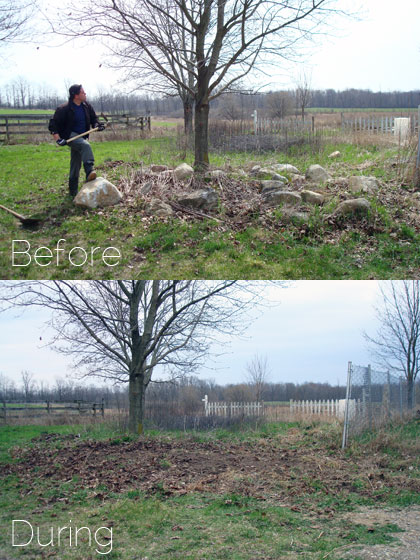
Matt, my Dad and I dismantled one of our biggest rock piles on the property–and it only took us four hours.

Cleaning up a rock pile

I started building a new flower garden around the well head. And this is when I died.

Rock edged flower garden around a well head

Last year’s landscaping efforts were limited to some very cursory grass cutting. The property was unkempt when we bought it, and our neglect over the past year while we focused on the basement reno made it worse.

The amount of work required to bring a garden back after years and years of neglect is never mentioned in the Secret Garden. Sure there’s a bit of pruning and weeding, but mostly it’s romance and roses.

In the category of things get worse before they get better, even our efforts at clean up have led to more mess. Drilling the new well and trenching new waterlines destroyed one established flowerbed and left lumpy piles of very hard dirt in its place. Burning brush and scrap lumber as we’ve tried to pick up around the property resulted a mountain of ash and a half scorched spruce tree.

Landscaping was at the top of the list on my home goals for this year, and I will get a handle on the situation outside, even if it kills me.