How to refurbish a ping pong table

It’s St. Patrick’s Day, so today’s post is all about something green. Our new(ish) ping pong table.

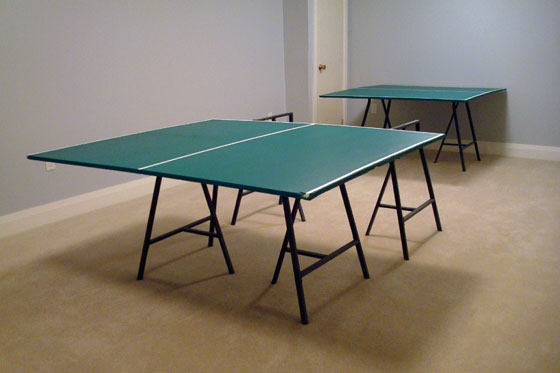
Refurbished pingpong table

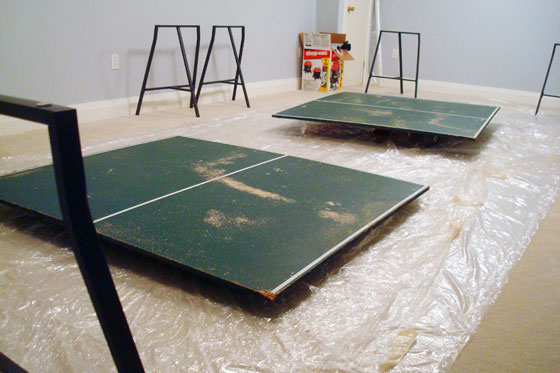
This ping pong table was a bit of an experiment. We found the top (in two pieces) in the barn when we first moved in. It was pretty dirty and had even been pooped on by the swallows that live in the barn.

I am always optimistic, so one day last summer, I dragged the two halves outside. I have no idea how I managed to move them by myself because each piece is extremely heavy. I haven’t been able to carry them on my own since. I scrubbed with a brush and sprayed with the hose until all of the poop and dirt (and a fair portion of the original green paint) washed away.

Damaged pingpong tabletop

Matt did not share my optimism that the table could be rehabilitated. That night he tucked the pieces deep into a corner of the driveshed. I have no idea how, though, because the tabletop is heavy even for him to move on his own.

Despite his lack of enthusiasm for the project, Matt did help me carry the top into the house. Then, one weekend while he was out of town, I went to work.

This project was a total experiment, and I’m sure ping pong purists out there will be horrified. But (spoiler alert) everything worked out, so I’m sharing my technique with you.

There were two big issues with the table: 1) We had no legs to go with the top. 2) The top itself was not in great shape.

The leg issue was easy to solve with six trestle style legs from Ikea (Lerberg).

Ikea Lerberg legs for a pingpong table

The top took a little more effort.

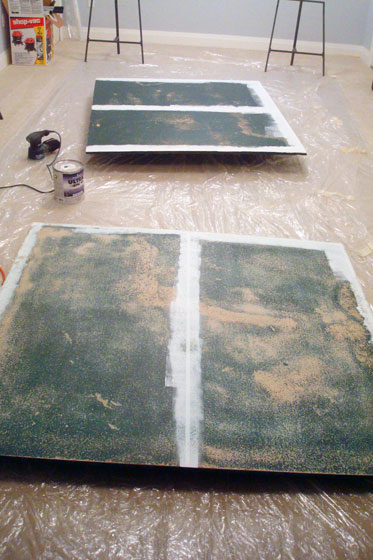
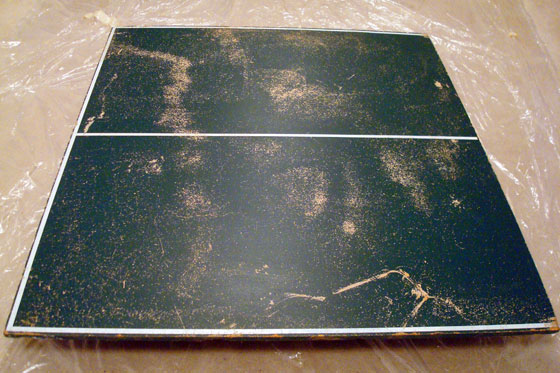
I started with a coat of fresh white paint over the lines. After sleeping on it for the night, I realized I really should have sanded the top first, so the next morning I basically started all over again. I sanded down the top, which was not an indoor task. Sanding resulted in a fine green powder over the whole room–not the best scenario with our nice light carpet. There was a defined line between where the drop cloth had protected the carpet and where the green dust had floated beyond the drop cloth’s reach. I was very glad Matt was not home to see the mess I had made.

Refurbishing an old pingpong table

The Shop Vac erased the green mist, and I was able to get back to the painting.

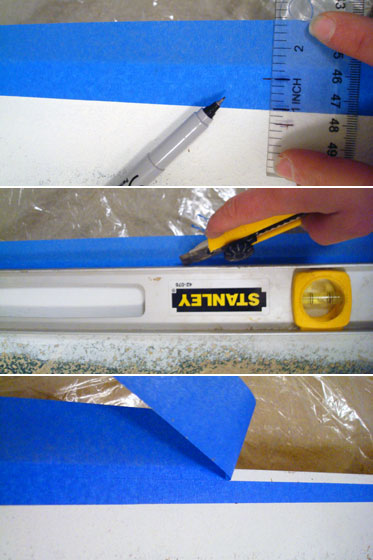
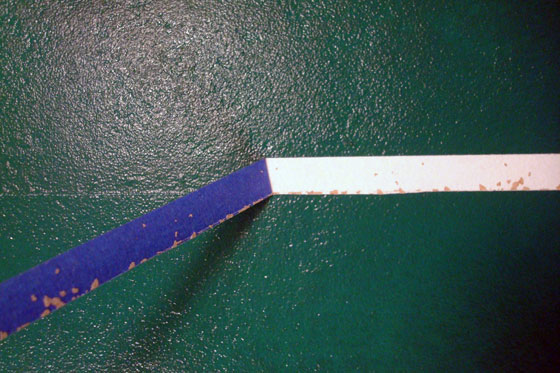
White paint went on again, and, then once it was dry, I taped off the lines. Since painter’s tape doesn’t come in ping pong line widths, I had to very carefully trim it.

Cutting painters tape to narrower width

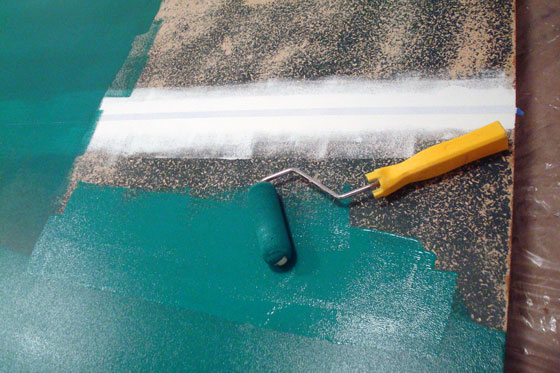
Then the tape got a quick coat of white paint to seal it, and after some drying time I moved onto the green. Since I wasn’t sure if this was actually going to work, I used some regular latex paint that we had left over from Matt’s office. It’s Manor Green from Benjamin Moore in case anyone’s interested.

Refurbishing an old pingpong table

The green took about three coats, I think. On the final coat, I carefully peeled off the tape to reveal the white lines. Some of the white flaked off (I think giving the white more time to dry, or even doing two coats would have been helpful).

Refurbishing an old pingpong table

Chips aside, the finish was a massive improvement over the table’s previous state. In fact, Matt was so impressed when he arrived home that he started to think that maybe I wasn’t entirely crazy in wanting to save the table.

So now I had a tabletop and I had table legs. How to put them together?

Refurbishing an old pingpong table

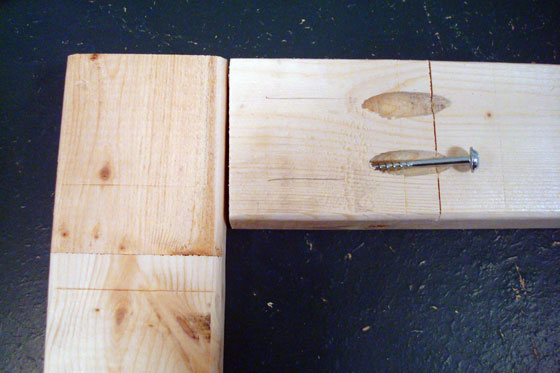
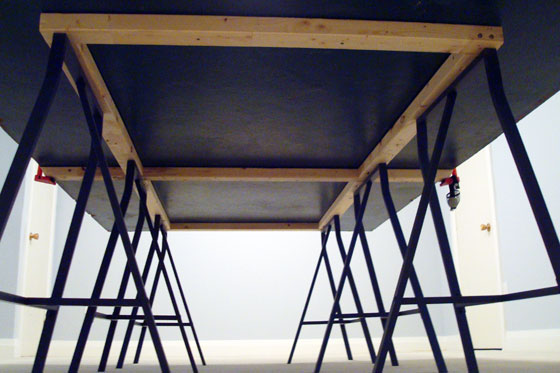
It turned out that the Lerberg legs are a bit shorter than regulation ping pong height of 30 inches–hey, I have some standards. Using a few 2x3s and my Kreg Jig I built a frame to attach to the underside of the tabletop.

Using a Kreg Jig to screw 2x3s together

I screwed the frame to the tabletop… or at least to one half. The top ended up being too unwieldy and heavy as one big piece, so I didn’t screw everything together. We set the top on the frame and the frame on the legs, and we think each piece is heavy enough to stay in place on its own.

Frame for the underside of a pingpong table

The six Lerberg trestles mean the table is very leggy. However, we really needed the support in the middle of the table as well as at each end.

We got a very simple cheap net at Walmart. It’s called an “everywhere table tennis” from EastPoint, and we just clipped it onto the table. Again, I wasn’t sure that this refurbishment was actually going to work, so I didn’t feel the need to invest in a professional net.

Anywhere table tennis net by East Point

With the table set up, Matt broke out the paddles, tapped one of the balls across the net, and it bounced. It worked! We had a functional ping pong table.

I had no ping pong skills, but after a week of daily practice, I’ve improved a lot. I finally won a game against Matt yesterday (he also may have let me win one). My ping pong prowess aside, refurbishing the table was a definite win.

Have you ever rehabbed a piece of furniture that seemed beyond hope? Anyone have any ping pong pointers? How are you celebrating St. Patrick’s Day?

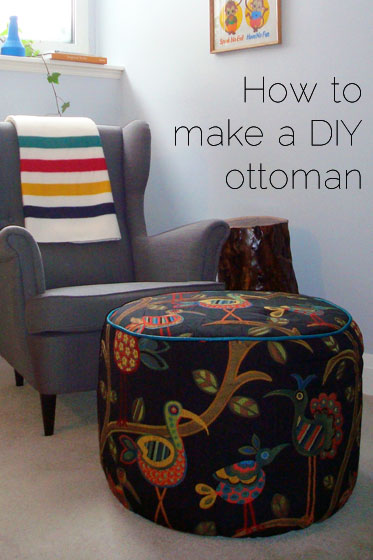
How to make a DIY ottoman

The search for the perfect footstool for my basement reading nook took a little while. How to make a DIY ottoman I knew I wanted something round. Between our sectional, the ottoman, the entertainment unit, the TV, and even my Austin chair, we have a lot of squares and rectangles happening in the basement, so I thought it was time for some contrast. And I wanted to make it myself. But how? What would give me the size and the shape that I wanted while being sturdy enough to sit on but light weight enough to move around? Maybe a Sonotube? But I couldn’t find one that was big enough in diameter, and I really didn’t want to buy a six foot tube and use only a short piece of it. Maybe I should just use one of the Moroccan poof patterns available online and upscale it? But that would take a lot of stuffing, and I wasn’t sure how it would work as a seat. Then one night it came to me just as I headed to bed. (Isn’t that always the way?) The next morning when Baxter and I headed out for our walk, we took a brief detour to our junk pile. (Doesn’t every farm have one?)
Baxter investigates our junk pile

“Uhhh… I don’t see anything that you’d want to put in the house over here…”

Are you confused like Baxter, or do you see it?
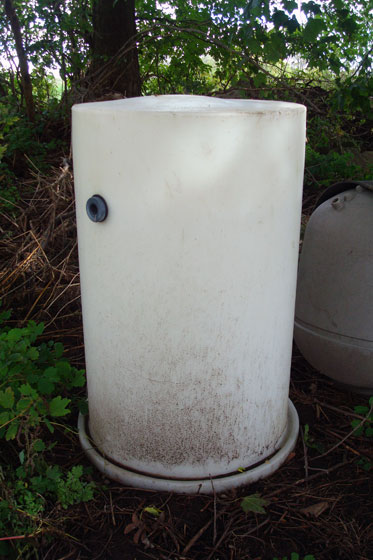
Plastic barrel

Yes, ladies and gentlemen, I upholstered a giant plastic barrel.

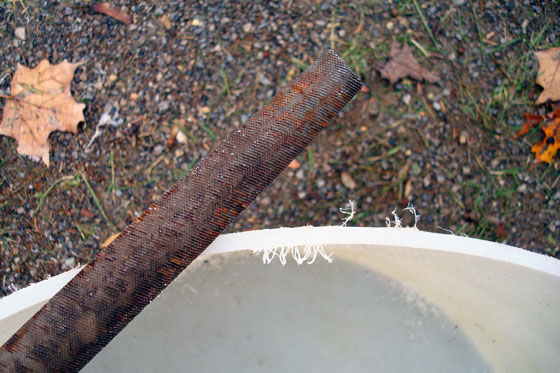
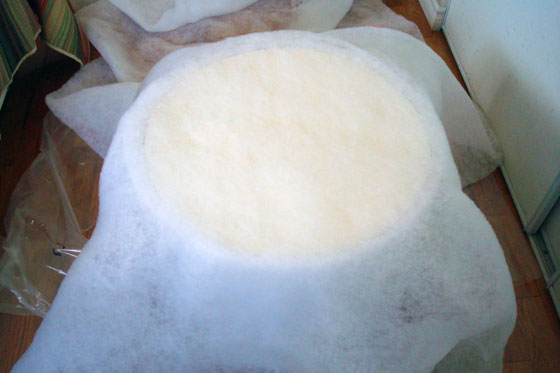
It was big. It was round. It seemed sturdy, but wasn’t too heavy. I had found my base. Now how to make it into an ottoman? I mulled the question of how to upholster it over for a little while. Here’s the technique I came up with. 1) Cut the barrel to my desired height–roughly equal to the height of Strandmon’s seat. I initially planned on using my hack saw, but then I realized that between the thickness of the plastic and the massive circumference of the barrel, cutting it manually would take forever. Plan B was my circular saw, which was much, much faster. Note: an extra person (thank you, Matt) to hold the barrel while you’re cutting is essential. Cutting a plastic barrel with a reciprocating saw Go over the cut edge with a file to smooth out any rough spots and remove any plastic strands. Use a file to smooth out plastic edges 2) If your barrel still looks like something that’s been sitting outside for who knows how long and really isn’t something you can see yourself bringing into your house, give it a good scrubbing. This is probably a good step regardless because you never know what’s been inside the barrel. Well, some of you might, but I sure didn’t. 3) Pack on the padding. I used a piece of 2 1/2-inch thick foam for the top. Using my barrel as a pattern, I traced a circle onto the foam. The foam cut easily by hand with a serrated bread knife, although I’ve heard that an electric carving knife also works. Using spray adhesive, I attached the foam to the top of the barrel.

Cutting and attaching foam to a foot stool

Note: Working in a barn avoids spraying sticky glue onto your floors, but you may end up with a few pieces of straw stuck to your stool.

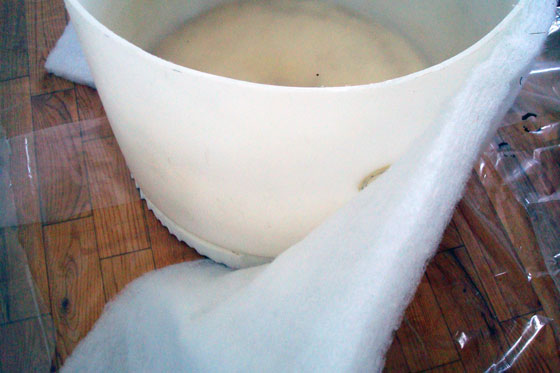
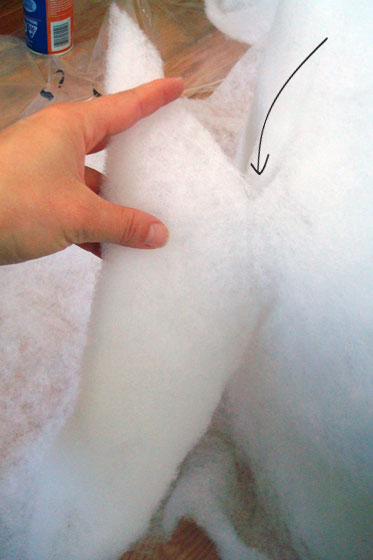
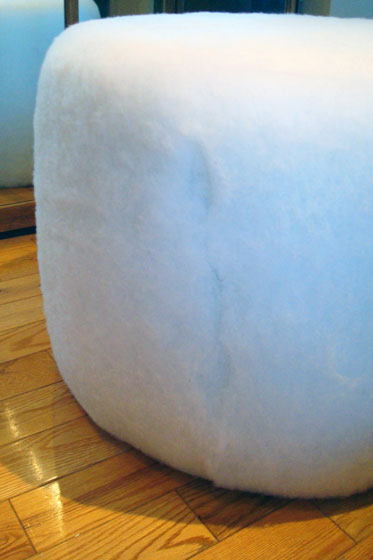
4) To soften up the sides, I took batting left over from my dining room chair upholstery project and glued it to the sides of the barrel. It was at this point that I realized I had less batting left over than I thought. As in not enough to complete the ottoman. So the padded barrel came into the house and sat until I could go to the fabric store. During the waiting period, I found out that the spray adhesive maybe wasn’t going to work quite as well as I’d expected. Basically, the barrel shed its fluffy skin. Quilt batting peeling off a plastic barrel 6) However, I was undeterred. Once I had more batting, I reattached the first layer using the same spray adhesive. By this point, it was cold outside, so I was working in the house. Note: Be prepared for some overspray. A drop cloth will help, but you will end up with sticky socks. Upholstering a foot stool in batting 7) You’ll notice that my batting was a little patchy. To smooth it out and hold it in place, I added two more layers of batting over top of the whole barrel. I’m going to try to explain how I did this, but if it’s not clear, feel free to ask for more information in the comments. I draped the big sheet of batting over the whole barrel making sure it hung evenly down each side. Upholstering a round foot stool Working in sections of about a quarter at a time, I sprayed the barrel with the adhesive, smoothed the batting down the side and stuck it in place. If you think of the barrel like a clock, I worked at 3, 6, 9 and 12 o’clock. In between each quarter section, I had extra batting. These looked like big triangle wings. I carefully took my scissors and cut off these wings. I wish I had a better picture of this, but my scissors hand was busy being camera hand in this moment. I snipped roughly where the arrow is pointing. Upholstering a round foot stool The nice thing about batting is that it doesn’t fray, so I could just snip it off and the smoosh the edges together. The join wasn’t perfect, but close enough ended up working just fine. Upholstering a round foot stool At the bottom of the barrel, I trimmed the batting so that I had about 6 inches overhang. Then I pulled it taunt, smoothed it out, wrapped it around the edge and tucked it up inside the barrel. A spritz of adhesive held it in place. Upholstering a round foot stool Now I had a giant fuzzy marshmallow. Um, yum? Upholstering a round foot stool 7) To protect the batting, make sure it stayed attached to the barrel and ensure a smooth surface to overlay my fabric, I decided to make a lining or slipcover before putting on my final upholstery fabric. This was also an opportunity to test my pattern for my outer fabric. To figure out the pieces for the slipcover, I measured first the circumference of my ottoman and then the height. I cut out a rectangle that was as long as my barrel was round (80 inches) and 8 inches wider than my barrel was tall (25 inches). Using the circumference measurement, I was able to figure out the size of circle that I needed to cut for the top of the stool. After a brief consultation with my resident math teacher, I remembered that Pi x diameter = circumference. So for my 80 inch around stool, I needed a circle that was approximately 25 1/2 inches in diameter (80 / Pi = 25.47). I started by cutting a 25 1/2 inch square, folded it into quarters, and then using a very makeshift compass I drew an arc that gave me the curve of my circle. I cut along the arc, and voilà a circle.
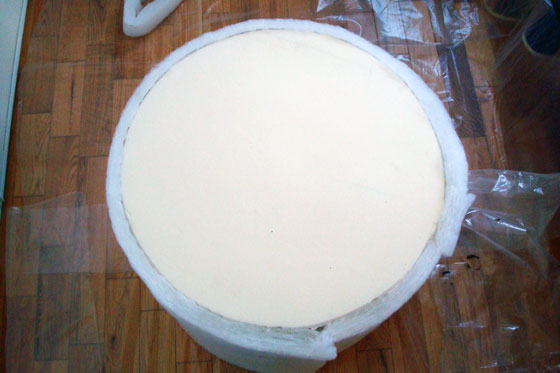
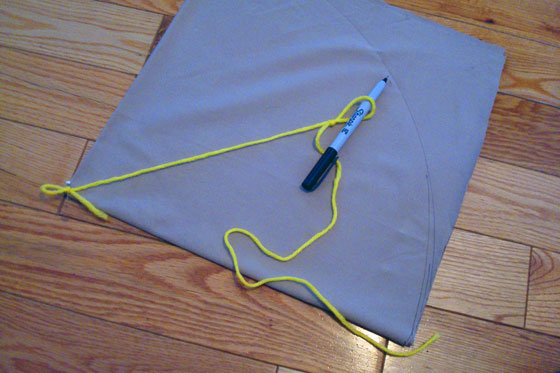
How to draw a large circle

Note that length of the string should be equal to the radius of the circle (half the diameter).

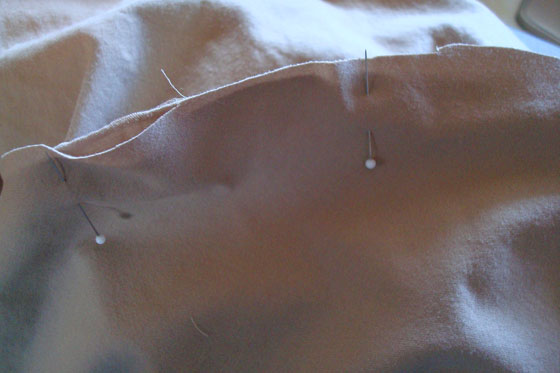
Before unfolding the circle, it’s helpful to mark the outer quarters (basically 3, 6, 9 and 12 o’clocks again). They’ll come in handy later. Now that I had my top, it was back to the sides of my slipcover. I joined the short ends of the rectangle to form a tube, stitching them together on my sewing machine. This is a good point to “try on” the cover. I slipped the tube over the footstool and adjusted the fit as necessary. You’ll notice I haven’t talked about adding seam allowances. I had them at first, but I found that the cover was looser than I wanted. To get a smooth, close-fitting cover, I found going with the actual measurements of the ottoman worked best. Once I had the fit I wanted, I marked the tube in the same way that I’d marked the circle. Using the seam as 12 o’clock, I marked the tube along one edge at 3, 6 and 9 o’clock (rather than measuring, I just folded the tube in half and then half again and pinned at the creases). Then, I pinned my circular piece of fabric to my tube, starting at each of my marked clock points. As I made my way around the circle, I had to smooth things out a little bit since I was joining a straight edge to a curved edge, but with some patience and adjustments everything lined up. Upholstering a round foot stool 8) Finally, I could sew the cover. I took it fairly slow as my machine stitched around the circle, and then I held my breath as I flipped it right side out and slipped it over the ottoman. Victory! It fit perfectly. 9) Now to finish the bottom edge. Remember, it was about 8 inches longer than than the barrel. I turned the raw edge under by a 1/4 inch all the way around, and then I turned the bottom up an additional 3/4 of an inch. Upholstering a round foot stool I stitched this hem almost all the way around. I left about a 2 inch gap so that I could insert a drawstring. Upholstering a round foot stool 10) It was time to dress the ottoman. I slipped the slipcover over top and using the drawstring cinched the bottom tightly. Upholstering a round foot stool I turned it over and… Victory #2! A pretty smooth, albeit slightly crooked, slipcover.
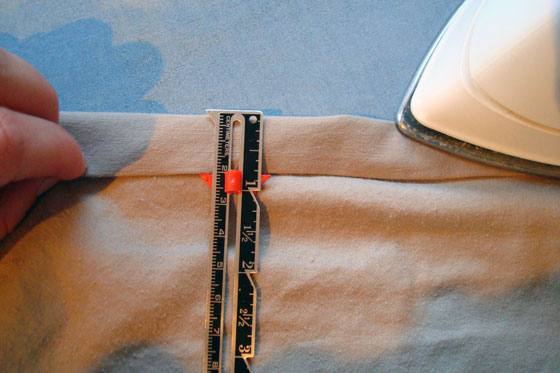
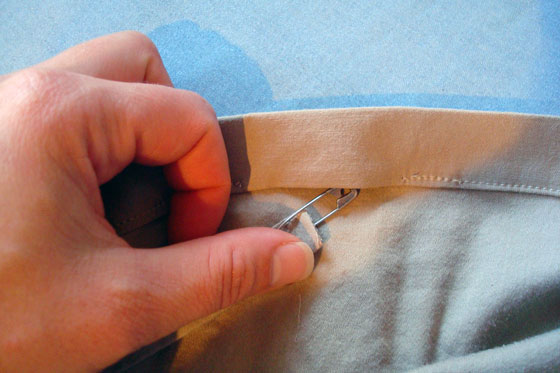
Upholstering a round foot stool

Note to self: In the future, straighten out the cover before taking the photo.

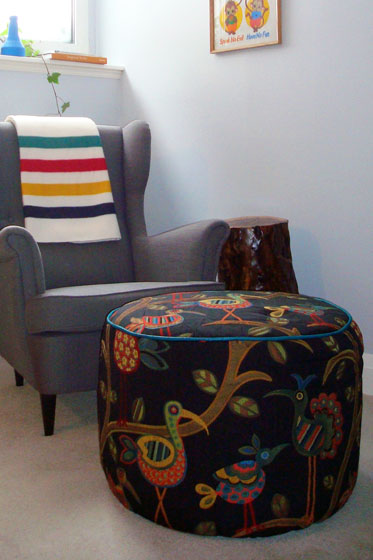
With my pattern perfected, it was time to move on to the official fabric. The search for this fabric had taken my Mom, her friend and me up and down the fabric district, in and out of every store. I was carrying one of the cases from the couch throw pillows, trying to find a fabric that was equally vibrant and equally fun. In one store, I went over to a particular bolt and said, “I love this fabric. I actually bought a few yards a year ago, just because I couldn’t bear not to have it.” My Mom’s friend said, “Hold your pillowcase up.” I did, and she said, “Julia, I think that’s your fabric.” It took me a minute, but then I saw that it was absolutely perfect. Swavelle / Mill Creek Crazy Ol Bird Midnight Fabric I bought some more because I couldn’t remember how much I had already, added some bright turquoise piping and carted it all home. For all of you who’ve admired the fabric, it’s Crazy Ol Bird Midnight by Swavelle/Mill Creek. To make the outer cover, I followed the same technique that I had used with the inner slipcover. I even did the drawstring at the bottom. The only change was that when I sewed the top to the sides, I sandwiched some piping in between the layers. The piping is a great pop against the black fabric, and I think it makes the ottoman look a bit more professional. Upholstering a round foot stool And here’s my finished ottoman sitting with Strandmon and the stump table in the reading nook. How to make a round footstool I love it. This ottoman is such a fun addition. It makes the reading nook a really comfortable spot to hang out. If you have any questions about the construction please let me know. Have you ever used something unconventional (like a plastic barrel) for furniture? What upholstery projects have you tackled?
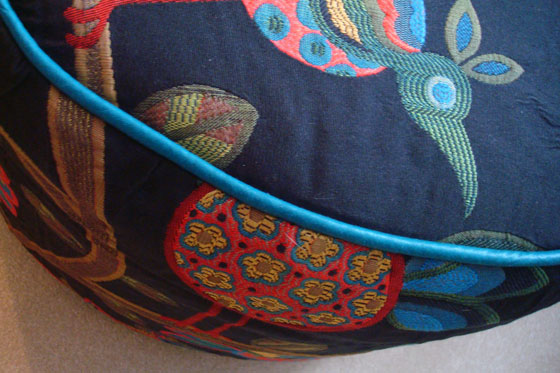
Update: While I know everyone doesn’t have a plastic barrel lying around outside, it just occurred to me that a plastic garbage can would probably work in much the same way and be close to the same size.

Linking up to: Happy Housie DIY Challenge Party: Fabric Projects, Happy Housie DIY Challenge Party: Patterned and Textured Projects

How to build simple closet shelves

When I first asked everyone’s advice on what we should do in our mudroom makeover, the most frequent suggestion was to pull off the closet doors and make built-in storage with a bench, cubbies, shelves and hooks. While I love that look, I knew I needed places to put things more than I needed to be able to sit down. The biggest improvement I could make to how the mudroom functioned was to build more storage in the closet.

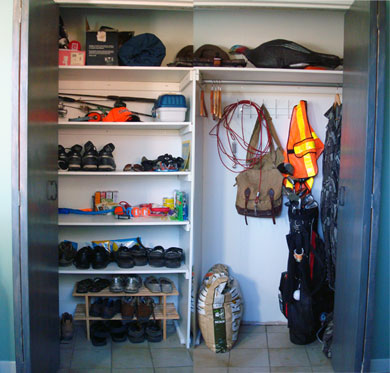
As you saw in the reveal, I split the closet in half, putting floor to ceiling shelves at one end and a single shelf over top of a hanging rod at the other.

Closet storage

To build these simple shelves, I went with my go-to shelving material: white melamine. It may not be the fanciest, but this stuff is easy. It comes in 12-inch or 16-inch widths (I chose the 16) and 8 foot lengths. One long edge is pre-finished. There is no painting (although you can), no sanding, no special tools.

To support the shelves, I screwed 1x2s (which I did paint) into the wall studs with 3 inch screws. The shelves simply sit on top.

White melamine shelving on 1x2s

For the top shelf, I used 1×3 as I wanted a wider board to attach the rod.

How to attach a closet rod

The divider in the middle is a piece of melamine run vertically. There was a cut-out in the ceramic tile floor for some long-ago shelving system, so I filled that with a 2×4 and cut a channel to hold the melamine in place.

Supporting a closet divider

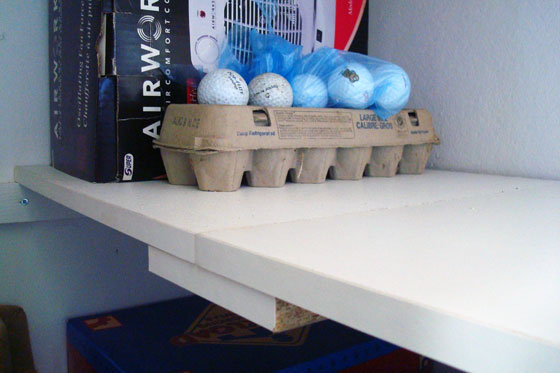
The melamine comes in 8 foot lengths, so for my 9 1/2 foot closet, I had to splice a few of the shelves. My technique was to tack a piece of melamine underneath. It’s perhaps not the most attractive solution, but tucked inside the mudroom closet I wasn’t super concerned about appearances. It’s sturdy and will easily hold a golf ball collection or anything else you want to put on it.

Joining melamine shelves together

The sturdiness of melamine is its best feature in my opinion. As long as it’s properly supported, it can hold a decent amount of weight and won’t sag. To prevent any droopiness, it’s important to put the 1×2 supports along all three sides of the shelf, not just at either end.

I know there are much more attractive storage systems out there, but, for a behind closed doors solution, this simple set up of melamine and 1x2s works for us. Even better, it’s completely custom and accommodates exactly what we need.

How do you handle closet organization? Has anyone else built a custom storage system? Any other melamine fans out there?

How to sharpen a shovel

In case you haven’t noticed, I’ve been spending a lot of my time outside landscaping. What you definitely haven’t noticed… probably because I haven’t shared this with you before… is that much of my landscaping time is spent hopping up and down on my shovels trying to convince them to sink into the dirt. Or hacking away at defenseless plants trying to cut through tough roots.

Obviously, it was time to sharpen my shovels. Past time, rather.

Round mouth shovels with dried dirt stuck to them

The solution? Call my Dad.

Unfortunately for me, the solution is never that easy. Fortunately for you, I now have another how-to to share.

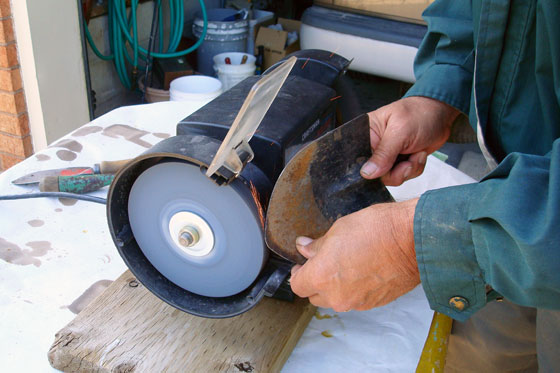
As soon as I pulled into the driveway at my parents’ house, shovels in tow, I realized that I was not going to be able to simply hand them over to my Dad. A whole sharpening station was set up in the driveway with a grinder, visor and safety glasses–multiple pairs.

There was going to be a lesson.

But first there was going to be a lecture.

“You know, back when I was on the construction site” (my Dad was a construction superintendent before he became a general contractor) “I had a labourer who would have taken those shovels away from you if he’d seen how you left them all covered in dirt. That’s not how you take care of your tools, Jules.”

Fortunately–or unfortunately depending on how you look at it–my Dad did not take away my shovels. He did brush them off, but then he gave me a demonstration with one of his smaller shovels of how to sharpen them on the grinder. Most important lesson: keep your fingers out of the way of the grindstone.

Sharpening a small shovel on a grinder

Keeping my fingers away was easier on my big scoop shovels when I could hold them by the handle. However, they were a little more unwieldy because of their larger size. Also unwieldy: my Dad’s visor which was not sized to my head at all, but did provide complete eye protection.

Sharpening a shovel on a grinder

To sharpen the shovel, hold the back side of the blade at a very shallow angle against the grindstone. Start about halfway down the edge of the blade and curve around to the tip. Do a couple of passes on one side and then on the other.

Direction to sharpen a shovel

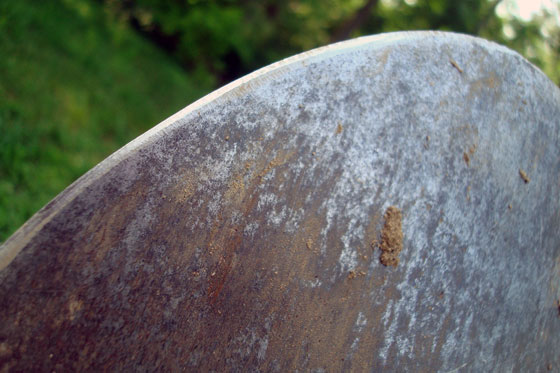
After running the shovels through the grinder a few times, I had a nice shiny, sharp edge.

Sharpened shovel

The shovels don’t magically become fillet knives, but they are much sharper and much easier to work with. Since sharpening, I have transplanted trees, bushes and flowers. Holes have been dug. Plants have been split, roots humanely cut with minimal trauma.

Oh, and the shovels have also had a shower.

Washing a muddy shovel

In addition to learning how to sharpen a shovel and remember to take care of my tools, I also learned why we used a standalone sharpening station set up in the driveway, rather than my Dad’s stable grinder that’s bolted to the bench in his work room. When the sharpening lesson was finished, he picked up the grinder and loaded it into my trunk.

I guess this means I have to do it myself from now on. My Dad’s wanted to give me this grinder for awhile now, and it will definitely come in handy for us. Although it is yet another tool to take care of. Thanks, Dad, for the lessons and the tools.

How to mend a torn window screen

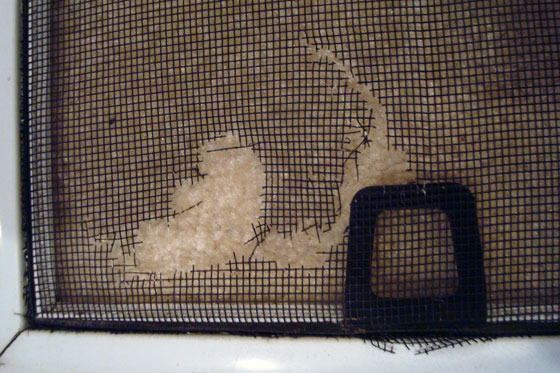
In the category of better late than never, I’ve finally fixed our torn window screens.

Torn window screen

You may remember that one of the last jobs I completed on my fall to-do list (on the first day of winter, no less) was to remove all of the window screens so that I could clean and patch them over the winter.

So yeah. That didn’t happen.

Now June is here and I’d really like to open a window without inviting the local mosquito population inside. It was time to get on with mending the tears.

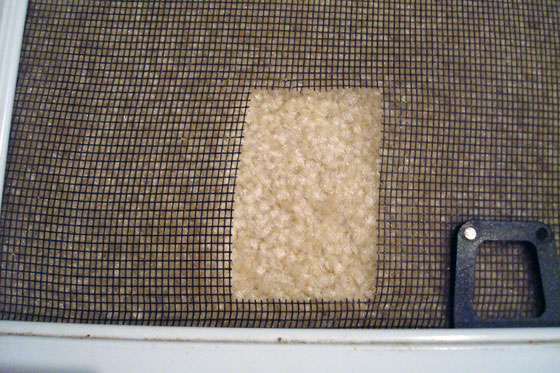
First I trimmed the ripped screen so that I had a regular shaped hole.

Square hole in a window screen

Then I cut a patch from my replacement screening. The patch should be about 1/4 inch bigger than the hole all the way around.

Patching a torn screen

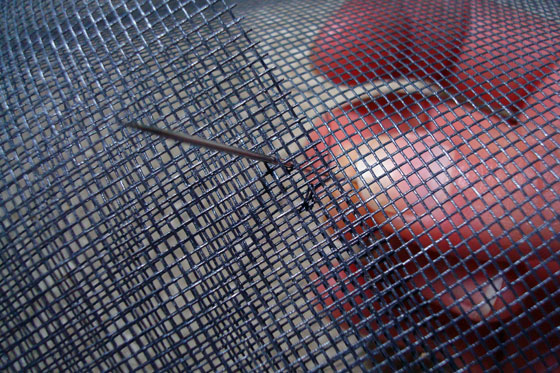
Next I lined the patch up over the hole and sewed it in place. I used regular black polyester sewing thread and tacked the screening about every three holes.

Stitching a patch on ripped window screen

I stitched my way around the patch and when I got to the end I simply knotted the thread a couple of times.

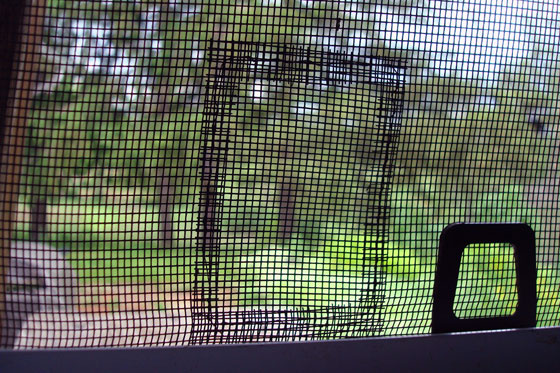
The patch is not invisible, but it’s not very noticeable. Most important, it does the job of keeping the skeeters and other flying critters on the outside while letting the fresh air come through to the inside.

Patched window screen

I will take an open window over air conditioning whenever possible, so with the weather getting steadily warmer, the repaired screens are a cause for celebration for me.

How about you? Are you a fresh air lover or an air conditioning aficionado? Does anyone else have experience patching screens? I’m sure my method isn’t the only solution. What’s the mosquito population like where you are? We seem to have had a baby boom this year, so the screens are absolutely essential.

How to match seams across an invisible zipper

I have a different type of how-to for you today, completely unrelated to home improvement or farming (not that I am any particular expert in that area yet).

This how-to is related to the dress that I sewed for my sister’s wedding. The bodice on this dress is made up of lots of pieces with a zipper in the side seam. The challenge when putting in that zipper is to line up all of the seams from front to back.

I’ll admit that the first attempt was a big fat fail. Horizontal seams were stair stepping down the zipper. Not attractive. In fact, I couldn’t even bring myself to take a picture.

Second attempt was much more successful. So, here’s my tutorial on how to line up horizontal seams across an invisible zipper.

Sew the first side of your zipper to the dress, having the zipper open and leaving the other side free.

How to insert an invisible zipper and match horizontal seams

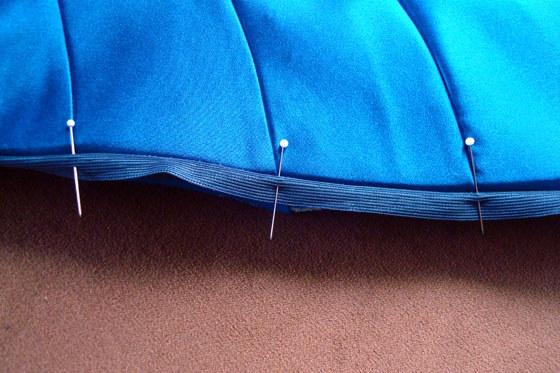
Close the zipper and, using pins, mark the seams that you need to match. Insert the pins horizontally in the tape on the unsewn side of the zipper.

Marching horizontal seams while inserting an invisble zipper

Unzip the zipper, and pin the unsewn side to the dress, starting at each of the seams.

How to insert an invisible zipper and make sure seams line up

Baste the zipper in place and stitch. When you close up the zipper, all of your seams should match.

Marching seams when inserting an invisible zipper

Or at least match close enough.

Next week, I promise a return to our regular program of home improvement and country living. We’re heading into the first long weekend of “summer” and I have big plans. Chainsaws–not sewing machines–are involved.

Hope you have a good weekend. Happy Victoria Day to my fellow Canadians.

How to stain and waterproof a wood countertop

Update: See how our counters have held up after one year and after four years.

With our new kitchen island, we decided to do an inside out colour scheme. By that I mean that we reversed the existing finishes that were already in the kitchen.

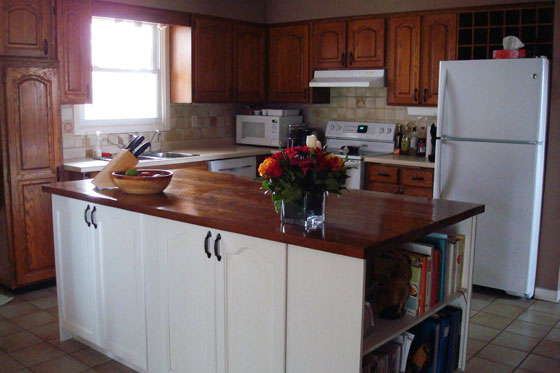
Around the perimeter of the kitchen, we kept the natural wood cabinets and the light countertop. On the new island that we added in the middle, we chose white cabinets with a wood countertop.

Kitchen island painted white with wood countertop

I wanted to keep the wood tones consistent, so when it came to finishing our DIY wood countertop, the usual methods–wax, oil–were out, as they would have left the countertop too light in colour. I sampled lots of stain until I found one that matched the existing cabinets as closely as possible–Early American from Minwax.

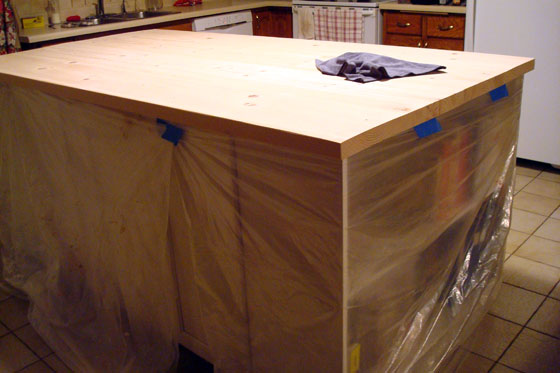
To prepare to stain the countertop, I wrapped the island in plastic drop cloths to protect our nice white cabinets and went over the wood with a tack cloth to pick up any dust and bits that might interfere with the finish.

Preparing to finish a wood countertop

For staining, I used the standard technique of brush it on, let it sit, wipe it off.

Staining a kitchen island

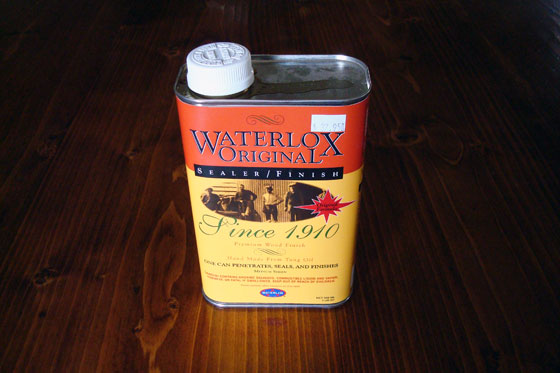
After letting the stain cure, it was on to the waterproofing stage. Given that I was working on a countertop, I wanted something very durable and of course food safe. I chose to go with Waterlox after reading positive reviews online.

Waterlox to finish a wood countertop

I followed their very detailed how-to guide on their web site to make sure I got the finish I was looking for. Waterlox was pretty easy to use.

I did four coats, brushing it on liberally with a natural bristle brush and letting it dry for 24 hours between each application.

Here’s some of the pros, cons and lessons learned.

First, Waterlox stinks when it’s wet. After the first coat, we developed a routine of putting the Waterlox on right before going to bed. We opened the windows, turned on fans, switched off the heat (since we had windows open) and closed the bedroom door. Given that it was March, it wasn’t necessarily the best weather to have windows open, but it was necessary both for the odor and for the cross ventilation needed to dry and cure the finish. The worst of the odor did ease after a couple of hours, thankfully.

Second, sanding between coats is not recommended with Waterlox. Instead, the guide tells you to wipe down the countertop with mineral oil before each coat to get rid of any dust. I did this, but I still feel the finish isn’t quite as smooth as I would like. I’m used to using Varathane where I sand between each coat and get a super smooth finish. The Waterlox guide recommended using a very fine steel wool between the second-to-last and last coat of finish to sand out any rough spots, which I did, but it’s still not perfectly smooth.

Third, the finished surface is very shiny. I used Waterlox Original Sealer/Finish, which is recommended for the first few coats (or all coats, if you choose) and is listed as having a medium sheen. A satin finish is available, but honestly I was too cheap to buy another can, so I did all four coats with the Original.

How to make a wood countertop

After the final coat of Waterlox, we let the island top cure for a full week without putting anything on it.

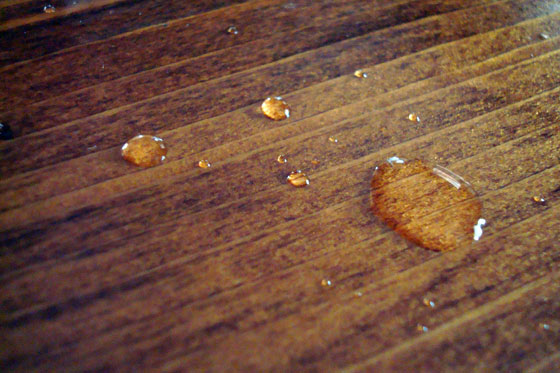
Now that we’re using the island, the finish seems to be both waterproof and durable.

Water droplets on a wood countertop

Given that it is a wood counter, we use a cutting board if we’re chopping and cork pads for any hot dishes. However, there are still occasions to put the finish to the test. If we spill (which of course never happens), liquids bead up on top of the surface. When we slide dishes across the counter, we don’t have to worry about scratching the finish. The wood wipes down really easily and looks fresh.

Finishing our homemade wooden countertop was a question of both form and function. I wanted to match the wood tones we had in the kitchen, and I also needed it to stand up to actual kitchen prep work. Done and done.

Update: See how our counters have held up after one year and after four years.

How to make a wood countertop

How to make a wood countertop

We’ve lived with our homemade wood countertop for more than a year now. To see my report on how it has worked for us, click here.

See the update after four years with our counters here.

Since we’d splurged on having our new kitchen island professionally made, I had to balance the scales and DIY the wood countertop.

There are some tutorials online and lots of inspiring photos, but in the end we pretty much winged it. Here’s what we did.

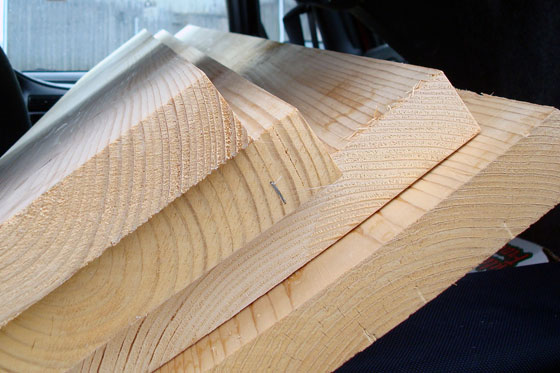
For our island’s 80 inch by 42 inch top, I decided that four 2x12s were the way to go. I chose spruce–the cheapest option at my local lumber mill. My first tip is to be very careful in selecting your lumber. I went through nearly the whole pile looking for the straightest, cleanest boards possible. Watch for chips, knots, bends and warps.

Once you’ve selected your boards, the first step is to trim them so that their edges are square rather than rounded. This will help you to get a smooth even surface when you join your boards together. I took a half inch off each side of my boards–or the staff at the lumber mill did for me.

Squared edges on lumber

We let our boards acclimatize inside the house for a day or so–especially important as the lumber had spent the winter outside and was completely frozen. We could hear them snapping as they adjusted to the temperature.

Once we were ready to start constructing the countertop, we laid out our boards and decided the best configuration.

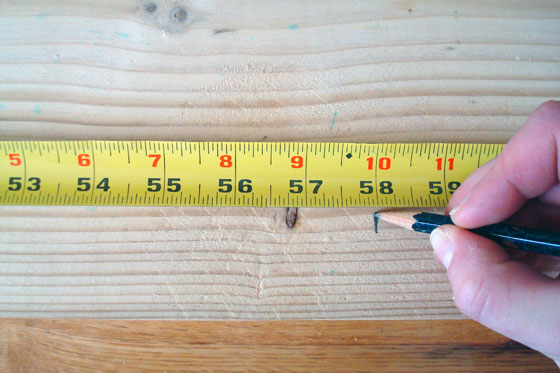
Making sure we kept everything in order, we marked the backside of the boards for screw holes.

Measuring and marking lumber

We spaced the screws 8 inches apart.

Then, I set up my newest toy and drilled holes using my Kreg Jig–yup, I got one!

Using a Kreg Jig to drill holes in a wood countertop

I was pretty confident that the Kreg Jig would give us really tight joints, but we glued each board as well with carpenter’s glue just to make certain. Be careful not to use too much glue, as you don’t want drips or seepage on the good side of your top.

Gluing boards for a wood countertop

Holes drilled and glue spread, it was time to put it all together. Matt held the boards even and kept the joints tight while I went along with the drill and set each screw.

Connecting boards for a wood countertop

Soon enough, we had a large slab of wood. Don’t be confused by the stamps and the holes from the Kreg Jig. This is the underside.

Back side of a wood counterop showing holes from the Kreg Jig

We took our incredibly heavy countertop and flipped it over. I trimmed one end with my circular saw to get a nice flush edge. I left the other end ragged, because I wanted to wait until we had the island, just to make sure I got the length exactly right.

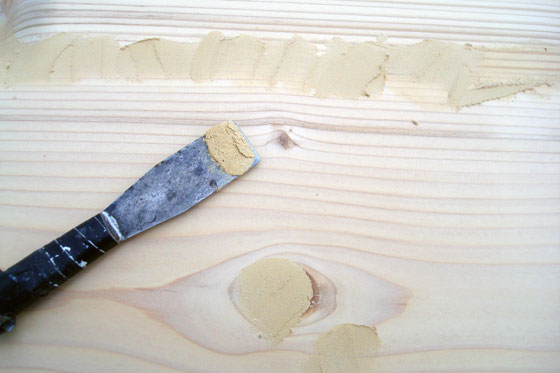
While the joints were really tight and pretty smooth, I still filled everything–every joint, every knot, every divot–with wood filler just to even out any imperfections.

Using wood filler on a wood countertop

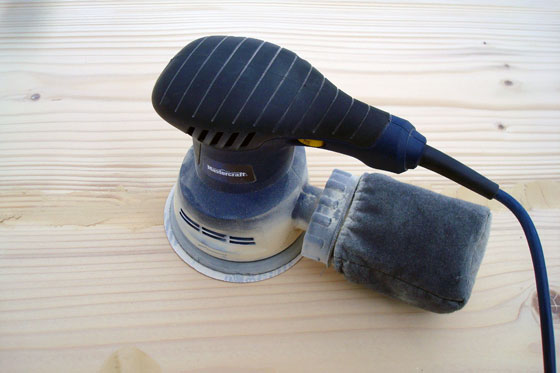
Then, it was on to sanding stage. Using my little orbital sander and lots and lots of sanding pads, I went over the countertop time and time again. I started with a 60 grit and slowly worked my way up to finer and finer grits (80, 120, 240 and 400).

Sanding a wood countertop

Despite choosing a very cheap grade of lumber, it came up beautifully smooth and even with the sanding. Take your time with your sander and don’t skimp on this step.

We did have one issue arise with our DIY wood countertop. Once the boards were all together and the top spent more time acclimatizing inside the house, it started to warp a bit. I attribute this to the frozen state of our lumber before we started construction. By the time the island was installed and we set the counter on top, we had a pretty good wave going on.

Unfinished warped wood countertop

Aaaah! A wonky wavy countertop was not at all what I envisioned. Our cabinet maker diplomatically limited his comments to “I dunno about that countertop.” My Dad suggested shimming under the one edge, where the gap between the underside of the countertop and the top of the cabinet was about 1/4 inch.

To everyone’s surprise–including mine–trimming the length of the countertop helped immensely. I don’t know whether most of the warp was happening at one end of the boards, but it was laying nearly flat after we cut off the extra length. Screwing the countertop into place on the cabinets leveled it out a bit more–even though we were very gentle and didn’t overly tighten the screws for fear of opening the joints between the boards.

My enthusiasm for my DIY wood countertop was rekindled. However, it was basically a large hunk of raw wood sitting in the middle of our kitchen–an attractive hunk of wood, but not the most useable surface.

The next step was to finish and waterproof the wood–which I’ll talk about on Wednesday. Stay tuned.

See my review on how our wood countertop held up over its first year.

See my review after four years.

How to use preglued veneer edging

I’ve posted an addition to this tutorial: How to apply pre-glued veneer on curved edges

Our new TV cabinet that you saw at the beginning of this week is a thing of beauty in my (admittedly biased) opinion. However, this wasn’t always the case.

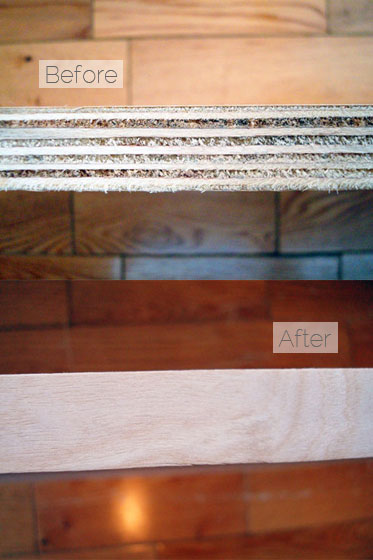
The cabinet is made of 3/4″ pine plywood. It’s paint grade, so the surfaces have a nice smooth finish. However, the raw edges are just that… raw. They’re rough and the layers of plywood are clearly visible. To finish off the edges, I used preglued veneer edging. This edging is very easy to use. Here’s what you do.

1. Gather your tools and materials.

Materials to apply veneer edging

This is a simple job that doesn’t require a lot of technical tools. Clockwise from bottom left, I have my roll of preglued veneer edging, my iron, a scrap 2×4 block, a file and scissors.

2. Set your iron to the cotton setting.

3. Prepare the edging. Use your scissors to cut a section of veneer that’s roughly half an inch longer than the edge you’re going to cover. You don’t have to be precise in your measurements. I just hold the veneer against the cabinet edge to figure out how long the section should be. You can work directly from the coil, but it’s easy for the veneer to get twisted, so I recommend cutting it into lengths first.

4. Starting at one end, carefully position the veneer against the edge that you want to cover.

Iron on veneer edging

The veneer will be slightly wider than the edge that you’re covering. Keep it flush on one end and one side and let it overhang the other.

5. With your edging in position, apply the iron to melt the glue.

Ironing veneer edging

I’ve found a “pressing” technique rather than an “ironing” technique works best. Just hold your iron in one spot for about 20 seconds. When you remove the iron, make sure the veneer is still aligned along the edge of the plywood. The glue will stay soft for only a couple of seconds so adjustments have to be made quickly.

6. Using your block of scrap wood, firmly press the edging onto the plywood.

Pressing veneer edging onto plywood

Press hard and slide the block back and forth over the section that you ironed making sure that the veneer fully adheres to the plywood.

Repeat steps 5 and 6 until the raw edge is completely covered with veneer.

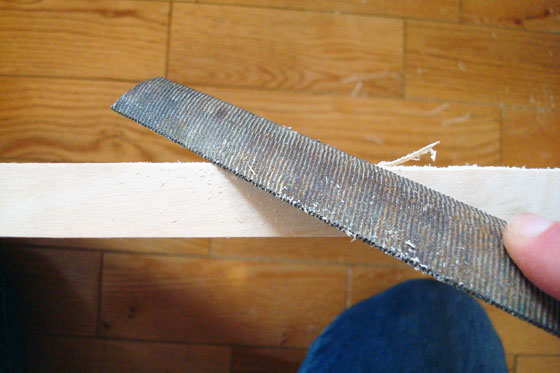
7. Once the veneer has cooled, trim the excess that’s overhanging the one side with a file.

Trimming veneer with a file

File towards the face of your plywood keeping the file at roughly a 45 degree angle. There are tools that will trim the veneer as well, but the file has always worked well for me.

Your edge should now be nice and smooth and ready for stain or paint.

Finishing a plywood edge with oreglued veneer edging

Some tips for using preglued veneer edging:

1. When cutting the veneer with your scissors, try to get a nice 90 degree cut. This will give you a good starting point for your next piece.

2. Check for joints in the veneer before you glue it to your plywood.

Finger joint in veneer edging

The veneer is connected by finger joints that aren’t the most attractive and wreck the illusion of a solid piece of wood.

3. Don’t skimp on pressing the veneer with your block. You don’t want your veneer to peel off once your cabinet is done. Pay special attention to the edges of the tape to make sure it’s firmly stuck.

4. If you use the file to trim the veneer, clean the file every so often. The sawdust will fill the grooves and make it more difficult to get a clean edge. I just tap the file to knock out the dust.

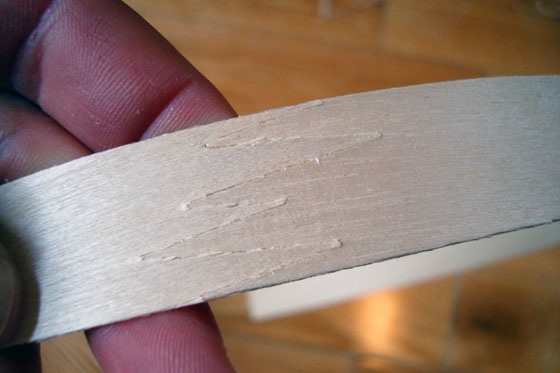
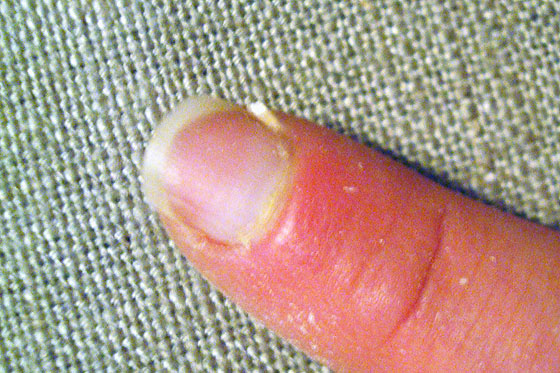
5. Watch out for splinters.

Splinter beside my fingernail

Ouch!

Although iron-on preglued veneer edging can be slightly dangerous for klutzes like me, it is very easy to use. Ironing is one of my least favourite tasks, but for some reason ironing wood is less tedious than ironing clothes for me. Just a little bit of effort results in a very nice polished finished for furniture, shelves or other creations.

Have you used veneer edging before? Who else is not a fan of ironing? Is anyone else susceptible to splinters? I seem to get a few a week. I’m sure a few are in my future this weekend. How about you? Any special projects on tap for the weekend?
I’ve posted an addition to this tutorial: How to apply pre-glued veneer on curved edges

How to install pot light trim

The end stage of a renovation involves a lot of little tasks: put on the cover plates, caulk the trim, touch up the paint, clean and dust everything. One of the little to-dos on our list was to put the trim on the pot lights.

My post on how to install pot lights is one of the most frequently accessed posts on the blog. But it’s unfinished. The housing for the pot light is just one part of the fixture. The other part is the trim, which goes on after the ceiling is finished.

Without the trim, the pot light looks a bit rough.

Pot light without trim

Our trim-less pot light

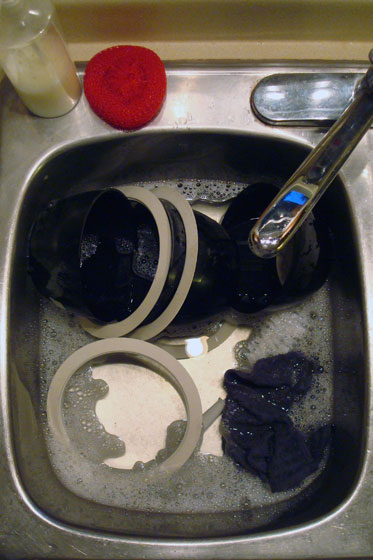
The first step in installing the trim is to wash a summer’s worth of drywall dust off of them.

Pot light trim in the sink

This step may be optional for some installations.

The trim should be made up of three pieces: the baffle, trim ring and spring or hook.

Pot light trim spring

This spring connects the trim to the housing

Step one is to attach the hook to the baffle. There should be little holes in the narrow end of the baffle specifically for this purpose.

Spring attached to pot light baffle

The end of the spring without the loop should be hooked to the baffle.

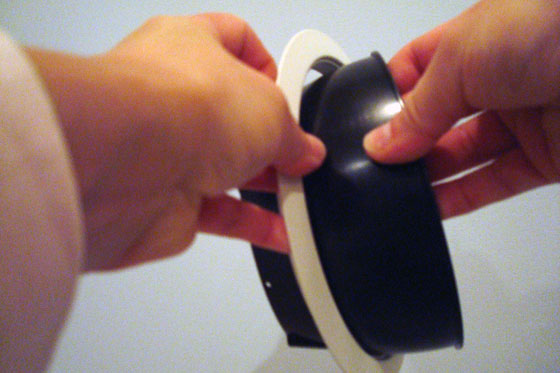
The next step is to connect your baffle and trim ring.

Putting trim on the baffle

This is probably the simplest step. Just slide the the trim ring over the baffle.

Remove the light bulb, so that you can reach into the housing. If necessary, adjust the height of the socket so that your bulb is recessed as much or as little as you want.

Adjusting the socket in a pot light

Loosen the wing nut, and the metal socket will slide up and down. Tighten it back up when the socket is positioned where you want.

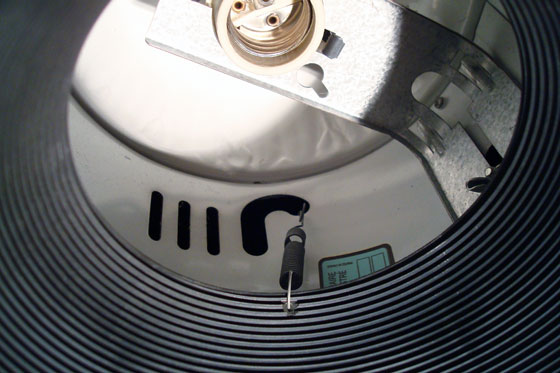
To connect the trim, insert the baffle into the housing, stretch the spring and hook it into the cut out on the pot light.

Pot light trim hooked in place

On our pot lights, the cut out looks like a candy cane

I found I was able to reach into the housing and hook the spring by hand. If your hands aren’t as small as mine, needle nosed pliers may come in handy.

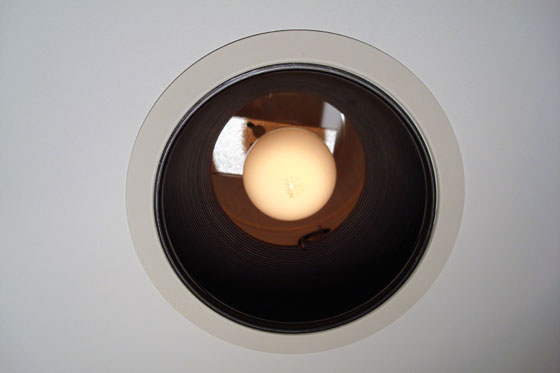
Screw the light bulb back in and admire your trimmed pot light.

Pot light

All done!

The trim reduces the brightness of the light somewhat and directs it downwards. I may adjust the height of the bulbs if we feel we need more light once we’re using the basement.
However, for now the pot lights are bright enough for me to admire our nearly finished basement. Is it weird that I stood there for nearly five whole minutes on the weekend just looking at the rooms and remembering how far we’ve come?