Forget jewels. I want tools!

I don’t know about anybody else, but the commercials that pop up this time of year talking about how really expensive diamond jewelry is the perfect Christmas gift are a little bit odd to me. Who has that much money to spend on a Christmas present?

But that could just be me. My Christmas list likely looks a little bit different than most women’s. At the top of my list this year is a Kreg Jig.

Kreg Jig

Photo from  www.kregtool.com since I don’t have a jig of my own to photograph… yet

As the reno winds down, I’m realizing I’m going to have to start furnishing some of these beautiful spaces we’ve built.

Thoughts of TV stands and kitchen islands and sofa tables and ottomans and coffee tables and benches lead to web searches and Pinterest and project plans and Ana White and “I can build that!”

So it’s official. If I’m going to be building furniture, I need a Kreg Jig.

Oh, and some extra red Robertson bits (#8) and a new carpenter’s square would also be helpful. Jewelry would not.

Santa, are you listening?

Wiley gets blinged out

Remember how I said Wiley likes to accessorize? Well, our little tractor is in heaven with a brand new bauble that arrived last week. And it’s a big one.

Rear mounted snowblower on a tractor

Subtle is not in Wiley’s vocabulary.

In case anyone doesn’t know what they’re looking at here, this is our new snowblower.

Rear mounted snowblower on a tractor

The sales rep from our tractor dealership goes for the first test drive (normally we will not be blowing 2 inches of snow)

Over the weekend, we got Wiley all set for winter, disconnecting the mower and hooking up the blower.

The mower deck has been scraped and scrubbed and tucked away for the season.

We even broke out our new grease gun and lubed up all of the fittings. Wiley’s affection for accessories became even clearer when he grabbed onto the grease gun and wouldn’t let go. After wiggling and jiggling and yanking Matt and I were starting to envision plowing snow with the gun dangling from the side of the tractor. However, through a combination of vice grips and pliers Matt was able to detach the gun from the fitting.

Sorry, Wiley, but sometimes less is more.

Climbing the property ladder

Everybody knows about the property ladder. Scrape your pennies together to buy a house and get on the bottom rung of the ladder. Eventually use the equity from your first house to move up the ladder until you’re able to (hopefully) afford to buy the house of your dreams.

The other week, I had the opportunity to talk to the Toronto Star about Matt’s and my experience with the mortgage on our first house. As I was preparing for the interview, it occurred to me that the lessons we learned might be interesting to some of you too.

Our first house got us onto the property ladder. It set us up to buy the farm and begin building our forever house. However, in order to go from our starter house to the farm, we had to skip a few rungs along the climb.

We were able to move up the property ladder quickly because when Matt and I sold our first house, we owned it free and clear. We had no mortgage.

For two 30-year-olds to pay off their first house in four and a half years is a bit unusual.

We didn’t win the lottery, no relative left us a big inheritance, we work regular jobs and earn average salaries, and our parents didn’t give us money to purchase either our first house or the farm.

So how did we pay off our mortgage early?

First, we bought a house we could afford. When we went to the bank to be pre-approved for our mortgage, we were astounded by how much we qualified to borrow. It was close to twice the amount we were expecting to spend. It’s easy to be sucked into spending more than you planned, especially if the bank says that you can. Be disciplined and stick to your budget.

The other thing that we did at the very start was to put down the biggest down payment we could. For Matt and me that was 25%. The hardest part of buying a house for many young first time buyers is building up their savings to make the down payment.

Fortunately, Matt and I were able to live with our parents and pay little or no rent. We saved and economized, and when we were ready to buy the house, we had enough (in my case just enough) to put 25% down. Making the largest down payment you can at the beginning puts you much further ahead in paying off your mortgage over the long term.

The biggest thing that helped us to pay off our mortgage in four and a half years was taking advantage of the accelerated payment plans our bank allowed. To start, we chose a “weekly rapid” plan where we made a payment every single Friday for a total of 52 payments a year. The amount of the payment was determined by taking what we would have paid monthly, dividing it by four and then paying that amount each week. This works out to basically making 13 months of payments rather than 12.

I remember sitting in the bank going over the payment options with the mortgage advisor and her showing us that by making just one extra month of payments a year, we would pay off our 25 year mortgage in 21 years. That was an easy choice for us.

However, 21 years wasn’t fast enough.

The other option we took advantage of was to make lump sum payments directly against the principal of our mortgage. For our bank, the maximum they allowed was 15% per year. Every single year, Matt and I took full advantage of this, and every single year we knocked roughly another 5 years off our mortgage.

I’m not saying it was easy to see that much money going out of my bank account each year, but getting a printout showing our mortgage would be done in 15, 8, and then 3 years did soften the sting.

Mortgage statement

The Amortization Period line at the bottom is the one to keep your eye on.

Most banks will also allow you to increase the the amount of your weekly (or biweekly or monthly) payments. We did eventually bump up our weekly installments, but for the most part we focused on saving for the annual lump sum payments.

With any financial situation, I think it’s really important to watch your numbers and understand exactly where your money is going. We requested extra statements from the bank that showed the breakdown of exactly how much of our weekly payments went towards principal and how much was interest. When the ratio finally crossed 50-50 with even just a few more dollars going towards principal than interest, that was cause for celebration. We also kept an eye on the amortization period that changed every time we made a lump sum payment and carefully read our annual statements.

Interest and principal mortgage payments

It will likely take a few years, but eventually you will pay more principal than interest.

Because we know our numbers, we know that we paid just over $20,000 in interest on our mortgage. This is versus nearly $200,000 in interest we would have paid if we stuck with the bank’s schedule and taken the full 25 years to pay off our mortgage.

Despite Matt’s and my focus on our mortgage, we did try to keep a balance in our life. Prioritizing our mortgage was important to us, but having a life was too. In the time that we owned our first house, we got married (and paid for our wedding), traveled, furnished our house and renovated. If we had put all of our money towards only our mortgage, I don’t think we would have enjoyed our house in the same way we were able to.

So here are my five tips for how we paid off our mortgage in less than five years:

  1. Buy the house you can afford.
  2. Put as much down as you can.
  3. Take advantage of accelerated and lump sum payment plans.
  4. Watch your numbers.
  5. Prioritize what’s important to you.

Now at the farm, we have a mortgage again, and it’s much bigger than it was on our first house. However, it’s still affordable for us. We’ve again chosen an accelerated payment plan of 13 months of payments per year. And we’re already planning on making a lump sum payment before the end of the year. (Note, lump sum payments are usually calendar year, not mortgage year, so even though we’ve only owned the farm for 8 months, we can still make a payment against the principal).

Our first house put us on the property ladder, and the strong financial foundation we built by paying off our mortgage early allowed us to quickly move up the ladder.

We won’t pay the farm off in five years like we did at our first house, but we’re not satisfied to wait the full term of our mortgage either.

Now it’s your turn. Do you have a mortgage? What’s your approach to payments? Any tips to share?

‘Twas a month before Christmas

‘Twas a month before Christmas and all through the house, there was scrubbing and dusting and vacuuming the couch.

(Not a perfect rhyme, I know).

Despite my earlier anxieties about hosting a big Christmas dinner before we were finished with renovations, everything came together–new carpet included–and the house was pretty presentable by the time Matt’s family arrived for the party last Saturday.

My main focus was on just having everything clean, so decor was mostly limited to the tables (and with 17 people for dinner, we needed two tables and lots of extra chairs).

Table set for Christmas dinner

I kept things simple with my go-to cream table cloths, a burlap runner down the middle, khaki napkins, a single candle centrepiece, some greenery, pine cones and our wedding china and crystal

The inspiration for the theme came from Mrs. Limestone’s woodsy place cards. Stefanie’s engravings are beautiful, and the animals were perfect for our rural setting.

I adjusted them slightly for our party, eliminating the tag portion and adding people’s names in George Gibson, a cool handwriting font I found via The Art of Doing Stuff. Then I tucked them into pine cones I picked up from behind the house and slipped them between the cutlery on everyone’s napkins.

Placecard

I love the attitude this porcupine has!

The other adjustment I made was on the back of the cards, where I printed little bits of trivia about each person’s animal.

Trivia place card

It might be a little cheesy, but people did enjoy reading about their animals. Little known fact: the porcupine with the largest quills (nearly a foot long) lives in Africa.

Of course, the decor is only one small part of a successful dinner party. The most important part–the food!–was a hit as well. While I was running around in the freshly fallen snow, gathering tree boughs and searching for similarly-sized pine cones, Matt took charge of our 20 pound turkey.

The best part of this shot is he’s not mugging for the camera. This was his actual facial expression as he was getting intimate with the turkey.

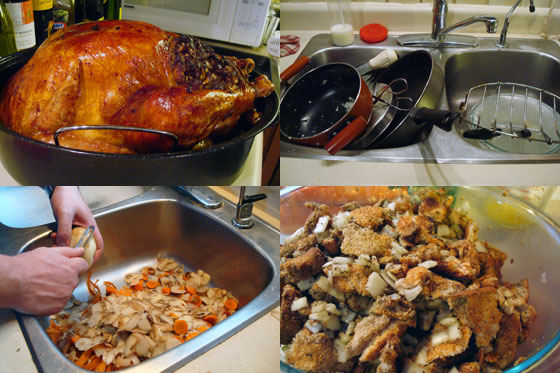
The fruits of Matt’s labour: a perfectly cooked turkey, a pile of dirty dishes, a bowl of stuffing and a sink full of vegetable peelings. (And yes, he did the clean-up as well as the cooking).

Before, during and after at the Christmas party.

According to the camera’s memory card, I spent the party doing things other than taking pictures, so I don’t have much documentation from the rest of the day. By all reports a good time was had by all. To return to where we started:

“We heard them exclaim ‘ere they drove out of sight, happy Christmas to all, and to all a good night!”

I hope everyone has a great weekend. Do you have a Christmas party to attend or host? A major meal to cook? A big cleaning blitz to complete? What’s your go-to decor for a dinner party? Anyone have any interesting porcupine facts or experiences to share?
My new pet

There’s yet another new addition at the farm, and this one is soft and fuzzy and warm and brings me much joy.

Standing on carpet in barefeet

These are happy feet, in case you can’t tell. The novelty of going down to the basement without first putting on shoes still hasn’t worn off.

Our new carpet was installed on Friday, and the difference it makes in the basement is amazing.

After the nasty, stained, old carpet that came with the house and the bare concrete that we’ve been looking at for the past 8 months, even just the sight of the underpad going down was an incredible transformation.

Carpet underpad

Our installers likely thought I was slightly odd given how I cooed over the underpad as soon as it was installed

Between the underpad and the carpet, the basement floor is extremely cushy on our tootsies–and our tushies, which is handy given that we currently don’t have any furniture.

Carpeted basement

Matt and I have both spent time sitting on our imaginary couch across from our imaginary TV. The shelf standing in for a TV stand is real, for anyone who’s wondering if they’re seeing things.

When it comes to selecting carpet, the array of choices is somewhat befuddling, in my opinion. Matt and I made our decision very quickly, mostly because we wanted the carpet installed as soon as possible so that this renovation could be finished as soon as possible.

Here’s the details:

Who: Alexanian in Burlington, Ontario. They have a good local reputation and had been used by a few people we know, including Matt’s Dad.

What: Spillguard underpad, the thickest offered by Alexanian, topped with a nylon cut loop carpet in a light beige colour

Why: For the coziness. I know carpet isn’t a lot of people’s first choice for flooring, but for a basement, it’s at the top of my list. In terms of the specifics of what we chose, I probably would have gone with a Berber or loop carpet. However, Matt prefers the plusher feel of the cut loop carpets, so I deferred to him on the texture while I chose the colour. I may regret going with such a light colour someday, but I really wanted something neutral.

Where: The whole basement, about 1100 square feet, including 11 stairs.

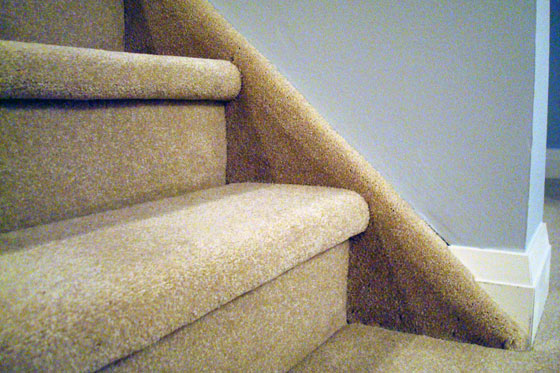
Carpeted stairs

All of the stairs, including risers, stringers and treads, got carpet.

Carpet installation is a major milestone in the basement renovation. We still have some paint touch-ups to do, light fixtures to install, (don’t talk to me about the bathroom that needs to be tiled), and a few other finishing touches, but overall the basement is now livable and useable. And it looks fabulous.

As much as I disliked that concrete floor, it did have one nice element.

Matt + Julia 2012

A secret message commemorating our renovation

Is it too harsh to say I’m hoping that we never see this message again?

A new look

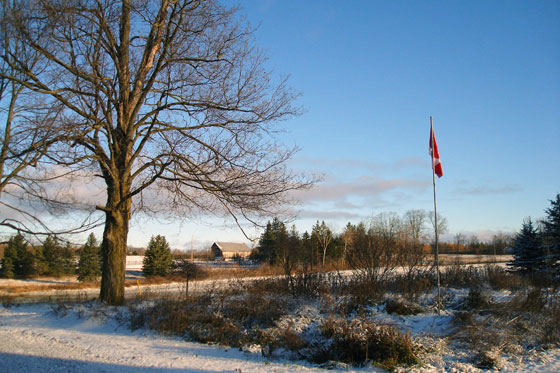
We had a new arrival at the farm this weekend: our first snow.

Snow on the fields

Flurries started on Friday night, and by Saturday morning we had a light dusting over everything.

Wild flowers dusted with snow

Our new landscape drew me out of the house first thing, just adding snow boots to my pyjamas

Standing in the first snow of the season

At the front of the house, I had an open view over the fields to the farm across the road.

First snowfall on the farm

Even the burrs look photogenic when they’re wearing a cap of snowflakes.

Snow covered burrs

Behind the barn, the lane to the back field and the woods also look particularly photogenic under a blue sky, bright sun and fresh snow.

Snow covered lane through the field

At the bottom of the meadow, the creek was flowing into the pond amongst the snow-covered boulders.

Snow on the creek

Back up at the house, our cozy abode under its first dusting of snow.

Our house with its first dusting of snow

Temperatures dropped over the past few days, so the snow stayed over the weekend. I’m hoping to have a true Canadian winter this year after a snowless season last year, so I’m happy to see the early snowfall.

What would be your reaction if you woke up to snow? Would you be outside in pyjamas and boots too? For some of my more southern readers, I expect a snowy morning would be a bit unexpected. Anyone from more northern climes, have you had your first snowfall yet? What type of weather are you hoping for this winter?

The 20lb creature in my fridge

While my American readers are celebrating Thanksgiving, we have moved onto Christmas already up here in the north.

Tomorrow we’re hosting Matt’s Mom’s side of the family for an early Christmas dinner, and in between vacuuming up drywall dust and supervising the carpet installers who arrive this morning–giving new meaning to last minute party prep–we’ve added a new animal sighting to our list.

Butterball turkey

Although our Butterball is not exactly a wild animal

Thanks to Matt’s parents for venturing south of the border and braving American grocery shoppers to bring us this turkey. In addition to the obvious Thanksgiving date conflict between Canada and the U.S. I think we may have inadvertently undermined 200 years of peace when my MIL’s friend Marg grabbed the last three turkeys in the store so that we could have the pick of the poultry.

20 pound turkey

Matt’s pick is for the biggest turkey he can find. At 20 pounds, I think this guy fits the bill.

I’ll post a full party wrap-up next week. Until then, I’m setting aside all cultural differences to wish everyone a good weekend and all of my American readers a very happy Thanksgiving.

Seasonal shut down

Nothing is ever simple with us, and winterizing the water lines was no exception.

Tools used included a drywall saw, an air compressor and a mop.

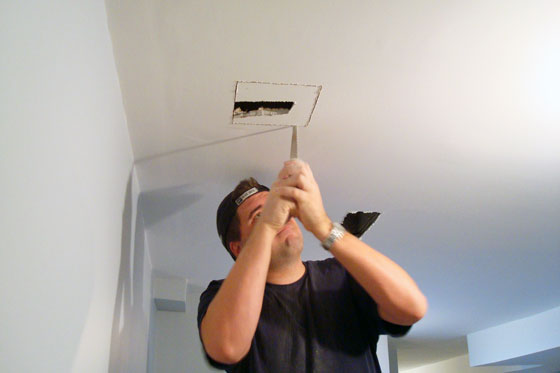
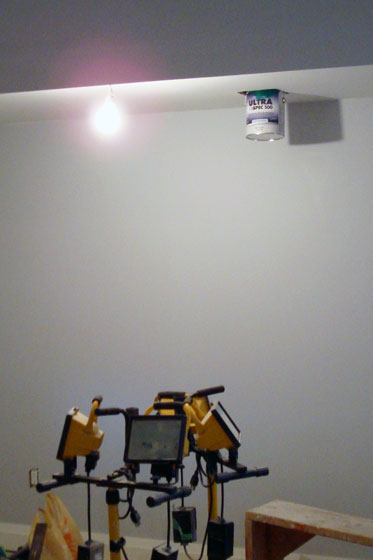
The drywall saw was required to access the one shut off, which was in the ceiling in the ping pong area of the basement. We knew it was there and had marked its location when we were installing the drywall. (The other cut-out in the ceiling is a heat register).

Matt cuts the hole in the ceiling

We hung buckets by their handles from the taps to catch the water as we drained the lines. However, we quickly ran out of buckets, so Matt used what was available: one of our empty paint cans.

Paint can hanging from the ceiling

Paint cans dangling from the ceiling is not the decor we’re going for in the basement. Fortunately, this line drained quickly, and Matt was able to install the access panel that we bought to cover the hole.

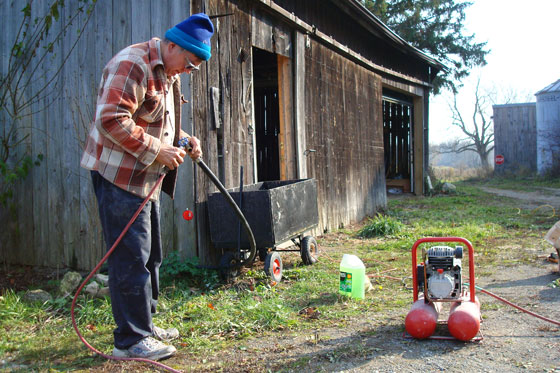
The water line to the driveshed needed a little help to drain, hence the air compressor. The low point of the line is in the utility room in the basement, so my Dad connected the air compressor to the tap at the driveshed and let ‘er blow.

Using an air compressor to clear a water line

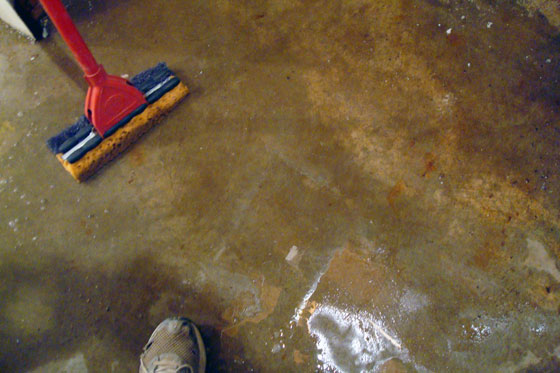
While the utility room is the low point, there’s obviously another area somewhere in the line where the water pools, because there was much more water in the line than I expected. The force of the air was a little too much for the bucket we’d hung on that tap, and we ended up with water sprayed all over the utility room.

Mopping up a puddle of water

It was nothing a mop couldn’t fix, but since the water flowed out into the rest of the basement we were very relieved that our new carpet isn’t installed yet.

Once the line was clear, we poured some antifreeze down the pipe just for extra protection.

Our third exterior tap and the old line to the barn were winterized without issue. The old pump and pressure tank in the barn are probably not fully drained, but, given their deteriorated state, I’m not concerned about any further damage. The line itself is clear and is also below the frost line, so when we’re ready to have running water in the barn we should be able to put it into service.

Winterizing the waterlines was at the top of the list of our fall chores, and it feels good to cross off another to-do.

Have you winterized your waterlines? Or is your climate gentle enough to not freeze your exterior hoses? Anyone else dealt with basement floods recently? Do you have any jobs that ended up being more complicated than you expected?

How to install pot light trim

The end stage of a renovation involves a lot of little tasks: put on the cover plates, caulk the trim, touch up the paint, clean and dust everything. One of the little to-dos on our list was to put the trim on the pot lights.

My post on how to install pot lights is one of the most frequently accessed posts on the blog. But it’s unfinished. The housing for the pot light is just one part of the fixture. The other part is the trim, which goes on after the ceiling is finished.

Without the trim, the pot light looks a bit rough.

Pot light without trim

Our trim-less pot light

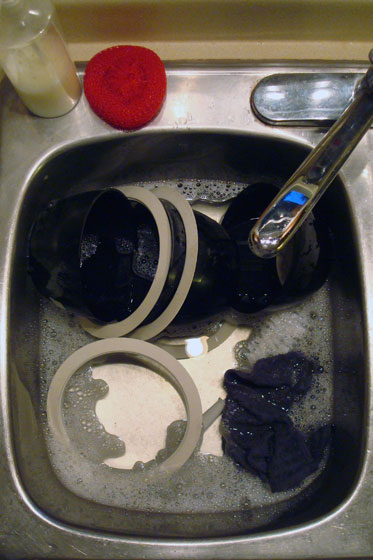
The first step in installing the trim is to wash a summer’s worth of drywall dust off of them.

Pot light trim in the sink

This step may be optional for some installations.

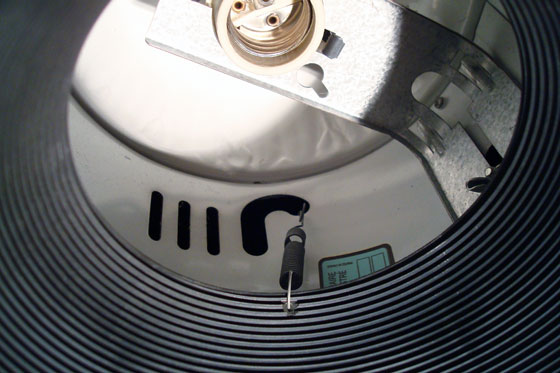
The trim should be made up of three pieces: the baffle, trim ring and spring or hook.

Pot light trim spring

This spring connects the trim to the housing

Step one is to attach the hook to the baffle. There should be little holes in the narrow end of the baffle specifically for this purpose.

Spring attached to pot light baffle

The end of the spring without the loop should be hooked to the baffle.

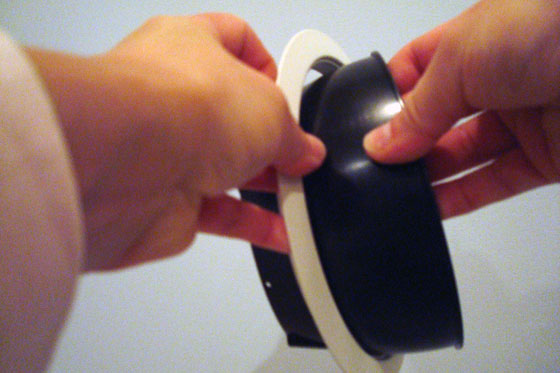
The next step is to connect your baffle and trim ring.

Putting trim on the baffle

This is probably the simplest step. Just slide the the trim ring over the baffle.

Remove the light bulb, so that you can reach into the housing. If necessary, adjust the height of the socket so that your bulb is recessed as much or as little as you want.

Adjusting the socket in a pot light

Loosen the wing nut, and the metal socket will slide up and down. Tighten it back up when the socket is positioned where you want.

To connect the trim, insert the baffle into the housing, stretch the spring and hook it into the cut out on the pot light.

Pot light trim hooked in place

On our pot lights, the cut out looks like a candy cane

I found I was able to reach into the housing and hook the spring by hand. If your hands aren’t as small as mine, needle nosed pliers may come in handy.

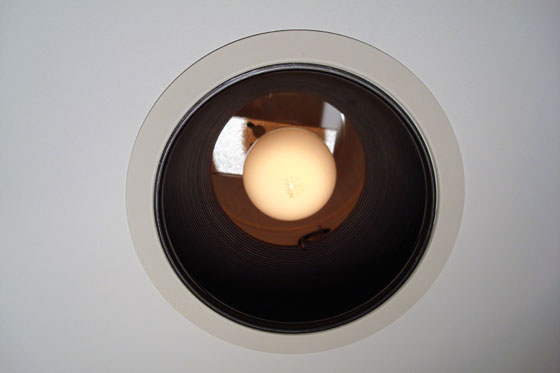
Screw the light bulb back in and admire your trimmed pot light.

Pot light

All done!

The trim reduces the brightness of the light somewhat and directs it downwards. I may adjust the height of the bulbs if we feel we need more light once we’re using the basement.

However, for now the pot lights are bright enough for me to admire our nearly finished basement. Is it weird that I stood there for nearly five whole minutes on the weekend just looking at the rooms and remembering how far we’ve come?

Friday night lights

I’ve mentioned before that the farm is a wee bit dark once the sun sets. Well, since the time change a few weeks ago, things have been extremely dark out here in the country.

The farm at night

This is not just a black square. I actually went outside and took a picture for you to show how dark it is.

Arriving home had gotten a bit hazardous between stepping on cats and randomly jamming the key in the general direction of the lock on the front door.

The time had come for a call to the electrician.

After a quick rewiring of the driveshed, an installation on the barn, relocation of a timer and a new circuit panel–also in the driveshed, the top of our driveway now looks like this when we arrive home at night.

Exterior lights on the barn and driveshed

Let there be light! This image was taken from roughly the same angle as the one above.

We had lights on the driveshed and barn already, but neither of them were working. In the driveshed, we’d killed the power because of sketchy wiring and an obviously unsafe fuse box. On the barn, the old light had a blown transformer, and ultimately the whole light had to be replaced.

Thanks to a timer we already had in the basement of the house that the electrician was able to repurpose outside, the lights come on automatically before we get home and then go off before we go to bed. The new barn light also has a photocell that senses darkness, but we decided we don’t need to see what’s going on outside all night long, so we let the timer shut everything down around 9 o’clock. We may adjust that, but for now it’s working well for us.

The lights are also working well for the cats who no longer have to worry about being stepped on or run over. Up until now, our only way of seeing them when we come home was watching for the glow of their eyes in our headlights.

As much as I’m thrilled with our new exterior lights, I do have to admit that I’m looking forward to being home during daylight this weekend. I’m starting to forget what my property looks like outside of the lighted sphere of the barn, driveshed and house.