How to add a harp to a lamp

My thrift store lamp that you met on Friday had a lot of things going for it, especially after its spray paint makeover. However, there was one thing missing that I didn’t notice until the very end: the harp.

The harp is the little bracket that goes around the light bulb and holds the lampshade.

I admit, I was a little intimidated by the prospect of installing a harp. I hear about a lot of people rewiring lamps, but I’ve never attempted that myself. It turns out it’s not hard. In fact, I just started trying to take the lamp apart and was able to figure it out pretty much on my own.

Step one was to remove the socket from the lamp base. It just unscrewed, and the cord was loose enough that I was able to pull it out a little bit.

Removing the socket from a lamp

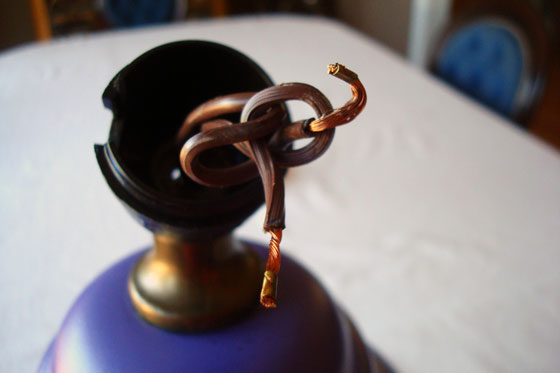
The wire was still buried deep in the socket, so I started trying to figure out how to access it. A close examination revealed a seam in the middle of the socket. You can see it partially opened here.

Removing the socket from a lamp

The socket easily unscrewed, and I could see where the wires attached to two screws. I could also see a really intimidating knot. Gulp.

Taking apart a lamp socket

A couple of turns loosened the screws enough to unhook the wires. Quick tip: I marked which wire went to which screw (one’s gold and one’s silver) by straightening the gold one and leaving the silver one hooked.

Taking apart a lamp socket

I was really, really hoping to not untie that knot, but in order to remove the bottom part of the socket–never mind putting on the harp–I had to. With the knot untied, the socket easily slid off and the harp bracket easily slid on.

How to add a harp to a lamp

After that, it was a (relatively) easy process of reassembling the socket. I slid the bottom part of the socket back into place. I retied the knot. (Okay, this was a bit complicated.) It turns out the knot is called an underwriters knot. I watched this animation a few times as I was tying my own knot. I hooked the wires back over their screws, and then screwed everything back together. I had a reassembled lamp that now included the bottom part of the harp.

How to add a harp to a lamp

The upper part of the harp slid onto the bottom bracket and I gave myself a congratulatory pat on the back.

How to add a harp to a lamp

And then I had to choose a lampshade. Last week I asked for your input, white or grey. So what did I end up choosing?

I went with the grey. It was pretty much the universal favourite last week, and I decided that I liked its flared shape best.

Purple lamp with flared grey shade

And another detail on the basement comes together. Slowly but surely I will finish this space.

Have you ever rewired a lamp? What DIY projects do you find intimidating?

Linking up to #DIYLightingChallenge

Christmas card display

It’s Thanksgiving this week for my American readers, but as she celebrates Sarah in Illinois is already looking ahead to Christmas. Timely, as we’re exactly one month away from Christmas. Yipes! Sarah is back today to share a cute DIY for displaying Christmas cards.

One of my favorite parts of Christmas is checking the mail box for Christmas cards. I love sending and receiving cards and putting them on display. However, I have never really had a way to display them that looked nice.

This year I decided to turn to Pinterest to come up with a plan. There were so many cute ideas, but I did not use one specific image as my inspiration. I searched for “Christmas card holder” and used an idea from here and a feature from there, and this is what I came up with:

Christmas card display

I started by making a frame out of simple 1×2. I decided I wanted the inside of my frame to be about 16×20 inches, but that measurement could easily be adjusted to any size.

I cut my 1×2 at a 45 degree angle making sure that the right and left side were exactly the same length and did the same for the top and bottom. That way the frame would be square.

Cutting 1x2s on a mitre saw

The trickiest part of the whole project was nailing the frame together. Because I am stubborn, I didn’t ask for help. But having someone to help hold the pieces would be easier. Using screws would also have been easier, but I didn’t want the screw heads to show.

At this point, I grabbed some stain that we had sitting around and gave it a good coat and wiped off the excess. Many of the inspiration pictures that I was looking at used chicken wire as the background, but I felt the chicken wire was too “country” for my taste so I planned to use hardware cloth.

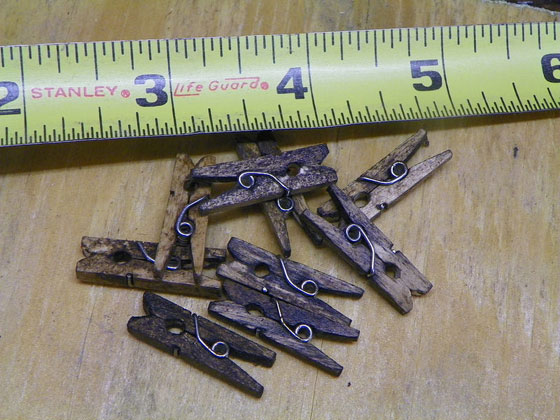
I found these little bitty clothes pins to use to hang the cards on the wire.

Mini clothespins

They came as bare wood, so I used the same stain as I did for the frame to give them a little interest. I used tin snips to cut the hardware cloth to size and then stapled it to the back of the frame.

Hardware cloth stapled to a wood frame

For the pennants, I had to do some experimenting. I used quarter-inch plywood and cut it in a strip 2.5 inches wide. Then I had to cut it into the pennant shape. But I didn’t know what angle that should be. So I just tried until I liked the way it looked.

I set my miter at 45 degrees, and I didn’t like that angle, so I changed it to 30 degrees. That was better, but I still felt it wasn’t exactly what I wanted. The next pre-marked measurement on my saw was 22.5 degrees, so I tried that and thought it looked just right!

Cutting penants on a mitre saw

After I cut several pennants, I used a little drill bit to put holes in the top to string some jute through.

Drilling holes

But before I strung them up I painted with a little craft acrylic paint. All that was left was to hang them at the top of the frame. I did that by tying the string to the back of the frame on the hardware cloth.

My frame is now hung on the wall and ready for the first card to come in the mail!

Christmas card display

What a cute display, Sarah. It’s just country enough, in my opinion. To see what else is inspiring Sarah, follow her on Pinterest.

I hope that Sarah and all my other American readers have a great Thanksgiving.

Finishing up the deck

I’m pleased to welcome Sarah in Illinois back to the blog. Today’s post is full of the things I love: a big doggie, country views and a great DIY transformation. Take it away, Sarah.

One of Steve and my favorite places to relax is on our deck. The summer of 2013 we drew up plans and built a large deck off the back of our house. There are some things about the deck that we wish we had done differently, but overall we are very happy with it. (Hello, Treu!)
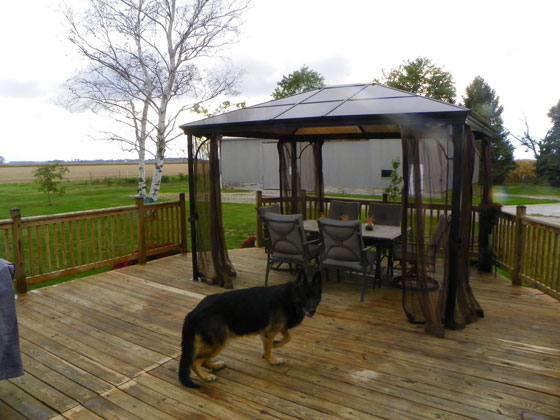
Deck with Treu

We had done a little research on how to protect it. One thing that we had read was to wait a year to put any sealant on it.

We chose to wait even longer. The boards we used were very green. That is, they had a lot of moisture in them. This was obvious when we installed it, but it also showed up over time as the boards warped more than we had liked as they dried.

This year I decided that it was time to get at least one coat of sealant on it. The thing was, after two years, the deck was very dirty and stained. I believe this was a combination of normal use, stains from the grill, mold from moisture and just pollution in the air.

Deck railing before

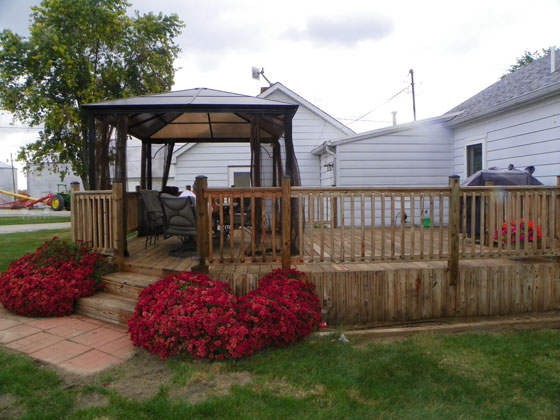
So I chose to clean it first. It took just a little bit of prep work. I have two unbelievable huge and beautiful mums, so I made sure to drape plastic drop cloths over them to keep the cleaner off of them. The deck wash I purchased was a bleach base and it worked like a charm for cleaning the deck.

Cleaning the deck

I bought what I believed to be enough based on the square footage that it said it covered. This was way off. I ended up needing double the amount. I think that part of the reason was that maybe the square footage listed did not take in account the railings. But I am sure it also had to do with how heavy I sprayed it on the wood.

I used a hand held pump sprayer to apply the cleaner, then I used a broom to lightly scrub trouble spots, and finally I sprayed it off with a garden hose. This was easily a one person job and if I had had enough cleaner would have taken just one afternoon.

Then I let the deck dry for a couple weeks. I wanted to make sure not to trap any moisture in with the sealant.

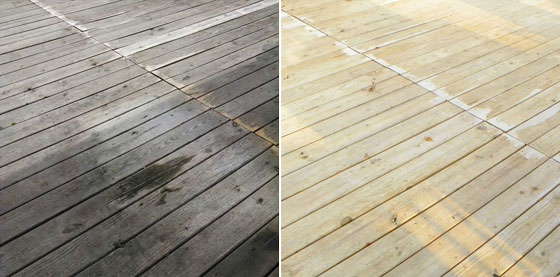
Deck before and after cleaning

When it was time to seal the deck, it took more prep work and took two people. Steve and I used the same hand pump sprayer to apply the sealant. We found the method that worked for us was for Steve to spray the railings, then the floor and for me to follow up with a brush and smooth any drips and puddles. We wanted to make sure we put a heavy coat on, but we wanted it to be fairly even.

Applying sealer to the deck

The sealant was much messier than the cleaner. It got everywhere–on us, on the siding, and even oversprayed to my nearby herb garden. We are planning to reside the house in the next year when our addition is finished, so I was not too upset by the overspray on the siding, but I sure wish I had harvested my basil and oregano before we got started.

We feel the deck needs at least one more coat of sealant for us to be happy with it. But since harvest has started, it looks like it is going to be next spring before that gets done.

In the meantime, I am so happy to have the first layer of protection on it. The cooler weather is just begging us to come out of the house and relax!

Deck with mums

What a great outdoor space, Sarah. Those mums are amazing. I’m always so impressed by how wood can be restored with a good cleaning and a bit of work. Good job. I hope you get to relax outside and enjoy it.

Anyone else have tips to share about restoring wood? Have you ever stained a deck? Who else has had a project that’s taken a bit longer to complete than planned?
Finally finished the fence

The benefit of using the old longe ring for the garden meant that we already had a fence. However, it was a beautiful sturdy weathered wood fence. Perfect for form, not so good for function when it comes to a garden.

The ring was used to exercise horses. Meaning anything smaller than a horse could fit through the fence.

Matt and I decided to add chainlink to keep the bunnies and other hungry creatures away from our garden.

I had collected a few rolls of chainlink from the ends of various people’s driveways, but the ring is so big that I had to buy three more rolls. So this project was definitely the most expensive part of the garden so far coming in at nearly $300.

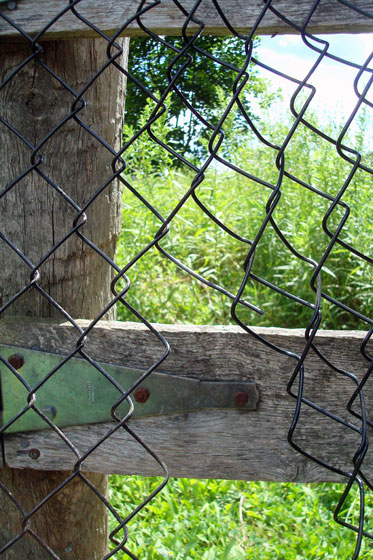
Fortunately, we didn’t have to buy posts or anything else besides staples. We made use of the wood fence and stapled the chainlink to the existing posts.

Chainlink fence stapled to a wood post

Lesson learned, we should have thought a bit more about who does what.

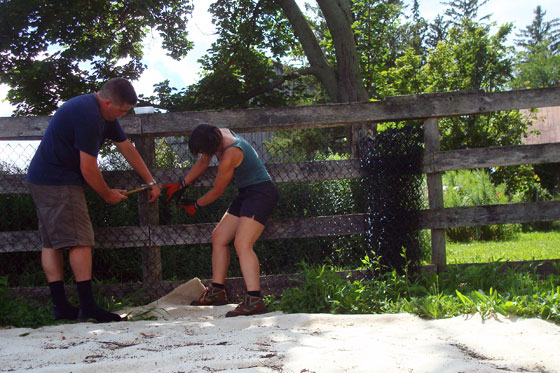
I stretched the fence, and Matt hammered the staples. I have less muscle than Matt, so stretching the fence was hard for me. Matt has bigger fingers than me, so he hammered his fingers a lot while he was holding the staples between the links of the fence.

Installing chainlink fence in the garden

Matt wasn’t going to give in though. There was no way he was switching roles. So we worked our way around the garden taking breaks to hammer the ground in frustration or slap mosquitoes who just won’t go away this summer.

When we reached the end of a roll, we joined it to the next section by weaving in a single strand of fencing. Just twist, twist, twist until the wire reaches the bottom. (To separate a section of fence, you just reverse the process and untwist one piece of wire. Your fence will easily split in two.)

Joining chainlink fence

Eventually, we got a rhythm. A lot of it consisted of us asking each other, “Ready?” And then, “Hold it, woman!”

Our marriage survived, and our garden is fenced.

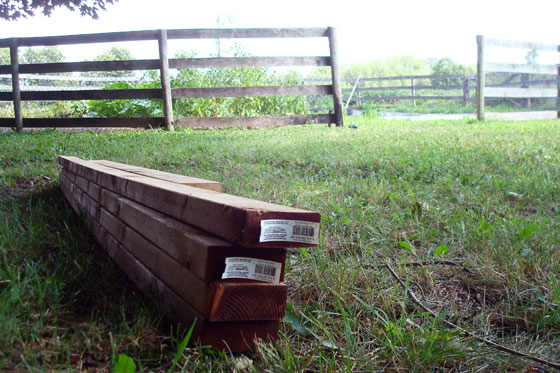
Fenced, but not gated. We bought wood for the gate last week but haven’t built it yet. So we are still welcoming the hungry creatures–horse-sized and smaller–to our garden.

The thing that I like about the fence is that the chainlink is pretty much invisible, so we still have the aesthetic qualities of the wood fence that I fell in love with from the start.

Wood for the garden gate

And to be honest, our garden isn’t really under threat from the local wildlife. Our beans were munched shortly after they sprouted, but the rest of their gardenmates have survived… and thrived. In fact, I think Matt would be happy if a hungry hoard descended on the zucchini.

Rough ride

The car was up on the hoist. Matt was underneath. The mechanic turned to him and said, “What are your intentions with this car?”

Never a good question when you’re standing under a 12 year old vehicle.

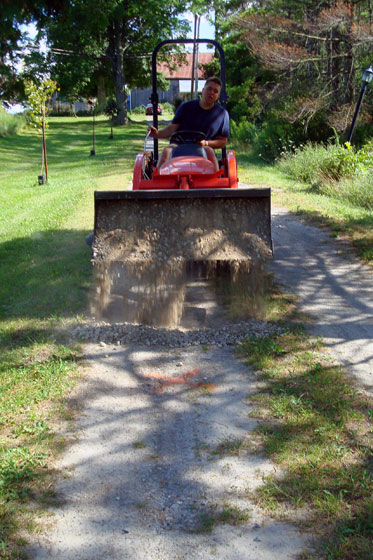
Pouring gravel out of the tractor into the potholes

There had been signs that not everything was right: warning lights, new noises, a dozen years on the road, the 262,000+km on the odometer.

Driving home, the car broke down three times on the side of the road. Jumper cables were required.

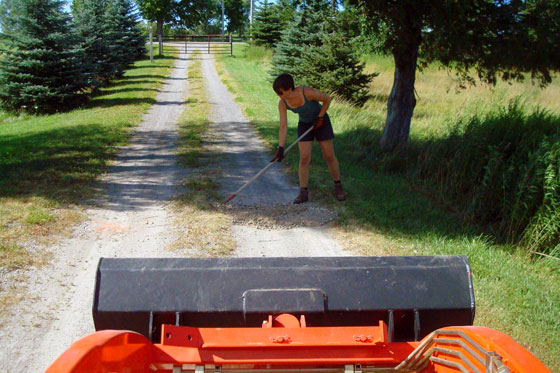
Filling the potholes in the driveway

I was at work and unaware all of this was happening, so my question when I got home of “How did the appointment with the mechanic go?” was met with an answer I didn’t entirely expect.

Filling the potholes in the driveway

“Ummm… I hope you don’t mind, but I bought a car today.”

To roll out the red carpet for Matt’s new car, we pushed the old car out of the way of the front door (the dealership sent someone to pick it up… with a tow truck), and we patched the potholes in the driveway.

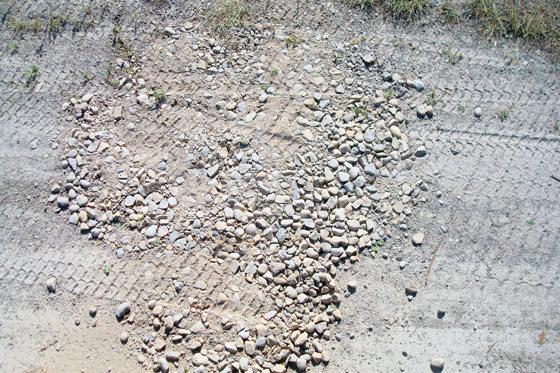
Fresh gravel in the pothole

We can’t have new suspension and steering put to the test by the obstacle course that is the usual access path for the farm.

What state is your driveway in? How old is your car? Have you ever had to buy a car urgently? Who else thinks I should have got to drive the tractor while Matt handled the rake?

The growth of a garden

As I was putting together Friday’s post, I started looking through old photos of the turnaround garden. It was amazing to me to see how far it’s come–even though I’ve been here for all of it. I had to share it with all of you.

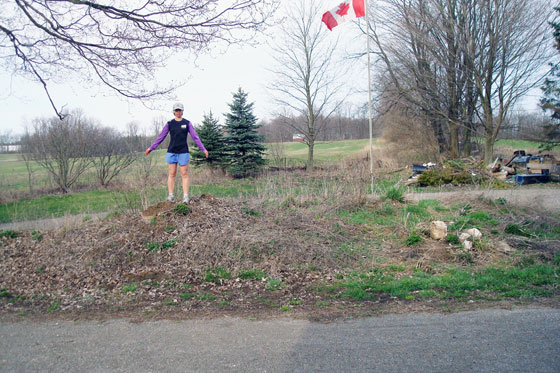
The turnaround started out as mountain goat territory. Rocks, mounds of dirt and weeds made a very unattractive scene right outside our front door.

Turnaround garden before

Allow me to illustrate the scale of our “mountains.” (And the pile of crap at the old firepit in the background. Ugh.)

Turnaround garden before

We did nothing to it the whole first year we lived here. Finally, in spring 2013, our farmer came by with his big tractor and flattened things out for us. Hello, Easter.

Turnaround garden before

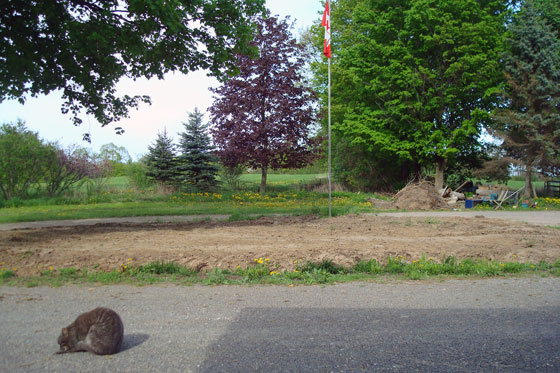
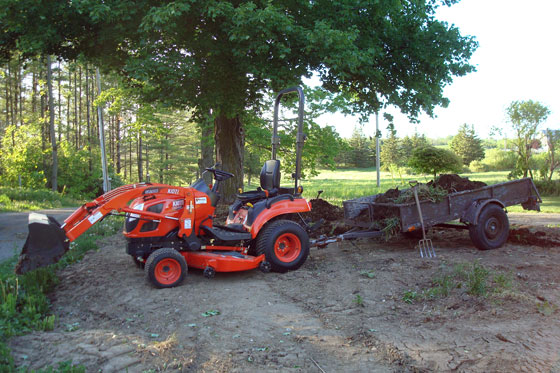
I enriched the soil with lots and lots of manure.

Kioti CS2410 towing a trailer full of manure

And my parents helped with mixing it into the soil and picking out rocks.

Rototilling a garden

Wiley, Matt, Easter and I dug out a path across the turnaround.

Digging the pathway

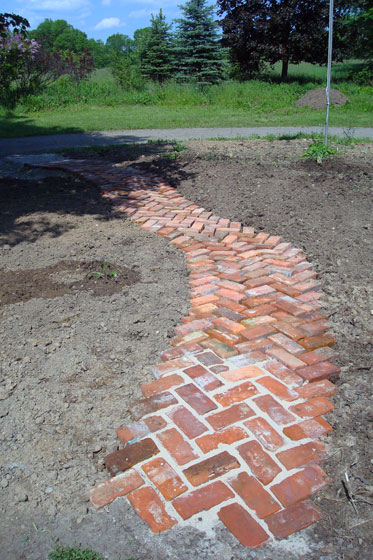
Then I laid a herringbone brick path.

Herring bone brick pathway

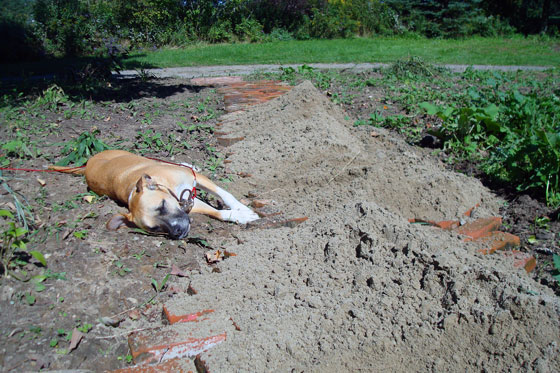
And Baxter joined the family in time to be part of the project, helping to fill the joints with sand.

Baxter helping with the brick path

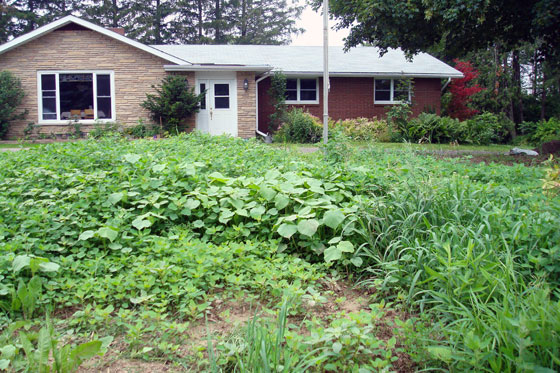
Then things got a little weedy (a lot weedy). The turnaround is huge–the size of a suburban backyard. I just couldn’t keep up with it.

Weeds on the turnaround

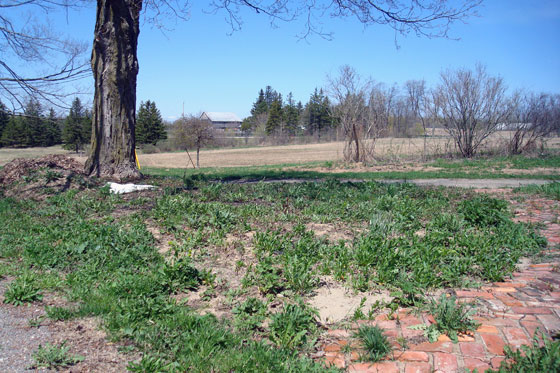
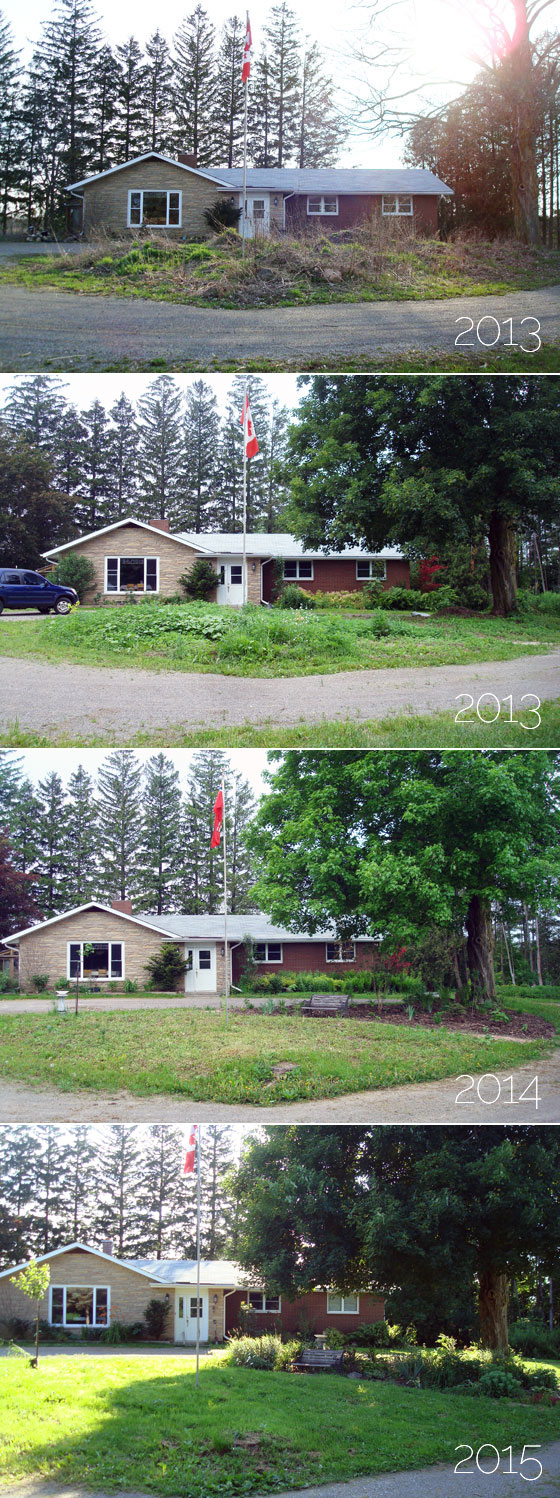
At the beginning of spring 2014, I had given up on half the turnaround. Matt mowed the weeds. The other half was still weedy at the beginning of May, but I went to work.

Weedy flower garden

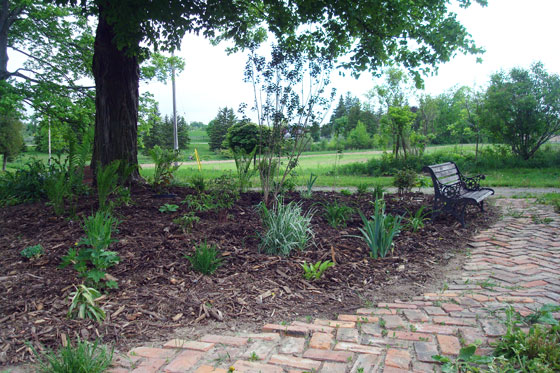
By the end of May, the turnaround was planted (half of it, at least).

Turnaround garden in May 2014

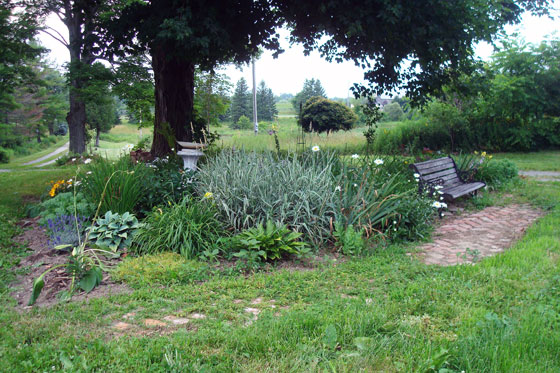
And this year, it looks like an actual garden. (And I’m already starting to think about the other half).

Turnaround garden in July 2015

I am amazed how much the plants have filled out in just one year. Everything in the garden, including the bench, the birdbath and the brick path, came from the farm or from family (except for the plants you saw on Friday). Transplanting and splitting–and a lot of hard work–have made this huge garden come together nearly for free.

The most important element of gardening in my opinion though is patience. Gardens take time to grow. But the payoff is huge. I’m so glad that I’m able to take a look back and realize how far we’ve come.

Evolution of the turnaround flower garden

Do you keep track of your garden’s progress through the years? Who else has a garden that’s taken awhile to come together?

How I became a DIYer

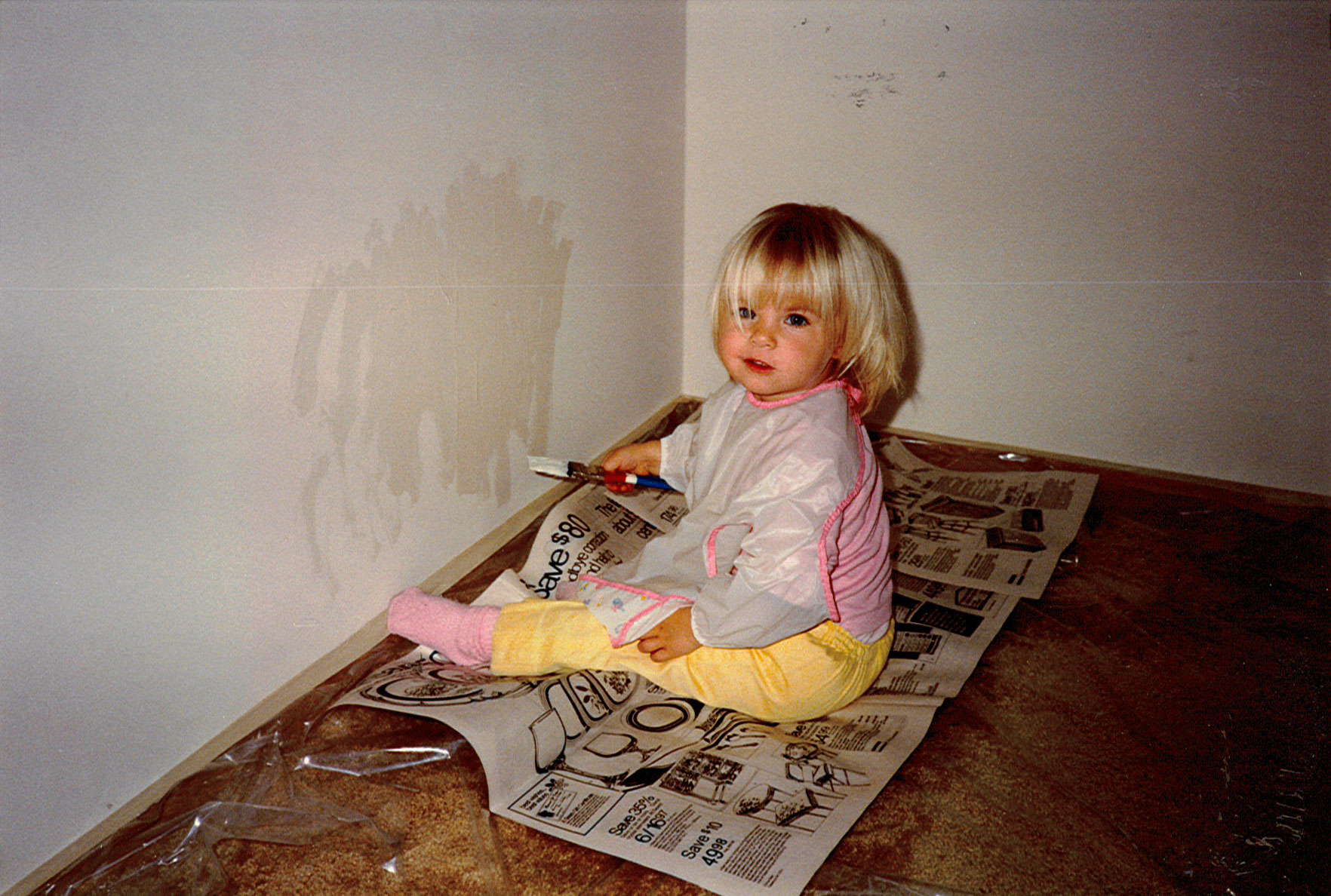
Both of my parents get the credit for teaching me how to do a tonne of things and giving me the confidence to tackle things on my own. From a young age, they involved my siblings and me in whatever projects they were working on around the house.

Painting my first bedroom

When it comes to the renovation and home improvement side of my DIY personality, my biggest influence is my Dad.

My Dad grew up working alongside his father, learning the construction business first hand. They built houses, dug out basements, renovated homes.

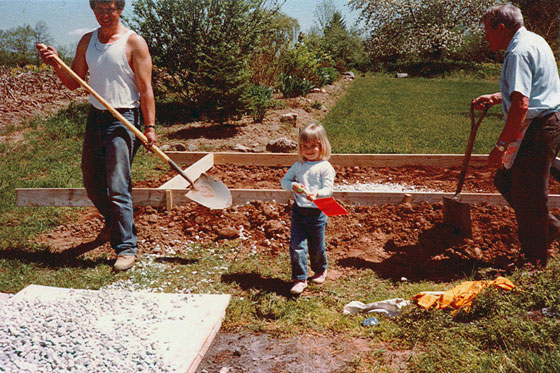
Working with my Dad and Grandpa

My Dad, me and my grandfather

Eventually, my father decided to make construction his career, and he went to college and earned a construction technology diploma.

My Dad with his parents on graduation day

My Dad with his parents

He worked for a number of companies over the years and ultimately served as site superintendent on a number of subdivision developments, including Canada’s first metric subdivision.

Our first home was in one of the neighbourhoods he built. And the second was a custom build that my parents still live in today.

Riding the forklift with my Dad

My Dad with my younger sister and me on the forklift at our new house

In the late 1980s, my Dad was laid off. Construction jobs were scarce at that time, but with four young kids at home, he didn’t have any option. He had to work. So he started his own company. He would load up our Oldsmobile, hook the trailer on the back, and off he’d go.

At first, it was just small jobs—pour a walkway, patch a wall, put up a fence. Eventually, they became bigger—renovate a kitchen, redo a bathroom, install a deck, put on an addition, build a whole house. As he had with my grandfather, my sisters and brother and I often worked with him. I think I was probably 10 the first time I went to work with him.

Working with my Dad

My Dad, my brother, my youngest sister and me

A few years later, working construction was my full time summer job. We often got some weird looks when we first showed up at the job sites—a contractor with a young girl assistant, sometimes two—but they always changed to looks of admiration when they saw how hard we worked and how good of a job we did.

My Dad prides himself on doing a job right, and he taught us all the same. I remember how for weeks every night he studied the building code and how happy he was when he wrote the exam and became licensed. The building code still holds a place of prominence at his desk, and his license numbers were typed proudly at the top of every estimate that he wrote.

Since we became homeowners, my Dad has been invaluable to Matt and me, advising us, working with us, teaching us. We wouldn’t be able to do everything we’ve done at the farm without him.

Drilling post holes with an auger

Matt working with my Dad

Happy Father’s Day, Dad. Thank you for everything you do for us.

Simple belt storage solution

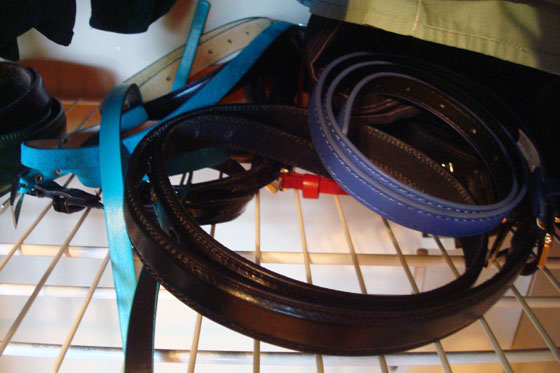
When we switched bedrooms, we switched closets too. I knew one thing I wanted to improve in the new closet was my belt storage. They’ve been tangled and tossed onto a shelf since we moved in.

belts2

When I still lived with my parents, I came up with a solution that worked very well for belts: cup hooks.

belts23

In the past, I’ve screwed the cup hooks directly into the drywall or plaster of the wall. However, this time I decided to go for something more portable so that I can move it if I ever relocate closets again. Screwing the cup hooks into a length of wood worked. Then I simply screwed the wood into the wall of the closet.

Simple belt storage solution

Super simple DIY. Super simple storage. My happiness is not commensurate with the simplicity of this project.

How do you organize your belts? Who else is a fan of cup hooks? Does organization make you happy?

How to apply preglued veneer on curved edges

More than two years ago, I wrote a tutorial on how to apply preglued veneer edging. Veneer edging covers up the raw edges of plywood and makes your piece of furniture or whatever it is you’ve made look like one solid piece of wood.

When I made the headboard for the master bedroom, I had a scenario that I’ve never dealt with before: applying the veneer to a curved edge. So today I’m posting an addition to my previous tutorial.

The same tools, techniques and principles still apply (mostly):

  1. Cut a piece of veneer slightly longer than the section of plywood that you’re covering.
  2. Line it up along one edge and apply heat and steady pressure to melt the glue.
  3. Firmly press the veneer down with a wood block (it will be too hot to touch with your hands) until the glue sets.
  4. Trim the overhang with a file.

For a convex edge (think the outside of a U), I didn’t have to do anything special. For a concave edge (think the inside of the U), I had to make a few more adjustments. On the more gentle curve, I found the very tip of my iron worked to soften the glue. I just had to work slowly, about an inch at a time.

Applying preglued veneer edging to a curve

Pressing the veneer into place as the glue dries is really, really important. On a curve, it’s particularly easy for the veneer to pull away from the plywood. A narrow pressing block or your fingers (protected with a glove or a rag)–along with patience–are essential.

For the tighter curves, I discovered why I still have a curling iron in my bathroom cupboard. The barrel was just the right size to fit into the curve at the top of the headboard. Once the adhesive was soft, I firmly pressed the veneer onto the plywood and held it in place until the glue set.

Using a curling iron to apply veneer edging

To trim the veneer, I always rely on a file. For the curved edges, I used the curved side of the file.

Curved profile on a file

Triming veneer on a curve with a file

A couple of swipes over the edge with fine sandpaper further smoothed veneer, and then it was ready for staining along with the rest of the headboard.

(And yes, the veneer takes stain and urethane and paint just like real wood).

Here’s the final product–in its impossible to photograph location in front of the window.

Applying preglued veneer edging to a curve

Anyone else have any tips for working with veneer edging? Who else has an old curling iron kicking around? Have you ever used beauty tools for DIY?
 

Making DIY dropcloth curtains – 8 lessons learned

In the last post, you saw the easy layered window treatments in the master bedroom. I promised more details on the dropcloth curtains I made.

Blackout blind, bamboo blind and drop cloth curtain window treatments

There are lots of tutorials out there on how to make dropcloth curtains. So I’m not going to write one here. Plus, I totally made these up as I went along, so a tutorial doesn’t really exist. I did want to share some of the things I learned from making my DIY curtains, though.

How to make dropcloth curtains

1. Dropcloths come with seams. I assumed that my 9 by 12 foot dropcloth would be one single piece of fabric. It wasn’t. All of my dropcloths had a seam down the middle. One had a centre seam plus an additional patch along one end.

For my two widest curtain panels, I just left the seam alone. It’s a bit thicker than I would like and a wee bit puckered, but I decided I could live with it if it was hidden in the folds of the curtains.

For the other curtains, my seam ripper and I spent some quality time pulling out the stitching.

Ripping out the seam on a dropcloth

2. Dropcloths come with holes. The canvas fabric of the dropcloths is not perfect. The rustic quality of the weave and the few strands of blue and red that were here and there are some of the elements I like best about using this fabric.

However, in a couple of spots my dropcloths went beyond rustic and veered into unraveled. So if you want to make anything out of dropcloths, check them over carefully. You don’t want to end up with a hole in the middle of your project.

3. Wash and iron before you start. Pre-washing your fabric is a basic tenant of sewing. I didn’t want my curtains shrinking (not that they’re going to be washed often) after I put the effort into making them, so I washed my fabric before I started sewing.

Dropcloth fabric is heavy duty. As a result, it wrinkles easily and the creases are really difficult to remove. I found that ironing the dropcloths when they were still damp from the washer helped to remove the worst of the wrinkles.

4. Use curtain tape. (Britt, this tip’s for you). From what I hear, making pinch pleat curtains is pretty tedious. Lots of measuring and calculating. A much easier solution is to use curtain tape. This is a kind of mesh fabric strip with channels on the back. You pair it with some special multi-pronged hooks, and it basically forms the pleats for you. I bought mine at a local fabric store.

The pleats are softer than they would be if you sewed them without the tape, but that was okay for my rustic fabric and my farm setting.

I sewed the tape along the edge of one of my dropcloths, put in the hooks and voilà, pinch pleat curtains.

Using curtain tape to make pinch pleat curtains

Using curtain tape to make pinch pleat curtains

Using curtain tape to make pinch pleat curtains

Pinch pleat dropcloth curtains

You can space your pleats as far apart or as close together as you want. I left one empty “pocket” for a space of about 6 inches between each pleat.

Pinch pleat dropcloth curtains

5. Use curtain tape to measure your curtains. Before I sewed the curtain tape onto my fabric, I formed all of my pleats until I had a strip that was as wide as I wanted my curtains to be. Then I cut the curtain tape at that length, removed the pleats and used the tape to measure the dropcloth fabric.

6. There are different types of hooks. The magic pleat-making hooks are very handy. They come in two different forms (there may be more, but I tried two). Whatever form you choose, the hooks hook onto the rings that go on your curtain rod. Option 1 has the hooks at the end, so the curtains hang a bit below the rings. Option 2 has the hooks in the middle, so the top of the curtain hangs up against the rings. This is the type of hook I ended up using.

There are also special non-pleating hooks (just plain single hooks) to hold up the ends of the curtains where there are no pleats.

7. Take your time hemming. I wanted my curtains to just brush the floor. For my first set, I hung the curtains, found the spot where they met the floor, and then I used a ruler to measure the rest of my hem from that point. The result was curtains that were the right length at one or two spots, but for the most part they scuffed, not brushed the floor.

Curtains hitting the floor

For my second set of panels and for the bed skirt that I also made out of dropcloths, I skipped the measuring tape. Instead, I used pins to mark the fabric at about 1/4 to 1/2 inch off the floor. I pinned my way across the bottom of the curtains, marking about every six inches. Then I pressed the hem using the pins as a guide. It wasn’t scientific, but it resulted in curtains that just brushed the floor.

8. You can totally do this too. Dropcloth curtains are pretty easy to make. Honestly, I found them a bit tedious. The only sewing is in straight lines. Loooooong straight lines. However, boring they may be, sewing straight lines is not difficult.

Dropcloth curtains in a navy master bedroom

Let me know if you try them yourself.

Have you ever made your own curtains? Any tips to share from your experience?

Linking up with: Happy Housie DIY Challenge Party