Laundry room rug – Ikea hack

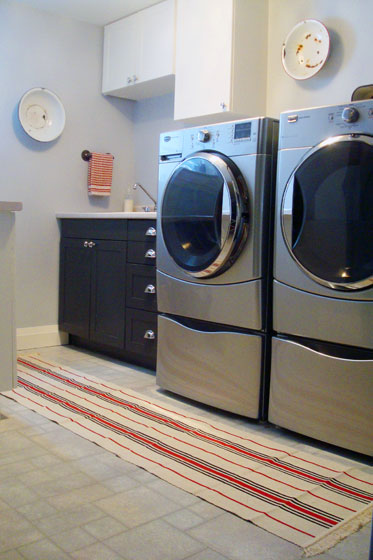
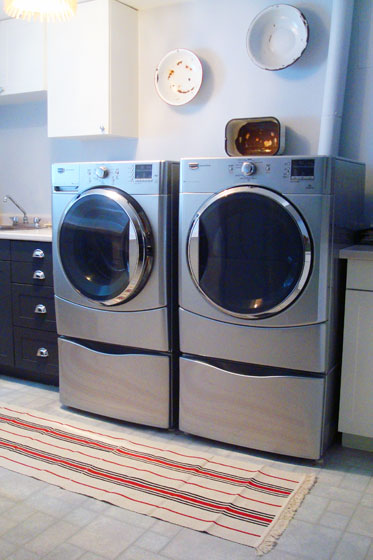
Three Ikea Signe rugs made into a runner in the laundry room

I finally found a rug for the laundry room… or rather, three rugs.

It was hard to figure out the exact dimensions that would work in this room. With jig and jogs around cabinetry and laundry machines and the drying rack, the rug could only be so wide. But it was a relatively long room. Did I want the rug to go just in front of the washer and dryer? Just in front of the sink? All the way from wall to wall?

I eventually decided that it made sense to have a rug in front of the sink, the washer and the dryer.

Three Ikea Signe rugs made into a runner in the laundry room

But then came the question of material. I liked the idea of a natural jute rug, but I wasn’t confident I’d find one that met my measurements for a price I was willing to pay. I’ve seen some great antique and vintage patterned rugs on other blogs, but, again, price was a factor and availability is always challenging

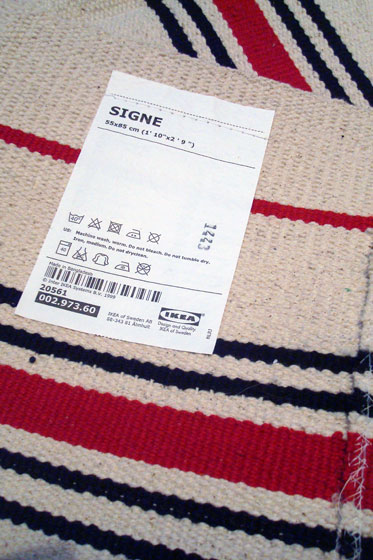
Then, during an Ikea trip, I came across Signe.

It was a fairly natural tone with pops of black and red, two accents I used a bit in the laundry room.

Plus it was cheap: $2.99.

Three Ikea Signe rugs made into a runner in the laundry room

The downside was it was short. One rug was less than 3 feet long. But for $2.99, I could buy three.

At home, I laid them out in the laundry room. This just might work.

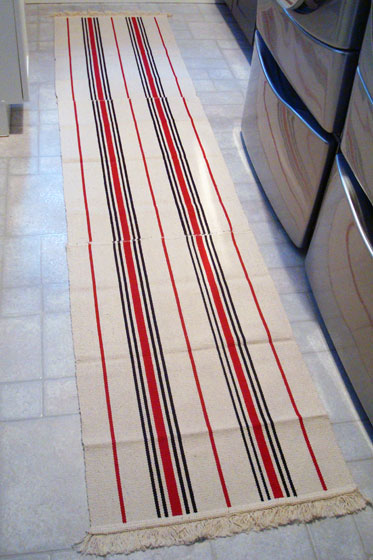
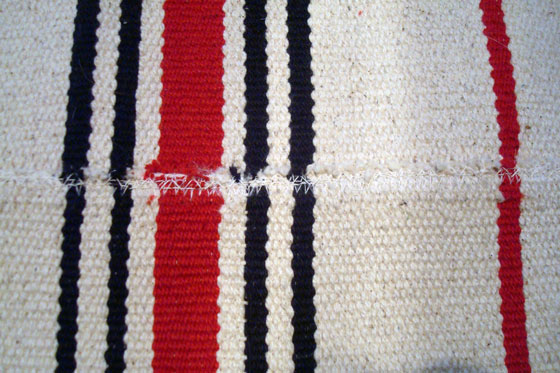
After an afternoon spent ripping off fringe and some time spent with my sewing machine, I had a runner the exact dimensions I needed–8 feet long by 22 inches wide.

I used a wide zig-zag stitch to join the rugs end-to-end, doing my best to match the stripes.

Three Ikea Signe rugs made into a runner in the laundry room

The result was the right colours, the right size and the right price. It’s a nice finishing touch in the laundry room.

Three Ikea Signe rugs made into a runner in the laundry room

Scraping a stipple ceiling

Pimples. It’s not even a nice word.

Popcorn. That’s a much nicer word.

Stippled ceilings have come to be known as popcorn ceilings. However, in my opinion, popcorn is much too nice of a word to be associated with these ugly ceilings. Not to trigger any traumatic teenage flashbacks, but stippled ceilings are closer to pimples than popcorn.

Popcorn ceiling

Step one in the master bedroom makeover was to help the ceiling grow up from its ugly adolescence into beautiful adulthood–and I couldn’t just make like a fashion magazine and airbrush.

It was gonna take muscle, and it was gonna be messy.

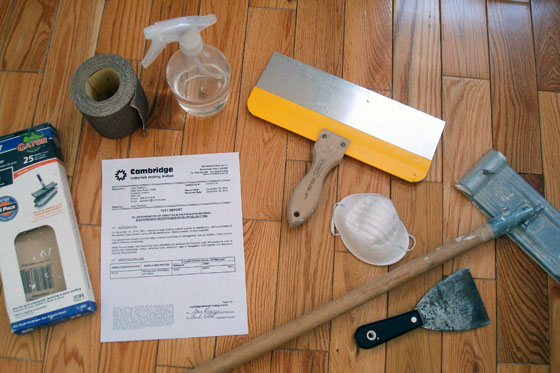
So, armed with an all-clear on my asbestos test, trowels, a spray bottle of water, pole sander, extra sandpaper and a dust mask, I went to work.

Tools for scraping popcorn ceiling

In the basement where we also had stipple ceiling, I actually sanded a lot of it off. This technique gave me a really nice smooth finish, even if it did generate a tonne of dust. In the bedroom, I found soaking in water and then scraping with the trowel worked best. As much as the big yellow trowel would have been faster, I liked the control of my little trowel.

It was still a lot of work. Scraping a stipple ceiling is not fun. However, fueled by ju-jubes, I got it done. (My skin may have progressed from its teenage years, but my diet has not. The orange ones are still my favourite).

Jujubs

Underneath the stipple, the drywall was smooth and painted, which leads me to ask why? Why finish a ceiling smooth, paint it and then cover it in pimples? I just don’t understand.

We all know the prep work is most important to get a good paint job. I spent more time on prep for the bedroom than I ever have before. Scraping the ceiling, scraping the caulking from between the crown molding and the ceiling (ugh), patching hundreds of little chips in the ceiling (they were just minor chips of paint, but there were truly hundreds of them), patching one bad ceiling seam and one crack in the wall, sanding and pasting over again.

Ceiling after scraping the popcorn

It took days.

Thank goodness I was off work for the Christmas break. Although it wasn’t the most restful holiday.

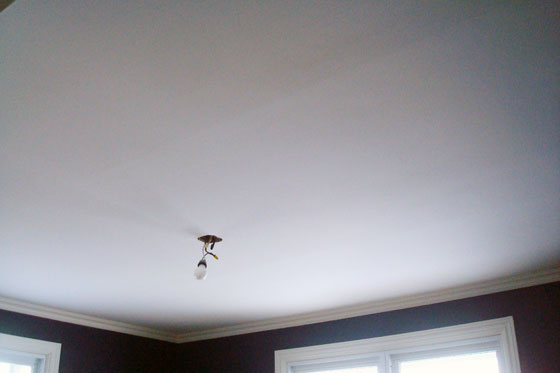
In the end though, my ceiling is all grown up and pimple-free. Much nicer to look at when I’m lying in bed in my new master bedroom. (Apologies for the really bad photo, but I think you can tell it’s nice and smooth. Oh, and there’s a sneak peak of the blue walls).

Finished ceiling after scraping the popcorn

Have you ever scraped a stipple ceiling? Any techniques to share? Any insights on why people stipple ceilings? And most important, what colour ju-jubes are your favourite?

Stone moving party
I was super happy when our stone supplier was able to source a single piece of stone for our hearth. No seams! Score. 🙂 However, now we’re at the point of installing the hearth. Moving a who-knows-how-heavy stone! Not so score. 😦

The stone is 10 feet long by 18 inches wide by 2 1/2 inches thick. Every time it has moved up to now has involved a forklift. However, we face two problems:

  1. We do not possess or have access to a forklift.
  2. A forklift will not fit into our house.

We are relying on people power. Pure brute strength.

I do not have good photos to illustrate the scale of this task because, you see, I really didn’t think ahead to consider the scale of this task.

So here’s the hearth at the far right peeking out from behind the skids of stone back when they were first delivered two and half weeks ago.

Stone for the fireplace

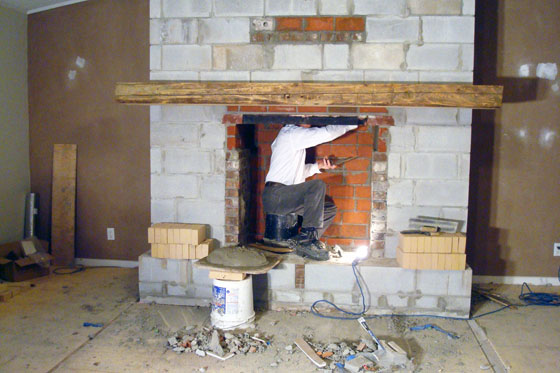
And here’s our mason sitting inside the fireplace, just to give you an idea of the size that we’re working with.

Mason building a fireplace

The plan was that Matt and I would get home from work a bit early last night and together with our contractor we’d move the hearth into place. Well, I made it home, but Matt got caught in a snowstorm and spent two hours on the road. Our mason and I tested moving the stone on our own. Not gonna happen.

New plan. The three of us would reconvene this morning at 6am before Matt left for work.

Matt and I did a test last night when he finally made it home. His verdict? “Woman, I don’t know if this is gonna happen, even with three of us.”

So we did what you always do in this situation: call Dad.

So the new, new plan is a stone moving party at our house this morning at 6am. There will be Matt’s Dad, the mason, Matt and me. Baxter will be here too, though he probably will not be very much help.

Wanna join us? It’ll be a special way to start your day. 😉

I realize most of you will be reading this after the stone moving party has ended. However, we’d still appreciate if you could send your good wishes. Heck, send levitation charms. Send muscle enhancing drugs. We’ll take all the help we can get!
Update: The stone is in place and is still in one piece. Yay! Full fireplace update to come on Monday.

My spin on a clothespin light
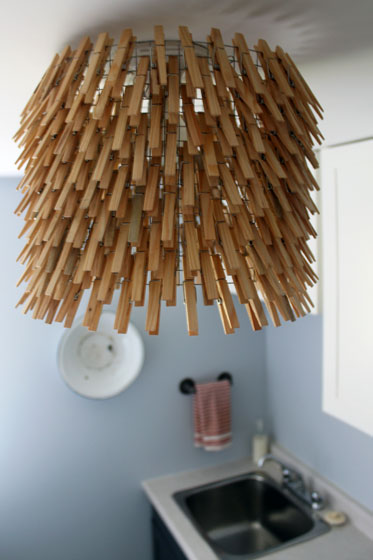
A lot of people had compliments for the clothespin light fixture in the laundry room.

Clothespin light in the laundry room

I can’t take credit for the idea or even the execution. I was inspired by this light from Young House Love.

I followed their tutorial pretty closely, and it was super easy. However, I did one thing differently and learned a couple of lessons along the way. I thought it might be helpful to share.

First the lessons.

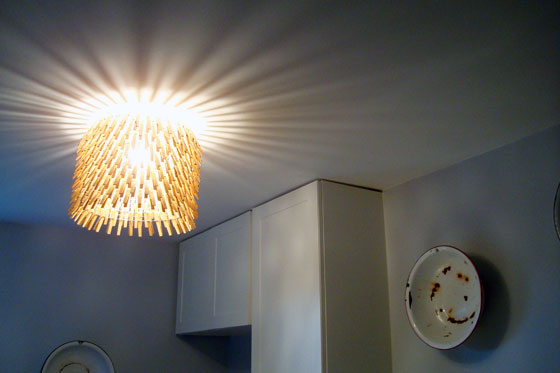
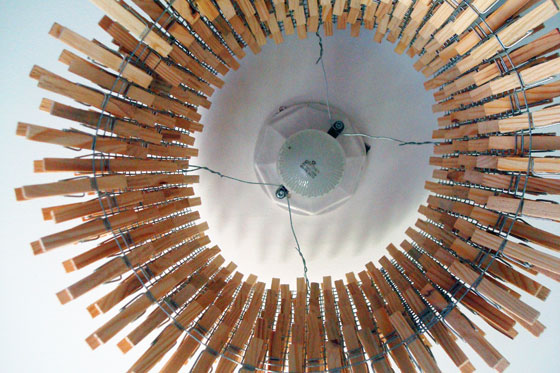
I chose to do the same zigzag pattern that John and Sherry did. In their tutorial, they mention alternating squares. However, what they didn’t say is that they also skipped a row of wire between each row of pins. If you look closely at the pictures in the YHL post, you’ll be able to see the pattern. Skipping every other row gives a comfortable amount of space between the pins so that they lay at a nice angle all the way down the shade. And this makes the great pattern on the ceiling when it’s lit up.

Clothespin light fixture

And talking about laying at an angle, in the YHL post, Sherry emphasized that it’s important to have an even number of squares around the top to maintain the pattern all the way around the shade. However, she didn’t talk about how many squares there should be from top to bottom. I nearly trimmed the bottom row of mesh off my shade because I had an empty row of squares. However, if I’d done that, my bottom row of clothespins would have hung straight down while all the other ones sat at an angle. Having an extra row of wire at the bottom holds the pins on the angle. So, while you want an even number around the shade, you want an odd number from top to bottom.

Clothespin light fixture

And now for what I did differently.

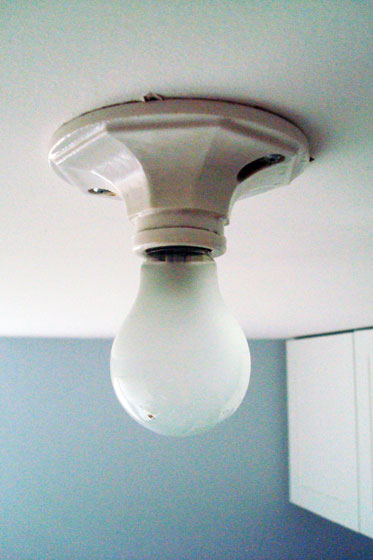
My light is closer to a flush mount than the YHL pendant. I used an old single socket lamp holder that I had lying around as the actual light. You can’t get more basic than that. Or cheaper. (Or, let’s be honest, uglier).

Keyhole light fixture

It took me a little while to figure out how to attach the shade to the light. I didn’t love the cup hooks on the YHL fixture. My solution was to run two pieces of wire loosely across the top of the shade. I then looped each wire around the screws in the lamp holder. It’s pretty much invisible, unless you’re standing directly underneath the fixture looking up.

Clothespin light fixture

The YHL light used 320 pins. Mine has 288. The final dimensions are 64 squares around and 17 from top to bottom. The overall dimensions of the drum shade are 11 inches high by 14 inches in diameter.

I love that I have a light fixture made out of clothespins in the laundry room. Even better, I love how it looks. Thanks John and Sherry for the inspiration.

Have you ever made anything out of clothespins? Have you made your own light fixture?

Linking up to #DIYLightingChallenge

8 tips for building furniture out of pipe

Pipe furniture is really popular these days. In the laundry room, you saw how I used pipe fittings to build the hanging rack and towel bar. Along the way, I learned a few lessons that I’m going to pass on to you.

8 tips for building furniture out of pipe

1. Pipe fittings are really easy to work with. The pieces go together very quickly. Assembling the towel bar probably took all of 10 minutes. I loved lego as a kid (who am I kidding, I still do), and this was like revisiting my childhood.

Towel rack made out of pipe fittings

2. Pipe fittings are oily. The fittings come in black or galvanized options. I chose the black because it looks more rustic to me. However, the black coating rubs off really easily.

Oil and rust rubbed off of pipe fittings

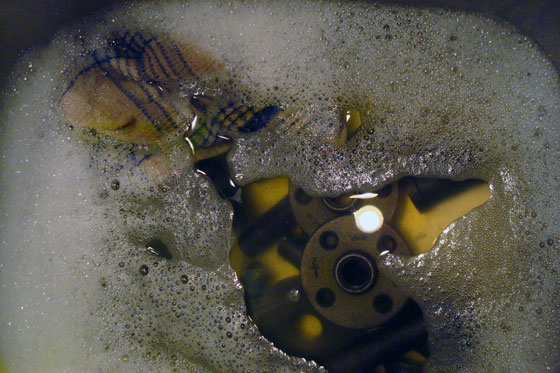
Before I could do anything with the fittings, I had to clean them. Some people online recommended degreaser, which I’m sure would have worked. I didn’t have any so I tried 2 other options: wiping them down with vinegar (didn’t really work) and washing them with dish detergent. The washing worked. I dried the pipes with a rag and let them sit for 24 hours to make sure the threads and interior of the pipes were completely dry before I did anything with them.

Washing the oil off of pipe fittings

3. Pipe fittings come in different diameters. Pay attention to what diameter you choose, because different size pieces won’t screw together without special fittings. I chose the 1/2 inch size because it was a bit cheaper than 3/4.

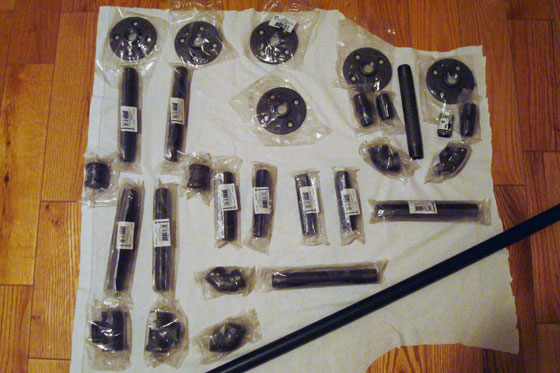
4. Pipe fittings come in different lengths and connectors. You should be able to find the pieces you need for pretty much any project…

Black pipe fittings

5. … But if you can’t, the store staff can cut the pipe too. The cutting was one of the dirtiest operations I’ve ever seen. I felt bad for making the staff person get so oily from running the cutting machine. The result though was the perfect lengths of pipe. The machine will also put threads onto your pipe.

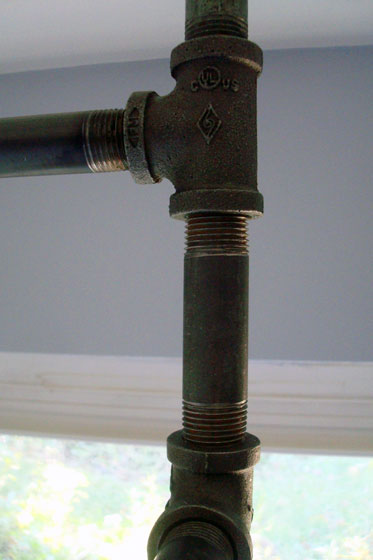
6. Pipe fittings don’t screw together fully. You’ll see the threads at each joint.

Screwing together pipe fittings

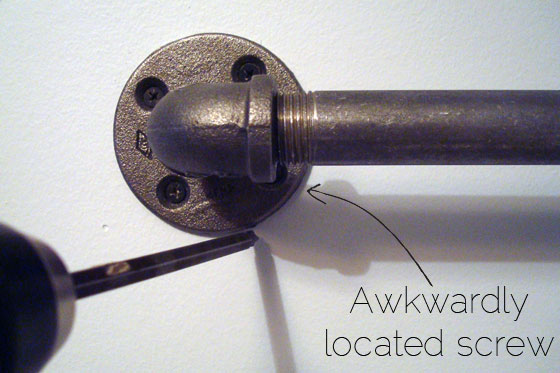
7. Drywall screws are good partners with pipe fittings. The pipe flanges attach to the walls with four screws. Since I chose black pipe, it made sense to use black screws. The coarse threads on the drywall screws dig into the wall and hold the pipe securely.

8. Attach the flanges to the wall first. Once your towel bar or hanging rack or whatever else you’re building is fully assembled, it can be hard to reach the screw holes in the flanges to attach your creation to the wall. However, attaching the flanges on their own is a piece of cake.

Tips for building furniture out of pipe

I elected not to paint my pipe fittings, although I’ve seen other projects online where people did. The finish isn’t pure black, but it’s a nice industrial dark grey–no sparkle here.

Just in case you’re interested in building your own towel bar or hanging rack, here are the pieces I used. I have to give credit for the hanging rack design to Angie over at Knick of Time. I’m not sure what pieces she used, but I think mine turned out pretty close. I spent a lot of time in the pipe fitting aisle at Home Depot. While my measurements may not be exactly the same as what you need, some of them might work for you and save you at least a bit of time.

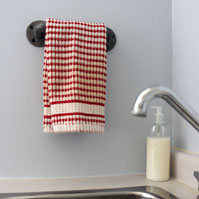
Towel bar made out of pipeTowel bar

Dimensions: 10 3/4 inches long (from the outer edge of each flange) and projects 3 inches off the wall

  • 2 flanges
  • 2 elbows
  • 2 1 1/2-inch pieces
  • 1 6-inch piece

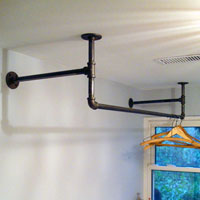
Hanging rack

Dimensions: 50 inches long, hangs down 10 1/2 inches from the ceiling and projects 17 inches off the wall
Hanging rack made out of pipe

  • 4 flanges
  • 2 elbows
  • 2 Ts
  • 2 3 1/2-inch pieces
  • 2 4-inch pieces
  • 2 15-inch pieces
  • 1 48-inch piece

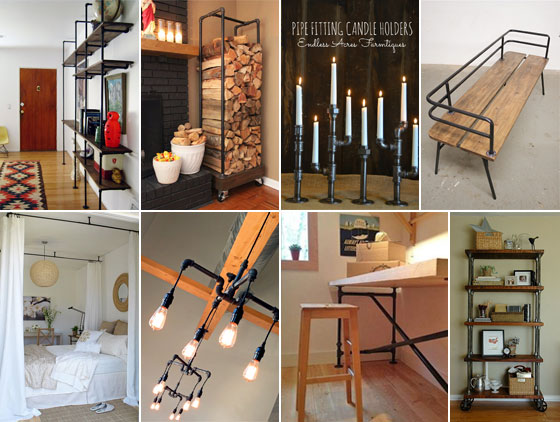
And just in case laundry isn’t your thing, here are some of my other favourite pipe projects.

If you’ve spent any time on Pinterest, you’ve probably seen furniture, lights, shelves and numerous other things made out of pipe fittings. They add a great industrial style for a pretty reasonable price.

Have you ever made anything out of pipe? Do you have any tips to share? Anyone want to make anything out of pipe? Do you like the rustic industrial look?

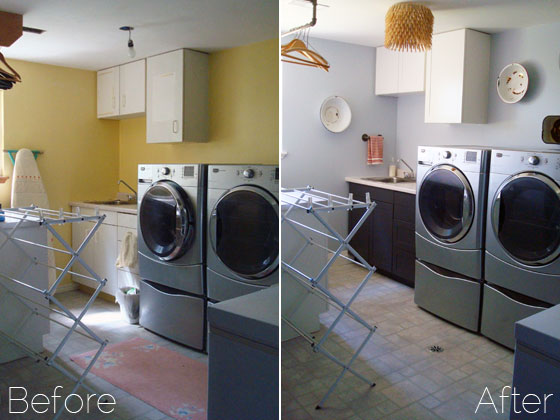
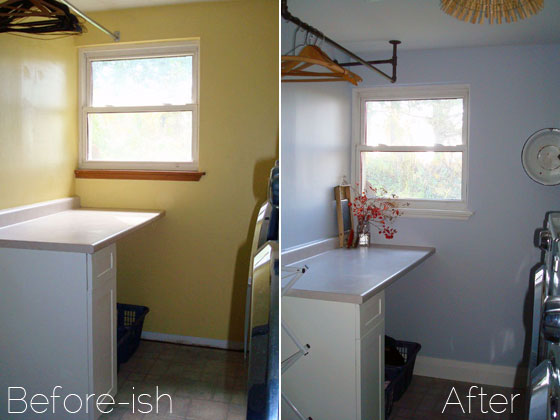
Laundry room before and after

It’s time for the reveal in the One Room Challenge. Back in September, I was really excited to start making over the laundry room. At the beginning of October, I was really excited when I joined the One Room Challenge to help keep me on track. Today, you’re going to see how far the laundry room has come. (And, yes, I’m still really excited).

Laundry room before and after

Laundry room before and after

This makeover was all about simple upgrades.

I converted the cabinets to a shaker style by adding strips around the border. A black and white paint scheme freshened them the rest of the way. We’re still missing the hardware on our cabinets. They’re special orders and are taking their time coming in. So just imagine sparkly chrome knobs and cup pulls, would you? (I’ll post an update when the hardware finally arrives).

Black and white shaker cabinets in the laundry room

Fresh paint on the walls, ceiling and trim–and fresh baseboard all the way around–brought the laundry room up to the same standard as the rest of the basement.

Then it was on to a few fun projects.

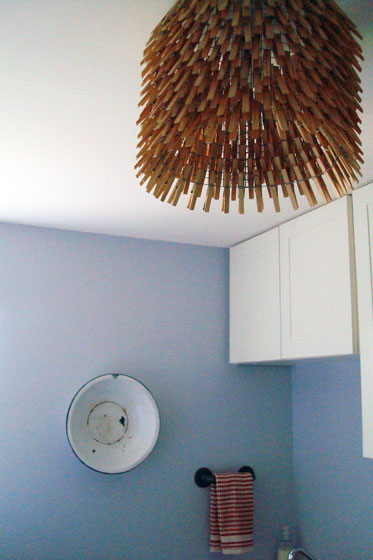
A light fixture made out of clothespins.

Clothespins light fixture

Look at the great pattern it makes on the ceiling when it’s all lit up.

Clothespin light fixture

To keep the wood tone accents going, I added a few baskets to the top of the free-standing cabinet Matt and I found a few months ago. I also made a simple hook board to hang the ironing board on the side.

Ironing board hanger

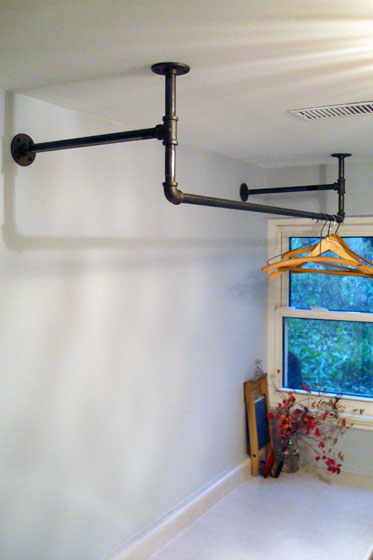
To save electricity, we hang dry most of our laundry. (Yes, we’re just that green… and cheap). Only sheets, towels and dog beds get the privilege of the dryer. The white metal drying rack is a key feature of the laundry room. I made an additional hanging rack out of pipe fittings to help with the drying.

Hanging rack made out of pipe fittings

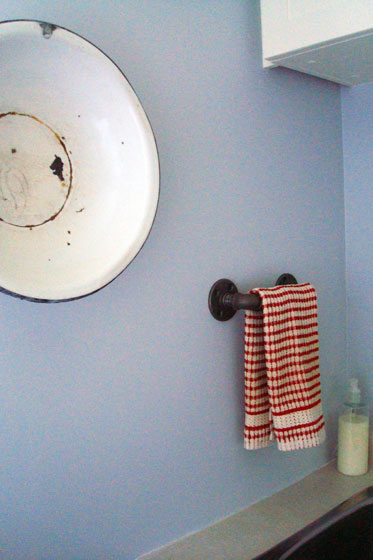
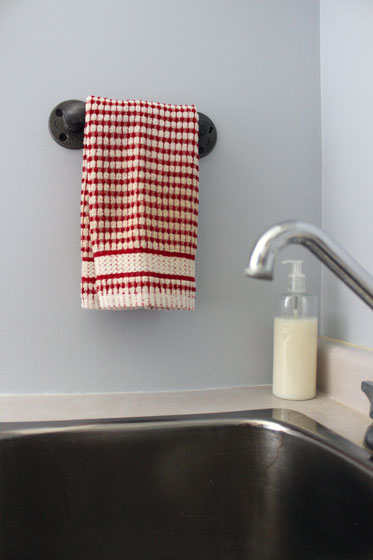
I also made a small towel bar out of some more pipe fittings.

towelbar1

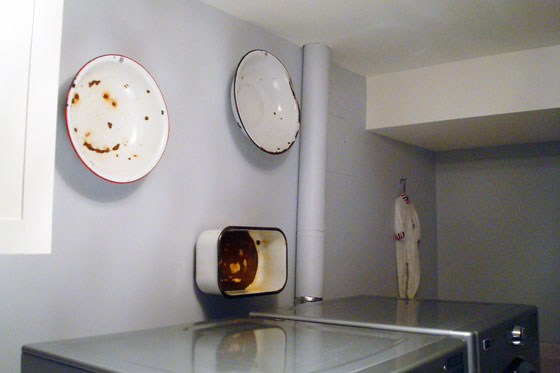
The picture above also gives you a glimpse of one of the main decorations in the laundry room. When it came to art, it took me a while to figure out what I wanted to put on the walls. Then I found this little enamel pot at Value Village.

Laundry room decorations

It holds packets of washing machine cleaner, and it also reminded me that I had a small collection of enamel basins. My sisters, brother and I played with these dishes all the time at my grandparents’ cottage. When my grandmother sold the cottage, the basins were going to be thrown out. I was feeling sentimental, so I took them, although I wasn’t sure when I’d ever use them. Well, it turns out they work perfectly as decorations in the laundry room. They may have crossed over from rustic to rusty, but I still think they add a nice touch.

Enamelware basins

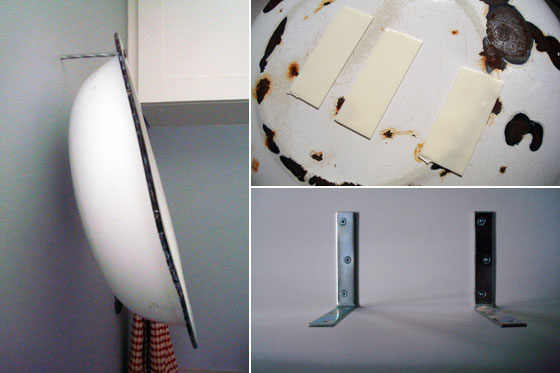
Hanging the basins facing out took a couple of tricks. First I needed a really long nail. I found some 5-inch spikes. The nails were too big to drive with just a hammer, so I drilled a pilot hole into the studs before I hammered in my nails. Once I hooked the basins on the nails, it turned out that their centres of gravity were a bit crooked. Some adhesive strips on the back stuck them to the wall and straightened them right up. For the rectangle basin, a couple of L brackets made a discreet and secure shelf.

Tricks to hang basins on a wall

The other item decorating the wall is also both sentimental and non-traditional art. These are the sleepers that newborn Matt wore when he came home from the hospital the first time. (I know, awwwwwwww). His Mom gave them to us years ago. Again, I had no idea what I was going to do with them. Then I realized that the red and navy stripes picked up some of the colours I was using elsewhere in the laundry room. I’ll likely end up building a proper shadow box for them, but the mini hanger works for now.

Matt's baby sleepers

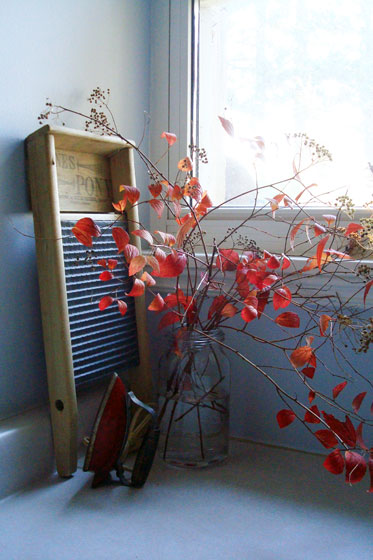
On the counter under the window, I have a few appropriately laundry decorations: an old washboard from my parents and a small red toy iron that my Mom had when she was a little girl.

Laundry room accessories

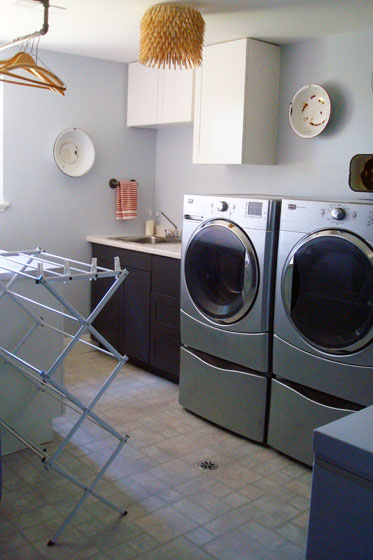
It may have been a simple makeover, but the results feel dramatic to me. It’s a pretty, personal, fun and functional space.

Laundry room after

Thanks to Linda at Calling it Home for organizing the One Room Challenge. I’ve now crossed another room off my Home Goals 2014 list. Thanks to all of you reading along for all of your support and encouragement throughout. Be sure to pop by Calling it Home to see all the other rooms.

How many people dream of a pretty laundry room? Does anyone else collect enamel ware? Have you ever made anything out of clothespins or pipe fittings? Who else air dries their clothes? What’s the most unusual thing you’ve hung on a wall?

Linking to: Happy Housie Get Your DIY On: Wall Decor

One Room Challenge Week 5

We’re in the homestretch now on the One Room Challenge. Today is the second last post. Next week is reveal time. Make sure to visit Calling it Home to check out all of the great progress everyone’s made.

Fortunately, the laundry room makeover is in the homestretch too. My original project plan was to have all of the “work” done as of last weekend so that this week could be devoted to decorating.  Guess what? I’m pretty much on schedule (aside from my back-ordered cabinet hardware).

  1. Add shaker style trim to the cabinets
  2. Paint the cabinets
  3. Install doors and drawers
  4. Remove ceiling rack – By Oct. 3
  5. Patch ceiling and walls – By Oct. 3
  6. Paint ceiling – By Oct. 10
  7. Paint and install baseboard and paint window trim – By Oct. 10 Done Oct. 13
  8. Deep clean (sink, counter, floor, machines) – Oct. 13 Rescheduled to Oct. 19 26 Done Oct. 26
  9. Paint walls – By Oct. 17 Done Oct. 18
  10. Replace ivory washer outlet with white one – By Oct. 19 Done Oct. 18
  11. Level washing machine – By Oct. 19 Done Oct. 18
  12. Build and install ceiling rack – By Oct. 24
  13. Build and install towel bar – By Oct. 24 Done Oct. 25
  14. Install cabinet hardware – By Oct. 24 Rescheduled to Nov. 11
  15. Build and install light fixture – By Oct. 26 Done Oct. 25
  16. Remove non-working sprayer from the sink and plug the hole – By Oct. 26 Done Oct. 27
  17. Decorate – By Oct. 31

The laundry room is currently a mix of projects to be finished and styling that has started.

Laundry room mid-makeover

I know you can’t see very much here (I have to save some suspense for next week’s reveal), but it’s looking so good. I’m super excited.

The suggestion for this post is to talk about if our plans have changed. Mine haven’t really. In fact, I realized over the weekend how close I am to my original plans.

I’ve been thinking about this laundry room for a long time. I love Pinterest, and I’ve been pinning laundry room ideas nearly since we first moved to the farm (see my board). I knew I wanted to make a clothespin light like this one from Young House Love. I knew I wanted to replicate the rustic drying rack from Knick of Time. I made both of these, and they turned out pretty much just like my inspiration.

Although I can’t truly say “made.” The rustic drying rack is being a bit cantankerous. Today will be sixth–that’s right, 6–trip to Home Depot for pipe. The main hanging part is working, but the horizontal braces are a total Goldilocks situation–either too short or too long. I keep buying new sections of pipe, but so far I haven’t found the right fit. The plan for this afternoon is to have the staff cut me the exact length I need (fingers crossed I’ve figured out what that is).

Hanging rack made out of pipe fittings

Although I had most of the laundry room worked out in advance, I did add a few things mid-project (changing the ivory plugs for white ones and removing the sprayer from the sink). Those can’t really be called a change in plans, though.

Now I just have to stay focused on the finishing details. That means I need to stop thinking about replacing the faucet and remember that I don’t have time to sew a new cover for the ironing board. The finish line is in sight. Now is not the time for detours and add-ons.

Do yDo yDo your projects usually turn out like you envision? Are there any other Pinterest fans? Do you like last minute add-ons too? Does anyone else start styling before the reno is completely finished?

One Room Challenge Week 4

We’re heading into week 4 on the One Room Challenge. I feel like the laundry room has turned the corner. By that I mean, I’m seeing some serious progress.

One Room Challenge Linking Participant

The transformation isn’t limited to the laundry room, either. In the spare bedroom (aka the painting area), I folded up all the drop cloths, put the paint cans away and swept the floor. It’s almost ready to go back to being a bedroom. In the basement, I broke out of the laundry room and vacuumed the carpet. This may seem like a more regular chore, but it represent serious progress because vacuuming has been on hold (as if I need an excuse) until the “messy” stuff in the laundry room is all done.

In the laundry room itself, the walls are all painted and the machines are back in place. Shall we sing praises to the power of paint? There’s no decoration or accessories, but I already feel like things are starting to come together.

Laundry room in progress

Let’s take a minute and talk about laundry pedestals, okay? When we bought our new machines and chose front loaders, I knew I wanted pedestals. I hate bending over to just a few inches above the floor to do laundry. The pedestals solve that problem easily.

They do remove the ability to put a counter over the top of the machines (unless I was 10 feet tall, which I’m definitely not). I didn’t need more counter space, though, so it wasn’t a big sacrifice. The pedestals also give a lot of storage in the drawers (although to be honest I haven’t used that either).

I probably could have simply built a platform and saved us the expense of the pedestals (and they were expensive for what they are). However, I do like that we have the option of using the drawers if we want to, and I also like that they match our machines.

You might recall that I mentioned in my update two weeks ago that the washer vibrates crazily (and noisily) when it goes into the spin cycle. While we had it pulled out of the way for painting, I took the opportunity to check it over. It turns out that the bolts holding the pedestal to the machine were all loose. A few quick turns with the socket wrench tightened everything up. Now that the washer’s back in place, it’s operating much smoother and quieter. Task #11 done.

Here’s the rest of the updated to-do list. In total I was able to cross three things off this week. Let’s hear it for progress!

  1. Add shaker style trim to the cabinets
  2. Paint the cabinets
  3. Install doors and drawers
  4. Remove ceiling rack – By Oct. 3
  5. Patch ceiling and walls – By Oct. 3
  6. Paint ceiling – By Oct. 10
  7. Paint and install baseboard and paint window trim – By Oct. 10 Done Oct. 13
  8. Deep clean (sink, counter, floor, machines) – Oct. 13 Rescheduled to Oct. 19 26
  9. Paint walls – By Oct. 17 Done Oct. 18
  10. Replace ivory washer outlet with white one – By Oct. 19 Done Oct. 18
  11. Level washing machine – By Oct. 19 Done Oct. 18
  12. Build and install ceiling rack – By Oct. 24
  13. Build and install towel bar – By Oct. 24
  14. Install cabinet hardware – By Oct. 24 Rescheduled to Nov. 11
  15. Build and install light fixture – By Oct. 26
  16. Remove non-working sprayer from the sink and plug the hole – By Oct. 26
  17. Decorate – By Oct. 31

Still on tap for this week? Paint touch-ups, some minor electrical work, and starting on the ceiling rack, towel bar and light fixture.

Laundry room in progress

I like the small projects stage of the makeover. Hopefully they go smoothly and progress happens quickly.

If you’re curious to see the progress that other ORC participants have made, make sure to head over to Calling it Home.

How do you feel about laundry pedestals? Do you have a front loader or a top loader? What’s your favourite stage of a project? Painting? Small bits? Electrical?

Hand-knit felted slippers

A sure sign it’s fall for me is the return of slippers.

A sure sign I need new slippers is this picture. Shameful!

Holey slippers

My friends had tried to convince me to throw these out more than a year ago. Honestly, I completely agreed with them. The problem was I had nothing to replace my raggedy slippers.

All of this is to explain how I found myself spending time this summer sitting on a beach with knitting needles in my hands.

Knitting on the beach

Et voilà!

Hand knitted slippers before felting

Confused? Check them out after a few turns in the washing machine.

French Press Felted Slippers

Still confused?

These are French Press Felted Slippers. It’s my fifth time making these slippers. The idea is that you knit over-sized slippers out of real wool and then throw them in the washing machine in super hot water. They shrink down to the size they’re supposed to be and the material becomes stiff and fabricy.

Felting is a pretty neat process. The final product is very solid. You can even cut it and it won’t unravel like regular knitting.

However, I’m not relying on my slipper’s natural density to avoid having another holey situation. I had some leftover fake leather, so I cut some soles out of that and stitched it onto the bottom of the slippers.

Let’s try this picture again.

Leather soles sewn on knitted slippers

Much cozier without the holes.

Are there any other knitters out there? Have you ever felted anything? How about anyone else with holes in their slippers… or even your socks?

Challenges in the One Room Challenge

The recommended theme for today’s One Room Challenge update is setbacks. It turns out that this is actually a fitting topic for this point in the laundry room makeover.

Setback 1: The times in between

I’m not sure if anyone else has this problem, but this one’s a common challenge for me in DIYing. In between each stage of a project, I sometimes find it hard to change gears.

I finished painting the cabinets, but then the idea of getting the ceiling ready for painting–never mind actually painting it–was extremely challenging.

A great thing about the One Room Challenge is it helps keep me moving.

Baseboard in the laundry room

Baseboards installed. Yay!

As I posted on Friday, work kicked my butt last week. I fought back, putting in extra time and staying late at the office. Of course, this meant that I had less time at home to work on the laundry room. Which meant that I finally started painting the ceiling at 9pm the night before my scheduled deadline.

I’m sure time will be a common challenge among ORC participants. Heck, finding time is a common challenge of DIYers everywhere, I think.

However, I am very pleased to report that I’m nearly on schedule. Here’s the original plan with adjusted deadlines and a few new tasks.

  1. Add shaker style trim to the cabinets
  2. Paint the cabinets
  3. Install doors and drawers
  4. Remove ceiling rack – By Oct. 3
  5. Patch ceiling and walls – By Oct. 3
  6. Prime walls (pshaw, who needs prime?) and paint ceiling – By Oct. 10
  7. Paint and install baseboard and paint window trim – By Oct. 10 I was a bit behind schedule on install, but it’s done as of Oct. 13
  8. Deep clean (sink, counter, floor, machines) – Oct. 13 (Happy Thanksgiving Monday!) Rescheduled to Oct.19
  9. Paint walls (first coat is on, one more to go) – By Oct. 17
  10. New Replace ivory washer outlet with white one – By Oct. 19
  11. Level washing machine – By Oct. 19
  12. Build and install ceiling rack – By Oct. 24
  13. Build and install towel bar – By Oct. 24
  14. Install cabinet hardware – By Oct. 24 Rescheduled to Nov. 11 due to setback #3 (see below)
  15. Build and install light fixture – By Oct. 26
  16. New Remove non-working sprayer from the sink and plug the hole – By Oct. 26
  17. Decorate – By Oct. 31

So it might be a problem that I keep remembering new tasks to add to the list. It seems like I’m adding things as fast as I’m crossing them off. However, the progress is continuing despite a couple more setbacks.

Setback 2: Paint

The second setback isn’t really serious enough to be classified as a setback. It’s more of a lesson learned.

Painting the laundry room

When it comes to painting ceilings, I just use white primer. We had a bit of primer left in the giant pail that we used for the rest of the basement reno. To make sure the colour was absolutely consistent, I wanted to use this primer. Well, it turns out that this paint has been sitting a little too long. There were all kinds of hardened bits in it. It made painting the laundry room ceiling incredibly frustrating. I got a mostly smooth finish, but I only did one coat. I think it looks good enough. If I have to, I will strain the paint and go again.

The other lesson learned (or confirmed) when it comes to paint is that BM Wrought Iron definitely has blue undertones. I first used Wrought Iron in Matt’s windowless bathroom. There it looks pretty pure, super dark grey. In the laundry room, where there’s lots of natural light from the window, the cabinets look a bit navy blue sometimes.

For the wall colour, we walked up the paint strip and chose a much lighter tone of grey from the same slip as Wrought Iron. It’s close to Bunny Gray (read the story of our Frankencolour). We already knew that this one was slightly blue as we used it on all of the other walls throughout the basement. I had intended that the walls and the cabinets would be a purer grey, but I don’t care enough to repaint.

Plus, anything’s better than that yellow. Sing it with me people in the tune of Elton John, “Goodbye yellow gross paint.”

Setback 3: The hardware

The final setback I’ve had is the cabinet hardware. I wanted cup pulls for the drawers. I wanted them to be pretty simple without a flange or other details, and I wanted a chrome finish. I had ordered these pulls from Home Depot.

Chrome cup pull

A week or so after I placed the order, I got a call from HD that they couldn’t get anyone at the manufacturer to answer email or the phone.

I looked at other big box stores and couldn’t find what I was looking for. HD had offered me a refund, but it took me awhile to make it into the store. By the time I was standing in front of the customer service desk, the associate let me know they’d started receiving orders again from the company. If you read my post on Friday, this is when I heard, “I’ll give you the refund, but let’s try and place the order again. I won’t charge you even if it goes through.”

How awesome is that?

A few days later I came home to a message from HD. My order went through (yay!), but the pulls are on back order (boo!). They should be here by Nov. 10. That’s just nearing the end of the One Room Challenge. I think I should be able to get them on in time for the final reveal.

The moral of the story

So, setbacks aside, the challenge rolls on. The best thing about this challenge is how encouraging everyone is. It’s been amazing to connect with other bloggers and have so many new people stop by my blog and offer their comments. Seeing everyone else’s projects is also super inspiring.

Make sure you get a chance to visit Calling it Home and see all of the works in progress.