How tiling is like reality TV

I should have known. It was like a scene out of reality TV where someone says, “I completely trust my alliance. That million dollars is mine.” You just know that they’re going to be the next person voted off.

A month after  I naively wrote “I actually enjoy [tiling]. It’s not hard work.” the reno gods were still chuckling at me as I glowered at the untiled walls of the basement shower.

I decided I really do mind tiling, and I did everything I could think of to avoid it. I delayed, I procrastinated, I spent my time on other things (important things like baseboards and tractors and carpet, and less important things like parties and first snowfalls). However, none of these were tiling and none were enough to distract me from the ugly cement board, the cartons of tile and the need to bring the two together.

So I appealed to my alliance.

I negotiated with the reno gods: “I don’t need the whole Lotto Max jackpot. Just a little bit will be enough to finish the tile!” I bargained with Matt: “I don’t think I’ll do a good enough job. What if it ends up crooked and we hate it?” I pleaded with my Dad: “Please call your tile guy!”

The reno gods were silent. Matt was supportive: “You’ll do a great job. I have confidence in you.” My Dad was befuddled: “You, the woman who drywalled her own basement, are now intimidated by a shower stall?” But because he’s my Dad, he called his tile guy.

The tile guy said it would be $900.

$900? Just for tiling? With materials I already own?

$900 for professionals versus $0 for me. Ummm… “I guess I’m tiling a shower.”

So I booked a day off work. I booked my Dad. Just like the challenge part of the episode, I threw myself into the mud pit (mortar bucket?), and we got to work.

The first step was to figure out our starting point. Between the bench, the niche, the accent band and the vanity, there were lots of spots that I wanted to line up. However, the most critical was the top of the vanity, so we drew our level line from there.

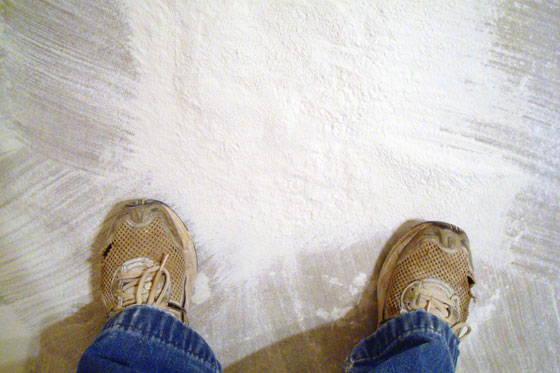
Level line for tiling

Despite any appearances, the line is actually in line with the top of the vanity, and it is level.

Once we got going with our tile, the most important objective was keeping everything level and even. For me the solution was using spacers. I wanted fairly narrow joints, and every single one had to be the same. I may have gone a bit overboard.
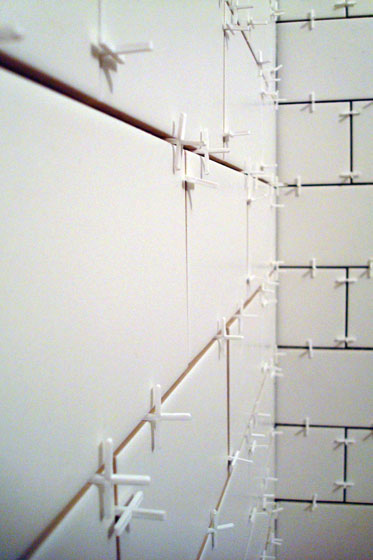
Tile spacers

Too many spacers?

I had two bags of spacers, but those were quickly emptied. As I progressed around the shower, I kept going back to areas that had already set up and removing the spacers so that I could reuse them.

The other spacing issue I ran into was with the accent band. I’d chosen a marble mosaic tile that was slightly thicker than the white subway tile I was using the rest of the shower. I could have camouflaged the difference with a chair rail or another type of tile, but I really wanted a flat, clean, simple look. My tile supplier suggested putting a little extra mortar on the subway tiles to build them out to the same depth as the mosaic.

Back buttering the subway tile

Back buttering the subway tile

I back buttered for two rows on either side of the accent band. Because I only did it in this one spot, the walls have a very slight curve. I’m hoping it’s imperceptible unless you know it’s there (obviously, all of you will be diplomatic enough to not point it out when you come to visit, please).
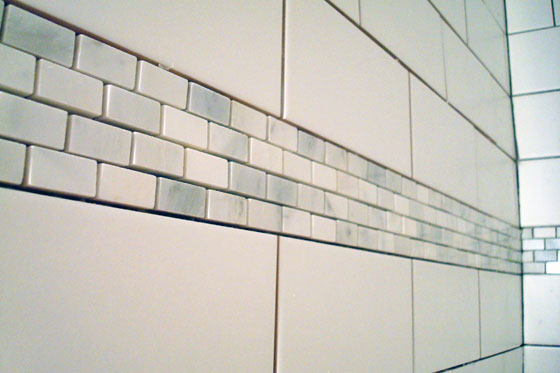
Carrera marble tile accent band

Everything looks pretty even between the carrera marble accent tile and the subway tile. Doesn’t it?

The back buttering was tedious, but not particularly difficult. The trickiest area–and the point that I started to go slightly insane–was the niche.

When we were building the shower, I thought the niche was a great idea. No bars of soap and bottles of shampoo set on the bench or the floor. No caddy hanging from the shower head. Just a convenient built-in shelf.

It turns out niche functionality, good. Niche tiling, bad.

Because I’m a glutton for punishment, I wanted the pattern to continue from the walls right through the niche. That meant dozens and dozens of cuts. In the whole niche, there is only one full tile. Ugh. But, I have to say, the result was worth all of the extra figuring and cutting. And yes, the next photo is completely bragging.
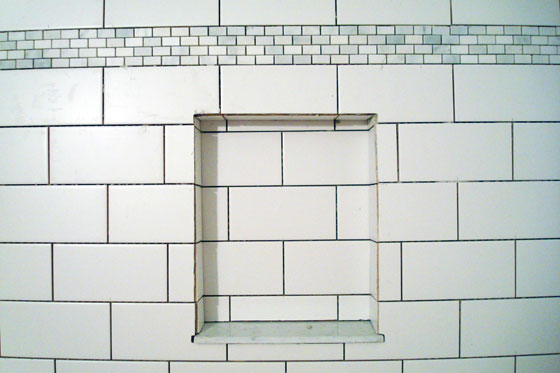
Tiled shower niche

Look at that brick pattern marching right along!

We used a small piece of marble we picked up at Home Depot for the base of the niche, as I wanted a single solid piece on any horizontal surface. It’s slightly sloped so that the water, but hopefully not the soap, will run off.

In the end, tiling the shower is not as fun as sitting on the couch all weekend watching a reality TV marathon, but my early fears proved unfounded. I did do a good enough job, I think. Everything is nice and straight–and it will look even better when it’s grouted.

I may not have won the million dollars, but I didn’t get voted off the island.

Comatose

No post today. I’m in a tile coma.

Tiled shower

The result of three days of labour

Obviously, I still have to put the seat on the bench and the top on the threshold, take out all of the spacers and grout everything, but the hard part is done.

Finally.

Thank goodness.

Sorry for the brevity today. Full breakdown… project breakdown, not personal sanity (already had my “I’m going crazy” moment at the end of my 12-hour second day)… will come later.

How did you spend your weekend?

Forget jewels. I want tools!

I don’t know about anybody else, but the commercials that pop up this time of year talking about how really expensive diamond jewelry is the perfect Christmas gift are a little bit odd to me. Who has that much money to spend on a Christmas present?

But that could just be me. My Christmas list likely looks a little bit different than most women’s. At the top of my list this year is a Kreg Jig.

Kreg Jig

Photo from  www.kregtool.com since I don’t have a jig of my own to photograph… yet

As the reno winds down, I’m realizing I’m going to have to start furnishing some of these beautiful spaces we’ve built.

Thoughts of TV stands and kitchen islands and sofa tables and ottomans and coffee tables and benches lead to web searches and Pinterest and project plans and Ana White and “I can build that!”

So it’s official. If I’m going to be building furniture, I need a Kreg Jig.

Oh, and some extra red Robertson bits (#8) and a new carpenter’s square would also be helpful. Jewelry would not.

Santa, are you listening?

How to install pot light trim

The end stage of a renovation involves a lot of little tasks: put on the cover plates, caulk the trim, touch up the paint, clean and dust everything. One of the little to-dos on our list was to put the trim on the pot lights.

My post on how to install pot lights is one of the most frequently accessed posts on the blog. But it’s unfinished. The housing for the pot light is just one part of the fixture. The other part is the trim, which goes on after the ceiling is finished.

Without the trim, the pot light looks a bit rough.

Pot light without trim

Our trim-less pot light

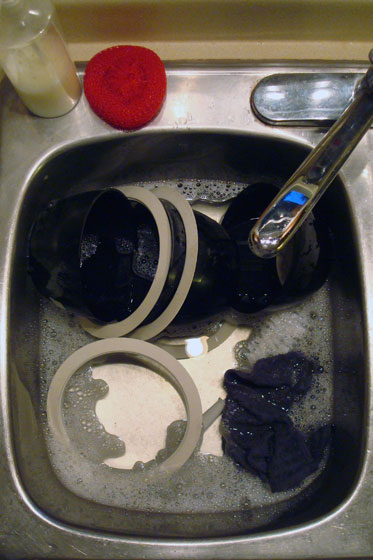
The first step in installing the trim is to wash a summer’s worth of drywall dust off of them.

Pot light trim in the sink

This step may be optional for some installations.

The trim should be made up of three pieces: the baffle, trim ring and spring or hook.

Pot light trim spring

This spring connects the trim to the housing

Step one is to attach the hook to the baffle. There should be little holes in the narrow end of the baffle specifically for this purpose.

Spring attached to pot light baffle

The end of the spring without the loop should be hooked to the baffle.

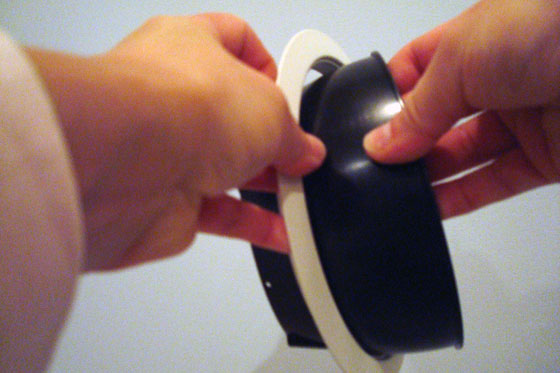
The next step is to connect your baffle and trim ring.

Putting trim on the baffle

This is probably the simplest step. Just slide the the trim ring over the baffle.

Remove the light bulb, so that you can reach into the housing. If necessary, adjust the height of the socket so that your bulb is recessed as much or as little as you want.

Adjusting the socket in a pot light

Loosen the wing nut, and the metal socket will slide up and down. Tighten it back up when the socket is positioned where you want.

To connect the trim, insert the baffle into the housing, stretch the spring and hook it into the cut out on the pot light.

Pot light trim hooked in place

On our pot lights, the cut out looks like a candy cane

I found I was able to reach into the housing and hook the spring by hand. If your hands aren’t as small as mine, needle nosed pliers may come in handy.

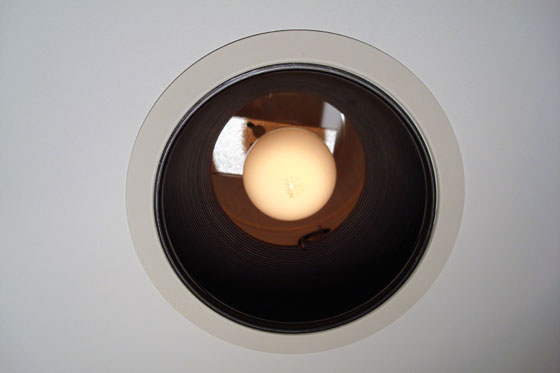
Screw the light bulb back in and admire your trimmed pot light.

Pot light

All done!

The trim reduces the brightness of the light somewhat and directs it downwards. I may adjust the height of the bulbs if we feel we need more light once we’re using the basement.

However, for now the pot lights are bright enough for me to admire our nearly finished basement. Is it weird that I stood there for nearly five whole minutes on the weekend just looking at the rooms and remembering how far we’ve come?

Friday night lights

I’ve mentioned before that the farm is a wee bit dark once the sun sets. Well, since the time change a few weeks ago, things have been extremely dark out here in the country.

The farm at night

This is not just a black square. I actually went outside and took a picture for you to show how dark it is.

Arriving home had gotten a bit hazardous between stepping on cats and randomly jamming the key in the general direction of the lock on the front door.

The time had come for a call to the electrician.

After a quick rewiring of the driveshed, an installation on the barn, relocation of a timer and a new circuit panel–also in the driveshed, the top of our driveway now looks like this when we arrive home at night.

Exterior lights on the barn and driveshed

Let there be light! This image was taken from roughly the same angle as the one above.

We had lights on the driveshed and barn already, but neither of them were working. In the driveshed, we’d killed the power because of sketchy wiring and an obviously unsafe fuse box. On the barn, the old light had a blown transformer, and ultimately the whole light had to be replaced.

Thanks to a timer we already had in the basement of the house that the electrician was able to repurpose outside, the lights come on automatically before we get home and then go off before we go to bed. The new barn light also has a photocell that senses darkness, but we decided we don’t need to see what’s going on outside all night long, so we let the timer shut everything down around 9 o’clock. We may adjust that, but for now it’s working well for us.

The lights are also working well for the cats who no longer have to worry about being stepped on or run over. Up until now, our only way of seeing them when we come home was watching for the glow of their eyes in our headlights.

As much as I’m thrilled with our new exterior lights, I do have to admit that I’m looking forward to being home during daylight this weekend. I’m starting to forget what my property looks like outside of the lighted sphere of the barn, driveshed and house.

William Wallace by way of a wet saw

Saturday morning, Matt’s bathroom looked like this.

Shower with cement board

It’s not just Saturday. The bathroom has looked like this for the past several months while our attention has been on finishing the drywall in the rest of the basement.

By Saturday evening it looked like this.

Tiled bathroom and shower floor

Beautiful tile. Finally progress!

I’ve tiled before, and I actually enjoy doing it. It’s not hard work, but it does require planning.

My Dad and I spent several hours in the morning laying out the shower floor, carefully fitting and figuring. When we finally spread out the mortar, we had a really good idea of how everything should go.

The marble mosaic hexagon tiles that we used on the shower floor are all on a mesh backing that basically makes them into 12×12 tiles. It’s important to  pay close attention when you join the sheets to make sure the gaps between the tiles are consistent. Despite our best efforts, I did still have a bit of difficulty keeping everything perfectly straight all the way across the floor, but I was able to adjust the spacing on the individual hexagons, and I think it will all look okay once it’s grouted.

Here are two lessons I learned about how to work with mosaic tile:

  1. Don’t start with your first sheet tight to the wall. Keep it off an eighth or even a quarter of an inch. This will give you more room to make adjustments on your other sheets as you progress across the floor.
  2. For areas like the drain, remove all of the tiles that come into contact with the drain. Lay your (mostly) full sheet as you usually would, and then insert individual tiles (or pieces of tiles) into the gaps as necessary.

On the main area of the floor we used actual 12×12 tiles, which were a piece of cake to install. The biggest piece of figuring we had to do was determine where the middle of the floor was and then centre our tile along that line.

The only sour bite in our cake was cutting out for the toilet. I know other people have used dremels or other tools to get nice round circles. We used the wet saw, which only cuts in a straight line. With lots of patience, lots of back and forth and even trading off cutting duties between my dad and me, we got the tile cut on the first try.

Tile cut around toilet flange

The cut of the day

It’s not as smooth as it would have been with another tool, but it will all be hidden under the toilet. That works for me.

What didn’t work for me was the William Wallace/Gene Simmons makeup I had going on after using the wet saw all day. All of the tile dust mixes with the water from the saw and from my waist to my hairline I had a dusty grey stripe in line with where the saw blade had sprayed me all day long–attractively along only the right side of my face.

Cutting tile on a wet saw

Thank goodness for safety glasses

Next step is grout and then I can move onto the walls. Who knows, someday we might even move on to installing the actual fixtures and using this bathroom.

What’s your tiling experience? Any tips for keeping things straight and even? Or cutting a curved line with a straight saw?

Party time

I booked a Christmas party. Hosted by us. At the farm.

What’s with the tone?

Well, I’m a bit anxious.

Because, you see, the party is set for exactly one month before Christmas Eve. One month from today.

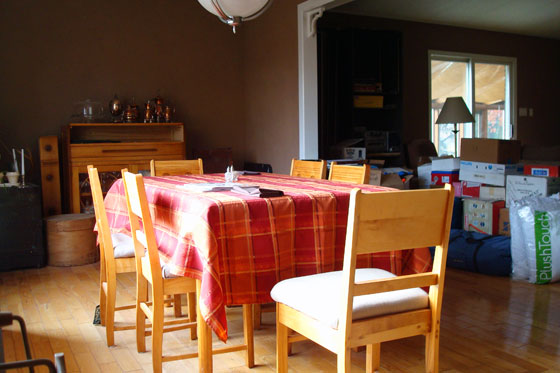
And my dining room currently looks like this.

Dining room

Keeping it real, folks. The drawer for the china cabinet was damaged in the move and won’t slide into place until we fix it. The extra furniture tucked in the left corner, the boxes stacked on the right and ironing board that is just outside of the picture will all go into the basement…whenever we finish the reno.

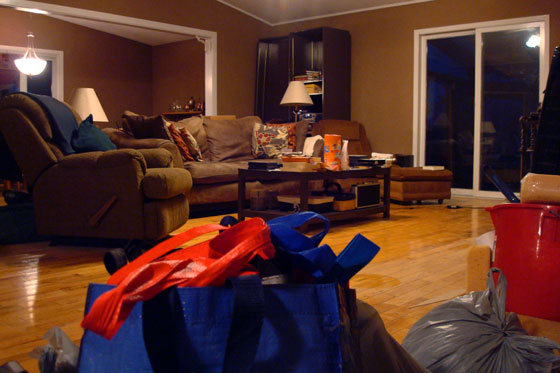
My living room looks like this.

Messy living room

The couch is in the right spot, but the grocery bags and cleaning supplies in the foreground of the photograph are not.

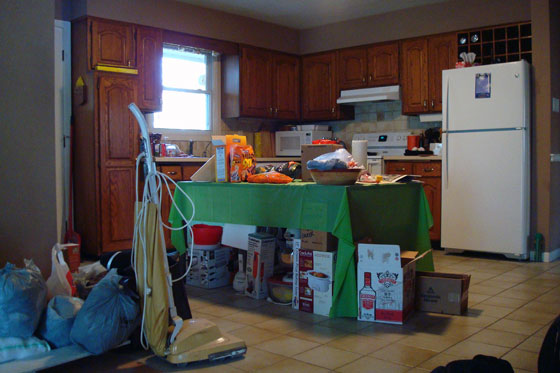
Oh, and my kitchen looks like this.

Messy kitchen

Our “island” is a metal patio table over which I have thrown a plastic dollar store tablecloth. All of my small appliances and boxes of cookbooks are tucked underneath, as I have no other place for them yet. On the bright side, we have a spot for our stash of Hallowe’en candy.

You may now realize why I haven’t shown a lot of pictures of the inside of the house.

For the past seven months since we moved to the farm, we’ve been living in an increasing level of chaos. And it seems to be getting worse.

Books, boardgames, extra furniture, sports equipment and all of the other items that will someday be in the basement are still packed in boxes and stacked behind the couch between the dining room and the living room. As we buy new things or have to access our packed items, everything gets a little more disorganized (see exhibit A above).

You can see the tracks of our footprints in the drywall dust on the living room floor (see exhibit B above).

I emptied the front hall closet, so that I could fit it out with shelves and rods and racks to actually store things in a somewhat more orderly fashion. That means our ancient vacuum cleaner, shopping bags, hats and gloves are all piled in the corner of the living room (see exhibit C above).

The good news is that we are heading into the home stretch on our basement reno.

The better news is that after exhibits A, B and C were photographed, a couple of tents, an air mattress, a camp stove and assorted Christmas decorations made their way downstairs.

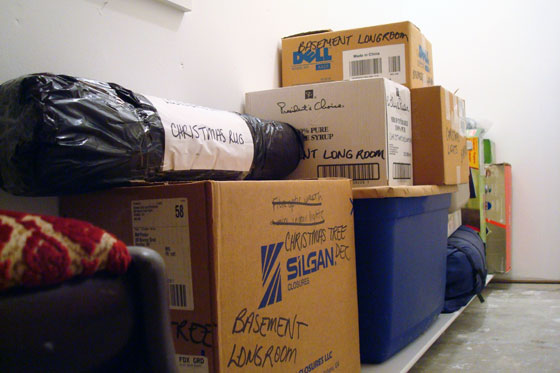
Cartons in a storage closet

No need for colour, carpet or trim in the closet under the basement stairs. Two coats of prime do the job just fine. Some proper shelves would be nice though.

I’m hoping that by party time carpet will be the floors in the rest of the basement. We may not have baseboards or much furniture by then, but if we can at least put some more things downstairs, I’ll feel a little better about our living environment.

I like hosting parties, and I don’t worry too much about my house being perfect. However, I do have some standards. A basic level of organization and tidiness is required. The current state is not even close.

Here’s hoping a hard deadline makes things move a little faster.

Oh, and to Matt’s family… we’re really looking forward to hosting you next month! Really.

Anyone out there have any tips on how to get organized? Please tell me someone else has tiles stacked in the living room, an ironing board in the dining room, dust tracks on the floors, a makeshift kitchen island and tools sitting on pretty much every available surface? Or perhaps you’re already looking ahead to Christmas. Who’s also in party planning mode already? What makes a good party at your house?

Stick a trowel in me…

… I’m done.

We are calling it on the drywall phase of the basement reno. Five and a half months–in case the text version wasn’t clear, let me translate that into numerals 5 1/2 (or 5.5 for you digitally minded folks) months–after we started drywalling the basement, we are finally finished.

Oh the glamourous life of DIYers.

Lest there’s any additional lack of clarity, the basement reno itself is not finished. Only the drywall stage is done.

Some other things that are done:

  1. Bandaging my fingers for my evening sanding sessions.
Bandaged fingers

This is what my hands looked like at the end of a night of sanding. The bandages are pretty much worn away.

I built up calluses on my fingers, of course, but calluses can only do so much. It took me two nights of bleeding fingers to learn my lesson. (Point in my favour: the nights were not consecutive. I’m not that dumb). Before the second incident, I thought my fingers were sufficiently toughened from the first incident to not require protection. I learned that no matter how leathery and rough I think my hands are, I can apparently always do more damage.

Good news is I would make a good spy these days, as my fingerprints are sanded off.

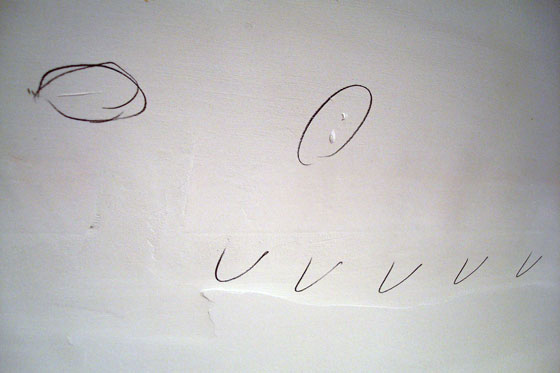
  1. Also done is Matt’s nightly decoding dilemmas as he tries to interpret the pasting instructions I draw on the drywall.
Pencil markings

The two circles highlight a scratch and some divots that need to be filled. The U and V markings are supposed to be arrows that point out a ridge that needs to be feathered out with paste.

The division of labour when it came to drywall was I sand, Matt pastes. As I work, I keep a pencil behind my ear, so that I can mark spots that need particular attention.

Additional symbols in my drywall lexicon include lines and once in awhile actual words–that usually still require translation.

  1. The biggest change that will result from concluding drywall work will be no more drywall dust throughout the house.
Pile of drywall dust

The partially swept office floor (and yes, I know my work shoes are looking a little worn).

In the basement, the dust was so deep that dunes were starting to form. It took Matt and me a full afternoon to wipe down the walls and ceilings, sweep up the worst of the dust and then vacuum the remaining powder.

Upstairs is also covered in a fine skim of dust, although we haven’t done a deep clean there yet. We have to keep up our glamourous DIY lifestyle, after all.

Starting out on this project, I never dreamed that drywall would take us nearly half a year (ouch, that sounds like a really, really long time). My only excuse is that we ended up having to redo a huge area–pretty much the whole basement, we didn’t work on it religiously every single day and we’re not professional, so we’re slow.

The finish is definitely not perfect, but I’m satisfied with how it turned out, and I’m really happy that Matt and I were able to tackle such a big project together by ourselves (with help from my Dad, of course. Thanks, Dad!).

And now, in the way of DIY, concluding one stage of the project means it’s now on to the next. Painting here we come!

What’s on your agenda for this weekend?

For sale: Woodstove (low mileage)

Item #8 on our fall to-do list is to sell the woodstove that we drove up the stairs out of the basement (hence, Matt’s low mileage joke in the title of this post).

Woodstove and stainless steel chimney

This could all be yours

The stove is still living in Matt’s future parking spot in the driveshed, but it is now officially for sale. The ad is live on kijiji and flyers are going up in the post office, feed mill, library and other local hot spots.

If you’re interested in a woodstove of your very own (and are in the Hamilton area), here are the details:

This large freestanding woodstove made in 2003 by top Canadian manufacturer Regency will heat your whole house, thanks to a built-in electric fan. Sale includes insulated stainless steel chimney, wall heat shields and everything else you need to set up your own private heat source.

This stove can be WETT certified.

  • 2003 Regency large freestanding wood burning stove with electric fan
    Model CSA B366.2, Width: 28” Height: 34” Depth: 28”
  • Stainless steel insulated chimney, 12” exterior diameter, 7” interior diameter
    Five 3’ long sections and one 16” section (16’ 4”: total lineal feet)
  • Cast iron chimney, 7” diameter
    One 2’ section, one 10” section, one 90º elbow
  • Two heat shields 22” x 52”
  • Plus all other chimney sections, connections and caps required for installation

Don’t sit around watching your heating bills soar this winter. Sit in your nice cozy living room (or basement, workshop or cottage) watching flickering flames through the glass door on your very own woodstove.

Winter is coming. Don’t delay!

We’re asking $2,500, although we are of course open to offers.

If you’re interested, contact me at homeon129acres@hotmail.com.

Eco incentive

These days, there are numerous programs where people can access government grants to help make their homes more energy efficient.

When we bought the farm, Matt and I were able to qualify for the ecoEnergy retrofit program through the Government of Canada. Knowing that we had a long list of repairs that we needed to do, including improving the insulation in the house and replacing the furnace and air conditioning system, we were looking for any help we could find.

The ecoEnergy program “provided grants up to $5,000 to help homeowners make their homes more energy-efficient.” Ummm, $5,000 is pretty helpful!

The challenge for us with the ecoEnergy program was that it had a very tight deadline: the end of March 2012. We only took possession of the farm on March 2, so as soon as our offer was accepted in January, we went to work to get things in place to qualify for our grant.

Step 1: Register for the program.

A registration number was required for all steps of the program. Registration was free and easy to do online. By requiring homeowners to register in advance, the government could manage the budget for the program; there was only space for 250,000 homeowners to participate. I registered the farm on Jan. 27. The program reached its cap and stopped accepting registrations the very next day. This was just one of many times where I felt fate was on our side with this property.

Once we had registered, we were in a bit of a holding pattern. While we were able to enroll in the ecoEnergy program before we officially owned the farm, inspections and any actual work had to wait until the deal closed on March 2. But, March 31 was the deadline to complete any upgrades. We would have just 29 days to do all of the work. That meant I spent February finding an inspector to do our pre-retrofit evaluation, getting quotes for our geothermal system and insulation upgrade, hiring contractors and scheduling everything so that we were ready to go as soon as the farm was ours.

Step 2: Pre-retrofit evaluation

Before we did any work, we had to have the house inspected by an inspector licensed by Natural Resources Canada. We chose to go with Energuy. The pre-retrofit inspection was scheduled for 12 noon on March 3, the day we officially took possession.

Energuy inspector

Serge, one of our inspectors from Energuy

The inspector looked through the house from the attic to the foundation, documenting the insulation, the furnace and air conditioner, the hot water tank, the windows and the toilets (the areas that were eligible under the terms of the program). With the help of a big fan he put in the front door, he also performed a blower test which showed any air leaks that we had in the house. He also helped us fill out all of the paperwork required by the program.

Blower test for an energy audit

The blower test fan set up in the front door

At the first inspection, our house received a rating of 58 points (out of 100) on the EnerGuide Rating System (ERS) scale. The ERS compares the our home’s efficiency with other similar houses by estimating our annual energy consumption based on our house’s “location, size, mechanical equipment and systems, insulation levels and air tightness.”

According to Energuy, the average rating for a house like ours is 64. So we weren’t too far below the average, but that wasn’t much comfort to this over-achiever.

Step 3: If we wanted to improve our rating, we one option: Do the work

Obviously, the biggest upgrade we were making was the geothermal system. Installation started on March 5 — 26 days left in the program. The attic insulation was upgraded on March 16 — 15 days to go. And then just under the deadline, on March 25, we bought two new low-flow toilets — 6 days to complete install!

Attic hatch

Post upgrade, our energy auditor checks out the new insulation in the attic.

We did one additional upgrade that we weren’t able to squeak in before the March 31 deadline–the spray foam insulation in the basement, which happened at the start of May.

Step 4: Post-retrofit evaluation

The final step in the ecoEnergy program was the final inspection. We had until June 30 to complete this step. Matt and I scheduled our inspection on June 29, as we wanted the basement renovation to be as far along as possible before the inspector came. While none of the work we did in the basement counted towards our grant, sealing the broken windows and insulating the exterior walls all contributed to the overall air-tightness of our house.

Testing for air tightness

During the blower test, the inspector took eight readings at five different pressure points to test how air tight our house is.

Again, the inspector checked the house top to bottom, took pictures of all of our upgrades and did another blower test. We gave him copies of all of our receipts to prove that we completed the work before March 31 and filled out some more paperwork, and then we waited.

And waited.

And waited.

Then, last week, this arrived.

Cheque from the government of Canada

Money coming in, rather than going out!

Yup. We maxed it out. We got the full $5,000 we were eligible for through the program!

The results from our second inspection spell out all of the details.

Remember that the rating from our first inspection was 58. Our first report, which included tips of how to improve our energy efficiency, said, “If you implement all of the recommendations in this report, you could reduce your energy consumption by up to 57 percent and increase your home’s energy efficiency rating to 80 points… and reduce your greenhouse gas emissions [such as CO2] by 9.0 tonnes per year.”

After all of our upgrades, our final ERS was 85. We beat the estimate of how much we could improve our efficiency by 5 points! Even better, we tied the “highest rating achieved by the most energy-efficient houses” in our category.

This over-achiever is satisfied.

The grant is a very nice acknowledgement of the improvements we’ve made to the farm and our commitment to be more energy conscious. The rebates offered by the government are not enough to make someone do repairs just to get the grant, but, for people like us who are planning to do the work anyways, the grant ends up being a nice bonus.

Anyone else out there ever participated in a government grant program? What are you doing to be energy conscious in your home?