How we installed a waterline for the vegetable garden

A big to-do on the garden task list is now done. We finally have a hose at the garden… and I’m so happy to cross this one off the list.
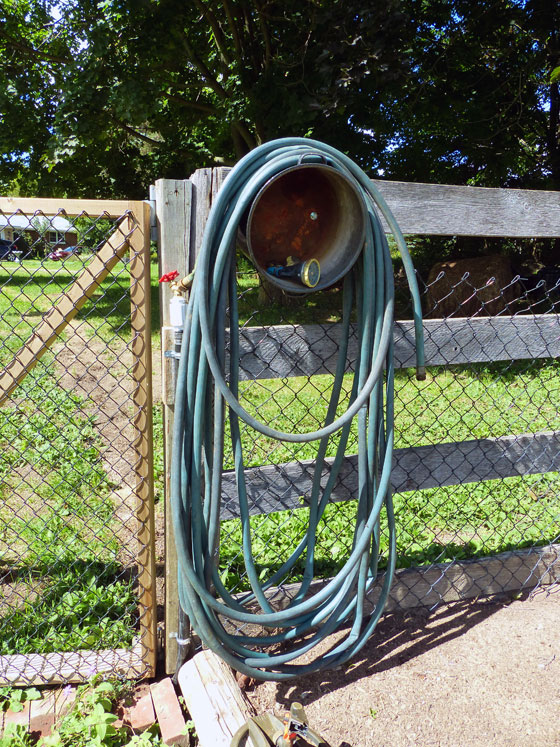
Hose in the vegetable garden

With the lack of rain we had this summer, we watered the garden a lot. However, the closest hose was at the driveshed. That was three hose-lengths away. I had screwed the hoses together back in the spring, and most of the time we kept them laid out across the yard. But any time I had to wind them up (like every time we cut the grass) it was a heavy haul.

Adding a tap at the garden was one of my Home Goals 2016. I already shared a bit of the misery that was digging the trench from the driveshed to the garden (ground so hard, summer so hot, rocks and roots so many, garden so, so, so far away).
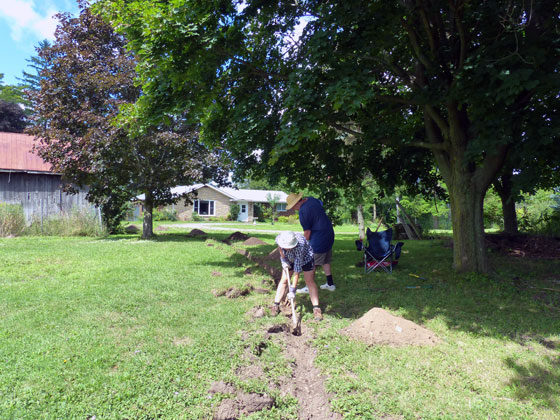
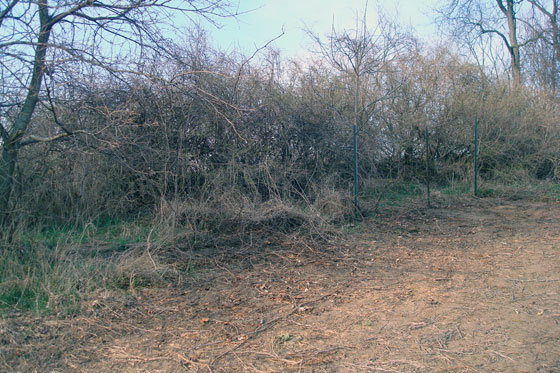
Trenching a waterline to the garden

When I measured the trench, it came out a bit more than 100 feet. I spent a week visiting various home improvement stores and then specialty plumbing suppliers trying to find someone who would sell me 110 feet of irrigation pipe. All I could find was 100-foot or 400-foot coils. Ugh.

I bought 100 feet and crossed my fingers that we could splice on a small extra piece we had at the farm already and still make it to the garden.

But it turned out I was worried for nothing. When Matt and I unrolled the pipe and laid it in the trench, it easily reached the garden. Thank goodness for small wins.

The other thing I was worried about was our plumbing abilities. I had a plan, but I wasn’t sure if it was actually going to work.

We dug down to the waterline that ran to the hose at the driveshed. After turning off the water, I took a deep breath and cut through the waterline with the hacksaw. So much for my brand new work gloves.
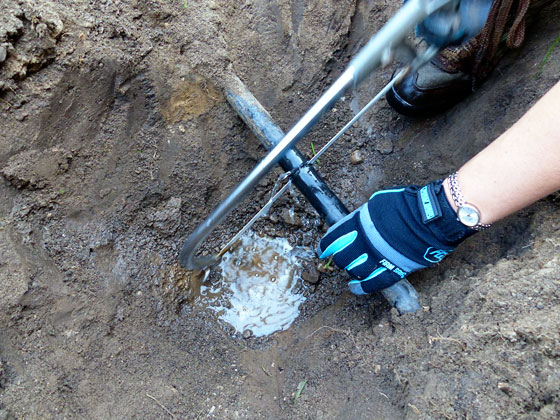
Cutting a waterline with a hacksaw

Then we inserted a T. A note about these connections. They fit super, super tightly. We boiled the kettle and then Matt poured the hot water over the pipe and that softened the plastic enough that I was able to wedge the fitting into place. The clamps on either side provide extra insurance to hold everything together and prevent leaks
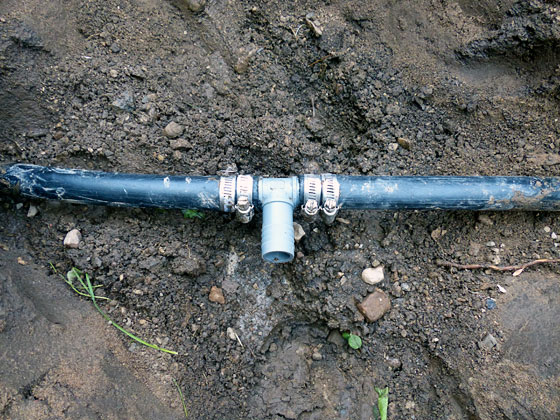
Adding a T connection on a waterline

From there, it was easy to connect our new 100 feet of pipe.
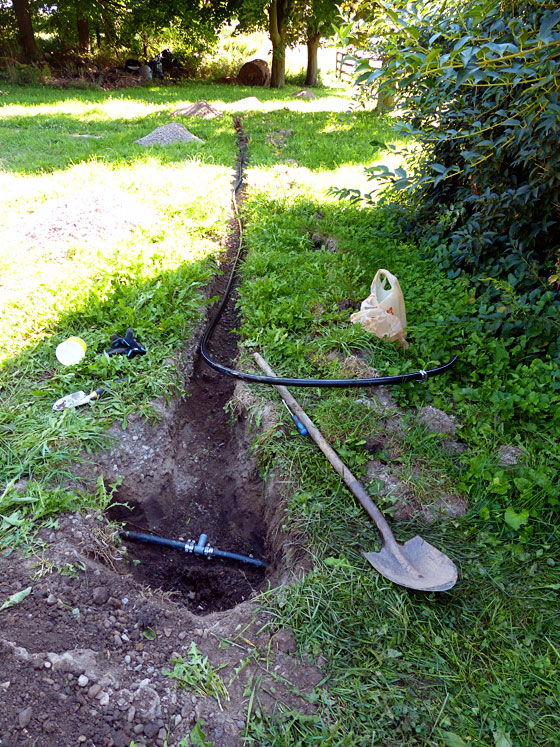
Running a waterline for a garden hose

At the garden, the pipe sneaks under the brick threshold at the gate and up the post. Look how much pipe we had. Exactly the perfect length. And look at the water flowing. We did it! And there are no leaks! Big wins all around!
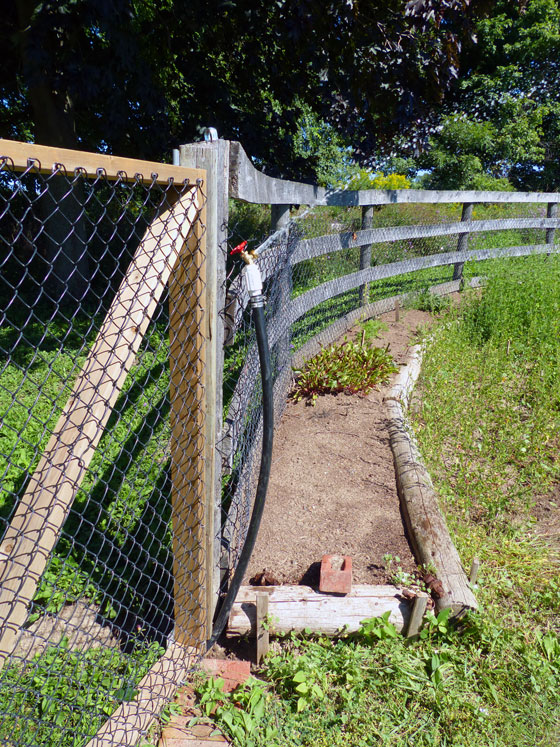
Adding a hose at the vegetable garden

Backfilling the trench was much easier than digging it out. Wiley helped which was huge.
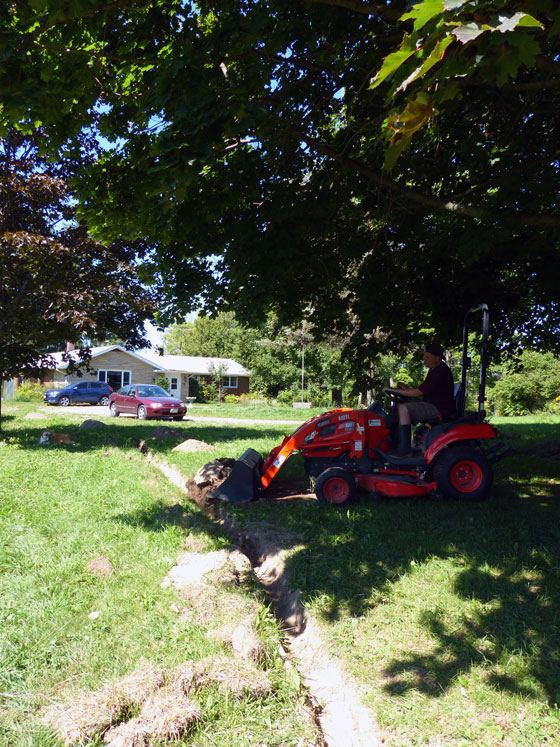
Backfilling the trench with the tractor

Baxter did not help. In fact he staged a sit-in (lie-in) to protest when Matt started to put the sod back down. “Dirt is good, dude.”
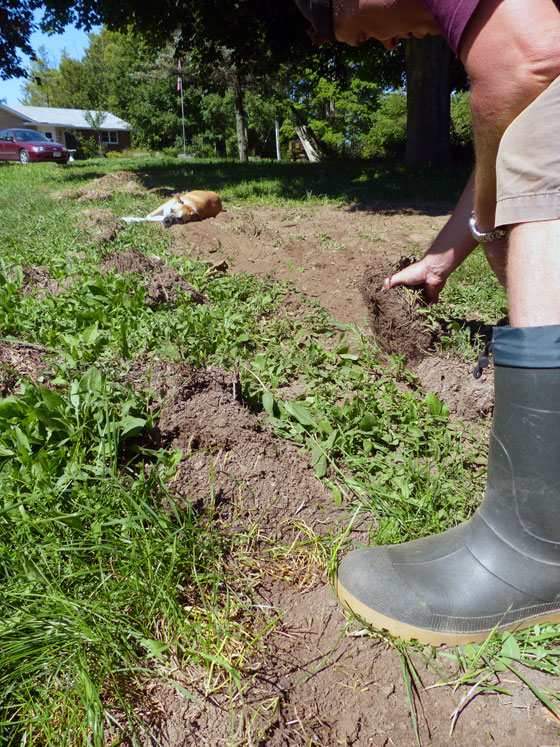
Baxter lying in the dirt

The finishing touches were clamping the waterline to the fence post and then installing a hose hanger.

Rather than a typical hanger, I wanted to try a metal bucket. I’ve seen a few other people do this, and I figured it would give us a place to stash nozzles or maybe even some garden tools.

Again, I spent some time running around to various stores trying to find the perfect bucket. Then I remembered a rusty old canning pot–one of our many gifts from previous owners. I knew there was a reason I didn’t throw that out.

I drilled a couple of holes in the bottom and then bolted it to the fence.
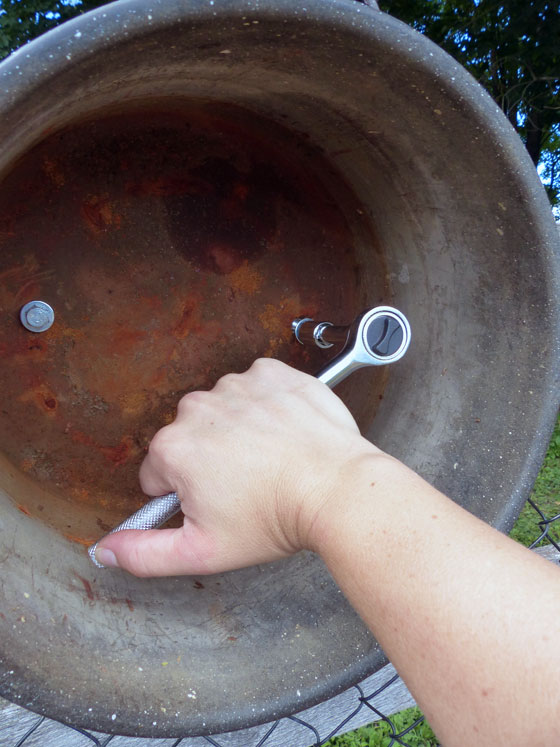
Using a pot as a hose hanger

Then I dragged the hose out to the garden one final time (except for seasonal shutdown, but don’t burst my bubble, okay?) and coiled it up.

Hose in the vegetable garden

Such a great addition to the garden. And this is actually our final to-do on our garden to-do list. This year has been all about adding the structure (raised beds, trellises, perennials) and functionality (gate, trellises, hose) to the garden. I think all of this is going to make a huuuuge difference next year.

The other thing that is going to make a huge difference–and that we have yet to do–is clean up. We have a whooooole bunch of weeds that I want out of there before winter sets in. That’s still a few weeks away though, as harvest is still going strong.


How is your garden growing? Does plumbing make anyone else anxious? How do you handle irrigation in your garden?
Save

Save

Save

Save

Save

Save

Getting in the mood

I had planned to share the final post in our waterproofing project today, but some of the finishing touches have been delayed. So instead, inspired by the project that took us away from the basement, I’m going to be sharing some thoughts on DIYing.

As I sat down to start writing this post, the announcers who are calling the baseball game on TV were talking about one of the players taking some time off for family problems.

Matt added his own commentary. “Family problems? What, did his wife make him dig a trench too? And complain all afternoon about not having a backhoe?”

Now, in my defense, I did not make Matt dig a trench. I came up with the brainwave to add a hose connection out at the garden this spring. I also advocated for renting a small backhoe or hiring out the trench (I even got a quote). Matt’s the one who came up with the brainwave to hand dig the trench for the new waterline and to do it on a humid 30+ degree afternoon in August.

As much as it might sound from my description that we’re sniping at each other, really we’re just teasing each other. This is part of our rhythm. When it comes to working around the farm, we are very much a team.

Trenching a waterline to the garden

But the thing about DIYing as a couple is sometimes we’re not both in the DIY mood at the same time. And that was definitely the case for me when we were digging the trench.

It was hot, between a cold (I hate a summer cold) and a lurking migraine (thank you, humidity) I wasn’t feeling great, our clay soil is super hard and full of roots and rocks, and the distance from the hose hook up at the driveshed (where we’re tying in) and the garden is loooooong.

But because of all of the things I listed above (except for how I was feeling), I didn’t want Matt to have to do the whole trench all by himself.

Plus, I really want a hose out at the garden, so if Matt’s in the mood to trench the waterline, I’m going to take advantage of that, no matter what mood I’m in.

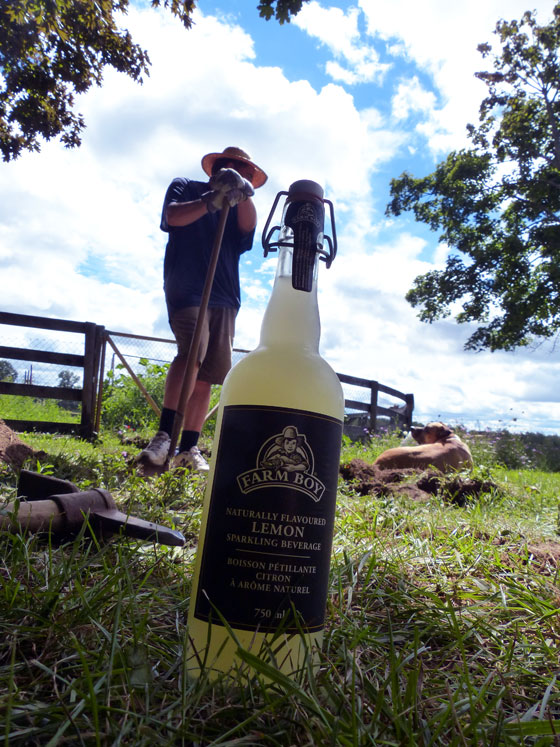
So I grumbled about a backhoe, how hard our soil is and my bad mood. I took breaks to sit and lie down in the shade. I kept refilling our water bottles and planned how we’d reward ourselves with a post-trench refreshment. And I also kept swinging the pick while Matt wielded the shovel.

And Matt was understanding. He didn’t begrudge me slacking off. He got extra drinks for us, posed for pictures and encouraged snuggle breaks with the dog.

Farmboy lemonade reward for a hard day's work

He also recognized that even though he said at various points, “Why don’t you go in and watch the Olympics,” there was no way I was going to leave.

Relationships are about give and take. Add in a farm and a heap of DIY, and we need to be even more flexible. For Matt and me, recognizing where we each are at and supporting each other–no matter our moods–allows us to accomplish everything we do around the farm.

How do you get in the DIY mood? What’s your secret to DIY success? Are you part of a DIY duo? How do you make a partnership work?

Save

Save

Save

Beating the heat

I don’t know what the weather’s like where you are, but here in Southern Ontario we are having a serious heatwave.

So what do you do if it’s mid-July and the forecast is showing hot and sunny all weekend? For many Ontarians, the answer is head to cottage country where you can be by a lake. In fact, that’s just what my husband did.

However, if you’re me, the answer is, “Why don’t you go by yourself? I’ll stay here and tape the drywall.”

What?

Yeah. I dunno what’s wrong with me.

Drywalling the laundry room

Thanks to our basement waterproofing (I promise I’ll share more details on this project), we have some drywall to repair. We also are building an extra closet in our laundry room, so we decided to do all the drywall at the same time.

We spent last week on framing, insulating and drywalling. Matt and I hung the last few sheets on Friday before he left. We’re a little rusty at drywall. Measurements were off and gaps between sheets were large. Fortunately, paste covers a lot.

By the time Matt got home, I had finished the first two coats, and things were looking much better.

Plus, the basement was cool. Not quite lakeside, but not an altogether terrible way to spend a weekend.

What did you get up to this weekend? Do you like the summer heat? I love it, honestly, and would have been quite happy to spend my weekend outside versus in the air conditioning. Would anyone else have prioritized drywall over a weekend away? Did you see the temperatures from Basra? I think that’s a little hot even for me.

Hardboard and six favourite projects

There’s one material that I go to over and over for DIY projects: hardboard.

Hardboard

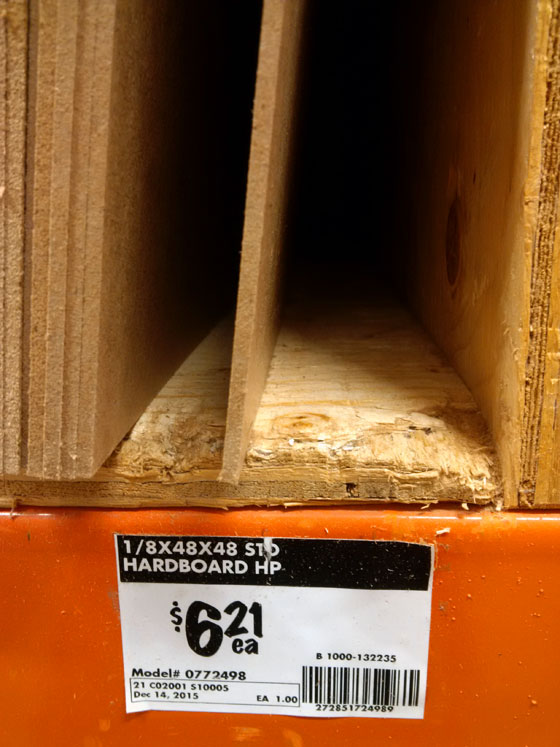
Hardboard is an engineered wood product also known as high-density fibreboard. Wikipedia says that it’s “made out of exploded wood fibers that have been highly compressed.” I’m not sure what exploded wood fibres are. By the time hardboard gets to the store, it has little resemblance to wood. It’s more like a super heavy-duty, super smooth cardboard. The main resemblance to typical construction materials is that hardboard comes in 4×8-foot sheets.

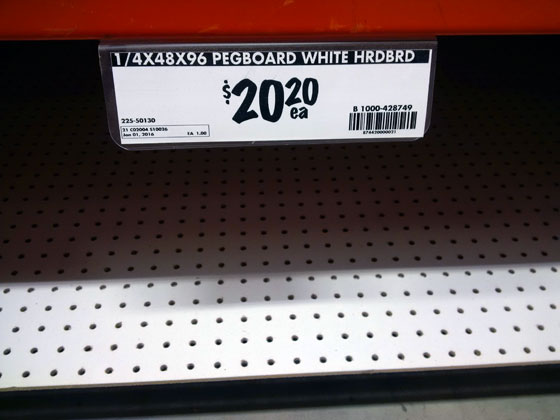
It’s less than a quarter inch thick, fairly light-weight, and cuts and bends easily. Sometimes it’s cut to other sizes than 4×8, finished with white on one side, or it’s also the material for pegboards.

Pegboard

Here are some of my favourite projects with hardboard:

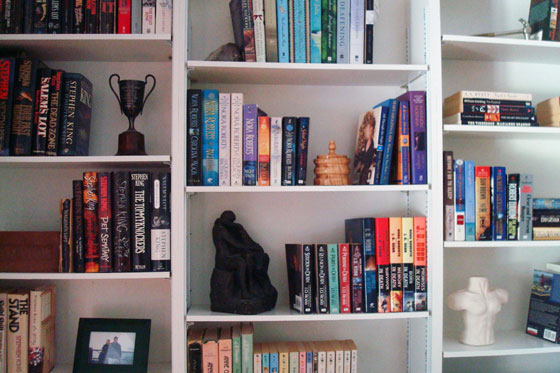
Living room bookshelves – Hardboard makes a very sturdy back for shelves and bookcases. But it’s thin and fairly lightweight, so it doesn’t add bulk to furniture.

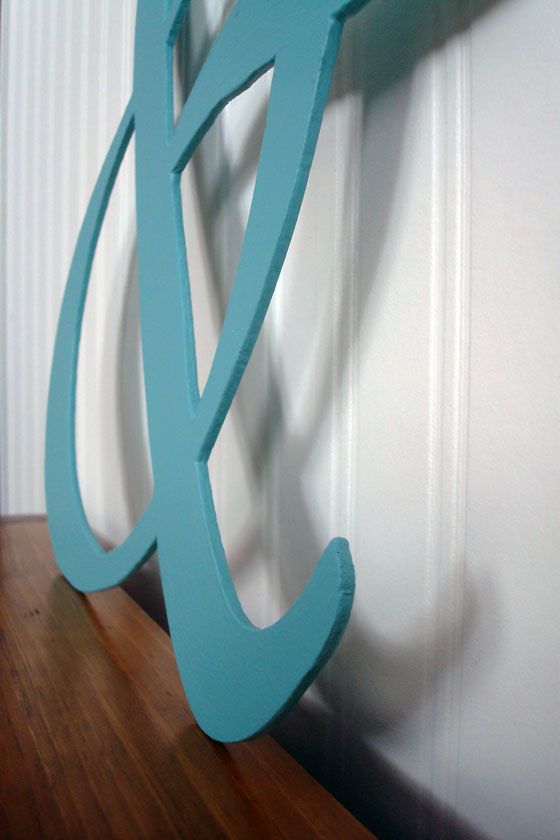
Monograms – Letters and words are popular decor trends. Hardboard is easy to cut with a jigsaw, won’t break or crack like solid wood, and is light enough to hang on a wall or sit on a shelf. I’ve found a quick pass of fine sandpaper can be helpful to smooth cut edges.

Ampersand monogram made out of hardboard

Ampersand monogram made out of hardboard

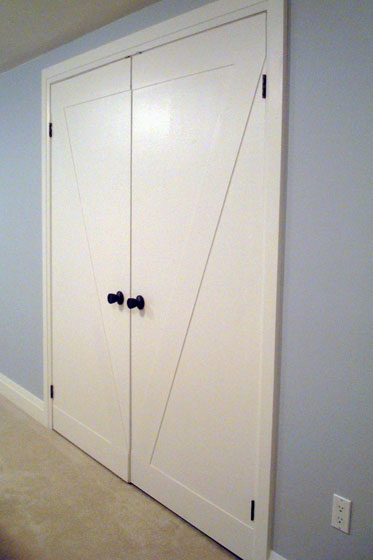
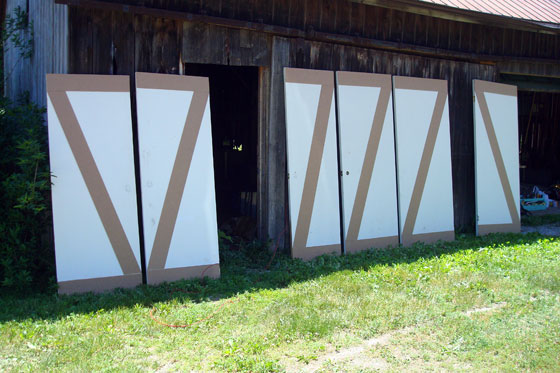
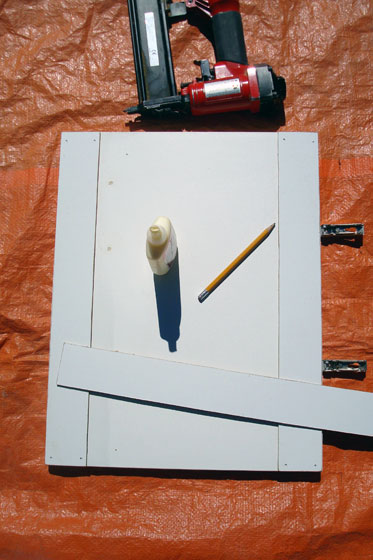
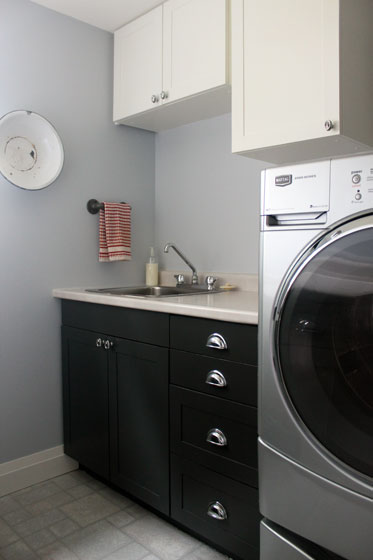
Doors and cabinet makeovers – Faced with boring slab doors in the basement and on the laundry room cabinets, I used strips of hardboard to transform them into barn doors and shaker-style cabinets. I was blown away by how successful the transformation was. I still love these doors. Plus the makeover saved us from spending money on new doors.

Making slab doors into barn doors

Score-keeping chalkboard – Hardboard is super smooth, and with a good primer and a foam roller, it takes paint very well. So I gave a sheet of hardboard a coat of chalkboard paint for a 6-foot tall, but very lightweight and easy to move chalkboard. Much lighter than actual chalkboard.

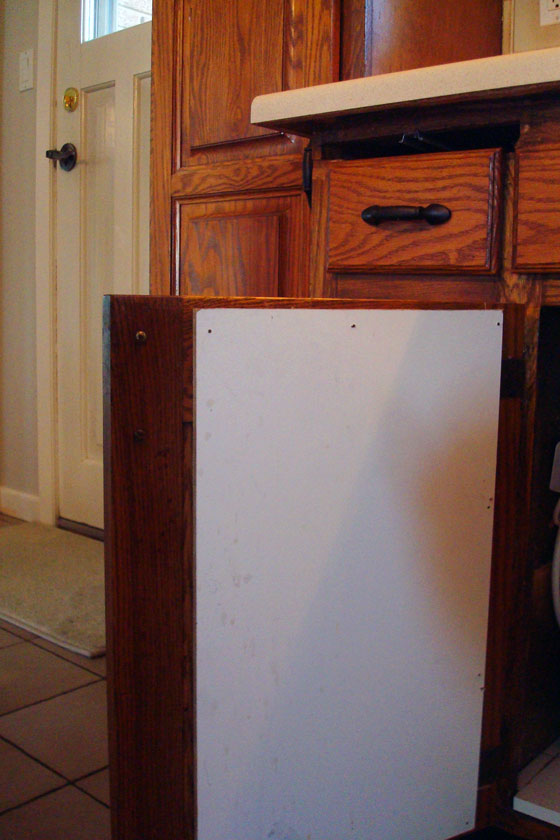
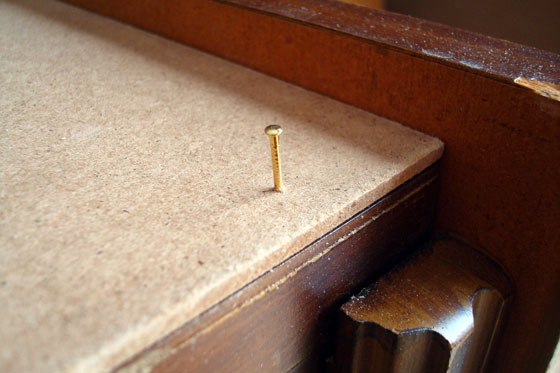
Cabinet door repair – Our kitchen needs a renovation, but until that day, we’re trying to hold things together however we can. Hardboard to the rescue once again. The cabinet door under the sink was separating from its frame. Backing it with hardboard has seen us through the last three years.

Holding a kitchen cabinet together with hardboard

Nightstand to dresser makeover – This dresser is one of my all-time favourite projects. Combining two nightstands into one dresser worked very well, but the join was very ugly. A panel of hardboard covered the seam and didn’t add much bulk to my narrow dresser.

I continue to find more uses for hardboard. And I’d love to hear if you’ve used it yourself. Any projects to share? What’s your go-to construction material?

Dueling DIY – The Final Update

Six weeks ago when I launched this Dueling DIY adventure, I thought, “I got this. No problem. I’ve got six weeks! Sarah’s going down.”

I had a somewhat ambitious list, but I thought it was entirely doable. Now that we’ve come to the end of the challenge and my final report, I’m stiff, I’m sore, I’m proud of what we accomplished… but I’m also a little bummed that I couldn’t cross everything off.

In that respect, Sarah, whose update you saw earlier this week, is the winner.

Here’s my final list:

  • Hang the gate
  • Edge the garden
  • Build raised beds around the perimeter
  • Build trellises for the raspberries, tomatoes and squashes (I have wood and wire, but nothing’s put together yet)
  • Start a few seeds indoors
  • Till in the ash, straw and manure (still only half the garden is done)

And a couple of maybes:

  • Weather permitting, plant grapes and potatoes
  • Run a waterline out to the garden (this one is Matt’s task, so I’m not really feeling too bad that we didn’t get this done)

So I made it just over halfway through my to-do list (56% if you’re wondering).

The perimeter beds were definitely a much bigger project than I anticipated–both in terms of the amount of work and their literal size. But I’m really happy with how they turned out. In fact, I’ve already started filling them up with onion (seeds), sunflower (seeds) and grapes.

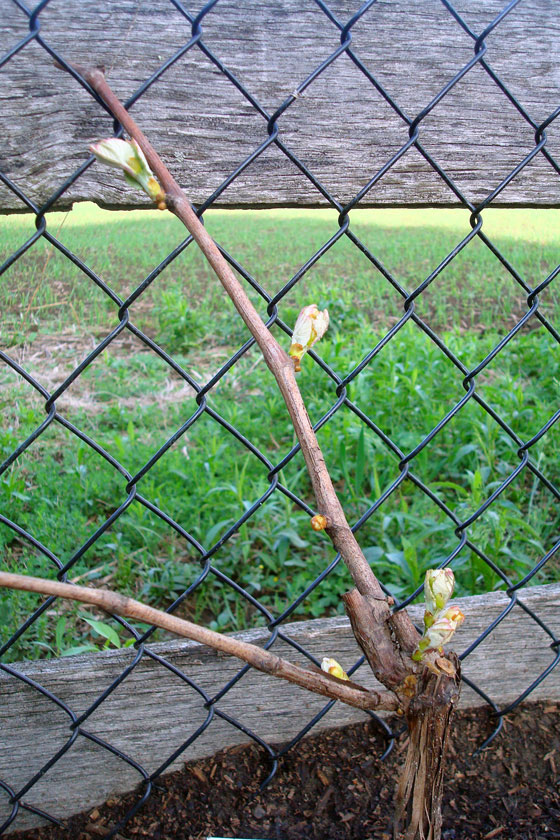
Grape buds

Although filling might be a bit of an exaggeration. According to my original calculations when we started this challenge, the perimeter of the garden is approximately 175 feet. The beds are just over 2 feet deep, which means we have 350 square feet in the perimeter alone. I’m not sure Matt and I eat enough food to keep up with this garden!

Rustic raised beds in a round vegetable garden

The outer beds are obviously where I spent most of my time throughout this challenge, but the interior of the garden–or at least half of it–got some attention too. We’re now up to 5 rows of potatoes (who exactly is going to eat all these?). We have three rows of reds, which we grew for the first time last year, and then we have two new varieties that we’re trying out: Kennebecs (highly recommended by Karen at The Art of Doing Stuff) and Russian Blues (another Karen suggestion that I couldn’t resist adding just for fun).

Potatoes growing in the garden

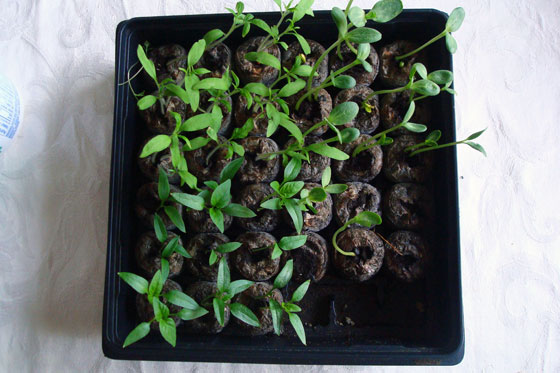
Our sprouts have overcome their damping off and are growing well. In fact, I’ve moved on to the hardening off stage and they’ve spent a few days outside this week. Matt brought home some tomato plants to supplement our own seedlings. Those can probably go in the garden this weekend, but I’m going to let our sprouts grow a bit more before they move outside permanently.

Sprouts and seedlings

Aside from finishing the raised beds, our biggest accomplishment last weekend was wrestling an abandoned hay bale out of the tree line beside our big field (where it and a friend have lived for years)…

Bales of hay stuck in the trees

onto the trailer (seriously, it took us about 45 minutes to get to this point)…

Straw bale in the trailer

and up to the garden.

Straw bale for mulching the garden

I’m going to try the deep mulch method to deal with weeds, maintain moisture and add nutrients to the garden. This bale is going to be my mulch. Hopefully it’s enough because I do not want to go back to get his friend. What a ridiculous way to spend a holiday Monday morning.

So obviously work does not end on the garden just because Dueling DIY has concluded. Trellising and tilling and gating and waterlining are still going to happen. As is planting and growing and (hopefully) harvesting. And I’ll be sharing more garden updates as we go along–I can’t help myself.

The beauty of taking on a project like this Dueling DIY is that in the end we each win. We’ve each made progress on our gardens, and we’re closer to enjoying the fruits of our labour (literally) than we were six weeks ago.

Thanks for the motivation, Sarah. And congratulations on your victory. I may have to send you a potato as a prize. And thanks to all of you for following along, doing your own challenges at your homes and encouraging us.

How’s your big spring project going? What gardening progress have you made recently?

Dueling DIY Week 5

Five weeks ago Sarah in Illinois and I started a friendly Dueling DIY competition to help us get our gardens in shape. In last week’s update, Sarah was distracted by newborn kittens and falling behind. I gave a fist pump and started to calculate how much farther ahead I could get. But apparently I was counting my kittens before they hatched as the saying goes. With just one week left, I’ve had a setback. Read on to find out what happened and if you want to review the progress we’ve made up to now, you can check out all of the previous posts here.

Let’s start with the bad news first.

#1: In this Dueling DIY challenge, this is all of the cuteness I can offer. Cute absolutely, but perhaps not at the level of Sarah’s kitten cuteness.

Cutie

Bad news #2: Some of our sprouts aren’t doing so hot. I think it might be a case of damping off. Although some things might be turning around. (More on this below).

Wilted watermelon seedling

And the worst news: We lost a full weekend of work because both Matt and I are sick. I ventured outside at one point and spent 45 minutes lying on the lawn when I felt like I couldn’t stand up anymore. Matt is on antibiotics for throat and ear infections. I’m holding on to my belief that this is just a cold. The amount of time we spent horizontal meant that we didn’t spend time working in the garden. So, so, so incredibly frustrating.

But between the time of my last update and being struck down with this plague, we had accomplished a few things. So there is some good news in this Dueling DIY challenge.

We have a new team member: Colonel Briggs. Short for Briggs and Stratton, our new rototiller. Honestly, Matt’s been wanting an upgrade since we inherited Fairfield. When he brought the Colonel home, he declared that the rototiller couldn’t have just a single name, hence the title.

Matt put the Colonel to work right away, and they’ve tilled half the garden.

(A face shield is not normally necessary for tilling. Matt wanted ear protection, and his chainsaw helmet was closest).

Tilling the garden

We’re thisclose on the raised beds. I have about four timbers left to set–less than 1/8 of the perimeter to go. Then I have to spread the cardboard, layer in the mulch and top them up with dirt.

Raised garden bed made of logs

We had four yards of triple mix delivered, and I’ve filled the raised beds more than half of the way around the garden. I feel I have to say the beds would be completely done if we hadn’t been sick. Argh.

Four yards of topsoil

Despite not being finished with the garden set-up, we’ve already moved on to planting. Three (!) rows of potatoes are in, and we’re not done yet. A new shipment of seed potatoes arrived in the mail yesterday.

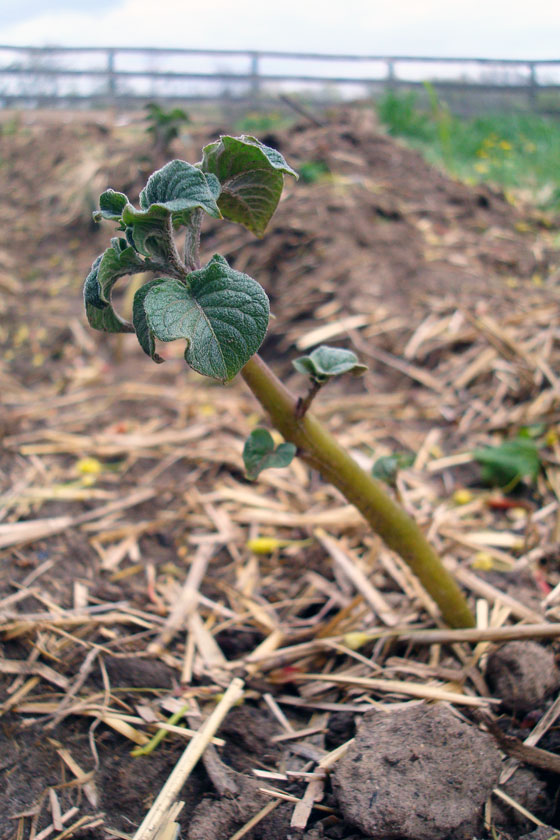
Potato shoot

I’ve also planted eight grape vines. I’m so excited about these grapes. Although I fully admit that I have no idea what I’m doing with them. I’m trying to read about pruning and planting and trellising and training. Right now, I’m focusing on watering them and keeping my fingers crossed that they take root. Please share any tips you have.

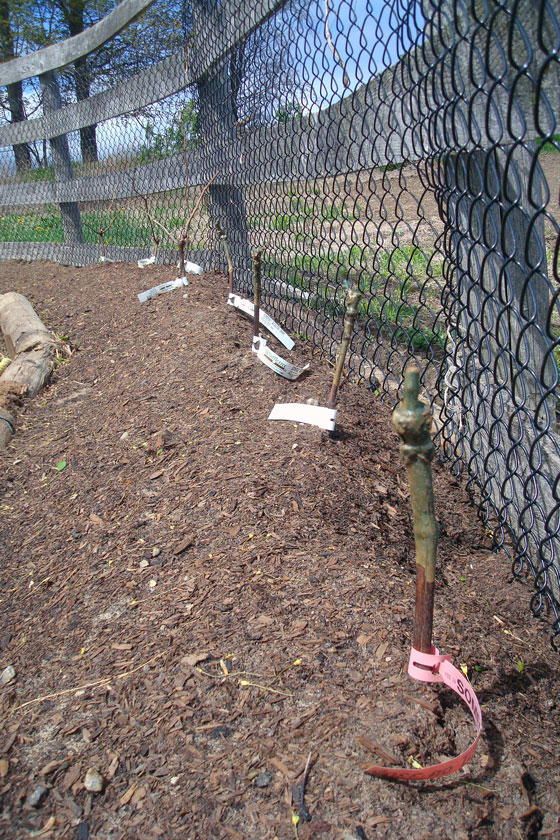
Freshly planted grape vines

In terms of smaller updates, let’s start with the literally small–the sprouts. As you saw at the top, we’ve had a lot of shriveling and dying. We’re down to just one watermelon out of seven. We lost about half the tomatoes too. I think it was a case of damping off, so I’m giving the watering can a rest.

The sprouts continued to die, but I was very surprised that some new sprouts started popping up as things dried out. We have a new watermelon–our first of the Crimson Sweet variety–and a whole bunch of new tomatoes. I know I’m going to have to separate the sprouts that are doubled (or tripled) up. I’m not sure I can bring myself to pinch out the extra sprouts, but I’m not sure I can keep everyone alive if I try to separate and transplant them. Any advice?

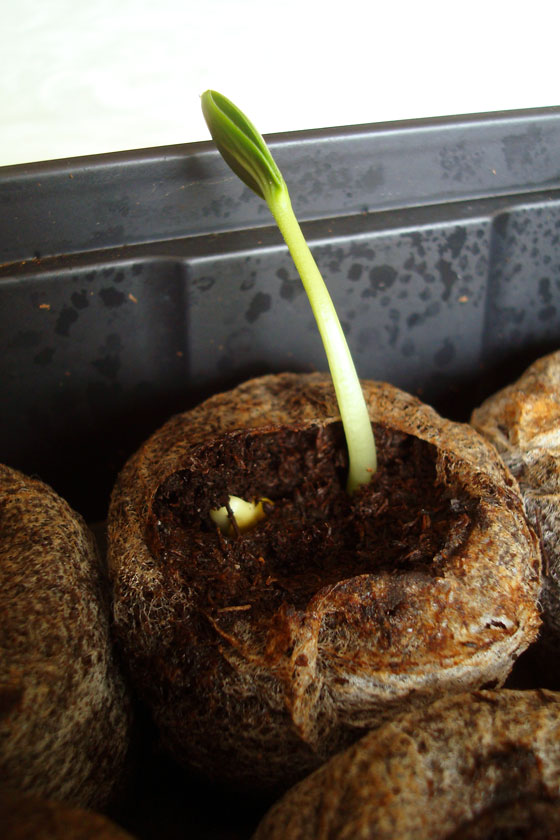
Crimson Sweet watermelon sprout

Pepper and tomato seedlings

The other win is that the raspberries–black and red–are weeded. And the raspberries themselves are spreading like weeds. I’m so pleased with how they’ve settled in.

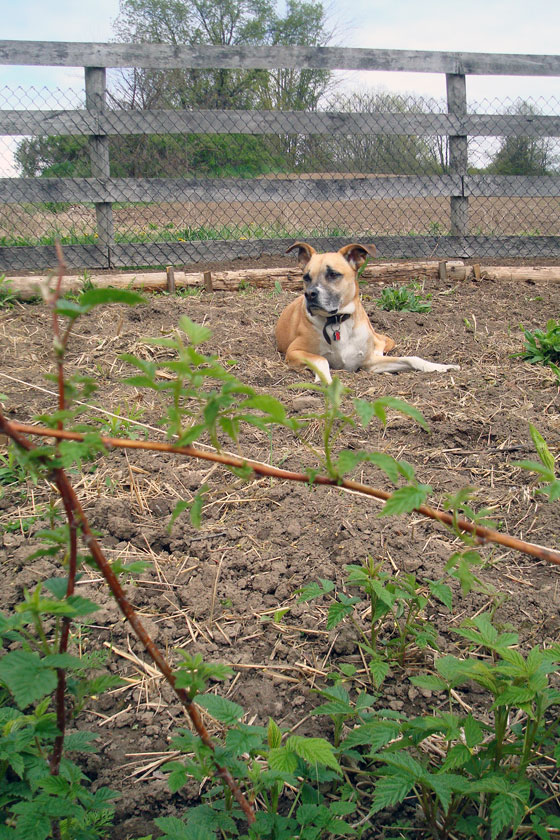
Young raspberry canes

And if we hadn’t spent our whole weekend horizontal, we would have the trellises set up to support them.

Argh.

Let’s move on, shall we? We’ll take a look at the original to-do list. Again, I can cross a little bit more off.

  • Hang the gate
  • Edge the garden
  • Build raised beds around the perimeter (more than half done)
  • Build trellises for the raspberries, tomatoes and squashes
  • Start a few seeds indoors
  • Till in the ash, straw and manure (half done)

Only one week to go in this Dueling DIY challenge. Send vitamins.

Garden Dueling DIY Week 3

Sarah in Illinois and I have entered into a friendly competition this spring to help us get our gardens in shape. We’re now at the conclusion of week 3 of this Dueling DIY, and I’m sharing my second update. You can check out all of the previous posts here.

It was just noon on Sunday. I had a long list of things that I wanted to do in the garden, but I was running out of steam. I managed a few more hours before I hobbled retreated indoors. (Sarah, take note that I said the garden claimed a temporary victory. I am not conceding anything yet in this DIY duel).

I still don’t have any dramatic before and after pictures to share yet. But I can report some progress.

The big accomplishment so far is edging the garden.

Our garden is 2,462 square feet, which means, if I’m remembering my geometry formulas correctly, its outer perimeter is roughly 175 feet. Whatever the distance, it felt like it took a very long time to go around the whole outer edge.

Here’s what the edge looked like at the start. Ugh.

Edging a weedy garden

Here’s the progress shot.

Edging the vegetable garden

And here’s the final.

Wood "curbs" to edge a vegetable garden

We used the fence posts (or in the case of the image above, the telephone pole) as “curbs.” I’m hoping they accomplish two things: 1) Keeping weeds out of the garden. 2) Keeping small critters from crawling under the chainlink and into the garden.

Matt cut the fence posts to length with his chainsaw and then we dropped them into the shallow trenches that I’d dug around the perimeter.

Remember this picture from my last update of all of the materials for the garden?

Materials for the garden update

We’re now down to a single pile of posts (and some firewood).

Fence posts

I also made a dent in the lumber part of the pile when I went on a marathon stake making session.

An electric mitre saw is perhaps not a conventional garden tool, but I wanted a lot of stakes.

Cutting garden stakes with a mitre saw

How many stakes? I couldn’t find the energy to count. More than 10 gallons worth.

Pails of garden stakes

The stakes came into play with my plan for the other half of the fence posts: the raised beds.

My plan is to build shallow raised beds just around the outside edge of the garden. These will host asparagus, grapes, rhubarb, sunflowers, and probably beets, lettuce and who knows what else.

Again, I’m using the fence posts as curbs, and I’m holding them in place with the stakes.

Shallow rustic raised vegetable garden beds

After digging my way around the outside of the garden, I have no desire to do more weeding, so I’m giving the lasagna method a try within the raised beds.

I used cardboard for my base layer. (Die weeds, die).

Using cardboard to kill weeds in the vegetable garden

Then I covered that with a layer of straw mulch that has been composting in the garden since last fall. I was surprised how much the straw has broken down already. I think it should be good food for the new beds.

Straw mulch

Four yards of topsoil arrived yesterday morning, so I will top up the beds this weekend.

The raised beds were where I lost my mojo. I had a small sledge for hammering in the stakes, but swinging the hammer over and over (and over and over) was surprisingly tiring. So I’ve made it halfway around the garden.

I know it’s halfway because I’ve marked the centre aisle with our super long rope. The picture below doesn’t look like a lot of progress, but you might be able to see the curbs at the far right waiting to be set in place.

Unfortunately, you’re also able to see all the weeds. Matt got the rototiller running with no trouble, which got us very excited, but as soon as he started to till it stalled. And stalled. And stalled. So frustrating. So the straw and weeds and ash are all still sitting on the soil.

Gardening progress

One place the weeds are gone is in the red raspberry row. Woo-hoo for small victories. (The twine is to mark the row until I get a proper trellis in place).

Raspberry row marked with stakes and twine

A bigger victory is how much the raspberries have expanded. Look at all those little plants. This is going to be good. And the black raspberries next door–while still weedy–also appear quite healthy.

Raspberry sprouts

My usual gardening sidekick is Bax. It was nice to be a trio this weekend thanks to Matt’s help with the fence posts. However, as soon as Matt was done cutting, Bax was more than ready for bro time–indoors. Apparently he’s only interested in gardening if he can work on his tan at the same time. The weather was cloudy and drizzly, and as much as dude likes to pretend he’s an outdoor dog, he’s a fairweather outdoor dog.

Thankfully, Ralph is much tougher than her brother, so she braved the weather to keep me company. And unlike the sunbather, she actually participated, inspecting the raised beds and even assisting with some weeding.

Ralph in the garden

Ralph in the garden

Eventually, though, even I gave in and retreated to the indoors. (Ralph as always stayed outside).

However, there’s still some more progress inside. Tomatoes (Sicilian Saucers) and peppers (a random mix) have sprouted, and I transplanted our tallest watermelon sprouts already.

Watermelon sprouts

We cut our seed potatoes down to isolate individual sprouts, and they’re firmly at the grody stage. We really need to get them in the ground this weekend.

Chitted potato sprouts

The weather forecast is supposed to be bright and warm this weekend, so I have high hopes again for progress and productivity. However, I’m away from the farm a bit (have to remember Mother’s Day) and… guess what… picking up my grapes. I’m excited to have my first vines. Finger crossed I can keep them alive and help them grow the way they’re supposed to.

Before I get to that, though, let’s go back to my original to-do list. I can cross at least a couple more things off.

  • Hang the gate
  • Edge the garden
  • Build raised beds around the perimeter (half done)
  • Build trellises for the raspberries, tomatoes and squashes
  • Start a few seeds indoors
  • Till in the ash, straw and manure

Three weeks to go, Sarah. We’re halfway through this Dueling DIY. Are you going to make it? The garden may have kicked my butt last weekend, but I’m going to be back and better than ever in just a few days. Watch out.

What progress have you made on your spring projects at your house? Any tips for lasagna gardening? Or building raised beds? How about growing grapes? Or keeping a rototiller running? Do you have any furry gardeners at your house?

Garden Dueling DIY Week 1

Fire in the field

In this Dueling DIY garden challenge, I am on fire. Literally.

These were my jeans at the end of Saturday.

Burned cuffs on my jeans

And this was the back of my neck at the end of the weekend. Ow-ee.

Sunburned neck

If you’re new to this Dueling DIY series, Sarah in Illinois and I are undertaking some friendly competition to help us get our gardens in shape this spring. You can check out all of the previous posts here.

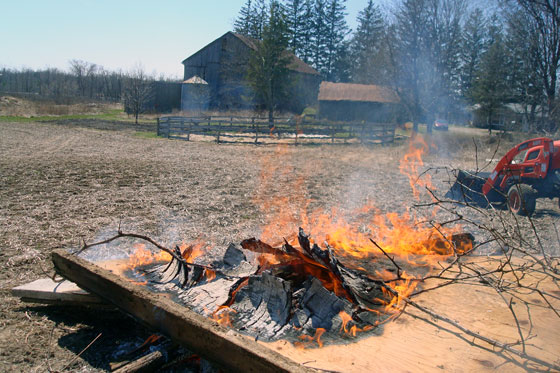
Now, if you look again at that top picture and squint through the smoke, you might notice that the fire is some ways away from the garden itself–that big round thing with the fence around it.

Fire in the field

Blame it on my pyromaniac tendencies. Blame it on the other outdoor task on my 2016 Home Goals list–general property cleanup. Blame it on the first nice weather of the year. I got a little bit distracted over the weekend.

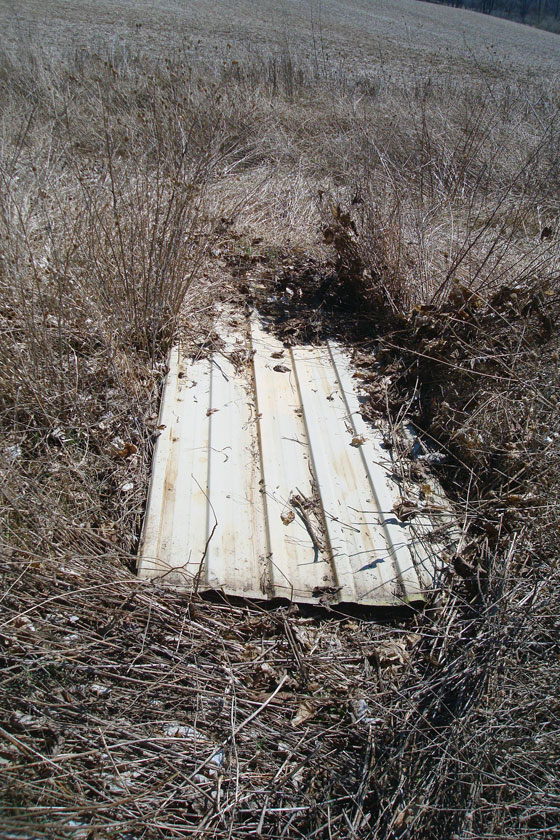
I cleared a stack of about a dozen incredibly heavy metal siding panels that had been hiding in the weeds on the south side of the garden.

Sheets of metal siding

Wiley and me moving the siding

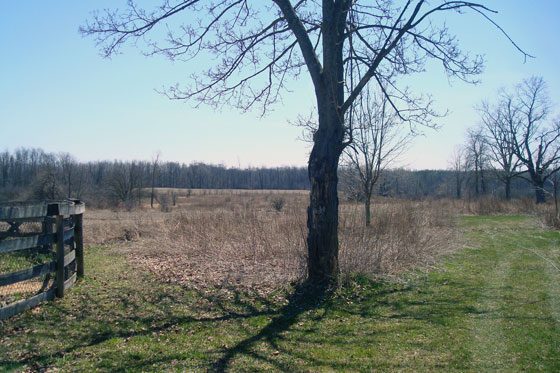
Then I cleared the weeds themselves–using my preferred method of fire.

Burning weeds in the south field

Burning weeds in the south field

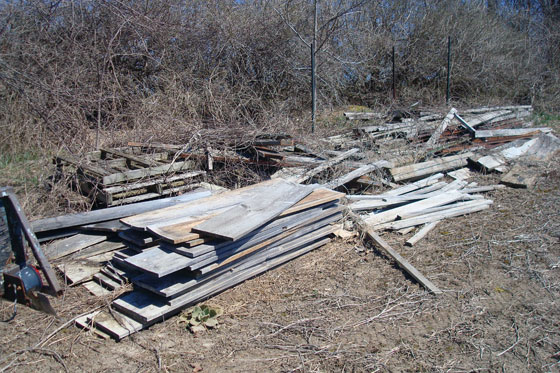
I cleared a very large pile of lumber at the edge of our centre field–and lit some of the really punky stuff on fire. (I might have a problem).

Lumber pile at the edge of the field

Field after clearing the lumber pile

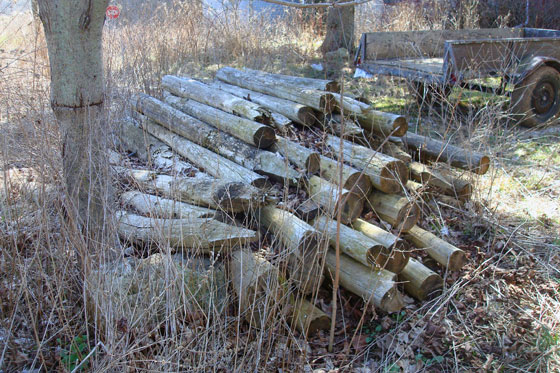
I cleared a stack of old fence posts beside the driveshed.

Pile of old wood fenceposts

I’ve moved these fence posts once before, picking them up from where they were scattered around the property and tucking them behind the driveshed. I had to remind myself a couple of times that I had moved them before, and I could move them again.

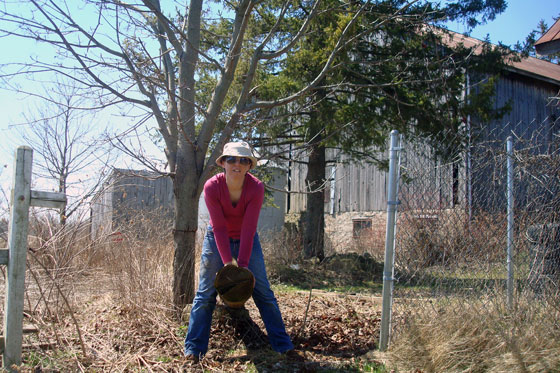
Moving the fenceposts

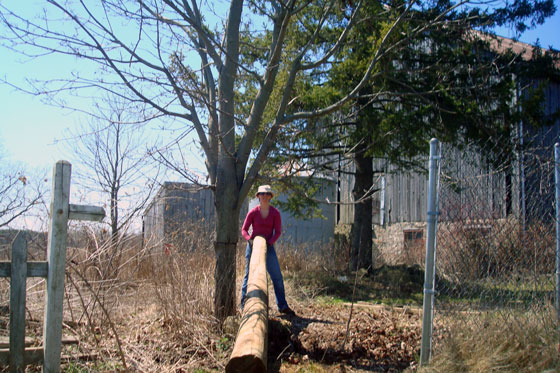
These things were heavy. The very last one was the girth and almost the length of a telephone pole–not even close to a fence post. Example 8,694 of why I don’t need a gym membership.

Moving the fenceposts

But I digress. All of these clearing tasks do actually have something to do with the vegetable garden.

The fence posts are going to become the “curbs” around the outside of the garden and the raised beds.

Some of the lumber from the field is going to be trellises for the tomatoes and stakes to hold the curbs in place.

The metal T-posts that were mixed in with the lumber pile are going to be the trellises for the raspberries.

So my big accomplishment in this Dueling DIY is that I have amassed all of my materials. A whole lot of materials.

Materials for the garden update

My other accomplishments are on the non-heavy lifting side: I ordered seed potatoes and grape vines, and we’ve started some watermelon, tomato and pepper seeds inside.

Here’s my original to-do list that I shared last week. I can cross just one thing off.

  • Hang the gate
  • Edge the garden
  • Build raised beds around the perimeter
  • Build trellises for the raspberries, tomatoes and squashes
  • Start a few seeds indoors
  • Till in the ash, straw and manure currently spread over the garden

But here’s how I’d calculate my scorecard so far:

  • I cleared the weeds from a space roughly equal to the size of the garden. Maybe this means fewer weeds to go to seed and infiltrate the garden itself.
  • I am prepped–and stocked–in the garden materials department.
  • I moved a telephone pole all by myself–in fact the equivalent of several telephone poles if you put all of those fence posts together.
  • And I lit myself on fire.

Beat that Sarah.

Thanks to everyone who shared their garden/spring to-do lists last week. Please share your progress. How is your spring project coming? Are there any pyromaniacs out there? Who else gets distracted from the primary project? What are you working on in your garden?
Painting with a smaller brush

Look what I made.

Painting of four ladies dancing

I haven’t painted in a very long time. I mean, aside from walls, ceilings, furniture.

My friends set up a girls night at a painting class.

Girls night at painting class

These paint and sips–wine is on offer along with paint–have become very popular in our area. Everyone paints the same painting as the artist talks you through the process.

This is the painting we were copying.

Painting class

The artist talked us through the background and then adding the bodies–paint a heart, add arms and very long legs.

Painting class

Add necks and heads and then dress them with swooshes of pink and blue and yellow and red. Accent it with white. And know when to stop before the colours all blend together–that was the most valuable part of the class. The instruction to put down my brush and walk away.

Painting class

I felt a bit like Degas.

Painting class

As the paintings took shape, it was neat to see how they were each slightly different, depending on the colours we chose and our own approaches.

Painting class

I deviated from the plan when it came to the very end. The ladies are dancing on grass, so the curtains in the original painting didn’t make a lot of sense to me. I added some tree branches instead.

Painting class

I can’t say that dancing ladies are my usual style when it comes to art, but I’m thrilled with how this painting turned out. In fact, I think I might give this another try on my own.

This painting high on a wall at the artist’s studio makes me think I might be able to do a rendition of my favourite furry fellow.

Shaggy dog painting

It was fun to be creative in a different way than usual.

Are you a painter? I mean, of actual paintings? Have you ever been to an art class? Or a paint and sip?

Looking for sawzall suggestions

One of the major perks of being a daughter of a contractor is the tools. Not only do I have access to all of my Dad’s tools, he also gives me tools when he upgrades.

That is the case with my hand-me-down vintage Sawzall.

Vintage Milwaukee Sawzall

Now I appreciate this saw. It’s come in very handy. But I think it’s time that I upgraded for myself.

My biggest complaint with this saw is the cord.

Cord and plug

I would love to have a cordless sawzall. But I have no experience with cordless sawzalls. Even the one that my Dad uses currently has a cord. So I’m looking for advice. Any suggestions of what to look for when I go shopping? What do you think is the best brand? Is a battery powered sawzall actually powerful enough to saw all?