How to encourage egg laying in the winter

Back in December, Sarah in Illinois shared some of the lessons she’s learned since adding laying chickens to her farm. In the post, she mentioned mentioned that their egg production had declined as winter set in. She had a few ideas to encourage more laying, and today she’s back to share what happened.

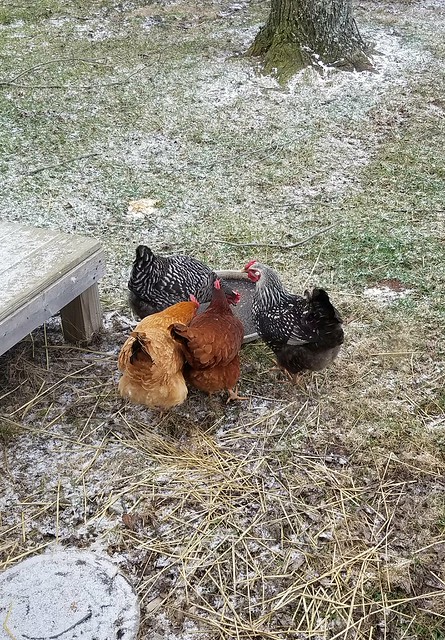
If you remember my post a couple months ago, I gave an update on the chickens and mentioned that their egg production had declined.

I thought that it was either from lack of daylight or cooler temperatures. I was willing to try to add some artificial daylight, but that I was not going to risk a barn fire by adding heat.

I am happy to report adding some light did the trick.
I went to the local home improvement store and purchased a light socket with metal shade. All you do is add a bulb and plug it in.

I took it a few steps further.

First, I chose an LED bulb. I am serious when I say that a barn fire is one of my worst fears, and I was going to take no chances in using a bulb that would get hot.

An LED did the trick. It produces almost no heat at all. I can rest my hand on the metal shield while it is on and there is no chance of me, or the chickens, getting burned.

As you can imagine with a traditional bulb there is no way I would be able to touch the shield, it would burn me instantly.
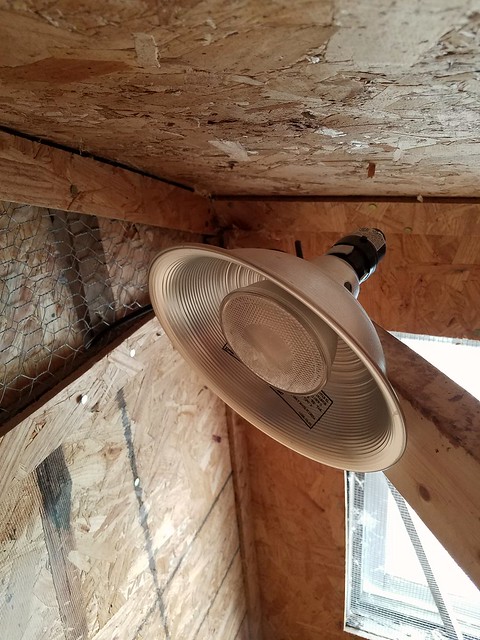
The second thing I did was to secure the fixture.

It came with a clamp to attach it where you need light. There is a good chance that it wouldn’t move, but I wanted to make sure it did not fall and rest in the straw in the bottom of the coop. So I ran a screw into the clamp after I had it where I wanted it.

No crazy chicken antics will cause the lamp to fall.

My final step was to add a timer. I have it set to come on every morning from 6 to 7 am and again from 4 to 8 pm.

After I had all of this in place I waited.

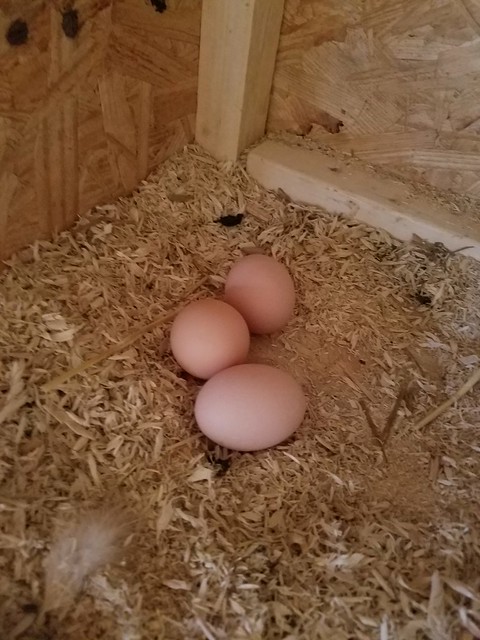
After about a week I found 2 eggs in the box.

And then a few days later I started getting 3 eggs a day.

I even had a bonus day yesterday where all 4 chickens laid an egg.

I can say that this project was a complete success, and I have no fear of burning our barn down.
I also have progress to report on my project goals that I listed in my last post.

One of my projects is to make over my Grandma’s Saint Francis statue.

I started by scraping off all loose paint. I did not intend to remove all the paint, only the paint that was loose and came off easily.
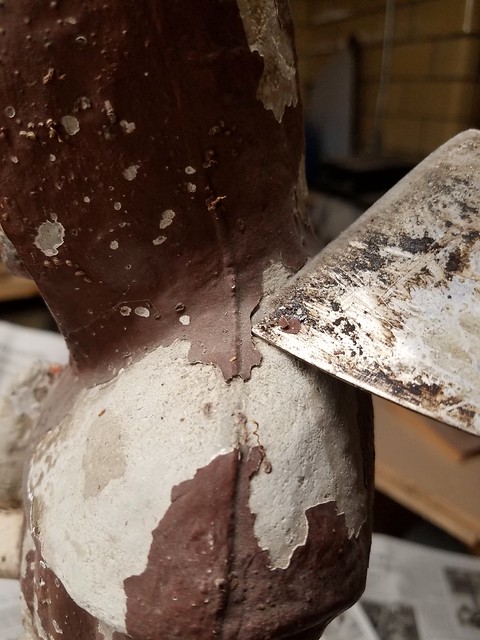
For the most part the concrete is in good shape but it has broken off of the base.
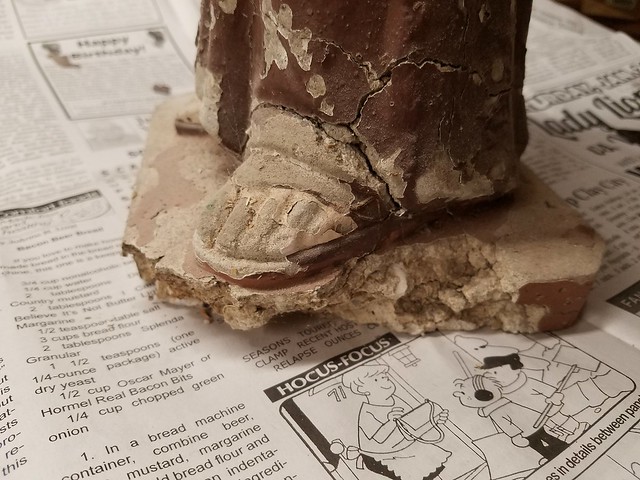
I am sure there are products meant for this type of project, but I chose to use what we had sitting around. We had a partial bag of thin-set mortar that we had used to install tile in our house. It sets up extremely hard, so I thought that once it is painted, it may work just fine.

I really don’t know about the longevity for this use, but I decided that it was worth a shot. I mixed some water and made it thick enough that I could apply it with a putty knife.
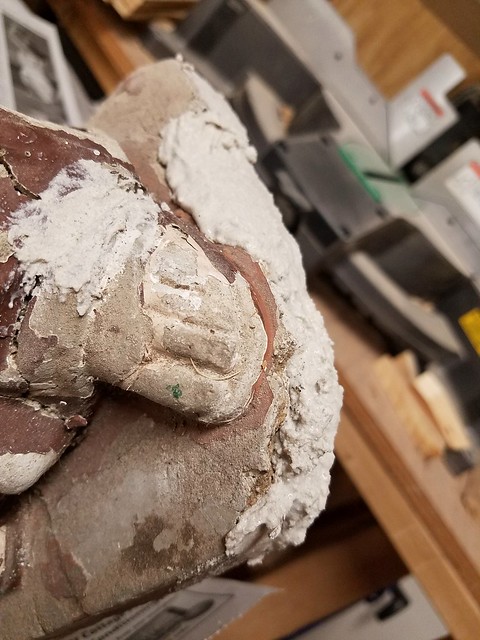
I knew that I wanted to add a couple layers instead of one thick layer so I purposely left the first layer bumpy instead of smooth so that the second layer will have something to attach to. I waited for it to dry and hoped that it would work.

24 hours after I added the thin-set to the statue, I started thinking that it is not going to work. I think the thin-set is too crumbly and will not hold up long term.

But that’s okay. I tried it, and I will try something else and report back how it goes.

Way to give things a try, Sarah. I’m glad that the chickens’ light worked so well. It’s great that you’re able to get fresh eggs again. I would miss those! Hopefully you’re able to find something that works for your Grandma’s statue too. 
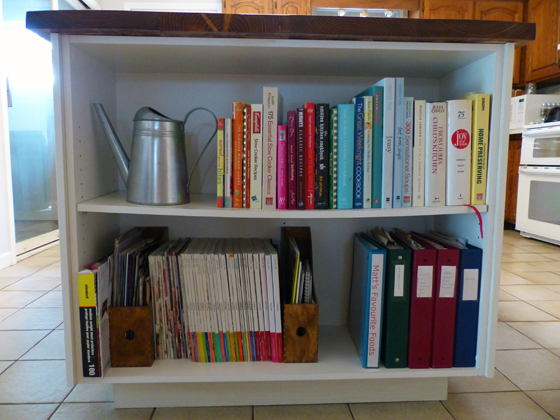
How I organize recipes

Open shelving in the kitchen for cookbooks

One of my favourite features of the island we added to the kitchen is the open shelving on the end that holds our cookbooks.

The books add a splash of colour to the wood and white of the kitchen. The shelves keep them organized and easily accessible. Plus I love cookbooks. I will sit and read them like a magazine or novel. (And, yes, you’re not imagining. The upper shelf is sagging a bit under the weight of all of our cookbooks).

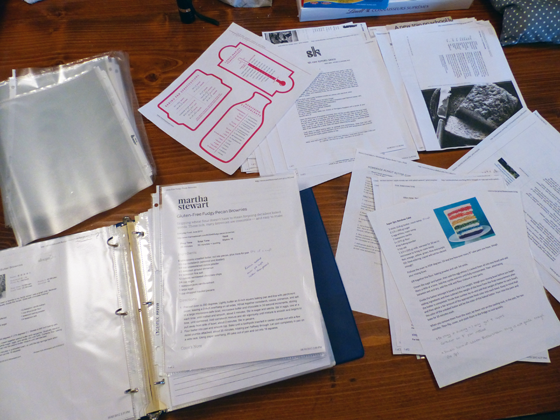
However, not all of my recipes reside in cookbooks. I have a bunch of printouts from recipes I’ve found online (I haven’t progressed to a tablet yet), clippings from the newspaper or magazines, even a few hand-written recipes from family and friends.

To keep these recipes organized, I returned to the lessons learned in school–binders, dividers and page protectors.

A couple of weeks ago, I added a bunch of new recipes to my collection, so I thought I’d share my organization method with you.

How to organize recipes

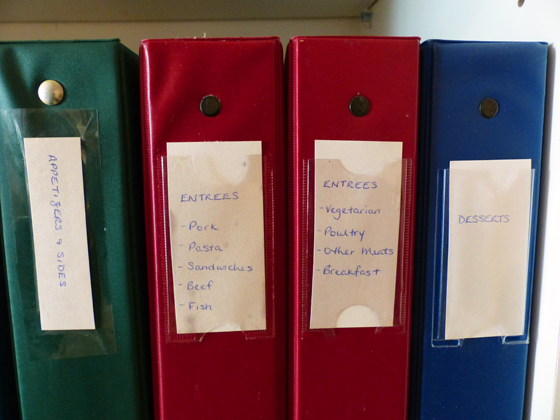
First are the binders. I have three major categories which each get their own binder: Appetizers and Sides, Entrees, Desserts and Sweets. Entrees outgrew its single binder and is now split into two books. I use different colours for each grouping.

How to organize recipes

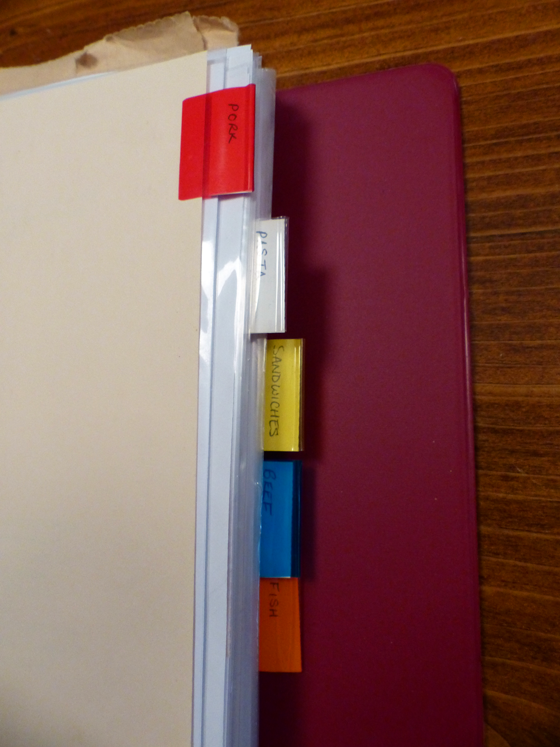
Within each binder, I’ve divided the recipes into subcategories.

In appetizers, the sections are appetizers, soups, salads, sides, snacks, breads and drinks. For entrees, I divided them into pork, pasta, sandwiches, beef, fish, vegetarian, poultry, other meats (venison, lamb), breakfast. Desserts starts with the most important, chocolate, and then goes to cookies, “buns” and bars (including muffins), cakes, pies, fruit, custards and Christmas.

How to organize recipes

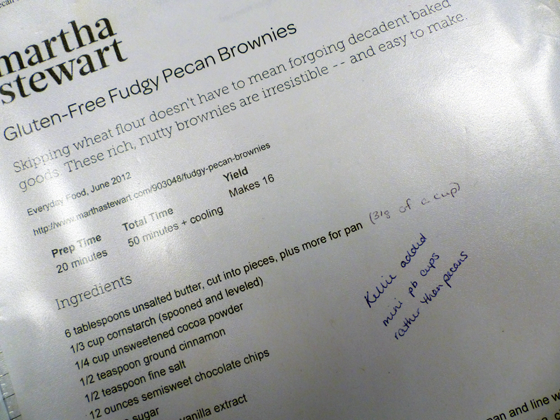
The recipes themselves are stored in plastic page protectors. I’m not the tidiest cook, so the plastic sleeves protect the paper from spills and splashes.

However, it’s easy to slide the recipe out of the plastic and add notes about what worked, what didn’t or what adjustments I made.

How to organize recipes

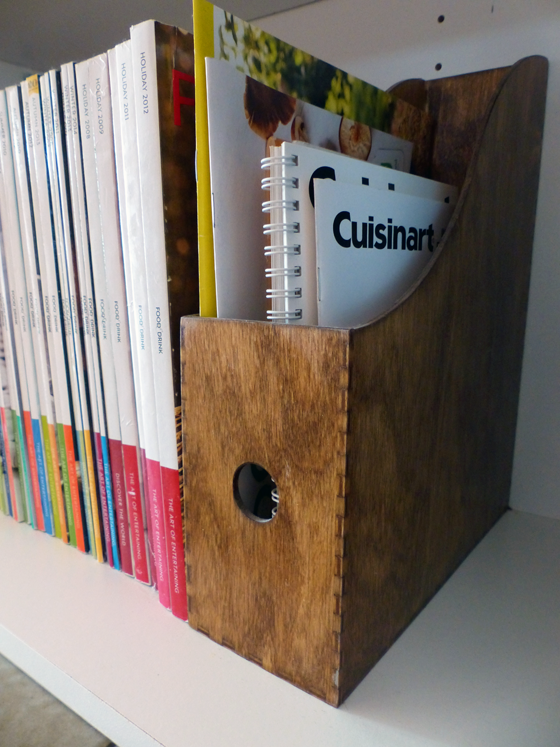
Beyond the binders, I also use magazine holders to organize the smaller pamphlets and cookbooks I’ve collected over the years. I got two wooden holders from Ikea and stained them to match the countertop and cabinets.

Wood magazine holder

I love having my recipes organized.

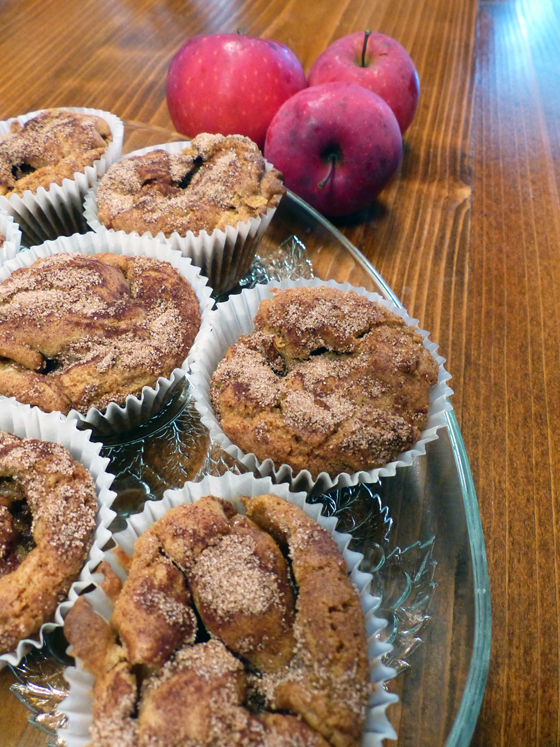
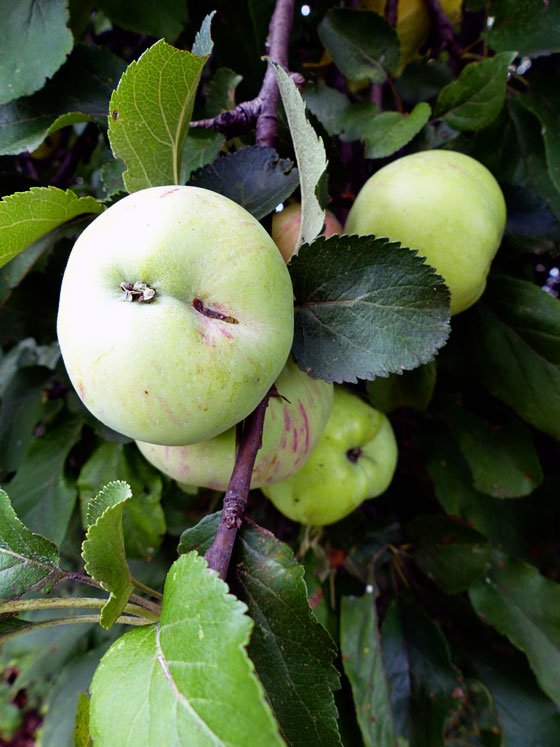
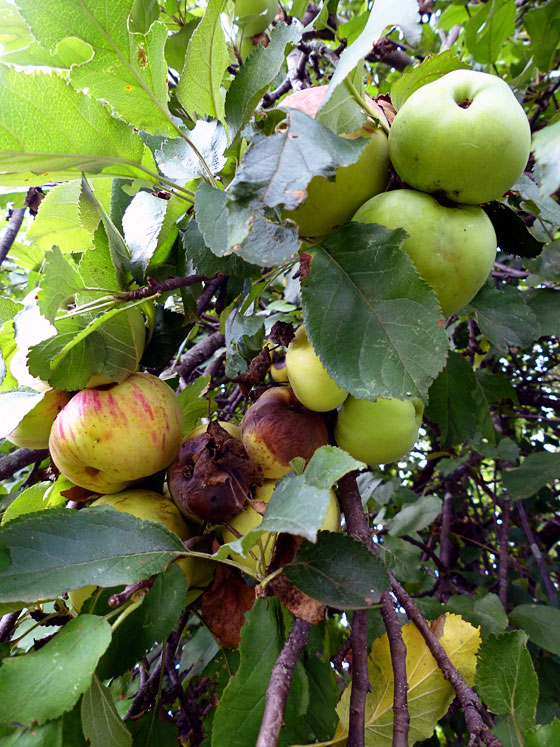
In fact, I was so inspired that I flipped through the dessert binder and whipped up one of my favourite fall recipes, spiced apple muffins, using the apples my friend gave me from her own tree.

Apple spice muffins

With my recipes all organized, I feel ready to move on from fall baking on to Christmas baking.

Are you doing any baking, either fall or Christmas? How do you organize your recipes?

When life gives you persimmons, make persimmonies

After using a pile of persimmons in her last post to try to predict what kind of winter we’re going to have, Sarah in Illinois is back today to answer the question of what she did with all of that fruit.

Persimmons are a big commodity in Illinois in the fall. A quick search on Facebook shows the going rate for persimmon pulp is $4/pint.

As I talked about in my previous post, I have used persimmons to try to predict the upcoming winter, but I had not used them to make any type of dessert. So this year I decided I should try one.

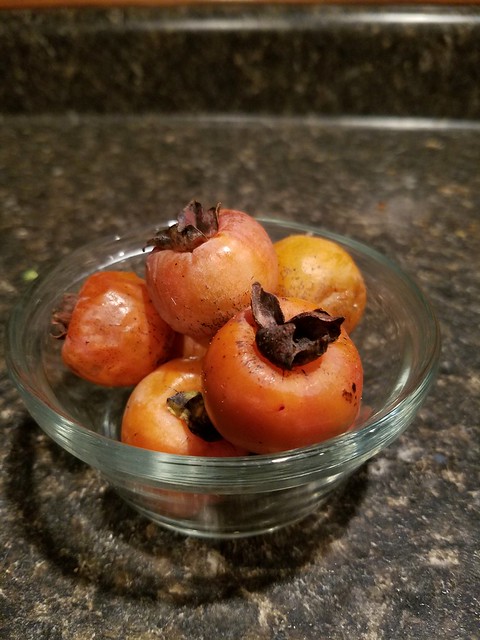
When you taste a ripe persimmon, it is really sweet and the texture is similar to an overripe peach. But there is a catch. If you taste a persimmon that is not ripe, you will know it.

An unripe persimmon will dry your mouth out in a second. I really have not tasted anything like an unripe persimmon.

So when I picked persimmons I tried to pick mostly from ones that had fallen to the ground. If they have fallen, they are most likely to be ripe.

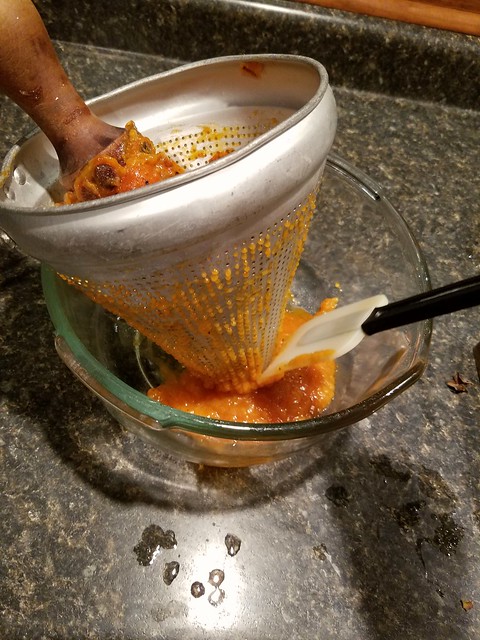
When I brought them home and removed the skin and the seeds, I put what was left in my Grandmother’s sieve/masher.

It has a wooden pestle that allowed me to push the pulp through the little holes. This step took a lot longer than I was expecting, but when I was done I had 2 cups of pulp.

Now I had to decide what to make.

When you say “persimmon” the first thing that comes to mind is “persimmon pudding.” A quick search on the internet will bring up more recipes than you can imagine. But that is not what I was looking for. Persimmon pudding is similar to a bread pudding, and I don’t care for bread pudding.

So my next search was persimmon cookies. Most cookie recipes call for walnuts and raisins. And I don’t care for either of those in my cookies. So what else could I make? Persimmon bread? Persimmon roll? Persimmon bars? Persimmon smoothie? Persimmon margarita?

I decided on Persimmonies which the author describes as a “cross between a bar cookie and a snacking cake.” It even has the suggestion of adding chocolate chips.

How can you go wrong with adding chocolate?

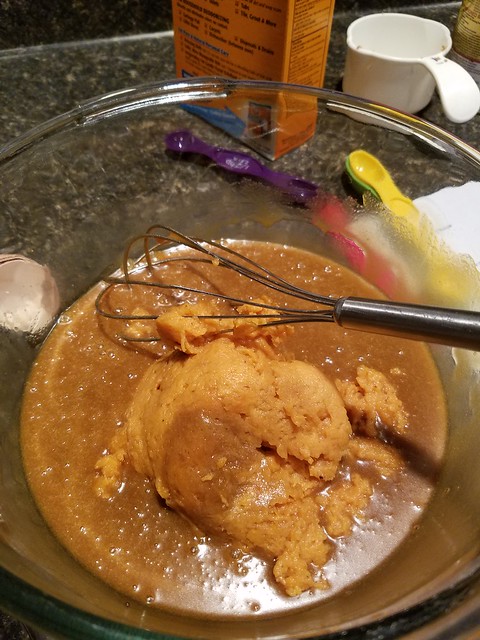
I followed the recipe exactly. I was surprised that the batter was pretty thick.

I won’t describe each step here, you can click on the website and get it straight from the author, but it was a pretty straight-forward cake like recipe.

I didn’t have chocolate chips on hand so I just used the author’s original recipe.

The results

In my opinion, it tasted like cinnamon bread, which was really, really good. I just didn’t taste much persimmon. Maybe I should have added some more pulp. And next time I will definitely add the chocolate chips, because again… chocolate.

I took the persimmonies to work and brought home an empty pan, so you could say they were a success.

Anyone made anything with persimmons? What recipe would you try? Are persimmons popular in your area?

I’ve not seen persimmons in our area, and I don’t think I’ve ever eaten one–let alone made anything with them. I’m curious now, Sarah, to give them a try. And I agree… chocolate is never a bad idea.

I have to add, a very happy Thanksgiving to Sarah and all of my other American readers.

Winter rye cover crop in the vegetable garden

Winter rye sprouts in the vegetable garden

Look at our pretty green sprouts.

Fall in Ontario is about brown. Gardening season is done. Leaves, grass, flowers are all pretty drab. But we have one new crop growing.

This is our winter rye cover crop in the vegetable garden. It’s our first time trying a cover crop.

We love our garden and how productive it is. So we’re working hard to maintain the quality of our soil. Last year, I spread straw and manure all over the garden. This year, we’re going with so-called green manure.

In the spring, we’ll cut the rye and turn it into the soil.

Have you ever grown a cover crop? Do you have any green growing at your house?

Vegetable garden highs and lows

I’m going to go a bit corporate today. Have you heard of a SOAR analysis? It’s a business planning exercise where you look at the strengths, opportunities, aspirations and results for a particular project. It’s a bit friendlier than the old-school SWOT (strengths, weaknesses, opportunities, threats).

Today’s project is the vegetable garden.

Vegetable garden in October 2016

Matt and I officially harvested everything last weekend. We have more clean-up yet to do, but I feel like I’m ready to look at what worked and what didn’t… or, more positively, what opportunities there are for next year.

Strengths

Soil – We have a great garden, and I can’t really take a lot of credit for it. Our soil is fabulous, and I’m doing everything I can to keep it healthy (see opportunities below).

Trellises – I’ve written about growing our raspberries, tomatoes and squash vertically. It totally worked. We got great yields in much less space than we would have without the trellises.

How to grow squash vertically

Watering – This was a very, very, very dry summer. I was very thankful for our well, so that we didn’t have to pay municipal water fees. We watered every other day–more than is recommended by most gardening how-tos–but I think it made the difference between losing most of our plants (which didn’t happen) and harvesting a very impressive crop (which did).

Crops – In terms of impressive, the key successes this year were peppers and beans, which last year did next to nothing. Two new crops–sunflowers and watermelon–were also great successes. The watermelon took forever to ripen, but finally made it thanks to the hot summer weather continuing well into fall.

Watermelon harvest fall 2016

Our potatoes, tomatoes and zucchini were crazy prolific as usual, and the new versions we tried–ridiculously giant Sicilian Saucer tomatoes and Russian Blue potatoes–were fun additions.

Russian blue potato

Opportunities

Raised beds – Argh the raised beds. I love having the perimeter beds in the garden, but the soil we bought for them was not good at all. Weeds didn’t even grow. The asparagus, hollyhocks and some of the herbs eventually got some traction, but it took all season. The carrots, beets and onions were nearly complete failures. Some of the herbs just shriveled up and died.

Pathetic carrots

Dead lavender plant

I’m not sure what we need to do to remedy this next year. The soil was triple mix which is supposed to include compost, peat moss and top soil. However, our triple mix is very sandy and seems to be deficient in nutrients. I’m thinking all kinds of compost and manure might revitalize it.

Black raspberries – My attempts to domesticate the wild black raspberries that grow elsewhere on the farm was also a big fat fail. These plants can only be described as brambles. They’re thorny and floppy–and when they flop over, they root themselves into the ground making a big tangled mess. I channeled Sleeping Beauty’s Prince Phillip and dug them all out last weekend. I’m looking forward to finding a new kind of berry to plant in their place next spring.

Weeds – One of the things I wanted to try this year was using a deep layer of straw as a mulch over the garden to smother the weeds. Matt and I brought an old abandoned bale of straw up to the garden, but I never got around to spreading it over the garden. We didn’t keep up with weeding by hand, so the garden was very, very weedy. The deep mulch method is still on my list for next year.

Weedy garden

Plant the whole garden – Our garden is big. Last year we planted just half, but this year we made it up to three quarters . I ended up mowing the weeds in the empty quadrant all summer. Not the best use of space. I’m hoping that we can use the whole garden next year.

Aspirations

Maintain the soil – I’m learning that gardening is about growing soil, more than growing plants. Last fall I added ash and manure to the whole garden. This year, I’m aiming for more manure and some compost–especially in the raised beds. I’m also trying a cover crop for the first time, seeding one quadrant with winter rye. Crop rotation is another consideration that I’m realizing takes lots of advance thought–as in years in advance.

Slow-growing crops – Asparagus and grapes were two additions to the garden this spring. Both are going to be long-term commitments, and I’m hoping that they make it through the winter and thrive next year.

First year grape vines

New additions – I’m looking forward to adding more herbs to the raised beds and putting more thought into how they’re clumped around the perimeter of the garden. Another consideration is maybe a cutting garden, or at least dressing up the vegetables–and filling some of the vacant spaces–with a selection of flowers.

Results

Infrastructure – There’s another corporate, distinctly non-garden word for you. But I don’t know how else to describe the base structures that form the garden–and that as of this year are all done. Last year our big accomplishment was the fence. This year, we added the curbs, raised beds, trellises, gate and waterline. I’m looking forward to not “building” the garden next year and just planting it.

#Harvest16 – Once again, the garden was super, duper productive. We had more zucchini, tomatoes and watermelon than we could use–to the benefit of our families and co-workers. We’re hoping that our squash and potatoes last well into the winter. Any storage tips?

Garden harvest fall 2016

Preserving – I feel like growing your own garden soon leads to preserving your own food, and this year Matt and I dove in to canning. We pickled about 10 pounds of beans–I was skeptical, but they’re so good I can eat a jar on my own–and made nearly 12 litres of our own ketchup–Matt is a big user of ketchup and is very particular about his preferred brand… although he has now switched allegiances to our homemade version. We’ve also loaded up the freezer with beans, roasted tomatoes, grated zucchini and plan to add peppers.

I’m not quite ready to call this year’s garden completely done, but I am ready to call it a success. In fact, we have also fulfilled every single goal I had for the garden in my original Home Goals 2016 post. That’s an achievement.

How did your garden grow this year? Any tips for storing potatoes and squash? Or favourite recipes to share? Anyone have ideas for the soil in our raised beds?

How to grow squash vertically

Last year, our squash took over the garden. Fully half of our nearly 2,500 square foot garden was completely covered in squash vines.

We loved the squash that we harvested, and we knew we were definitely growing squash again. However, we knew that we weren’t willing to give up that much of the garden this year.

My plan to corral the squash was first to plant less. No matter how much we like squash, we cannot eat nearly 40 butternuts and about 70 acorns (last year’s harvest).

Wheelbarrow full of acorn squash, butternut squash and pumpkins

The second part of the plan was to coax it up, rather than across. Up was a theme of our garden all this season. I’ve already shared how our raspberries and tomatoes are growing vertically. Now it’s time for the report on our final vertical experiment.

And this truly was an experiment. We were growing acorn and butternut squash. They weren’t small and lightweight. I wasn’t sure whether the vines would be strong enough to support the hanging fruit.

Back in the spring, I built a large A-frame. It was about 8 feet tall and 16 feet long.

A-frame squash trellis

We used 2x3s for the As with plywood at the peaks for extra stability. The top ridge is two 2x2s. Each A is screwed into stakes that are hammered into the ground. We spread wire fencing across each side and attached it to the wood with big staples. Just for extra stability, we tied each end of the trellis to the fence so that it couldn’t fall over.

How to grow squash vertically

With the A frame in place, I planted (half) our squash seeds under the trellis.

Squash seedlings

As the plants grew, I tucked the vines into the mesh. The vines were a bit fragile and bruised or even snapped easily. I learned it was important to not let the plants get away from me. I had to be diligent about training them up the trellis before they grew too big. Fortunately, the squash seemed to recover quickly from any of the damage I inflicted.

Squash growing up an A-frame trellis

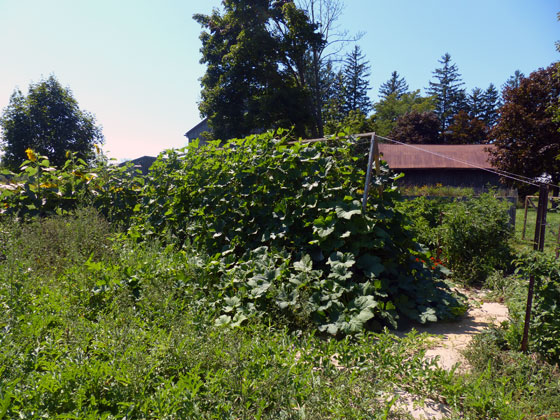
Just like last year, though, the squash took over. Thankfully, this year it took over in the right direction–up. Soon, the whole A frame was completely covered.

squashtrellis7

The plants blossomed and set fruit. And I crossed my fingers that the fruit would stay on the vines long enough to ripen.

We’re nearing the end of the season now, and I’m happy to report that things are looking really good. The leaves are starting to die off, so you can see just how good for yourself. Behold, the squash.

How to grow squash vertically

Yup. Once again, we have a whole lotta squash. And they’re big ‘uns. Oy vey.

How to grow squash vertically

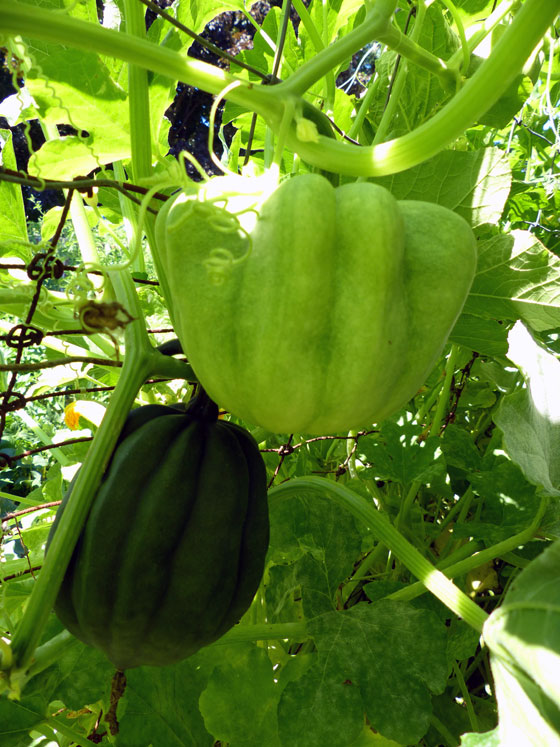
The butternuts are phenomenal. The acorns are more iffy. But I’m not sure that I can blame the trellis.

First, we don’t have quite as many acorns as I was expecting. The butternuts definitely have them beat for quantity.

Second, the acorns aren’t exactly all acorns. They come in a few different shapes. Any ideas what would make them grow so differently?

Elongated acorn squash

Mishapen acron squash

Despite some mutants, I’m calling the vertical squash growing experiment a success. It’s definitely a method we’ll be using again.

Have you done any experiments in your garden this year? Have you tried vertical gardening? What’s your favourite type of squash? Any tips for storing the squash or recipes to share?

Save

Save

Save

Save

Save

Garden Olympics in Illinois

Today’s post from Sarah in Illinois further solidified my belief that we’re completely kindred spirits. Obviously, Sarah and I both love our gardens. I realized today that we also both love the Olympics. Sarah has come up with a really clever, Olympic-esque way of summarizing her garden’s performance this year. Let the medal ceremonies begin.

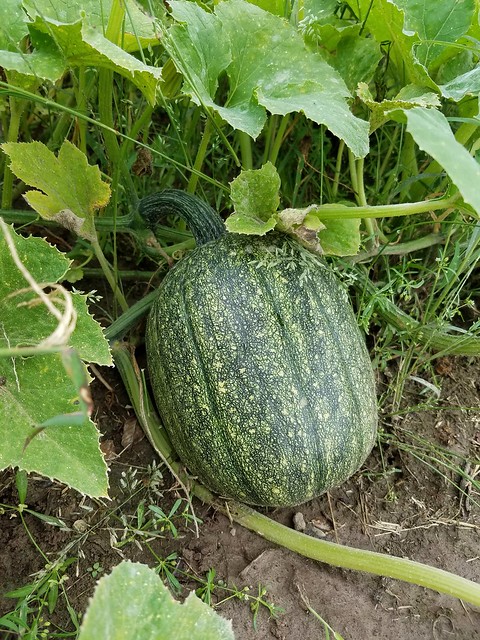
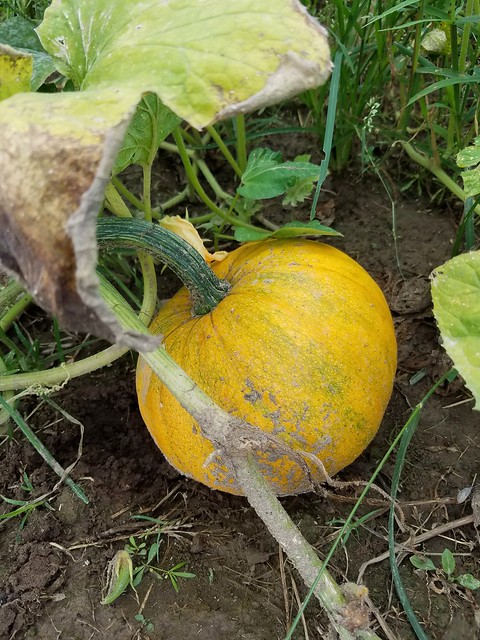
Our garden is just about done for the year. We currently only have two things still growing: peppers and pumpkins. In a future post I will go over some of the ways that I am preparing for next year, but for now I will review this year.

I started out with such high aspirations for our garden. And it’s a good idea to set your goals high, but when I look back over the year I need to be realistic with my results. I need to focus on what went well and not what didn’t. So I am going to go over the results in the spirit of the Olympics and start with my gold medal winners.

Gold medals

Sugar Snap Peas – With a mild spring and plenty of rain, I had a much bigger harvest than normal and I even still have some in my freezer.

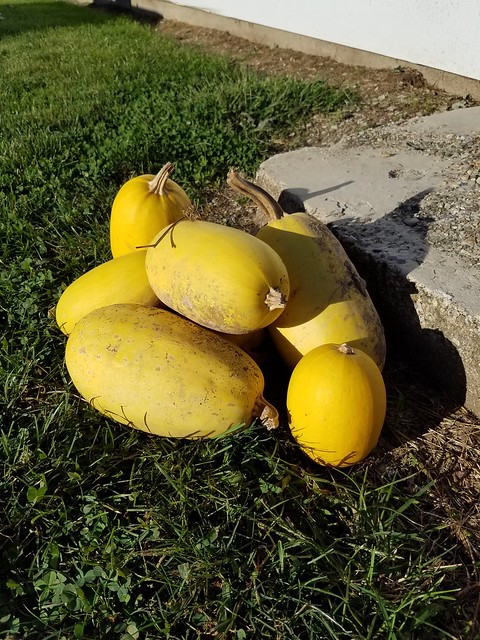
Spaghetti Squash – I gave away several, I baked a few, froze some and I still have more to use up.

Kale – I couldn’t keep up with my Kale this year. I didn’t know what to expect when starting it from seed indoors and transplanting it, but it could not have done better.

Green Beans – We had an excellent first harvest and even got a few meals from a second harvest.

Potatoes – The potatoes did very well and we still have a meal or two to dig up before we close down the garden.

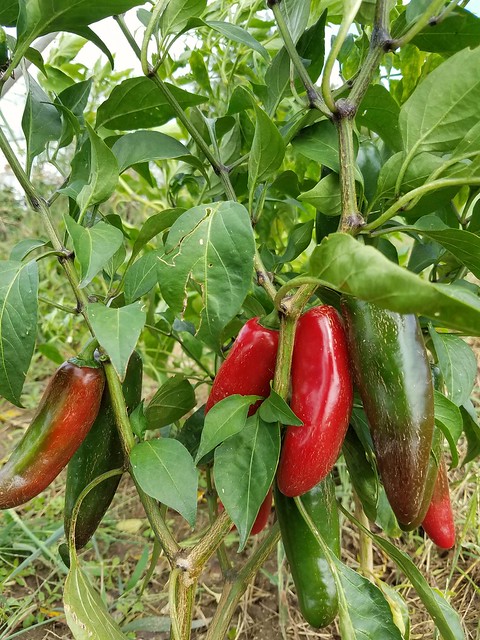
Peppers – Both our green peppers and our hot peppers really did well this year.

Silver medals

Radishes – The plants themselves did well. I just did a poor job of planning and planted too much at one time. So a lot was wasted.

Cauliflower – This was my first year for growing cauliflower. Again, the plant grew well, and I pinned the leaves closed like I was supposed to. Then I waited, and waited, and waited, and waited. Steve finally mentioned that he thought they should have been ready to pick by now. However, I had waited too long and they were all bitter. If I had been more vigilant they would have gotten a gold medal.

Tomatoes – The plants grew large and produced a lot of fruit. We made one harvest and took them to Steve’s mom to can. She made a few quarts of tomato juice from them. We had planned another harvest and then rain hit. In one weekend we got over 4 inches of rain and the garden was too soft for me to walk in. By the time the ground dried up a little and I remembered that we needed to pick tomatoes, most of them were rotten.

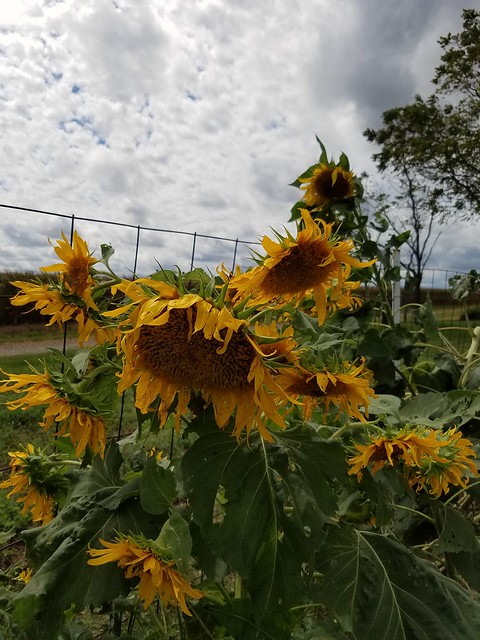
Sunflowers – The flowers are beautiful, but I did not pay attention to the amount I planted of each variety. I got several plants that are really pretty but only two are the type that you can harvest the seed from and the kids are disappointed that we will not have sunflower seeds to eat.

Bronze medals

Red Cabbage – I had planted 4 plants and they looked healthy, but I only was able to harvest one head.

Carrots – We planted the carrots too close together. The few that we harvested were good, but they did not have much room to grow very large.

Cabbage – I am thinking maybe cabbage moths or some type of pest took over the plants. All of the leaves were full of holes and we did not harvest any cabbage.

Asparagus – I didn’t know what to expect for my first year of asparagus. And I would normally think that maybe mine looked okay. Until I went to my brother’s and saw his first year of asparagus. His plants look so full and healthy and mine look so thin and spindly. I will have to add some new crowns next year.

There were a few vegetables that did not even show up to my “garden olympics” and so they did not get awarded anything:

Cucumbers – my plants this year were pitiful. Just pitiful. There is no other way to describe them. I think out of about 15 plants I harvested 2 cucumbers. TWO.

Brussels Sprouts – This was my first year of growing them and I knew that they didn’t seem to be doing anything. My thoughts were confirmed when I went out to the garden and saw Steve mowing the plants down. Apparently he had given up on them before I did.

Overall, I should be happy. We produced our own food. We grew food that was healthy and fueled our bodies with the best quality nutrients. There really is nothing I should be upset about. I should just look to improve next year.

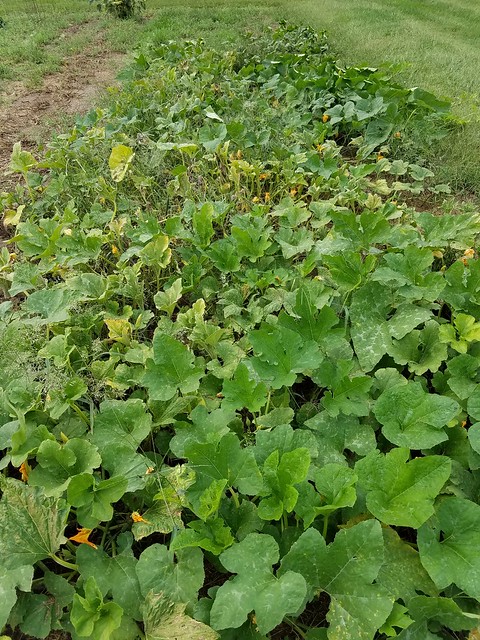
In the meantime, I will keep checking on these vines and hope that we have some pumpkins to carve this year!

Great summary, Sarah. I think as gardeners we learn very quickly that we can’t expect everything to be a success. It even varies year to year. It’s really good to keep a record like this of what worked and didn’t, and use that to set goals and plan for next year. (BTW, I love the fuzzy fluffy sunflowers! I’m adding those to my garden plan for next year.)

Save

September garden update

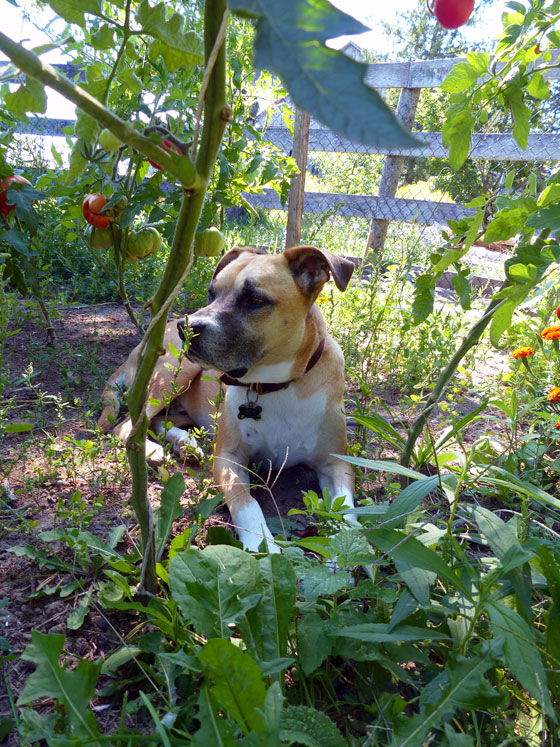
Look! We grew a puppy again!

Baxter in the garden

We grew a lot of other things too. Yet again, this garden is crazy productive.

Sicilian Saucer tomatoes

Purple peppers

Butternut squash

First year grape vines

Watermelon

Watermelon

Asparagus

Acorn squash

Red potatoes

The puppy didn’t fit in the basket.

Not pictured are the zucchinis that just won’t stop and hundreds of cherry tomatoes (I roasted a bunch last night for all kinds of goodness).

What’s growing in your garden?

Save

Save

Save

How to grow tomatoes vertically

This season in the garden, we’re all about growing vertically. I’ve shared how we’re keeping our raspberries upright. Today, I’m talking tomatoes.

How to train tomato plants to grow up a string

I love training my tomatoes to grow tall. They take up less space in the garden, and I think they’re also more productive due to increased air circulation, better sunlight and less contact with the dirt.

Since moving to the farm, I’ve used various methods to stake or cage our tomatoes, but this year for the first time we had space to build a proper trellis. This method is not new for me. I learned from how my Dad grew tomatoes in his garden.

How to train tomato plants to grow up a string

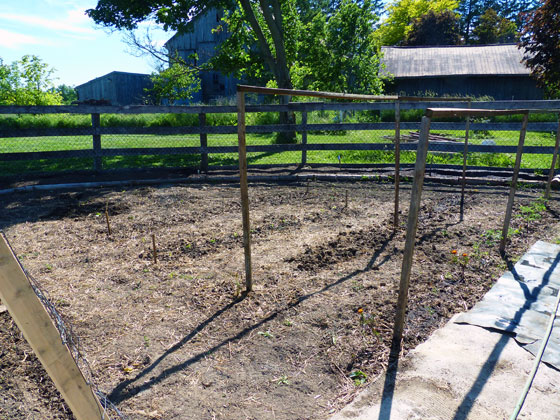
I used 2x2s to build a frame. Matt hammered three 2×2 posts into the ground leaving about 8 feet between each post. The posts were about 5 feet long, and he hammered them in about a foot, giving us a final height of roughly 4 feet. Then we screwed 8 foot pieces of 2×2 across the top of each post. This gave us rows that were 16 feet long.

Here’s a photo from back in the spring of the trellises in place.

How to build a simple tomato trellis from 2x2s

We then planted our tomato seedlings underneath the trellis. Once they grew about a foot tall, it was time to tie them up.

Using twine, I tied a very loose knot around the base of the tomato stem. It’s important that the knot is loose as your tomato plant has a lot of growing to do, and you don’t want the twine to end up too tight.

How to train tomato plants to grow up a string

I then wrapped the twine around the stem a few times, making my way up the plant. Leaving a bit of slack, I tied the other end of the twine to the 2×2 crosspiece directly above the plant.

From then on, it was about basic maintenance. Every few days, I’d walk the row and continue to wind the tomato plants around the string.

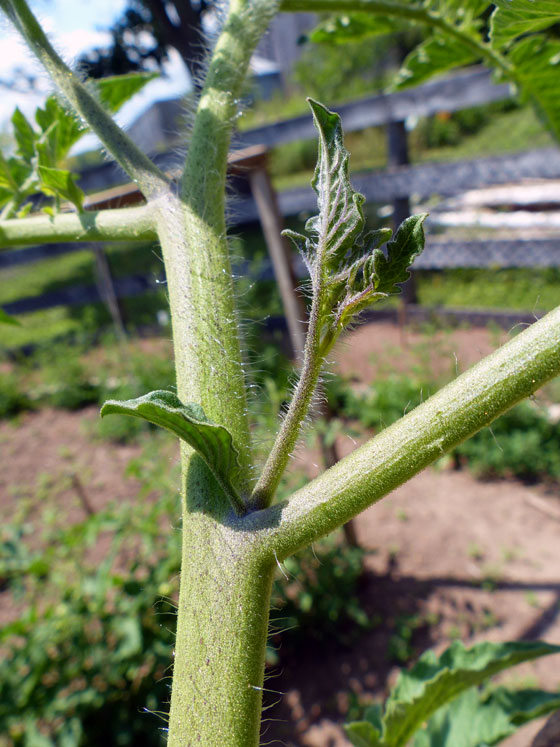
I’m also pretty vicious when it comes to suckering my plants. I remove the lower leaves plus any “suckers” that sprout in the crotch between branches and the main stem.

Tomato sucker

Suckering allows the plant to put its energy into producing fruit rather than more leaves and keeps the plants a manageable size. Suckering usually depends on whether you have determinate (bush) or indeterminate types of tomatoes. I always just assume I have indeterminate tomatoes and rip those suckers off.

However, we tried a new kind of tomato this year–Sicilian Saucers–and they did not take well to suckering. They kind of rebelled when I started pulling off their leaves, so I backed off and tried to let them do their thing a bit more.

I was still able to wind them up the strings fairly well, which is helpful because these plants and their fruit are super heavy. Our giant tomatoes would definitely be lying in the dirt if they weren’t supported by the trellis.

How to train tomato plants to grow up a string

Now that the plants and the fruit are very well established, I did go through and clipped off a lot of the lower leaves. I’m trying to get a bit more sunlight onto the Saucers to encourage them to ripen.

As the plants have grown, some of them have exceeded the height of the trellis. I’m tying them along the top 2×2 and just trying to support them so the stems don’t bend or break.

How to build a simple tomato trellis from 2x2s

So far this season, we’ve had a great tomato harvest. From the looks of our Sicilian Saucers we have much, much more goodness ahead.

Do you grow tomatoes? Are you into suckering or do you leave them alone? Have you ever tried to grow tomatoes vertically? What method do you use to trellis tomatoes?

Save

Save