Winterized

Notice the past tense on the title of this post? We are ready for winter here at the farm.

… Well, I’m not ready for cold and dark, but the house and the property are.

I had a small project list for November.

  1. Make sure all of the gutters and downspouts are winter-ready.
  2. Remove the mower deck from the tractor (and maybe attach the snowblower).
  3. Add some protection around our new trees.
  4. Turn off the outside water taps.
  5. Take off the window screens.
  6. Transition the mudroom to winter mode and get the winter clothing out of storage.
  7. Set up the bird feeder on the driveway turnaround.

I am thrilled, proud, excited, relieved (choose your adjective) to share with you today that every single one of these tasks is done.

Here is some photographic evidence to prove it.

Patchwork brown and white downspout that regularly fell apart replaced with white downspout that’s securely screwed together.

Fixing downspouts

Weeping tile rabbit/weed eater barriers around all of our littlest trees. (How to: Cut section of weeping tile approximately 12 inches long. Slit it vertically (a sharp utility knife works well, but it takes patience). Wrap the weeping tile around the bottom of your tree).

Use weeping tile to protect trees from rabbits in the winter

Bird feeder in the ground, full of food and accepting customers.

Chickadee at the bird feeder

The thing I’m most excited about is seeing the birds at the feeder. Last year, it took them until Christmas to find it. This year it took them a day. As usual, the chickadees are the bravest, but a pair of cardinals has joined them as of last weekend.

Are you all ready for winter? What have you accomplished? Or what’s still outstanding on your to-do list?

Tips for making renovations manageable

Let’s be honest. Renovations can be a nightmare. DIY renovations can be especially challenging. In watching my Dad do construction for his whole career, working with him for several years and talking to friends and co-workers, I’ve seen some of the same issues:

  1. The vision in my head is too big. I don’t know where to start.
  2. The vision in my head is big and beautiful, and I’m going to do it all right now.
  3. I’ve started, but the vision in my head has gotten bigger, and now I’m never going to finish.

I’m going to share some of my perspective on each of these three scenarios. I’d love if you would weigh in too with your tips… or your renovation challenges. Between all of us, I think we can come up with some useful tips to help each other make renovations more manageable.

Problem #1: The vision in my head is too big. I don’t know where to start.

Yup. Renovations are daunting. But like anything you do, there is a first step and a second step. Sure in a renovation you might get to 1,000 steps… or even more. But sometimes you have to just take the first step.

My original vision for the laundry room was a standalone room on the main floor. Full of natural light, it would be a dedicated space for sewing, crafting and laundry. I’d have a big island, tonnes of storage, multiple sewing machines, an impressive fabric and yarn stash and so on and so on. It would be beautiful.

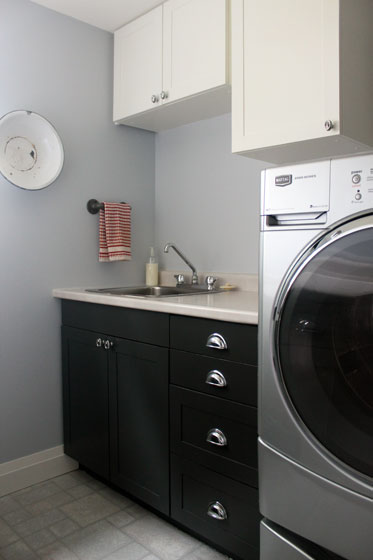
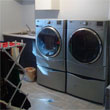
I’m pretty sure that this laundry room is never going to happen, but even if it does, there’s nothing to stop me from having a pretty laundry room now. I started with updating the cabinets, moved on to paint, did some decorating and now I have a pretty, functional space in the basement, thanks to a simple makeover.

Problem #2: The vision in my head is big and beautiful, and I’m going to do it all right now.

I’m a big believer in taking your time when renovating. You have to really figure out what exactly you need and what makes the most sense for your family. You also have to build up your energy and your finances.

Renovations take a lot of time and a lot of money. Gutting a whole house and renovating every room and landscaping your entire property all at once is a lot to take on.

Renovating in stages takes longer, but it might make it more manageable, both for your budget and your sanity. Paint the walls, but don’t replace the floor yet. Update the hardware, but don’t feel like you have to renovate the whole kitchen.

Using the laundry room as my example again, there are a few things I would have liked to have done. To borrow a phrase from one of my former bosses, here are my “even better ifs.”

I think some wood butcher block counters would look great in that room. A new floor would definitely spruce things up. I’d love to add some more racks for laying sweaters flat to dry. It would have been nice to put the plumbing for the washing machine and the venting for the dryer inside the wall rather than on the surface and patch the old observation portal for the oil line to the furnace.

Laundry room venting running over the wall

But if I did all of that as part of my makeover, I’d still be renovating. Counters and floors and drying racks can be individual projects that I do someday in the future.

Problem #3: I’ve started, but the vision in my head has gotten bigger, and now I’m never going to finish.

Scope creep happens in most renovations. As I wrote way back when as we were just beginning the basement reno:

Scope creep happens when you say to each other, “Since we’re doing A and B, we might as well do C, D, E, F and G.”

Sometimes scope creep is necessary. If you uncover an electrical problem, you’re going to have to fix it. However, sometimes we just get carried away.

Towards the end of the laundry room makeover, I started thinking about replacing the faucet, sewing curtains and building a picture frame. These may sound like small add-ons, but they definitely would have extended the project. And just like the countertop that I mentioned above, none of these things were necessary. Pretty, but not necessary.

I was working towards a deadline for the One Room Challenge. I wanted time to take pretty photographs and write my blog post. Scrambling up to the last second with add-ons would have added extra stress that I just didn’t need.

Even if you don’t have a blogging deadline to meet, there are life deadlines, and sometimes you just have to stop. There’s always Laundry Room Version 2 (and 3 and 4 if necessary).

My tips:

So looking back over what I’ve written, I feel like these 7 tips sum up some of my approach to renovating:

  1. Start. Just start.
  2. Take your time and figure out exactly what you need.
  3. Don’t do everything at once.
  4. Have a plan.
  5. Break it down into steps and stages.
  6. Stick to the plan.
  7. Know when to stop.

I can’t promise if you follow these tips you’ll have a problem-free reno (does that even exist?), but they might help to make things go a bit more smoothly.

Now it’s your turn. What are your tips for keeping a renovation manageable? Have you ever encountered any of the problems I described? How did you work through them?

Family photo display

One of the biggest hits at our month-before-Christmas party over the weekend (aside from the food) was a family photo display that I added to the living room. Everyone who came to the party spent time looking at the pictures.

Family photo display

It was neat to see my young nephews, who never met their great grandparents, getting to know them a little bit more through their pictures. I liked talking with Matt’s uncle about my family and introducing him to some of my relatives.

The photos sit on the sideboard behind the couch. Some frames face the living room and some face the dining room. The frames mostly came from Value Village. In the store, the smaller frames (for photos 4 inches by 6 inches or less) are bundled together and sold for just a couple of dollars. Which is great, because I think the smaller frames work best for a display like this since I can squeeze in more photos. (And I already have plans to add a few more frames).

Family photo display

To fill the frames, I chose a mix of pictures from Matt’s and my families. My Mom and I spent a fun afternoon a few weeks ago going through all of our old albums so that I could pick out some of my favourites.

Family photo display

I love having our family members with us. It was great to see everyone at the party on the weekend, and it’s nice to have the reminder of them in the pictures throughout the year.

How do you display family photos?

Odds and sods

Some happenings from this week:

  • Matt and I got the mower deck off the tractor. Taking it off is easier than putting it on, but either way the mower deck is a beast. This John Deere commercial blew me away the first time I saw it. Who would have guessed that I’d find tractor attachments so exciting? (And, yes, Wiley’s safe. We’re not trading in our Kioti any time soon).
  • We’re holding off on putting the snow blower on the tractor, although we’ve had a surprising amount of snow over the past week–although not Buffalo quantities. It’s only November for goodness sake!
  • A friend gave me a chandelier that she didn’t want in her house. It’s a gaudy shiny brass crystal monstrosity that I think will be wonderful in my office.
  • Matt and I are hosting our annual month-before Christmas party this weekend, including a full turkey dinner. Of course one of the oven elements is on the fritz. Matt sourced a new one and installed it, but it’s still not working. Argh.
  • I have the vision for our master bedroom worked out in my mind. That is, except for the paint colour. This bedroom has me thinking about navy.
  • The safe house bedroom that Kelly at View Along the Way made is one of the most thoughtful spaces I’ve seen.

What’s been the highlight of your week? Any special plans for the weekend?

My spin on a clothespin light

A lot of people had compliments for the clothespin light fixture in the laundry room.

Clothespin light in the laundry room

I can’t take credit for the idea or even the execution. I was inspired by this light from Young House Love.

I followed their tutorial pretty closely, and it was super easy. However, I did one thing differently and learned a couple of lessons along the way. I thought it might be helpful to share.

First the lessons.

I chose to do the same zigzag pattern that John and Sherry did. In their tutorial, they mention alternating squares. However, what they didn’t say is that they also skipped a row of wire between each row of pins. If you look closely at the pictures in the YHL post, you’ll be able to see the pattern. Skipping every other row gives a comfortable amount of space between the pins so that they lay at a nice angle all the way down the shade. And this makes the great pattern on the ceiling when it’s lit up.

Clothespin light fixture

And talking about laying at an angle, in the YHL post, Sherry emphasized that it’s important to have an even number of squares around the top to maintain the pattern all the way around the shade. However, she didn’t talk about how many squares there should be from top to bottom. I nearly trimmed the bottom row of mesh off my shade because I had an empty row of squares. However, if I’d done that, my bottom row of clothespins would have hung straight down while all the other ones sat at an angle. Having an extra row of wire at the bottom holds the pins on the angle. So, while you want an even number around the shade, you want an odd number from top to bottom.

Clothespin light fixture

And now for what I did differently.

My light is closer to a flush mount than the YHL pendant. I used an old single socket lamp holder that I had lying around as the actual light. You can’t get more basic than that. Or cheaper. (Or, let’s be honest, uglier).

Keyhole light fixture

It took me a little while to figure out how to attach the shade to the light. I didn’t love the cup hooks on the YHL fixture. My solution was to run two pieces of wire loosely across the top of the shade. I then looped each wire around the screws in the lamp holder. It’s pretty much invisible, unless you’re standing directly underneath the fixture looking up.

Clothespin light fixture

The YHL light used 320 pins. Mine has 288. The final dimensions are 64 squares around and 17 from top to bottom. The overall dimensions of the drum shade are 11 inches high by 14 inches in diameter.

I love that I have a light fixture made out of clothespins in the laundry room. Even better, I love how it looks. Thanks John and Sherry for the inspiration.

Have you ever made anything out of clothespins? Have you made your own light fixture?

Linking up to #DIYLightingChallenge

8 tips for building furniture out of pipe

Pipe furniture is really popular these days. In the laundry room, you saw how I used pipe fittings to build the hanging rack and towel bar. Along the way, I learned a few lessons that I’m going to pass on to you.

8 tips for building furniture out of pipe

1. Pipe fittings are really easy to work with. The pieces go together very quickly. Assembling the towel bar probably took all of 10 minutes. I loved lego as a kid (who am I kidding, I still do), and this was like revisiting my childhood.

Towel rack made out of pipe fittings

2. Pipe fittings are oily. The fittings come in black or galvanized options. I chose the black because it looks more rustic to me. However, the black coating rubs off really easily.

Oil and rust rubbed off of pipe fittings

Before I could do anything with the fittings, I had to clean them. Some people online recommended degreaser, which I’m sure would have worked. I didn’t have any so I tried 2 other options: wiping them down with vinegar (didn’t really work) and washing them with dish detergent. The washing worked. I dried the pipes with a rag and let them sit for 24 hours to make sure the threads and interior of the pipes were completely dry before I did anything with them.

Washing the oil off of pipe fittings

3. Pipe fittings come in different diameters. Pay attention to what diameter you choose, because different size pieces won’t screw together without special fittings. I chose the 1/2 inch size because it was a bit cheaper than 3/4.

4. Pipe fittings come in different lengths and connectors. You should be able to find the pieces you need for pretty much any project…

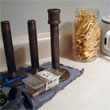
Black pipe fittings

5. … But if you can’t, the store staff can cut the pipe too. The cutting was one of the dirtiest operations I’ve ever seen. I felt bad for making the staff person get so oily from running the cutting machine. The result though was the perfect lengths of pipe. The machine will also put threads onto your pipe.

6. Pipe fittings don’t screw together fully. You’ll see the threads at each joint.

Screwing together pipe fittings

7. Drywall screws are good partners with pipe fittings. The pipe flanges attach to the walls with four screws. Since I chose black pipe, it made sense to use black screws. The coarse threads on the drywall screws dig into the wall and hold the pipe securely.

8. Attach the flanges to the wall first. Once your towel bar or hanging rack or whatever else you’re building is fully assembled, it can be hard to reach the screw holes in the flanges to attach your creation to the wall. However, attaching the flanges on their own is a piece of cake.

Tips for building furniture out of pipe

I elected not to paint my pipe fittings, although I’ve seen other projects online where people did. The finish isn’t pure black, but it’s a nice industrial dark grey–no sparkle here.

Just in case you’re interested in building your own towel bar or hanging rack, here are the pieces I used. I have to give credit for the hanging rack design to Angie over at Knick of Time. I’m not sure what pieces she used, but I think mine turned out pretty close. I spent a lot of time in the pipe fitting aisle at Home Depot. While my measurements may not be exactly the same as what you need, some of them might work for you and save you at least a bit of time.

Towel bar made out of pipeTowel bar

Dimensions: 10 3/4 inches long (from the outer edge of each flange) and projects 3 inches off the wall

  • 2 flanges
  • 2 elbows
  • 2 1 1/2-inch pieces
  • 1 6-inch piece

Hanging rack

Dimensions: 50 inches long, hangs down 10 1/2 inches from the ceiling and projects 17 inches off the wall
Hanging rack made out of pipe

  • 4 flanges
  • 2 elbows
  • 2 Ts
  • 2 3 1/2-inch pieces
  • 2 4-inch pieces
  • 2 15-inch pieces
  • 1 48-inch piece

And just in case laundry isn’t your thing, here are some of my other favourite pipe projects.

If you’ve spent any time on Pinterest, you’ve probably seen furniture, lights, shelves and numerous other things made out of pipe fittings. They add a great industrial style for a pretty reasonable price.

Have you ever made anything out of pipe? Do you have any tips to share? Anyone want to make anything out of pipe? Do you like the rustic industrial look?

Laundry room makeover

You saw the before and after of the laundry room last week. What you didn’t see was the cabinet hardware. Well, it finally came in. Between the sparkle of my new pulls and having an SLR camera for the weekend, I decided to reshoot the laundry room photos. You don’t mind do you?

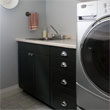
Black and white shaker cabinets with chrome hardware in the laundry room

Clothespin light in the laundry room

Vintage washboard and red toy iron in the laundry room

Hanging ironing board in the laundry room

Black shaker cabinets with chrome cup pulls and knobs

Enamel basins and infant sleepers hanging in the laundry room

Matt's infant sleepers

Vintage wood hanngers on a hanging rack

Laundry room decorations

Towel rack made out of pipe fittings

Laundry room decorations

Laundry room

Thanks for your patience with my laundry room infatuation.

Remembrance

Remembrance Day is tomorrow. You might recall that this a very meaningful day for me.

In addition to marking the end of World War I and an occasion to remember the service and sacrifice of veterans as well as current soldiers, it is also my Grandpa’s birthday.

My grandfather in his World War 2 uniform

My grandfather at Avellino Dec. 29, 1944.

In Canada, many people observe Remembrance Day by wearing poppies for the weeks leading up to Nov. 11. The Royal Canadian Legion distributes the poppies. Poppies are never sold or purchased. People donate to the poppy campaign, and donations help ex-servicemen and women and their families.

A few years ago, I came across a free knitting pattern to make my own poppy from Canadian knitting designer Laura Chau. Laura wrote a great blog post earlier this month that includes a link to her pattern.

Knitting poppy for Remembrance Day

The poppies are easy to knit. To stitch one up is a small effort in light of what the poppy symbolizes.

Remembrance Day previously:

The end of soybean season

The sun has set on our first soybean crop.

Sunset over the soybean field

As of two weeks ago, our fields are empty, so it’s time for the final report of the year.

At last report, the soybeans were just turning gold. By harvest time, there was no trace of green or gold left, except in the trees along the border.
Dry soybean field

Dry soybeans

The plants dropped all their leaves and the beans dried.

Dried soybean plants

They no longer looked like edamame and they tasted a bit like peanuts.

Dried soybeans

And they sounded like rattles. I’m not sure if their sniffiness changed, but Baxter apparently liked the sound of them or the feel of them against his face… or something. Every field walk he insisted on walking through the plants.

I found the harvest part very interesting, so brace yourself for lots of photos.

The main piece of equipment is the combine.

Combine harvesting soybeans

This thing is massive.

Combine harvesting soybeans

I would not want to be a soybean.

From the combine the beans go into a trailer.

Trailer full of soybeans

Shucked soybeans

Again the scale is massive. The tires on this trailer are over 5 feet in diameter.

Tractor towing a trailer full of soybeans

The trailer full of beans is relayed to a big truck for transport. (For scale, there’s a person standing on top of the truck behind the chute).

Soybean harvest

All that’s left are the dry stalks, husks and a few stray pods.

Harvested soybean field

As of last weekend, the stalks got a light dusting of snow. Yes, already.

First snow 2014

And so concludes our first season of soybeans.

Who else has had snow already? Is the harvest done where you live? Does anyone else find the harvest process fascinating? Are you as easily impressed as I am by farming equipment?