Simple belt storage solution

When we switched bedrooms, we switched closets too. I knew one thing I wanted to improve in the new closet was my belt storage. They’ve been tangled and tossed onto a shelf since we moved in.

belts2

When I still lived with my parents, I came up with a solution that worked very well for belts: cup hooks.

belts23

In the past, I’ve screwed the cup hooks directly into the drywall or plaster of the wall. However, this time I decided to go for something more portable so that I can move it if I ever relocate closets again. Screwing the cup hooks into a length of wood worked. Then I simply screwed the wood into the wall of the closet.

Simple belt storage solution

Super simple DIY. Super simple storage. My happiness is not commensurate with the simplicity of this project.

How do you organize your belts? Who else is a fan of cup hooks? Does organization make you happy?

Irises

This is going to be our third summer on the farm. Our flower gardens are finally looking like gardens, not just random plants stuck in a big expanse of dirt.

Gardening takes work and it takes patience, but oh it pays off. It totally pays off.

The ferns that I transplanted last year have all sprouted, we’re going to have a ton of peonies, and our irises are amazing.

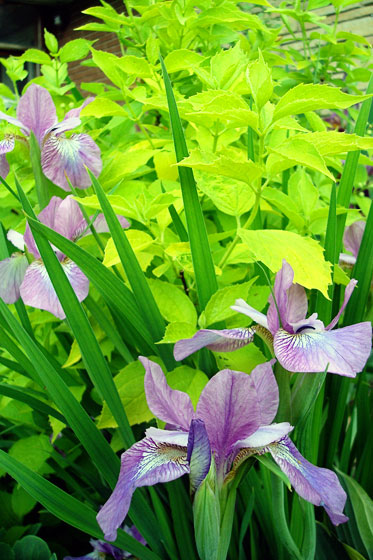
When I was growing up, my parents had some beautiful irises in their gardens: blue, peach and dark purple. When I was setting up the gardens here at the farm my parents were taking out the last of their irises–the purple ones–and they gave me a bunch of plants. The stalks have taken root and they’re blooming prolifically. I love the frilly showy blossoms.

Dark purple iris

Iris from above

Out on the turnaround, one particular plant has given us two-tone blossoms. Light purple on a couple of stalks and dark purple on the rest.

Light purple and dark purple irises

Close up of a purple iris

I especially like the purple veins of the buds.

Iris buds

You might recall that the farm came with a whole bunch of plants still in their nursery pots. Last year, I finally stuck them in the ground. This spring, I’ve discovered that some of them were miniature irises.

They must be happy to be out of their pots because they’re blooming like crazy.

Miniature irises

I’ve been feeling like the gardens are finally established this year. Plants are filling out and blooming. I’m focused more on maintenance rather than actually building the gardens. It’s nice to see the fruits–or the blooms–of my labour.

How is your garden growing? Do you have any irises at your house? What colour are they? Who else is an iris fan? What’s blooming at your place?

It never rains but it pours

For the past few years, it seems we’ve gone from winter to summer. Just skipped over spring completely. This year, we’ve seesawed back into winter a couple of times (brrr). But we’ve definitely missed spring–and its spring showers.

The grass seed that I sprinkled has sprouted–thanks to diligent daily waterings.

Grass seed sprouts

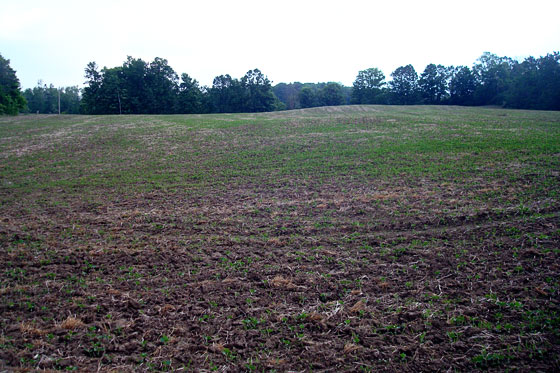
Our fields are going green and our soybeans are growing, but my hose doesn’t help them, and I wasn’t sure how long they’d hang on without rain.

Soybean field

Soybean sprouts

Saturday morning, we watched clouds building to the north of us, wondering if rain was finally going to fall. (If you look closely, you might be able to see the bright green watering can halfway down the driveway, next to a newly planted tree).

Rain clouds at the end of a country driveway

A few hours later, we had our answer. Yes, it was finally raining, but it was pouring. More water than the dry, dry ground could possibly absorb.

It doesn’t seem like we just have rain anymore. It’s either a deluge or nothing. Maybe the gentle rain is hanging out wherever spring has gone.

Pouring rain over a country driveway

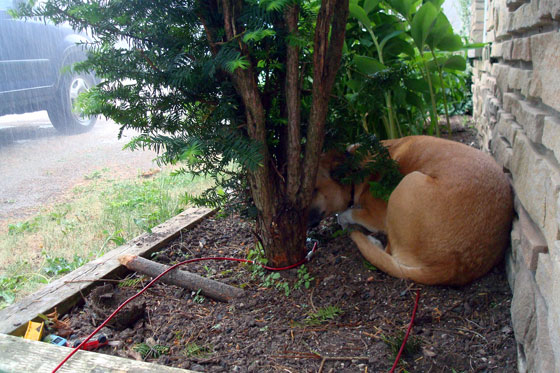
Poor Baxter did not appreciate the cooling moisture as much as the plants did. Apparently, melting from the heat is preferable to melting from rain.

Baxter hiding from the rain

The torrential downpour did eventually ease. By the end of the weekend, we had a full day and a half of rain.

So I won’t have to do any watering for a little while.

What season is it where you are? What season should it be? Have you had too much, too little or just enough rain? Are seeds sprouting where you are? Does your dog like the rain?

How to apply preglued veneer on curved edges

More than two years ago, I wrote a tutorial on how to apply preglued veneer edging. Veneer edging covers up the raw edges of plywood and makes your piece of furniture or whatever it is you’ve made look like one solid piece of wood.

When I made the headboard for the master bedroom, I had a scenario that I’ve never dealt with before: applying the veneer to a curved edge. So today I’m posting an addition to my previous tutorial.

The same tools, techniques and principles still apply (mostly):

  1. Cut a piece of veneer slightly longer than the section of plywood that you’re covering.
  2. Line it up along one edge and apply heat and steady pressure to melt the glue.
  3. Firmly press the veneer down with a wood block (it will be too hot to touch with your hands) until the glue sets.
  4. Trim the overhang with a file.

For a convex edge (think the outside of a U), I didn’t have to do anything special. For a concave edge (think the inside of the U), I had to make a few more adjustments. On the more gentle curve, I found the very tip of my iron worked to soften the glue. I just had to work slowly, about an inch at a time.

Applying preglued veneer edging to a curve

Pressing the veneer into place as the glue dries is really, really important. On a curve, it’s particularly easy for the veneer to pull away from the plywood. A narrow pressing block or your fingers (protected with a glove or a rag)–along with patience–are essential.

For the tighter curves, I discovered why I still have a curling iron in my bathroom cupboard. The barrel was just the right size to fit into the curve at the top of the headboard. Once the adhesive was soft, I firmly pressed the veneer onto the plywood and held it in place until the glue set.

Using a curling iron to apply veneer edging

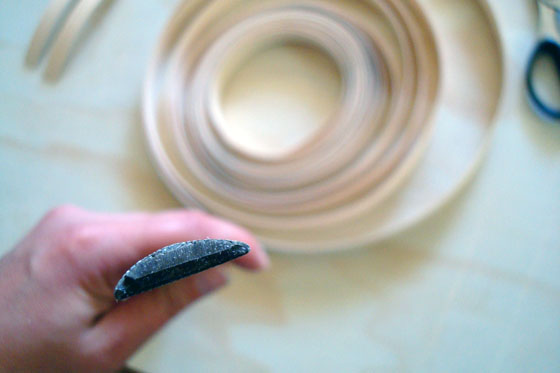
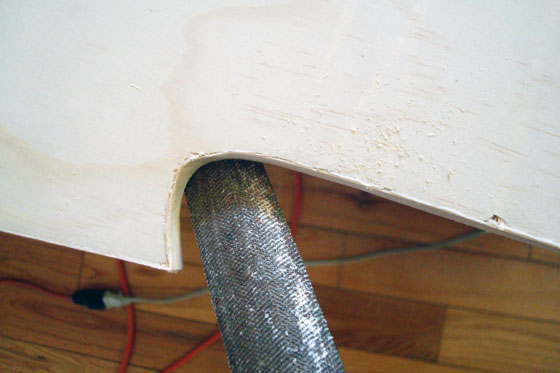
To trim the veneer, I always rely on a file. For the curved edges, I used the curved side of the file.

Curved profile on a file

Triming veneer on a curve with a file

A couple of swipes over the edge with fine sandpaper further smoothed veneer, and then it was ready for staining along with the rest of the headboard.

(And yes, the veneer takes stain and urethane and paint just like real wood).

Here’s the final product–in its impossible to photograph location in front of the window.

Applying preglued veneer edging to a curve

Anyone else have any tips for working with veneer edging? Who else has an old curling iron kicking around? Have you ever used beauty tools for DIY?


Planted!

It may not look like much–especially considering that there’s still carpet lying over the weeds–but the first plants are in the garden.

First plants in the garden

We’re still waiting on our hand-me-down tiller to arrive, but that didn’t stop Matt from coming home with a dozen tomato plants and 4 red pepper plants. So that meant I got out the pitchfork and went to work to dig out the weeds in a corner of the garden by hand.

It was just a small corner, but it was home to two heaping wheelbarrows-full of weeds. The roots didn’t go deep, but they snaked along just under the surface making a thick dense mat. I really hope the rototiller is able to break up the ground. It didn’t take me as long as I thought to pull out the weeds by hand, but doing the whole garden by hand will not be fun.

So you’re still seeing a few weeds and grasses and roots strewn through the dirt. But you’re also seeing tomatoes and peppers.

First plants in the garden

The garden has begun!

How is your garden growing?

Too close for comfort

Baxter here, y’all. Last Monday was an exciting day. It was Victoria Day, so Matt and Julia and me were all home together. (I dunno who Victoria is. I don’t think she’s from Kentucky.)

The best part of the day was when Julia and I went for our afternoon walk. It was sunny and sniffy. We were walking across the field behind the driveshed. There was lump in the field. I always investigate the bumps, the longest grass, the tallest weeds (and usually pee on them too). I was going to check out the lump, but Julia called me back. I went. (I’m getting very good at not wearing my leash.)

I was almost beside Julia when I saw that she was looking at the lump too. I took another look, and I saw what she saw. The lump had ears, and eyes, and a nose.

I’ll show you what it looked like (sorta). Her head was low to the ground between her paws and her ears pointed straight up. (And her furs were grey and brown just like the dirt. That’s why we couldn’t see her at first.)

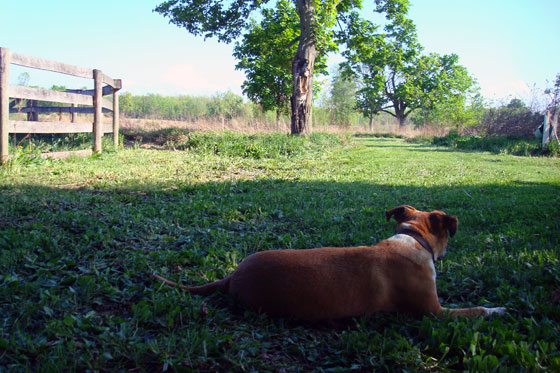
Baxter lying in the field

It was the doggie that Matt and Julia never let me meet: coyote!

I wasn’t going to miss my chance this time.

I heard Julia land on the dirt as she tried to tackle me, but I was speedy. The coyote was speedy too. She stayed just in front of me all the way across the field, down the hill and into the marsh. I’m not going to tell what happened in the marsh. Julia said she called me, but I didn’t hear her. I was just trying to meet coyote.

Eventually, I realized coyote didn’t want to meet me, and I remembered I’m supposed to stay close to Julia. But I couldn’t find Julia. I left the marsh, but she wasn’t in the field. I went back to the house, and the door opened when I got there. Matt and Julia were both there. Matt was holding my leash and wearing his tall boots and long pants even though it was really hot out, and he’d been wearing shorts before.

I gave them lots of smiles and wiggles, but I couldn’t help dancing too, so they saw that my legs and feets (and other parts too) had some black marsh mud on them. (Okay, there was lots of black mud.) They weren’t as happy as me. Julia grabbed my collar and gave me a couple of hard shakes. Then Matt took my collar and clipped me to my long line.

We could see the field behind the driveshed, and we saw my coyote come back. She climbed over the top of the hill and walked to the tree line. Matt went out to the field, but Julia stayed with me. She went and got the hose and washed off the mud. I usually don’t like the hose, but I was so hot from running that the water felt good. Plus I was still pretty excited.

I stayed outside for awhile to dry off, but I didn’t see the coyote anymore on Victoria Day. We’ve seen her pretty much everyday since then. But I haven’t gotten to introduce myself again.

Addition from Julia: We officially have coyotes. I was very excited a month ago when I first saw the coyote, as I hadn’t seen one on our property before. But now they (yes, we’re up to two coyotes) have become regulars, and it’s a little less exciting–Baxter’s opinion notwithstanding.

I’m a live and let live kind of woman, but I’m not sure the coyotes share my philosophy.

Their confidence and comfort grows quickly. So far they seem to be mostly curious. One followed–just followed, not stalked or hunted–Bax and I on our walk on Friday morning. When he got too close, I shouted at him, and he ran away.

Our biggest concern is Ralph. We can keep Baxter on leash, but we can’t lock Ralph up in the barn. She’s a pretty savvy girl, and she sticks very close to the barn, but the fact that a coyote was sitting on the driveway the other night–and that Ralph likes to hang out on the barn ramp in the middle of the night–isn’t a comfort. Plus, when two coyotes were cavorting in the field, her reaction was to roll on her back and ask for scratches (from us, not from the coyotes).

Ralph asking for belly scratches

Argh. I wish coyotes were vegetarians.

Making DIY dropcloth curtains – 8 lessons learned

In the last post, you saw the easy layered window treatments in the master bedroom. I promised more details on the dropcloth curtains I made.
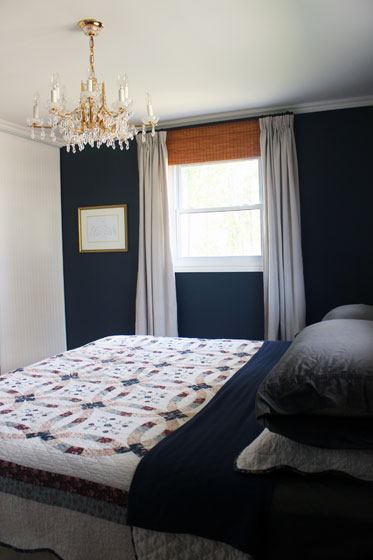
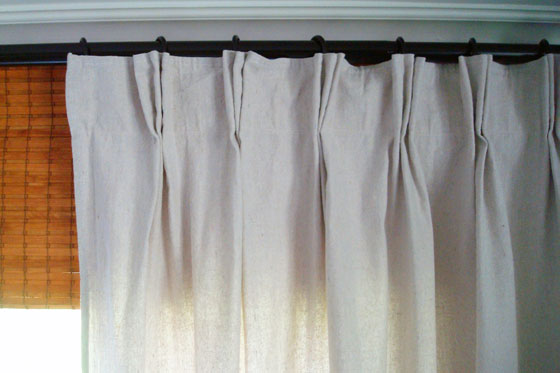
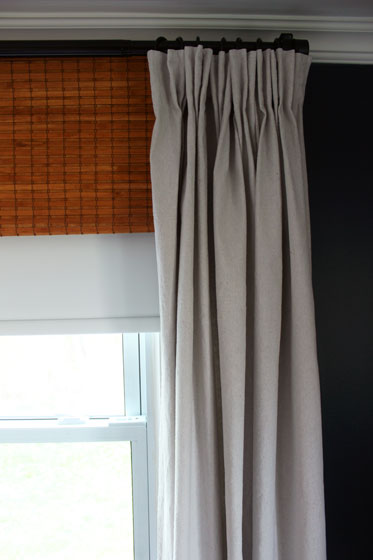
Blackout blind, bamboo blind and drop cloth curtain window treatments

There are lots of tutorials out there on how to make dropcloth curtains. So I’m not going to write one here. Plus, I totally made these up as I went along, so a tutorial doesn’t really exist. I did want to share some of the things I learned from making my DIY curtains, though.

How to make dropcloth curtains

1. Dropcloths come with seams. I assumed that my 9 by 12 foot dropcloth would be one single piece of fabric. It wasn’t. All of my dropcloths had a seam down the middle. One had a centre seam plus an additional patch along one end.

For my two widest curtain panels, I just left the seam alone. It’s a bit thicker than I would like and a wee bit puckered, but I decided I could live with it if it was hidden in the folds of the curtains.

For the other curtains, my seam ripper and I spent some quality time pulling out the stitching.
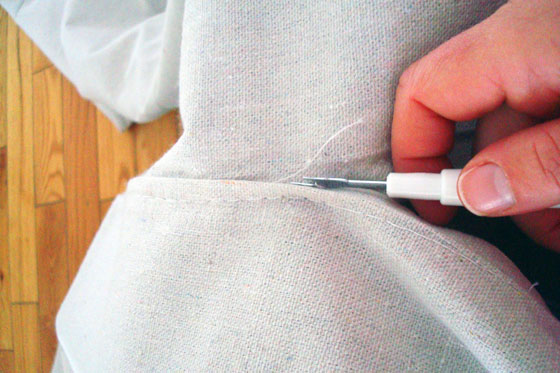
Ripping out the seam on a dropcloth

2. Dropcloths come with holes. The canvas fabric of the dropcloths is not perfect. The rustic quality of the weave and the few strands of blue and red that were here and there are some of the elements I like best about using this fabric.

However, in a couple of spots my dropcloths went beyond rustic and veered into unraveled. So if you want to make anything out of dropcloths, check them over carefully. You don’t want to end up with a hole in the middle of your project.

3. Wash and iron before you start. Pre-washing your fabric is a basic tenant of sewing. I didn’t want my curtains shrinking (not that they’re going to be washed often) after I put the effort into making them, so I washed my fabric before I started sewing.

Dropcloth fabric is heavy duty. As a result, it wrinkles easily and the creases are really difficult to remove. I found that ironing the dropcloths when they were still damp from the washer helped to remove the worst of the wrinkles.

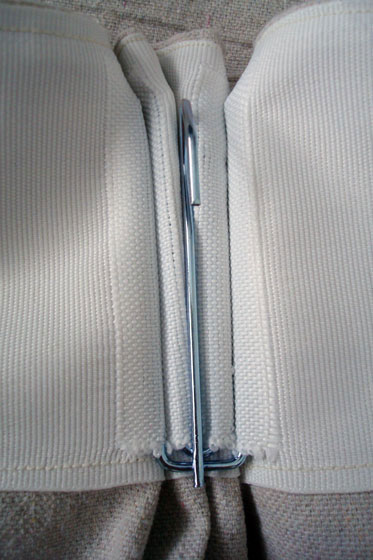
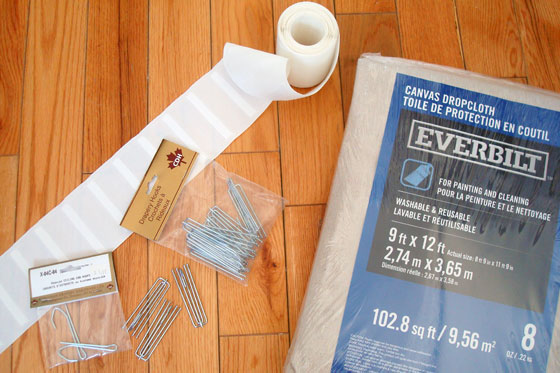
4. Use curtain tape. (Britt, this tip’s for you). From what I hear, making pinch pleat curtains is pretty tedious. Lots of measuring and calculating. A much easier solution is to use curtain tape. This is a kind of mesh fabric strip with channels on the back. You pair it with some special multi-pronged hooks, and it basically forms the pleats for you. I bought mine at a local fabric store.

The pleats are softer than they would be if you sewed them without the tape, but that was okay for my rustic fabric and my farm setting.

I sewed the tape along the edge of one of my dropcloths, put in the hooks and voilà, pinch pleat curtains.

Using curtain tape to make pinch pleat curtains

Using curtain tape to make pinch pleat curtains

Using curtain tape to make pinch pleat curtains

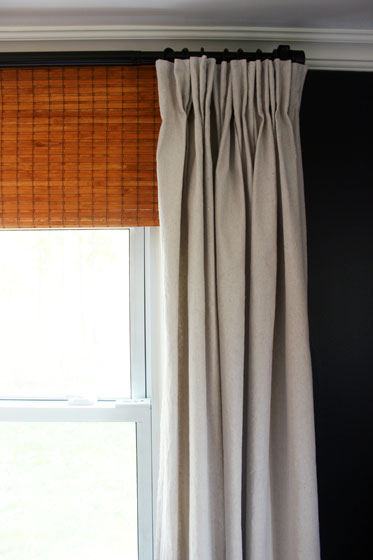
Pinch pleat dropcloth curtains

You can space your pleats as far apart or as close together as you want. I left one empty “pocket” for a space of about 6 inches between each pleat.

Pinch pleat dropcloth curtains

5. Use curtain tape to measure your curtains. Before I sewed the curtain tape onto my fabric, I formed all of my pleats until I had a strip that was as wide as I wanted my curtains to be. Then I cut the curtain tape at that length, removed the pleats and used the tape to measure the dropcloth fabric.

6. There are different types of hooks. The magic pleat-making hooks are very handy. They come in two different forms (there may be more, but I tried two). Whatever form you choose, the hooks hook onto the rings that go on your curtain rod. Option 1 has the hooks at the end, so the curtains hang a bit below the rings. Option 2 has the hooks in the middle, so the top of the curtain hangs up against the rings. This is the type of hook I ended up using.

There are also special non-pleating hooks (just plain single hooks) to hold up the ends of the curtains where there are no pleats.

7. Take your time hemming. I wanted my curtains to just brush the floor. For my first set, I hung the curtains, found the spot where they met the floor, and then I used a ruler to measure the rest of my hem from that point. The result was curtains that were the right length at one or two spots, but for the most part they scuffed, not brushed the floor.
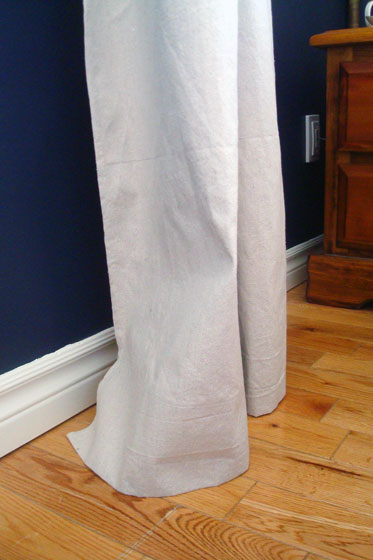
Curtains hitting the floor

For my second set of panels and for the bed skirt that I also made out of dropcloths, I skipped the measuring tape. Instead, I used pins to mark the fabric at about 1/4 to 1/2 inch off the floor. I pinned my way across the bottom of the curtains, marking about every six inches. Then I pressed the hem using the pins as a guide. It wasn’t scientific, but it resulted in curtains that just brushed the floor.

8. You can totally do this too. Dropcloth curtains are pretty easy to make. Honestly, I found them a bit tedious. The only sewing is in straight lines. Loooooong straight lines. However, boring they may be, sewing straight lines is not difficult.
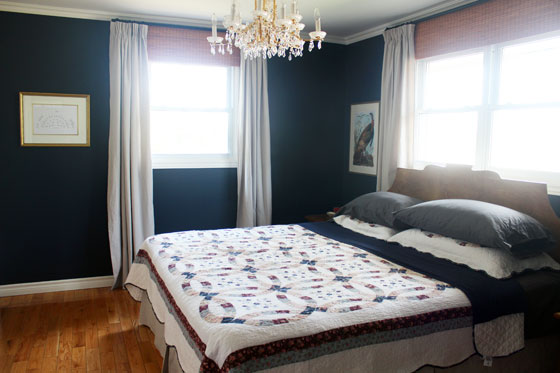
Dropcloth curtains in a navy master bedroom

Let me know if you try them yourself.

Have you ever made your own curtains? Any tips to share from your experience?

Linking up with: Happy Housie DIY Challenge Party
How to make simple layered window treatments

When I had the brainwave to move our bedroom across the hall, Matt didn’t understand why we couldn’t just stay in our current room. He went along with my plans, but he had one requirement: he wasn’t moving in until we had curtains.

Blackout blind, bamboo blind and drop cloth curtain window treatments

We haven’t had curtains on any windows in any room since we moved to the farm. With no neighbours, privacy is not a concern.

However, our new bedroom is on the east side of the house. There are fewer trees on that side, so more light comes in the windows. At night, the lights on the barn and the driveshed and even headlights from the cars on the far-away road shine into the room.

Plus, east equals sunrise. If we wanted to sleep past dawn on any summer morning, we needed curtains.

But I wanted more than just curtains. I stumbled over Kristine’s window treatments on the Painted Hive and thought her solution was ingenious. (So I really can’t take credit for this idea).

Kristine’s solution is a great mix of form and function.

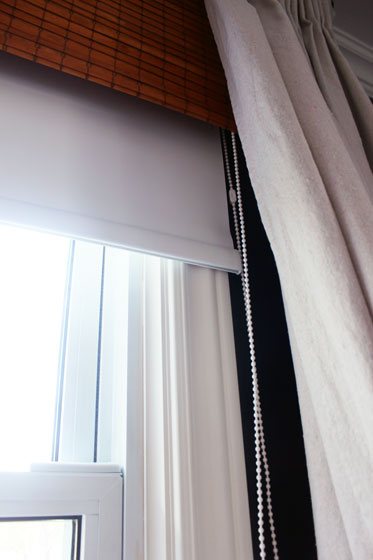
Function starts with a basic blackout vinyl roller blind, which I mounted above the window casing.

Vinyl blackout blind hidden behind bamboo blinds and dropcloth curtains

Form comes next.

The blackout blind is hidden behind a bamboo blind. Or what looks like a bamboo blind.

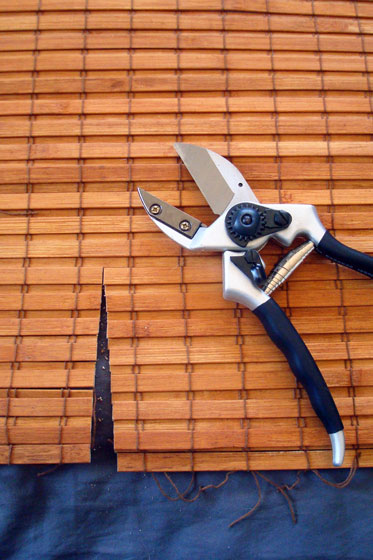
In reality, it’s basically just a valance. I took one bamboo blind and chopped it to pieces. For the main window over the bed, I was able to use the full six foot wide blind, but I only wanted it to be about 16 inches long. To shorten it, I clipped the strings that hold the slats together and knotted the ends so that the blind didn’t fall apart. I’m not going to lie, tying hundreds of tiny strings into tight double knots was pretty tedious.
For the smaller side window, I needed a narrower blind. A set of strong pruning sheers and Matt’s strong hands clipped off the excess width. Then, I again cut the strings to give me a 16 inch length and tied another whole bunch of tiny knots.

Cutting a bamboo blind

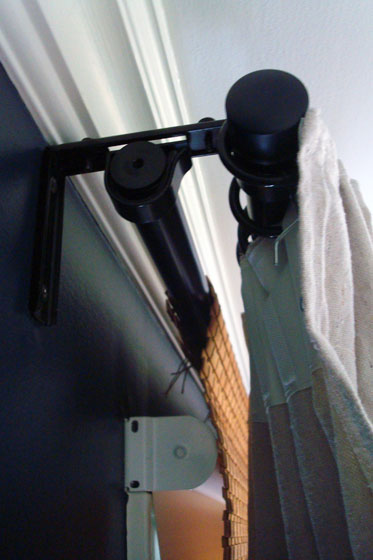
To put bamboo blind in place, I installed a double curtain rod just below the crown molding. I chose the Räcka and Hugad from Ikea.

The bamboo panels just drape over the rear rod (I tied them in place) and hang over the top of the window. They hide the blackout blind and, because I hung them so high right under the crown molding, they make the windows look much taller.

Double curtain rod

The front rod supports the dropcloth curtains that I made. The curtains are completely functional, but we don’t need to use them, thanks to the blackout blind, so they’re mostly just for form. They do hide the edges of the two blinds and help to block light from sneaking around the sides of the window though.

I’ll be sharing more about some of the lessons I learned from making dropcloth curtains in my next post.

I used the trick of hanging the curtains so that they fall just outside the window casing. This really does make the window look bigger in my opinion.

Altogether, the blackout blind, bamboo valance, double curtain rod and full length dropcloth curtains make for stylish and functional layered window treatments.

Blackout blind, bamboo blind and drop cloth curtain window treatments

Plus there’s the added benefit of keeping Matt happy.

Happy husband. Stylish master bedroom. I’m all set.

What are your master bedroom must-haves? Are you a blackout blind-er or a up with the sunshine-er? What’s your window treatment style?

An evening walk along the pond trail

The nature of farm living is that it’s tough work. Last night, after a day full of hard labour, my skin was stinging from scrapes, thorn pricks and a pretty decent sunburn.

My muscles and grip strength were gone. At one point, Matt had said, “Pull!” as we were stringing the fence in the garden. And at my response–“I’ve got nothing left!”–he just laughed.

It was after 5 o’clock, and the dog still needed his afternoon walk–a daunting prospect.

But the nature of farm living is that there’s also an incredible setting, right in our backyard, so Baxter and I headed for the pond trail.

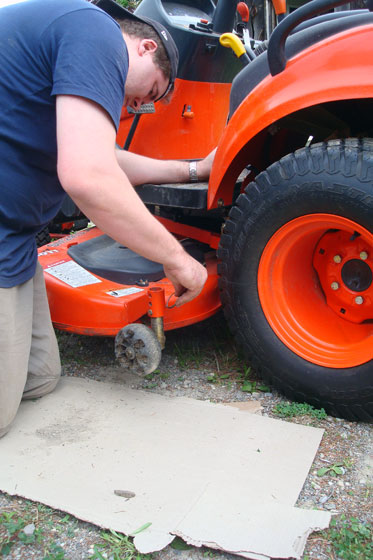
Matt cut this trail for us last year. Some of our hard work earlier earlier in the day had been  sharpening the mower blades (with help from my parents), attaching the deck to the tractor and mowing the grass.

Sharpening lawn mower blads

Attaching the mower deck to the tractor

In addition to doing the lawn, Matt did a pass over the trail, so Bax and I had a lovely space to hike.

We walked alongside the lilac hedge that leads from the house down to the water.

Lilac hedge

Purple lilac

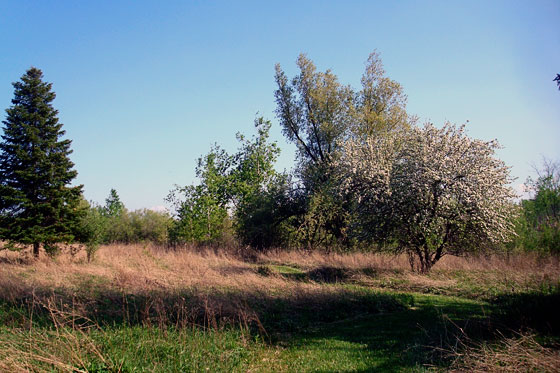
We turned left and followed the trail along the shore towards one of our old apple trees. This tree is a showstopper this year. Absolutely covered in blossoms.

Apple tree in blossom

Apple blossoms

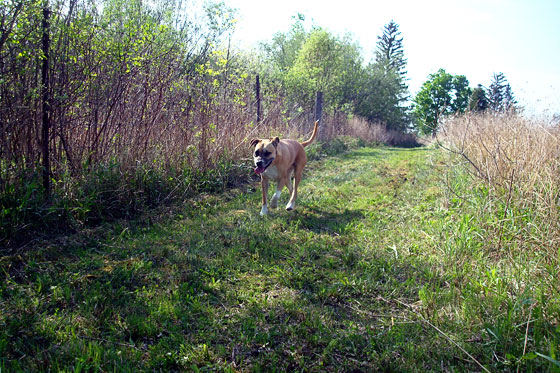
From there, the trail heads into the small pasture behind the barn, following the fence at the edge of the marsh.

Baxter walking along the pond trail

Baxter walking along the pond trail

It loops around past the manure pile and then up to my favourite tree.

My favourite maple tree

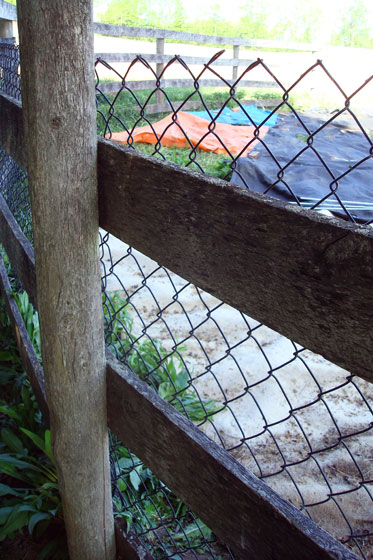
We took a detour by the garden to check out the new fence.

Chain link fenc stapled to a wood fence

And as I headed to house, Baxter decided he was going to stay out for awhile yet. He laid down beside the garden and gazed back down the trail and across the farm.

Baxter laying in the grass

The view is fields and forest and trees and marsh, and it’s worth any scrapes, pricks, burns, aches, hard work and exhaustion.

The payoff–this farm–is exactly where I want to be.

Getting ready for the great gardening weekend

This is it, folks. The Victoria Day long weekend. The first long weekend of “summer.” The kick off to gardening season in Canada.

And I have ambitious plans.

First on the list is mowing our jungle grass. Every spring, we’re late getting our grass cut. The first year, we’d just moved to the farm and didn’t have a tractor. The second year, the tractor wouldn’t start, thanks to a broken fuel pump. Last year, it took us a couple of weeks to get the mower deck attached to the tractor (the level ground that is required to get all of the pins to line up perfectly does not exist at the farm).

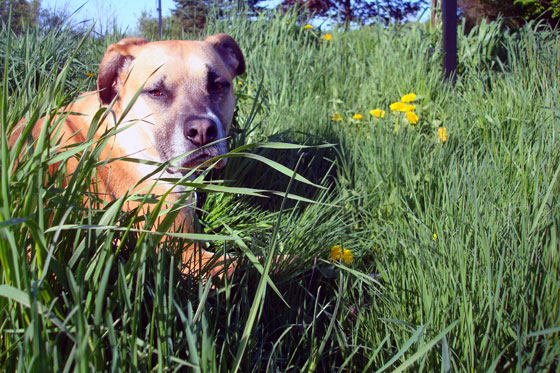
Baxter's not impressed face at our long grass

This year we’re delayed because we need to sharpen the blades. I’ve done it before, but always with my Dad and always on much smaller mowers. For the first time taking the blades off our deck, we want some help, so we’re waiting until my Dad can come to supervise.

Next on the list is giving my forsythia haircut. (Dad, can you bring your hedge trimmer when you come over, please?)

After that, I need to weed two more flower gardens–the biggest ones, of course.

And then there’s the vegetable garden.

I know this was supposed to be my one and only outdoor project for this year. Obviously I’m multi-tasking with grass and forsythia and flower beds. Just trust that those things are necessary too, okay?

I’m anxious to get started on the vegetable garden, but I’m not going to be able to do as much as I had hoped over the next three days… and not just because of the other things on my list.

The biggest vegetable garden task this weekend is going to be the fence. We have a nice weathered wood fence. It looks great, but it’s not that helpful for protecting the garden from the local wildlife. I need to add some chainlink, and I need to build a gate. ‘Cause if I leave the door wide open, it doesn’t matter how much chainlink I have on the rest of the fence.

I had hoped that that I’d be able to break up the sod too this weekend, but it doesn’t look like that’s going to happen.

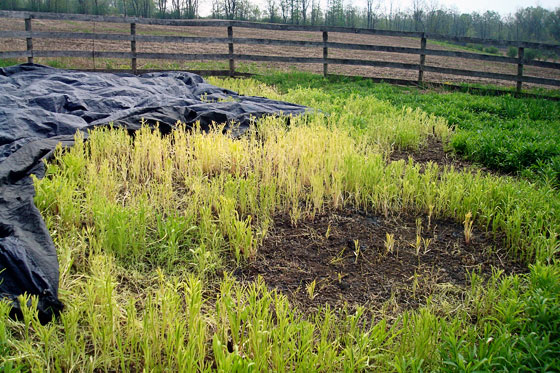
The tarps that have been spread over the garden for the past few weeks have not succeeded in killing the weeds. They’ve just turned them a bit pale.

Weeds after being covered with a tarp

Our farmer tilled our fields last weekend. I ran after the tractor one evening and asked him if it came in a smaller version–small enough to fit inside the ring. He shook his head and said, “I’d have to do that one by hand.”

As the tilling continued, I looked enviously at the tractor every time it drove past the ring.

Tilling the field

I had reserved a heavy-duty rototiller from a local equipment rental shop (because neither my Dad nor Matt’s want to sacrifice their rototillers to fulfill my garden ambitions–spoilsports), but it was surprisingly expensive to rent. Matt’s and my cheapskate sides came out, and I canceled the reservation.

I had heard a rumour that one of my cousins had a rototiller he wasn’t using. Turns out he doesn’t need it anymore, and we can have it… in a couple of weeks. So we’re waiting on our new-used (and better yet free) tiller before we tackle the sod.

Even without the rototiller, I think we have enough to keep us busy… for all three days of this weekend.

Wish us luck, would you? Hopefully I’ll survive the weekend and be back next week with an update for you.

In the meantime, let’s keep each other motivated. What’s on your weekend to-do list? Are you gardening? Or hoping to garden?