How we cleaned our chimney ourselves

Alternate title for this post “That time Matt’s Dad didn’t suffocate and fall off our roof.”

If you’ve been reading along here for any length of time, you know how much we enjoy our wood-burning fireplace and have fires nightly as soon as the weather turns cold.

It’s been three years since the fireplace was rebuilt and over that time we’ve never cleaned the chimney.

Before we fired anything up this year, I knew I wanted to address that.

Red brick chimney

Our go-to was Matt’s Dad. He heats his entire house with wood and cuts and splits all his own firewood. He’s our resource for all things fire.

He initially suggested dropping a heavy chain down the chimney and using it to knock off the soot. I was skeptical, but after a quick online search it seemed like that was a legit method of cleaning a chimney. However, consensus seemed to be that a brush was a more legit method.

Onto my Dad. I was pretty sure I remembered seeing a chimney brush and poles up in the rafters of the garage. After spending some time on a ladder peering around the garage, I found the poles but no brush.

So onto the store. I found a brush that I thought would probably fit our chimney and brought it to my parents’ house to try it on their poles. They didn’t fit together.

Back to the store, where I bought a handful of poles guessing at how many might be needed to reach the full length of the chimney.

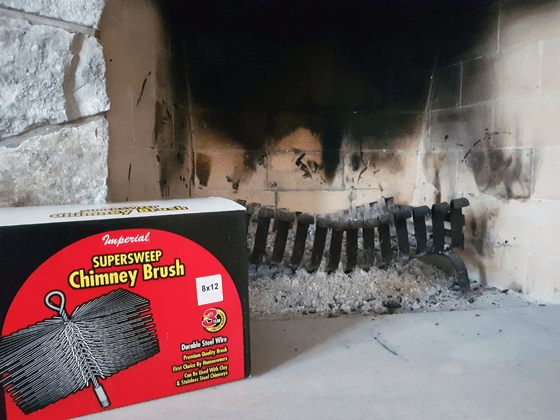
Chimney brush in front of the hearth

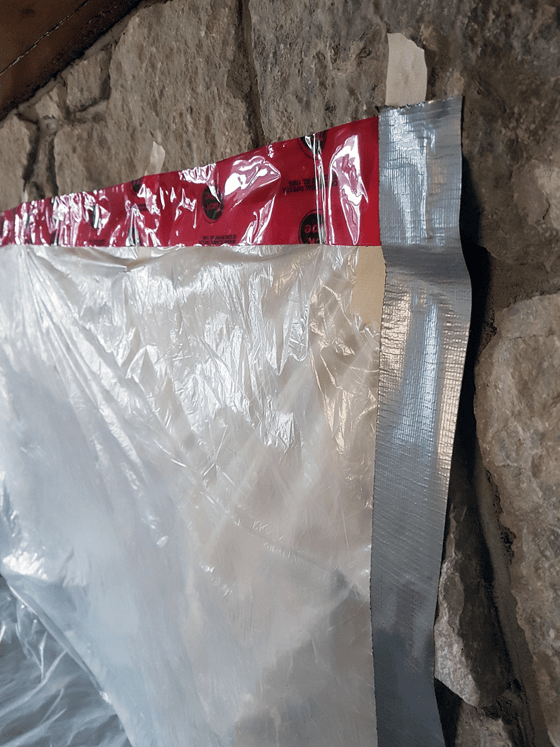
Once we had the equipment, we needed to prep the inside of the house. I cleaned out the hearth, opened the damper and then covered the mouth of the fireplace to prevent dust from coming into the house.

Covering the fireplace to prevent dust during chimney sweeping

Covering the fireplace to prevent dust during chimney sweeping

Then it was onto Dick Van Dyke Matt and his Dad. (I asked for a Mary Poppins rooftop routine, but they were not in the mood. Although Matt did give me a strong man demonstration.)

Matt goofing around while cleaning the chimney

They popped the cap off the chimney and took a look.

Taking the cap off the top of the chimney

The chimney wasn’t too dirty. You can see the flakes of soot on the flue.

Soot on the inside of the chimney flue

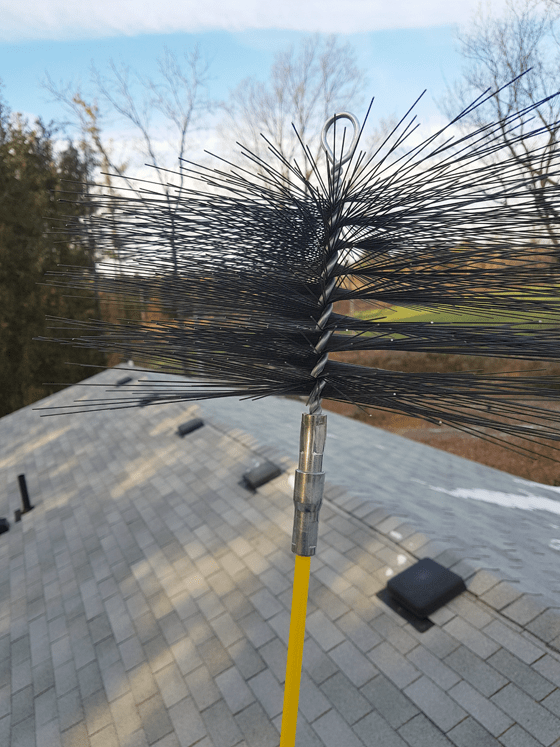
They screwed the brush onto the first pole and got ready to sweep.

Chimney cleaning brush

Then this is where the suffocation comes in. Before he stuck the brush down the chimney, Matt’s Dad stuck his head in a large plastic bag–probably one that has a suffocation warning printed on it.

Cleaning the chimney

When he cleans his own chimney, my FIL does it from a ladder, which doesn’t give him much maneuverability. Therefore, there have been times where the wind has blown soot back in his face. The plastic helps to protect him from getting entirely dirty. On our roof, they could move around to avoid the wind if necessary.

The next stage was–to quote Matt–“dunk and scrub.” (My husband loves his movie references… although the line is actually “plunge and scrub,” but my darling husband maintains that “dunk” sounds better than “plunge”… or at least it does in his version of an Irish accent.)

My FIL dunked plunged the brush up and down in the chimney until the soot was removed. As he reached the end of one pole, he and Matt screwed on another section.

Attaching chimney sweeping poles together

Once they’d done the full length of the chimney, that was all there was to it. They put the cap back on top, came inside and pulled the plastic off the opening, swept the wee bit of dust out of the hearth, and we were ready for a fire.

Logs burning in the fireplace

Cleaning the chimney turned out to be pretty easy (so says the woman on the ground… but seriously, I know I could do it and you can too). I’m very grateful to Matt and his Dad for their work.

Here are my tips to clean your chimney yourself.

  1. Find a brush that fits your chimney. Our chimney has a 12 inch square flue. Most of the brushes I found in different stores were smaller and round. That works for my FIL’s woodstove, but not for our masonry chimney. Eventually, I found a brush that was an 8-inch by 12-inch rectangle. Even though it wasn’t the 12 by 12 that I originally had in mind, Matt’s Dad said that it worked very well.
  2. Buy extra poles. It turns out that two poles and a long arm (to quote Matt’s Dad) are enough to do our whole chimney. I bought five because I did not want to come up short. I’ll be returning the other three.
  3. Lubricate your poles. The poles screw together so that the handle of your brush gets progressively longer as you proceed down the chimney. Before he went up on the roof, Matt’s Dad gave the threads a shot of WD40 to ensure they’d easily screw and unscrew this year and for the years to come.
  4. Cover up inside. Tape a sheet of plastic over your fireplace opening. If you have doors on your fireplace, this step may not be necessary. With our open hearth, there was a good chance that soot and dust dislodged during cleaning would float into the living room. Covering the opening with plywood or plastic helps to contain the mess in the fireplace, where you can sweep it up later.
  5. Dunk and scrub (or plunge). Jostle your brush up and down inside the chimney. Be relatively vigorous–you want to knock off all the soot–but a bit gentle–you don’t want to damage your chimney.
  6. Watch which way the wind blows. It’s probably not necessary to don a plastic hood and face shield à la Matt’s Dad. However, chimney cleaning is a dirty job (another Mary Poppins clip, anyone?), so wear old clothes or coveralls, gloves and try to choose an angle where you won’t have soot blowing in your face.
  7. Do this yourself. Chimney cleaning is an easy DIY. It took about a half hour start to finish and in total our investment in the brush and the poles is less than $100. We’ll have the equipment for years. We didn’t get a professional quote on cleaning the chimney, but I’m certain that we would have spent more than $100 if we’d hired this out.

Now we can enjoy the fireplace, confident that it’s safe and clean.

How we cleaned our chimney ourselves

Trials and errors in Illinois

Sometimes, we cross our fingers and give something a try. We’re hopeful that it will work, but not quite sure how it might turn out. That’s the case in many aspects of life, but especially DIY. Sarah in Illinois is back today to report on the results of two experiments.

There have been a few projects in the past that I have posted about and said that I would report back how they turned out. I thought I’d report back on two of them today.

The most recent was the storage tomatoes. You can see the process I used here. But unfortunately, it didn’t work at all. Two weeks after I put them away, they looked like this:

My best guess is that the garage that I stored them in was too warm. Next year I plan to try again but find a cooler storage spot. I may also try another variety like Longkeeper.

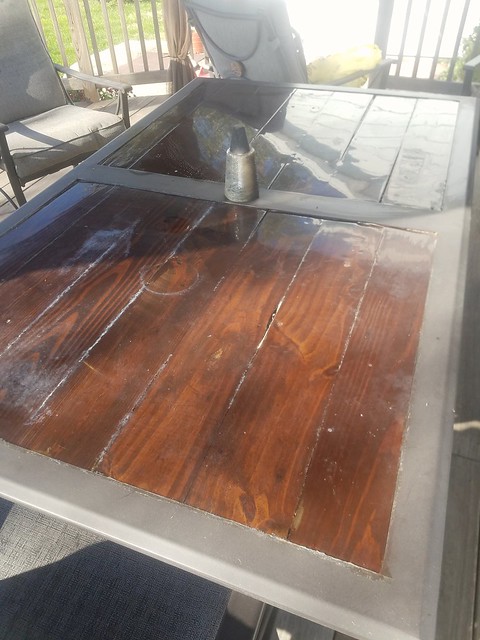
My second follow-up is for the table that we refinished for the deck.

I said in my original post that the epoxy we used stated that it wasn’t for outdoor use, but we chose to use it anyway.

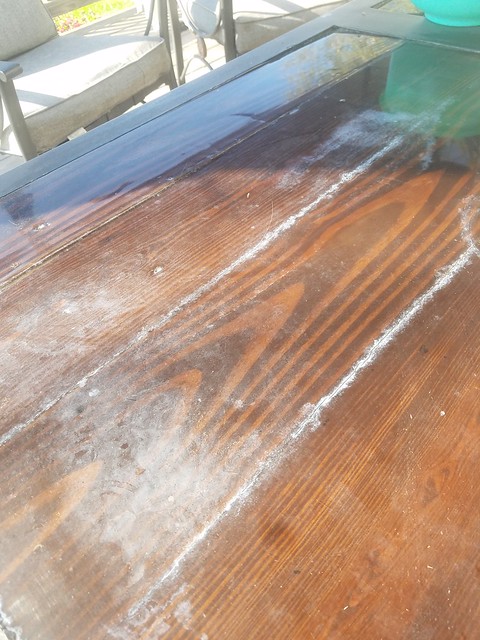
They are a few small issues that popped up after a summer of outdoor use.

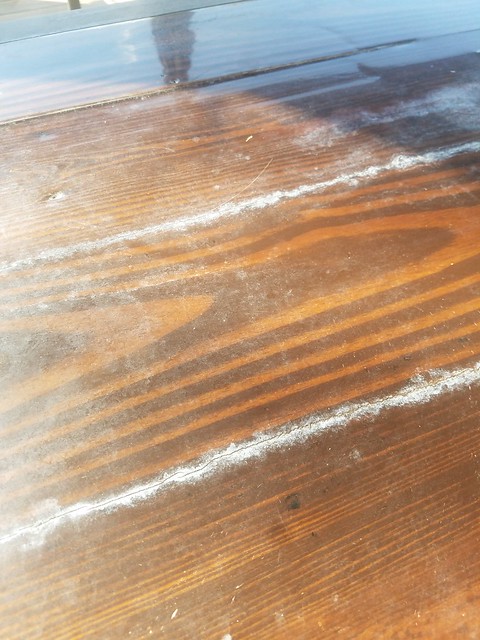
There are small cracks appeared in the epoxy which allowed moisture to sleep down underneath.

Also something that sat on the table, possibly a pot of plants, held moisture against the epoxy and made a cloudy ring where it should be clear.

I wouldn’t consider this a complete failure for the project, but it tells me that the finish won’t hold out as long as I hoped. My plan is to see how it looks after using it again next summer then possibly trying a different method to coat the wood.

So unfortunately, both trials didn’t go perfectly, but that is why they were truly experiments for me. Most things in life are trial and error. The best thing to do is learn from it and move on.

That’s about the only choice, Sarah! I’m sure these results are a bit disappointing, but they are absolutely learning experiences.

I have to say I’m bummed about the tomatoes and the table for you. We lost a bunch of our favourite potatoes this year just a couple of weeks after we put them in storage. There wasn’t anything to do but move on, but it was frustrating that we’d had such a good harvest and then so many didn’t keep–and especially that it was our favourite variety that was hit. Also, the last time you shared that table, it was so shiny! 😦

Refinishing a vintage metal bed frame

Thanks everyone for your good wishes on my last post. Matt seems to be recovering well from his surgeries. We’re hopeful that our follow-up appointments over the next few months give us more positive news.
The guest room has become Matt’s treatment room where we can lay out all his drops and ointments, and the patient can receive them. You may recall that back when I shared the finished guest room nearly, oh, a year and a half ago, the room was missing a key component–a bed frame.

Well, we’ve finally managed to remedy that.

Metal bed frame in the guest room

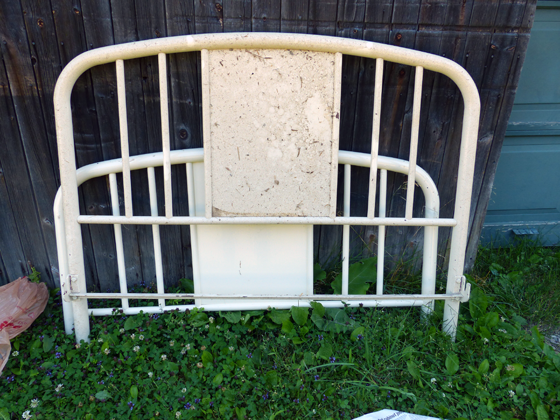
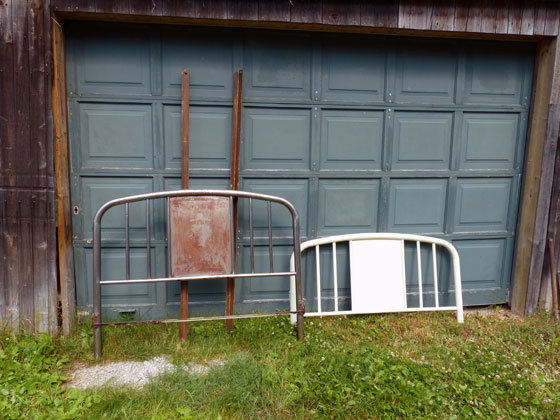
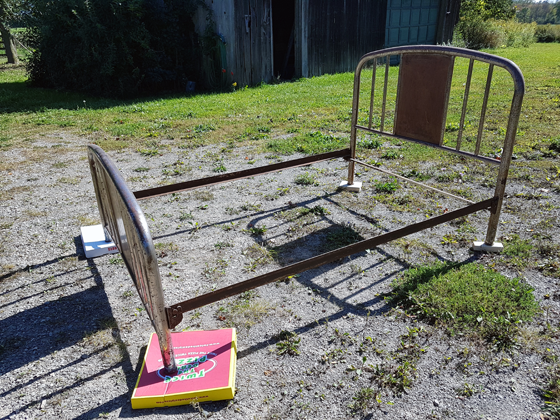
We had an old metal bed frame that was in my cottage bedroom growing up and then Matt and I used it in our first house. This style of frame has become pretty trendy, and I’m seeing various versions all over the web, so I wanted to keep it. Plus it was free.

However, the finish was in rough shape. During the cottage days, it was a greyish, pinkish flesh tone. Matt and I repainted it cream, but it was our first foray into spray paint and the finish was drippy and chipped (and dusty after living in the barn for several years).

Vintage metal bedframe painted cream

One of my home goals from 2016 was to strip the frame. I had hoped that the metal was in good enough shape that it wouldn’t need to be painted and it could just go right into the guest room.

Stripping paint off metal is very similar to stripping paint off wood. I used my usual chemical stripper, scrapers and wire brushes. It was a fiddly process because of all of the spindles and layers of paint (and as usual my sidekick was no help).

Baxter helping to strip the paint off the metal bed frame

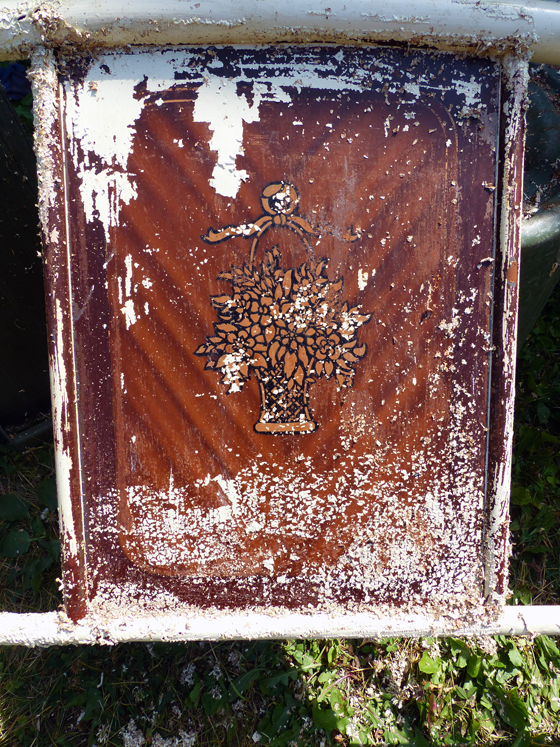
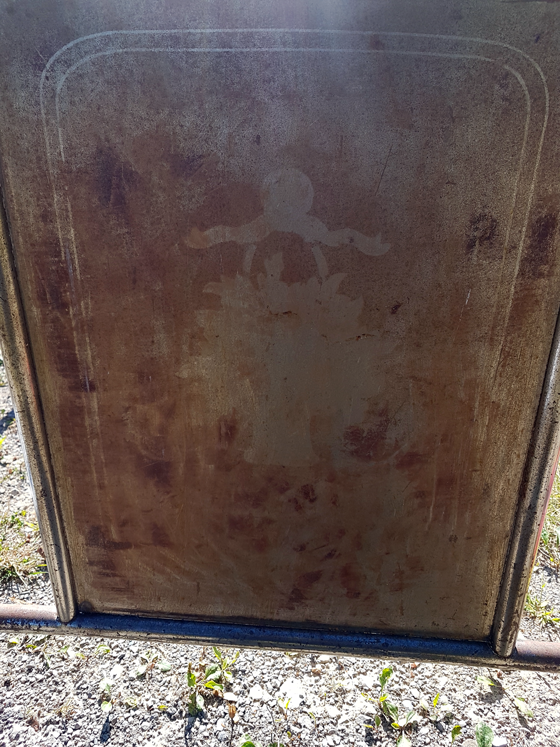
The original finish on the bed was a faux wood treatment. It was not what I expected to find at all. I had seen glimpses of this stenciled basket through the subsequent layers of paint and thought it might be embossed into the metal. That was not the case, and it was a feature of the original finish.

Faux wood grain paint on a metal bedframe

Stripped metal bed frame

Unfortunately, the metal was not in great shape once I got the paint off. There were scratches and pits and rust and the welds were obviously different colours. I knew I would have to repaint the whole bed. Faced with that reality, I stopped stripping. I had removed the paint from the headboard and two siderails, but I had visions of simply adding another layer of paint to the footboard.

Stripping paint off a vintage metal bedframe

But I knew that wasn’t what I really wanted. If I’m going to do the job, I might was well do it right and take the footboard back to the original metal. Plus the footboard is the most visible part of the bed, and I was worried that the chips and goopy layers of paint would show through my new finish.

So this summer I returned to the bed frame and finally stripped the footboard. Then I waited for the weather to cool off enough to paint–and to figure out what colour I wanted to paint.

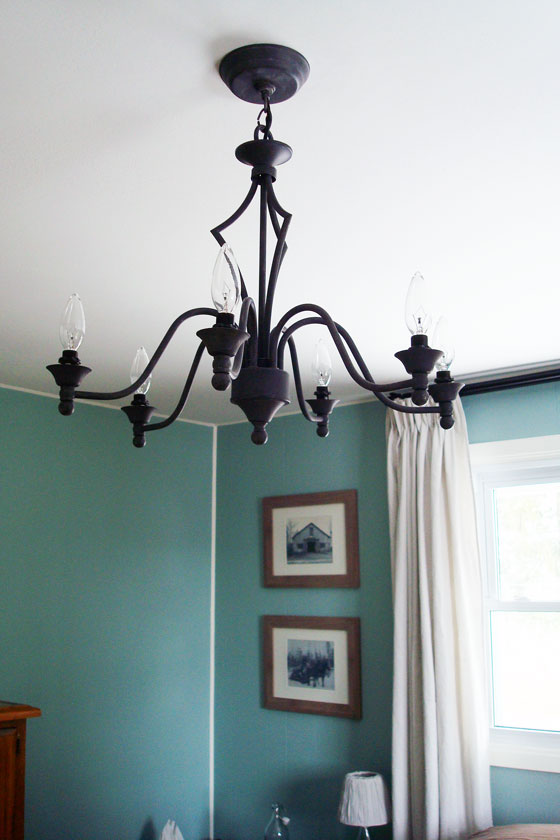
So many of the metal bed frames I see are black. I love the look. But between the trunk that’s already in the room, the chandelier and the curtain rods, I already have my pops of black. I didn’t feel like I needed more.

Rustic black chandelier

The second place colour seems to be white, but there’s also a few white pieces in the room, we’d kind of already done this with the cream paint and honestly I wanted something more interesting than white.

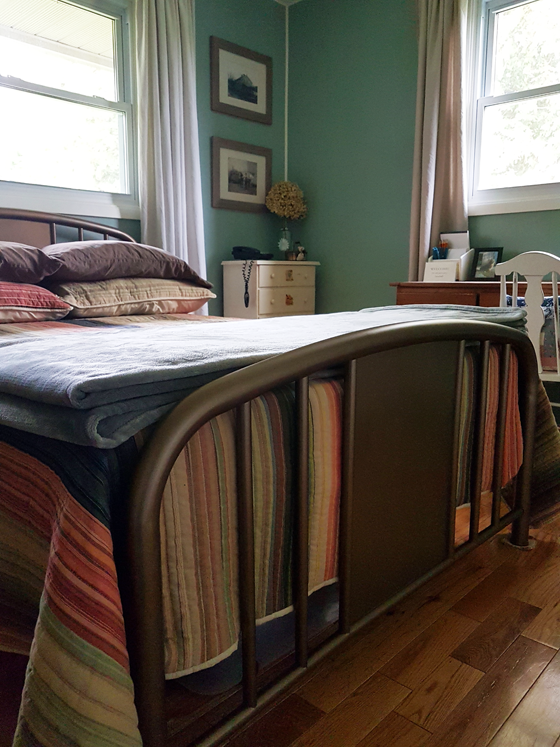
I sampled a bunch of colours, but that didn’t help. Finally, I went to the store and just picked a colour. I chose Antique Brass by Rustoleum. I liked the idea of echoing traditional brass beds. Plus some of the hardware in the room on the desk and the chest of drawers is brassy.

Rustoleum Antique Brass spraypaint

I figured, if I didn’t like it, I could always repaint. At least I now have a smooth surface to do so, and I wouldn’t need to strip again.

We set up the bed on the driveway, and I went to town. Given the state of the metal, I think I could have used a primer, but after a brief sanding I went straight to paint–and ended up having to run to the store to get more cans. In the end, all of the scratches were covered and the finish looks good–much better than any of the previous finishes.

Metal bed frame set up on the driveway for painting

After a week of airing out in the driveshed, we brought the bed in and set it up.

Antique brass metal bed frame

And now, I can finally say the guest room is done. Ready for our next patient guest.

How to rescreen a screen door

Fresh country air is one of the best parts of summer living on the farm. But summer on the farm also means bugs, so screens are an absolute necessity. Sarah in Illinois is here today to share how she fixed her screen door after it had a few too many encounters with a puppy who was enthusiastic to enjoy the country air in person dog.

I don’t think you can live in the country without a screen door. Unfortunately screen doors and young energetic dogs don’t mix. Blitz gets so excited to head outside that he pushes the door open with his big paws.

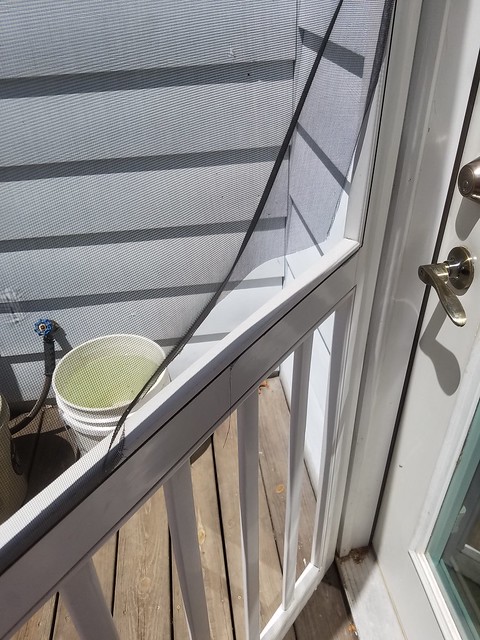
The screen became damaged enough that I decided that it was time to try my hand at re-screening a door.

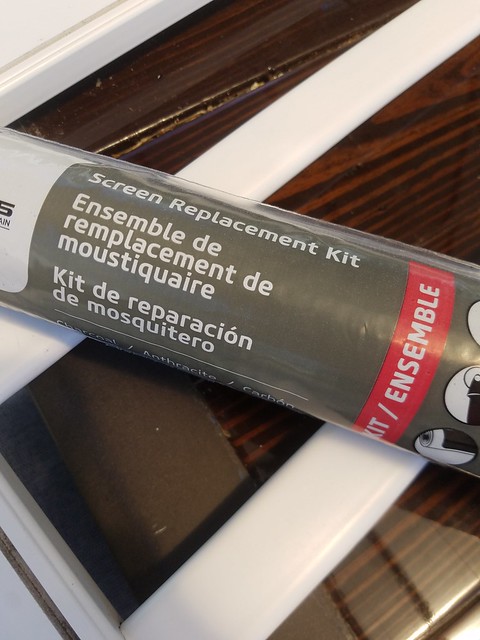
I started with buying a screen replacement kit at our closest home improvement store. It comes with a large roll of screen, a roll of spline and a spline tool. The only other tools that I needed were a utility knife and pick.

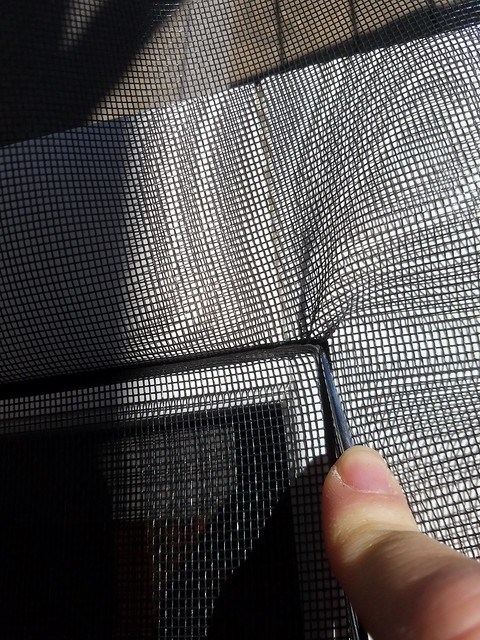
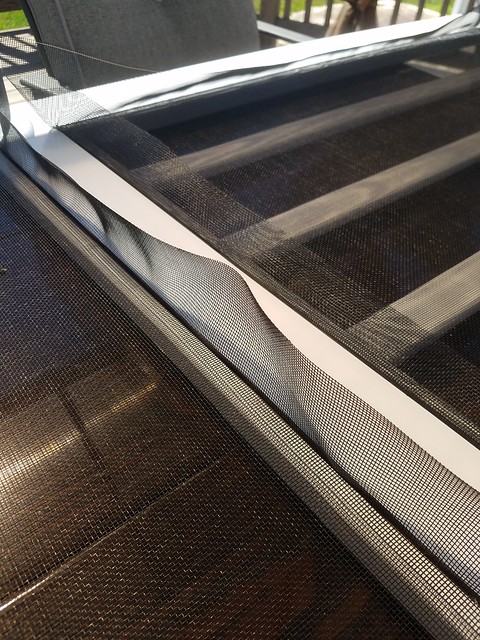
I started by removing the damaged screen and using the pick I pried all of the old spline out of the grooves.

I compared my old spline to the new spline. My only concern was making sure that they were the same diameter. If the newer spline was too large it wouldn’t fit in the groove, if it was too small, it wouldn’t stay in place. Thankfully, it was close enough to work well.

After all of the spline was removed and I cleaned the door, I was ready to start putting the new screen in place.

I carefully centered the screen over the opening and laid the spline over the groove. Working with just one side I used the spline tool, which is basically a handle and a roller, and pushed the spline down into the groove. It was a tight fit, but not too tight, just enough that I knew that it wasn’t coming out.

I worked my way around all four sides pulling slightly on the screen to keep it taut.

At the corners I had to use the pick again to squish the spline down tight where the spline tool couldn’t reach.

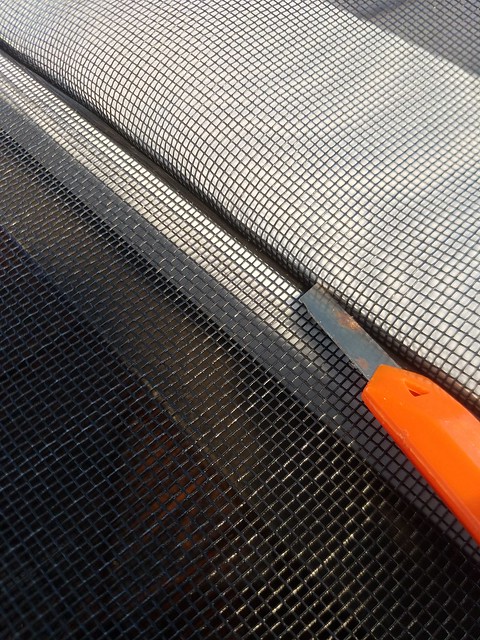
Once I felt that the screen was in securely and pulled tight, I trimmed the excess screen off with a razor blade.

In the case of our door, there were two separate screen areas so I repeated everything on the second half of the door.

I was then ready to rehang the door.

I was nervous tackling this project because I was worried that it would never look like it did when the door was new. But honestly, this was such an easy project and cost me less than $10 for the kit.

Now we’re ready for this guy’s next adventure.

Well done, Sarah. It looks really professional. We love having the windows open in the summer, but I’m realizing a few of our screens are in need of repairs. We’ve found ourselves chasing moths or even the occasional mosquito in the house. In the past, I’ve patched a hole. Rescreening sounds pretty easy and straightforward. Plus I’m ensured of not missing any holes.

Building a round wood framed mirror

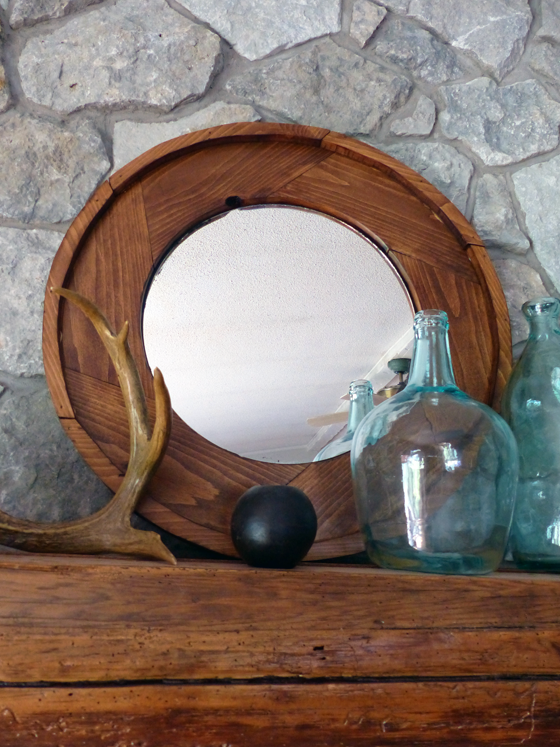
Large round wood frame mirror

It’s been two years since I watched a bunch of bloggers participate in the One Board Challenge. Two years since I haven’t been able to get this round mirror by Jenn at Build Basic out of my mind. The fact that it was built with a single 1×8 made it even cooler.

Every time I went to a thrift store, I casually looked for a large round mirror. This spring I finally found one at Value Village (for $9.99), and it was time for my own One Board Challenge.

Round mirror makeover before

I’m not going to post a how-to here because, hello, not my project and also Jenn’s instructions are very good.

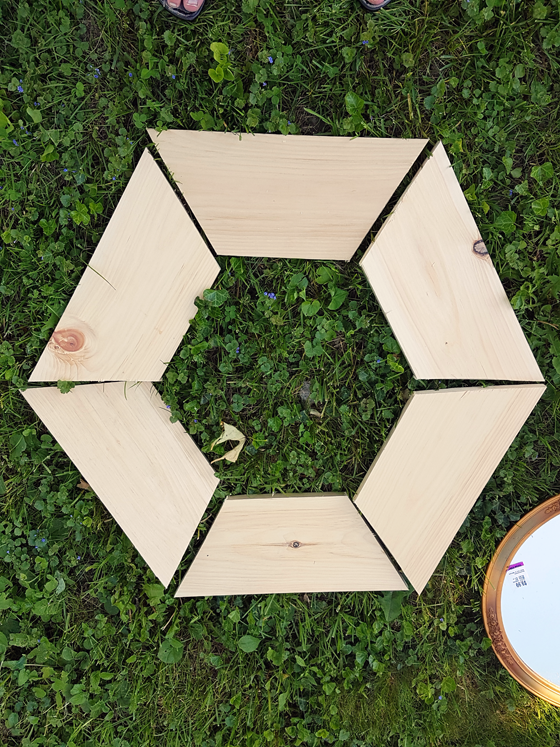
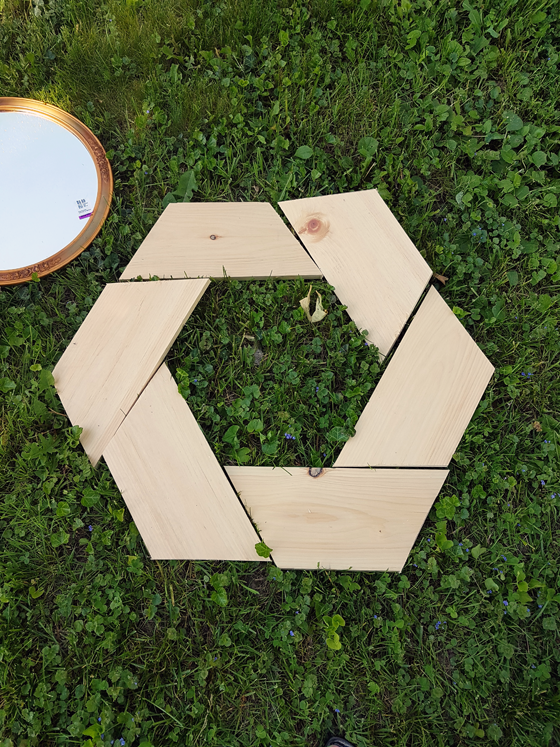
I love the creativity of the One Board Challenge. My brain does not work like this. I would not think to make a round frame out of a straight board. In fact, even with the tutorial, it took me a couple of tries to figure out how to arrange the wood. My first try was fine, but not as interesting as Jenn’s configuration.

Building a round wood frame

Jenn notes that there are multiple ways to arrange the wood. I feel like her arrangement had more interesting angles, so that was what I went with.

Building a round wood frame

If you’re thinking of trying this mirror yourself, I do have a few notes to share.

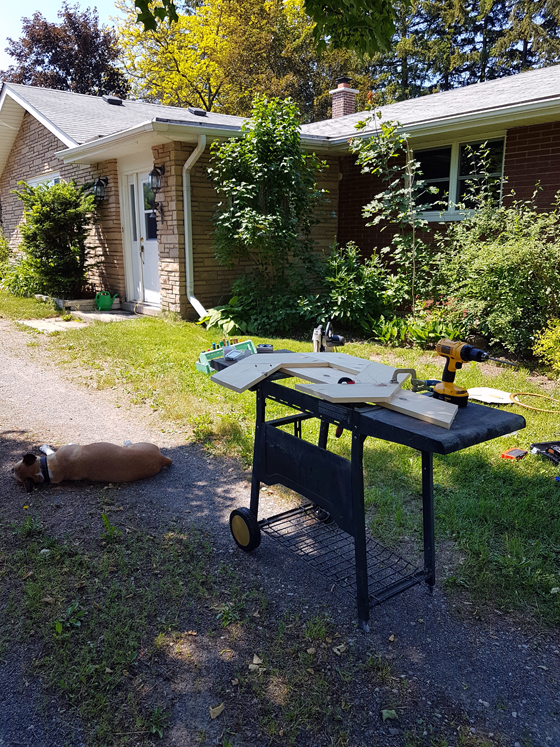
This project is rated moderate. It’s very doable, and none of the skills are particularly difficult. What might make this challenging for a novice DIYer is that building the frame takes a lot of tools. I had my tool box, mitre saw, jig saw, drill, Kreg Jig, sander and clamps all spread out over the front lawn (plus the dog). Then I went to my parents’ house and used my Dad’s nailer and air compressor.

Outdoor workshop

Cutting the curves with the jigsaw–especially the narrow border pieces–takes a certain level of confidence. I think it would be much easier to do the little pieces on a table mounted jigsaw versus freehanding it.

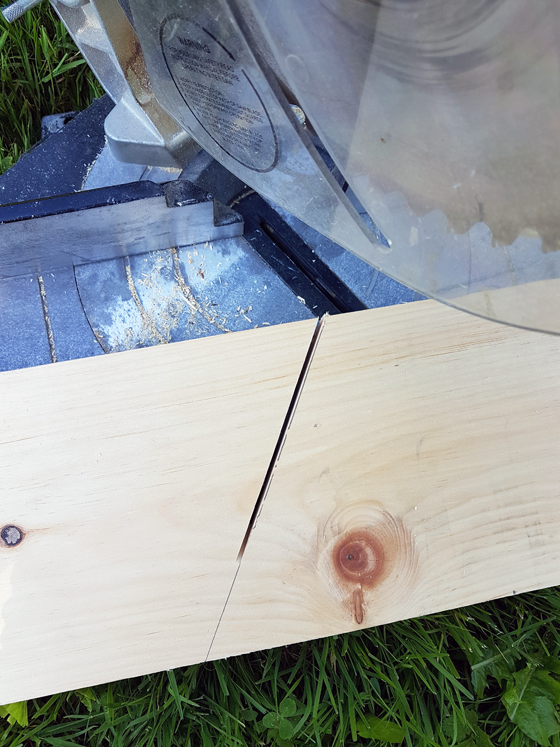
Speaking of tools, my mitre saw wasn’t big enough to handle the major angle cuts in one shot. A 1×8 is not a narrow board. I had to cut partway through, then flip over the board, readjust the angle of the saw, and cut the other half. It wasn’t difficult. Just slow.

Building a round wood frame

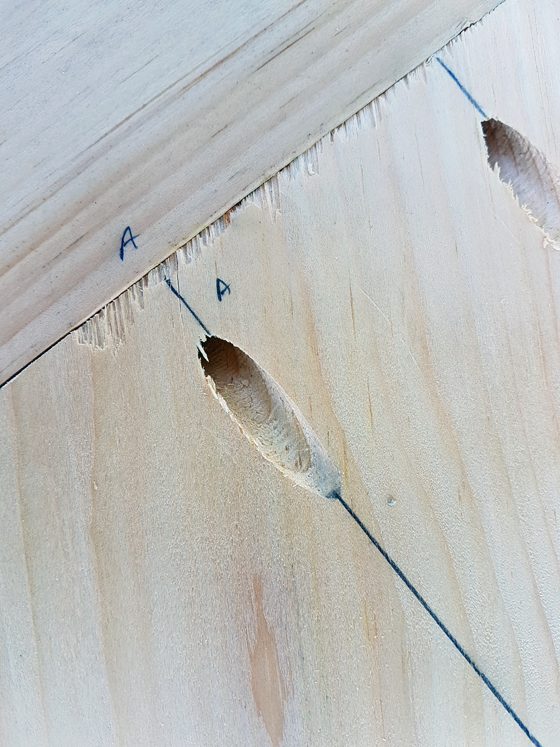
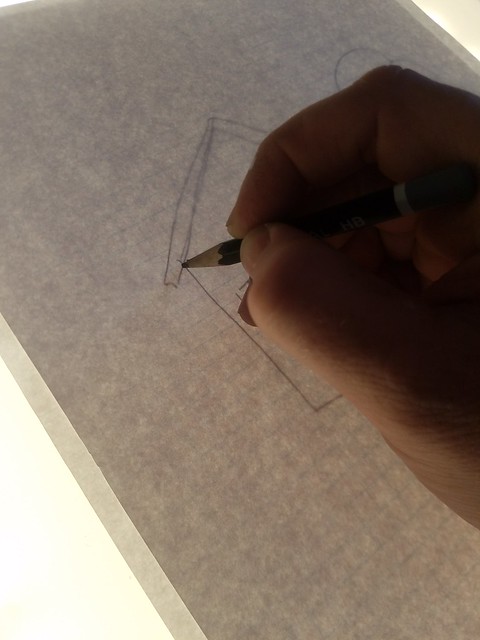
In Step 4, Jenn says “On each joint, mark a unique registration line so that it’s easy to quickly reassemble the pieces later on.” A simple registration mark is letters–you want each to be unique, so a line or slash isn’t distinctive enough. With letters, you can make one joint the A joint, another B and so on. You draw an A on each of the pieces to be joined together, so that you know which piece connects to which, even after dryfitting, sanding and the rest of the steps.

Registration marks

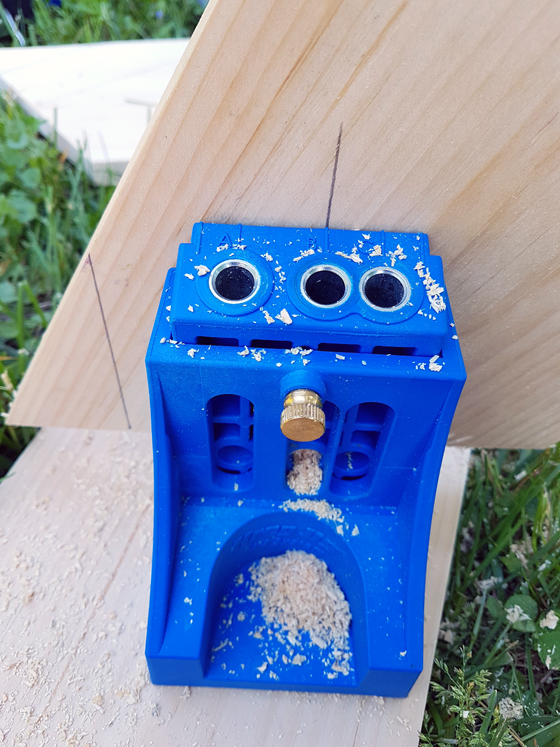
When marking your holes for the Kreg Jig, draw your lines extra long so that the jig doesn’t cover them up.

Kreg Jig

Once the frame was assembled, I stained it my favourite Provincial. Then the final step was attaching the mirror to the frame.

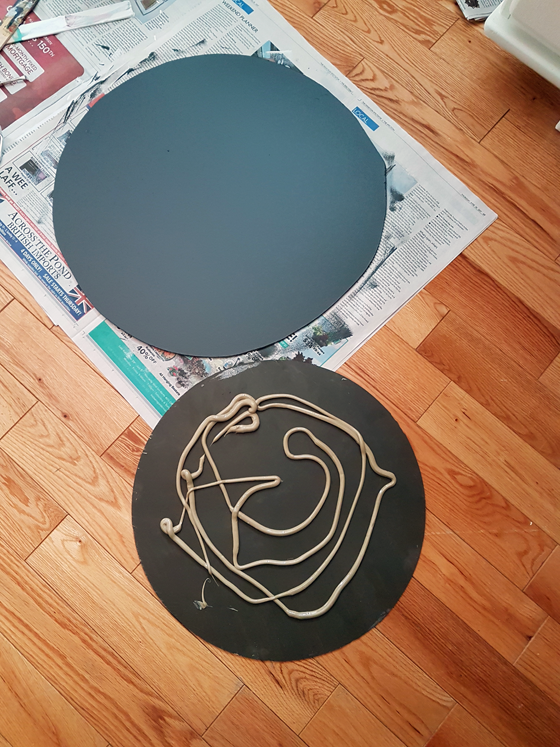
I broke from Jenn’s suggestion to attach the mirror using clips because my mirror ended up being just a wee bit smaller than the finished opening. Instead, I cut a disc from hardboard. I painted it black to camouflage any gaps that might show between the edge of the mirror and the frame, then I used construction adhesive to glue the mirror to the disc.

Gluing a mirror with construction adhesive

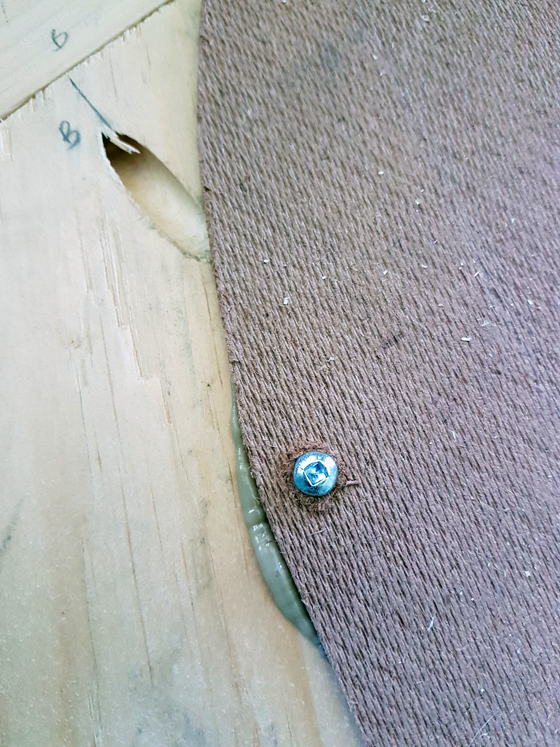
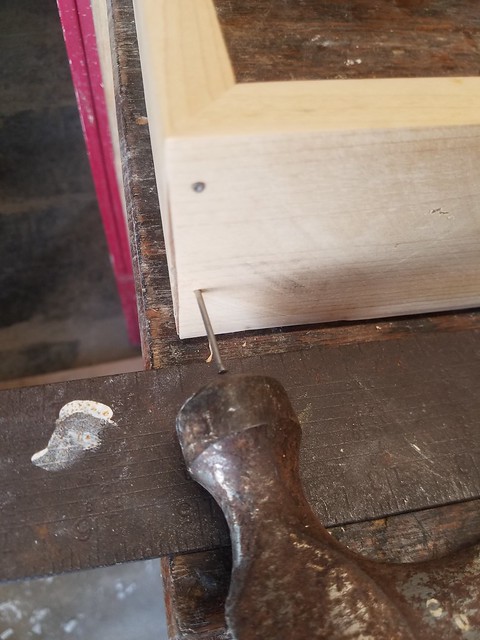
Once the adhesive was set, I then glued the disc to the back of the wood frame. I added a couple of tiny screws for extra insurance.

Attaching the mirror to the wood frame

As soon as I flipped it over, I was ecstatic. I love how this turned out.

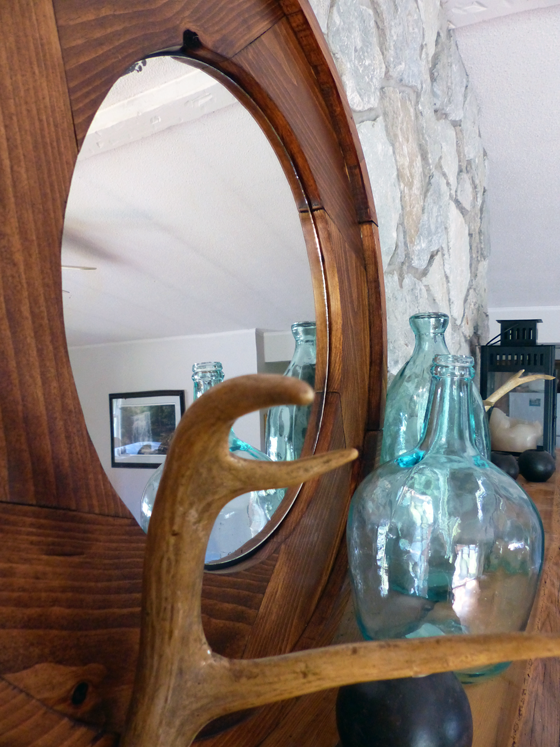
Large round wood frame mirror

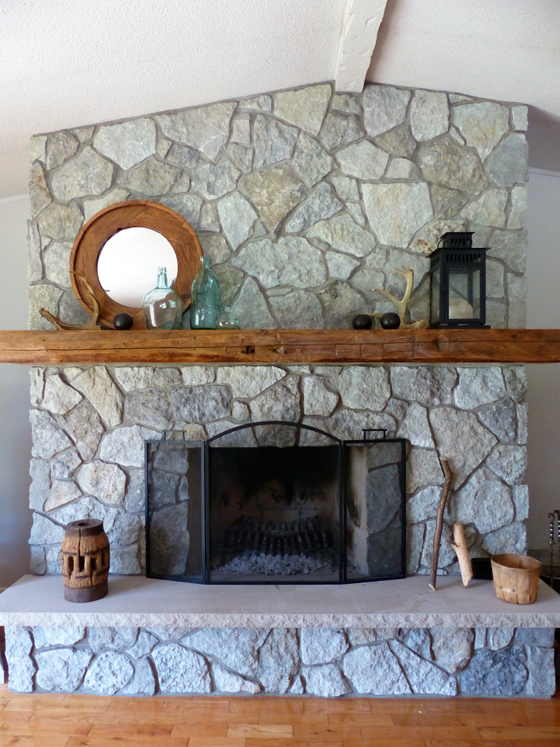
Fieldstone fireplace in the summer

It’s large and bright and a little bit rustic–and a great addition to the summer mantel in the living room. Thanks to Jenn at Build Basic for sharing such a great project.

Do you decorate with mirrors? What would you build in a One Board Challenge?

How to make a light box for tracing

Hand up if you’ve ever found yourself standing at a window, trying to hold two pieces of paper steady while you traced a pattern. My hand’s definitely up. It’s awkward, right? For crafters, tracing is an important part of a lot of projects.

A light box is a handy tool that makes tracing much, much easier. Sarah in Illinois is sharing how she made a light box for her quilting mother. 

I hinted a few posts back that I was not making good progress on my “one project a month.” If you remember, my three projects for the second quarter of the year were

  1. Light box for my mom
  2. Grill lighting
  3. The garden

Starting from the bottom, the garden is doing well. Very well. Plants are growing, we’ve picked some veggies, had some setbacks, but overall it’s doing very well. I decided to write a separate post on the garden, so I will just say I am very happy with the progress so far.

The grill lighting is on hold. When we hung the decorative string lights on our awning this year we decided that they give off enough light to make sure our hamburgers aren’t burnt. And since we are not sure what we want in permanent lighting we decided to do more research before we make the money and time commitment. So not done, but on hold.

As for the light box, I can say it is done.

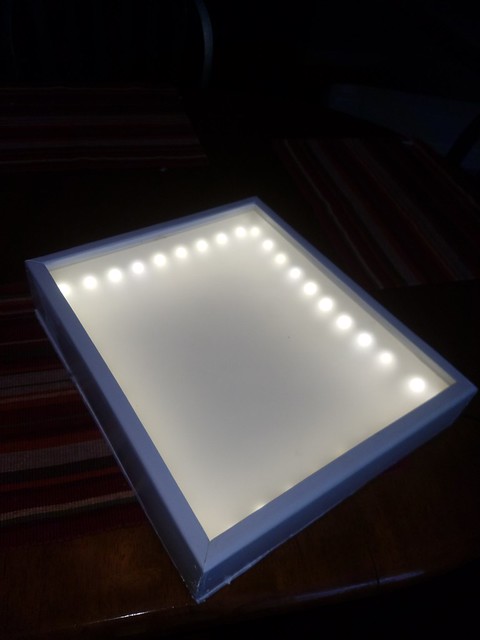
So what is a light box? Basically, it is box with a transparent top and a light source inside.

When you put a print and a blank piece of paper on top of the box, the light shines through and makes it easy to trace the original print. This is great for crafters wanting to copy patterns. In this case, my mom wanted one for making quilts.

I started by cutting 45 degree angles for the 4 sides of the box.

Then I got to play around with the router. Honestly, I had not used our router before. It is kind of Steve’s toy, but using some practice boards it was fairly easy to get the hang of. The reason for the router was to cut a groove in the sides of the box for the transparent top to sit in.

I also used the router to curve the edges of the boards to give it a nicer look.

So this was the point where I would have started assembling the pieces. Except I came home and found that Blitz had put his mark on two of the pieces, quite literally.

It aggravated me of course, but who could I blame but the person who left them where a 10 month old pup could reach them? In case that wasn’t clear, that person is me.

So after redoing half of my work I began putting the sides together. Simply put, it is like building a frame for a picture.

The finished dimensions are 13 inches by 15.25 inches with the “window” area being 12.5 inches by almost 14.75 inches. Obviously I didn’t work by any plans, I just wanted to make sure it was large enough to use a standard 8.5 by 11 piece of paper for tracing.

I pre-drilled my nail holes and put three sides together.

It was at this point that I put the first coat of white paint on all of the pieces. It has been extremely humid here which is not the best weather for paint to dry. I got several scratches and finger prints on the pieces that had to be touched up once I was done handling everything.

I slid the “window” into the channels that I routed and attached the fourth side.

For the window I used a piece of plexiglass that I cut with a razor blade and snapped to break. To hide the inside of the box and to dull the brightness of the intense lights that I chose, I sprayed the plexiglass with a frosted paint.

It was at this point that I turned the box over and installed the light source. I chose this LED tape at our local home improvement store. I wanted LED so that heat did not build up inside the box.

This tape is 6.5 feet long but came with instructions on how to cut it to the correct fit. I used both the adhesive back and the small mounting brackets that came with the tape. I cut a small hole near the bottom to run the cord out of.

I was pleasantly surprised that the light tape came with a switch so that it will be easy for Mom to turn on and off as needed.

And finally I screwed the back to the box. I chose to use screws so that I can remove the back if I ever need to make any adjustments or repairs.

I am happy with the results and can’t wait to give it to Mom for her to try out.

That light box looks great, Sarah. It’s super professional with the routed channel for the plexiglass and the LED strip. I’m sure your Mom will appreciate it. Maybe you’ll get a new quilt out of it. 🙂

Maintaining not building

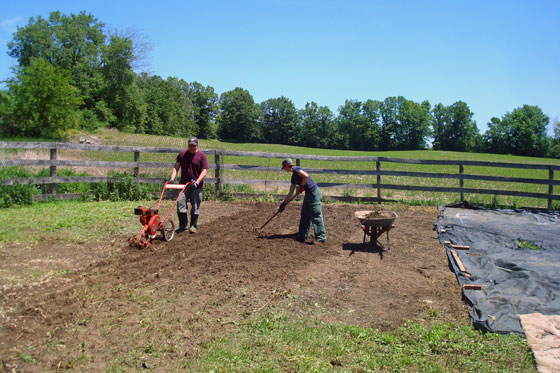
Matt and I tilling the garden

Spring is a mad dash around the farm. There’s winter clean up, like picking up branches, and there’s summer prep, like putting the mower on the tractor. And before we know it, we’re weeding gardens, cutting grass and deep in the routine of outside work. I have this feeling that if I don’t get the gardens, lawn, trees, flowers, patio, barn, tractor, equipment, what-have-you set up right now, I’ll be behind all year.

However, this year it’s been feeling a wee bit different. It’s almost calmer. Almost.
For the first time, I feel a bit like we’re maintaining, rather than building.

Our first five years at the farm have been about so much work–reclaiming the overgrown property, establishing flowerbeds, making the vegetable garden. There are still pieces of that, but I feel a bit like the main parts are in place, and the way we work on the property is a bit more normal.

Overgrown flower garden

Cleared garden

Garden in bloom in June

I do have one big “building” project on my Home Goals list: clear the pond shore. When Matt broke his arm last month, we had to re-evaluate what we were going to be able to do this year. So the pond shore has been deferred. As the brush is already quite overgrown, I’m thinking it may be easiest to wait until next spring when it’s all died off again.

But good news, Matt gets his cast off today. And ready or not, summer has arrived.

It’s an ongoing battle to keep the farm somewhat civilized, but through a lot of work we’re in decent shape this year.

How’s spring going for you? How do you handle property maintenance at your house?

How to mix and match throw pillows

How to mix and match throw pillows

Throw pillows are a great way to add personality to a space. You can easily change them out for the season or your mood. However, mixing fabrics is a skill. It takes practice and sometimes some trial and error.

Join me in a little demonstration.

These are the pillows I chose when we first bought our beloved basement couch. It came with six pillows, and I selected three different fabrics. I wanted colour, pattern and something not too serious. However, it turned out they didn’t all play together as nicely as I wanted.

Observe.

How to mix and match throw pillows

On their own, the patterned pillows each work with the turquoise velvet, but they do not work with each other, despite sharing several colours.

How to mix and match throw pillows

However, let’s look at another equation.

How to mix and match throw pillows

Remember back when I made our big round ottoman? How I searched for the perfect fabric, and the one that ended up working best with the striped pillows was the bird fabric that I already had in my stash? I still love this fabric, and since I ended up buying more to supplement my stash, I still had a good amount of yardage. More than enough to make two pillows.

These ended up being the most professional pillows I’ve ever made. They have zipper closures, piping and even extra liners to help contain the feathers, which always seem to work their way out through the covers. I love them so much.

How to mix and match throw pillows

But what about the poor rejected blue-green geometric? Here’s another equation for you.

How to mix and match throw pillows

The feather is another fabric that I’ve had in my stash for years. I had always planned to use it to make cushions for the couch upstairs, and I finally got around to it. The blue and green bring a bit of summer into the living room.

How to mix and match throw pillows

I love the serendipity of two stash fabrics being perfect mix for pillows that we already had. Along the way, I’ve learned a few lessons about mixing fabrics.

  1. Let’s start with defining our fabrics. For the purpose of this demonstration, I’m going to use the labels “solid” (pretty self-explanatory), “geometric” (could be a stripe or another more linear pattern–the colourful stripe and the blue-green links both fall into this category for me) and “floral” (self-explanatory, but I’ll extend this to include fabrics like my birds or the feather).
  2. Don’t mix like patterns. By this I mean geometric with geometric or floral with floral. Unless the scale is dramatically different similar patterns will compete with each other like my pillows did. This exercise has taught me that the best bet is to mix different types of fabrics, like a geometric with a floral.
  3. Pick fabrics that share similar colours. This is probably the easiest way to mix. Colours don’t have to match exactly (the turquoise piping on the bird pillow isn’t the same as the turquoise velvet, but they still play well together).
  4. When mixing patterns, start with your most dominant pattern first. This is probably my biggest takeaway. My mistake in the family room was using the turquoise velvet as the base. It’s easy to match cushions to a solid. It’s harder to match the bossy stripe. But once I put that at the centre of the equation, I was able to make the mix work.
Pillows are some of the easiest items to sew–and there are also plenty of options to buy. They can add a finishing touch to a room or completely change the feel of a space. I like being able to freshen up the living room for the summer season, and I’m also very glad to have found the right mix for the family room.

Do you enjoy mixing and matching pillows? Do you sew your own or purchase? Do you change your decor with the season? What are your tips for finding a mix that works?

Two tiny shelves

When I was working on my office, I knew I wanted to find a way to display two collections. One was my Red Rose Tea figurines and the second was china thimbles my MIL has brought back from various trips she’s taken.

The thing about both of these collections is that they’re small. I had the shelves of the china cabinet where I could tuck in a few thimbles or figures, but they’d be lost amongst the bigger items on display. I also didn’t want them on a tabletop where they took up space that could be a work surface.

I decided to do two small shelves.

First was a small floating shelf for the thimbles. This shelf was so small and the thimbles are so light that I knew it wouldn’t need much support and I could screw it right to the wall.

China thimbles displayed on a small floating shelf

I cut a piece of 1×2 to the length I wanted and then drilled two holes through the face of it. The holes served two purposes. The first was to make sure the shelf didn’t split when I screwed it to the wall. The second was to recess the heads of the screws. I made the holes slightly bigger on the front so that the screws would go into the shelf by about a quarter of an inch.

I painted the shelf the same colour as the wall and then screwed it into place. Then I filled the holes with woodfiller and painted over them. The shelf blends into the wall very well, so that it (almost) looks like the thimbles are floating.

The second shelf is ingenious, but I can’t take credit for it. I found the idea on The DIY Mommy. This shelf started its life as a cutlery tray. I lopped off the one segment that ran perpendicular to the others on my Dad’s tablesaw. Then I painted it white, and simply screwed it to the wall. It is exactly the right size for my collection of nursery rhyme tea figurines.

Red Rose Tea figurines displayed on a cutlery tray made into a shelf

I love having different things hanging on the wall, rather than the usual pictures and paintings. These two collections have a lot of meaning for me. Memories of the tea figurines that lived in my grandmother’s china cabinet, appreciation for my mother-in-law thinking of me and my love of sewing when she’s traveling.

Do you have any small collections? How do you display “smalls”? Have you built any tiny shelves?

Basement TV area before and after

This reveal has been a loooooong time coming. The seventh post I ever wrote for this blog was “Basement reno begins” –that was more than five years ago. A few weeks after writing that post I shared a to-do list, the plans and then celebrated when we finished demo. Five years ago this week, we had fixed the wiring, reframed the exterior walls and received new spray foam insulation.

Now, I’m finally ready to share with you the TV area. You’ve seen snippets of this along the way, and we’ve been using this room for the past four and a half years. But there were a few missing elements that have finally come together, so I’m ready to show it off.

Let’s take a walk down memory lane first, shall we?

This is what we saw the first time we visited the house. A gross cluttered basement with a random dude sitting in a chair (just kidding, that’s our real estate agent taking a break with one of the books that was left behind). Please note the ceiling fixture that was installed as a wall sconce (there’s a matching one just out of the picture on the right) and the giant woodstove.

TV area before

Somehow, we saw past all of this and bought the place. After several trips to the dump, we ended up with a cleared, if not clean slate. This angle shows you the half wall leading into the laundry room (which we removed) and the doorway to Matt’s office (which we moved).

Basement before

On the other side of the room, we have the woodstove, the matching pair to the ceiling sconce and you can get a glimpse of the ceiling fan, which was recessed into the ceiling so that it didn’t decapitate anyone. In my caption on this photo originally, I wrote “Picture a large, comfy sectional couch where the woodstove is and a big TV on the wall opposite the staircase.”

The main room before

Uh-huh. It’s a good thing I had a clear vision. We needed something to get us through the next six plus months of work.

We started demo. Byebye half wall. Hello new doorway. Byebye exterior drywall. Why are you still there ceiling sconces?

Basement demo in progress

Then we reframed the walls so that they were deep enough for more insulation, removed the ceiling drywall so that we could fix bad wiring and finally got rid of those ceiling sconces. I’m still proud that I was able to replace the ceiling fan with a fifth potlight and put them all on the same switch. Me! I did that.

The partially gutted basement

We hauled the woodstove up the stairs with a rope tied to the back of my Dad’s truck, our mason patched the hole from the chimney, and we left a little message on the concrete.

Matt + Julia 2012

With spray foam insulation complete, we started to approach the putting it back together stage. What followed were six months of drywall. So much drywall.

Installing drywall in the basement

Then finally paint.

Trim and carpet. (The crush to get the trim installed before the carpet arrived was tight).

Painting trim

Our new couch arrived just before Christmas 2012, and the basement was habitable.

Decor-Rest sectional couch with chaise

We’ve made tweaks (obviously) since then. Want to see what it looks like now?

Basement TV area

I have another post coming up that goes into all of the details on the finished space. But until then, here are a couple more before and afters for you.

Basement before

Basement TV area after

The main room before

Basement TV area after

This is by far our most significant renovation. I love that we saw the potential of the space, stuck with it through all of the hard work and created a hangout area that works perfectly for us. The fact that we did almost all of it by ourselves makes me very proud.